Financial Operations
What Is a Cash Disbursement? A Founder's Guide to Financial Control
Understand what is a cash disbursement and why mastering it is critical. Learn how to implement controls that protect cash flow and fuel your company's growth.
ByJumpstart Partners, CPA, QuickBooks ProAdvisor
··15 min readKey Takeaway
A cash disbursement is any payment your company makes—payroll, vendors, software, rent. For companies in the $1M-$5M ARR range, uncontrolled disbursements quietly bleed businesses dry through duplicate payments, unapproved expenses, and poor cash visibility. Implementing proper controls (segregation of duties, tiered approvals, three-way matching) and AP automation transforms disbursement management from an administrative chore into a strategic tool for optimizing working capital and extending runway.
As a founder, you live and die by your cash flow. Period. A cash disbursement is any payment your company makes—every dollar that leaves your business for payroll, software, rent, or vendors. Without a tight grip on this outflow, you are putting your entire runway at risk.
This isn't just about paying bills on time; it's about strategically controlling your company's lifeblood. Poorly managed disbursements quietly bleed a growing business dry. Seemingly small leaks, like duplicate payments or unapproved expenses, snowball into major cash flow crises that threaten your financial stability and erode investor confidence. Getting this right is non-negotiable.
Why Managing Cash Disbursements Is Your Most Critical Job
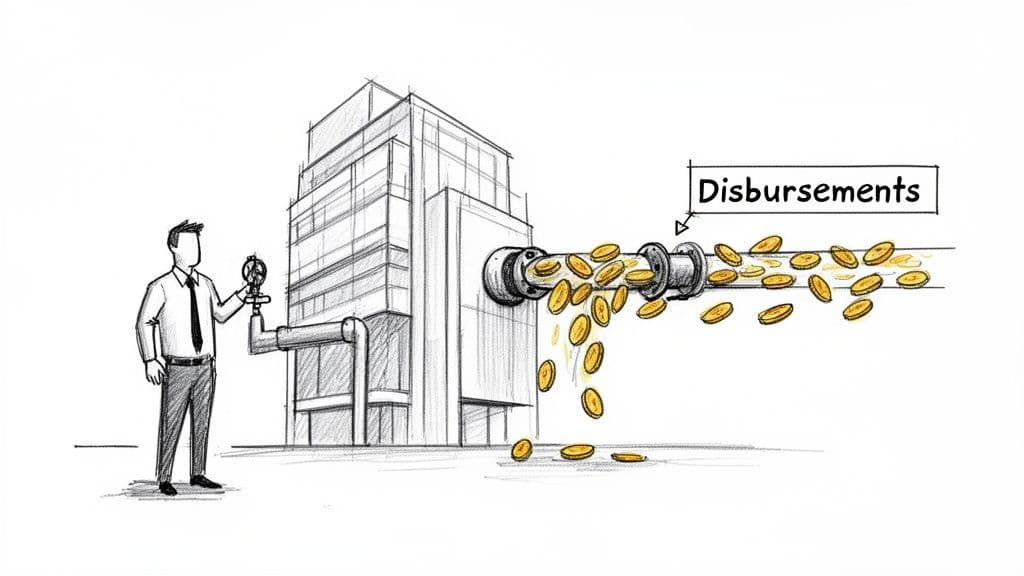
Think of your disbursement process as your business's operational engine. When that engine runs inefficiently, it burns through your cash at an alarming rate. Many companies in your revenue range still rely on manual, ad-hoc processes, creating dangerous blind spots. Without a centralized and controlled system for payments, you lack the visibility to make smart financial decisions.
It becomes impossible to accurately forecast your cash needs, negotiate better terms with vendors, or even know your true cash position at any given moment. This lack of control directly impacts your ability to scale.
The Real Cost of Uncontrolled Spending
The numbers don't lie. SaaS companies in the $1-5M ARR range should aim to keep their total operating expenses (OpEx) between 80-100% of their revenue. According to OpenView's 2023 SaaS Benchmarks, letting this metric balloon is a primary reason companies miss growth targets. Uncontrolled disbursements are the fastest way to blow past that benchmark.
"Many founders focus intensely on revenue, which is critical, but they often overlook the strategic importance of controlling outflows. A dollar saved through a smart disbursement process is just as valuable as a dollar earned—and often easier to achieve." – Tom Ciafone, Payments Expert, Federal Reserve Bank of Atlanta
This isn't a theoretical problem. A digital agency we worked with was losing nearly $8,000 per month to redundant SaaS subscriptions and unapproved project expenses. By implementing a simple purchase order system and approval workflow, we cut that waste entirely, adding nearly $100K in cash back to their runway annually.
Mastering your disbursement process is non-negotiable. It transforms a basic administrative task into one of your most powerful tools for building financial stability and driving strategic growth. To learn more, check out our complete guide on how to calculate burn rate and runway for your startup.
The Most Common Types of Cash Disbursements
for a scaling SaaS company or a growing digital agency, your cash disbursements fall into a few key buckets. Getting this right matters. Misclassifying a major asset purchase as a regular expense, for example, distorts your profitability and sends the wrong signals to investors during your next funding round.
Operating Expenses (OpEx)
These are the recurring, day-to-day costs required to keep your business in motion. Think of them as the fuel you burn every month just to operate.
Common OpEx disbursements for your business include:
- Payroll and Salaries: This is almost always your largest and most important disbursement, covering employee wages, benefits, and payroll taxes.
- Vendor and Supplier Payments: Paying invoices for services you've used, like fees for your marketing agency, freelance developers, or legal consultants.
- Software Subscriptions: All those monthly or annual fees for essential tools that run the business—your CRM (Salesforce), project management software (Asana), or cloud hosting (AWS)).
- Rent and Utilities: The predictable costs for your office space, electricity, and internet.
Capital Expenditures (CapEx)
Unlike the daily burn of operating expenses, a capital expenditure is a payment for a significant asset that will provide a benefit for more than one year. These aren't just costs; they're investments in your company's future.
for example, your professional services firm buys new high-performance laptops for the entire consulting team for $25,000. This is a classic CapEx. Instead of hitting your income statement as a massive one-time expense, this cost is capitalized on your balance sheet as an asset. It’s then depreciated over its useful life (e.g., three years), which properly matches the expense to the long-term value it provides.
Other Critical Disbursements
Beyond OpEx and CapEx, a few other cash outflows demand careful management.
- Tax Payments: The non-negotiable outflows to federal, state, and local governments. This includes payroll taxes, sales tax, and corporate income taxes. for more on this, read our small business guide to quarterly estimated taxes.
- Debt Repayments: If you've taken on loans, these are your scheduled principal and interest payments to lenders.
- Owner Draws or Dividends: Payments made to founders or shareholders from the company's accumulated profits.
- Customer Refunds: When you return cash to customers for canceled services, it’s a direct hit to both your cash balance and your recognized revenue.
How to Record Disbursements for an Accurate Financial Picture
Getting cash disbursement entries wrong is like using a distorted map to navigate. It warps your financial reality, leading to flawed decisions and inevitable compliance headaches. Your accounting system must be the ultimate source of truth, and if the inputs are garbage, your financial statements will be, too.
The process boils down to creating a journal entry, the official record of a financial transaction in your general ledger.

From paying a contractor to running payroll, each disbursement needs the right accounting treatment to keep your books clean and audit-ready.
Accrual vs. Cash Basis: A Worked Example
for any founder who plans to seek investment, accrual basis accounting is non-negotiable. This method records expenses when they're incurred, not just when cash moves, giving you a far more accurate picture of your company's performance.
Let's walk through a scenario for your digital agency. You receive a $5,000 invoice from a freelance developer on March 25th for work they completed that month. You don't actually pay the invoice until April 10th.
Step 1: Record the Expense (March)
With accrual accounting, the moment that invoice is approved, you create this journal entry:
| Account | Debit | Credit |
|---|---|---|
| Professional Services Expense | $5,000 | |
| Accounts Payable | $5,000 | |
| To record freelance developer expense incurred in March |
This entry correctly recognizes the expense in March—the month the work happened—and increases your Accounts Payable, showing you owe money.
Step 2: Record the Cash Disbursement (April)
When you pay the bill in April, you record the second entry:
| Account | Debit | Credit |
|---|---|---|
| Accounts Payable | $5,000 | |
| Cash | $5,000 | |
| To record payment of March developer invoice |
This clears the liability and reduces your cash balance, but the expense correctly stays booked in March. This two-step process makes your period-over-period financial analysis reliable.
"Many early-stage founders get trapped by cash-basis thinking because it feels intuitive. But accrual accounting is the language of investors and lenders. Mastering it early prevents painful restatements down the line and builds critical credibility." – Jenna Marsh, CPA & Controller-led finance ops for SaaS Startups
Getting these entries right is fundamental to a reliable financial close. To see how this fits into the bigger picture, check out our guide on building a complete monthly close process framework.
Red Flags That Your Disbursement Controls Are Failing

Uncontrolled cash disbursements are a silent business killer. If your company is scaling, moving beyond ad-hoc payment approvals isn't optional—it's essential for survival. The core principle is simple: the person approving a payment should never be the one making it. This foundational concept, known as segregation of duties, is your first line of defense against both internal fraud and expensive mistakes.
Are you still relying on verbal approvals or letting a single person manage the entire accounts payable cycle? If so, you have a critical vulnerability. It’s time to spot these warning signs before they become a crisis.
Vague or Rising "Miscellaneous" Expenses
A sudden spike in expenses categorized as 'Miscellaneous' or 'General' is a major red flag. While some uncategorized spending is normal, a consistent or growing trend signals lazy bookkeeping at best—and at worst, a deliberate attempt to hide illegitimate payments. Every disbursement must have a clear business purpose and be coded to a specific account. A bloated 'Miscellaneous' account makes it impossible to know where your money is actually going.
Payments to Unfamiliar Vendors
Are new, unrecognized vendor names popping up on your bank statements? Payments to unfamiliar companies or individuals without a signed contract or a verified W-9 on file are a massive cause for concern. This points to a breakdown in your vendor onboarding process and can lead to paying fraudulent invoices or making duplicate payments. Every vendor must be vetted and formally approved before the first dollar leaves your account.
Lack of Formal Approval Workflows
If your process for approving a cash disbursement relies on a quick email or a Slack message, it’s broken. You need a documented, multi-step approval workflow built directly into your accounting or bill pay software.
This system should automatically enforce your policies. Here are the non-negotiables:
- Tiered Approvals: Any invoice over a certain threshold (e.g., $5,000) requires a second, more senior approver.
- Three-Way Matching (for relevant purchases): Payments are only initiated after matching the vendor invoice to a corresponding purchase order and a receiving report.
- Audit Trail: Every step—from invoice submission to final payment—must be logged with a timestamp and the user responsible.
Without these systemic checks, you are operating on trust alone. That is not a scalable or secure financial strategy.
Building a Smarter Disbursement System With Automation

Manual accounts payable is a direct barrier to scaling. If you're still relying on paper invoices, email approvals, and manual check runs, you're operating with a system that's slow, riddled with human error, and wide open to fraud. The solution is AP automation, and for any founder serious about financial control, it's a necessity.
Automation software plugs directly into your accounting system—like QuickBooks or Xero—creating a single, reliable source for everything you owe. The benefits are immediate.
How AP Automation Transforms Your Workflow
Instead of chasing down approvals and manually keying in data, automation brings structure and control to the entire lifecycle of a cash disbursement.
| Manual AP Process (The Problem) | Automated AP Process (The Solution) |
|---|---|
| Invoices arrive via mail/email, requiring manual data entry. | Software uses OCR to automatically scan and digitize invoice data. |
| Approvals are chased via email chains or Slack messages. | Invoices are routed automatically based on pre-set approval rules. |
| Payments are made manually via check or one-off bank transfers. | Payments are scheduled in batches to optimize cash flow and capture discounts. |
| Accounting entries are manually created in your GL. | Approved invoices and payment data sync automatically to your GL. |
The shift to digital payments is happening fast. According to Gr4vy's 2024 report, 82% of businesses are now accepting digital wallets, a clear sign that manual processes are obsolete. You can learn more about the trends driving the payment industry and see why this matters now more than ever.
It’s About Strategic Financial Control, Not Just Efficiency
Implementing an automated system is a strategic move to de-risk your business. By centralizing all your disbursement activity, you create an unchangeable audit trail that logs every single touchpoint. This level of control drastically reduces the risk of duplicate payments and invoice fraud. It also gives you real-time visibility into your cash position and upcoming liabilities, empowering you to make smarter forecasting and budgeting decisions.
If your current system is a messy patchwork of spreadsheets and email chains, it’s time for an upgrade. See how we can help with a professional AP setup and automation project.
Turn Your Disbursement Process into a Strategic Advantage
It’s time to stop thinking of cash disbursements as a back-office chore. for a growing company, it’s one of the most powerful financial levers you have. When you know exactly where your cash is going and why, you start making decisions backed by hard numbers, not guesswork. This is where an expert finance partner makes a real impact, implementing best-in-class controls and automation to give you real-time insight into your cash flow.
This Isn't Just About Paying Bills Faster
In its 2025 Global Treasury Survey, PwC found that 83% of treasurers are concerned with managing cash outflows amidst economic volatility. Expert financial oversight transforms your disbursement process from a simple AP function into a tool for optimizing working capital and preparing for your next funding round.
"The true value of a locked-down disbursement process isn’t just fraud prevention—it’s the predictive power you gain over your cash. When you can accurately forecast outflows, you can negotiate better terms, manage your runway with precision, and present a much stronger case to investors." – Sarah Jennings, Controller for B2B SaaS Companies
Your Actionable Next Steps
Ready to turn your disbursement process from a liability into an asset? Here are the immediate steps to take:
- Map Your Current Workflow: On a whiteboard, draw out every single step from invoice arrival to payment confirmation. Identify every manual handoff and bottleneck. Who approves what?
- Audit Your Controls: Do you have clear segregation of duties? Are there defined spending limits that trigger higher-level approvals? Is your vendor list regularly cleaned and verified?
- Evaluate Your Tech Stack: Is your bill pay software fully integrated with your accounting system? Are you using its automation features, or is it just a digital checkbook?
- Get an Expert Assessment: controller-led finance ops or controller can perform a full assessment in a fraction of the time. They will build a clear roadmap for implementing automation and controls that fit your business.
Don't let an outdated, manual disbursement process dictate your company’s financial future. It's time to take control and build the scalable foundation your business deserves.
Ready to transform your financial operations? Schedule a consultation with Jumpstart Partners to see how we build strategic, audit-ready disbursement systems for companies like yours.
Cash Disbursement Questions We Hear All The Time
As a founder or finance leader, you're constantly in the details of cash flow. Here are direct answers to the most common queries we get from businesses scaling from $1M to $5M ARR.
What is a cash disbursement journal?
A cash disbursement journal is the chronological log of every payment your company makes. Think of it as the definitive record for every dollar that leaves your bank account, whether by check, ACH, or wire transfer. This journal isn't a "nice-to-have"; it's a critical part of your accounting system that creates a clean audit trail and helps you track spending patterns.
What is the difference between an expense and a disbursement?
This is a classic point of confusion, but the distinction is crucial for accurate financial reporting.
- A cash disbursement is the action of paying out cash. It’s the literal movement of money from your bank account to someone else's.
- An expense is an accounting concept. It’s the cost of a good or service you’ve used up to generate revenue, recorded in the period it was incurred—not necessarily when you paid for it.
Here’s a real-world example: You receive a $2,000 invoice for new software in March. That $2,000 is a March expense under accrual accounting. If you pay the bill in April, that’s when the cash disbursement happens. That timing difference is exactly why separating the two concepts is so important.
How does a disbursement affect the accounting equation?
Every cash disbursement immediately decreases your assets (specifically, your cash account). How it impacts the rest of the accounting equation (Assets = Liabilities + Equity) depends on what you paid for.
- Paying a Vendor on Credit: You decrease Cash (Asset) and decrease Accounts Payable (Liability). The equation stays in balance.
- Calculation: If Assets were $100k, Liabilities $30k, Equity $70k. After a $5k payment, Assets are $95k, Liabilities are $25k, Equity is still $70k. ($95k = $25k + $70k).
- Paying for an Expense Immediately: You decrease Cash (Asset) and decrease Retained Earnings (Equity) because the expense lowers your net income.
- Buying an Asset: One asset (Cash) goes down, while another asset (like Equipment) goes up. The total value of your assets does not change.
Getting these details right is what separates messy books from investor-ready financials. If you're ready to build a disbursement process that’s secure, scalable, and frees up your time, Jumpstart Partners can help. We act as your expert controller to implement best-in-class financial controls and automation.
Schedule a free consultation today to get total visibility and control over your company's cash flow.