Financial Operations
Stop Burning Cash: The Founder's Guide to Calculating Customer Acquisition Cost
Discover how calculating customer acquisition cost reveals true profitability and guides smarter marketing for SaaS, agencies, and service businesses.
ByJumpstart Partners, CPA, QuickBooks ProAdvisor
··20 min readYour revenue is climbing, but your profits are flat. Sound familiar? For founders of growing SaaS, agency, and service businesses, the culprit is almost always a dangerously simple understanding of Customer Acquisition Cost (CAC). Just dividing ad spend by new customers is back-of-the-napkin math that hides fatal flaws in your business model.
If you don't know your true, fully-loaded CAC, you are flying blind. You're making budget decisions based on gut feelings, not hard data, and likely pouring cash into channels that feel productive but are actually bleeding your company dry.
Why a Miscalculated CAC Is Sabotaging Your Profitability
Revenue growth is a vanity metric if the cost of acquiring it crushes your margins. As a founder or CEO, you face constant pressure to scale. But if each new customer costs you more to acquire than they generate in profit, you are not building a sustainable business—you are just buying revenue. This is the fastest way to burn through cash, even when your top-line looks fantastic.
An imprecise grasp of your acquisition costs leads directly to poor financial decisions. You can't confidently answer tough questions from your board or investors about the efficiency of your growth engine. Without a precise, fully-loaded CAC, you're making strategic bets with a blindfold on.
The Common (and Costly) Misconception: Simple vs. Fully-Loaded CAC
The most dangerous mistake is calculating CAC by only dividing your monthly ad spend by the new customers you acquired. This formula ignores a massive chunk of your actual acquisition expenses and creates a false sense of security.
To get the real picture, you must calculate a fully-loaded CAC, which includes every single dollar spent on winning new business.
A proper calculation includes:
- Salaries and Commissions: The prorated salaries, benefits, and bonuses for your entire marketing and sales teams.
- Software and Tools: All costs for your CRM, marketing automation platforms, analytics software, and other sales/marketing tech.
- Overhead: A portion of your office rent and utilities allocated to the sales and marketing functions.
- Creative and Agency Costs: Any fees paid to freelancers, content creators, or digital marketing agencies.
Ignoring these costs makes your acquisition efforts look far more efficient than they are. When your profit and loss management shows margins getting thinner despite rising revenue, an underestimated CAC is almost always the villain.
"Many founders are surprised by their true CAC once we account for prorated salaries and software stack costs. A seemingly profitable channel can quickly turn into a cash drain. You can't manage what you don't accurately measure." — Jonathan Price, Controller-led finance ops
This isn't a minor accounting error; it has huge strategic consequences. According to research from FirstPageSage, the median B2B CAC has risen to $535, with costs in some sectors soaring much higher. If you aren't tracking your true costs, you have no way of knowing if you are falling behind your competitors in efficiency. You can dive deeper into these trends in the full customer acquisition cost report.
How to Calculate Your True, Fully-Loaded Customer Acquisition Cost
Most founders are flying blind on their true Customer Acquisition Cost because they only count ad spend. This is a fatal mistake. To build a predictable growth engine, you have to calculate your fully-loaded CAC, which means accounting for every single dollar spent to win a new customer.
Getting this right isn't just an accounting chore; it's a strategic necessity. It starts by digging into your financial systems—pulling expense reports from QuickBooks or Xero and payroll data from Gusto. This is where the real work begins.
Step 1: Gather Your Total Sales & Marketing Costs
Before you can touch the formula, you need to sum up all sales and marketing costs for a specific period (monthly or quarterly is best). A superficial glance is a recipe for disaster.
Your fully-loaded CAC calculation absolutely must include:
- Salaries & Wages: The gross pay for everyone on your sales and marketing teams.
- Commissions & Bonuses: Every dollar of variable comp tied to performance.
- Ad Spend: The obvious one—all direct campaign costs from Google Ads, LinkedIn, etc.
- Software & Tools: Your CRM, marketing automation platforms, analytics tools, and any other subscriptions your S&M teams use.
- Overhead Allocation: A fair share of your rent, utilities, and other general overhead.
- External Costs: All fees paid to agencies, consultants, or freelance content creators.
This isn't about padding numbers; it's about facing reality. The simple calculation is dangerously wrong. You need to see the full picture.
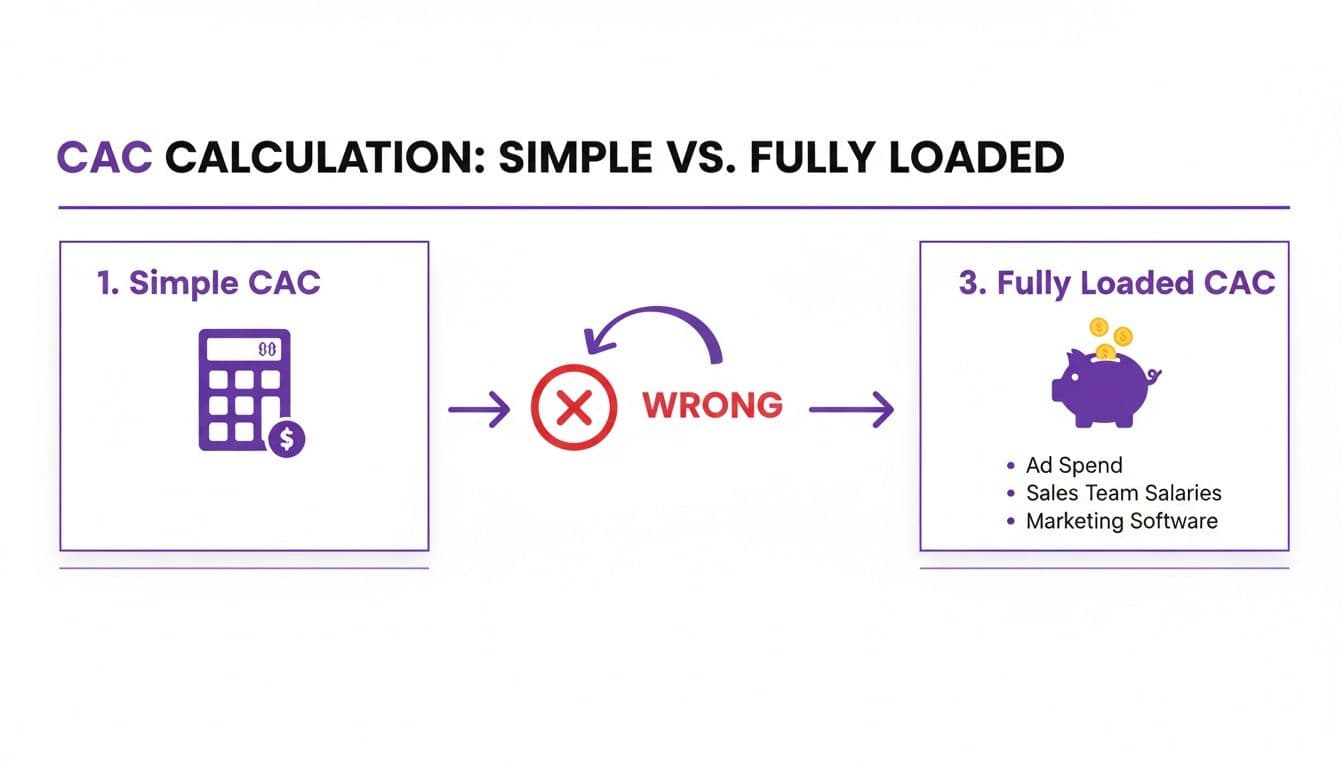
Relying on a simple CAC gives you a false sense of security. The fully-loaded number gives you the accuracy needed to make smart financial moves.
Step 2: A Worked Example (SaaS vs. Agency)
The costs you track will look different depending on your business model. To make this tangible, let's walk through how a B2B SaaS company and a digital agency would calculate their monthly fully-loaded CAC.
| Cost Category | B2B SaaS Example (Monthly) | Digital Agency Example (Monthly) | Notes |
|---|---|---|---|
| Sales & Marketing Salaries | $25,000 | $20,000 | Includes prorated salaries for teams focused on new business. |
| Sales Commissions | $5,000 | $8,000 | Directly tied to new deals closed. |
| PPC & Ad Spend | $10,000 | $5,000 | Digital advertising on platforms like LinkedIn and Google. |
| Content & SEO (Freelancers) | $3,000 | $2,000 | Costs for creating top-of-funnel assets and SEO work. |
| Software Stack | $2,000 | $1,500 | CRM, marketing automation, and other relevant tools. |
| Overhead Allocation | $1,500 | $2,500 | Portion of office rent and utilities for S&M teams. |
| Total Costs | $46,500 | $39,000 | |
| New Customers Acquired | 30 | 5 | |
| Fully-Loaded CAC | $1,550 | $7,800 | (Total Costs / New Customers) |
As you can see, the digital agency's $7,800 CAC dwarfs the SaaS company's $1,550 CAC. This is typical. High-touch service businesses have larger deal sizes and longer sales cycles, driving up acquisition costs. The SaaS business, in contrast, acquires more customers at a lower cost per head by relying on more scalable marketing efforts. For a deeper dive into this, check out this guide on What Is Cost Per Acquisition.
Step 3: Actionable Next Steps
Once you have your total costs and the number of new customers acquired in the same period, the formula is simple:
Fully-Loaded CAC = Total Sales & Marketing Costs / Number of New Customers Acquired
Now it’s time to put this to work in your own business:
- Choose a time period: Decide on a consistent period—monthly or quarterly—and stick to it.
- Build a tracking system: Create a simple spreadsheet or dashboard to track each cost category we've covered. Pull this data from your accounting software every month without fail.
- Automate and analyze: Work with your finance team or controller-led finance ops firm to build this KPI directly into your financial dashboard. Automating the calculation is key to keeping it front and center in your decision-making.
Calculating your CAC correctly is just the first step. The real power comes when you analyze it alongside other key metrics, something we cover when you learn more about understanding contribution margin and its direct impact on your bottom line.
Moving Beyond a Blended CAC to Drive Growth
A single, blended Customer Acquisition Cost for your entire business is a vanity metric. It offers a high-level health check, but it’s like trying to navigate a city with a map of the entire country—you miss the street-level details that determine whether you win or lose. Profitable growth isn't about knowing your average CAC; it's about knowing which channels and customers actually make you money.
To make smart budget decisions, you must break this number down. The real insights come from calculating CAC at two more specific levels: by marketing channel and by customer cohort. This is how you shift from simply measuring CAC to actively managing it.
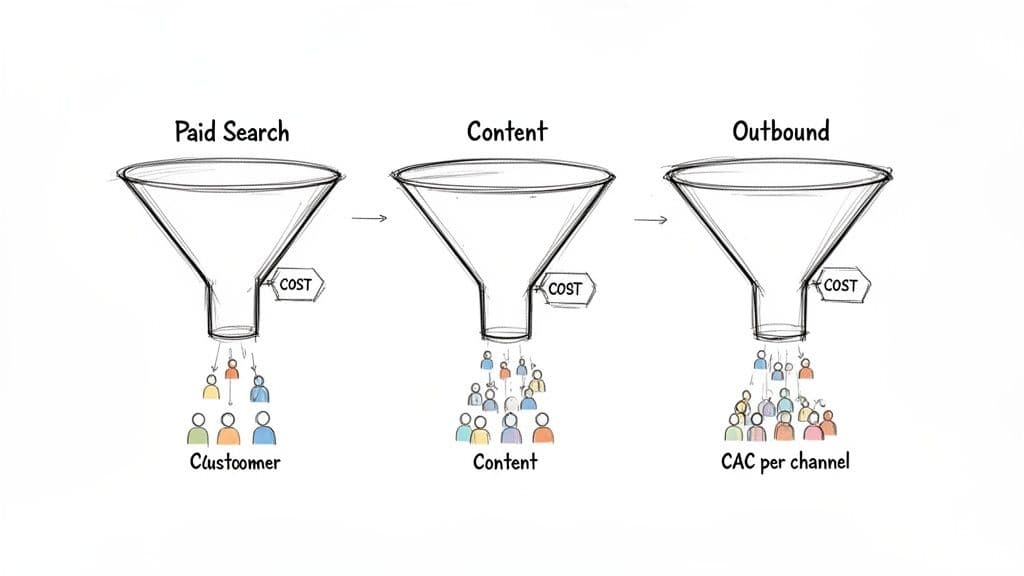
Calculating CAC by Marketing Channel
Dissecting your CAC by channel is where you find out what’s actually working and what’s just burning cash. Are your expensive ads delivering high-value customers, or is your "slower" content marketing a more efficient engine for long-term growth? Without this analysis, you are flying blind.
To do this, you must accurately attribute your sales and marketing costs to the specific channels they support.
- Paid Search: This includes all ad spend plus a prorated portion of the salary for the team member or agency managing these campaigns.
- Content Marketing & SEO: Sum the costs of writer salaries or freelancer fees, SEO software subscriptions, and any associated creative expenses.
- Outbound Sales: Account for the salaries, commissions, and software stack (like your CRM and sales engagement tools) for your business development team.
Let's say your total blended CAC is $1,500. On the surface, that might seem reasonable. But when you break it down, a very different story often emerges.
| Marketing Channel | Monthly Costs | New Customers | Channel CAC |
|---|---|---|---|
| Paid Search | $15,000 | 5 | $3,000 |
| Content & SEO | $10,000 | 10 | $1,000 |
| Outbound Sales | $21,500 | 15 | $1,433 |
This channel-specific view is a game-changer. Suddenly, you see that your paid search efforts are generating customers at more than double the cost of your content marketing. This doesn't automatically mean you should kill the paid search budget, but it gives you a clear directive: find out why that channel is so expensive and start optimizing its efficiency.
Analyzing CAC by Customer Cohort
The next layer of financial rigor is calculating CAC by customer cohort. This is especially critical for businesses serving different market segments, like a SaaS company with both SMB and Enterprise plans. The acquisition strategy, sales cycle, and costs vary dramatically between these groups.
Lumping them together completely obscures reality. You will discover your high-touch, expensive sales process for enterprise clients yields a $15,000 CAC, while your low-touch, automated funnel for SMBs results in a $900 CAC.
According to OpenView's 2024 SaaS Benchmarks, a key part of scaling efficiently is understanding how acquisition models differ by customer segment. Analyzing CAC by cohort allows you to ensure the cost to acquire a customer aligns with their potential lifetime value.
This segmentation gives you the data to ask much better questions. Is the higher LTV from enterprise clients worth the 16x higher acquisition cost? Can you apply learnings from your efficient SMB funnel to lower costs elsewhere? A robust SaaS churn analysis often reveals that different cohorts have vastly different retention profiles, which directly impacts how quickly you earn back their acquisition cost.
Common Objections and Misconceptions
As you begin this granular analysis, watch out for common pitfalls that distort your numbers.
One of the biggest mistakes is improper cost allocation. A common error is attributing a salesperson's entire salary to outbound sales CAC, even if they spend 30% of their time upselling existing accounts. You must prorate costs based on the time and resources dedicated specifically to acquiring new customers for that channel or cohort.
Another frequent error is using inconsistent time periods. If you're analyzing a channel with a long sales cycle, like content marketing, you have to use an attribution window that reflects that reality. A blog post published in January might not generate a paying customer until April; a 30-day view would incorrectly show high costs and zero return. Matching the time frame to the customer's journey is essential for an accurate view of performance.
CAC Benchmarks and Financial Warning Signs
Calculating your CAC is a great first step, but the number itself is meaningless without context. A $1,500 CAC could be a huge win for one company and a death sentence for another. To figure out if your acquisition engine is efficient, you need to measure it against industry benchmarks and, more importantly, your own internal financial health.
Ignoring these warning signs isn't a marketing problem; it's a direct path to cash flow crises and stalled growth.
How Does Your CAC Stack Up? Industry Benchmarks
Customer acquisition costs vary wildly between industries. This is why comparing your CAC to relevant benchmarks is so crucial for evaluating marketing efficiency and setting a realistic budget. B2B companies face longer sales cycles and higher costs than B2C brands.
To get a clearer picture, here are some widely cited industry benchmarks.
Customer Acquisition Cost (CAC) Benchmarks by Industry
| Industry | Average CAC | Notes |
|---|---|---|
| B2B SaaS | $395 | Varies significantly based on ACV. |
| Professional Services | $410 | High-touch, relationship-based sales. |
| Financial Services | $644 | Trust-intensive, longer consideration phase. |
| Legal Services | $740 | Extremely high competition and client value. |
| B2C E-commerce | $65 | Lower transaction value, faster purchase cycle. |
Source: Data compiled from FirstPageSage, StartupTalky, and other industry reports.
In complex, relationship-driven industries like legal and financial services, the numbers are stark. These figures reflect the high-stakes, trust-based nature of their sales processes. Use these as a starting point, but remember that the most important comparison is internal.
Financial Red Flags: When Your CAC Is a Serious Problem
Benchmarks provide external context, but the most important comparison is internal—pitting your CAC against your own unit economics. These are the red flags every founder and finance leader needs on their dashboard:
- CAC Payback Period Exceeds 12 Months: For any recurring revenue business, this is the time it takes to earn back the money you spent acquiring a customer. If your payback period stretches beyond a year, your business is a "leaky bucket," tying up cash for too long and crippling your ability to reinvest in growth.
- LTV-to-CAC Ratio Dips Below 3:1: The lifetime value (LTV) to CAC ratio is the ultimate test of profitability. A healthy business must generate at least $3 in lifetime value for every $1 spent on acquisition. If your ratio drops below this benchmark, your entire business model is on shaky ground.
- CAC Is Rising Faster Than LTV: Are your acquisition costs climbing every month without a matching increase in customer lifetime value? If so, your margins are shrinking with every sale you make. This is a classic sign that your market is getting more competitive or your go-to-market channels are losing efficiency.
"A rising CAC isn't just a marketing problem; it's a direct threat to your company's financial stability. When we see CAC outpacing LTV, it’s an all-hands-on-deck moment to diagnose the inefficiency before it permanently damages the business model." — Jonathan Price, Controller-led finance ops
Spotting a warning sign is step one. Step two is knowing what it means and what to do about it. A long payback period, for instance, isn't always a CAC problem—it could mean your pricing is too low or your churn is too high. Before you can fix the problem, you must understand the fundamental relationship between your costs, pricing, and revenue. A critical part of this is performing a break-even analysis to guide your strategy.
Actionable Next Steps to Lower Your CAC
Knowing your CAC is step one. Actively driving it down is what separates high-growth companies from those that stall. As a founder or finance leader, your job is to find leverage—to get more output from every dollar you invest in growth.
The game has changed. Paid advertising costs are climbing, but smart companies are fighting back. You must implement a multi-pronged strategy to build a more efficient growth engine. For more on these trends, you can discover insights on customer acquisition cost benchmarks.
Action 1: Systematically Optimize Your Conversion Rates
Your website is your best salesperson—it works 24/7. Improving its performance directly lowers your CAC. If you double your website's conversion rate, you effectively cut your CAC in half without spending another dime on ads.
Start by digging into your funnel. Where are people dropping off?
- A/B Test Your Landing Pages: Are your headlines clear? Is the call-to-action compelling? Test simpler forms; removing just one unnecessary field can boost conversions significantly.
- Improve Website Speed: A slow-loading site is a conversion killer. Use Google PageSpeed Insights to diagnose and fix performance issues. A two-second delay can increase bounce rates by over 100%.
- Add Social Proof: People trust other people. Add customer testimonials, case studies, and well-known client logos to your key pages. It builds instant credibility.
This isn't a one-time task. Continuous optimization is how you build an efficient conversion machine that systematically lowers your cost per customer.
Action 2: Double Down on Customer Retention
It sounds counterintuitive, but one of the most effective ways to lower your acquisition cost is to stop losing the customers you already have. The logic is simple: retained customers provide predictable revenue, which reduces the pressure to constantly acquire expensive new ones just to hit your growth targets.
A 5% increase in customer retention can boost your company's profitability by 25-95%, according to research from Bain & Company. That's because repeat customers are cheaper to serve and more likely to buy again.
Every customer you keep is one less you have to acquire from scratch. This shifts your focus from a frantic "growth at all costs" mindset to building a sustainable, profitable business. To tackle high costs, you must implement strategies that help you reduce customer acquisition cost by looking at both ends of the funnel: acquisition and retention.
Action 3: Build Long-Term Leverage with Content and SEO
Paid advertising gives you instant results, but it’s like renting an audience. The second you stop paying, the traffic disappears. Content and SEO, on the other hand, are assets you own. The work you do today can generate qualified leads for months, even years, effectively driving down your average CAC over time.
Instead of just pouring more budget into expensive, bottom-of-funnel ads, invest in creating valuable content that answers your ideal customer's biggest questions.
- For a SaaS Company: Create a comprehensive guide on a core problem your software solves.
- For a Digital Agency: Publish a detailed case study showing how you achieved a 5x ROI for a client.
As these content assets start ranking in search engines, they attract a steady stream of highly qualified, "free" leads. This organic traffic acts as a powerful counterbalance to rising ad costs and gives your business a durable advantage. This is especially true for agencies, where a smart agency pricing strategy relies on a predictable flow of inbound leads to maintain margins.
"The game has changed. With paid acquisition costs soaring, the real competitive advantage lies in personalization at scale. We're seeing clients use AI-driven tools to tailor website experiences and email nurture sequences in real-time. This level of relevance not only improves conversion but also builds a brand that customers feel understood by, fundamentally lowering long-term CAC." — Jonathan Price, Controller-led finance ops
Your Top CAC Questions Answered
Calculating your Customer Acquisition Cost is step one. But the number itself is useless without context. The real work is asking the right follow-up questions—the ones that separate businesses that think they're growing from those that actually are.
Here are the most common questions we get from founders and finance leaders, with the direct answers you need.
What Is the Ideal LTV to CAC Ratio?
The gold standard for a healthy, scalable SaaS or professional services business is an LTV to CAC ratio of 3:1 or higher. This means for every dollar you spend to acquire a customer, you generate at least $3 in lifetime value.
- Below 3:1: This is a serious red flag. Your business model is likely unprofitable, and you're essentially paying to lose money on each new customer.
- Above 5:1: While it sounds great, this often signals underinvestment. You’re likely leaving market share on the table for competitors to grab because you aren't spending enough on growth.
A ratio of 3:1 to 5:1 is the sweet spot, indicating you have a profitable model with room to scale aggressively.
How Long Should Our CAC Payback Period Be?
For most recurring revenue businesses, your target CAC payback period should be under 12 months. This ensures you recoup the cost of acquiring a customer within their first year, which is absolutely critical for maintaining healthy cash flow.
A payback period stretching beyond 12 months isn't automatically a disaster, especially if your customer retention is exceptionally high and you're well-funded. However, it puts significant strain on your working capital. Shorter is always better.
How Do I Account for Marketing Salaries in My CAC Calculation?
This is where many businesses get it wrong. You must prorate salaries based on the actual time employees spend on new customer acquisition activities. It is a huge mistake to allocate 100% of a marketing manager's salary to CAC if they also work on retaining existing customers.
"A common mistake is treating all marketing team salaries as a single acquisition cost. You have to be more granular. If a team member spends half their time on top-of-funnel content and half on customer retention emails, only 50% of their compensation should be included in your CAC calculation. Precision here is non-negotiable." — Jonathan Price, Controller-led finance ops
For instance, if your content lead spends 70% of their time writing blog posts to attract new leads and 30% creating a newsletter for existing customers, you must include only 70% of their fully-loaded salary in your CAC calculation. This includes their base pay, benefits, and payroll taxes. Anything less and you're artificially deflating your acquisition cost.
Should I Include Freemium Costs in My CAC?
Yes, absolutely. If a freemium plan or a free trial is a core part of your acquisition funnel, you must include all associated costs. This isn't optional.
These costs include:
- Prorated server and hosting costs for free users
- Support staff time dedicated to non-paying users
- Any other expenses required to service your free user base
To calculate it correctly, sum all those supporting costs along with your other marketing and sales expenses. Then, divide that total by the number of new paying customers you acquired in that period. This gives you an accurate, fully-loaded CAC for converting prospects into actual revenue.
Calculating and interpreting your CAC is fundamental to financial health, but it's just one piece of the puzzle. At Jumpstart Partners, our US-based, CPA-led team provides the financial rigor you need to build investor-ready dashboards and make data-driven growth decisions. If you're ready to move beyond spreadsheets and get true visibility into your business performance, schedule your free consultation.