Financial Operations
Mastering Delaware LLC Tax Payment for Founders
Delaware LLC tax payment guide for founders. Pay the $300 franchise tax, plus navigate Gross Receipts & withholding taxes. Get deadlines & tips.
ByJumpstart Partners, CPA, QuickBooks ProAdvisor
··16 min readMost advice on delaware llc tax payment is too shallow. It tells you to pay $300 by June 1 and move on. That advice is fine for a dormant shell entity. It's weak advice for a real operating company.
If you're running a SaaS business, agency, or professional services firm in the $500K to $20M range, your risk isn't just one missed state payment. Your risk is walking into fundraising, banking, or due diligence with a messy state tax posture, incomplete records, or an entity that can't produce good standing on demand. Investors don't care that Delaware compliance is "simple." They care whether your finance function is controlled, predictable, and clean.
Don't Just Pay the $300 Tax Manage Your Full Liability
Paying the $300 Delaware LLC tax is the easy part. What separates a clean finance function from a sloppy one is whether you control the full Delaware tax picture before a bank, investor, or buyer asks for proof.
Yes, your LLC owes the flat annual franchise tax, and LLCs do not file a Delaware annual report. That requirement is simple. The operational risk is not. SaaS companies and agencies add complexity fast through payroll, multi-entity structures, tax elections, and revenue activity that triggers filings beyond the annual fee.
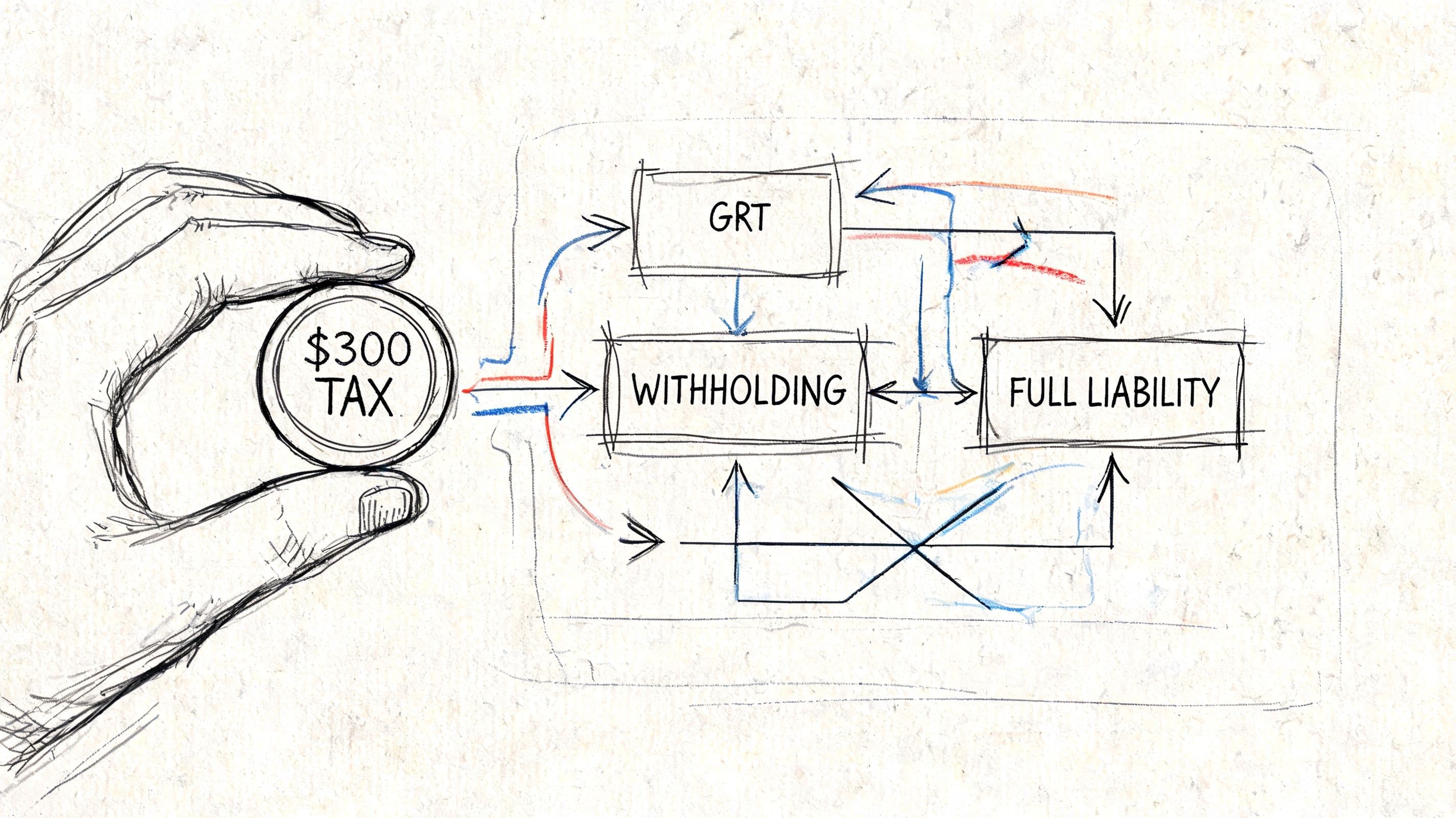
Operational readiness decides whether compliance stays clean
Founders often dump state tax work into legal, payroll, and bookkeeping without giving one person clear ownership. That creates predictable failures. The registered agent gets one set of notices, payroll files another set of returns, accounting records tax payments somewhere else, and nobody can prove the company is current without a scramble.
That is a control problem, not an admin problem.
If your company has Delaware employees, more than one entity, or an LLC taxed as a corporation, the annual franchise tax is only one item on the checklist. You need your books, payroll system, entity records, tax calendar, and payment archive to match.
Practical rule: If you cannot pull entity records, payment confirmations, payroll filings, and supporting documentation the same day, your Delaware tax process is not investor-ready.
Store that backup in one place. Keep payment confirmations, formation documents, withholding filings, and the supporting invoices and receipts to keep for taxes that support deductions and state filings.
What founders should manage like operators
A serious finance team does not rely on one June reminder. It maintains a current view of Delaware exposure across every entity and filing stream. Your process should answer these questions without debate:
- Entity control: Is each Delaware entity active, assigned to an owner, and tied to the right finance contact?
- Tax scope: Does the LLC only owe the franchise tax, or do Delaware payroll, withholding, gross receipts, or corporate income tax rules also apply?
- Documentation: Can you produce proof of payment, notices, and good standing records without searching inboxes?
- Year-end process: Is Delaware compliance reviewed as part of year-end tax readiness planning, instead of getting treated like a one-off June task?
My recommendation is simple. Treat Delaware tax compliance as part of your close process and control environment. Assign ownership, set filing calendars by tax type, reconcile payments monthly, and keep your records ready for diligence at all times. That is how you avoid penalties and look sharp when outside capital starts asking questions.
The Four Delaware Taxes Your LLC May Owe
Most founders know one Delaware tax. Serious operators map all four categories that may matter to an LLC structure.
The point isn't to assume you owe all of them. The point is to stop guessing.
Delaware tax obligations for LLCs
| Tax Type | Who It Applies To | What Triggers It | Typical Deadline |
|---|---|---|---|
| Annual Franchise Tax | Delaware LLCs | Existence on Delaware records during the prior calendar year | June 1 |
| Gross Receipts Tax | LLCs with Delaware-sourced business activity | Revenue tied to Delaware business activity | Varies by filing obligation |
| Withholding Tax | LLCs with Delaware-based employees | Payroll paid to employees subject to Delaware withholding | Varies by payroll filing obligation |
| Corporate Income Tax | LLCs that elect corporate tax treatment | Election to be taxed as a corporation, depending on structure and activity | Based on applicable return deadlines |
The one everyone knows
The franchise tax gets all the attention because it's universal for Delaware LLCs. If your entity is on the state's records for the prior year, you owe it. Delaware doesn't prorate the fee based on revenue, activity level, or how recently you formed the entity. That simplicity is useful, but it also tricks founders into thinking the rest of the state tax picture is simple too.
It isn't.
The one founders overlook
Income tax treatment creates confusion fast. Many scaling companies focus on the franchise tax and then get blindsided by how profits flow through the entity.
According to Cogency Global's summary of Delaware Division of Revenue FAQs, a single-member LLC treated federally as a disregarded entity does not file a separate Delaware return, but the LLC's profits are still taxed on the owner's personal return. Founders regularly miss this distinction because so much content about delaware llc tax payment stops at the annual state fee.
A founder who says "we paid Delaware" may still be missing the tax treatment of the profits generated inside that LLC.
Gross receipts and withholding are operational taxes
These are the obligations that catch companies after they scale.
If you have Delaware-sourced revenue, you need to determine whether gross receipts tax applies. If you hire Delaware-based employees, withholding obligations can start immediately. These aren't edge cases for growth-stage businesses. They're normal consequences of selling across states and building remote teams.
Use your controller or tax advisor to review:
- Revenue footprint: Where are services delivered, and where are customers located?
- Payroll footprint: Where do employees physically work?
- Entity elections: Is the LLC taxed as a disregarded entity, partnership, S corporation, or C corporation?
- Cash planning: Are taxes built into your forecast, not handled as surprises?
If your finance team hasn't documented those answers, fix that now. If you're still handling state obligations ad hoc, clean up the broader workflow with a more disciplined approach to quarterly estimated taxes for small businesses.
How to Pay the $300 Delaware Franchise Tax Online
The $300 payment is easy. Sloppy teams still miss it.
That is a problem because investors and acquirers do not care that the tax was small. They care that your finance function let a fixed, predictable filing turn into a penalty, an interest balance, or an avoidable notice from Delaware.
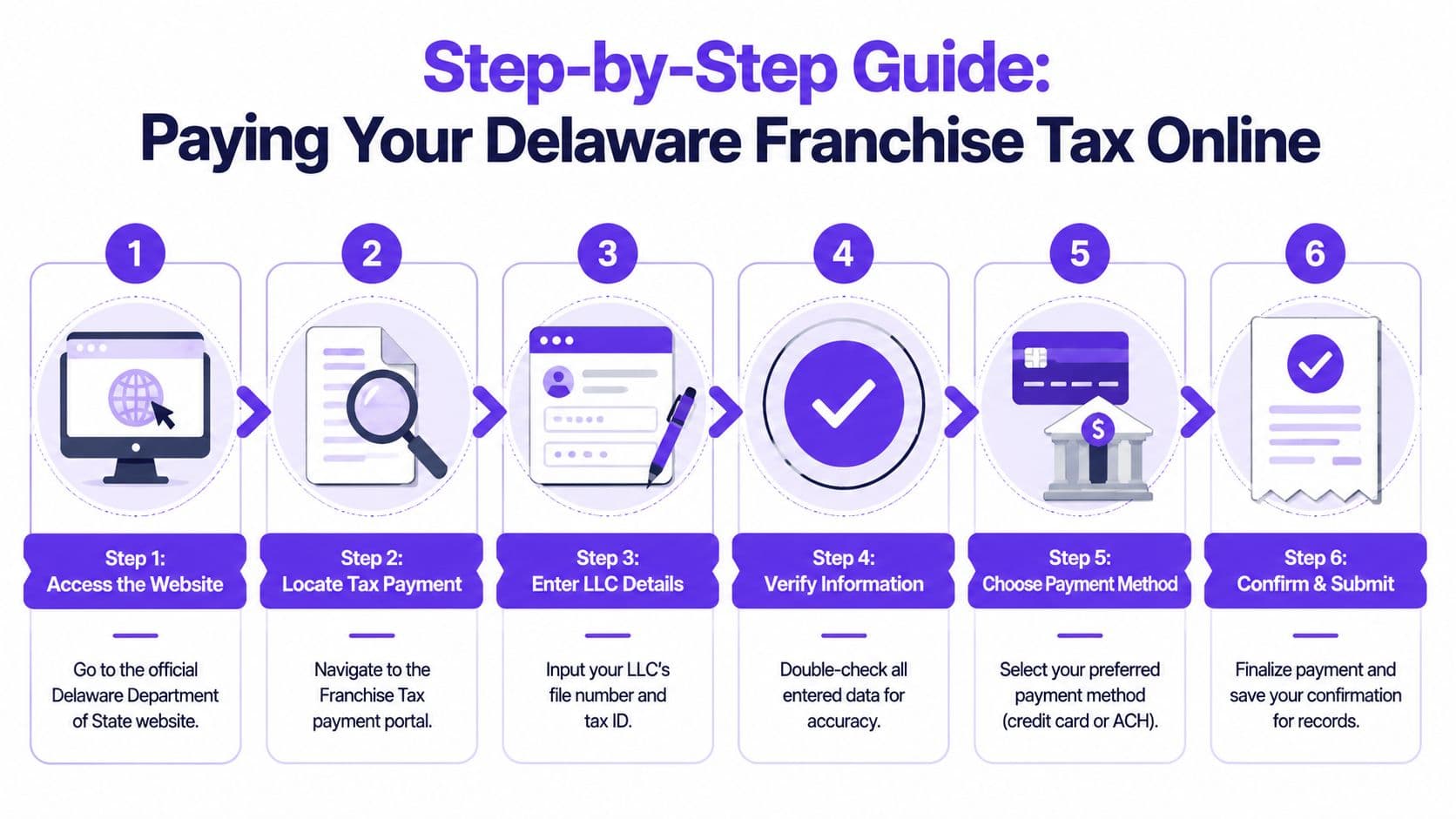
The online payment process
Standardize this as a recurring finance task, not a founder memory test.
- Pull the Delaware file number. Confirm the LLC's 7-digit Delaware File Number in your entity records or the state entity search.
- Open the state payment portal. Select Alternative Entity Tax for the LLC franchise tax payment.
- Enter the entity information. Use the file number and the requested verification details.
- Choose the payment method. ACH is usually the cleanest option. Credit card is available if your team needs it.
- Submit and archive proof. Save the confirmation email, payment receipt, and screenshot of the completed filing in your compliance folder.
The filing steps and payment options are also outlined in MLRPC's Delaware annual franchise tax filing guide.
ACH versus credit card
Use ACH by default.
It keeps the payment tied directly to your operating account, reduces avoidable processing costs, and makes the entry easier to trace during close. Credit cards are acceptable for edge cases, but they create more noise if your team is already cleaning up intercompany activity, old notices, or multi-entity filings.
What late payment actually costs
Delaware treats this mechanically. If you miss the deadline, the state adds a $200 penalty plus 1.5% monthly interest on the unpaid tax and penalty.
Here is the math after one month:
| Item | Amount |
|---|---|
| Franchise tax | $300 |
| Late penalty | $200 |
| Balance before interest | $500 |
| Month 1 interest at 1.5% | $7.50 |
| Total after 1 month | $507.50 |
That is not a cash problem for a scaling SaaS company. It is a control problem.
Set the payment on your annual compliance calendar, assign a named owner, and require receipt storage in the same folder as your Delaware registrations and notices. Then tie the disbursement into your monthly close with a documented bank reconciliation process for state tax payments.
Managing Delaware Gross Receipts and Withholding Taxes
The annual franchise tax is fixed. Gross receipts and withholding taxes are not. They depend on what your business does.
That makes them more dangerous. Teams miss them because they aren't one-size-fits-all, and nobody feels immediate pain until a notice arrives or diligence starts.
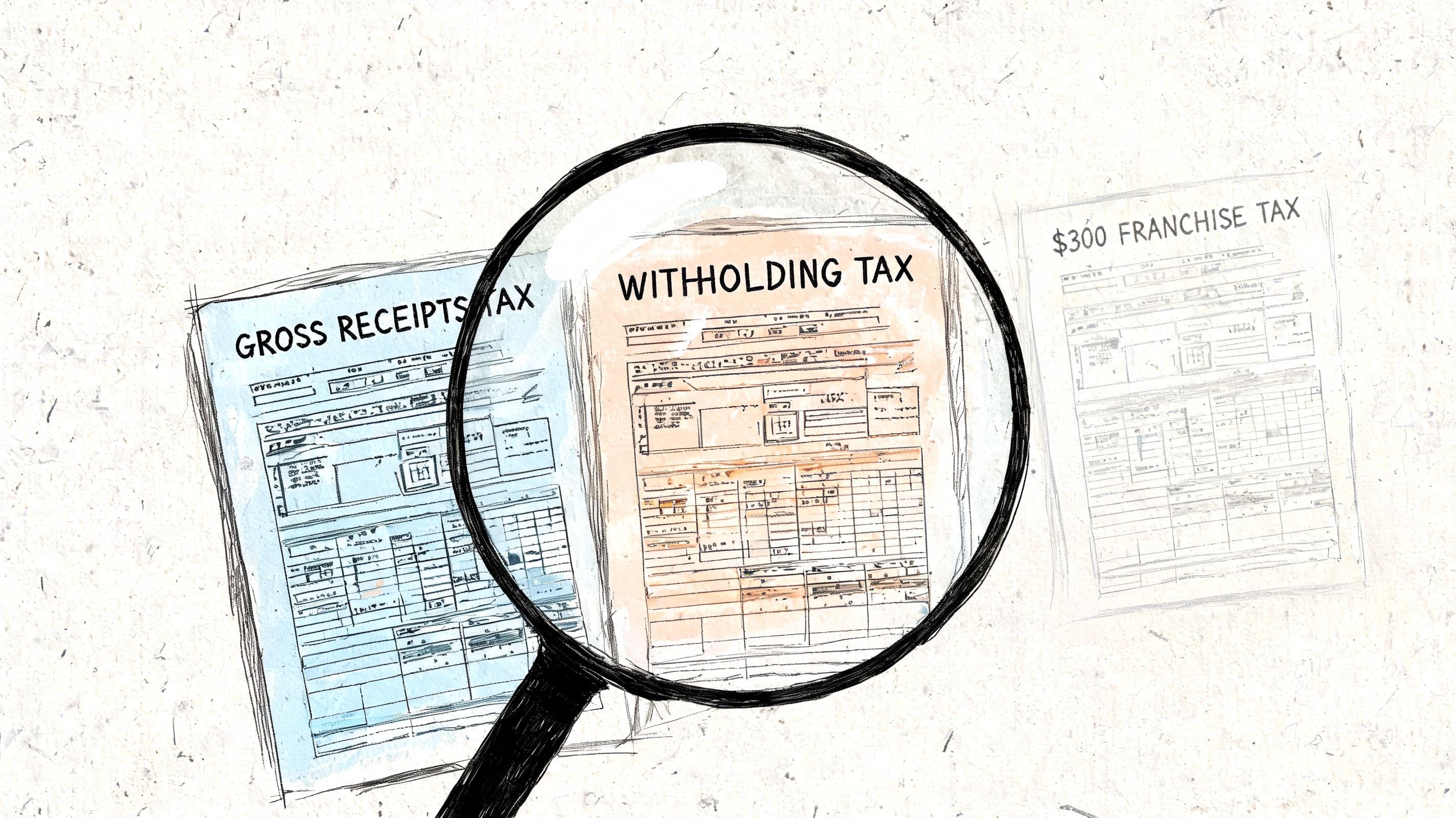
Gross receipts tax exposure starts with business activity
If your company has Delaware-sourced revenue, you need to analyze whether Delaware gross receipts tax applies. This isn't something to handle by intuition. You need a documented position tied to how you sell, where you deliver services, and how revenue is sourced.
Use a practical review process:
- Customer location: Identify customers with Delaware operations or delivery points.
- Revenue mapping: Review contracts and invoices to see whether services are tied to Delaware activity.
- Entity mapping: Confirm which legal entity signed the contract and booked the revenue.
- Escalation: If Delaware sourcing is material or recurring, have your tax advisor assess filing obligations.
The exact tax amount depends on applicable rules and classifications, so don't guess. If your agency lands a $1M retainer and you determine that 10% of the work is tied to Delaware activity, you now have $100,000 of revenue to evaluate for Delaware gross receipts purposes. That doesn't tell you the tax due by itself. It tells you where the analysis starts.
Withholding starts when you hire in Delaware
The moment you hire a Delaware-based employee, payroll tax compliance stops being theoretical. You need to determine registration and withholding obligations right away.
A lot of founders miss this because remote hiring feels operational, not tax-driven. But payroll creates state obligations fast.
Watch for these triggers:
- First Delaware employee: Review payroll setup before the first payroll run.
- Address changes: Existing employees who move into Delaware can trigger new state withholding requirements.
- PEO or payroll provider assumptions: Don't assume Gusto, ADP, or another payroll platform has handled every registration step unless someone on your team verified it.
Your payroll system can process wages correctly and still leave your entity out of compliance if nobody completed the underlying state setup.
If your company already tracks multi-state sales tax exposure, use the same discipline here. The finance team should review employee locations and state tax triggers on a recurring basis, just as you would for a broader SaaS sales tax and economic nexus compliance process.
Keep the operational file clean
For both gross receipts and withholding, maintain a state tax folder with:
- Entity documents
- State registrations
- Payroll account numbers
- Revenue sourcing memos
- Filing confirmations
- Correspondence from state agencies
That file matters. During diligence, "we think we're fine" isn't a usable answer.
Warning Signs Your Delaware Tax Compliance Is Broken
Most broken tax processes don't look broken until someone asks for proof. Then the gaps show up all at once.
If any of the warning signs below sound familiar, your company has already outgrown a founder-managed compliance setup.
Red flags finance leaders should catch early
- You don't know who owns the filing process. If the registered agent sends notices to a founder inbox, a former operator, or a generic admin account, you've created an avoidable failure point.
- Your Q2 forecast ignores entity taxes. Delaware franchise tax hits during a quarter when many growth companies are also managing hiring, board reporting, and fundraising prep.
- Your legal entity list doesn't match your accounting records. That's how inactive subsidiaries stay on the books, active entities miss payments, and due diligence turns ugly.
- You hired in Delaware but never reviewed payroll registrations. Payroll often expands faster than compliance review.
- You can't produce payment support quickly. If someone asks for a certificate, payment history, or prior notice response and your team starts searching inboxes, your controls are weak.
Common misconceptions that create problems
A few bad assumptions show up repeatedly.
| Misconception | Why it's wrong |
|---|---|
| "Our LLC had no activity, so we don't owe anything." | Delaware's annual LLC franchise tax applies regardless of activity if the entity remained on record for the relevant year. |
| "Our payroll platform handles state compliance automatically." | Software helps process payroll. It doesn't replace ownership of registration, review, and follow-up. |
| "We only need to think about Delaware tax once a year." | Franchise tax may be annual, but payroll, entity maintenance, and income tax treatment require ongoing attention. |
Broken compliance usually starts with a tiny task nobody owns. It ends with a board deck footnote, a delayed closing item, or a state notice your team can't explain.
What to do if these red flags apply
Don't patch this with reminders alone. Fix the operating model.
Start with a simple audit:
- List every Delaware entity you control.
- Assign one owner for compliance tracking.
- Match legal entities to bank accounts, books, payroll profiles, and tax records.
- Review employee locations and revenue footprint.
- Centralize confirmations, notices, and prior filings.
If your team can't complete that review quickly, you need stronger finance controls.
Building a Bulletproof Delaware Tax Workflow
The $300 payment is the easy part. The hard part is building a finance process that catches every Delaware tax obligation tied to the entity before a notice shows up, a financing closes, or due diligence starts.
A scaling SaaS or agency business should treat Delaware tax compliance as a recurring control, not a once-a-year filing task. The objective is simple. Know what each entity owes, know who owns each filing, and keep proof in one place your finance team can produce immediately.
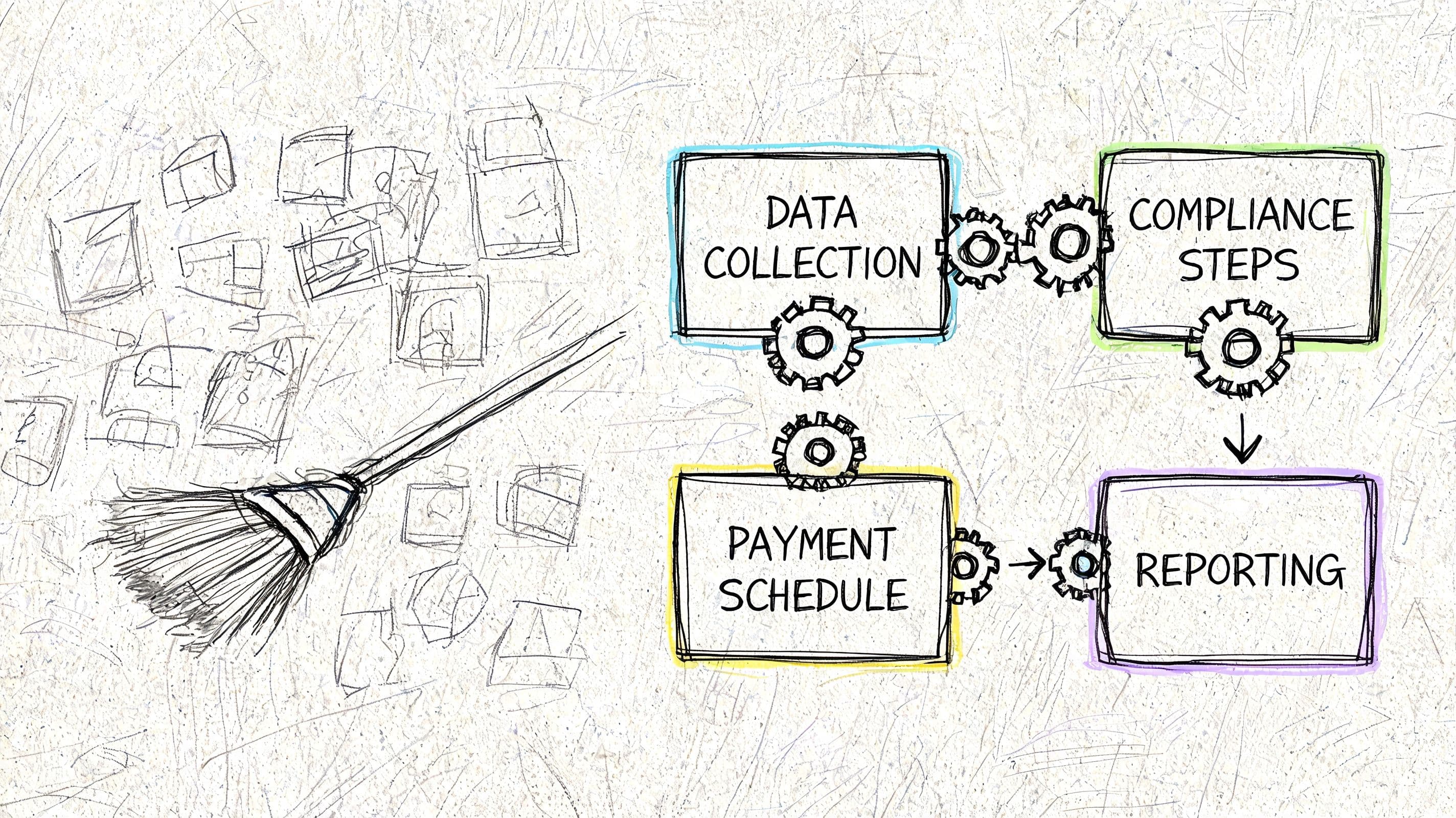
The operating model that works
A clean workflow has five parts.
1. Keep an entity register your finance team actually uses
Build one live register for every Delaware entity and connect it to monthly close, treasury, and payroll review. Do not leave this in a legal folder or founder inbox.
Track:
- Entity name
- Delaware file number
- Formation date
- Registered agent
- Federal tax classification
- Delaware tax accounts
- Bank account and general ledger mapping
- Payroll relationship
- Internal owner
- Outside CPA or tax contact
This register should tell your controller, at a glance, whether the LLC only owes the annual franchise tax or also has Delaware withholding, gross receipts, or a corporate income tax filing path because of its election and activity.
2. Put Delaware tax dates inside your finance systems
If the deadline lives only on a founder's calendar, expect misses.
Set up recurring tasks in the same tools your team uses for close and bill pay. QuickBooks, NetSuite, Xero, Asana, ClickUp, and your AP workflow should all point to the same calendar. Assign a preparer, assign a reviewer, and require the payment confirmation, notice response, and filing copy before the task can close.
If your team needs faster issue spotting on edge-case entity questions, AI tools for legal research can help organize statutes and filing rules. They do not replace tax review or sign-off.
3. Forecast Delaware taxes as planned cash outflows
Stop burying these payments in miscellaneous admin spend.
Put Delaware taxes into your 13-week cash flow forecast and your annual budget by entity. The annual LLC tax is predictable. Gross receipts and withholding can move with revenue and headcount. If the LLC elected corporate treatment, the state income tax filing path may change too. Finance should know that before quarter-end, not after a state notice arrives.
This matters in fundraising. Investors read sloppy compliance as weak controls, weak controls as reporting risk, and reporting risk as a pricing problem.
4. Separate legal admin from finance ownership
Registered agents receive documents. They do not run compliance.
Your finance lead should own the operating checklist:
- Deadline calendar
- Tax account access
- Cash approval
- Payment execution
- General ledger coding
- Filing support retention
- Escalation when entity elections, payroll footprint, or Delaware revenue activity changes
Legal can support formation, amendments, and unusual filing questions. Finance should own the recurring process because finance owns cash, books, and investor reporting.
5. Test the workflow before you need it
A good process works under pressure. Pull a sample now.
Ask your team for the last Delaware payment confirmation, the current good-standing status, the tax classification memo, and any active state account numbers. If that package is hard to produce, your process is not ready for diligence, a bank request, or a board question. Fix it now and formalize it inside your broader financial controls implementation plan.
Your next move
Set this up as a recurring finance control:
- Inventory each Delaware entity and series
- Confirm the federal tax election and resulting Delaware filing obligations
- Map each entity to payroll, revenue activity, and bank accounts
- Assign one preparer and one reviewer
- Calendar annual, quarterly, and payroll-related Delaware deadlines
- Store filings, confirmations, notices, and account credentials in one permanent folder
- Review the workflow quarterly, especially after hiring, restructuring, or fundraising
Sharp operators do not treat delaware llc tax payment as clerical cleanup. They treat Delaware compliance as proof that the company is controlled, investor-ready, and not about to lose time to avoidable state issues.
If your team needs help turning scattered tax tasks into a clean, investor-ready finance process, talk to Jumpstart Partners. They help growing companies build tighter close processes, stronger controls, better cash visibility, and a finance function that can handle compliance without last-minute chaos.