Financial Operations
What is a Fractional CFO? The Real Meaning for a Growing Business in 2026
Discover the true fractional CFO meaning for growth-stage businesses. Learn what a fractional CFO does, how much they cost, and when your business needs one.
ByJumpstart Partners, CPA, QuickBooks ProAdvisor
··17 min readIf you’re the CEO of a fast-growing SaaS, digital agency, or professional services firm, you’ve likely felt this pain: your revenue is climbing, new customers are lining up, but your ability to make smart financial decisions is lagging. You're steering a multi-million-dollar business with gut feelings and messy spreadsheets. This is the danger zone.
A fractional CFO offers strategic financial leadership on a part-time basis, giving you C-suite expertise without the six-figure executive salary. It’s not just an advisor; it’s about embedding a high-level strategist into your leadership team for a fraction of the cost.
When Growth Outpaces Your Financial Strategy

Your revenue is climbing, and new customers are lining up. Operationally, you're winning. Financially? You’re still making critical decisions on hiring, marketing spend, and product development without a clear forecast or reliable data. This is a classic—and dangerous—stage for businesses between $500K-$20M in revenue: your growth has officially outpaced your financial maturity.
This gap between operational success and financial clarity is precisely where profitable growth stalls out and fundraising efforts completely fall apart. You are forced to make decisions with high stakes and low confidence.
Misconception: "My Bookkeeper Has Finance Covered"
Many founders believe their bookkeeper or controller has finance covered. While these roles are absolutely essential for recording historical data—what happened last month—they aren’t designed to build your financial future. This isn't about better accounting; it's about adding a forward-looking strategist.
A fractional CFO’s job isn't to look backward. It's to connect the numbers to your strategy so you can:
- Engineer Profitable Growth: Move beyond simply tracking revenue to deeply understanding your unit economics, pricing strategy, and margins so you can scale without burning cash.
- Secure Funding on Your Terms: Build the investor-ready financial models, reporting cadence, and data rooms required to secure capital from a position of strength.
- Achieve Cash Flow Confidence: Get the forward-looking forecasts you need to make hiring and spending decisions with confidence, not anxiety.
They help you map out a plan to capitalize on new revenue opportunities, like figuring out how to sell digital products online, and ensure your business scales effectively.
"Founders often mistake historical bookkeeping for financial strategy. A true fractional CFO doesn't just report the past; they build the financial roadmap for the future, turning your data into a predictive asset for growth and fundraising." — Jonathan Lister, Partner at Growth Equity Partners
If your financial insights feel stuck in the past while your business races ahead, that’s your signal. You have reached the point where you need more than just a bookkeeper. For a deeper look, check out the signs you've outgrown your bookkeeper and what to do next.
The True Meaning of a Fractional CFO
So, what exactly is a fractional CFO? Think of it less as a job title and more as embedding a top-tier financial strategist in your leadership team, but only for the "fraction" of time you actually need them. You get C-suite brainpower—the kind that guides companies through funding rounds and acquisitions—without the $400,000+ annual salary and equity package of a full-time executive.
This isn’t just a fancy term for a high-level accountant. A fractional CFO’s job is completely different from your bookkeeper or controller. Those roles are fundamentally backward-looking, focused on recording history accurately.
A fractional CFO is relentlessly forward-looking. Their job is to use that history to write your company's future.
The Strategist, Not The Scorekeeper
Let’s use a race car analogy to make this crystal clear.
- A bookkeeper meticulously records every transaction—like a mechanic logging every part that goes into the car. They ensure the historical record is perfect.
- A controller assembles the financial statements—like the crew chief who ensures the car is built correctly and the engine runs. They manage the financial machine.
- A fractional CFO is the expert driver. They analyze the track ahead, manage fuel (cash flow), and execute the race-winning strategy to get you across the finish line ahead of your competitors.
Your bookkeeper and controller make sure the engine is sound. The fractional CFO is the one who actually wins the race with it.
This model isn't new, but its popularity has accelerated. A 2026 survey found that 68% of mid-market CEOs now prefer fractional hires for key leadership roles, especially for high-stakes events like fundraising where a full-time CFO's cost is prohibitive. You can see how this model is shaping modern startups in reports from financial platforms like Brex. The core of the fractional CFO role is turning financial data into a strategic roadmap. They take the reports your controller prepares and translate them into actionable plans for growth, profitability, and capital efficiency.
Fractional CFO vs Other Financial Roles
It's easy to get these roles confused, but their focus areas and costs are worlds apart. Here’s a simple breakdown of how they differ.
| Role | Primary Focus | Key Activities | Typical Cost (Annualized) |
|---|---|---|---|
| Bookkeeper | Historical Transactions | Data entry, bank reconciliations, recording invoices and bills. | $5k - $15k |
| Controller | Historical Reporting & Compliance | Managing month-end close, financial statements, audit prep, payroll. | $80k - $150k |
| Fractional CFO | Future Strategy & Growth | Financial modeling, cash flow forecasting, fundraising strategy, M&A. | $60k - $120k |
Understanding this table is key. While a controller ensures your financial reporting is accurate, a fractional CFO uses that accurate reporting to tell you what to do next. They answer questions like, "Can we afford to hire three new engineers?" or "How much runway do we have if we double our marketing spend?"
When you're weighing a fractional CFO vs a full-time CFO, the main difference isn’t the caliber of expertise—it's the cost and engagement model. You get the same strategic mind, but applied in a focused, high-impact way that aligns perfectly with a growth-stage company's budget and needs.
What a Fractional CFO Actually Delivers
Let’s get one thing straight: you aren’t paying for high-level advice. A true fractional CFO is defined by the concrete, strategic assets they build for your business. These aren’t just reports—they’re the tools that create a predictable, scalable company and drive up your valuation.
Sure, a good one will find effective cost reduction strategies, but their real value comes from moving your financial operations from reactive to proactive.
From Messy Spreadsheets to a Strategic Financial Model
One of the very first things a fractional CFO builds is a dynamic, forward-looking financial model. This isn't your bookkeeper’s P&L export. It’s a sophisticated roadmap that connects your sales pipeline, operational costs, hiring plans, and growth goals into a single source of truth for decision-making.
With this model, you can run “what-if” scenarios in minutes, not days.
Worked Calculation: Scenario Modeling
Let's say your SaaS business is at $2M ARR with a $500K cash balance. You want to hire two senior developers at a fully loaded cost of $20,000/month.
- Baseline Model: Your current burn rate is $25,000/month. Your runway is $500,000 / $25,000 = 20 months.
- Scenario Model: The new hires increase your burn to $45,000/month ($25K + $20K). Your runway immediately drops to $500,000 / $45,000 ≈ 11 months.
This simple calculation reveals the hire cuts your runway in half. The model forces a strategic conversation: "Can our new sales hires ramp up fast enough to offset this burn, or do we need to raise capital sooner?" You stop making decisions in a vacuum.
The Power of a 13-Week Cash Flow Forecast
For any SaaS, agency, or growth-stage business, cash is oxygen. A fractional CFO immediately moves you beyond simply checking the bank balance by implementing a rolling 13-week cash flow forecast. This tool gives you a full quarter’s worth of visibility into your most critical resource.
Here’s a simplified, real-world example of how it puts you in control:
| Week | Opening Cash | Inflows (Collections) | Outflows (Payroll/Bills) | Closing Cash |
|---|---|---|---|---|
| Week 1 | $250,000 | $0 | ($40,000) | $210,000 |
| Week 2 | $210,000 | $0 | $0 | $210,000 |
| Week 3 | $210,000 | $0 | ($40,000) | $170,000 |
| Week 4 | $170,000 | $100,000 | ($15,000) | $255,000 |
| ...Week 9 | $135,000 | $0 | ($40,000) | $95,000 |
Without this forecast, you’d get a nasty surprise in Week 9 when your cash balance unexpectedly drops below $100,000. With the forecast, you have two full months to see that dip coming and pull the right levers: accelerate collections, negotiate vendor terms, or draw on your line of credit. This is proactive business management.
This chart shows exactly where a strategic fractional CFO fits into the finance team hierarchy.
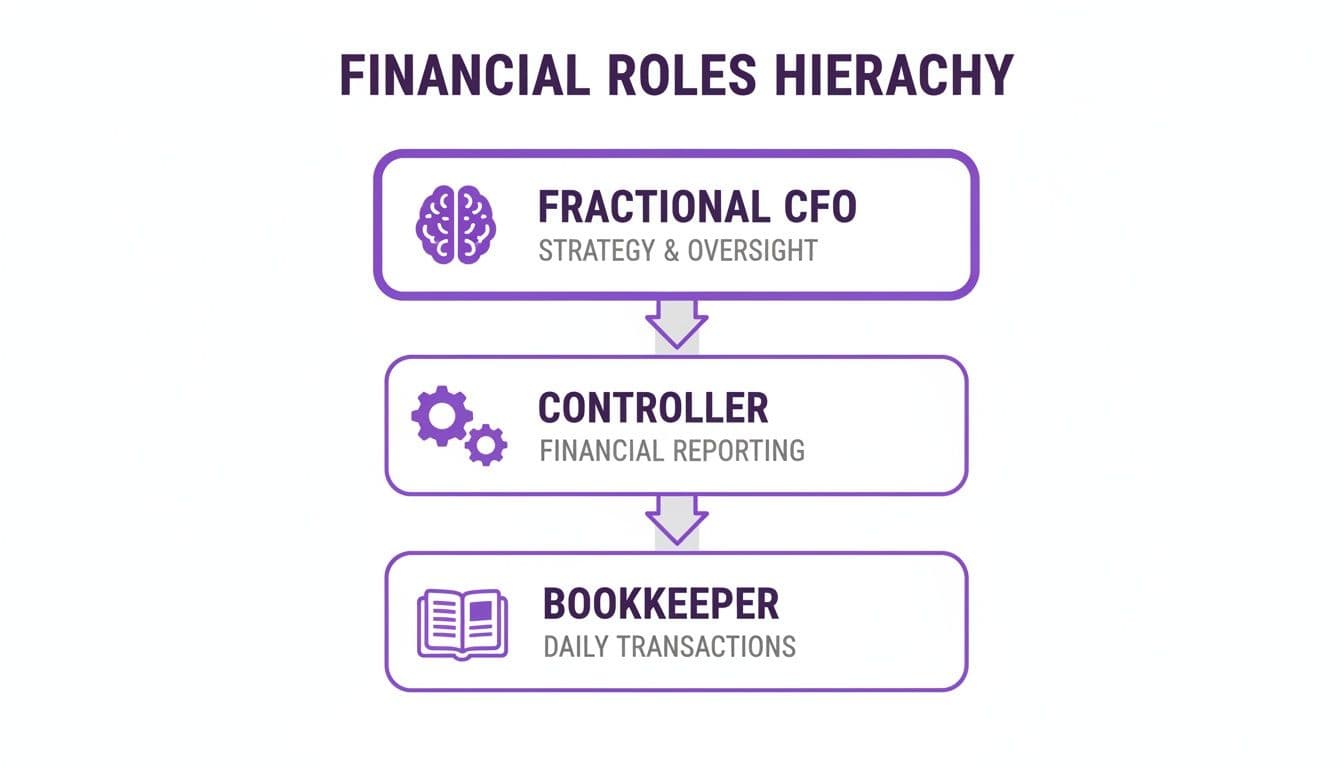
The fractional CFO sits at the top, focused on forward-looking strategy. The controller owns the systems and reporting, while the bookkeeper handles the daily transactions. This structure ensures you have the right expertise focused on the right things.
To see how this strategic guidance applies in practice, explore our dedicated fractional CFO services and learn how they build these assets for businesses like yours.
Warning Signs You Need A Fractional CFO
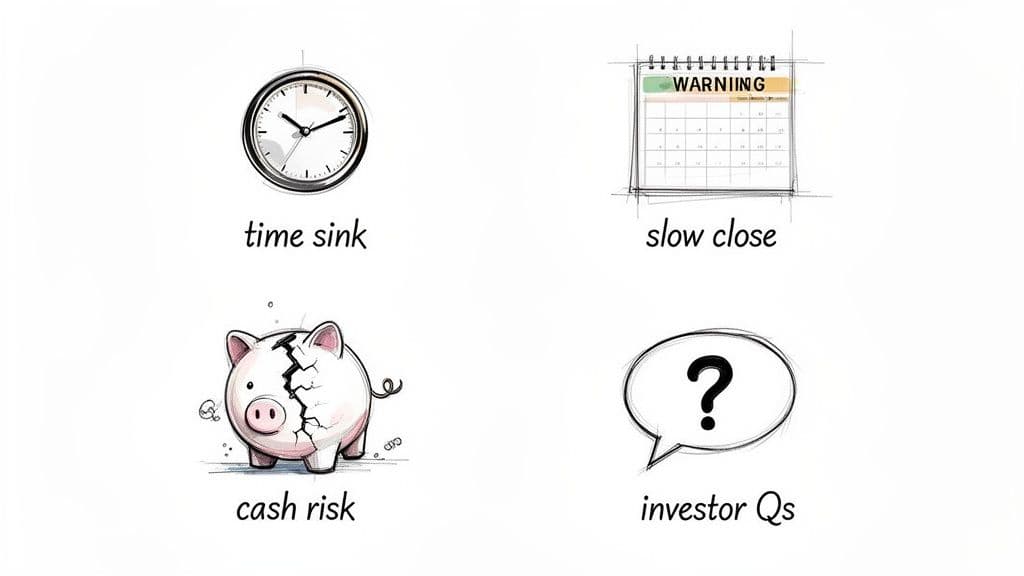
How do you know it’s time for real financial leadership? It’s not a single moment. It’s a slow burn of persistent problems—the feeling that your current financial setup just can’t keep up with your growth. Spotting these red flags early is the difference between stalling out and unlocking your next phase.
Red Flag 1: You (the CEO) Are the de Facto CFO
Are you spending hours every week wrestling with spreadsheets, chasing numbers, and trying to cobble together a forecast? When you're stuck in the financial weeds, you aren't focused on sales, product, or leading your team. That’s a massive resource allocation problem.
- The symptom: You're spending more than 10% of your week on financial tasks that aren't high-level strategy.
- The fix: Offload this work to a strategic finance partner. Your time is the company's most valuable asset—it must be spent driving growth.
Red Flag 2: Your Month-End Close Takes Weeks
If it’s the 20th of the month and you’re just now seeing how you performed last month, you’re driving by looking in the rearview mirror. A slow close means your data is stale the moment you get it, making it useless for quick, tactical decisions. This is a classic sign that your accounting processes are broken or your team is underwater. A fractional CFO installs the systems for a fast, reliable close—typically within five business days.
Red Flag 3: You Can’t Answer Investor Questions with Confidence
An investor asks, “What’s your LTV to CAC ratio?” Or, “Walk me through the key assumptions in your hiring plan for the next 18 months.” If your answer is a hesitant guess or a promise to “get back to them,” you are not ready for a serious fundraising conversation.
- SaaS Benchmark: According to OpenView's 2024 SaaS Benchmarks, top-performing companies maintain an LTV:CAC ratio of 3x or higher. You need to know your number and have a plan to improve it.
- Key Takeaway: Investors fund predictability. A fractional CFO builds the financial story and command of the numbers that gives them the confidence to write a check.
Adoption of fractional CFOs has surged, and today, 72% of US companies under $20M in revenue use fractional experts for cash flow visibility and forecasting. Delaying strategic leadership is a risk fewer growth companies are willing to take, as you can see in these insights on the rising popularity of fractional CFOs. If you are facing these issues, it is important to understand when to hire a bookkeeper, controller, or CFO to ensure you have the right expertise for your stage.
How To Hire The Right Fractional CFO
Hiring your fractional CFO isn't just filling a role; it's a critical leadership decision. You’re not hiring a bookkeeper or a temporary accountant—you're bringing a strategic partner into your inner circle. The goal is to find someone who will challenge your assumptions and drive tangible results, not just deliver reports.
The evaluation process must be rigorous. A great fractional CFO for a manufacturing company will be a poor fit for your SaaS business, and settling for general financial expertise is a recipe for wasted money and stalled growth.
Core Evaluation Criteria
Before you even look at a resume, you need a clear scorecard. A top-tier fractional CFO must check three non-negotiable boxes: deep industry expertise, a proven track record at your exact growth stage, and fluency in your company’s tech stack.
- Deep Industry Expertise: For a SaaS company, they must live and breathe metrics like MRR, LTV to CAC ratio, and Net Revenue Retention. For an agency, they must speak intelligently about project profitability, utilization rates, and client concentration risk. They have to understand the unique economic engine of your business model, not just general accounting principles.
- Proven Growth Stage Experience: A CFO who has only worked with $100M+ public companies will not understand the scrappy, cash-constrained realities of a $5M business. Look for a track record of success with companies at your specific revenue stage (e.g., $500K-$20M). They need to have navigated the exact growth pains you are experiencing right now.
- Tech Stack Fluency: A strategic partner must hit the ground running. They need hands-on familiarity with your core financial systems, whether that's QuickBooks Online, Xero, Stripe, Gusto, or NetSuite. If they spend the first three months learning your tools, you’re burning precious time and cash.
Hard-Hitting Interview Questions
Generic interview questions won’t cut it. You need to pressure-test their strategic thinking and problem-solving abilities to see how they think, not just what they know.
Here are the specific questions to ask:
- "Walk me through the process you would use to build our 12-month financial model from scratch. What key drivers would you focus on for our business?" This reveals their modeling methodology and whether they truly grasp your business's core KPIs. It separates the doers from the delegators.
- "Describe a time you helped a company like ours navigate a cash flow crisis. What specific steps did you take, and what was the outcome?" This tests their crisis management skills. You're looking for someone who acts decisively under pressure, not someone who just reports on the problem.
- "Looking at our current stage, what are the top three financial mistakes you see companies like us make, and how would you prevent them?" This question assesses their foresight and proactive mindset. A great answer will show they are thinking ahead about protecting your business, not just reacting to last month's numbers.
Finding the right partner is a direct investment in your company’s future. For more on structuring this key relationship, see our guide on CFO services and consulting.
Your Actionable Next Steps
You've seen what a fractional CFO does and how to identify if you need one. Reading about financial strategy is one thing. Acting on it is another. This is where you move from putting out financial fires to building a fire-proof business.
It doesn't start with a massive, risky investment. It starts with a single step to get clarity.
How to Get Started in 3 Steps
Don't let another quarter go by with guesswork driving your decisions. The path to financial control is simpler than you think.
| Step | Action | Outcome |
|---|---|---|
| 1. Self-Audit Your Red Flags | Review the "Warning Signs" section. If you identify with two or more, it's a clear signal to act. | Acknowledgment of your specific financial gaps. |
| 2. Define Your Top 3 Questions | What are the three biggest financial questions you can't answer right now? (e.g., "What's our true runway?") | Clarity on the immediate value a CFO must deliver. |
| 3. Schedule a Diagnostic Call | Book a consultation to discuss your specific business challenges and goals. This is a working session, not a sales pitch. | A concrete plan with clear deliverables to address your financial gaps. |
This is what we do at Jumpstart Partners. We build that complete financial picture for growth-stage companies, giving you an immediate sense of control and a clear plan.
Ready to build your roadmap to profitable growth? Book a free consultation today and get a clear, actionable plan for your business.
Common Objections and Final Questions
Let's address the practical questions every founder asks before engaging a fractional CFO. We'll give you the direct answers you need.
"Isn't a fractional CFO just a glorified, expensive consultant?"
No. A consultant gives you a report and leaves. A fractional CFO integrates into your leadership team, owns the financial strategy, and is held accountable for results like extending runway and hitting forecast targets. They don't just advise; they execute.
"How much does a fractional CFO cost?"
Engagements typically run on a monthly retainer between $3,000 and $10,000+, depending on your company’s size, complexity, and strategic needs. This provides access to top-tier strategic talent for a fraction of the $350,000+ all-in cost of a full-time hire (salary, benefits, equity). It is an investment in strategic horsepower, not a 40-hour-a-week employee.
"How much time will I actually get?"
This isn't about logging hours; it's about driving impact. A great fractional CFO plugs into your leadership team's rhythm. They will be in your key leadership meetings, run financial planning sessions, and be on call for critical decisions. The goal is consistent, high-value guidance that moves the needle, whether that takes five hours a week or twenty.
"My bookkeeper is fantastic. Why do I need a CFO, too?"
This is a great question, and the distinction is critical. Your bookkeeper is the historian of your business, meticulously recording every transaction. That work is the bedrock of everything.
A fractional CFO is a forward-looking architect. They take that perfect historical data and use it for activities that are completely outside a bookkeeper's scope, such as:
- Building a multi-year financial forecast to guide your long-term strategy.
- Analyzing unit economics like LTV to CAC to ensure your growth is profitable.
- Leading the financial strategy during a fundraising round or M&A process.
They don’t replace your bookkeeper. They make your bookkeeper’s work more valuable by using it to guide your most important decisions about the future.
The right partnership provides more than advice—it builds a complete financial engine. At Jumpstart Partners, we pair CFO-level strategy with expert controller and bookkeeping services to deliver flawless execution. Book a free consultation today to build your roadmap for profitable growth.