Financial Operations
CFO Services Consulting: A Founder's Guide for 2026
Unlock scalable growth with our CFO services consulting guide. Learn when to hire, what to expect, and choose the right partner for your scaling business.
ByJumpstart Partners, CPA, QuickBooks ProAdvisor
··22 min readIf you're leading a business between $500K and $20M in revenue, you’ve likely discovered a painful truth: the financial strategies that got you here will not get you to the next level. CFO services consulting bridges this gap. It's not just about better bookkeeping; it's a strategic partnership that combines expert accounting, controller oversight, and forward-looking CFO strategy to turn your financial data from a source of anxiety into a clear roadmap for profitable growth.
This guide is for founders, CEOs, and leaders at SaaS companies, digital agencies, and professional services firms who are tired of flying blind. You're making critical decisions about hiring, pricing, and growth with incomplete data. Let's fix that.
When Your Growth Outpaces Your Financials
Your business is scaling—a huge win. But success brings a new class of problems. The simple bookkeeping that got you here now feels dangerously inadequate.
You’re landing new clients and shipping product, but the financial back-end is starting to creak and groan under the pressure.
The Problem With DIY Finances
The root of the issue isn't a lack of effort; it's a gap in strategic financial capability.
You’re probably living with some of these growing pains:
- Constant Cash Flow Anxiety: You're profitable on paper, but you’re never quite sure if you have enough cash for payroll, a new hire, or that big marketing push.
- Useless Reporting: Your financial reports are historical artifacts. They tell you what happened last month, not what you should do next quarter to hit your goals.
- Gut-Feel Decisions: You're making critical business decisions—on pricing, hiring, or expansion—based on gut feelings because you don't have reliable data on customer acquisition cost (CAC), lifetime value (LTV), or unit economics.
These aren't just bookkeeping problems. They're strategic blind spots that will absolutely limit your company's potential. If this sounds familiar, it’s worth checking the signs you’ve outgrown your bookkeeper and figuring out what comes next.
"The CFO’s role has evolved. It’s no longer about just keeping the books. It's about being a strategic partner to the CEO, leveraging data to drive growth and unlock opportunities the rest of the team can't see." - Jack McCullough, President, CFO Leadership Council
This shift from gatekeeper to growth driver is exactly what CFO services consulting delivers. It bridges the gap between basic accounting and the sophisticated financial insights you need to make confident, data-driven decisions.
This trend is playing out across the industry. The Financial Performance Index (FPI) recently hit a record high, with 53% of finance leaders reporting better performance year-over-year. This confidence isn't happening by accident; it's fueled by bringing in outside expertise that lets leadership focus on scaling the business. The 2026 CFO and Controller Sentiment Study shows how top-performing companies are using this exact playbook.
Engaging a CFO consulting service isn't about getting prettier spreadsheets. It's about gaining the strategic horsepower to fund your next big move, whether that's entering a new market, securing a round of funding, or preparing for an exit. It’s about finally transforming financial chaos into a clear plan for your company's future.
Building Your Modern Finance Team
The single biggest mistake founders make when scaling isn't product or marketing—it's hiring the wrong finance person at the wrong time. You know you need help beyond basic bookkeeping, but the sea of titles is a minefield. Get this hire right, and your finance function becomes a growth engine. Get it wrong, and it’s an anchor dragging you down.
Founders burn precious capital using terms like “Controller,” “Fractional CFO,” and “CFO Services” interchangeably. They aren't the same. Each role solves a very different business problem, and picking the right one is critical.
Who Does What on the Finance Pit Crew
Think of your finance team like a Formula 1 pit crew. The bookkeeper changes the tires—essential day-to-day work logging transactions and keeping the car on the track. They are all about the past.
The Controller is your chief mechanic, running diagnostics. They make sure the data is flawless, the systems are running correctly, and the engine is healthy month after month. They are the masters of the present, ensuring historical accuracy.
The CFO is your race strategist. They use the data from the Controller and real-time track conditions to tell you when to pit, how much fuel to add, and which line to take for the win. A Fractional CFO gives you access to that strategist on a part-time basis—perfect for when you don't need a full-time executive but absolutely need the expertise.
When you have the wrong person for the job, painful symptoms emerge.
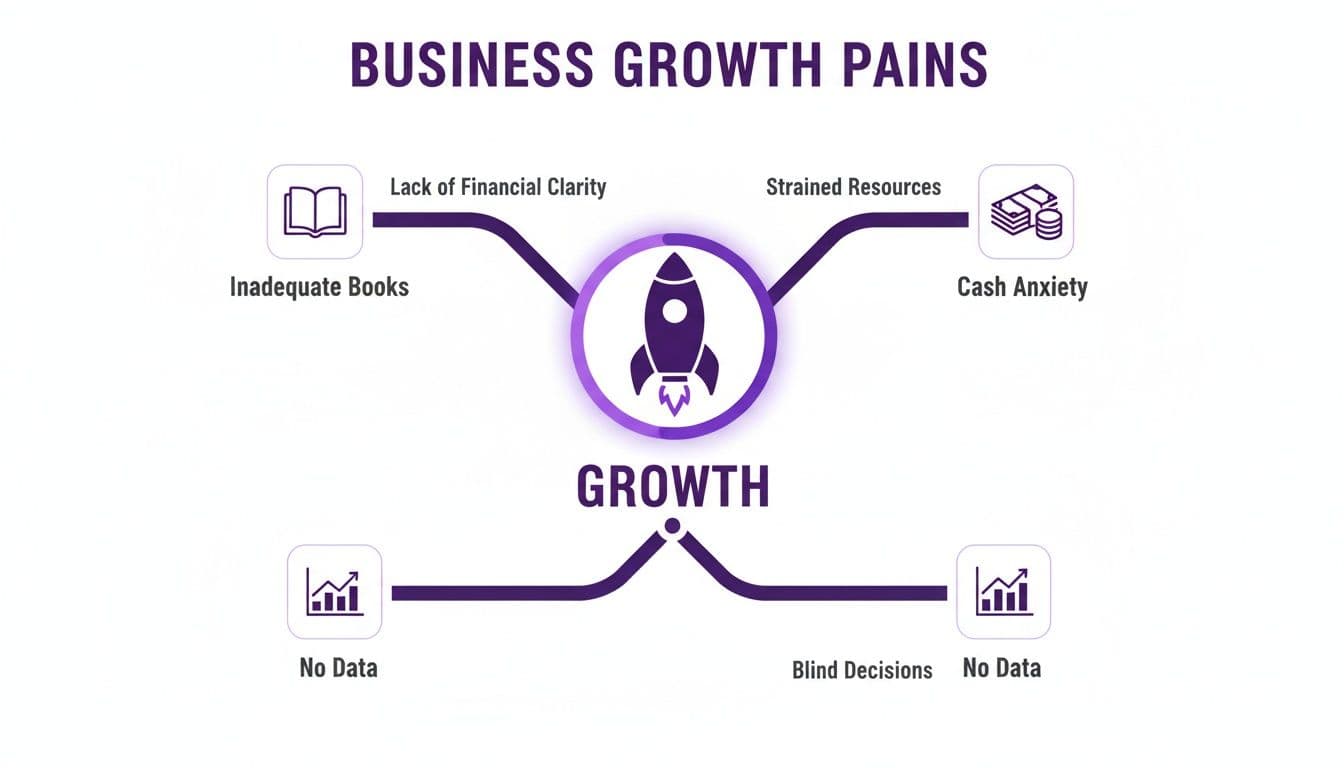
These issues—messy books, constant cash anxiety, and making decisions in the dark—are direct consequences of a mismatch between your company's growth stage and its financial leadership.
A recent 2025 CFO review shows that outsourcing tactical functions like controller services is a key strategy for high-growth companies. It frees up your leadership to focus on high-impact decisions and gives you access to top-tier processes without the crippling overhead of a full-time team.
Bookkeeper vs. Controller vs. Fractional CFO
Understanding the specific deliverables of each role is the key to diagnosing your company's primary need. Are your problems historical (bad books), or are they forward-looking (no strategy)?
| Role | Primary Focus | Key Deliverables | Best For Companies... |
|---|---|---|---|
| Bookkeeper | Transaction Recording | Coded bank transactions, basic financial reports, accounts payable/receivable processing. | Just starting out, needing basic historical record-keeping. |
| Controller | Accuracy & Compliance | Flawless month-end close, reconciled accounts, financial statement preparation, audit readiness. | With clean books but needing reliable, auditable historical data and process control. |
| Fractional CFO | Strategy & Forecasting | 13-week cash flow forecast, financial modeling, KPI dashboards, board/investor relations. | With clean books but needing forward-looking guidance to make strategic decisions. |
Choosing the right partner comes down to identifying your most pressing pain point.
Are your books a disaster? You need a Controller to clean up the past. Are your books clean, but you feel like you're flying blind on strategy? You need a Fractional CFO to map out the future. If you need both—and many growing companies do—an integrated CFO services consulting firm provides the most efficient path, combining both roles into one cohesive team.
Modern teams also build efficiency with new tools. For example, you can use AI to turn conversations into structured deliverables, quickly converting board meetings and investor calls into actionable analysis.
Ultimately, deciding on your next finance hire is a pivotal moment. Don't make the common mistake of hiring a bookkeeper to do a controller's job or a controller to do a CFO's. Understanding when to build out your finance team is one of the most important decisions you'll make this year.
The Tangible Results of CFO Consulting
What do you actually get from CFO services consulting? It’s not just a clean Profit & Loss statement. While accurate books are the bare minimum, the real work begins where bookkeeping ends. A great CFO consultant turns your historical financial data into strategic tools that help you make better decisions, grow faster, and increase your company's valuation.
These aren't just reports to file away. They’re the financial horsepower you need to scale, whether you're a SaaS founder staring down a cash crunch or an agency owner trying to figure out which clients are actually profitable.
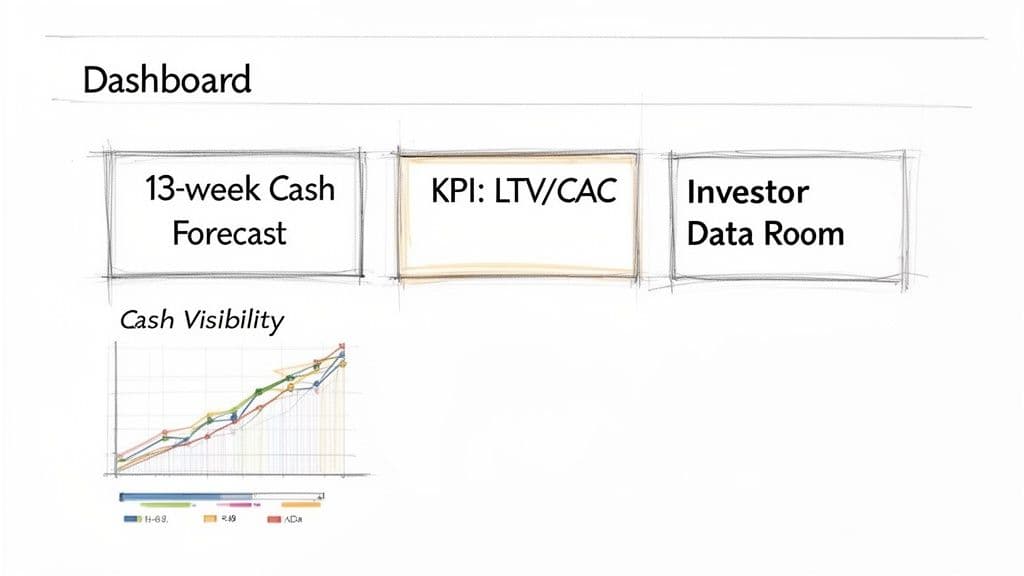
The 13-Week Cash Flow Forecast
If there's one deliverable that provides immediate, game-changing clarity for a founder, it’s the 13-week cash flow forecast.
This isn't your bank balance. It’s a forward-looking model that projects your cash position week-by-week for the next quarter. It’s the difference between reacting to your bank account and proactively managing your financial future.
Why 13 weeks? It’s the sweet spot—long enough to make meaningful strategic moves but short enough to maintain high accuracy.
Let's walk through a real-world example for a digital agency with $2M in annual revenue.
Worked Calculation: Improving Cash Visibility
- Starting Cash: The agency has $150,000 in the bank at the start of Week 1.
- Cash Inflows (Projected):
- Client A (Retainer): +$15,000
- Client B (Project Milestone): +$25,000
- Total Inflows: +$40,000
- Cash Outflows (Projected):
- Payroll & Taxes: -$50,000
- Software Subscriptions: -$3,000
- Office Rent: -$5,000
- Total Outflows: -$58,000
- Net Weekly Cash Flow: $40,000 - $58,000 = -$18,000
- Ending Cash (Week 1): $150,000 - $18,000 = $132,000
By repeating this for 13 weeks, you spot future problems and opportunities. See a cash dip in Week 8? You now have two months to pull in a receivable, delay a non-critical expense, or tap your line of credit. This level of foresight delivers an immediate 40%+ improvement in cash visibility, giving you the confidence to hire, spend, and invest.
KPI Dashboards That Drive Action
Generic metrics are useless noise. A top-tier CFO service builds dashboards with KPIs that are laser-focused on your specific business model. It's about finding the handful of numbers that truly measure the health and momentum of your company.
- For a SaaS Company: The name of the game is unit economics. Your dashboard will zero in on your LTV/CAC Ratio (Lifetime Value to Customer Acquisition Cost). According to OpenView's 2024 SaaS Benchmarks, a healthy SaaS business aims for a ratio of 3x or higher. Your dashboard will also track Monthly Recurring Revenue (MRR), Churn, and Net Revenue Retention (NRR).
- For a Professional Services Firm: Profitability lives and dies by utilization and project margins. Your dashboard will shine a light on Billable Utilization Rate, Project Gross Margin, and Average Bill Rate. You simply can't manage what you don't measure.
- For an E-commerce Brand: It's all about margins and how fast you can turn over inventory. Your key numbers are Landed Cost (the true cost to get a product to your warehouse), Inventory Turnover, and Return on Ad Spend (ROAS).
These dashboards cut through the static, giving you a real-time pulse on your business. You'll find many of the same principles apply whether you're building a finance function from scratch or bringing in part-time help. Learn more in our guide to the core deliverables you should expect from fractional CFO services.
The Investor-Ready Data Room
Whether you plan to raise capital in six months or six years, you need to operate as if a deal could happen tomorrow. An investor-ready data room is a secure, organized home for all of your company's critical financial, legal, and operational documents.
A great CFO partner builds and maintains this for you, so you're never caught flat-footed. The process involves:
- Creating a Standardized Folder Structure: Using the same best practices that venture capital and private equity firms expect.
- Populating Financials: Uploading audited or reviewed historical financials, detailed financial models, and your KPI dashboards.
- Gathering Corporate Documents: Assembling incorporation docs, your cap table, board minutes, and all key contracts.
- Quarterly Updates: Making sure the data room is always current and ready to go.
This single deliverable transforms fundraising from a chaotic, six-week fire drill into a calm, organized process. It makes sure you’re always prepared to seize an opportunity the moment it appears.
Warning Signs Your Finances Are Unscalable
That exhilarating feeling of rapid growth? It often papers over the cracks in your financial foundation. The scrappy spreadsheet and cheap bookkeeper that got you to your first million in revenue will not get you to ten million. In fact, they’ll start to break, creating risks that can quietly sink your company.
Many founders think a budget bookkeeper is a smart way to save money. The reality is the exact opposite. We find an average of $47,000 in correctable errors for new clients—money they were losing to bad processes, botched revenue recognition, or missed tax credits. Underinvesting in your financial engine costs you far more than you save.
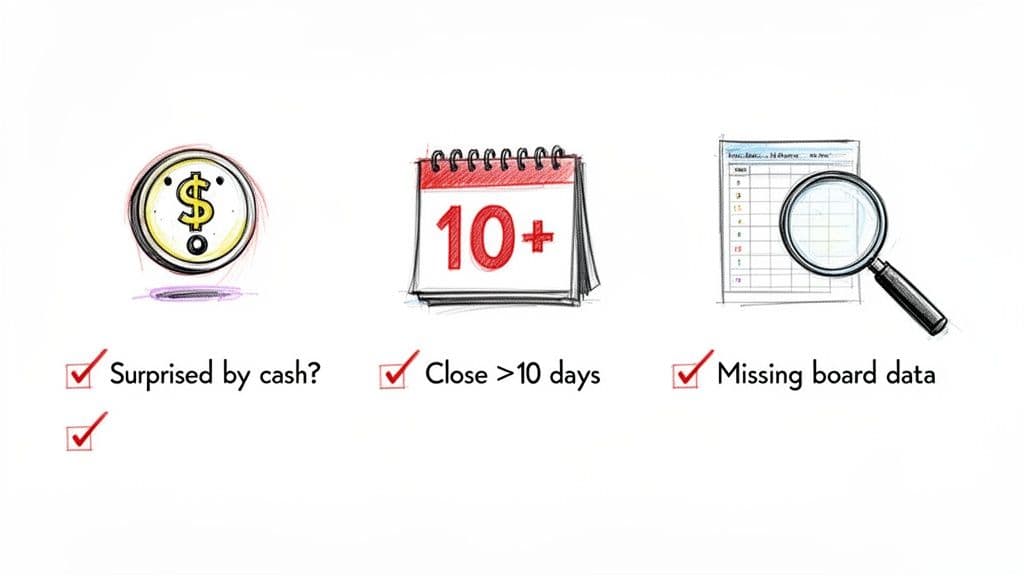
A Diagnostic Checklist for Your Financial Health
As a founder, your time is the company's most precious resource. Every minute you spend chasing down numbers or putting out financial fires is a minute you aren't spending on growth. If your finance function can't keep up with your ambition, you'll see these red flags pop up.
Do any of these sound painfully familiar?
- Your Month-End Close Takes Forever: If closing the books takes more than 10 business days, you’re making decisions based on stale data. High-performing companies close in 5 days or less, giving their leaders a timely, accurate view of the battlefield.
- You're Constantly Surprised by Your Cash Balance: Profit on the P&L is not cash in the bank. If you’re ever scrambling to make payroll or pay a big vendor bill, it’s a clear sign you have zero cash flow visibility. This is how profitable companies go bankrupt.
- You Can't Answer Basic Board Questions: When an investor asks for your Customer Acquisition Cost (CAC) or gross margin by product line, "I'll get back to you" is the wrong answer. It signals you don't have a handle on the core drivers of your business.
- Your Financials are Always "Under Review": Your bookkeeper is constantly re-categorizing transactions and making adjustments. This isn't just messy; it’s a symptom of having no standardized processes, which puts you at high risk for errors and compliance failures.
These issues aren't isolated problems. They’re symptoms of a bigger disease: a complete lack of strategic financial oversight. It's the reason smart companies turn to outside experts.
Debunking the "Do-It-Yourself" Finance Myth
There's a dangerous misconception that strategic financial management is something you worry about after you get big. The truth is, getting the financial foundation right is what allows you to get big in the first place.
FTI Consulting's latest Global CFO Survey shows that 42% of CFOs now hold their position for over five years. This kind of stability comes from outsourcing operational headaches so leaders can focus on what matters. For a growing company, that means finding a partner who can deliver 99.8% accuracy and the security of SOC 2 compliance. You can explore the full findings of the CFO survey to see how the best leaders build their teams.
Ignoring these warning signs is like ignoring a check engine light. The problem doesn't go away—it just gets more expensive and painful to fix later. Investing in CFO services consulting isn't about cleaning up a mess; it's about building a scalable financial engine to power your growth.
How to Choose the Right CFO Consulting Partner
Choosing a financial partner is one of the most critical decisions you will ever make. This isn't like picking a new software subscription; it's a choice that directly shapes your company's trajectory, its valuation, and your own peace of mind. To get it right, you have to look past the monthly price tag and dig into what actually creates value.
The right firm becomes a true extension of your leadership team. The wrong one is just another expense on your P&L, delivering reports you never use. Here’s how to tell the difference.
Beyond Price: A Focus on Expertise
Your first filter for any CFO services consulting firm shouldn't be price. It must be verifiable industry experience.
A generalist who worked with a construction company last month won’t understand the nuances of your SaaS business’s revenue recognition under ASC 606. They won't know the critical benchmarks for a digital agency. You need a specialist.
Ask pointed questions to screen for real-world expertise:
- For SaaS: "Walk me through how you calculate and report on our LTV/CAC ratio and Net Revenue Retention. What benchmarks do you use?" A top-tier firm should immediately reference sources like OpenView's 2024 SaaS Benchmarks and be aiming for an LTV/CAC of 3x or higher.
- For Digital Agencies: "How do you help agencies track project profitability and billable utilization? Can you show me an example of the dashboard you use?" They must prove they can move you beyond a simple P&L to real-time project margin analysis.
Shallow answers are a massive red flag. If they can’t speak your industry’s language fluently, they’re the wrong partner.
"A well-organized data room signals to investors that you run a tight ship. It builds confidence before you even start pitching the business." - Alyse Bodine, Heidrick & Struggles
This is a key point. A great CFO partner does more than just close the books. They build strategic assets—like a bulletproof data room—that directly increase your company’s value. That’s a level of service you’ll never get from a generic bookkeeping shop.
The Technology and Security Gut-Check
In 2026, your CFO partner’s tech stack is your tech stack. Mismatched or outdated technology creates data silos and manual work, completely defeating the purpose of hiring an expert in the first place.
Technology Integration: Your potential partner needs deep, native experience with the tools that run your business. Make a simple checklist of your core systems and ask them to detail their integration capabilities.
- Accounting: QuickBooks Online, Xero, NetSuite
- Payments: Stripe, Shopify, Square
- Payroll: Gusto, BambooHR
If their "integration" is just a manual data export-and-import process, walk away. True integration means automated reconciliations and real-time data flow.
Security Compliance: You are about to grant this firm the keys to your financial kingdom. Data security is absolutely non-negotiable.
The gold standard is SOC 2 Type II compliance. This isn't just a marketing buzzword; it's a rigorous, third-party audit verifying that a firm’s systems and processes are built to keep your sensitive data secure and confidential. Ask to see their SOC 2 report. Any hesitation or inability to produce it is an immediate disqualifier.
The Vendor Scorecard: Your Final Decision Tool
Before you sign a contract, use this vendor scorecard to compare your final candidates. Don't just ask the questions—evaluate the quality of the answers. This process will quickly separate the true strategic partners from the mere scorekeepers.
| Evaluation Category | Key Question | What to Look For |
|---|---|---|
| Industry Fit | "How many clients do you have in our specific industry (SaaS, Agency, etc.)?" | At least 5-10 active clients. They should volunteer specific challenges they’ve solved. |
| Month-End Close | "What is your guaranteed timeline for delivering month-end financials?" | 5 business days is best-in-class. Anything over 10 is too slow for decision-making. |
| Client Retention | "What is your annual client retention rate?" | Look for 95% or higher. High turnover signals service or delivery problems. |
| Team Structure | "Who will be my primary point of contact and who is on my team?" | You want a dedicated team, not a random call center. Knowing the difference between their bookkeepers and controllers is crucial; our guide on bookkeeper vs controller can help you ask smarter questions. |
Choosing your CFO consulting partner is too important to get wrong. Use this structured approach to vet firms methodically, and you’ll find a partner who doesn't just manage your books, but helps you write your company's next chapter.
Your Action Plan for Financial Mastery
Information is useless without action. You've seen the warning signs, you know the difference between a CFO and a controller, and you understand what a high-performing finance function should deliver.
This is your roadmap to move from reading this guide to actually taking control of your company's financial future. Let's turn what you've learned into a concrete plan.
Step 1: Perform a Financial Self-Audit
Before you can solve a problem, you have to define it—honestly. Use the checklist from our "Warning Signs" section as your guide and be brutally objective with yourself and your team.
- Month-End Close: How many business days did your last close really take? If the answer is more than 10 days, that’s your first major red flag.
- Cash Flow Visibility: Have you been surprised by a low cash balance in the last quarter? A simple 'yes' means your forecasting is broken.
- Data Readiness: If an investor called right now and asked for your LTV:CAC ratio or gross margin by service line, could you answer confidently within an hour?
Write down the answers. This turns those vague anxieties into a concrete list of problems to solve. This list is the foundation for your conversations with any potential partner.
Step 2: Schedule Targeted Consultations
With your problem list in hand, it's time to find the right expert. Don’t just Google "CFO services consulting" and call the first name on the list. Be strategic.
Identify 2-3 shortlisted firms that have explicit, verifiable experience in your industry—whether that's SaaS, an agency, or e-commerce. Use the vendor scorecard from the previous section to frame your initial calls.
Remember, you aren't just outsourcing tasks; you're buying back your own time and focus. During your calls, push past the sales pitch. Ask them how they would solve the specific problems you identified in Step 1.
Step 3: Prepare for Your First Call
To make your consultations count, have your key financial documents ready. A serious firm will want to see your real numbers to understand your situation. Messy books are fine—in fact, that's why you're calling them.
Gather these three core statements:
- Profit & Loss (P&L): Your income statement for the last 12 months.
- Balance Sheet: The most recent version you have.
- Cash Flow Statement: If you have one. If not, that alone highlights a critical gap.
Bringing these to the table shows you're a serious founder ready to build a professional operation. It allows a potential partner to give you specific, actionable feedback from the very first conversation. Your journey toward stronger financial operations management starts right here.
From this point, a good partner will outline a clear onboarding plan, starting with data cleanup and moving toward your first 90-day strategy session. You’ve done the reading. Now it's time to act and build the financial engine your company truly deserves.
Frequently Asked Questions
When founders start looking into high-level financial help, the same questions pop up every time. Here are the straight answers you need about CFO services consulting.
How Much Do CFO Consulting Services Cost?
You have to stop thinking of this as an expense and start seeing it as an investment. The real cost isn't the monthly fee; it's the cash flow crisis you didn't see coming, the funding round you weren't ready for, and the strategic blunders that cost you six figures.
For companies in the $500K-$20M revenue range, comprehensive CFO services consulting typically costs between $4,000 and $12,000 per month. This isn't just a fee; it's an investment with a clear return. For perspective, the average salary for a full-time CFO is over $250,000 plus benefits. A consulting service gives you the strategic expertise for a fraction of that cost. The ROI comes from fixing costly bookkeeping errors (which average $47,000 for our new clients), improving cash flow, and preventing expensive missteps before they happen.
The cost of the service is almost always wiped out by the value it creates.
At What Revenue Stage Should I Hire a Fractional CFO?
The most common tipping point is somewhere between $1M and $3M in annual revenue. This is where the financial complexity starts to grow faster than a founder can manage it with a handful of spreadsheets.
Once you get here, decisions around pricing models, hiring plans, and where to put your capital demand sophisticated financial modeling, not just a backward look at last month's bank statement. And if you're even thinking about raising a Seed or Series A round, you must bring on a fractional CFO at least six months before you start the process. This gives them time to get your financial story straight and your data room in order.
How Does an Outsourced Service Protect My Financial Data?
Data security is completely non-negotiable. Handing over the keys to your financial kingdom requires absolute trust, and top-tier firms protect your data as if it were their own.
Any reputable CFO consulting firm is SOC 2 Type II certified. This isn't some marketing claim; it’s a grueling, third-party audit that proves the firm’s systems and processes meet incredibly strict standards for security, availability, and confidentiality. Before you sign anything, demand to see their security credentials and compliance reports.
How Hard Is It to Switch from My Current Bookkeeper?
It’s not hard at all, because a professional CFO consulting firm handles the entire transition for you. Their number one job is to upgrade your entire financial operation without disrupting your business.
The process usually kicks off with a "cleanup" or "catch-up" project to fix the historical errors lurking in your books. From there, their team methodically takes over the monthly close, reconciliations, and reporting. A good partner can have you fully onboarded and seeing actionable financial insights within 30-60 days.
Ready to turn your financial chaos into a clear roadmap for growth? Jumpstart Partners provides the expert bookkeeping, controller, and strategic finance support that scaling companies need. Book a consultation today to see how our 5-day close and 99.8% accuracy can give you the confidence to scale.