Financial Operations
Mastering Financial Operations Management for Scalable Growth
A complete guide to financial operations management. Learn to build a 5-day close, track key metrics, and create an investor-ready finance function.
ByJumpstart Partners, CPA, QuickBooks ProAdvisor
··21 min readIf you’re steering a business between $500K and $20M in revenue, you’re likely grappling with a messy financial backend. You’re making high-stakes decisions with outdated reports, cash flow is a constant source of anxiety, and your team is buried in manual work. This isn't just an operational headache; it's a direct threat to your growth and valuation.
Financial operations management, or FinOps, is the system you build to escape this chaos. It's the engine that combines your processes, people, and technology to turn raw financial data into the accurate, timely intelligence you need to scale, secure funding, and boost your company's value.
The True Cost of Manual Processes
Relying on spreadsheets and manual entry isn't just inefficient—it’s actively eroding your bottom line. These outdated methods are a breeding ground for errors, they delay critical insights, and they consume hundreds of hours that your team could be spending on strategy.
You’re not alone. A staggering 85% of financial firms admit their current processes will struggle as transaction volumes increase. It's no surprise that 82% of companies still depend on manual tasks for a huge chunk of their financial operations. The cost is real: the AutoRek 2026 Investment Capital Markets Survey found that firms burn nearly 16% of their operational budgets just fixing errors from these manual tasks. That’s capital that should be funding innovation, not paying for endless cleanup cycles.
This constant firefighting traps you in a cycle of reactive decision-making. Instead of analyzing future trends, you’re stuck correcting last month’s mistakes. Worse, a messy financial backend is a massive red flag for investors and will torpedo your company’s valuation during a fundraising round or acquisition. If your books are a mess, you will face a deep—and costly—cleanup engagement. We see this all the time; learn about the common issues we uncover in our QuickBooks cleanup services.
From DIY Chaos to Strategic Control
The table below contrasts the daily pain of a manual, DIY approach with the strategic freedom of a managed FinOps system. One creates bottlenecks and risk, while the other builds a foundation for scalable growth.
The Business Impact of Manual vs. Managed Financial Operations
| Area of Impact | Manual / DIY Approach (The Problem) | Managed FinOps System (The Solution) |
|---|---|---|
| Decision-Making | Based on outdated, error-prone spreadsheets; high-stakes guesses. | Decisions made with real-time, accurate data; confidence in every move. |
| Investor Readiness | Messy, unreliable books; scrambling for months to prep for due diligence. | Clean, audit-ready financials on demand; impresses investors and accelerates deals. |
| Team Productivity | Valuable team members bogged down in data entry and manual reconciliation. | Team freed from repetitive tasks to focus on high-value analysis and strategy. |
| Cash Flow | Constant anxiety; unpredictable cash position and surprise shortfalls. | Proactive cash forecasting; predictable runway and visibility into future needs. |
| Valuation & Risk | Lowers valuation, raises red flags for buyers/investors, high operational risk. | Increases valuation, demonstrates operational maturity, minimizes financial risk. |
Moving from a DIY setup to a managed one isn’t just about cleaning up the books. It's about shifting from a state of constant uncertainty to one of predictable control. This transformation allows you to:
- Make decisions with confidence using real-time, accurate data.
- Impress investors with clean, audit-ready financials whenever they ask.
- Free your team from manual drudgery to focus on high-value analysis that grows the business.
Effective financial operations management isn't about better bookkeeping; it's about building a strategic asset that fuels your company's forward momentum.
The Five Pillars of High-Performing FinOps
World-class financial operations is not a single task you check off a list. It's a living system built on five interconnected pillars. When these pillars are solid, your business runs with the control and predictability needed for scalable growth. But when they're weak, you face cash flow surprises, investor red flags, and pure operational chaos.
Let's break down each pillar so you can see where your own system might be cracking.
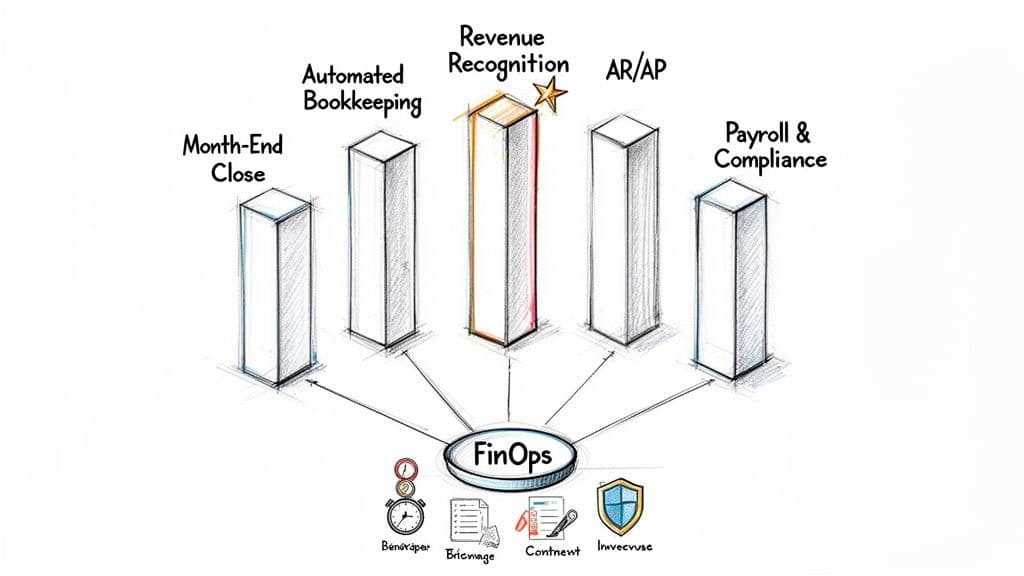
Pillar 1: The Month-End Close
The gold standard for closing your books is not a three-week marathon. It's a 5-day sprint. A swift close is proof that your data is clean, your processes are dialed in, and your team is spending its time on forward-looking analysis, not digging through last month’s receipts.
If your close regularly bleeds into the third or fourth week of the month, you’re making decisions on stale information. You're not ready for an investor or a lender to come knocking. This is the first, most foundational element of sound financial operations management.
Pillar 2: Automated Bookkeeping and Reconciliations
Your financial statements are only as trustworthy as the bookkeeping behind them. Elite FinOps has moved past manual data entry. It relies on automated bookkeeping, where transactions from your bank, credit cards, and payment processors like Stripe flow directly into your accounting system.
This isn't just about saving time; it's about eliminating errors and enabling daily—not monthly—reconciliations. As market pressures force companies to prove their profitability, having investor-ready financials at all times is no longer a luxury. The Financial Services Industry Outlook 2026 shows that in response, top finance teams are prioritizing technology investments (52%) and cross-training their people (62%) to get a better handle on cash flow. Exploring workflow automation software for financial operations is a necessity for survival.
Pillar 3: Revenue Recognition and ASC 606
For any SaaS or professional services firm, this isn’t just an obscure accounting rule—it's a critical driver of your company’s valuation. The ASC 606 standard is clear: you recognize revenue as you deliver the value, not just when you get paid.
For example, if your SaaS company signs a $120,000 annual contract, you cannot book that entire amount in Month 1. You must recognize $10,000 each month over the 12-month term. Getting this wrong creates lumpy, inaccurate revenue figures that will get torn apart during due diligence. Getting it right shows you have a mature handle on your business model and gives investors real confidence in your growth. Managing this requires strong internal controls, which you can learn more about in our guide on implementing financial controls for growing businesses.
Pillar 4: Streamlined Accounts Receivable and Payable
Think of your Accounts Receivable (AR) and Accounts Payable (AP) as the two main levers controlling your cash. Unmanaged AR means you’re giving interest-free loans to your customers. Inefficient AP wrecks supplier relationships and makes you miss out on early payment discounts.
The AR aging report is your best friend here. It shows you exactly who owes you money and, more importantly, for how long.
Example AR Aging Calculation
Imagine you have three outstanding invoices:
- Invoice A: $5,000, due 15 days ago (Current to 30 days)
- Invoice B: $2,000, due 45 days ago (31-60 days)
- Invoice C: $8,000, due 95 days ago (91+ days)
Your AR aging report instantly flags the problem:
| Aging Bucket | Amount Outstanding | Percentage of Total AR |
|---|---|---|
| Current - 30 Days | $5,000 | 33.3% |
| 31 - 60 Days | $2,000 | 13.3% |
| 61 - 90 Days | $0 | 0.0% |
| 91+ Days | $8,000 | 53.3% |
| Total | $15,000 | 100% |
Seeing that over half your cash is tied up in invoices more than 90 days past due is a massive red flag. This is a fire that demands immediate attention.
Pillar 5: Payroll and Compliance
This is a zero-error game. A mistake in payroll does not just create an unhappy employee; it creates significant tax and legal liabilities. A high-performing FinOps system ensures payroll is processed accurately and on time, every single time. It also handles benefits administration, state and federal tax filings, and keeps you compliant with a web of ever-changing labor laws. As your team grows, especially across different states, the complexity explodes. A robust payroll system isn't a good idea—it's non-negotiable.
Building Your Leadership Financial Dashboard
A good financial dashboard is what separates reactive founders from strategic CEOs. It moves your leadership team away from constant firefighting and gives them the clarity to make proactive, forward-looking decisions. This isn’t about cramming dozens of metrics onto one screen. It's about distilling your entire financial operation down to a handful of vital signs that tell you exactly where the business stands. Without this, you’re flying blind.
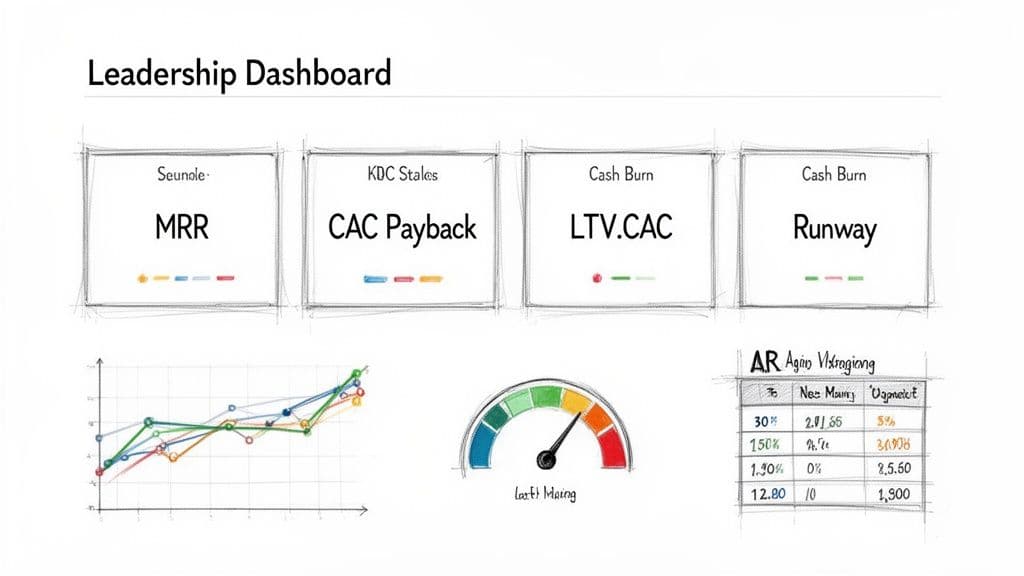
Key SaaS Metrics for Your Dashboard
For a SaaS business, your dashboard must show the health of your subscription model. Three metrics are absolutely non-negotiable for understanding the efficiency of your growth engine.
-
Monthly Recurring Revenue (MRR): This is the predictable lifeblood of your company. Your dashboard cannot just show total MRR; it must break it down into New MRR, Expansion MRR (from upgrades), and Churned MRR (from cancellations). This tells you not just if you're growing, but how.
-
Customer Acquisition Cost (CAC) Payback Period: This metric tells you exactly how many months it takes to earn back the cash you spent to acquire a new customer. A long payback period will torch your cash flow, even if your top-line MRR is growing.
-
LTV:CAC Ratio: This ratio stacks up the lifetime value of a customer against the cost to acquire them. According to OpenView's 2024 SaaS Benchmarks, a target LTV:CAC ratio of 3x or higher is considered good for most SaaS companies. Anything less and your customer acquisition strategy is simply too expensive for the value it creates. A ratio of 5x or higher is exceptional.
A Worked Example of CAC Payback
Let’s walk through how to calculate the CAC Payback Period. This shows precisely how long your cash is tied up before a customer generates profit. Imagine in Q1 you spent $30,000 on sales and marketing and brought in 10 new customers.
- CAC = Total Sales & Marketing Spend / New Customers Acquired
- CAC = $30,000 / 10 = $3,000 per customer
Now, let's say your average customer generates $500 in MRR and you run an 80% gross margin.
- Gross Margin per Customer per Month = MRR x Gross Margin %
- Gross Margin per Customer per Month = $500 x 0.80 = $400
Finally, you can find the payback period.
- CAC Payback Period = CAC / Gross Margin per Customer per Month
- CAC Payback Period = $3,000 / $400 = 7.5 months
It will take seven and a half months just to recoup the cost of acquiring that customer. A rising payback period is a critical early warning sign that your unit economics are getting worse. To dig deeper into these metrics, check out our guide on creating financial dashboards with key metrics for CEOs.
Key Metrics for Professional Services Firms
For agencies and other professional services firms, the dashboard's focus shifts from recurring revenue to project-based profitability and team efficiency.
| Metric | What It Tells You | Why It Matters |
|---|---|---|
| Utilization Rate | The percentage of your team's billable hours versus their total available hours. | This is your firm's core efficiency metric. Low utilization means you're paying for bench time, which directly kills your margins. A benchmark target is 80-85% for billable staff. |
| Gross Margin per Client | The revenue from a client minus the direct costs (mostly salaries) to serve them. | This helps you spot your most and least profitable clients, allowing you to focus resources where they generate the best return. |
| Average Project Profitability | The profitability of your typical project. | This surfaces systemic issues with your scoping, pricing, or project management that eat away at your bottom line. |
The Two Survival Metrics Every Leader Must Watch
While industry-specific KPIs are crucial, they all roll up to two universal numbers that determine whether your company survives: Cash Burn and Runway.
"The first thing I look at in a portfolio company's dashboard is runway. I want to know how many months of cash they have in the bank. Everything else is secondary to that." – Sarah Jennings, Managing Partner, ScaleUp Ventures
Your dashboard needs to display these numbers front and center. Cash Burn is the net negative cash flow of your business each month. Runway is simply your total cash balance divided by your monthly burn—it tells you how many months you have until the lights go out. These aren't just financial metrics; they are the countdown clock for your business.
Designing Your Modern Finance Tech Stack
Your financial operations are only as good as the tech that powers them. A disconnected mess of spreadsheets and manual data entry is a recipe for costly errors and delayed insights that put your business at a disadvantage. A modern finance tech stack fixes this, creating a single source of truth by automating the data flow between your critical systems.
This isn't about buying a massive, all-in-one Enterprise Resource Planning (ERP) system on day one. That’s a common mistake that leads to over-investing in a system you will barely use. The smart approach is to build a scalable, integrated stack centered on a core accounting system that fits your business right now.
The Core and Its Connections
For most businesses in the $500K to $20M revenue range, the right foundation is a robust general ledger like QuickBooks Online or NetSuite. This is the central hub of your financial world. The real power comes from how it connects to the other tools you use to run your business.
A properly designed stack ensures data flows automatically, not manually.
- Payment Processors (e.g., Stripe, Shopify): Sales transactions, fees, and refunds flow directly into your accounting system, eliminating manual reconciliation.
- Payroll & HR Systems (e.g., Gusto): Payroll runs, tax payments, and benefits costs are automatically recorded, so your labor costs are always up to date.
- Expense Management (e.g., Ramp): Employee expenses are captured, coded, and synced in real-time, giving you an immediate view of spending as it happens, not a month later.
This closed-loop system is the engine behind a fast month-end close and real-time reporting. According to Tomorrow's Office, the walls between finance and operations are expected to crumble by 2026 as integrated cloud systems become the minimum standard—a necessity for any business that wants to scale. You can find more details in the full report on 2026 finance trends.
Misconception: "I Need a Big ERP System."
Too many founders think they need a massive ERP implementation to get their finances in order. This is rarely true. A modern, best-in-class approach—where you integrate specialized tools with your core accounting software—delivers better results at a fraction of the cost.
The goal is to create a unified data environment without the rigidity and expense of a legacy system. This approach lets you swap out components as you grow, giving you flexibility a monolithic ERP cannot offer. For example, you can upgrade from QuickBooks Online to NetSuite without ripping out your entire expense management or payroll system. To see how this transforms your reporting, check out our guide on financial reporting automation.
Your Roadmap to an Investor-Ready 5-Day Close
A fast, accurate month-end close is the ultimate proof of elite financial operations management. It’s the loudest signal you can send to investors, lenders, and your own leadership team that your data is clean, your processes are tight, and your financial engine is built for scale.
For too many companies, the close is a three-week marathon of manual reconciliations and spreadsheet chaos. This isn't just inefficient; it's a liability. Here is a clear, four-week roadmap to transform that painful process into a predictable 5-day sprint.
The secret is not working harder; it's moving from disconnected manual work to an integrated system. A modern finance tech stack creates a single source of truth by automating the flow of data from your core operations directly into your accounting ledger. No more exporting CSVs. No more copy-paste errors.
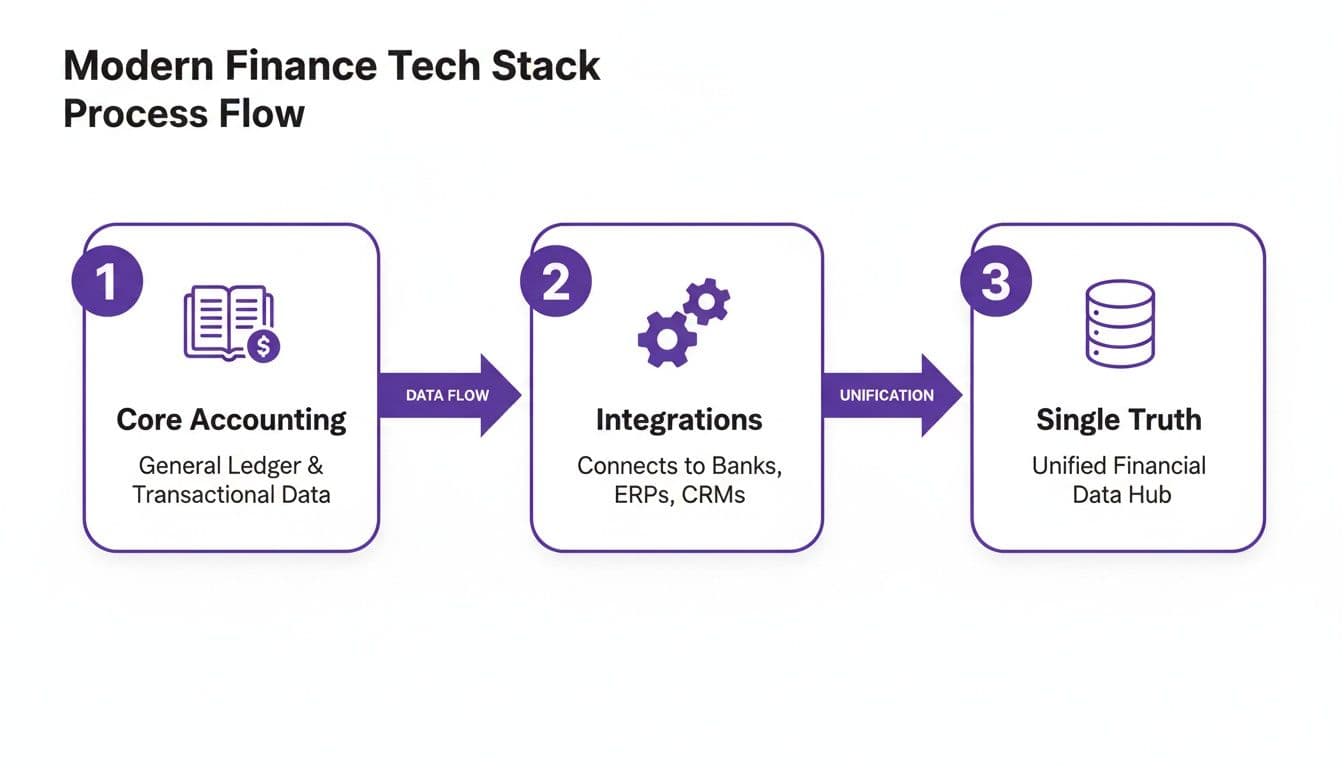
This is what a modern finance flow looks like. Data moves seamlessly from your core accounting system, through automated integrations with your banks and operational tools, into a unified data hub. This architecture is the foundation of a fast close because it kills the manual data entry that causes delays and errors.
The 4-Week Sprint to a 5-Day Close
You cannot just flip a switch and get a 5-day close. But you can get there systematically in just one month. Each week builds on the last, tackling a specific area to make the 5-day close a repeatable part of your operations.
| Week | Focus Area | Actionable Next Steps |
|---|---|---|
| Week 1 | System & Process Audit | Map your current close process from start to finish. Identify every manual step, spreadsheet, and owner. This immediately reveals your biggest bottlenecks. |
| Week 2 | Implement Automation & Integrations | Connect bank feeds, credit cards, payment processors (like Stripe), and payroll directly to your general ledger. The goal is to eliminate manual data entry. |
| Week 3 | Create the Pre-Close Checklist & Train the Team | A fast close starts before the month ends. Develop a pre-close checklist with tasks for the last week of the month (e.g., reviewing accruals, pre-reconciling sub-ledgers). Train your team on the new, faster timeline. |
| Week 4 | Execute Your First Accelerated Close | Put the new process to the test. Follow a strict daily schedule to ensure every task is completed on time. This is your dry run for the new standard. |
Red Flags: Warning Signs Your Close Process Is Broken
If you recognize any of these red flags, your current close process isn't just slow—it's actively holding your business back and making you un-investable.
- It takes more than 10 business days to close the books. Period.
- Financial reports are full of surprises or require constant restatements.
- Your team spends more time exporting to Excel than analyzing data in your accounting system.
- You cannot explain major variances between your P&L and your cash flow statement.
- The phrase "due diligence" sends your finance team into a full-blown panic.
These are not just minor inefficiencies; they are symptoms of a broken financial operation that will crack under the pressure of growth or investor scrutiny. A disciplined, 5-day close is your first and most important step toward building a truly scalable company. For a more detailed checklist, explore our article on month-end close best practices.
Take Control of Your Financial Future
You’ve seen the roadmap. The pillars, the KPIs, the tech stack, the playbooks—it’s all laid out, from achieving a 5-day close to building an audit-ready financial machine. The only thing standing between your current financial chaos and future clarity is the decision to act.
Continuing with manual processes and month-old reports is a choice. It’s a choice that leads to missed opportunities, gut-feel decisions that backfire, and a valuation that never reflects your company’s true potential. The path forward is to systematize, automate, and delegate. You can spend the next six months trying to piece this together yourself, or you can have an expert team install a proven system in a fraction of the time.
The Choice Is Yours: DIY Trial-and-Error or Expert Implementation
This isn't just about tidying up your books; it's about taking command of your company’s destiny. For SaaS founders, this means mastering your unit economics. For agency owners, it's about protecting your margins on every project. For any growing business, taking control also means managing major expenses like your cloud infrastructure, as detailed in this essential guide to cloud spending.
| The DIY Path (6+ Months) | The Expert Path (Weeks) |
|---|---|
| Trial-and-error system design and implementation. | Proven playbooks and best practices from day one. |
| Distracts you and your team from core business activities. | Your team stays focused on growth and client delivery. |
| High risk of costly configuration errors and rework. | Guaranteed accuracy and an investor-ready setup. |
| Delayed access to the critical data you need. | Immediate visibility into cash flow and key metrics. |
If you’re ready to achieve a 5-day close, generate investor-ready financials on demand, and unlock real-time control over your cash flow, it’s time to take the next step.
“Accounting is a tool that opens doors to key information, provides useful insights, helps gain perspective, and aids in decision-making. It’s how we represent, in a concrete way, the past performance, future potential, and even the values of an organization.” – V.G. Narayanan, Professor, Harvard Business School
Stop letting chaotic finances dictate your company's potential.
Ready to build a financial operation that drives growth? Schedule a consultation with Jumpstart Partners and see how we can deliver investor-ready financials in weeks, not months.
Your FinOps Questions, Answered
Founders are always asking us how to get their finances ready for the next stage of growth. Here are the straight answers to the questions we hear most often about building a high-performance financial operation.
What is the difference between bookkeeping and financial operations management?
Bookkeeping is the essential task of recording your financial history—every transaction, every invoice, every bill. It’s a backward-looking function that tells you what already happened.
Financial operations management, or FinOps, is the forward-looking strategic system you build on top of that data. It’s about designing the processes for a fast month-end close, actively managing your cash, and turning your financial data into a tool for making smart decisions.
Think of it this way: a bookkeeper lays the bricks. A FinOps expert is the architect who designs the entire house, making sure it’s strong enough to weather a storm and valuable enough to attract premium buyers when you’re ready to sell.
At what revenue stage should I invest in professional FinOps?
The pain becomes impossible to ignore somewhere between $500K and $1M in ARR. This is the point where founders can no longer manage the books "off the side of their desk." The transaction volume gets overwhelming, spreadsheets start breaking, and investors or lenders begin demanding clean, reliable financials. You simply cannot fake it anymore.
If you wait until you're at $5M or $10M, you’re signing up for a massive and expensive cleanup project to untangle years of messy data. The smart move is to build a scalable foundation early, turning your finance function into a strategic asset from day one.
Can't my CPA just handle this?
No. A traditional CPA is a tax specialist. Their primary job is to look backward at historical data to prepare your annual tax return and ensure compliance. Their focus is minimizing your tax liability.
A financial operations partner is forward-looking. They are embedded in your day-to-day operations, managing the month-to-month health of your financial engine to help you make better strategic decisions in real-time.
- CPA (Tax Focus): Looks at last year's data to file your taxes. Their work is seasonal, centered around filing deadlines.
- FinOps Partner (Operations Focus): Looks at last month's—and last week's—data to help you run the business today. Their work is continuous, integrated into your daily workflow.
Relying on your CPA for operational finance is like asking your tax lawyer to also be your company’s Chief Operating Officer. They're both important, but they are entirely different disciplines.
If you’re tired of making decisions with outdated financials and want to install a system that gives you real-time control, the team at Jumpstart Partners can help. We deliver investor-ready financials and a 5-day close for growing businesses just like yours.
Start the diagnostic and take control of your financial future.