Financial Operations
Accountant for Small Business Cost: A Founder's Guide
Decode the accountant for small business cost. Get pricing models, ROI calculations, and benchmarks for SaaS & agencies to choose the right financial partner.
ByJumpstart Partners, CPA, QuickBooks ProAdvisor
··17 min readMost small businesses should expect $500 to $1,500 per month for ongoing outsourced accounting, while more complex companies usually land in the $1,500 to $3,000+ per month range. That isn't arbitrary overhead. It's the price of getting books, reporting, payroll coordination, and compliance handled at the level your operating complexity demands.
Founders ask the wrong question when they ask, “What does an accountant cost?” The useful question is, “What level of finance support does my business require right now, and what does it cost me when I underbuy?”
That distinction matters because accountant for small business cost is rarely driven by revenue alone. A clean one-entity agency with simple invoicing can stay on the lower end. A SaaS business with Stripe, deferred revenue questions, payroll, state tax exposure, and investor reporting climbs fast. Same top-line ballpark. Very different accounting burden.
There's also a historical reality worth keeping in mind. One summary of SCORE's 2015 small-business accounting-cost data shows 23% of owners spent $1,000 or less annually, 31% spent $1,000 to $5,000, 18% spent $5,000 to $10,000, 12% spent $10,000 to $20,000, and 16% spent $20,000 or more annually (Indeed summary of SCORE data). Accounting has never been a one-price commodity. Businesses with more moving parts pay materially more, and they should.
Cheap accounting is often expensive accounting with a delay attached.
Table of Contents
- Decoding the Three Accountant Pricing Models
- The 5 Factors That Actually Drive Your Accountant Cost
- Sample Accountant Budgets From $1M to $5M ARR
- In-House vs Outsourced vs Fractional Controller
- Calculating the ROI of a Professional Accountant
- Checklist for Choosing a Cost-Effective Partner
- Get Your Accounting Costs Under Control
Decoding the Three Accountant Pricing Models
Most founders don't buy accounting. They buy a pricing model, then discover later what that model does and doesn't include.
That's backwards. You need to know how the service is packaged before you compare quotes.
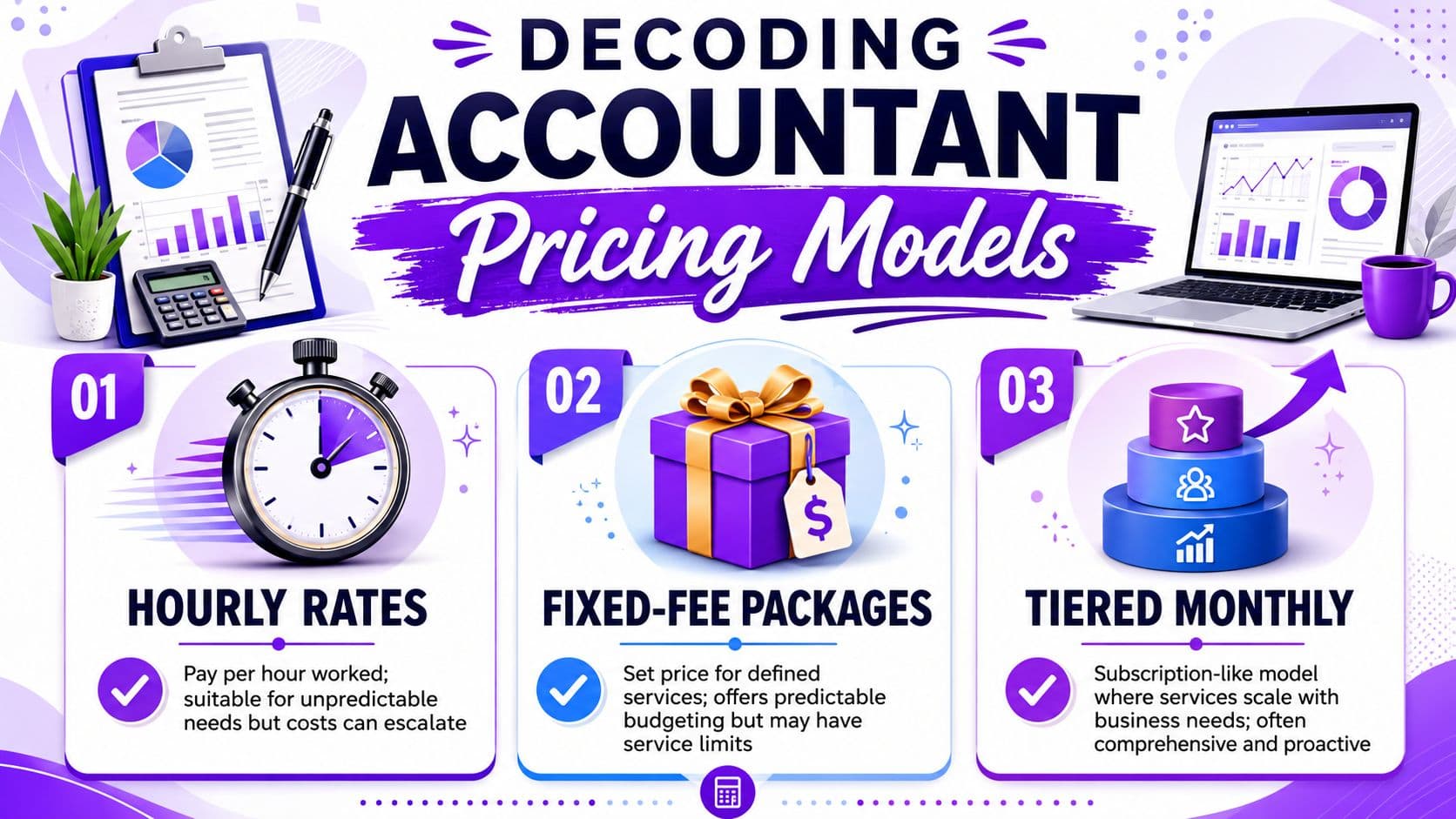
Hourly billing is flexible but punishes complexity
Hourly pricing sounds reasonable until you live with it. Basic work is often quoted around $100 to $250 per hour (FlowFi accountant cost guide), while small-business accounting rates can also cluster around $150 to $400+ per hour depending on whether you're paying for bookkeeping, CPA review, tax strategy, or specialized advisory work (Drill Down Solution small business accounting costs).
Here's the problem. Hourly billing makes your bill directly sensitive to every broken process in your business. Extra Stripe transactions, unreconciled credit cards, payroll corrections, owner distributions booked badly, and surprise reporting requests all turn into invoice line items.
Practical rule: If you need ongoing monthly support, hourly billing should be the exception, not the default.
Fixed fee works when the scope is narrow
Fixed-fee packages work well for tightly defined projects. Clean up old books. Prepare annual returns. Build a reporting package. The advantage is budget certainty.
The downside is that many fixed-fee offers are narrower than founders think. One guide notes that basic bookkeeping may run about $300 to $900 per month, full-service accounting with tax planning and quarterly reviews may start around $1,000+ per month, payroll can add $300 per month or more, and annual tax prep can range from $850 to $1,800+ depending on complexity (Stenger Tax small business accountant pricing). If you compare two “fixed-fee” proposals without reading the scope line by line, you're not comparing the same service.
Tiered monthly plans fit growing businesses better
Tiered monthly pricing is usually the most sensible structure for a company that's scaling. It's comparable to software plans. You pay for a service level matched to your current complexity, then move up when your needs change.
This model tends to balance predictability and access. You're not penalized every time you ask a question, and the provider can build recurring processes instead of reacting to one-off tickets. It also makes scope changes visible. If payroll, KPI dashboards, or board reporting appear, your plan changes for a reason.
If you want to see how a tiered structure is usually packaged in practice, review a real outsourced accounting pricing model and compare what's included at each service level.
| Pricing model | Best for | Main upside | Main risk |
|---|---|---|---|
| Hourly | Cleanup, ad hoc projects, tax questions | Flexibility | Unpredictable spend |
| Fixed fee | Narrow, defined deliverables | Clear budget | Scope gaps |
| Tiered monthly | Ongoing accounting for growth businesses | Predictable support that scales | Requires honest scope matching |
The 5 Factors That Actually Drive Your Accountant Cost
Two companies can both do a few million in revenue and have completely different accounting bills. Revenue is a weak proxy. Complexity is what drives the number.
The standard market ranges tell you that plainly. Ongoing accounting commonly sits around $500 to $1,500 per month for standard needs, while more complex businesses often move into $1,500 to $3,000+ per month because of factors like more bank feeds, multi-entity activity, payroll, multi-state tax handling, and management reporting (The Fino Partners accounting cost analysis).
Volume beats size
A founder with one bank account, a small number of invoices, and clean expense controls is cheaper to serve than a founder with fragmented operations. Transaction volume is labor. Every card swipe, refund, ACH, payroll run, and software charge needs classification and reconciliation.
For agencies, project-based billing and contractor payouts create friction fast. For SaaS, Stripe and app integrations can create a large reconciliation footprint even when headcount is still lean.
Your systems change the labor model
Tech stack matters more than most founders expect. QuickBooks and Xero are efficient when your processes are clean. NetSuite, custom integrations, deferred revenue workflows, or disconnected reporting tools raise the expertise requirement immediately.
This isn't just software preference. It's operating design. If you're deciding whether to keep core finance systems lean or adopt heavier infrastructure, the broader tradeoffs in cloud vs on premise costs are worth understanding because finance tooling decisions affect both direct software spend and accounting labor.
Compliance complexity is where costs jump
SaaS companies often get surprised. Revenue recognition questions, multi-state filings, payroll tax exposure, and entity structure issues don't look dramatic in the budget, but they become expensive when they're wrong.
Five common cost drivers show up repeatedly:
- Entity structure. One legal entity is simpler than multiple entities with intercompany activity.
- Sales tax and state exposure. More jurisdictions mean more filings and more review.
- Payroll complexity. Employees, contractors, reimbursements, commissions, and benefits all add accounting touches.
- Revenue rules. SaaS contracts, annual prepaids, credits, and implementation fees require more judgment than simple invoice accounting.
- Audit or investor readiness. Once outside parties care about your numbers, “close enough” stops working.
Reporting expectations raise the bar
Monthly financial statements aren't the same as decision-ready reporting. A founder may need only reconciled books. A CEO, board, or investor group may need budget-to-actuals, cash runway, margin analysis, and department-level views.
That's why the right lens isn't “What's the average accountant for small business cost?” It's “What reporting package do I need to run the business well?” If you want a deeper breakdown of what typically sits inside that cost, this guide to the cost of accounting is a practical reference.
Messy books are an expensive starting point
If your prior periods are wrong, current monthly pricing won't tell the whole story. Cleanup work, recoding, historical reconciliations, and catch-up reporting often sit outside normal monthly service.
The cheapest proposal often assumes your books are already clean. That assumption is where overruns start.
Sample Accountant Budgets From $1M to $5M ARR
Generic averages aren't enough. Founders need budgeting logic that matches their business model.
A SaaS company and a digital agency at the same revenue level rarely need the same accounting setup. SaaS usually carries more complexity around billing systems, deferred revenue, metrics, and investor reporting. Agencies tend to be simpler unless they run multiple entities, complicated payroll, or heavy contractor workflows.
Estimated monthly accountant cost by revenue and business model
The table below uses the verified market ranges as guardrails, then applies them by likely complexity profile.
| Annual Revenue | SaaS Company (High Complexity) | Digital Agency (Medium Complexity) |
|---|---|---|
| $1M ARR | $1,000 to $1,500 per month | $500 to $1,000 per month |
| $5M | $1,500 to $3,000+ per month | $1,000 to $1,500 per month |
| $20M | $3,000+ per month | $1,500 to $3,000+ per month |
These are budgeting ranges, not universal quotes. Service scope still decides the final number.
How I'd budget at each stage
At $1M ARR, a SaaS company usually needs more than raw bookkeeping. You need reconciliations, monthly reporting, a clean close process, and someone who understands how subscription cash differs from earned revenue. That pushes the budget toward the top of the standard range. A digital agency at this stage can often stay lower if invoicing is straightforward and the owner isn't demanding custom reporting every month.
At $5M, the split gets wider. A SaaS business often needs tighter reporting cadence, more scrutiny around revenue treatment, cleaner KPI definitions, and better cash forecasting. This is usually where “cheap monthly bookkeeping” breaks. An agency at the same size may still fit in a standard monthly package if operations remain single-entity and the tech stack is clean.
At $20M, you're no longer buying basic accounting. You're buying finance infrastructure. The accounting partner has to support management reporting, process discipline, and often board or lender expectations. SaaS businesses nearly always live above the baseline range here. Agencies can too, especially if they have multiple service lines, multiple states, or acquisition activity.
Here's a simple way to pressure-test your quote:
- If you're under $1M and simple: expect basic monthly accounting, not deep finance support.
- If you're between $1M and $5M and scaling: expect costs to rise once you need payroll coordination, KPI reporting, or cleanup.
- If you're above $5M: judge the provider on reporting quality and decision support, not just reconciliations.
- If your books are behind: budget separately for catch-up work.
- If you use multiple platforms: expect more monthly effort.
A lot of founders underestimate how much bookkeeping quality affects later finance work. If you need a refresher on the underlying mechanics, this primer on bookkeeping basics for small business is worth reviewing before you compare proposals.
In-House vs Outsourced vs Fractional Controller
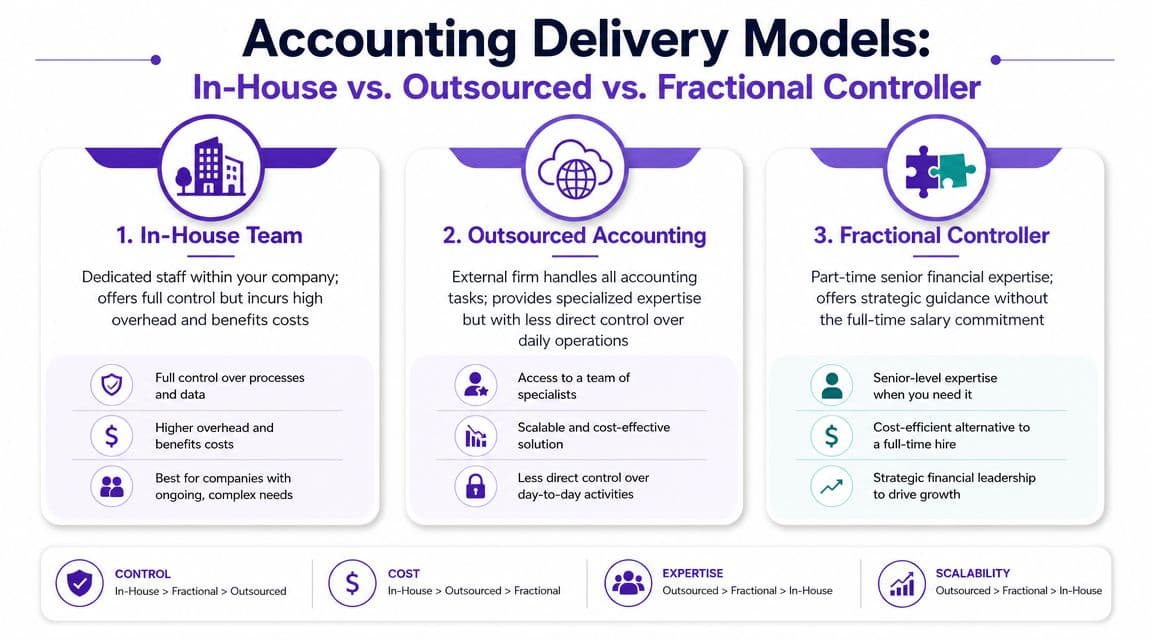
The delivery model matters as much as the monthly fee. You're not just deciding what to pay. You're deciding how the work gets done, how much expertise you can access, and how exposed you are when one person drops the ball.
A strong outsourced team and a fractional controller solve different problems. An in-house hire solves a different one again.
What each model is actually buying you
| Model | Best fit | Strength | Limitation |
|---|---|---|---|
| In-house accountant | Stable workload, daily internal coordination needs | Direct access | Narrow bench, harder to scale |
| Outsourced accounting firm | Ongoing monthly accounting plus process discipline | Broader expertise across bookkeeping, controller tasks, and systems | Less hallway access |
| Fractional controller | Companies that already have basic accounting covered but need oversight | Higher-level review and reporting | Usually not built for daily transaction execution |
In-house works when your volume is steady and you want someone embedded in operations. The risk is concentration. One person owns the books, and your process quality depends heavily on that one hire's experience.
An outsourced model usually makes more sense for businesses in the $1M to $5M ARR range because it gives you a team structure. One person reconciles. Another reviews. Another handles controller-level oversight. That's operationally stronger than hoping a single hire can do everything well.
When founders evaluate providers, the same principles used in IT outsourcing selection insights apply here too. You're evaluating process maturity, communication, scope clarity, and whether the provider has a bench, not just a face on a sales call.
Here's a useful video overview before you decide which model fits your current stage.
Where each option fits
If your books are late, your reporting is inconsistent, and you don't have anyone owning close discipline, outsourced accounting is usually the first fix. If your books are already solid but leadership needs forecasting, board packs, and variance analysis, add a fractional controller layer. If finance work is heavy every day and operationally embedded, build in-house.
One example of a tiered outsourced model is Jumpstart Partners' controller decision framework, which maps outsourced support against in-house and controller needs by stage.
The wrong finance hire isn't just expensive. It leaves you with slow closes, weak reporting, and cleanup projects six months later.
Calculating the ROI of a Professional Accountant
Founders obsess over accounting cost because the invoice is visible. The return usually isn't. That's a mistake.
Bad accounting doesn't only create compliance risk. It distorts pricing decisions, hiring plans, cash expectations, and founder confidence. If your monthly numbers arrive late or wrong, every decision built on them gets weaker.
A simple ROI framework founders can use
Use this formula:
ROI = Financial value created or protected minus annual accounting cost
The “value created or protected” bucket should include only items you can defend. Don't invent soft wins. Keep it tight:
- Errors caught before they hit tax filings, lender reporting, or management decisions
- Owner and leadership time recovered
- Cash preserved through better billing, collections, spend visibility, or forecasting
- Better decisions tied to margin, pricing, headcount, and runway
If you want a simple refresher on structuring the math, this ROI calculation guide gives a clean baseline framework.
Worked examples with real cost numbers
Example one. A professional firm costs $1,500 per month, or $18,000 per year. During the year, that team identifies material errors in errors detected per client in the course of cleanup and review work, based on Jumpstart Partners' published operating data. If the errors found and corrected exceed the annual fee, the service already paid for itself before you count time savings or better reporting. You can review that lens through this controller services ROI analysis.
Example two. A business paying $3,000 per month spends $36,000 annually for higher-touch accounting support. If that support prevents one bad pricing decision, catches payroll or coding errors, and gives leadership the confidence to manage cash tightly, the ROI case becomes operational, not cosmetic.
For SaaS founders, Jason Lemkin's framing is the right one: > “Unit economics are the truth serum for SaaS businesses. You can have beautiful growth charts and impressive MRR, but if you're spending $15,000 to acquire customers who only generate $12,000 in lifetime value, you're not building a business, you're lighting money on fire.” (Jason Lemkin on SaaS unit economics)
That quote isn't about bookkeeping. It's about the cost of not knowing your numbers in time to act on them.
Checklist for Choosing a Cost-Effective Partner
A low monthly fee doesn't mean low cost. It often means you're buying delayed pain.
The right partner should make the finance function more reliable, not just cheaper on paper.
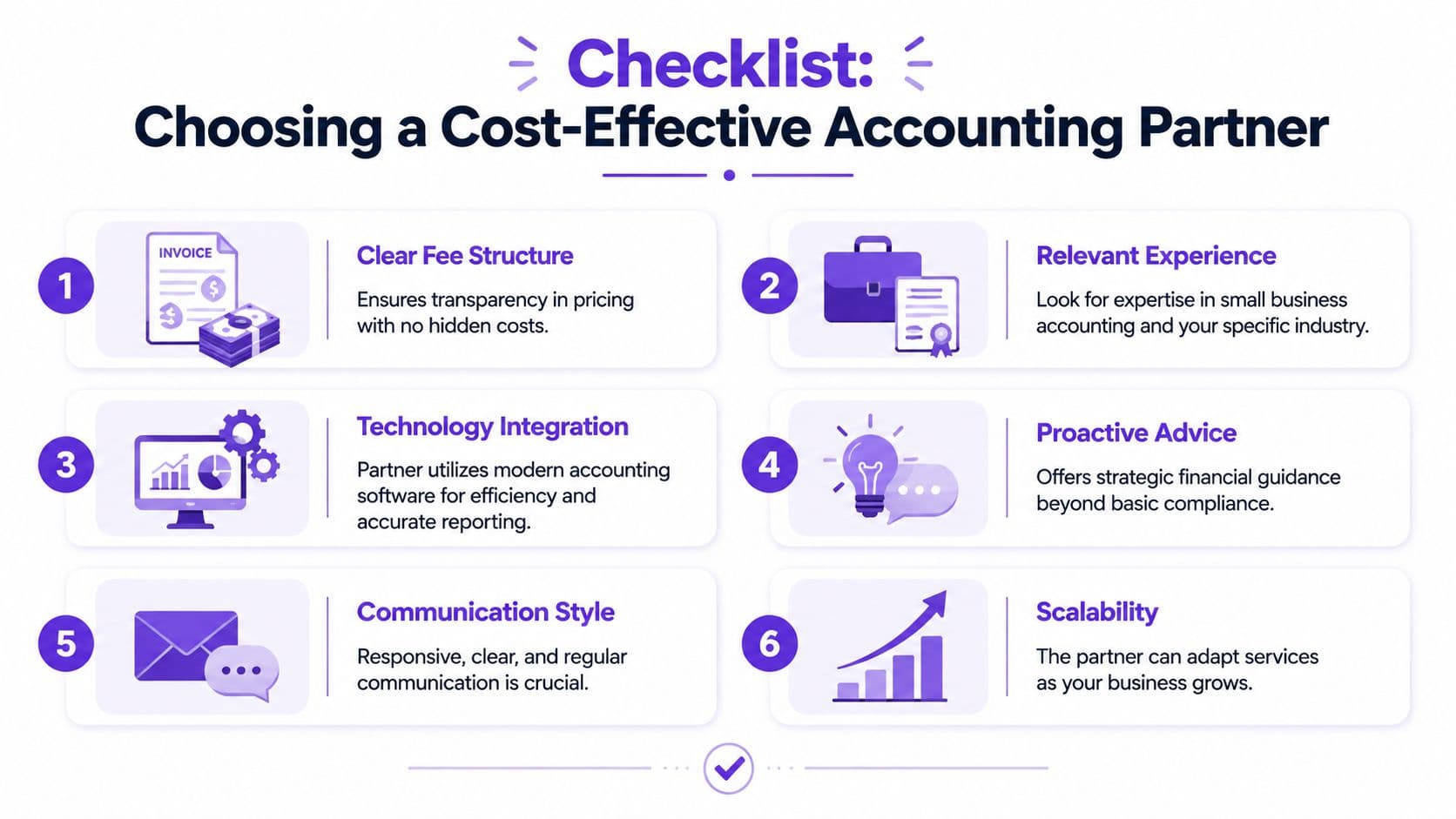
Questions to ask before you sign
Use these in every sales conversation:
- What exactly is included each month? Ask whether reconciliations, monthly financials, payroll coordination, KPI reporting, tax coordination, and year-end support are included or billed separately.
- How do you price ongoing work? Many pages on accountant cost ignore that hourly pricing can hide the true cost of a poor fit. One source notes CPA hourly rates of $150 to $450 per hour, and argues the core issue is what outcomes, such as management reporting and forecasting, the spend justifies beyond basic compliance (Accountant Partners on small business accountant pricing).
- Who does the work? Ask whether a junior bookkeeper handles everything or whether there's review by a controller or CPA.
- How do you handle my tech stack? Name your tools. QuickBooks, Xero, NetSuite, Stripe, Gusto, Shopify, Ramp, bill pay tools, expense tools, and CRM systems all affect workflow.
- What does month-end look like? You want a defined close process, assigned responsibilities, and a reporting calendar.
Founder filter: If a provider can't explain their close process in plain English, they probably don't run one well.
Red flags that usually signal future cleanup work
Some warning signs should end the conversation quickly.
- Exclusively hourly billing for recurring work. That usually means weak process discipline.
- No industry pattern recognition. If they don't understand SaaS billing logic or agency margin structure, you'll pay them to learn.
- Unclear review structure. One person doing transaction entry and final review is a control issue.
- No definition of deliverables. “Monthly bookkeeping” is not a deliverable.
- Reactive communication. If they answer only after you ask, they're not running finance. They're recording history.
A cost-effective partner isn't the cheapest quote. It's the provider who gives you reliable numbers, a clean scope, and enough financial visibility to run the business decisively.
Get Your Accounting Costs Under Control
If you're shopping purely on monthly price, you're making this harder than it needs to be.
Start with your actual operating complexity. Count your entities, payment platforms, payroll setup, reporting expectations, and compliance needs. Then match your service level to that reality. A founder with a simple agency doesn't need controller-style support on day one. A SaaS company with recurring billing, investor expectations, and messy close processes absolutely needs more than bargain bookkeeping.
Your next move should be specific:
- Audit your current scope. List what your provider does each month.
- Map your complexity. Note entities, bank feeds, payroll, states, revenue model, and reporting needs.
- Separate cleanup from recurring support. Don't let one quote blur the two.
- Model annual cost, not just monthly fee. Include add-ons like payroll and tax prep.
- Buy for decision quality. The right service gives you faster, cleaner answers.
The total cost of an accountant for a small business isn't just the invoice. It's the invoice plus the consequences of weak numbers.
If your business is in the $1M to $5M ARR range and you need clean books, controller-level visibility, and a finance process built for growth, talk with Jumpstart Partners. They provide outsourced bookkeeping and controller support for SaaS, agencies, and service businesses that need more than compliance work.