Financial Operations
The True Cost of Accounting in 2026: A Guide for Founders
Uncover the true cost of accounting for your growing business. Learn how to diagnose hidden costs, benchmark prices, and maximize your financial ROI.
ByJumpstart Partners, CPA, QuickBooks ProAdvisor
··19 min readThe real cost of accounting isn't the line item on your bookkeeper's monthly invoice. For founders of businesses generating between $500K and $20M in revenue, the true cost is measured in stalled decisions, surprise tax bills from messy books, and the countless leadership hours you burn trying to make sense of confusing reports.
It's the growth you sacrifice when you are forced to fly blind.
If you lead a SaaS company, digital agency, or professional services firm, your accounting function is either a strategic asset or a dangerous liability. There is no middle ground. This guide provides the benchmarks, calculations, and red flags you need to determine which side you are on and how to fix it.
Why Your Accounting Is Costing More Than You Think
As a founder, you live and die by your numbers. But the figure on your bookkeeper’s invoice is a dangerously incomplete picture. The genuine cost of your accounting is hidden in the opportunities you miss, the strategic focus you lose, and the painful cleanup projects that inevitably arise.
A reactive, low-ROI accounting setup isn’t a passive expense—it actively sabotages your growth. If your books are consistently late, inaccurate, or just plain confusing, you’re operating with a massive handicap. For a fast-moving SaaS, digital agency, or professional services firm, this isn't just an annoyance; it’s a critical vulnerability.
You are left making high-stakes calls on hiring, marketing spend, and product development without a clear view of your financial reality.
"Many founders treat accounting as a compliance task to be minimized, but that’s a massive strategic error. Your financials are a real-time feedback loop on your business. If that loop is slow, broken, or inaccurate, you're flying blind, and the cost of one bad decision can dwarf a year's worth of proper accounting fees." — David Willbe, Partner, VC-Backed SaaS Fund
Misconception: "My bookkeeper is cheap, so my accounting costs are low."
This is one of the most dangerous beliefs a founder can hold. A cheap bookkeeper delivers a history report, often late and riddled with errors. The "savings" you see on that invoice are erased the moment you:
- Make a hiring decision based on inflated cash flow numbers.
- Miss a tax deadline and incur penalties.
- Spend weeks cleaning up the books for an investor due diligence process.
- Discover a profitable client is actually losing you money.
The true cost is the sum of the fee plus the cost of the bad decisions, mistakes, and wasted time.
Diagnosing Your Current Accounting ROI
So, how do you know if your accounting is an asset or a liability? The symptoms are often subtle at first but leave a trail of financial drag. Use this table to diagnose where your hidden costs are piling up.
| Symptom (Low-ROI Accounting) | Hidden Cost | Outcome (High-ROI Accounting) |
|---|---|---|
| Financial reports are delivered 20+ days after month-end. | You make critical business decisions using old data, leading to misallocated resources and missed opportunities. | You get financials within 5-10 business days for real-time insight. |
| Your reports are basic P&L and Balance Sheet statements only. | You lack visibility into key drivers like project profitability, customer acquisition cost (CAC), or churn. | You receive custom KPI dashboards and industry-specific metrics. |
| Your bookkeeper cannot answer strategic financial questions. | You waste leadership time trying to interpret data or hire expensive consultants for basic analysis. | Your finance partner provides proactive analysis and strategic advice. |
| You frequently find errors or need to make adjustments. | You face a high risk of overpaying taxes, failing audits, and making flawed budget forecasts that erode investor trust. | Your financials are audit-ready with a 99%+ accuracy guarantee. |
If the symptoms on the left feel familiar, your accounting isn't just an expense line—it's a bottleneck. Shifting to a high-ROI model doesn't just fix problems; it unlocks new levels of strategic control and confidence in your decisions.
The Six Key Drivers of Your Accounting Costs
Your accounting cost isn't a flat rate; it's a dynamic figure that mirrors your company's complexity. To understand what you're paying for—and why—you must look past the final invoice and see the specific activities that drive your accountant's time.
We find that six key drivers dictate the monthly fee for a growing business.
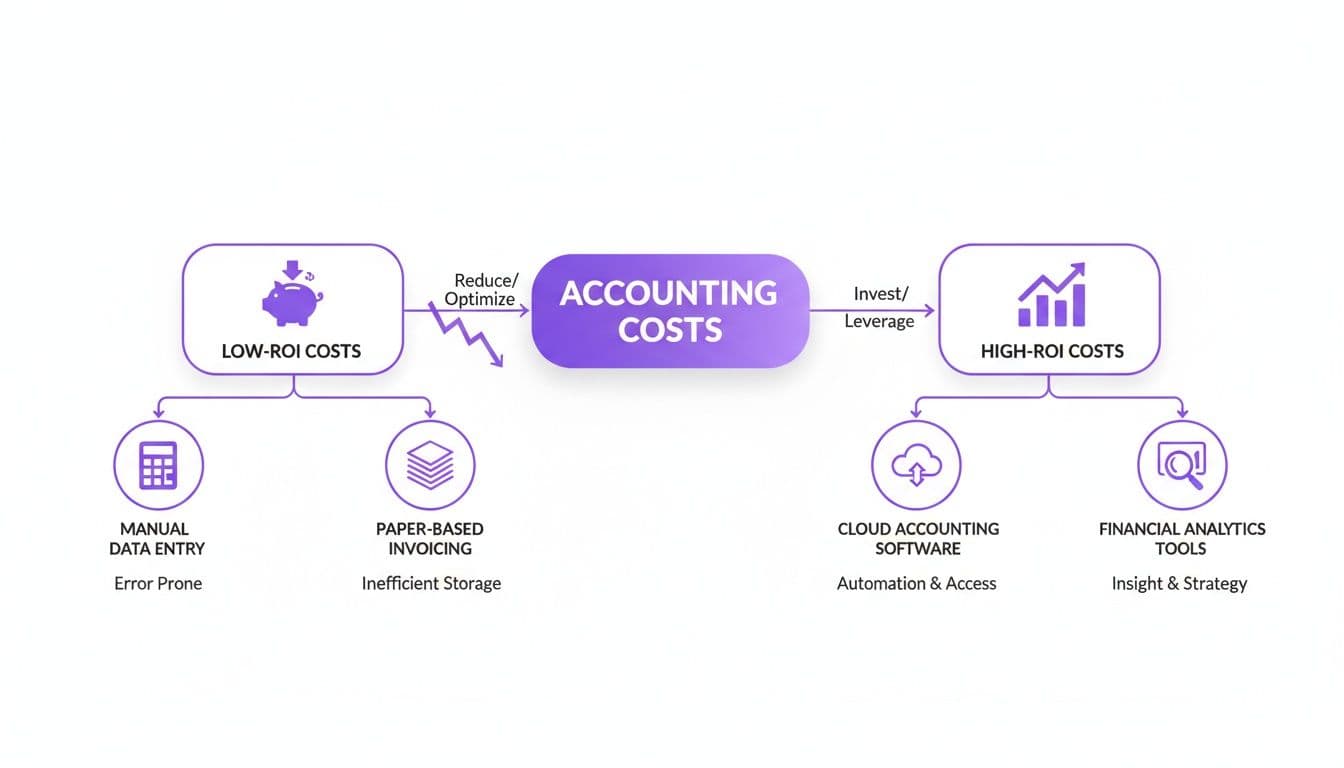
The goal is to shift your investment from low-ROI manual tasks to high-ROI strategic activities.
1. Transaction Volume and Type
The sheer number of transactions is a primary cost driver, but the type of transaction is what really moves the needle. It is one thing to reconcile 100 high-value B2B invoices. It is a completely different ballgame to manage 10,000 individual credit card charges from a platform like Stripe or Shopify, each with its own processing fees, potential disputes, and reconciliation quirks.
An e-commerce brand with thousands of monthly orders requires exponentially more reconciliation effort than a professional services firm with a dozen large client retainers. More transactions mean more hours spent on data entry, reconciliation, and validation. Period.
2. Revenue Recognition Complexity
For SaaS companies and creative agencies, recognizing revenue is rarely straightforward. If you sell annual subscriptions or get paid for multi-month projects, you cannot just recognize all that cash as revenue the day it hits your bank account.
GAAP standards, specifically ASC 606, mandate that you recognize revenue as you deliver the service over time. This creates a significant accounting workload.
For a SaaS business, this means:
- Deferred Revenue Schedules: Tracking and amortizing revenue for every single customer contract, month by month, without fail.
- Metric Integrity: Correctly calculating your most important metrics like Monthly Recurring Revenue (MRR) and churn, which are completely dependent on accurate revenue timing.
For a digital agency, it means meticulously matching revenue to project milestones or hours worked. This complexity can easily double the time required compared to a simple cash-basis business.
3. Payroll Intricacy
Payroll is another area where complexity quickly inflates your accounting bill. A business with ten salaried W-2 employees in one state has a simple payroll process.
Contrast that with a company juggling hourly workers, salaried staff, and 1099 contractors spread across multiple states. Every state adds a new layer of tax withholding rates, employment laws, and filing requirements. This doesn't just add work; it multiplies the risk of expensive compliance errors and demands specialized expertise.
4. System Integrations and Tech Stack
Your accounting software doesn't operate in a silo. It must talk to your CRM, payment processor, payroll system, and expense management tools. The more disconnected systems you have, the more manual work you create.
A poorly integrated tech stack is a recipe for wasted hours. If your Stripe transactions don't sync cleanly with QuickBooks, someone has to spend their day manually matching deposits to invoices. A modern finance partner ensures these systems communicate seamlessly, slashing manual work and the potential for human error. A solid foundation here is key, and it all starts with good bookkeeping basics for small business operations.
5. Investor and Audit Readiness
The level of financial rigor you need is a major cost factor. If you're gearing up for a fundraising round, an M&A event, or a SOC 2 audit, your books cannot just be "good enough"—they need to be immaculate. This "audit-ready" standard means maintaining meticulous documentation, providing clear support for every journal entry, and ensuring strict GAAP adherence. That level of diligence takes more time and a higher level of expertise, which directly impacts your costs.
6. Project-Based Accounting
For digital agencies and professional services firms, company-level profitability is a vanity metric. True success is measured project by project. This requires a sophisticated accounting setup that can track:
- Direct Costs: The time and materials allocated to specific client projects.
- Resource Utilization: How effectively your team's billable hours are being used.
- Project Margins: The real profitability of each and every engagement.
Setting up and maintaining these systems is more work. But the insight it provides into your business's financial health is invaluable—and often, it is the key to survival and growth.
Benchmark Costs: In-House vs. Outsourced Accounting
Let’s talk numbers. Understanding the drivers of accounting cost is one thing, but seeing the bottom-line impact is what really matters. For most founders, the decision comes down to a direct P&L comparison: building an in-house team versus hiring an outsourced provider.
You will almost always dramatically underestimate the real price of hiring. The salary is just the starting point. It’s the fully-loaded cost that tells the true story.
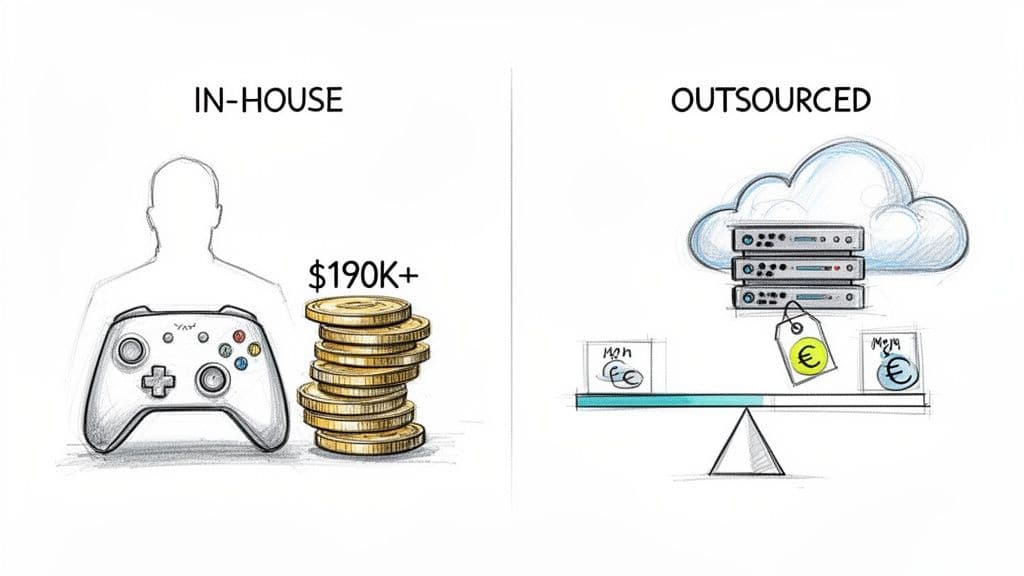
The Fully-Loaded Cost of an In-House Team
Hiring a single experienced, full-time controller is a massive investment. The base salary is only the beginning. Once you add benefits, taxes, software, and overhead, the number skyrockets.
Here is a worked calculation for one in-house controller in a major US city:
- Average Base Salary: $130,000
- Payroll Taxes & Benefits (30%): $39,000 (Health insurance, 401(k) matching, FICA, etc.)
- Overhead & Software (20%): $26,000 (Recruiting, training, office space, accounting software subscriptions)
The total annual cost to the business is over $195,000 for just one key finance hire. That single salary often costs more than an entire outsourced accounting solution.
Outsourced Accounting Benchmarks
Outsourced accounting flips the model. Instead of one high-cost employee, you get access to a full team—from bookkeepers to controllers—for a predictable monthly fee. You get specialized expertise without the headache and expense of hiring, training, and managing an internal department.
According to OpenView's 2025 Finance & Operations Benchmarks, businesses in the $1M to $20M revenue range spend between $24,000 and $96,000 annually for outsourced controller and bookkeeping services. This is 2-3x less than the cost of a comparable in-house team.
The table below breaks down the costs for a hypothetical $5M revenue SaaS company, showing just how stark the difference is.
In-House vs. Outsourced: Cost Comparison for a $5M SaaS Company
| Cost Component | In-House Team (Annual Cost) | Outsourced Partner (Annual Cost) |
|---|---|---|
| Salaries & Benefits | $169,000 (Controller, fully-loaded) | Included in Service Fee |
| Software Stack | $8,000 (QuickBooks, Gusto, Expensify) | Included in Service Fee |
| Recruiting & Training | $20,000+ | $0 |
| Management Overhead | Significant leadership time | Minimal |
| Total Annual Cost | $197,000+ | $48,000 - $84,000 |
The math does not lie. For less than what you would pay a single employee, you can get a complete finance stack covering everything from basic bookkeeping to strategic financial planning. The savings are immediate and significant.
And do not forget compliance. For many companies, especially in SaaS, achieving SOC 2 compliance is a non-negotiable, and the expenses pile up fast. To get a grip on those numbers, you must understand the real SOC 2 certification cost, from auditor fees to the internal hours spent preparing. An outsourced partner with deep SOC 2 experience navigates that process far more efficiently.
Ultimately, this is not just about cost—it is about ROI. The outsourced model lets you swap a massive fixed cost for a flexible operating expense, giving you access to a higher level of expertise for a fraction of the price. If you want to dig deeper into specific pricing, you can learn more about how a fractional controller costs are typically structured.
Industry-Specific Accounting Cost Scenarios
General benchmarks are a good start, but the real cost of accounting lives in the details of your business model. How you sell, what you deliver, and how you recognize revenue creates unique accounting challenges that directly drive your monthly fees. Let's break down three cost scenarios for a business at the $3M annual revenue mark, each with its own complexities.
Scenario 1: SaaS Company at $3M ARR
For a software-as-a-service business, everything revolves around recurring revenue and unit economics. Your accounting function isn't just about closing the books; it provides the data that proves your model works.
The single biggest cost driver is ASC 606 revenue recognition. When you sign a customer to a $12,000 annual contract, you cannot just book that cash. You must recognize $1,000 in revenue each month for the next twelve months, meticulously tracking the rest as deferred revenue. This is not optional—it is a GAAP requirement that investors will scrutinize.
Here’s a typical scope for a $3M SaaS company:
- Transactions: Reconciling 300-500 monthly transactions from bank feeds and Stripe.
- ASC 606 Compliance: Managing deferred revenue schedules for every customer.
- SaaS Metrics: Building and maintaining dashboards for MRR, ARR, churn, and LTV.
- Scope: Full-stack service including accounts payable, month-end close, financial reporting, and strategic advisory.
Estimated Monthly Cost: $4,000 - $6,000
You are not just getting clean books; you are getting the financial intelligence to make critical decisions on pricing, product, and growth investments. For a deeper look into these specific needs, our guide on accounting for SaaS is essential reading.
Scenario 2: Digital Agency at $3M Revenue
For a digital agency, profitability is measured project by project and client by client. Your accounting system has one primary job: to tell you, with brutal honesty, where you are making money and where you are losing it. This demands project-based accounting.
The main cost driver is tracking project-level profitability. This means allocating every hour of employee time and every direct cost—like ad spend or contractor fees—to a specific client project.
Let's break down the scope:
- Transactions: Managing 200-300 monthly transactions.
- Project Accounting: Tracking revenue, direct costs, and margins across 15-20 active projects.
- Retainer Management: Properly accounting for complex retainers, one-off projects, and pass-through expenses.
- Scope: Services must include project P&L reporting, cash flow management, and a complete month-end financial package.
Estimated Monthly Cost: $3,500 - $5,500
The cost is driven by the labor required to ensure every dollar and payroll hour is tied to a project. Without this discipline, you have zero visibility into which clients are profitable and which are quietly draining your resources.
Scenario 3: Professional Services Firm at $3M Revenue
Professional services firms—think consultants, engineers, or architects—run on their people. Your team's time is your inventory, and the most critical financial metric is billable utilization. The complexity of tracking this, especially with a distributed team, is what drives your accounting cost.
Your primary cost drivers are utilization reporting and multi-state payroll compliance. If you have employees in five different states, your payroll complexity is not just a little higher—it is five times higher. Each state brings its own tax laws, withholding rules, and filing requirements.
Here’s what the work involves:
- Transactions: Processing 150-250 monthly transactions, heavily focused on client invoicing and payroll.
- Utilization Tracking: Integrating with time-tracking software to produce crucial reports on billable vs. non-billable hours.
- Multi-State Payroll: Managing compliance for a workforce spread across several states.
- Scope: Full-service accounting including payroll processing, detailed utilization reporting, and partner-level financial dashboards.
Estimated Monthly Cost: $3,000 - $5,000
This investment buys you specialized expertise in managing a people-powered business. It ensures you can optimize your most valuable asset—your team's time—while staying compliant in every state you operate in.
Warning Signs: Red Flags That Your Accounting Is Broken
If you are experiencing any of the following, your accounting function is not just inefficient—it is actively costing you money and exposing you to risk.
- You get financials more than 15 days after month-end. Making decisions on stale data is like driving by looking in the rearview mirror.
- Your bookkeeper cannot explain your key business metrics. If they cannot discuss project margin, CAC, or churn, they are just a data entry clerk.
- Your balance sheet has "suspense" or "ask my accountant" accounts. These are black holes of unclassified transactions and a sign of sloppy work.
- You are still using manual expense reports. In 2026, if you are not using automated tools for expenses and AP, you are wasting money on low-value tasks.
Each of these is a direct signal that you need to re-evaluate your entire finance operation, starting with a professional QuickBooks cleanup services project if necessary.
The Historical Cost Principle: Why Your Balance Sheet Isn't What You Think
Ever looked at your balance sheet and thought, "That number feels wrong"? It’s a common reaction. The reason your GAAP-compliant financials record assets in a very specific, and sometimes counterintuitive, way is a rule called the historical cost principle.
Simply put, you must record an asset on your books at its original purchase price. If you bought a server array for your SaaS platform for $120,000, that’s the number that hits the balance sheet. Even if its market value drops to $90,000 a year later, your financials still reflect the original cost, minus any depreciation.
Why Objectivity Matters
This isn’t just accountants being difficult. The historical cost principle is a hard-won lesson, widely adopted after the 1929 stock market crash. That collapse was fueled in part by companies valuing their assets at wildly optimistic and subjective market prices. The principle anchors your balance sheet to verifiable, objective transactions, which is why investors and auditors insist on it. You can read more on the evolution of the historical cost principle and its impact.
The Founder's Blind Spot
Here is the critical takeaway for you as a founder: historical cost does not represent the "true" current value of your company.
Your balance sheet might list an office building you bought a decade ago for $500,000. If its market value today is $2 million, that $1.5 million in appreciation is completely invisible on your standard financials.
The same goes for internally developed assets. That brilliant proprietary software your team built—likely your company’s most valuable asset—has a book value of zero under GAAP rules unless you acquired it from a third party. This creates a massive gap between what your financials say and what your business is actually worth.
"Your GAAP financials are the official record, but they don't tell the whole story. A good finance partner provides the narrative—explaining the 'off-balance-sheet' value to investors so they understand the real potential of the business, not just its historical cost." — Jessica Marlow, CPA & Fractional CFO
Without this context, an investor might undervalue your company during a fundraise, or a potential acquirer could get the wrong impression during diligence. A skilled finance partner doesn't just prepare the books; they bridge this gap. They prepare the supplementary analysis that shows the real market value of your assets and the economic value of your IP, ensuring your historical financials do not hamstring your growth story.
Actionable Next Steps: How to Fix Your Cost of Accounting
Knowing what your accounting costs is one thing. Actually taking control of those costs is what really matters. This is your playbook for turning your finance function into a strategic advantage.

Step 1: Conduct a Financial Health Audit
Before you can fix anything, you must diagnose the problem. A financial health audit is a deep, honest look at your current accounting processes to find every expensive inefficiency.
- Time to Close: How many days after the month ends do you actually get your financial reports? If it's more than 10 business days, that's a major red flag.
- Manual Work: How many hours does your team spend on manual data entry, chasing receipts, or reconciling payments? Calculate the cost of these hours.
- Error Rate: How often do you find and fix mistakes in your books? These errors lead to wasted time, tax overpayments, and flawed decisions.
Answering these questions uncovers the hidden cost of accounting that quietly eats your margins. To tighten up these processes, build and implement clear Standard Operating Procedures for your accounting department.
Step 2: Embrace Strategic Automation
In 2026, paying people for repetitive tasks that software can do perfectly is a tax on your growth. Strategic automation is about systematically removing manual work from your core financial workflows.
Focus on these three high-impact areas first:
- Accounts Payable (AP): Get a tool like Bill.com. It will automate your invoice processing and approvals, cutting the time you spend paying vendors by more than 50%.
- Expense Management: Use a platform like Ramp or Brex to kill the manual expense report.
- Payroll & HR: Modern systems like Gusto handle complex calculations, tax filings, and multi-state compliance.
"The goal isn't just to cut costs. It's to free up human intelligence for higher-value work. Automation handles the 'what.' Your team, and your finance partner, should be focused on the 'so what'—the strategic insights that drive the business forward." — Marcus Moore, CPA & Outsourced Controller
Step 3: Choose the Right Partner
This is the single most important step. Finding the right outsourced accounting firm is not about finding the cheapest bookkeeper. It's about finding a partner who provides the technology, process, and expertise to help you scale.
When you vet potential firms, ask them directly:
- What is your standard time to close the books?
- Do you have proven expertise in our industry (SaaS, agency, professional services)?
- Are you SOC 2 compliant? How do you protect my data?
- What kind of accuracy guarantees do you offer?
The difference between a good partner and a bad one has a clear, measurable impact. To see what that looks like, check out our in-depth analysis of controller services ROI.
Ready to stop guessing and get a clear, data-driven picture of your finances? Jumpstart Partners provides outsourced controller services with a guaranteed 5-day close and investor-ready financials. Get a customized plan to optimize your cost of accounting and drive growth by booking a free consultation.