Financial Operations
A Founder's Guide to Bookkeeping: From $1M to $5M ARR
Master the bookkeeping basics for small business. This guide helps founders at $1M-$5M ARR firms streamline financials, avoid costly errors, and drive growth.
ByJumpstart Partners, CPA, QuickBooks ProAdvisor
··18 min readLet’s be direct: for founders and CEOs leading businesses in the $1M to $5M ARR revenue range, treating bookkeeping as a back-office chore is a direct threat to your growth. "Good enough" bookkeeping isn't just sloppy—it’s a liability that actively kills profitability, obscures vital performance data, and stops investor deals cold.
Why Flawless Bookkeeping Is Your Strategic Advantage
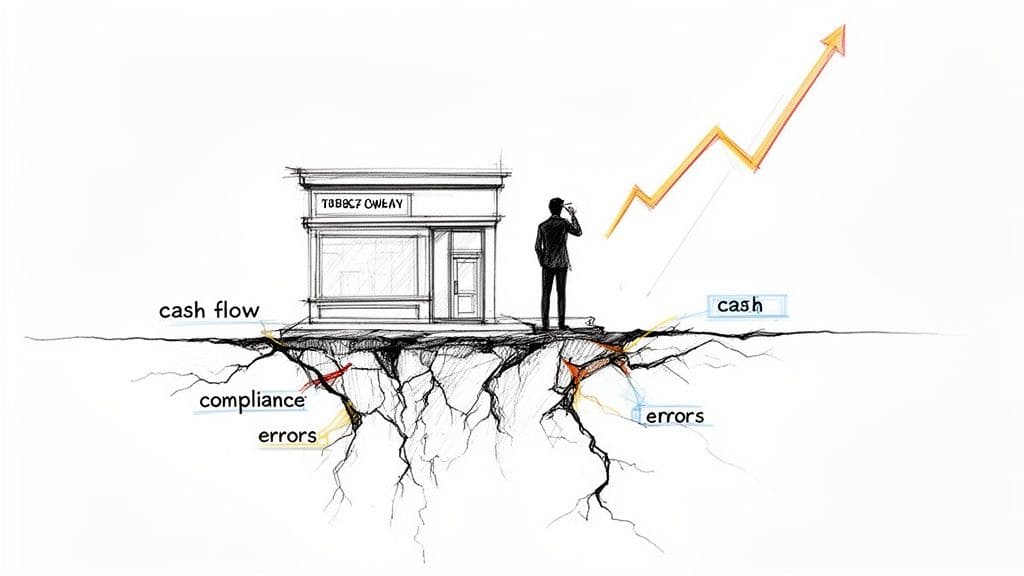
As you steer a high-growth SaaS, digital agency, or professional services firm, your financial data is the ground truth for every strategic decision you make. Yet, many leaders tolerate messy spreadsheets or financial records that are weeks out of date. This approach doesn't just create a mess; it creates massive blind spots that derail promising companies.
Inaccurate books prevent you from answering the most fundamental questions with any real confidence:
- Are we actually profitable? Revenue is vanity; profit is sanity. Your bank balance can easily lie, especially if you're just looking at cash moving in and out.
- Which clients or services are really driving growth? Without knowing your true cost of service, you are pouring resources into the least profitable parts of your business.
- Can we afford that key hire we desperately need? Bad cash flow forecasting turns a critical growth investment into a high-stakes gamble.
- Are we ready for an audit or due diligence? Messy books kill deals. Investors demand pristine, investor-ready financials and will not wait for you to clean them up.
The Hidden Costs of Neglecting Your Books
Ignoring your books introduces real risks that go far beyond accounting errors. These aren't theoretical problems; they are the exact crises we see founders face when they outgrow their DIY financial systems.
“Founders often underestimate how quickly poor bookkeeping can unravel a business. A delayed month-end close means you’re making decisions based on last quarter's reality, which is a lifetime ago in a scaling company. It's like trying to navigate a new city with a map that's three months old.” — Founder, Finance Forward (CPA)
The global bookkeeping services market is expanding at a compound annual growth rate (CAGR) of 9.8% from 2023 to 2030 for a reason—businesses like yours are trying to get ahead of these pitfalls. We’ve seen firsthand how outsourcing to a CPA-led team can deliver a 5-day month-end close, spot an average of material errors in costly errors, and help boost cash flow by up to 40%.
Ultimately, getting your bookkeeping right is about taking control. It’s the difference between reacting to one financial surprise after another and proactively steering your company where you want it to go. If you're trying to figure out what level of support you need, our guide on bookkeeping services for small businesses is a great place to start.
To get a real handle on your company’s financials, you don’t need to be a CPA. You just need to understand the four core ideas that turn bookkeeping from a painful chore into one of your sharpest strategic tools.
The Four Core Concepts of Modern Bookkeeping
1. The Chart of Accounts: Your Financial Sitemap
Think of the Chart of Accounts (CoA) as the architectural blueprint for your company's finances. It's a complete, organized list of every single account where you can record a transaction—from specific revenue streams like "SaaS Subscriptions" and "Professional Services Fees" to detailed expense categories like "Software Subscriptions" and "Contractor Payments."
A well-designed CoA, custom-built for your business model, is a strategic asset. The generic CoA from your accounting software is insufficient. A custom CoA lets you see exactly where your money comes from and where it goes, giving you the granular data you need for real performance analysis.
2. Accrual vs. Cash Accounting: The Only Choice for Growth
As soon as your business starts to scale, the debate between cash and accrual accounting is over. You must use the accrual method.
Cash accounting, where you only record transactions when money actually hits or leaves your bank, is dangerously misleading for a growing SaaS or service business. It tells you about your bank balance, but it tells you almost nothing about your actual business performance.
Accrual accounting records revenue when it's earned and expenses when they're incurred, no matter when the cash changes hands. It's the only way to get a true picture of your profitability and obligations.
Accrual in Action: A $120K Example You sign a new client on a $120,000 annual contract in January, and they pay you the full amount upfront.
- Cash basis: You’d record $120,000 in January revenue. This makes January look like a blockbuster month, followed by eleven months where that client generated zero revenue. It completely distorts your performance.
- Accrual basis: You recognize $10,000 of revenue each month for the 12-month term. This correctly matches the revenue to the period you're delivering the service, giving you a stable and true view of your performance.
This is a critical topic. For a deeper look, check out our complete guide on what is accrual accounting and why it's a non-negotiable for having investor-ready financials.
Accrual vs Cash Basis Accounting: A Practical Comparison
| Aspect | Cash Basis Accounting | Accrual Basis Accounting | Why It Matters for You |
|---|---|---|---|
| Revenue Recognition | Recorded when cash is received. | Recorded when revenue is earned. | Accrual shows your true monthly performance, avoiding the "lumpy" revenue that cash basis creates. |
| Expense Recognition | Recorded when cash is paid. | Recorded when an expense is incurred. | Accrual matches costs to the revenue they helped generate, giving you an accurate profit margin for that period. |
| Financial Picture | A snapshot of your bank account. | A true picture of your business's health and profitability. | Investors and lenders demand accrual financials. Cash basis numbers are seen as amateur and unreliable. |
| Best For | Very small, simple businesses with no inventory or outstanding invoices. | SaaS, service businesses, and any company with contracts, invoices, or inventory. | If you have recurring revenue, issue invoices, or have long sales cycles, cash basis will hide your real performance. |
Simply put, cash basis accounting looks in the rearview mirror at your bank balance. Accrual accounting gives you a forward-looking view of your company's actual financial health, which is essential for making smart decisions about hiring, spending, and growth.
3. Double-Entry Bookkeeping: The Self-Correcting System
Every single transaction in your business has two sides, and double-entry bookkeeping is the system that tracks both of them. When a customer pays an invoice, your "Cash" account goes up (a debit), and your "Accounts Receivable" account goes down (a credit).
This method remains the gold standard because it’s a self-correcting ledger. The total of all your debits must always equal the total of all your credits. If they don't, you know there’s an error somewhere that you need to find and fix. Mastering these timeless basics powers modern business decisions, driving real ROI through faster month-end closes and the ability to catch critical errors before they snowball.
4. The Three Core Financial Statements
All of these concepts come together in three essential reports that, together, tell the complete story of your business's financial health.
- The Income Statement (P&L): This report shows your revenue, expenses, and profitability over a specific period, like a month or a quarter. It answers the simple question, "Did we make or lose money?"
- The Balance Sheet: This gives you a snapshot of your company's financial position at a single moment in time. It lists out your assets (what you own), liabilities (what you owe), and equity (your net worth).
- The Statement of Cash Flows: This is the report that connects your P&L's net income to the actual cash in your bank. It shows exactly how cash moved through your business from operating, investing, and financing activities.
Your Guide to a Flawless Month-End Close
If it takes you until the 20th of the month to know last month’s numbers, you're making critical decisions about hiring, spending, and growth using a rearview mirror. A slow, chaotic month-end close isn’t just a headache; it's a strategic liability.
The real goal isn't just to "close the books." It’s to get accurate, reliable financial reports in your hands within 5-10 business days of the month's end. That speed is the difference between reacting to last month’s problems and getting ahead of next month’s opportunities.
This is about building a fast, predictable rhythm that turns your financials into a forward-looking tool.
The Core Month-End Workflow
A flawless close is a systematic process, not a frantic, one-time event. It’s about methodically reconciling, reviewing, and adjusting your accounts to paint a true picture of your financial performance for the period.
At a high level, the process looks like this:
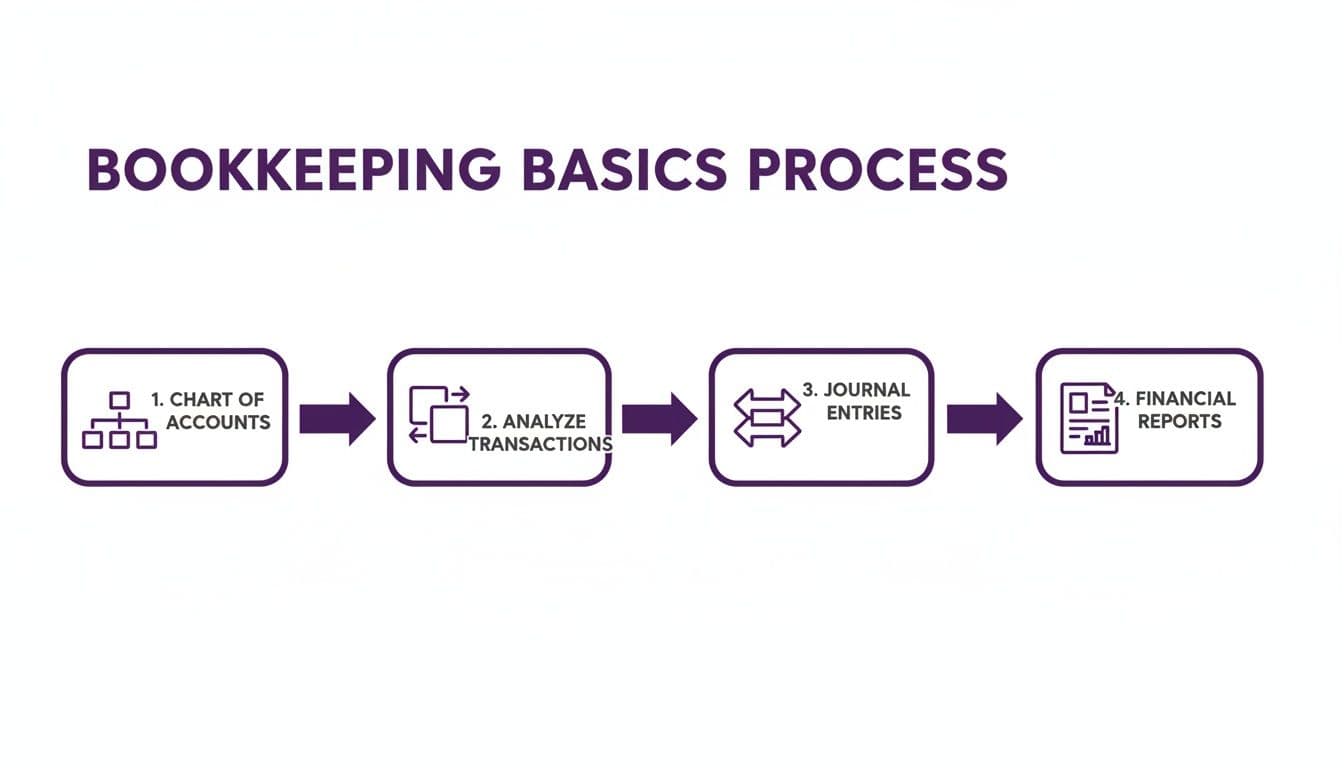
It all starts with a solid Chart of Accounts, flows through daily transaction management, and culminates in the financial statements that should be guiding your strategy.
Step-by-Step Month-End Checklist
Here’s a proven process to follow every single month. This isn’t just about ticking boxes; it’s about ensuring accuracy at every stage. For a more detailed breakdown, you can grab our complete month-end close checklist.
| Step | Action | Why It's Critical |
|---|---|---|
| 1. Categorize Transactions | Assign every single transaction from bank and credit card feeds to the correct account in your CoA. | This is the bedrock of accurate reporting. Skipping this step guarantees garbage reports. |
| 2. Reconcile Accounts | Match the transactions in your accounting software to your official bank and credit card statements. | Confirms every dollar is accounted for and helps spot errors, duplicates, or potential fraud. |
| 3. Review Receivables & Payables | Check open invoices (A/R) to chase late payments. Review outstanding bills (A/P) to plan cash outflows. | This is the foundation of active cash flow management, not passive bookkeeping. |
| 4. Record Adjusting Journal Entries | Record non-cash transactions like accrued expenses, prepaid expenses, and depreciation. | This is what makes accrual accounting work. It ensures your P&L is a true reflection of performance. |
| 5. Review Financial Statements | Analyze the P&L, Balance Sheet, and Statement of Cash Flows for accuracy and trends. | The numbers tell a story. This is where you find it and translate data into business intelligence. |
"A fast close is a competitive advantage. The best-run SaaS companies have their books closed within five business days, giving leadership almost a full month to act on the data. A slow close means you're flying blind." — Ray Rike, Founder & CEO of RevOps
Red Flags: Common Bookkeeping Mistakes Costing Founders Millions
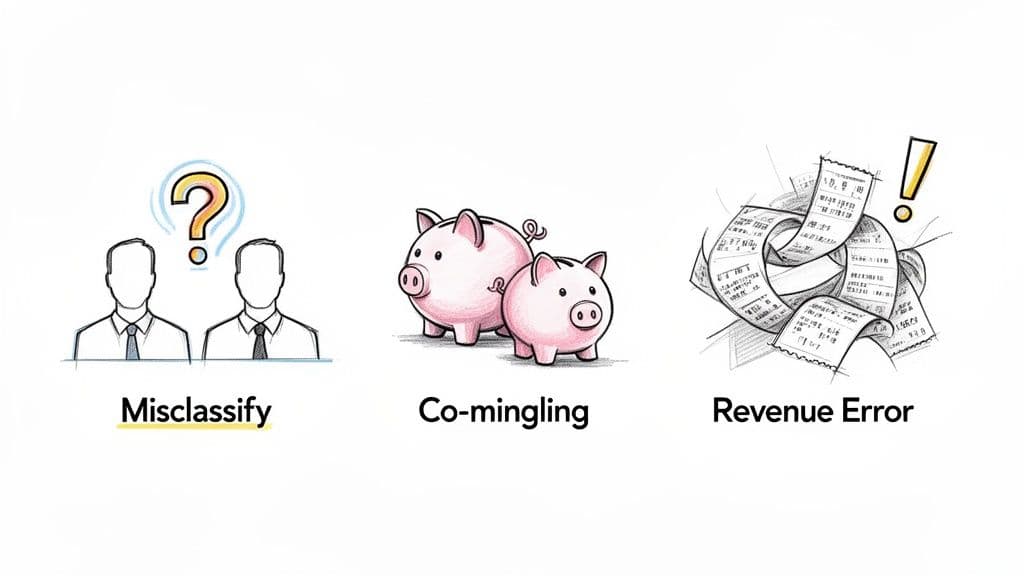
As you scale past your first million in revenue, the small bookkeeping shortcuts you took in the early days metastasize into expensive liabilities that derail your growth. These are not clerical errors; they are foundational flaws that distort your financial reality, spook investors, and invite costly penalties from the IRS.
Misconception #1: "A Little Co-mingling Isn't a Big Deal"
Reality: Using your business account for personal expenses (or vice versa) is an immediate red flag for auditors, investors, and the IRS. It pierces the corporate veil—the legal shield that separates you from your business. This simple mistake could expose your personal assets (your home, car, and savings) to business lawsuits and debts.
"I've seen due diligence on a promising $5M ARR SaaS company completely halt because the founder co-mingled funds. It took a six-week, $25,000 cleanup project just to get the financials clean enough for investors to even consider. It erodes trust instantly." – Senior Controller, Jumpstart Partners
Misconception #2: "They're Contractors, So I Don't Need to Worry About Payroll Taxes"
Reality: The distinction between a W-2 employee and a 1099 contractor isn't a judgment call; it's a strict legal test defined by the IRS. Misclassifying an employee as a contractor means you fail to withhold and pay critical payroll taxes. When the IRS discovers this, you are on the hook for all the back taxes, plus steep penalties and interest. For a team of just five misclassified "contractors" earning $80,000 a year, this can easily spiral into a six-figure tax bill overnight.
Misconception #3: "If the Cash is in the Bank, It's Revenue"
Reality: For a SaaS or service business, you must recognize revenue as you earn it, not when cash hits the bank (ASC 606).
Real-World Scenario: A digital agency lands a $60,000 project and collects a 50% upfront payment of $30,000. They incorrectly book the full $30,000 as revenue immediately. For the next two months, as they work on the project, they book zero revenue, making performance look volatile. This "lumpy" revenue is a major turn-off for investors, who prize smooth, predictable monthly recurring revenue (MRR). A proper QuickBooks cleanup is the mandatory first step to fix this.
Misconception #4: "Dev Costs Are Just an Expense"
Reality: For SaaS companies, certain software development costs must be capitalized—treated as an asset on your balance sheet—and then amortized (expensed) over the software's useful life. Improperly expensing all development costs upfront artificially deflates your short-term profitability and understates the value of your assets. This directly tanks your company's valuation. Exploring data entry automation can significantly reduce these kinds of costly manual errors.
When to Outsource Your Company's Bookkeeping
Every founder starts as the bookkeeper. But there comes a point where clinging to DIY bookkeeping switches from a scrappy, cost-saving measure to a serious strategic liability holding your business back. That tipping point arrives much faster than you think. If you’re spending more than five hours a week wrestling with your books, or if closing the month drags past day 10, it's time to outsource.
The Tipping Points: When DIY Becomes a Liability
Recognizing the moment to hand over the reins is a critical operational decision. It’s not about giving up control; it’s about gaining professional oversight so you can lead with clear, accurate financial intelligence.
You’ve hit the outsourcing trigger if:
- Your Time Is Worth More Elsewhere: As a founder, your time should be invested in high-value activities like sales, product development, and leading your team—not categorizing receipts.
- Complexity Is Ramping Up: You’re dealing with ASC 606 revenue recognition, managing deferred revenue, or capitalizing software development costs. These aren't areas for guesswork.
- You Need Investor-Ready Financials: Due diligence is not the time to discover your books are a mess. Outsourcing ensures your financials are clean, accurate, and ready for scrutiny at a moment's notice.
A recent Intuit QuickBooks report found bookkeeping and taxes are the top tasks business owners want to delegate. As companies grow, the administrative burden becomes a major bottleneck—so much so that 54% of owners admit to skipping their own pay just to manage cash flow pressures. You can discover more insights on 2026 business ownership trends from Intuit.
DIY vs. In-House vs. Outsourced: A Clear-Eyed Comparison
Many founders get stuck here, comparing an outsourced firm's monthly fee to their current "cost" of zero. This is a false economy. The real cost of DIY bookkeeping is measured in your wasted time, costly mistakes, and missed growth opportunities.
Decision Matrix DIY vs In-House vs Outsourced Bookkeeping
| Factor | DIY Bookkeeping | In-House Bookkeeper | Outsourced Firm |
|---|---|---|---|
| Annual Cost | "Free" (but high opportunity cost) | $75,000+ (salary, benefits, taxes, overhead) | $12,000 - $30,000 (for most businesses under $5M) |
| Expertise | Limited to founder's knowledge | Limited to one person's skills and availability | Access to an entire team of CPAs and specialists |
| Scalability | Doesn't scale; breaks under complexity | Fixed cost; hard to scale services up or down | Flexible; services adjust as your transaction volume grows |
| Time Commitment | 5-10+ hours per week | Hiring, training, and management | Minimal; streamlined onboarding and monthly check-ins |
The numbers don't lie. For less than half the cost of a junior hire, you get access to a team of senior-level experts. This isn't just about saving a few hours; it's about fundamentally upgrading your company's financial intelligence. To find the right level of support for your specific stage, it helps to understand when to hire a bookkeeper, controller, or CFO.
Take Control of Your Financial Future Today
You’ve seen the mechanics of solid bookkeeping and what’s at stake. It’s time to stop letting your financials be a source of stress and start using them as the strategic tool they are. The move from messy spreadsheets to a system that delivers confidence isn't just an upgrade—it's a fundamental shift in how you run your business.
Your Actionable Next Steps
Waiting until you're deep in investor due diligence is the most expensive way to handle your books. Take control now by establishing a rhythm where accurate financial intelligence lands on your desk predictably, every single month.
Your immediate actions should be:
- Mandate Accrual Accounting: If you are not already, make the switch now. This is a non-negotiable for any scaling business.
- Define Your Month-End Close Process: Use the checklist in this guide to create a repeatable process. Set a firm deadline of closing within 10 business days of month-end.
- Evaluate Your Tech Stack: Ensure your accounting software (best free accounting software for small business) integrates with your other key systems like payroll (Gusto), payments (Stripe), and CRM to eliminate manual data entry.
- Assess Your Team: Objectively evaluate if you have the internal expertise to manage complexities like ASC 606. If not, it's time to seek external help.
“Founders get stuck thinking about bookkeeping as a cost center. It’s not. Proactive, expert bookkeeping is a high-ROI investment that pays for itself in avoided mistakes, optimized cash flow, and the ability to make faster, smarter strategic moves.” — Senior CPA, Jumpstart Partners
How We Deliver Clarity and Control
Jumpstart Partners offers controller-led finance ops for founder-led B2B AI SaaS teams—monthly close, reporting, and billing support scoped after the Finance Ops Diagnostic. and let’s talk about how we can give you back your most valuable asset: your time.
FAQ: Straight Answers for Founders
Here are the straight answers to the questions we hear most often from founders in the $1M to $5M ARR range.
What’s the best bookkeeping software for a growing business?
For most businesses in this stage, the debate starts and ends with QuickBooks Online and Xero. They are the center of a financial tech ecosystem. The real goal is to build a system where your bookkeeping software talks automatically to your other platforms. The "best" software is the one that kills the most manual data entry. As you push toward the higher end of the revenue range, you'll outgrow them and migrate to an ERP like NetSuite.
How much should outsourced bookkeeping services really cost?
Outsourcing costs are tied directly to your monthly transaction volume and complexity. For a company doing $1M–$5M in annual revenue, expect to invest between $750 and $2,500 per month. This covers core bookkeeping and an accurate month-end close. Controller services, which include financial modeling and strategic oversight, typically range from $2,500 to $7,000+ per month. The mistake is comparing this to doing it yourself. You must compare it to the fully-loaded cost of an in-house senior accountant, which easily tops $90,000 a year.
According to SaaS industry benchmarks, how fast should my month-end close be?
According to OpenView's 2024 SaaS Benchmarks, top-quartile companies complete their month-end close in 5 business days or less. The median is 10 days. If your close takes longer than 10 days, you are operating at a significant disadvantage, making decisions on stale data while your competitors are already acting on fresh insights.