Financial Operations
Fractional CFO for Startups: Your Guide to Smarter Growth
Discover how a fractional CFO for startups drives growth, secures funding, and provides expert financial leadership without the full-time executive cost.
ByJumpstart Partners, CPA, QuickBooks ProAdvisor
··21 min readA fractional CFO for startups is a seasoned financial executive you bring on part-time. It’s how you get C-suite strategic leadership without the $400,000+ annual salary of a full-time hire, making top-tier expertise affordable as you scale.
Is Your Financial Strategy Keeping Up With Your Growth?
Your startup has cleared the launch phase, and revenue is climbing from $500K toward the $5M mark. The problem is, the simple financial setup that got you here—basic bookkeeping and a mess of spreadsheets—is now a massive blind spot. You’re making critical decisions with your gut instead of with data.

This gap between rapid growth and immature financial systems is exactly where promising startups start to fall apart. You are wrestling with problems like these:
- You can’t forecast cash flow. You have no real idea what your cash balance will be beyond a few weeks, which makes meeting payroll and paying vendors a constant source of stress.
- Your financials aren’t investor-ready. The reports you have would never survive the scrutiny of a due diligence process, putting your next funding round in serious jeopardy.
- You have no clear financial roadmap. You don't know which levers to pull—pricing, staffing, marketing spend—to actually improve profitability and scale faster.
The Modern Solution for Scaling Startups
This is the exact pain point that has triggered the explosive growth of the fractional CFO model. You know you need executive-level financial strategy, but you can’t justify the sticker shock of a full-time CFO.
The market for fractional CFO services in the U.S. is on track to blow past $3.2 billion in 2026 and nearly double to $6.4 billion by 2028. Today, about 72% of companies in the $3-15 million revenue bracket either use or are seriously considering a fractional CFO.
A fractional CFO acts as that strategic bridge, giving you elite financial guidance tailored to your specific stage and budget. They build the foundation you need for scalable growth and develop sophisticated strategies for things like managing cash flow for small business. This is how you stop flying blind and get back in control.
What a Fractional CFO Actually Delivers for Your Startup
Most founders think a fractional CFO is just a high-level accountant. That’s a critical mistake. An accountant looks backward, organizing the past for tax and compliance purposes. A fractional CFO for startups is your forward-looking financial co-pilot, building the roadmap to win your market.
Thinking a fractional CFO just cleans up your books is like thinking an architect just lays bricks. Their real job is designing the blueprint—the financial strategy—that ensures what you're building is valuable and won't collapse.
From Data Entry to Strategic Direction
A bookkeeper handles the raw data. A controller turns that data into accurate historical reports. They answer the question, "What happened?" A fractional CFO takes those reports and answers, "So what?" and "What do we do next?"
They translate financial history into your go-to-market strategy, challenging assumptions and modeling the future. It’s the shift from simply reporting the score to calling the next play. A huge part of their job is making sure you can confidently understand what is monthly recurring revenue (MRR) and other key metrics that drive your valuation.
To make the roles crystal clear, here’s how the finance function breaks down.
Fractional CFO vs Controller vs Bookkeeper: Key Differences
This table clarifies the distinct roles and responsibilities across the finance function to help you identify your startup's specific needs.
| Function | Bookkeeper | Controller | Fractional CFO |
|---|---|---|---|
| Primary Focus | Recording past transactions | Reporting historical accuracy | Driving future performance |
| Key Deliverable | Categorized expenses & bank reconciliations | Month-end financial statements (P&L, Balance Sheet) | Dynamic financial model, fundraising strategy, KPI dashboards |
| Typical Question | "How should I code this invoice?" | "Are our financials closed for last month?" | "How does reducing churn by 1% impact our valuation?" |
| Strategic Impact | Foundational data entry | Ensures financial hygiene & compliance | Optimizes pricing, guides investment, raises capital |
The table shows a clear progression. Bookkeeping is the foundation, the controller builds the walls, and the CFO designs the entire structure and ensures it’s built to last.
Concrete Deliverables That Drive Growth
A fractional CFO’s work isn't just about giving advice. They produce the specific tools you need to scale your business and convince investors you know what you’re doing.
Here are the core deliverables you should expect:
- A Dynamic Financial Model: This is not a simple spreadsheet. It’s a living, multi-year forecast that lets you stress-test your business. You can instantly see how a new pricing tier, a delayed product launch, or hiring three new engineers impacts your cash and runway.
- A SaaS Metrics & KPI Dashboard: They build and own the dashboard that tracks the vital signs investors and your board care about most—Monthly Recurring Revenue (MRR), Customer Lifetime Value (LTV), Customer Acquisition Cost (CAC), and payback periods.
- Board-Ready Reporting Package: They create a polished, concise report for every board meeting. This isn't a data dump. It’s a compelling story that uses numbers to highlight key wins, explain variances from the plan, and outline the financial strategy for the next quarter.
"A great fractional CFO doesn't just hand you reports; they interpret the story behind the numbers. They translate complex financial data into a clear, actionable plan that the entire leadership team can rally behind." — John Smith, Partner at Growth Equity Partners
The Strategic Work That Creates Value
Beyond the reports, the most valuable work is strategic. A fractional CFO is your financial co-pilot, helping you navigate the tough decisions. This is where you see the real ROI.
For example, a fractional CFO will analyze your LTV to CAC ratio. If you’re spending $5,000 to acquire a customer who will only generate $10,000 in lifetime value (a 2:1 ratio), your business model is broken. According to OpenView's 2024 SaaS Benchmarks, a healthy LTV:CAC ratio is at least 3:1.
Your CFO will spot this immediately. They’ll then work with marketing to optimize ad spend or with your product team to improve retention, pushing that ratio toward that healthy benchmark. That single adjustment directly increases your startup's profitability and valuation.
This is what separates a true strategic partner from a number-cruncher. They ensure your financial house is in order, but more importantly, they turn your financials into a competitive weapon. For a deeper dive into optimizing these systems, check out our guide on financial operations management.
When to Hire a Fractional CFO: A Growth Stage Timeline
Get the timing wrong, and you'll pay for it. Hire a fractional CFO too early, and you're just burning precious runway. But wait too long, and you’ll find yourself buried in a financial mess that puts your next fundraise at risk and grinds your growth to a halt.
Knowing when to pull the trigger isn't about hitting a specific date on the calendar. It's about recognizing the inflection points where financial complexity outpaces your team's ability to manage it. Let's walk through the timeline, stage by stage.
Pre-Revenue to $500K ARR: The Foundation Stage
At this point, a fractional CFO is overkill. Your entire focus is on finding product-market fit, and your finances are simple enough for a good bookkeeper and your own oversight to handle. The main job here is to build good financial habits from day one.
Warning Signs You’re Falling Behind:
- Your bookkeeping is a mess of uncategorized Stripe transactions and credit card charges.
- You have no real budget or a basic forecast for how long your cash will last.
- You’re still using the business card for personal expenses (or vice-versa).
You don't need a CFO to fix these things, but you absolutely need clean books. If you're already struggling here, it might be time for your first finance hire. Our guide on building your initial finance team can help you figure out who that should be.
$500K to $2M ARR: The Scaling Stage
This is the classic entry point for a fractional CFO. Your business model is validated and starting to work, but that growth is straining the simple financial setup you started with. You're probably looking to raise a Seed or Series A round in the next 12-18 months.
Your bookkeeper keeps the score, but they can't prepare you for investor due diligence. You need forward-looking models and strategic financial narratives, not just historical reports. This is where a fractional CFO steps in to build the fundraising machine.
The core deliverable at this stage is a dynamic, multi-year financial model. It becomes the single source of truth that lets you forecast hiring plans, model different revenue scenarios, and show investors a clear, defensible path to your next major milestone.
$2M to $5M ARR: The Complexity Stage
You’ve successfully raised capital and the team is growing fast. Now the financial challenges shift from fundraising to operations. It’s no longer just about getting the money; it’s about building a scalable financial engine to spend it wisely.
This is where the engagement with a fractional CFO deepens, moving from high-level modeling to implementing systems and driving performance.
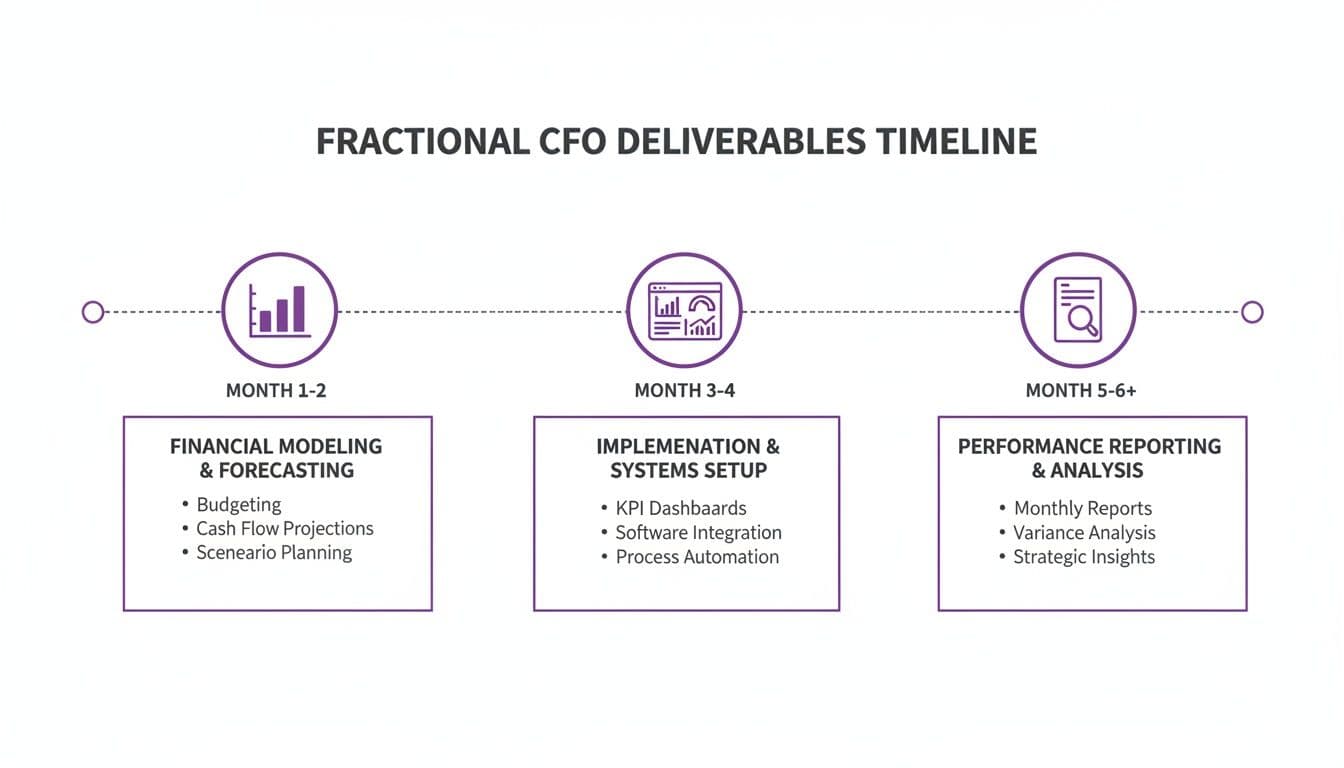
The journey evolves from creating the initial financial blueprint to implementing robust systems and delivering consistent reports that actually guide your strategy.
At this stage, you’re hitting new hurdles that demand senior expertise:
- Unit Economics: You have to get religious about tracking and improving metrics like LTV:CAC.
- ASC 606: For SaaS companies, recognizing revenue the right way becomes a complex, non-negotiable accounting standard.
- Departmental Budgets: That simple spreadsheet budget gets replaced with departmental plans that require real variance analysis and accountability.
A fractional CFO helps navigate these complexities, ensuring your financial operations don't lag behind your commercial growth. Companies making this investment report 35% better strategic decisions, 45% faster financial close processes, and a 50% improvement in board reporting quality, according to a 2023 survey by the FPA.
$5M to $10M+ ARR: The Optimization Stage
By now, you likely have a real finance function in-house, probably led by a controller. The question is no longer if you need a CFO, but whether the fractional model still makes sense. For many, it does—we see startups stick with a fractional CFO well past $20M ARR because the value shifts from hands-on execution to high-level strategy.
At this level, your fractional CFO’s focus becomes purely strategic:
- M&A Strategy: Modeling potential acquisitions or evaluating strategic partnerships.
- Capital Allocation: Making the tough calls on where the next dollar goes—R&D, sales expansion, or paying down debt.
- Systems Scaling: Leading the painful but necessary migration from QuickBooks to a full-blown ERP like NetSuite.
The fractional CFO acts as a strategic advisor and mentor to your internal finance leader. They provide the wisdom of a seasoned executive, keeping the company on the right financial track as you scale toward a potential exit or IPO.
The ROI of a Fractional CFO: A Worked Example
It's easy to talk about strategic value, but as a founder, you live and die by the numbers. Let's get real and build a concrete, numbers-based model to prove the ROI of a fractional CFO for startups.
Let's use a hypothetical $5M ARR SaaS startup. This is a classic inflection point—a stage where strategic financial leadership becomes critical, but the cost of a full-time executive feels impossible.
Step 1: The Obvious Math—Direct Cost Savings
First, let's just compare the direct costs. Bringing on a full-time CFO for a company this size is a massive financial commitment, and the total package is far more than just salary.
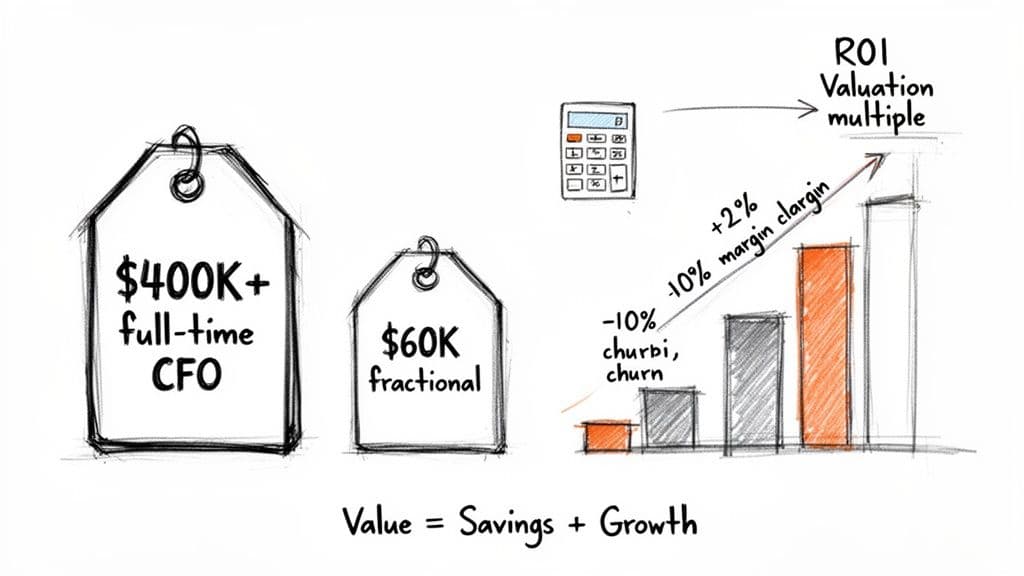
- Full-Time CFO: A competitive package includes a base salary around $250,000, plus benefits ($30,000), a performance bonus ($50,000), and equity ($70,000+). This quickly adds up to over $400,000 per year.
- Fractional CFO: A typical retainer for a $5M ARR startup that needs strategic oversight and operational support runs about $8,000 per month, or $96,000 annually.
Right out of the gate, you're looking at $304,000 in direct annual savings. For your startup, that's a year's worth of runway for two senior engineers. But this is just the tip of the iceberg.
Step 2: Modeling the Real Value—Strategic Impact
The true value of a fractional CFO isn't just in what they cost—it's in what they do. They aren't just a cheaper option; they're a growth accelerator.
Let's model two specific, high-impact improvements they would drive at our hypothetical $5M SaaS company.
Improvement 1: Gross Margin Optimization Your fractional CFO digs into your Cost of Goods Sold (COGS), scrutinizing everything from hosting fees and third-party software licenses to support team costs. They immediately spot an unoptimized AWS bill and notice you're paying for dozens of unused seats on several software tools.
- Impact: Through negotiation and optimization, they improve your gross margin by just 2%.
- Calculation: 2% of $5,000,000 ARR = $100,000 added directly to your bottom line.
Improvement 2: Churn Reduction Through LTV:CAC Analysis Next, they build a real cohort analysis and discover that customers acquired through one specific marketing channel are churning at twice the company average. This channel has a disastrous LTV:CAC ratio and is actively destroying value.
- Impact: By reallocating that marketing spend to higher-value channels, they manage to reduce overall net revenue churn by 10%.
- Calculation: According to SaaS Capital benchmarks, this kind of improvement in unit economics can boost your valuation multiple from 6x ARR to 7x ARR. At your next funding round, that single change adds $5,000,000 in enterprise value.
We saw this firsthand with a B2B SaaS client at $4.5M ARR who used a fractional CFO to build their investor model and data room, ultimately raising $12 million at a valuation 15% higher than their initial target.
Step 3: Putting It All Together—The Total ROI
Now, let's add it all up to see the undeniable financial case.
A fractional CFO isn't a cost center; they are an ROI-generating engine. The investment pays for itself many times over through cost avoidance, operational improvements, and a higher company valuation.
This table breaks down the value created in the first year alone.
| ROI Component | Calculation | Annual Value |
|---|---|---|
| Cost Savings vs. Full-Time CFO | $400,000 - $96,000 | $304,000 |
| Gross Margin Improvement | $5M ARR x 2% | $100,000 |
| Total Annual Cash Impact | $304,000 + $100,000 | $404,000 |
| Enterprise Value Increase | $5M x (7x - 6x Multiple) | $5,000,000 |
Your initial $96,000 investment didn't just save you money—it generated over $400,000 in immediate cash impact and millions more in long-term enterprise value. This is the clear, quantifiable power of bringing in the right fractional cfo for startups.
For a more detailed breakdown of these financial analyses, you might find our Controller Services ROI Analysis helpful.
Do you actually need a fractional CFO yet?
Three quick questions. No email — see your finance-ops readiness signal instantly, then get a personalized workflow map.
Start the diagnosticHow to Select the Right Fractional CFO Partner
Hiring the wrong fractional CFO is worse than having no one. A bad fit doesn’t just waste money; they create confusion, deliver flawed insights, and can steer your startup straight into a wall. You're not just buying reports—you're bringing on a strategic co-pilot for your entire company.
The selection process needs to be just as rigorous as hiring a C-suite executive. After all, you’re entrusting them with your company’s financial future.
Look Beyond the Resume
A flashy resume stacked with big-name company logos means very little. The single most important factor is deep industry specialization. A fractional CFO who has spent a decade in SaaS understands the DNA of your business—MRR, churn, and ASC 606 revenue recognition—on a level a generalist simply cannot.
For a digital agency, you need a partner who lives and breathes project profitability and utilization rates. An e-commerce expert will already know the nuances of inventory management and COGS attribution. Don’t settle for a jack-of-all-trades; find a master of yours.
"A great fractional CFO doesn't just know finance; they know your business. They should speak your industry's language fluently and have a proven track record of solving the exact challenges you're facing right now."
Evaluate Their Tech Stack and Team Structure
A modern finance function is built on an integrated tech stack, not just spreadsheets. Your fractional CFO partner must have hands-on, expert-level experience with the tools that run your business.
- Accounting Systems: Are they fluent in QuickBooks Online or Xero, or do they have the battle scars from managing a NetSuite migration?
- Billing & Payments: Do they have deep expertise in platforms like Stripe Billing, Chargebee, or Recurly?
- Operational Tools: Can they actually integrate and pull data from your payroll system (like Gusto) and your expense management platform (like Ramp)?
Beyond technology, look closely at their team structure. Are you hiring a solo practitioner or an integrated firm? A solo CFO might be a brilliant strategist, but they won't have the bandwidth to manage daily bookkeeping or controller-level tasks.
A firm like Jumpstart Partners provides a complete team—bookkeeper, controller, and CFO. This ensures the strategic work is built on a foundation of accurate, timely data, and you aren’t stuck managing three different vendors to get one clear picture.
The Interview Questions That Reveal True Strategic Partners
Your interview process has to slice through the jargon and identify people who think like a founder. Arm yourself with questions that force them to prove their problem-solving skills and strategic thinking.
Key Vetting Questions:
- "Walk me through your 90-day plan for a new client like us." A strong candidate will outline a clear, phased approach: clean up the past, build a reliable forecast, then implement KPI dashboards for ongoing strategic planning. A weak answer is vague and full of buzzwords.
- "Describe a time you helped a startup navigate a cash flow crisis. What specific steps did you take?" This separates the theorists from the operators. Look for concrete actions: building a 13-week cash flow model, renegotiating payment terms with vendors, or working with the sales team to accelerate receivables.
- "Our LTV:CAC ratio is currently 2:1. What are the first three things you would investigate?" This is a direct test of their SaaS fluency. A great startup CFO will immediately suggest digging into customer cohort data, analyzing channel-specific CAC, and reviewing pricing and churn drivers.
Choosing a financial partner is a major decision. While a fractional CFO offers incredible flexibility and expertise, a full-time hire has its own set of advantages for later-stage companies. If you are weighing your options, our guide on fractional CFO vs. a full-time CFO provides a detailed comparison to help you make the right call.
Stop Guessing. Start Scaling.
You've seen how bringing in a fractional CFO for startups can fundamentally shift your company's trajectory. This guide has laid out the path from financial chaos to strategic clarity, covering everything from fundraising readiness to building a finance function that doesn't break the bank. You’re no longer in the dark about what high-level financial leadership actually looks like.
If you're a founder with a business doing between $500K and $20M a year and you saw your own struggles on these pages, the next step is simple. It's time to stop making critical decisions based on gut feel and messy spreadsheets. It's time to get a clear, accurate picture of your company's financial health.
Your Immediate Action Plan
Don't let analysis paralysis set in. The information you've gathered is only powerful if you act on it. Here are the exact steps to take right now to get control of your financial future.
- Schedule a Financial Health Assessment: The first step is always a diagnosis. You need an expert to look under the hood of your financials and pinpoint the immediate risks and opportunities. This isn't a sales call; it's a strategic work session.
- Map Your Key Challenges: Before that meeting, list your top three financial anxieties. Is it unpredictable cash flow? A lack of investor-ready metrics? An upcoming audit you're totally unprepared for?
- Define Your Growth Goals for the Next 12 Months: Where do you want the business to be in a year? Are you raising a Series A? Expanding into a new market? Your financial strategy must be built to achieve these specific goals.
The most successful founders don't wait for a crisis to get their finances in order. They build a strategic financial function before they need it, turning their finance department from a cost center into a growth engine.
One of the most immediate tools a strategic partner will put in place is a rock-solid cash flow forecast. To get a head start, you can learn how we build a powerful 13-week cash flow model in our detailed guide.
The time for guessing is over. Book a no-obligation consultation with Jumpstart Partners today. We'll help you map out your financial challenges and build a concrete plan to hit your growth targets. This is your moment to move from simply reading about solutions to finally implementing them.
Common Objections and Top Questions About Fractional CFOs
Even after seeing the value, most founders have a few final, practical questions before bringing a fractional CFO on board. Let's address the most common objections head-on with direct answers.
"I can't afford a fractional CFO right now."
This is the most common misconception. The reality is, you can't afford not to have this expertise. As our ROI example showed, a fractional CFO isn't a cost center; they are an ROI-generating engine. For a $6,000-$8,000 monthly investment, they can unlock hundreds of thousands in savings and millions in enterprise value. Missing a critical financial issue—like a broken pricing model or a looming cash crunch—is infinitely more expensive.
"How much does a fractional CFO for a startup typically cost?"
The cost depends on your startup’s stage and the level of support you need. For early-stage companies (think $500K-$2M ARR), a typical retainer runs from $4,000 to $7,000 per month. This gets you the essentials: a solid financial foundation, an investor-ready model, and critical strategic guidance.
For more established scale-ups ($5M-$20M ARR) that need deeper operational partnership—like implementing new finance systems, managing a team, or driving departmental budgets—retainers are usually in the $8,000 to $15,000 per month range. Either way, you're accessing elite financial expertise for a fraction of the $400,000+ all-in annual cost of a full-time, executive-level CFO.
"What is the difference between a fractional CFO and an outsourced accountant?"
It’s the difference between looking in the rearview mirror and looking at the road ahead. Your outsourced accountant is focused on the past. Their job is to record historical transactions, reconcile your accounts, and close the books for tax and compliance. They answer the question, “What happened?”
A fractional CFO takes that historical data and uses it to build your future. They transform the accurate reports from your accountant into financial forecasts, fundraising scenarios, and pricing models. Your accountant tells you what happened last quarter; your fractional CFO tells you what to do in the next two quarters to win.
A fractional CFO doesn't replace good accounting; they build a strategic layer on top of it. They turn your financial data from a historical record into a forward-looking roadmap for growth.
"How involved is a fractional CFO in daily operations?"
A fractional CFO is a true member of your leadership team, not a distant consultant who just emails reports. While they aren't bogged down in day-to-day transactions, they are deeply embedded in the strategic pulse of your business.
A typical engagement involves 10-20 hours per week of dedicated partnership. This usually looks like:
- Joining weekly leadership meetings to provide the financial context for key operational decisions.
- Owning the creation and presentation of your monthly or quarterly board materials.
- Being your on-call expert for critical moments, like modeling a new pricing tier or evaluating a partnership offer.
They own the financial strategy, freeing you up to focus on what you do best: building the product, closing deals, and leading your team.
The time for guessing is over. Book a no-obligation consultation with Jumpstart Partners today to map out your financial challenges and build a concrete plan to hit your growth targets. Visit us at https://jumpstartpartners.finance to get started.
Finance Ops Scorecard
How healthy is your finance ops?
Three quick questions identify the first likely break. No email is required. A deeper three-step review is optional after your result.
Answer all three questions to reveal your first likely break.