Financial Operations
How Long to Keep Business Records: Your 2026 Guide
Discover how long to keep business records for IRS, state, and industry compliance in 2026. Essential for SaaS, agencies, & e-commerce. Includes a template.
ByJumpstart Partners, CPA, QuickBooks ProAdvisor
··20 min readPoor record retention doesn’t just create audit pain. It weakens your position when you raise capital, defend a tax position, or try to sell the company.
A founder usually makes one of two mistakes. They either keep everything forever and create a bloated, insecure mess, or they delete records too early and can’t reconstruct the story when a buyer, auditor, lender, or tax authority asks hard questions. Neither is disciplined finance. Both are expensive.
If you’re running a SaaS company, agency, or services business in the $1M to $5M ARR range, you need a retention system that is conservative where risk is real and lean where clutter adds no value. That means knowing the legal minimums, knowing what deserves permanent storage, and knowing which platform data from Stripe, Shopify, QuickBooks, NetSuite, Gusto, or your contract stack needs to stay accessible long after the original transaction is “done.”
The Billion-Dollar Mistake in Your Digital Filing Cabinet
A bad filing system can reduce the value of a good company.
The strongest proof is in M&A. A 2025 EY report cited by Incorp’s guide to keeping records after closing a business found that 71% of tech acquisitions that failed in due diligence did so because of incomplete historical financial records, costing an average of $5.8M in lost deal value or post-acquisition restatements. That should change how you think about how long to keep business records.
This is not an admin problem. It’s a valuation problem.
The two founder mistakes I see most
The first mistake is indiscriminate hoarding. Every invoice, draft contract, Slack export, duplicate PDF, and stale spreadsheet gets saved somewhere. Usually that means Google Drive, Dropbox, QuickBooks attachments, and someone’s desktop all become partial systems of record. When diligence starts, no one knows which file is final.
The second mistake is premature deletion. Founders assume the “three-year IRS rule” applies to everything, purge old folders, close systems after a migration, or let access lapse in Stripe, Shopify, or payroll platforms. Then they need to rebuild history from fragments. In the worst cases, they need outside help to recover lost data from damaged drives or inaccessible devices because no real backup process existed.
Practical rule: If a document helps prove revenue, ownership, tax treatment, payroll compliance, or contract rights, you need a retention decision. “We’ll keep it somewhere” is not a decision.
What disciplined retention looks like
You need a middle ground. Keep what matters for the correct period. Destroy what no longer serves a legal, financial, or operating purpose. Centralize the archive so your controller, CPA, auditor, and buyer all see the same truth.
If your books are already messy, start there. A retention policy built on broken accounting is worthless. Clean up the ledger, standardize attachments, and fix your source documentation before you worry about fancy naming conventions. If that’s your current bottleneck, this guide on QuickBooks cleanup services is the right place to start.
The Core Rules for Business Record Retention
The IRS gives you the baseline. It does not give you a complete retention strategy.
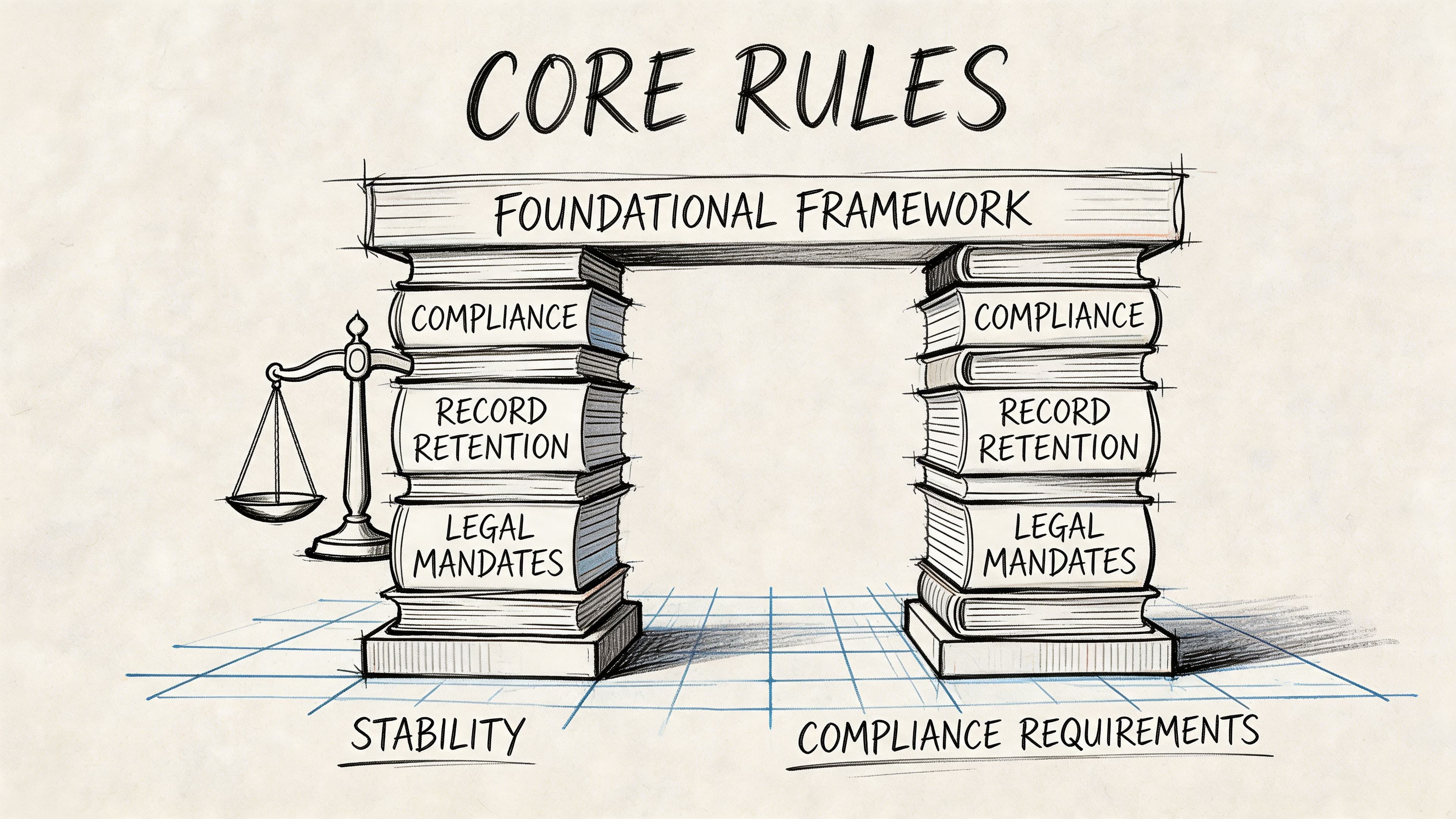
For most business tax returns, the IRS says keep records for 3 years. But that’s only the starting point. The IRS extends the window to 6 years if you underreport income by more than 25% of the gross income shown on the return, and it requires 7 years for claims involving worthless securities or bad debt deductions. Employment tax records must be kept for at least 4 years after the tax becomes due or is paid, whichever is later, according to the IRS recordkeeping rules for businesses.
The myth that one rule covers everything
Founders love simple rules. “Keep everything seven years” sounds simple. It’s also incomplete.
Some records belong in a shorter compliance bucket. Some belong in a longer one. Some should never be destroyed. The critical task is sorting records by legal function, not treating every PDF the same.
Here’s the plain-English version:
| Rule | What it covers | Why it matters |
|---|---|---|
| 3 years | Standard tax return support | Baseline IRS audit window |
| 6 years | Returns with substantial underreporting | IRS gets more time when income is materially omitted |
| 7 years | Worthless securities and bad debt support | Specific tax positions require longer retention |
| 4 years | Employment tax records | Payroll tax compliance follows its own clock |
| Indefinite | Fraudulent returns or failure to file | There is no normal limitation period |
A worked example founders actually understand
Let’s say your SaaS company filed a return showing $1,000,000 of gross income.
If the IRS later determines you failed to report more than $250,000, you crossed the 25% threshold. That means the ordinary 3-year audit window no longer controls. The IRS can use the 6-year window described in its guidance.
That’s why I don’t recommend designing your system around the shortest possible rule. A founder who stores tax support for only three years is optimizing for luck, not risk control.
If your records determine tax treatment, payroll liability, or reported income, keep them in a system built for retrieval, not just storage.
My recommendation for operating companies
For a growing private company, 7 years is the correct standard for most tax-related and accounting support. It covers the normal IRS timeline, the extended underreporting timeline, and the special cases that appear more often than founders expect.
That doesn’t mean every record has equal importance. It means seven years is the right default for ordinary financial documentation if you want a finance function that can stand up under scrutiny.
I also want you to separate U.S. rules from non-U.S. operations. If you have an international footprint, don’t assume your U.S. baseline travels cleanly. For UK-specific context, Lighthouse Consultants' record keeping guide is useful as a jurisdictional comparison.
What these minimums don’t solve
IRS retention rules won’t tell you how to preserve Stripe exports tied to deferred revenue, where to store signed board consents, how to archive vendor bills linked to QuickBooks entries, or how to maintain an audit trail after a NetSuite migration. That’s where finance operations matter.
A practical retention policy should sit alongside your broader internal control environment. If you haven’t formalized approvals, storage ownership, and source-of-truth systems, fix that first. This breakdown of financial controls for growing businesses is the operational layer most founders skip.
Your Definitive Record Retention Schedule By Document Type
A real retention policy isn’t a slogan. It’s a schedule.
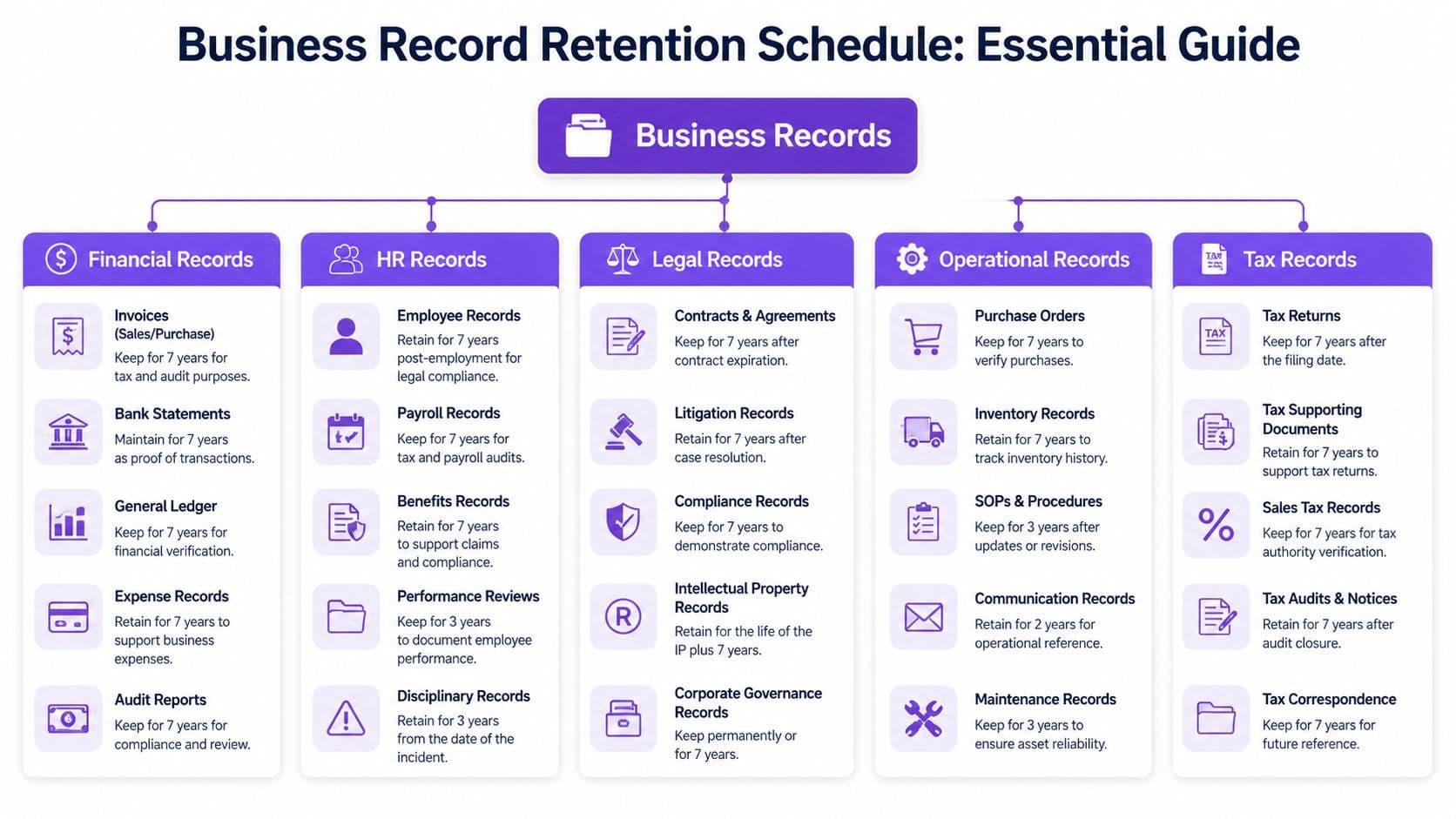
You need one table that your finance team, founder, ops lead, and outside accountant can follow without interpretation. That means every document type gets a retention period, an owner, and a storage location.
The biggest distinction is this: temporary financial support records follow a multi-year schedule, while foundational corporate and ownership records should be retained permanently. The U.S. Chamber states that business formation and ownership records such as certificates of incorporation, articles of organization, patents, trademark registrations, property deeds, stock ledgers, and annual meeting minutes should be kept permanently, and that contracts and leases should be retained for at least 6 years past termination in many jurisdictions, as outlined in the U.S. Chamber’s small business document retention guide.
Business Record Retention Schedule
| Document Type | Federal Minimum | Jumpstart Recommended | Rationale |
|---|---|---|---|
| Business tax returns and supporting schedules | 3 years in standard cases; longer in specific IRS scenarios | 7 years | Supports audits, amended positions, and common diligence requests |
| Payroll tax filings and employment tax records | 4 years after due date or payment, whichever is later | 7 years | Payroll disputes and tax reconciliations often surface late |
| Bank statements tied to accounting and taxes | Not stated here as a universal federal rule | 7 years | They substantiate cash movement and reconciliations |
| Credit card statements tied to business deductions | Not stated here as a universal federal rule | 7 years | They support expense substantiation and vendor tracing |
| Invoices, bills, receipts, and expense support | Not stated here as a universal federal rule | 7 years | These are your proof behind ledger entries |
| General ledger detail | Not stated here as a universal federal rule | Permanent | It is the historical spine of the business |
| Annual financial statements | Not stated here as a universal federal rule | Permanent | Lenders, buyers, and investors want long-term comparability |
| Audit reports and reviewed financials | Not stated here as a universal federal rule | Permanent | They become central diligence materials |
| Articles of incorporation or organization | Permanent | Permanent | They establish legal existence |
| Bylaws, operating agreements, and cap table records | Permanent for ownership records | Permanent | They prove governance and ownership history |
| Stock ledgers and board or annual meeting minutes | Permanent | Permanent | They support equity, approvals, and major transactions |
| Patents, trademarks, deeds, and IP registrations | Permanent | Permanent | Rights and title issues can arise decades later |
| Client contracts, MSAs, SOWs, vendor agreements, leases | 6 years past termination in many jurisdictions | Permanent for major agreements; otherwise 7 years after termination | Key contracts often matter in disputes and diligence |
| HR personnel files | Varies by record type and jurisdiction | 7 years after termination | Conservative practice supports claims defense and HR history |
| Revenue recognition workpapers and billing support | Not specifically covered by one universal rule | 7 years minimum; permanent for policy memos | You need to defend how revenue was recognized |
| Financing documents and debt agreements | Not specifically covered by one universal rule | Permanent | Future lenders and buyers ask for full debt history |
What belongs in the permanent archive
Permanent retention isn’t just for legal formalities. It’s for records that define the company’s identity, ownership, and long-term financial story.
Keep these forever:
- Formation records such as articles, certificates, and operating agreements.
- Equity and governance records including stock ledgers, board approvals, and annual minutes.
- Intellectual property files such as trademark registrations, patent documentation, and assignments.
- Historical financial statements and core ledgers that explain how the business evolved.
- Major contracts that shaped revenue, debt, ownership, exclusivity, or long-term obligations.
A worked storage model
Here’s a simple way to operationalize that schedule if you run on Google Workspace and QuickBooks or NetSuite:
| Folder | What goes there | Retention rule |
|---|---|---|
| Corporate Permanent | Formation docs, board minutes, cap table support, IP files | Permanent |
| Finance Annual | Final financials, tax returns, audit reports, key memos | Permanent |
| Finance Support | Invoices, bills, receipts, reconciliations, payroll support | 7 years |
| Contracts Archive | Signed client and vendor contracts, amendments, notices | 7 years after end date, or permanent if material |
| HR Restricted | Personnel records, payroll support, separation records | By policy, with restricted access |
That structure is better than scattering documents across Slack, DocuSign inboxes, QuickBooks attachments, and desktop folders named “final-final-v2.”
Founder filter: If losing a record would weaken your position in an audit, lawsuit, financing, or acquisition, it doesn’t belong in an informal folder.
The recommendation I’d give a $10M company
At your size, stop debating whether a file is “probably fine” to delete. Build a formal schedule and enforce it. Default ordinary accounting support to seven years. Default major corporate, financing, ownership, and strategic contract records to permanent retention.
Your year-end close is the right time to test this. Reconcile the ledger, verify support, and archive final files while the accounting period is still fresh. If you need a tighter process, use a year-end tax readiness checklist to align your archive with your close.
Industry-Specific Retention Needs You Cannot Ignore
Generic retention advice fails fast when it hits a modern operating model.
A SaaS company doesn’t just keep invoices. It keeps subscription histories, pricing approvals, deferred revenue support, product-to-billing mappings, and the logic behind revenue recognition. An agency doesn’t just keep contracts. It keeps statements of work, timesheets, client change requests, and the communication trail that proves work was approved. An e-commerce business doesn’t just keep payout statements. It keeps Shopify order data, Stripe payment records, refunds, chargebacks, and state tax support.
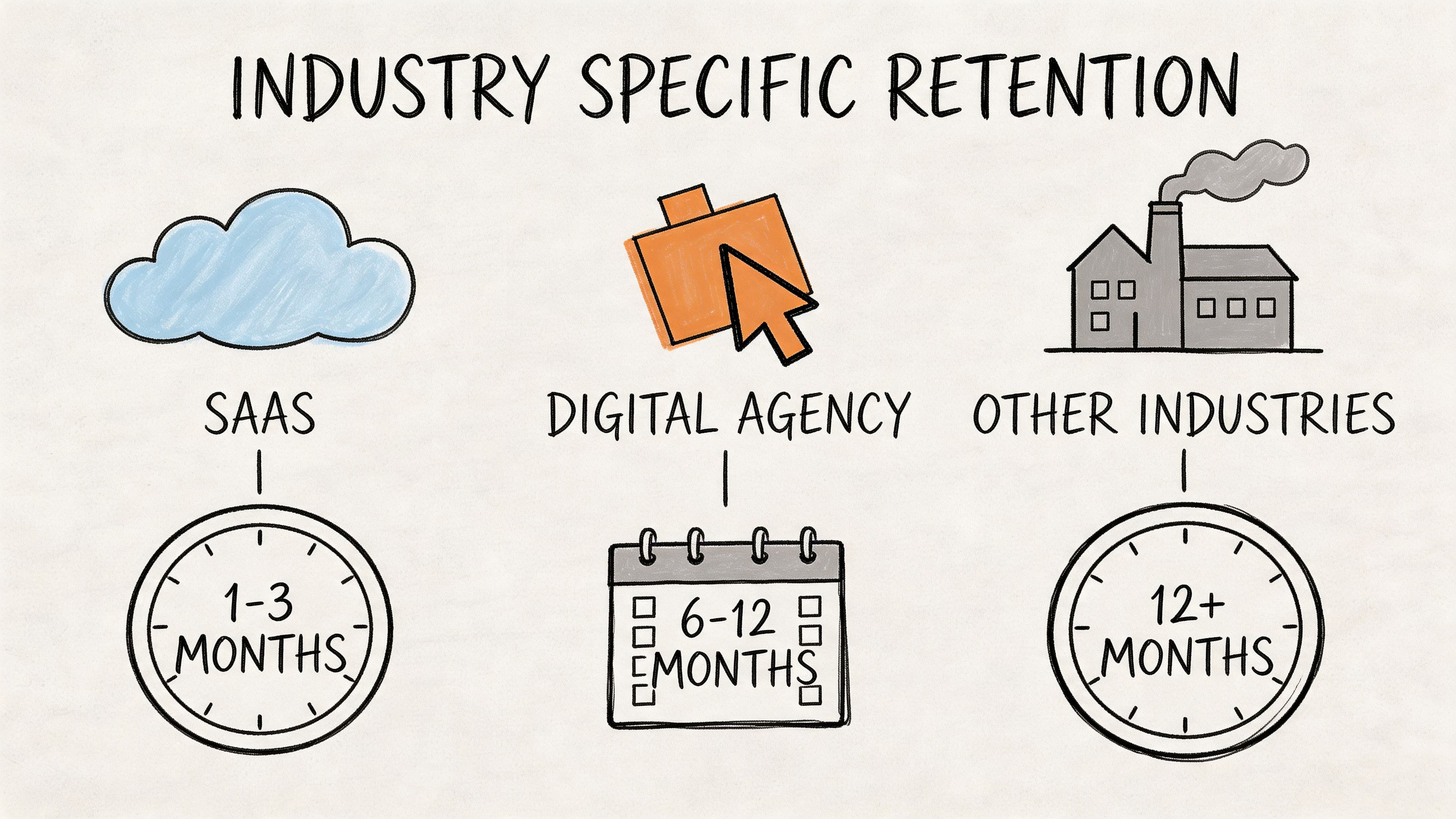
SaaS companies need defensible revenue history
If you report MRR, ARR, deferred revenue, or cohorts to investors, you need to preserve the inputs behind those metrics. That means more than saving a board deck.
Keep these records accessible together:
- Contract and billing alignment so each subscription has a signed agreement, pricing terms, and billing evidence.
- Revenue recognition support including policy memos, export logic, exception handling, and override approvals.
- Platform history from Stripe, Chargebee, QuickBooks, or NetSuite showing credits, upgrades, downgrades, and refunds.
- Customer master changes so name changes, plan migrations, and contract amendments don’t break the trail.
If your accounting team can’t explain a contract modification from two years ago, your diligence process will get ugly. This is one reason many finance leaders tighten accounting for SaaS long before a raise or sale.
“In SaaS, the file that matters isn’t just the invoice. It’s the chain between the contract, the billing event, and the revenue treatment.”
A Jumpstart Partners CPA
Agencies and services firms need proof of earned revenue
Agency founders often underestimate documentation risk because the business feels relationship-driven. Buyers and auditors don’t care about that. They care about evidence.
You should retain:
| Record | Why it matters |
|---|---|
| Signed MSAs and SOWs | Establish scope, rates, and deliverables |
| Change orders and amendments | Prove why revenue or margin shifted |
| Timesheets and resource logs | Support labor-based billing and project profitability |
| Client approvals and acceptance emails | Defend disputed invoices |
| Final deliverables and billing schedules | Connect work performed to revenue booked |
The common failure is storing these in separate tools. The contract is in DocuSign, project history is in Asana, approvals are in email, and billing is in QuickBooks. That fragmentation turns simple questions into forensic work.
E-commerce brands need platform-level traceability
If you sell through Shopify and collect through Stripe, you need to preserve the transaction chain. That includes gross sales, discounts, returns, fees, payouts, and tax treatment.
Keep the raw platform exports and the reconciled accounting outputs. Don’t assume your accounting system is enough on its own. Once a platform changes reporting views or your subscription lapses, reconstructing history gets harder.
For multi-channel sellers, store marketplace reports by period, not just as one-off downloads. You want monthly archival discipline, not a panic export when a buyer asks for support.
Warning Signs Your Record Keeping Is a Liability
Most founders don’t realize their records are a problem until someone external asks for them.
That someone might be the IRS. It might be a lender. It might be a buyer. By then, you’re not improving your process. You’re defending a mess.
The stakes are real. A 2025 EY report, cited in Incorp’s discussion of post-closure business record retention, found that 71% of tech acquisitions that failed in due diligence did so because of incomplete historical financial records, with an average cost of $5.8M in lost value or post-acquisition restatements.
Red flags I’d treat as immediate action items
- Your corporate records live in a founder’s personal drive. Ownership and governance files should never depend on one person’s account access.
- You can’t produce a signed customer contract for revenue already recognized. That’s not a filing issue. That’s a credibility issue.
- Your QuickBooks or NetSuite entries have no source attachments. A clean ledger without support still fails under scrutiny.
- You rely on platform access instead of archived exports. If Stripe, Shopify, Gusto, or your contract tool changes permissions, your history disappears from view.
- No one knows what can be deleted. That means sensitive records stay around too long, and important ones get deleted casually.
- Your finance team rebuilds old reports by hand. If historical reporting depends on memory, your process is not reliable.
- Closed entities or old subsidiaries have no formal archive owner. Sale, wind-down, and restructuring records often become urgent later.
The receipt excuse doesn’t hold up
Founders often say, “We lost some receipts, but the books are basically right.”
That’s weak. If source documents are missing, you need a documented fallback process, not a shrug. For practical context on what tax authorities may accept when original support is gone, this guide on IRS acceptable proof for missing receipts is useful. The broader point is simple. Missing documentation should be treated as an exception to resolve, not a normal operating condition.
A finance function earns trust by producing support quickly, consistently, and from one system of record.
A fast self-test
Ask your team these questions:
- Can you produce the final signed version of your top customer agreements?
- Can you tie a sample invoice from two years ago to the contract, service period, and cash receipt?
- Can you show board approval for equity grants and financing decisions?
- Can you export historical payroll support after an employee leaves?
- Can you hand a buyer one archive for each closed year?
If the answer to any of those is no, your record keeping is already a liability.
A short walkthrough on what organized retention should look like in practice is worth your time:
How to Build an Audit-Proof Retention System
You do not need a complicated policy. You need a policy your team will follow.
A strong system has five parts. One schedule. One owner per category. One approved storage location. One destruction process. One rule that suspends deletion when litigation, an audit, or a transaction is on the horizon.
Start with a simple policy template
Use this as your working draft:
Document Retention Policy
We retain business records according to document type, legal requirement, tax exposure, and operational need. Permanent records include formation documents, ownership records, board minutes, material financing documents, intellectual property files, annual financial statements, and core ledgers. Standard finance support records, including invoices, bills, receipts, reconciliations, and tax support, are retained for 7 years unless a longer period applies. Employment tax records are retained according to applicable law and internal policy. Material contracts are retained for the life of the agreement plus the required post-termination period, and major agreements are archived permanently. All records subject to audit, dispute, investigation, financing, or transaction review are placed on hold and are not destroyed until released by authorized management. Electronic storage is the official archive unless original hard copies are legally required.
That is enough to start. Add department owners and exact system names next.
Assign a home for every record type
Most retention failures happen because documents have no defined home.
Use a storage map like this:
| Category | System of record | Backup archive | Owner |
|---|---|---|---|
| Corporate governance | Secure drive folder with restricted permissions | Secondary cloud archive | Founder or finance lead |
| Accounting support | QuickBooks or NetSuite attachments plus annual archive | Secure drive by fiscal year | Controller |
| Contracts | Contract repository or signed PDF archive | Secure drive by customer or vendor | Ops or legal |
| Payroll and HR | Payroll or HRIS export archive | Restricted HR folder | HR lead |
| Tax filings | Annual tax folder with final return and support | Secure drive by entity and year | Controller or CPA |
Founders often overcomplicate things. You do not need six tools. You need clarity on which tool is authoritative.
Standardize file naming before you automate anything
If your files are named “scan001.pdf,” your archive is not search-friendly.
Use a pattern that survives staff turnover:
- Year-Month-Day
- Entity or customer/vendor
- Document type
- Version status if relevant
Example:
2026-01-31 Acme Corp MSA Signed2026-02 Payroll Tax Filing Q12025 Annual Financial Statements Final
Simple naming rules reduce retrieval time and stop duplicate “final” files from spreading.
Build retention into monthly close
Don’t treat archiving as a year-end chore. Tie it to close.
A disciplined monthly process looks like this:
-
Close the books Finalize reconciliations, post accruals, and lock the period.
-
Attach support Ensure major journal entries, bank recs, payroll summaries, and unusual items have source documentation attached or indexed.
-
Export platform data Save the month’s Stripe, Shopify, payroll, and contract reports in the archive folder if those platforms drive material accounting entries.
-
Tag permanent items Move signed financing documents, board approvals, and strategic contracts to the permanent archive immediately.
-
Review deletion queue Remove records only if the policy allows it and no hold applies.
Put legal holds in writing
Deletion should stop when a dispute, investigation, claim, or deal process begins.
That rule should be explicit:
- Audit notice received
- Litigation threatened or filed
- M&A diligence launched
- Tax position under review
- Employment claim expected
When one of those events happens, your normal destruction schedule pauses. If your team destroys records after that point, you created a problem with your own hands.
Operating principle: Retention is a finance control. Destruction is a legal event. Treat both accordingly.
Plan for platform migrations and business changes
This is where modern companies get burned.
When you migrate from QuickBooks to NetSuite, switch payroll providers, replace your contract system, or sell a business unit, archive the old system before access ends. Do not rely on “we can always log back in later.” You often can’t.
For post-close or post-migration planning, define these items in writing:
- Who owns legacy access
- What data exports were captured
- Where they are stored
- Who can retrieve them
- How long they stay available
If you are preparing for an audit or formal diligence process, use a checklist instead of relying on memory. This checklist for auditors is a practical starting point for assembling records in the format outside reviewers expect.
What to do this week
If your current setup is loose, don’t try to solve everything at once. Do these five things first:
- Create a retention schedule. Use the table in this article and assign periods by document type.
- Name a record owner. One person must own the archive even if several teams contribute files.
- Separate permanent from seven-year records. This single step fixes a lot of chaos.
- Archive platform data monthly. Especially if Stripe, Shopify, Gusto, QuickBooks, or NetSuite feed your books.
- Write down the legal hold rule. Your deletion policy is not complete without it.
Founders usually treat record retention as cleanup work. It isn’t. It’s a control system that protects tax positions, supports clean closes, speeds diligence, and keeps your company from looking careless when scrutiny arrives.
If you want this implemented properly, Jumpstart Partners can build the retention process into your monthly close, controller workflows, and audit prep so your records stay organized, defensible, and ready for fundraising, diligence, or a sale.