Financial Operations
Outsourced Chief Financial Officer: A CEO's Guide
Learn what an outsourced chief financial officer does, how much they cost, and when to hire one. A complete guide for founders and CEOs of growing businesses.
ByJumpstart Partners, CPA, QuickBooks ProAdvisor
··19 min readYou’re probably running a business that looks healthy from the outside and messy from the inside.
Revenue is up. Headcount is growing. Clients are coming in. But when you need clear answers, finance stalls. You can’t say with confidence how much cash you’ll have in six weeks. You don’t know which service line drives profit. Your investor, lender, or board asks for a clean forecast, and your team scrambles through QuickBooks, spreadsheets, Stripe exports, and half-finished reports.
That setup doesn’t break all at once. It slows you down decision by decision. You hire late, price wrong, miss cash issues, and raise money with weaker credibility than you should. If that sounds familiar, your problem isn’t bookkeeping. It’s the absence of financial leadership.
The Strategic Imperative for a Modern CFO
A lot of founders treat finance like back-office administration until growth exposes the gap.
At a certain stage, “books are mostly current” stops being good enough. If you’re between $1M-$5M ARR, you need more than reconciliations and tax prep. You need someone who can turn your numbers into operating decisions.

Good enough finance is usually the bottleneck
Here’s the blunt truth. Most scaling companies don’t hire a full-time CFO when they first need one. They wait too long, usually because they think the choice is either a six-figure executive hire or nothing.
That’s outdated.
According to this 2024 CFO outsourcing report, 90% of CFOs are outsourcing at least some accounting functions, and 90% of those who outsource report they can easily find qualified accountants when needed. That tells you two things fast. First, outsourcing is no longer a fallback. Second, the talent market is forcing smart companies to rethink how they build finance.
If you’re still relying on a founder-managed spreadsheet stack, you’re competing against companies with better reporting discipline and faster financial decision-making.
Practical rule: If your leadership team can explain revenue growth but not cash movement, your finance function is behind your business.
Finance should be a growth lever
A real outsourced chief financial officer doesn’t just clean up reporting. They give you decision-grade clarity.
That means:
- Cash visibility: You know what’s coming in, what’s going out, and when pressure hits.
- Profitability insight: You stop guessing which clients, channels, or service lines deserve more investment.
- Investor readiness: You can answer questions on performance, margin, runway, and forecast logic without scrambling.
- Operational discipline: Budgeting and KPI reviews become recurring management tools instead of annual paperwork.
If you’re still piecing together support from a bookkeeper, tax CPA, and your own instincts, you’re running an incomplete finance system.
For companies still building that foundation, this guide on outsourced accounting for startups is useful because it shows how early-stage teams can formalize reporting before the cracks get expensive.
And if your issue is broader process breakdown, not just leadership, it’s worth reviewing what strong financial operations management should look like across close, controls, reporting, and cash.
What an Outsourced CFO Actually Does
An outsourced chief financial officer is not a glorified bookkeeper. They own the forward-looking side of finance.
They help you decide. They don’t just document what already happened.
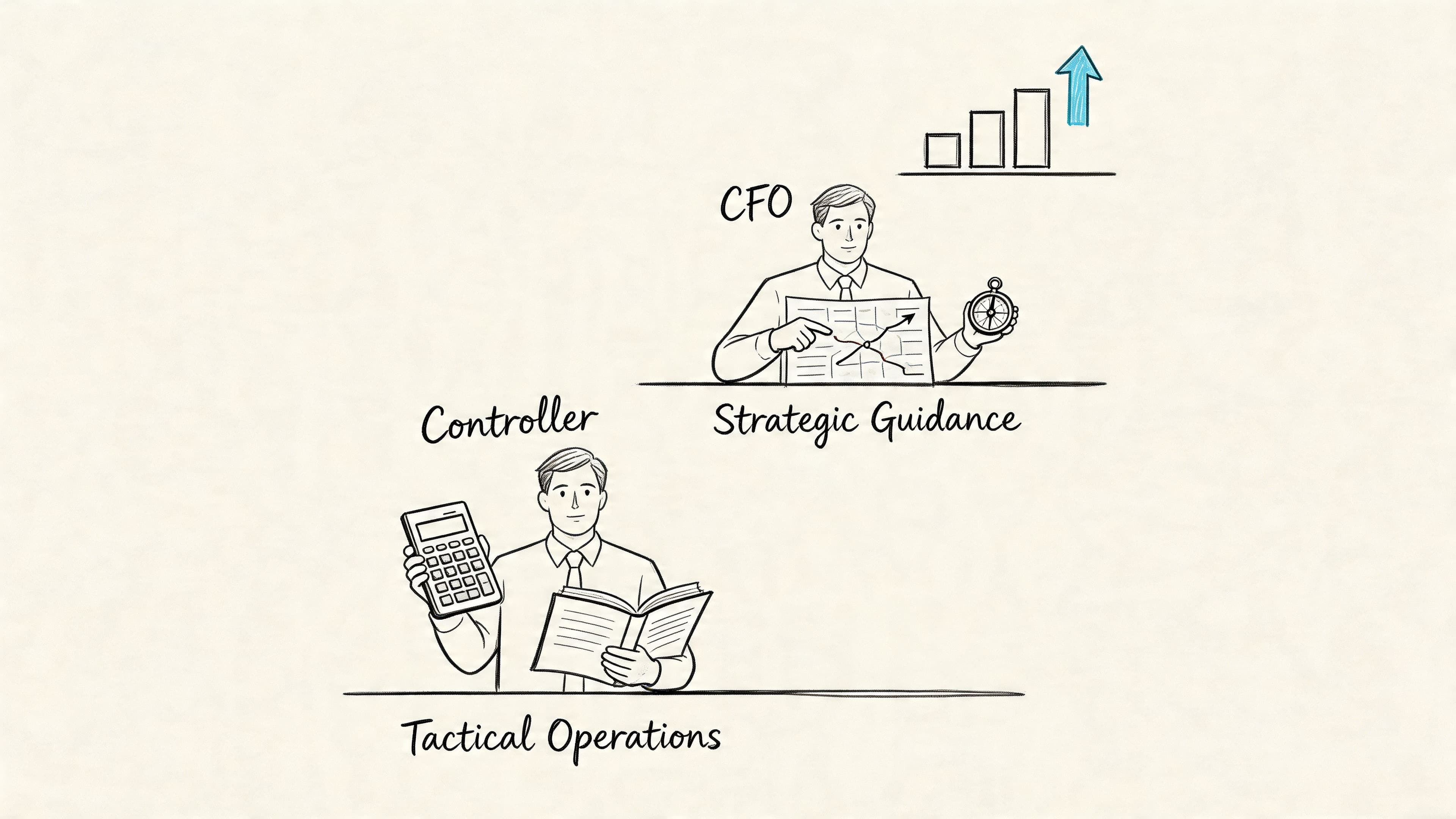
The three layers of finance
Most growing companies need to separate finance into three levels.
| Role | Primary focus | Typical output |
|---|---|---|
| Bookkeeper | Transaction accuracy | Reconciliations, categorization, bill pay support |
| Controller | Financial control and close process | Monthly financials, accruals, compliance, internal controls |
| CFO | Strategy and decisions | Forecasts, cash planning, KPI dashboards, board reporting |
If one person is trying to do all three, something gets neglected. Usually it’s strategy.
What an outsourced chief financial officer owns
A strong outsourced CFO handles the work that changes management behavior:
- Forecasting and scenario planning: They build operating models so you can test hiring, pricing, and expansion decisions before committing.
- Cash flow management: They monitor liquidity, not just profit on paper.
- KPI design and reporting: For SaaS, that often includes MRR, ARR, CAC, and revenue quality. For agencies and services firms, it usually means utilization, delivery margin, client concentration, and cash conversion.
- Budgeting: Not a static spreadsheet. A living operating plan tied to actual performance.
- Fundraising and lender prep: They turn financials into a credible narrative.
- Board and leadership reporting: They translate raw data into decisions and accountability.
According to NOW CFO’s summary of outsourced CFO metrics, outsourced CFOs use Operating Cash Flow (OCF) as a core weekly dashboard metric, and high-performing engagements achieve 85% to 95% forecast accuracy when they integrate OCF with scenario modeling.
That matters because cash discipline is what keeps a scaling company out of panic mode.
OCF tells you whether the business is generating cash from operations, not just showing accounting profit. That’s the number CEOs need when growth starts stressing payroll, vendor timing, and reinvestment choices.
They do this, not that
Use this test if you’re unsure whether you need CFO help or lower-level support.
| They do this | Not that |
|---|---|
| Build a hiring plan tied to revenue and cash | Process individual employee expense claims |
| Create a board-ready forecast | Code every transaction in the ledger |
| Design KPI dashboards for Stripe, Shopify, or NetSuite data | Chase down every missing receipt |
| Prepare your business for fundraising diligence | Run routine payroll administration |
| Analyze pricing, margin, and cash implications of a new service line | Enter vendor bills all day |
If you’re comparing providers, this overview of outsourced finance and accounting helps clarify how finance leadership should sit above day-to-day accounting execution.
A quick overview can help if your team still confuses controller work with CFO work:
The weekly rhythm that changes performance
A good outsourced CFO doesn’t disappear until month-end.
They usually establish a management cadence like this:
- Weekly cash review
- Monthly close review
- KPI and variance discussion with leadership
- Quarterly planning refresh
That rhythm is what turns finance into a management system instead of a reporting archive.
Outsourced vs In-House vs Fractional CFO Comparison
If you’re deciding between an outsourced firm, a full-time executive, or a solo fractional consultant, stop framing this as a title decision. It’s a delivery model decision.
The question is simple. Which option gives you the right mix of expertise, continuity, and execution without overbuilding too early?
CFO Model Comparison: Outsourced vs. In-House vs. Fractional
| Criterion | Outsourced CFO (Firm) | In-House CFO | Fractional CFO (Individual) |
|---|---|---|---|
| Cost structure | Variable, service-based, easier to match to stage | Fixed overhead and long-term commitment | Flexible, often part-time |
| Team depth | High if the firm includes controller, accounting, and systems support | Depends on one hire, then additional hires underneath | Limited to one person’s capacity and skill range |
| Scalability | Strong. Can usually expand scope as reporting gets more complex | Slower. Expansion often requires more hiring | Moderate. Works well until execution load outgrows one person |
| Coverage risk | Lower if the provider has multiple specialists | High if the CFO leaves | High if the consultant is unavailable |
| Systems and implementation support | Often stronger because firms see more tech stacks and processes | Varies by the executive’s background | Varies widely |
| Industry pattern recognition | Usually broad across multiple clients | Can be deep, but narrower to one background | Can be deep in one niche |
| Internal leadership presence | Less embedded day to day | Highest | Moderate |
| Best fit | Companies needing strategic finance plus execution support | Larger businesses with sustained complexity and budget | Businesses needing senior advice but not a full support team |
My opinion on the right choice
For most companies in the $1M to $5M ARR range, the outsourced firm model is usually the strongest choice.
Why? Because these businesses rarely need only strategy. They need strategy plus follow-through. They need someone who can help with forecasting, but also make sure close processes, dashboards, and reporting packages get built and maintained.
A solo A fractional CFO can be excellent. But many of them operate as advisers, not operators. If your books are messy, systems are fragmented, or your month-end process is weak, an individual consultant can become another smart person blocked by bad infrastructure.
An in-house CFO makes sense later, when:
- the business needs daily executive presence,
- organizational complexity is already high,
- and the budget supports a dedicated senior leader plus the team underneath them.
The hidden issue is execution capacity
Most founders underestimate this. A finance strategy is useless if nobody executes it.
You don’t just need someone to say, “Track cash better” or “Build a forecast.” You need a model that ensures:
- data gets cleaned,
- systems connect,
- revenue is recognized correctly,
- dashboards stay current,
- and reports arrive on time.
That’s why many companies first explore an outsourced model, then later decide whether to bring leadership in-house. If you’re comparing these paths more closely, this breakdown of fractional CFO services is worth reviewing.
The wrong hire isn’t just expensive. It delays better decisions for quarters at a time.
Common misconception to drop now
A lot of CEOs assume in-house automatically means better control.
Not necessarily.
A weak in-house hire with no systems support gives you proximity, not performance. A strong outsourced team with a defined cadence, clear reporting, and documented processes often gives you more consistency than a single executive working without enough infrastructure.
Choose the model that solves the bottleneck. For most scaling firms, that bottleneck is not executive title. It’s reliable financial leadership paired with operating capacity.
How Outsourced CFO Services Are Priced
Most founders ask the wrong first question.
They ask, “What does an outsourced CFO cost?” The better question is, “What am I buying, how is it priced, and what’s the return compared with my current setup?”
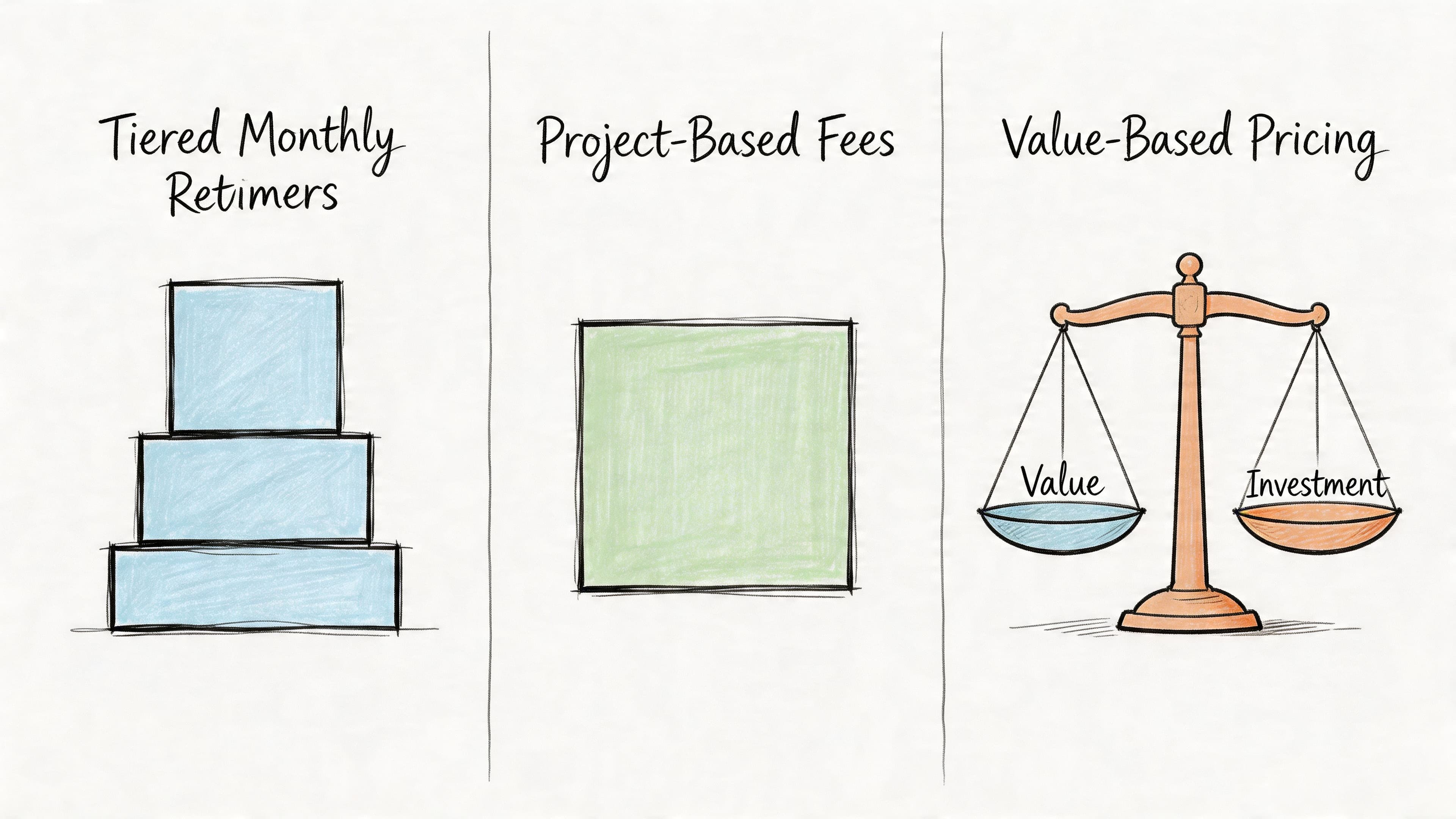
The three pricing models you’ll see
| Pricing model | Best for | What to watch |
|---|---|---|
| Monthly retainer | Ongoing support, recurring meetings, cash and KPI oversight | Make sure scope is clearly defined |
| Hourly billing | Short-term advisory, diligence, or cleanup support | Costs can drift if work isn’t managed tightly |
| Fixed-fee project | Specific outcomes like a forecast rebuild or fundraising package | Good for testing fit before a retainer |
According to McCracken Alliance’s pricing overview, outsourced CFO rates typically range from $200 to $250 per hour for experienced professionals, and can be as low as $150 per hour for small companies.
That pricing is the reason many growth-stage companies can access CFO-level work without taking on the full cost of a permanent executive hire.
A worked cost example
Let’s use only the verified numbers available.
Assume you engage an outsourced CFO for 8 hours per month at $200 per hour.
- Monthly cost = 8 x $200 = $1,600
- Annual cost = $1,600 x 12 = $19,200
Now assume you need more support, say 20 hours per month at $250 per hour.
- Monthly cost = 20 x $250 = $5,000
- Annual cost = $5,000 x 12 = $60,000
Those are real operating numbers you can model today.
If you want another benchmark, at $150 per hour, 10 hours per month would cost:
- Monthly cost = 10 x $150 = $1,500
- Annual cost = $1,500 x 12 = $18,000
How to think about ROI
The return comes from better decisions and fewer expensive mistakes.
A CFO engagement pays off when it helps you:
- tighten cash planning,
- avoid bad hiring timing,
- catch margin problems early,
- present cleaner numbers in fundraising or lending conversations,
- and stop the CEO from acting as the part-time finance department.
That return won’t always show up as one neat line item. It usually shows up in avoided damage and faster decision cycles.
Operator’s view: If finance leadership frees you to spend more time on sales, hiring, delivery, and capital planning, the value is larger than the fee.
Which pricing model I recommend
For most CEOs, start with one of these two options:
- A fixed-fee project if your books, model, or reporting are still unreliable.
- A monthly retainer once you need recurring cash reviews, KPI oversight, and leadership support.
Avoid open-ended hourly work unless the scope is tight and the deliverables are explicit.
You also need transparent service boundaries. If pricing sounds vague, it usually is. Review structure, support tiers, and project options before you sign anything. A pricing page like this one for outsourced finance support is the kind of clarity you should expect from any provider.
Key Business Triggers to Hire an Outsourced CFO
You don’t hire an outsourced chief financial officer because it sounds impressive. You hire one because your current setup is starting to block growth.
If two or three of the situations below apply to you, the need isn’t theoretical anymore.
The clearest operational triggers
- You can’t forecast cash with confidence. You know your bank balance. You don’t know your future cash position.
- Month-end close drags and still feels shaky. Leadership discussions happen before the numbers are ready, so decisions get made on partial data.
- You’re preparing for fundraising, debt, or due diligence. Investors and lenders won’t accept hand-wavy reporting.
- You don’t know which customers or service lines are profitable. Revenue growth without margin clarity creates fake confidence.
- Your systems don’t talk to each other cleanly. QuickBooks, Stripe, Shopify, payroll, and reporting tools are producing conflicting views of the business.
- The CEO is still doing finance triage. If you’re personally answering accounting questions, rebuilding forecasts, or chasing reports, leadership time is being wasted.
Strategic triggers that matter even more
Some companies look stable operationally but still need CFO leadership because the business has become harder to steer.
Watch for these:
- you’re changing pricing,
- entering a new market,
- hiring senior leaders faster,
- dealing with revenue recognition complexity,
- or trying to install accountability around budget versus actual performance.
These are decision problems. Bookkeeping won’t solve them.
A quick self-assessment
| Sign you’re ready | What it means |
|---|---|
| You keep revising hiring plans because cash feels unclear | You need rolling forecasts, not static budgets |
| Board or investor questions expose reporting gaps | You need finance leadership, not better spreadsheet formatting |
| Your controller or bookkeeper is overloaded | The business has outgrown a purely transactional finance model |
| You’re making growth bets without scenario planning | Strategy is running ahead of finance |
The objection I hear most
“We’re not big enough yet.”
That usually means one of two things. Either the business has simple finances, or leadership has normalized operating without visibility. The second one is more common.
You don’t need a full-time CFO title to justify better financial leadership. You need enough complexity, enough risk, and enough ambition.
If you’re unsure whether you need bookkeeping help, controller support, or CFO leadership, this guide on when to hire a bookkeeper, controller, or CFO is a practical way to sort the signal from the noise.
How to Evaluate and Choose the Right Provider
Most companies don’t fail with outsourced finance because the idea was wrong. They fail because they picked the wrong provider.
A polished website doesn’t tell you whether a firm can handle your reporting complexity, your systems, or your pace. You need a due diligence process.

Start with fit, not charm
The best provider for a product-led SaaS company may be a poor choice for a multi-entity agency or a services business with complicated payroll and project margin issues.
Ask direct questions:
- What kinds of companies do you serve repeatedly?
- What systems do you work in every week?
- Who does the work?
- How do you handle handoff between bookkeeping, controller work, and CFO advisory?
- What does your reporting package look like?
- How do you manage security and access controls?
If they answer in generalities, keep looking.
Technology capability is not optional
A provider that can’t work cleanly across your stack will eat up the savings you expected.
According to Bridge Alternatives’ outsourced CFO analysis, hidden integration costs can erode 15% to 20% of savings for $1M to $5M ARR SaaS and agency clients when the provider lacks native expertise in tools like Xero, Gusto, or BambooHR.
That’s one of the biggest evaluation mistakes CEOs make. They focus on strategic credentials and ignore systems fluency.
If your provider can’t handle platforms like QuickBooks, NetSuite, Stripe, Shopify, Gusto, or your reporting layer, you’ll feel it in delayed closes, reconciliation errors, and manual workarounds.
Ask for specific examples of how they connect systems, not just a list of logos on a sales page.
The provider scorecard
Use a simple pass-fail screen before you go deeper.
| Evaluation area | What you want to hear | What should worry you |
|---|---|---|
| Industry fit | Clear experience with your business model and reporting needs | “We work with everyone” |
| Team structure | Defined roles across accounting, control, and CFO advisory | One person doing everything |
| Reporting cadence | Weekly or monthly rhythm tied to decisions | Reporting only when requested |
| Systems knowledge | Familiarity with your accounting, billing, payroll, and KPI tools | Heavy dependence on manual spreadsheets |
| Security | Clear controls, access management, and documented policies | Vague answers about data handling |
| Scope clarity | Concrete deliverables and boundaries | Fuzzy promises and broad language |
| Reference quality | Relevant clients with similar complexity | References that don’t match your stage |
Ethical judgment matters more than most CEOs think
A provider is going to see things your internal team may have normalized.
They may uncover revenue recognition problems, weak controls, reimbursement issues, or reporting practices that aren’t defensible. That’s where ethics and backbone matter.
You want a partner who will challenge bad practices early, document issues clearly, and push for correction even when the conversation is uncomfortable.
Ask:
- How do you handle discovering improper financial practices?
- What happens if management resists a correction?
- How do you document disagreements on treatment or disclosure?
- What is your escalation path for fraud or serious control failures?
If they’ve never thought through those questions, they are not ready to be trusted with your finance function.
Red flags you should treat seriously
Red flag one
They pitch strategy but can’t explain close process, controls, or how numbers are produced.
That means they’ll give you opinions built on shaky data.
Red flag two
They rely too heavily on one senior person.
If one consultant becomes unavailable, your reporting cadence can collapse.
Red flag three
They don’t ask detailed questions about your business model.
A capable CFO partner asks about revenue timing, customer concentration, payroll structure, deferred revenue, and cash pressure points early.
Red flag four
They can’t show a sample deliverable.
You should be able to review examples of dashboard design, forecast structure, board reporting style, or a month-end package format.
Red flag five
They dismiss integration work as simple.
It isn’t simple. Not when your stack spans billing, payroll, sales tax, revenue recognition, and KPI reporting.
What to ask in the final interview
Use direct language. You’re not hiring a personality. You’re hiring judgment.
Ask them:
- What does your first month look like?
- Which metrics will you review with us regularly?
- How will you improve cash visibility quickly?
- What systems in our stack create the most risk?
- Who owns deliverables if something slips?
- How do you prepare a company for lender or investor scrutiny?
If you want a broader benchmark for what strong firms should offer, review a list of best outsourced accounting services and compare providers against your own scorecard instead of trusting branding alone.
The right provider reduces uncertainty. The wrong provider adds another layer of it.
Your Action Plan for Hiring a Financial Partner
You don’t need a long buying cycle. You need a disciplined one.
Step one
Thoroughly confirm the need.
If your cash visibility is weak, your reporting is late, or your leadership team can’t answer basic economic questions about the business, stop pretending the current setup is temporary.
Step two
Shortlist only a few providers.
Pick two or three serious candidates. More than that usually creates noise, not clarity. Screen them for industry fit, systems fluency, reporting discipline, and team depth.
Step three
Run structured interviews.
Use the same questions with every provider. Ask about:
- first-month process,
- reporting cadence,
- tool compatibility,
- security controls,
- scope boundaries,
- and how they support fundraising or lender prep.
Take notes in a simple scorecard. Don’t rely on memory.
Step four
Start with a contained engagement.
The smartest way to reduce risk is to begin with a fixed-fee project or tightly defined initial scope. That lets you test:
- communication quality,
- responsiveness,
- technical competence,
- and whether the provider improves visibility.
A forecast rebuild, reporting cleanup, cash planning sprint, or finance process assessment is usually enough to reveal whether the relationship should expand.
Step five
Measure the relationship by outcomes
Judge the engagement on practical results:
- Are reports clearer?
- Is cash easier to forecast?
- Are leadership meetings more productive?
- Are fewer decisions based on guesswork?
- Is the CEO spending less time in finance weeds?
That’s the standard. Not how impressive the title sounds.
You don’t need more finance activity. You need finance leadership that helps you run a stronger company.
Jumpstart Partners offers controller-led finance ops for founder-led B2B AI SaaS teams—monthly close, reporting, and billing support scoped after the Finance Ops Diagnostic.