Financial Operations
Scale Your Business with Outsourced Controller Services
Discover how outsourced controller services deliver investor-ready financials, strategic clarity, and scalable growth for your business.
ByJumpstart Partners, CPA, QuickBooks ProAdvisor
··19 min readOutsourced controller services give you the financial expertise of a seasoned professional to manage your accounting, produce accurate financial reports, and guide strategy—all without the six-figure salary of a full-time hire. It’s how you get the clarity to scale your business with confidence.
Your Financial Blind Spots Are Silently Killing Growth
As a founder steering a SaaS, digital agency, or professional services firm in the $500K–$20M revenue range, your attention is laser-focused on the big picture: product, sales, and winning market share. But while you're pushing for growth, are you ignoring the financial engine that powers it all?
The hard truth is that sloppy financial oversight is one of the biggest threats to your company's ability to scale. Many businesses are simply flying blind, with no real clarity on their own performance. The first step to fixing this is a solid understanding of your Profit and Loss Statement, but even that only scratches the surface.

Warning Signs Your Financials Are Holding You Back
When your financials are a reactive chore instead of a proactive tool, you expose the business to huge risks. These aren't minor headaches; they’re fundamental barriers that prevent you from raising capital, passing due diligence, and making confident strategic moves. Here are the red flags:
- Improper Revenue Recognition: Getting this wrong distorts your key metrics, giving investors and lenders a completely misleading picture of your growth. This is a common and dangerous trap for SaaS and service firms.
- Disorganized Cash Flow: Without a firm grip on cash in and out, you will run into unexpected shortages that put payroll and operations in jeopardy.
- Slow Month-End Close: Waiting weeks for financial reports means you’re making critical decisions based on old, irrelevant information. According to OpenView's 2024 benchmarks, best-in-class companies close their books in under 5 days.
These issues directly sabotage your ability to scale. You simply can't secure funding, pass an audit, or plan for the future when your numbers are a mess. For a closer look at this problem, check out our guide on the automation of financial reporting.
Why Outsourced Controller Services Are the Solution
If you're facing these challenges, you're not alone. The Business Process Outsourcing market is exploding precisely because founders like you need specialized expertise without the overhead.
An outsourced controller isn't just another expense—they are a strategic partner. They bring the financial discipline and expertise needed to turn your accounting from a liability into a genuine growth driver. By installing proven systems and delivering clear, accurate reporting, they eliminate your financial blind spots and give you the confidence you need to lead.
What an Outsourced Controller Actually Delivers
Let's cut through the jargon. What does an outsourced controller actually do for your business? This isn't about just having tidier books. It's about installing the financial machinery that allows your company to scale without breaking—and turning your financials from a chaotic mess into a tool for making smart, confident decisions.
A great controller builds the repeatable processes and produces the reports that investors, lenders, and your own leadership team need to see. Their work is the bedrock of accurate forecasting and strategic planning.
"A controller is a financial expert responsible for managing and supervising various accounting tasks within an organization. They ensure financial accuracy, provide timely reporting, and enable informed decision-making by top executives." – Sean Troy, CPA, Founder of Jumpstart Partners
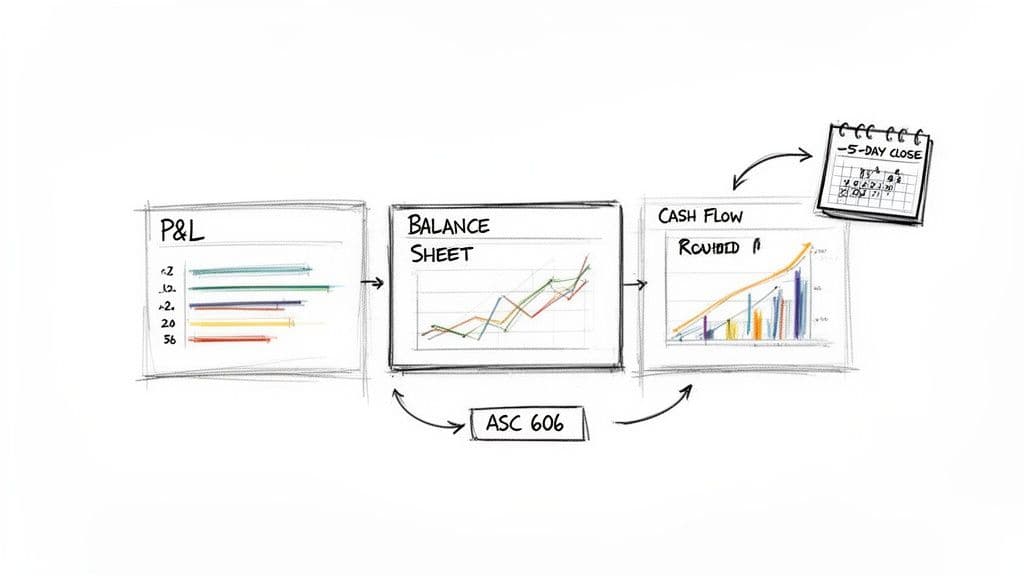
An outsourced controller’s work is organized around a set of core deliverables that have a direct impact on your business's health and scalability. Below is a breakdown of what you should expect.
Core Deliverables of an Outsourced Controller
| Deliverable | What It Is | Why It Matters for Your Business |
|---|---|---|
| Fast Month-End Close | Closing the books within 5 business days of month-end. | Gives you near-real-time data to react quickly to opportunities and threats. Ends decision-making based on stale information. |
| GAAP-Compliant Financials | Producing the P&L, Balance Sheet, and Cash Flow Statement according to Generally Accepted Accounting Principles (GAAP). | This is a non-negotiable standard for passing due diligence with investors or securing traditional bank financing. |
| Accurate Revenue Recognition | Implementing proper ASC 606 processes to recognize revenue over the life of a contract, not just when cash is collected. | Prevents you from misrepresenting your growth and burn rate to investors, a mistake that kills deals and destroys trust. |
| Cash Flow Management | Providing a clear picture of cash movements and a rolling 13-week cash forecast. | Helps you manage runway, anticipate shortfalls, and make critical decisions about hiring, spending, and investment. |
| KPI & Management Reporting | Creating dashboards that track SaaS/service metrics like MRR, LTV, and CAC to provide actionable insights. | Translates raw financial data into a clear story about business performance, highlighting what's working and what's not. |
These deliverables work together to create a system of financial control and intelligence that growing companies desperately need but often can't afford to build in-house.
A Predictable Month-End Close in 5 Days
If you're still waiting until the 20th of the month to find out what happened last month, you're making decisions with obsolete data. A key function of an outsourced controller is to enforce a disciplined, predictable month-end close process. The goal is firm: close the books within five business days.
This speed gives you a near-real-time view of your performance, so you can pounce on opportunities or fix problems before they get out of hand. For a closer look at the tasks that make this possible, check out our guide on what a controller does to orchestrate a fast close.
Investor-Ready, GAAP-Compliant Financials
Your controller produces the three core financial statements your business runs on: the Profit & Loss (P&L), Balance Sheet, and Statement of Cash Flows. The critical part? They ensure these are prepared according to Generally Accepted Accounting Principles (GAAP).
Without GAAP-compliant financials, you simply won't pass due diligence with savvy investors or secure traditional bank financing. It’s a hard requirement for any company aiming for a significant funding round, a bank loan, or an acquisition.
Accurate ASC 606 Revenue Recognition
This is a minefield, especially for SaaS companies and professional services firms. ASC 606 is the accounting standard that dictates how you recognize revenue from customer contracts. Getting it wrong paints a dangerously misleading picture of your company’s health.
Example: The Cost of Getting Revenue Wrong
Imagine you're a SaaS company and you sign a new client on a $120,000 annual contract, which they pay upfront in January. An inexperienced bookkeeper sees the cash hit the bank and records the full $120,000 as January revenue.
- The Wrong Way: January Revenue = $120,000
- The Correct ASC 606 Way: January Revenue = $10,000 (with the remaining $110,000 booked as a liability called "Deferred Revenue" on the Balance Sheet)
That one mistake overstates your January revenue by $110,000. If you show that to an investor, you have misrepresented your burn rate and runway. It’s a fatal error that destroys credibility and kills deals on the spot.
An outsourced controller ensures this never happens. They manage the amortization schedule so your P&L always reflects earned revenue, not just cash in the bank. This precision is exactly what separates amateur bookkeeping from professional financial management.
Calculating the True ROI of Outsourced Controller Services
Hiring a full-time, US-based controller is a gut-check moment for any founder. You're looking at a $150,000+ annual commitment once you factor in salary, benefits, and taxes—a massive investment that can suck the air out of your cash flow.
But if you’re only looking at outsourced controller services as a way to save money, you're missing the point. The real value isn't just in what you save, but in the strategic firepower you gain. An outsourced team brings a level of expertise and operational efficiency that a single hire rarely can, all at a fraction of the cost.
Let’s break down the real numbers to see how the return on investment (ROI) actually stacks up.
Direct Cost Comparison: Full-Time Hire vs. Outsourced
The most straightforward comparison is the direct cost, and the difference is stark. A full-time employee comes with loaded costs beyond their base salary: benefits, payroll taxes, recruiting fees, and technology costs. An outsourced service bundles all that expertise and overhead into a single, predictable monthly fee.
Here’s what that looks like side-by-side for a typical growth-stage company:
| Cost Component | Full-Time In-House Controller | Outsourced Controller Service |
|---|---|---|
| Annual Salary | $120,000 | $0 |
| Payroll Taxes & Benefits (30%) | $36,000 | $0 |
| Recruiting & Onboarding | $25,000 (one-time) | $0 |
| Software & Training | $5,000 | Included |
| Outsourced Service Fee | $0 | $48,000 (at $4,000/month) |
| Total Year 1 Cost | $186,000 | $48,000 |
| Year 1 Savings | $138,000 |
The direct savings are obvious. But the true ROI isn't just in cost arbitrage; it's in the value that money creates.
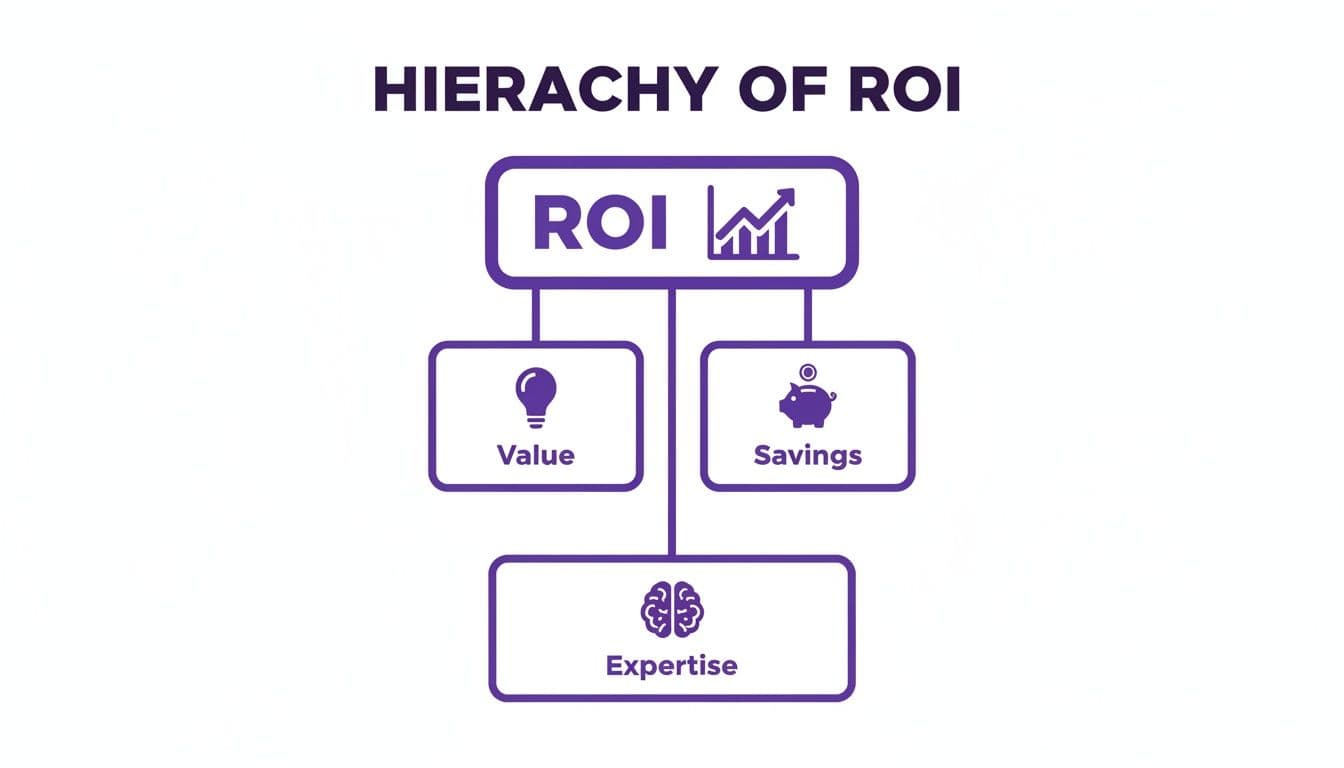
Quantifying the Hidden ROI
The most significant returns come from the places you don't immediately track on a spreadsheet—the "hidden ROI" that has a massive impact on your company's financial health, scalability, and valuation. This is where an expert partner proves their worth.
- Catching Costly Errors: A skilled controller team doesn’t just record transactions; they scrutinize them. For instance, misclassifying a $5,000 monthly software expense can wreck your Cost of Goods Sold (COGS) and gross margin, leading you to make terrible pricing decisions. For SaaS companies, a healthy Gross Margin is 75% or higher. An error like this can make a healthy business look unprofitable.
- Improved Cash Flow Visibility: Vague cash forecasts are a death sentence for a growing company. An expert controller improves cash flow forecast accuracy by 40% or more. A reliable 13-week cash flow model lets you manage working capital with precision, dodge surprise cash crunches, and confidently time strategic investments in hiring or marketing.
- Audit-Ready Financials on Demand: Being "audit-ready" isn't just about passing an audit. It means you can accelerate due diligence for a fundraising round or acquisition. This state of readiness slashes weeks off a deal cycle, giving you a huge negotiating advantage and preventing the deal fatigue that kills opportunities.
This shift toward precision financial management is why the demand for these services is exploding. The global market for financial outsourcing, which includes controller services, was valued at USD 58.86 billion and is projected to hit USD 80.8 billion by 2030. This growth is fueled by companies like yours demanding more than just basic bookkeeping. You can dig deeper into this trend in the full financial outsourcing services market report.
Ultimately, calculating the real ROI requires looking beyond a simple cost-benefit analysis. The true value is in building a scalable financial foundation that supports your growth, prevents catastrophic errors, and gives you the confidence to make bold decisions.
For a more detailed breakdown, dive into our complete Controller Services ROI Analysis to model the potential impact on your specific business.
Controller vs. Bookkeeper vs. CFO: Understanding the Roles
One of the most common—and costly—mistakes founders make as they scale past $1M in revenue is confusing the roles within their finance function. They treat "bookkeeper," "controller," and "CFO" as interchangeable titles, leading to financial chaos, missed opportunities, and a complete lack of strategic visibility. To fully grasp their unique responsibilities, you have to understand the core differences in accounting and bookkeeping essentials.
Think of your finance team like a ship’s crew. Each role is critical for the journey, but they have entirely different jobs.
The Bookkeeper: The Historical Record-Keeper
Your bookkeeper is the crew member in the ship’s log room, meticulously recording the journey that has already happened. They are entirely backward-looking, focused on daily financial transactions: categorizing expenses, processing payroll, and reconciling bank accounts.
Their job is data entry and organization. This work is essential for basic compliance and tax prep, but a bookkeeper’s role stops at recording history. They don’t analyze the data, build financial models, or offer guidance on what to do next.
The CFO: The Long-Term Strategist
At the other end of the spectrum is the Chief Financial Officer (CFO). They stand on the ship’s bridge with a telescope, charting the course to a distant destination. A CFO is entirely forward-looking and strategic.
Their focus is on the big picture:
- Raising capital and managing investor relations
- Leading mergers and acquisitions (M&A)
- Developing long-range financial plans and market strategy
- Managing risk at the highest level
For most businesses under $20M in revenue, a full-time CFO is an expensive luxury. They operate at the 30,000-foot level and aren't involved in day-to-day accounting.
The Controller: The Tactical Navigator
This is where the controller comes in—and where most growing businesses have a critical gap. The controller is the ship’s navigator, using real-time data from the ship's instruments to manage the present journey and keep you on the right course. They are the crucial link between historical bookkeeping and future-focused strategy.
An outsourced controller takes the data the bookkeeper records and turns it into actionable intelligence. They analyze, interpret, and report on what’s happening right now. This is the person who ensures your month-end close is fast, your financials are accurate, and your internal controls are strong. The table below breaks down exactly how these roles differ in focus, value, and cost. If you're still unsure, our complete guide on the differences between a bookkeeper vs. controller offers an even deeper comparison.
Bookkeeper vs. Controller vs. CFO Comparison
| Function | Bookkeeper | Outsourced Controller | CFO |
|---|---|---|---|
| Primary Focus | Historical Data Entry | Present-Day Analysis & Control | Future Strategy & Growth |
| Core Question | "What happened?" | "What is happening and why?" | "What's next?" |
| Key Deliverables | Reconciled accounts, basic reports | GAAP financials, cash forecasts, KPI dashboards | Financial models, fundraising strategy, M&A |
| Typical Cost | $50k - $75k / year | $3k - $8k / month | $200k+ / year |
For a growing SaaS or service business, relying solely on a bookkeeper is like trying to navigate a storm with only a logbook of where you've been. You need a controller to interpret the data, manage the controls, and keep the ship on the right path today.
How to Choose the Right Outsourced Controller Partner
Picking an outsourced controller isn't like choosing a new software subscription. Choosing the wrong partner is a costly mistake that can set your growth back by months, create a tax nightmare, or leave you with financials you can't trust. You need a clear scorecard to cut through the sales pitches and find a firm that will actually act as a financial guardian for your business.
The right partner moves beyond just closing the books; they become a strategic extension of your leadership team. This is why the entire Business Process Outsourcing (BPO) market, which includes these vital finance services, is expected to grow significantly, as detailed in projections on the BPO market from Fortune Business Insights. This boom is driven by cloud technology that lets expert firms deliver the high-caliber services growing companies need.
Your goal isn't just to hire an accountant—it's to find a partner who gets your industry, knows your tech stack, and is built to handle your growth ambitions.
The Core Vetting Checklist
Treat this as a non-negotiable checklist when you're talking to potential firms. A "no" on any of these points is a serious red flag and a good reason to walk away.
- Industry Specialization: Do they really understand your business model? A firm that says they "work with everyone" is a master of none. A SaaS specialist will live and breathe ASC 606, MRR, and churn, while a professional services expert will be fluent in project accounting and utilization rates. Generic experience is not enough.
- Team Qualifications: Who is actually doing the work? You need to know. The team should be US-based and led by licensed CPAs. This isn't negotiable. It ensures they are experts in US GAAP, understand federal and state tax nuances, and can communicate clearly without you fighting time zones.
- Tech Stack Proficiency: Your controller has to be fluent in the tools that run your business. Don't settle for "we've heard of it." Ask for direct, hands-on experience with your exact stack, whether it’s QuickBooks, NetSuite, Stripe, or industry-specific platforms. Deep integration knowledge is what unlocks automation and efficiency.
- Security Protocols: You are about to hand over the keys to your financial kingdom. How are they protecting your data? They must have ironclad security measures. Look for SOC 2 compliance as the minimum standard for data protection and operational controls.
A high-quality firm will be proud to show you their credentials in these areas. If they get vague or dismissive when you press for details, it’s time to end the conversation. For a more detailed breakdown of the pros and cons, our in-house vs outsourced controller decision guide can help you clarify the best path for your company.
Red Flags to Watch For
Knowing what to look for is only half the battle. You also need to know the warning signs of a low-quality provider that will create more problems than they solve.
| Red Flag | Why It's a Problem |
|---|---|
| Vague or Complex Pricing | If they can't give you a clear, fixed price, get ready for surprise bills. You want transparent, fixed-fee monthly plans, not a black box that spits out invoices. |
| No Verifiable Case Studies | Any firm worth its salt will have client testimonials and case studies with hard numbers (e.g., reduced month-end close by 5 days, found $50K in miscategorized expenses). A lack of proof means a lack of results. |
| Non-US-Based Teams | A lack of direct, US-based oversight for a controller role introduces huge risks in quality control, communication, and understanding of US business regulations like ASC 606. |
| No Accuracy Guarantee | Top-tier firms stand behind their work with a guarantee. If they won't promise accuracy, it means they lack confidence in their own people and processes. Why should you have any? |
Choosing your outsourced controller is one of the most important financial decisions you'll make. It directly impacts your ability to raise capital, manage cash, and scale effectively. Use this framework to filter out the noise, avoid a costly mismatch, and find a partner who will give you the financial control and clarity your business deserves.
Your Questions, Answered
As a founder, it’s smart to be skeptical before handing over a critical function like financial oversight. Here are direct answers to the most common objections and questions we hear from leaders who are on the fence.
How much do outsourced controller services cost?
The cost isn't a one-size-fits-all number. The right price depends entirely on your company’s transaction volume, complexity, and growth stage.
For a business in the $500K-$2M revenue range, a foundational plan usually starts around $3,000 per month. As you push toward the $5M-$20M mark and your needs get more complex—think multi-entity consolidation or advanced revenue recognition—costs typically land between $5,000 and $8,000+ per month.
Compare that to the $186,000+ annual loaded cost of a single, full-time controller we calculated earlier. With an outsourced service, you get an entire team of US-based, CPA-certified experts for a fraction of the cost, without the extra overhead of benefits, payroll taxes, or recruiter fees.
Objection: "I will lose control of my finances by outsourcing."
This is the biggest myth, and the reality is the exact opposite. Outsourcing your controller function doesn’t mean losing control; it means gaining superior control through radical visibility.
Think about it: are you truly in control right now if your books are a mess, your cash forecast is a wild guess, and your month-end close drags on for weeks? An expert controller installs proven systems and delivers timely, accurate reports. You finally get a clean dashboard showing exactly what’s happening in your business.
You get the reliable data needed to make confident decisions. This isn’t losing control; it's finally getting the tools to steer your business with precision.
How long does onboarding take?
A professional firm will have a well-oiled onboarding process. The goal is simple: integrate with your systems, clean up any historical mess, and establish a new financial rhythm—all with minimal disruption to you and your team.
A typical onboarding takes just 2 to 4 weeks and follows a clear, structured path.
| Week | Key Activities |
|---|---|
| Week 1 | Kickoff & System Integration: Granting secure access to your accounting software (QuickBooks, NetSuite), bank accounts, and payment processors like Stripe. |
| Week 2 | Diagnostic & Cleanup: The team dives into your historical data, flags errors, and starts the cleanup and reconciliation process. |
| Week 3 | Process Implementation: New, documented workflows for accounts payable, revenue recognition, and payroll are put in place. |
| Week 4 | First Streamlined Close: We execute your first month-end close under the new system, delivering financials within 5 business days. |
By the end of your first month, you will have a clean, reliable financial engine and a set of reports you can actually trust to run your business.
Your Next Step: Take Control of Your Financials
You've outgrown your current financial setup, and that's a good problem to have. It means it's time to install the financial discipline your company deserves. You don't have to tackle complex accounting rules, cash flow modeling, and investor reporting by yourself. That’s our job.
The team at Jumpstart Partners provides the clarity and control you need to scale with confidence. Book a free consultation today to see how our US-based, CPA-led outsourced controller services can transform your financial operations.