Financial Operations
QuickBooks Bookkeeping Services: What Growing Firms Need
Discover how QuickBooks bookkeeping services streamline your finances, ensure accuracy, and free up time for strategic growth. Explore the benefits today.
ByJumpstart Partners, CPA, QuickBooks ProAdvisor
··13 min readQuickBooks bookkeeping services for growing companies usually run $300 to $2,500+ per month depending on complexity. The payoff isn't transaction entry, it's how many days you cut from month-end close and how fast you get decision-grade numbers.
For founders and finance leaders at $500K to $20M in revenue, that distinction matters. You're not buying a cleaner ledger, you're buying a faster operating rhythm, tighter cash visibility, and financials that don't fall apart when an investor, lender, or board member asks a hard question.
Table of Contents
- Why QuickBooks Bookkeeping Is a Growth Problem, Not an Admin Task
- What QuickBooks Bookkeeping Services Actually Deliver
- QuickBooks Bookkeeping Pricing Explained With Real Numbers
- Starter vs Growth vs Scale Plans Compared
- How QuickBooks Bookkeeping Works for SaaS, E-Commerce, and Agencies
- ROI of Outsourced QuickBooks Bookkeeping
- How to Choose a QuickBooks Bookkeeping Provider
- Your Next Steps and How to Engage
Why QuickBooks Bookkeeping Is a Growth Problem, Not an Admin Task
QuickBooks has become the default system for small-business bookkeeping in major markets, so the key question isn't whether you use it. The question is whether your setup produces numbers you can trust fast enough to run the business.
QuickBooks dominates the category with 62.23% of the accounting software market, far ahead of ADP at 14.30%, Sage 50 at 10.30%, and Xero at 8.90%. That scale matters because recent estimates put its user base at about 29 million U.S. businesses, 5.3 million QuickBooks Online users worldwide, and more than 7 million small-to-mid-sized businesses using QuickBooks globally as of 2024. When a platform is that embedded, sloppy bookkeeping doesn't stay “back office.” It shows up in pricing decisions, hiring decisions, and cash planning. Accounting software market statistics
Practical rule: if you're still waiting on month-end to understand cash, your bookkeeping isn't bookkeeping anymore, it's delay.
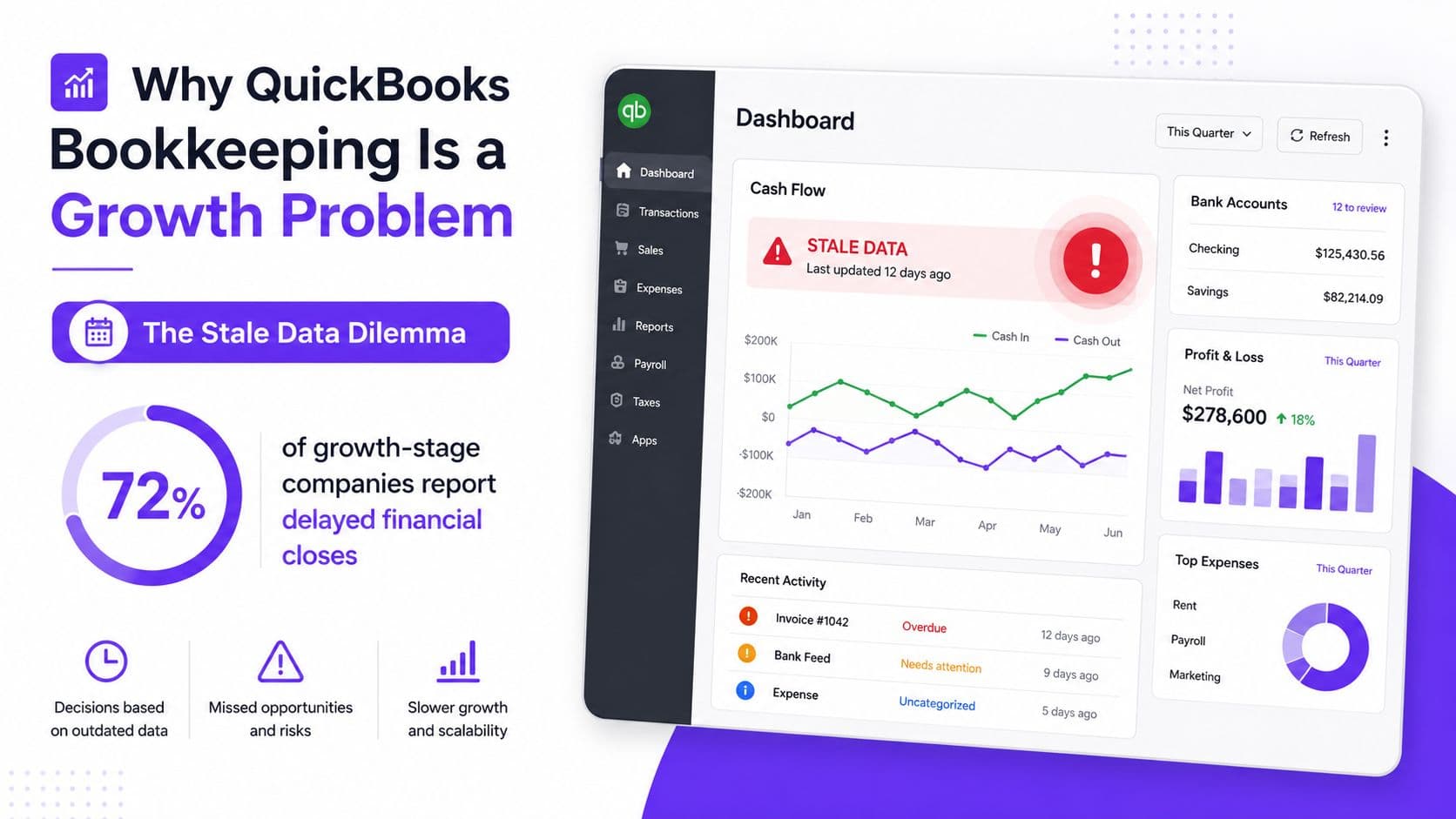
The stale data problem
Growth-stage teams lose time when bank feeds, receipts, and payroll entries sit unreviewed. That lag creates stale dashboards, which is why outsourced QuickBooks bookkeeping services should be judged on close speed and data freshness, not on whether someone “keeps the books.”
If you want a basic framing of the service layer, the bookkeeping services for small businesses discussion is useful, but growing firms need a stronger bar. You're not optimizing for tidy categorization. You're optimizing for fewer surprises, faster reconciliation, and a close process that doesn't drag into the next month.
QuickBooks itself also makes the operating model obvious. Its bookkeeping engine leans on direct bank and credit-card feeds, automated categorization, and continuous reconciliation, which is exactly why the quality of the setup determines whether you get decision-ready financials or just a prettier version of lag.
What QuickBooks Bookkeeping Services Actually Deliver
A competent QuickBooks service owns the financial plumbing end-to-end. If a provider only “enters transactions,” you're paying for clerical work while the core finance work still lands on your desk.
The core deliverables
A proper service should handle bank and credit-card reconciliations, accounts payable and receivable workflows, payroll reconciliation, month-end close, management reporting, and cash-flow visibility. Intuit's accountant-focused tools emphasize multi-client workflows and reconciliation features for firms operating at scale, and its product materials also highlight receipt capture, bill management, automated invoices and reminders, revenue recognition, project tracking, custom reporting, and KPI dashboards. That mix is what lets bookkeepers move from entry work to control-layer work. QuickBooks accountant features
Operational rule: if a provider can't explain how they reconcile cash, payroll, and revenue together, they're not running your books, they're assembling them.
For companies with real process discipline, the value comes from lowering exception load. Reconciliations make the rest of the financial statements believable. Payroll reconciliation keeps labor expense and cash outflows aligned. Revenue recognition matters because SaaS investors don't care how pretty your P&L looks if deferred revenue and recognized revenue don't match reality.
That's also why you should think beyond bookkeeping when tax and compliance enter the picture. The guide to business tax compliance is a helpful resource if you're mapping how bookkeeping feeds tax filings, estimated payments, and year-end reporting. Strong books make tax work easier. Weak books make every downstream deadline more expensive.
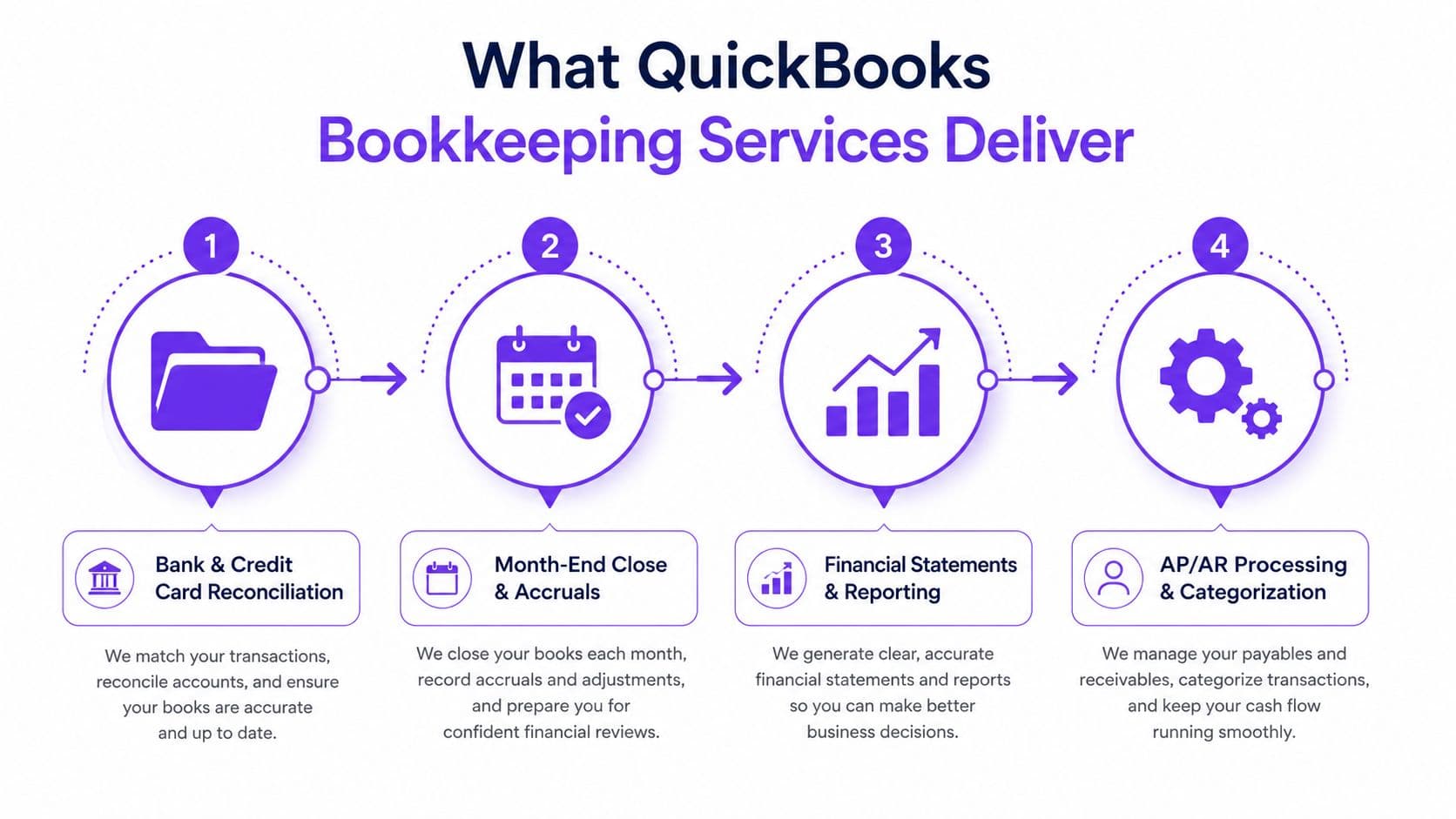
A decent provider should also tell you what they own during close. If they don't own accruals, reporting, and exception review, they're not delivering controller-grade output. They're only reducing your transaction pile.
QuickBooks Bookkeeping Pricing Explained With Real Numbers
Pricing makes sense only when you connect it to complexity. A flat quote without scope is just a guess with a nicer font.
QuickBooks' own outsourcing guidance says small businesses may start around $300 per month, while companies with multiple revenue streams, inventory, or complex payroll can expect $2,500 or more monthly. That spread is not about whether the bookkeeper is “busy.” It's about whether someone is making judgment calls across cash, payroll, revenue, and reporting. QuickBooks bookkeeping service pricing guidance
Three revenue stages, three pricing realities
At $750K in annual revenue, a founder often has a small stack, one main operating account, and light payroll. That's the zone where a lower-cost service can work if the chart of accounts is clean and the business doesn't have messy revenue recognition.
At $3M, the business usually has more than one revenue stream, more payment methods, and enough volume that close mistakes start affecting board updates. At that point, a mid-tier service is the right baseline because you're paying for someone to catch exceptions, not just sort transactions.
At $12M, complexity becomes the product. Inventory, contractor payroll, multiple entities, and investor reporting push the work into controller territory. The monthly fee is higher because the consequence of getting it wrong is higher.
| Revenue stage | What usually changes | What you should expect |
|---|---|---|
| $750K | Simpler transactions, lighter reporting | Basic reconciliation and monthly financials |
| $3M | More accounts, tighter cash oversight, more judgment calls | Faster close, accrual support, stronger reporting |
| $12M | Multi-system, multi-entity, investor-facing operations | Controller-grade close, custom reporting, exception handling |
For budgeting, use this rule. $300 per month buys transaction processing. $2,500+ per month buys a controller-grade operation that can own the cleanup when things don't tie. If you want a deeper look at package structure, the pricing page is the right place to compare scope against the stage of the business.
If you're also trimming software sprawl, the cut wasted subscription spend article is worth reading before you blame bookkeeping costs alone for margin pressure. In plenty of companies, the software stack and the finance stack are both bloated.
Starter vs Growth vs Scale Plans Compared
Teams often underbuy bookkeeping. They choose the cheapest plan, then act surprised when close drags and the books still need cleanup.
A better way to think about it is stage fit. Starter is for low-complexity businesses. Growth is for companies that need usable numbers fast. Scale is for businesses that are already operating like financial systems matter.
| Plan | Best For | Typical Close Time | Core Deliverables |
|---|---|---|---|
| Starter | Early-stage firms with limited accounts and simple cash activity | 20 days | Reconciliations, basic financial statements, standard categorization |
| Growth | Companies that need reliable management reporting and tighter close discipline | 5 days | Reconciliations, accruals, monthly close, reporting, cash visibility |
| Scale | Multi-entity or investor-facing companies with more operational complexity | 5 days or less with heavier oversight | Controller support, consolidated reporting, deeper review, exception management |
The mistake most companies at $1M to $5M revenue make is pretending Starter is enough. It isn't. You save a little monthly, then lose far more in delayed decisions and cleanup time. If your finance lead is still chasing bank matches at the end of the month, you're paying the wrong team to do the wrong job.
CFO rule: don't buy the cheapest close, buy the close that lets you run the business before the month is old.
For founders comparing finance platforms and operating models, the pricing strategy guide for founders is useful context, because underpricing and underinvesting in finance follow the same bad instinct. You want enough structure to see reality early, not after it's already expensive.
How QuickBooks Bookkeeping Works for SaaS, E-Commerce, and Agencies
The service looks similar on paper, but the configuration changes by business model. If your provider treats every client the same, they're missing the point.
SaaS needs revenue discipline
SaaS bookkeeping lives or dies on ASC 606 revenue recognition, deferred revenue tracking, and clean payment reconciliation from tools like Stripe into QuickBooks. The goal is simple, your MRR and ARR dashboards have to reflect reality, not just cash collected. If revenue is recognized incorrectly, the reporting layer becomes unreliable fast.
E-commerce needs inventory and payment clarity
E-commerce and DTC businesses need Shopify and Square integrations, COGS mapping, inventory sync, and multi-channel payment reconciliation. The hard part isn't entering sales. It's matching sales, refunds, fees, payouts, and inventory movement so gross margin is trustworthy.
Agencies need project economics, not just a P&L
Professional services firms need project profitability tracking, retainer versus project revenue treatment, and labor-cost allocation. Without that, the books tell you revenue, but not whether the work is healthy.
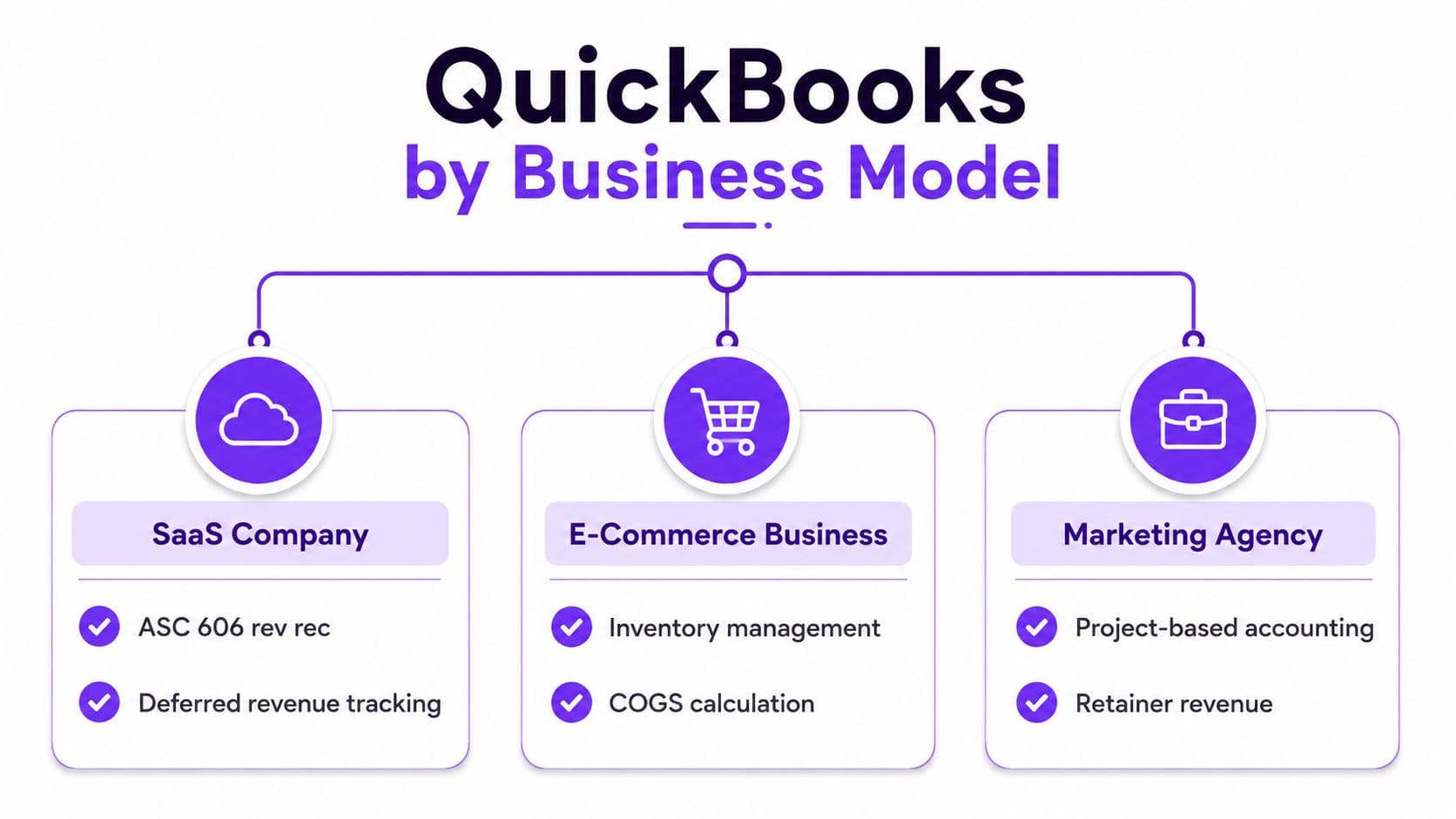
The internal mechanics matter. A SaaS company that understands its revenue engine will usually outgrow DIY bookkeeping faster than a local agency with one bank feed and steady retainers. For a more detailed SaaS-specific lens, the accounting for SaaS article is the right companion read.
Jumpstart Partners is one option in this market, and its service model is built around QuickBooks, Xero, NetSuite, Stripe, Shopify, Square, Gusto, and BambooHR integrations. That matters because the bookkeeping work only works when the provider understands the systems feeding the ledger.
ROI of Outsourced QuickBooks Bookkeeping
The ROI case is not theoretical. Faster close, fewer reconciliation errors, and better cash visibility change how quickly you can act.
Independent professional-services benchmarks show that 67% of firms with $1M to $10M in revenue reported faster monthly closes after outsourcing some or all bookkeeping functions. That's the primary lever. Faster close means leadership can use the month while it's still current instead of reacting after decisions are already locked in. Bookkeeping industry statistics
A simple $5M SaaS example
Say you run a $5M SaaS company with a seven-person team and a CFO who spends too much time waiting on books. If outsourced bookkeeping cuts close from 15 days to 5 days, you gain 10 days of decision time each month. That's 120 days a year of earlier visibility into cash, churn, collections, and hiring pressure.
Now layer in error detection. Jumpstart Partners reports $47K+ in errors detected per client in its own operating results. Even if you discount that heavily for your own business, the point stands. One reconciliation issue, one misclassified payroll run, or one revenue-recognition error can distort management decisions long before the books are finalized.
The fee is easy to see. The cost of bad timing is usually hidden until it's expensive.
The cash-flow gain matters too. If you're forecasting weekly instead of guessing monthly, you stop overreacting to collections noise and vendor timing. That doesn't show up as a neat line item on day one, but it changes how much slack you need in the bank.
If you want a clean framework for connecting accounting work to finance outcomes, the controller services ROI analysis is worth reviewing. My view is blunt, when a provider delivers a 5-day close, catches meaningful errors, and hands you board-ready reporting, the monthly fee pays for itself fast.
How to Choose a QuickBooks Bookkeeping Provider
Most providers sell the same words. You need a way to separate real control from polished sales talk.
Use this checklist
- QuickBooks depth: Ask who manages the file, not just who sells the service.
- U.S.-based CPA oversight: You want accounting judgment close to the work, not hidden behind a handoff chain.
- Security posture: Look for SOC 2 Type II or an equivalent control environment.
- Written accuracy commitment: If they won't stand behind the work, they don't trust the work.
- Stack fit: Confirm experience with Stripe, Shopify, Gusto, and NetSuite if those tools are in your stack.
- Close target: A provider should be willing to commit to a 5-day close if you need controller-level output.
Red flags that matter
If a firm gives you vague pricing, it's hiding scope. If it uses offshore-only teams with no clear review layer, you're buying fragility. If it says a slow close is “normal,” it's normal for them, not for a growing company.
The what a virtual accounting firm does piece is useful background, but don't let the category language distract you from the outcome. You need a provider that reduces friction, not one that recites service labels.
One more thing. If the sales call sounds broad but the proposal is thin, walk away. Weak providers talk about bookkeeping as a task. Strong providers talk about close, reporting, and cash control.
Your Next Steps and How to Engage
Bring the right documents to the first call or you'll waste the meeting. You need your last three months of bank statements, your current QuickBooks file, payroll reports, and any debt or investor agreements that shape reporting requirements.
That prep lets a provider tell you what's clean, what's broken, and what can be fixed quickly. It also exposes whether the firm understands your business model or just wants to process transactions.
Prepare this before you talk to anyone:
- Bank statements: so reconciliation gaps show up immediately.
- QuickBooks file: so chart-of-accounts issues are visible.
- Payroll reports: so labor and tax treatment can be checked.
- Debt and investor documents: so reporting obligations aren't missed.
Jumpstart Partners offers month-to-month bookkeeping and controller support, a 5-day close target, a 30-day money-back guarantee, and a CPA-certified team built for growing companies that need cleaner reporting without locking into a long contract.
If you're evaluating quickbooks bookkeeping services this week, start with your current close timeline and your current reporting pain. Then compare every provider against those two numbers, not against a vague promise.
If you're ready to stop treating bookkeeping like admin work, talk to Jumpstart Partners about a close process that gives you usable numbers in days, not weeks. Visit Jumpstart Partners to book a consultation and see whether your current QuickBooks setup is helping you grow or slowing you down.