Financial Operations
Three Way Match: A Founder's Guide to Financial Control
Learn the three way match process to stop cash leaks. A guide for founders on implementing PO, receipt, and invoice matching to prevent fraud and overpayment.
ByJumpstart Partners, CPA, QuickBooks ProAdvisor
··20 min readIf you run a business with real vendor spend, you need a three-way match. More than 70% of mid-to-large businesses with $5M+ in annual revenue already require it in AP, and automation cuts invoice processing time by an average of 40 to 50% compared with manual two-way matching.
A three-way match is the accounts payable process of comparing the purchase order, goods receipt, and supplier invoice so you only pay for exactly what you ordered and received at the agreed-upon price. That sounds basic. It isn't. Most founders don't lose cash because someone steals from them in plain sight. They lose it through sloppy approvals, duplicate invoices, bad pricing, partial delivery issues, and service invoices pushed through without a control framework.
For SaaS companies, agencies, and professional services firms, there's a second problem. Most advice on three way match assumes you buy inventory or physical goods. You don't. Your spend often runs through subscriptions, contractors, cloud tools, retainers, and utility bills. If you apply a rigid manufacturing-style workflow to those invoices, you'll slow down payment approvals without improving control. If you skip controls entirely, you invite cash leaks.
That's the blind spot. And it matters because recent 2025 data indicates that 58% of AP exceptions in mid-market tech companies stem from non-PO processing, where the “receipt” is ambiguous or missing altogether, according to Rillion's overview of three-way matching.
Table of Contents
- Stop Overpaying Your Vendors Unknowingly
- How a Three-Way Match Protects Your Cash
- The Step-by-Step Three-Way Match Process
- Red Flags Common Failures and Smart Exceptions
- Automating the Three-Way Match in Your Business
- KPIs to Measure Your Accounts Payable Performance
- Your Three-Way Match Implementation Plan
Stop Overpaying Your Vendors Unknowingly
If your AP process is “invoice comes in, manager approves it, bookkeeper pays it,” you have a weak control environment. That setup works when you're tiny. It breaks as soon as vendor count, software spend, and team autonomy increase.
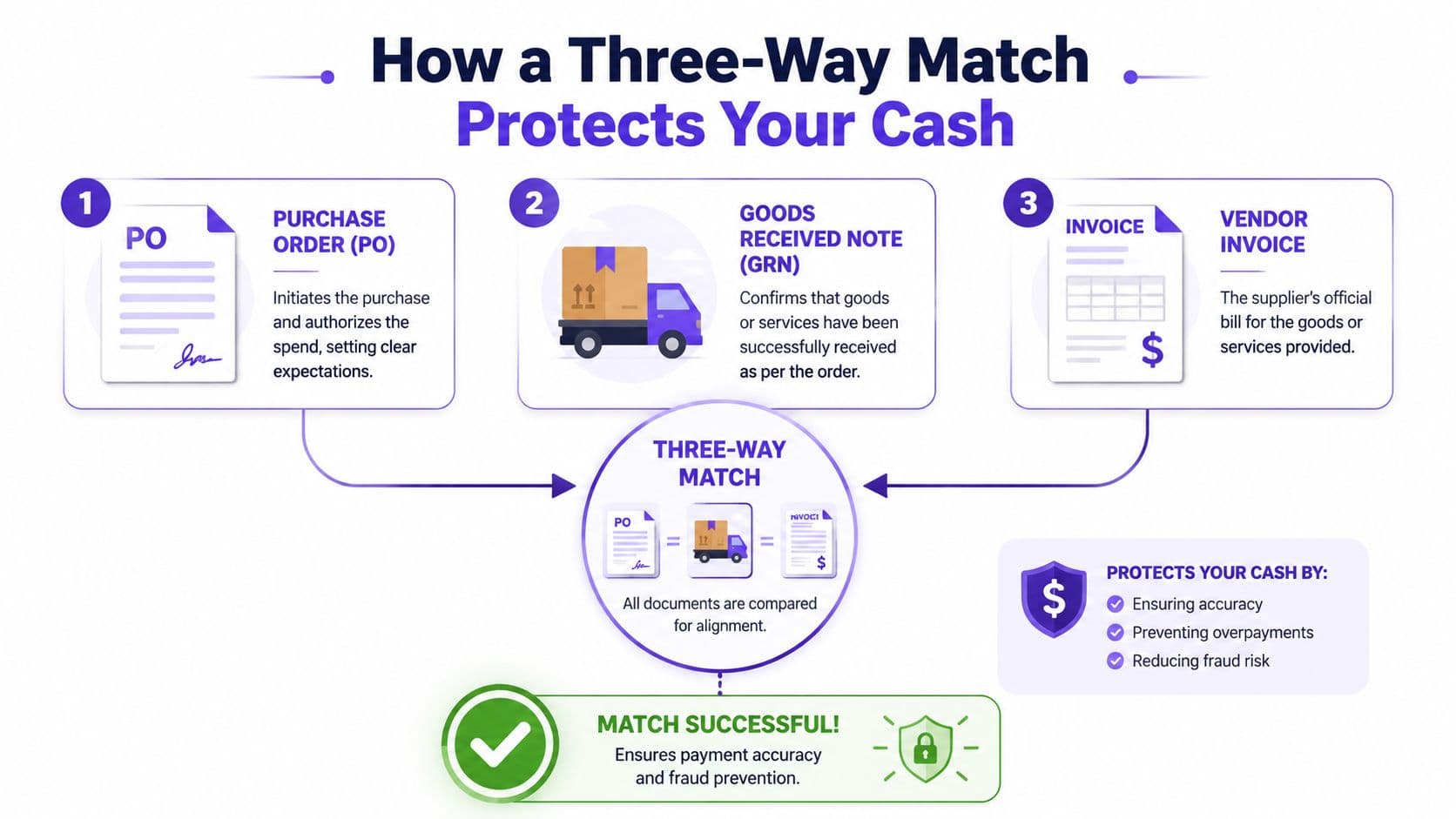
A proper three way match closes that gap. It forces your team to prove three things before cash leaves the bank:
- The purchase order authorizes the spend
- The goods receipt confirms delivery
- The invoice matches what was ordered and received
That's why this process became standard in enterprise finance operations and why over 70% of mid-to-large businesses with $5M+ in annual revenue use three-way matching as a mandatory AP step, with automation reducing invoice processing time by 40 to 50% on average versus manual two-way matching, as noted in Precoro's guide to implementing 3-way matching.
What each document actually does
The PO is your authorization record. It says who approved the purchase, what you agreed to buy, the unit price, quantity, and expected total.
The GRN or receiving record is your proof of delivery. For physical goods, this confirms the items arrived. For service businesses, it is common for teams to get lazy or confused.
The supplier invoice is the vendor's request for payment. It should never be the document that creates the spend decision. It should only bill against a spend decision that already exists.
Practical rule: An invoice is not approval. It's a request.
Why founders should care
When your controls are weak, your financial statements get noisy. Expenses hit the wrong period. Duplicate payments distort cash forecasting. Vendor disputes waste management time. And if you're raising capital or preparing for diligence, buyers and investors will spot that your AP process isn't audit-ready.
If you want a cleaner close, tighter cash control, and fewer ugly surprises, start with AP discipline. A solid process sits alongside other accounts payable best practices for growing companies.
How a Three-Way Match Protects Your Cash
Payment errors rarely start with fraud. They start with ordinary sloppiness. One invoice gets approved without proof of delivery. One SaaS renewal bills for seats nobody uses. One contractor invoice slips through with hours above the agreed scope. A three way match blocks those leaks before they turn into recurring cash loss.
What this control does in practice
A three way match puts a hard review point between invoice receipt and payment release. AP checks three facts before cash leaves the bank.
The spend was approved.
The product, service, or subscription was delivered.
The invoice matches both.
That matters even more in service and SaaS businesses because many invoices never tie neatly to a warehouse receipt. Generic guides focus on inventory. Your real risk sits in non-PO invoices like agencies, software renewals, freelancers, implementation work, and monthly retainers. If you do not adapt the match for those categories, you create a blind spot right where a lot of your cash goes.
Worked example with real numbers
You approve a software purchase for 10 seats at $150 each.
Approved amount = $1,500
The vendor invoices 11 seats at $150 each.
Invoice amount = $1,650
Overbilling = $150
Now apply the service and SaaS version of the third document. Instead of a warehouse receipt, you use a user provisioning report, admin console export, contract milestone signoff, or project owner approval. If that record shows only 10 active seats or only the approved scope delivered, AP holds payment.
If nobody checks and that extra seat stays on the invoice every month, you lose $1,800 per year on one vendor alone.
That is how margins erode. Subtly, repeatedly, and across dozens of vendors.
Why founders get burned on non-PO invoices
Physical goods usually force discipline because someone has to receive them. Services do not. SaaS does not. The invoice shows up, a department head says “yes, we use them,” and AP pays it.
That is weak control.
For non-PO spend, replace the classic goods received note with a required proof-of-service record. Use one of these:
- statement of work milestone approval
- ticket closure report
- timesheet approval
- license provisioning log
- campaign completion signoff
- monthly service review from the budget owner
If your team cannot produce one of those records, do not pay the invoice. An invoice by itself is not evidence that value was delivered.
This discipline strengthens your broader cash disbursement control process. It also improves diligence readiness. Buyers and investors discount companies with weak AP controls because weak controls usually mean misstated expenses, poor forecasting, and preventable cash leakage.
Teams that manage approvals inside project workflows often connect task completion to payment evidence through tools like the Kanban Tasks by Tooling Studio integration. The principle is simple. Payment should follow documented completion, not verbal confirmation.
Why two-way matching misses the real risk
A two-way match checks the PO against the invoice. That catches some pricing and authorization issues, but it does not confirm delivery or completion.
In a service business, that gap is expensive. You can still pay for:
- work that was never completed
- software seats that were never provisioned
- retainers billed outside scope
- duplicate monthly charges after cancellation
- invoices submitted before approval of a change order
Use a full three way match for material spend. For recurring non-PO categories, build an equivalent control with approved scope, proof of completion, and invoice review. That is how you stop cash leaks without slowing down the business.
The Step-by-Step Three-Way Match Process
A manual three way match isn't complicated. It just requires clear ownership. Procurement creates the PO. Operations or the requestor confirms receipt. AP performs the match and holds payment if anything is off.
The core workflow
-
Create the PO before the vendor starts work or ships goods
No PO, no clean control. The PO needs the vendor name, date, quantity, unit price, total amount, and approval. -
Capture receipt or completion evidence
For inventory, that's a goods receipt note. For service work, use a service acceptance record, project manager signoff, ticket closure, or license provisioning log. -
Collect the invoice
AP should require the invoice to reference the PO or other approved spend document. -
Match line by line
Don't compare only the total. Compare quantity, unit price, total amount, PO number, and vendor details. -
Resolve exceptions before payment
AP shouldn't “just fix it in the system.” Send mismatches back to the responsible owner.
Three-Way Match Verification Process
| Document | Key Fields to Match | Verification Action | Common Mismatches |
|---|---|---|---|
| Purchase Order | Vendor name, PO number, item or service description, quantity, unit price, total amount, approval | Confirm the purchase was authorized before work began | Missing approval, wrong price, outdated scope |
| Goods Receipt or Service Confirmation | PO number, quantity received, delivery or completion date, item or service description | Confirm what was actually delivered or completed | Partial delivery, missing receipt, service not signed off |
| Supplier Invoice | Vendor name, PO number, quantity billed, unit price, total amount, billing period | Compare invoice against PO and receipt before payment release | Overbilling, duplicate invoice, wrong billing period |
| AP Final Review | All shared fields across the three records | Approve, reject, or route for exception handling | Manual override, unsupported changes, coding errors |
What to verify every single time
AP should check these fields in this order:
- PO number first: If the invoice can't tie to an approved request, stop.
- Quantity next: This catches overbilling and partial completion issues fast.
- Unit price after that: A wrong rate often hides in otherwise clean invoices.
- Billing period and description: Critical for retainers, subscriptions, and milestone work.
- Math and duplicate review: Make sure totals tie and the invoice hasn't already been entered.
If you want this to work at scale, track every exception visibly. Teams often use task systems so operations, project leads, and AP can resolve mismatches without endless email chains. A practical option is building exception follow-up into a workflow tool or calendarized queue, similar to this Kanban Tasks by Tooling Studio integration, so owners close issues instead of ignoring them.
Who owns what
This process fails when everyone assumes someone else checked it.
- Department lead: Requests and approves the spend
- Operations or project owner: Confirms receipt or completion
- AP: Matches documents and enforces payment holds
- Controller or finance lead: Defines policy, thresholds, and override rules
If your team needs a formal buildout, map the policy, approval chain, document flow, and exception routing into a proper AP setup project.
Red Flags Common Failures and Smart Exceptions
The biggest mistake I see is founders treating three way match like a rigid rule that should apply to every invoice. That's lazy finance design. Good controls are precise, not heavy-handed.
Warning signs your process is weak
- Invoices arrive without POs: Your team is letting vendors define spend after the fact.
- No one documents service completion: You have no clean evidence for retainers, subscriptions, or project milestones.
- AP overrides mismatches manually: That destroys the audit trail.
- Receiving is informal: Slack messages and verbal confirmations aren't controls.
- Everything gets full review: Your process is choking itself with low-value admin work.
The non-PO blind spot for SaaS and service firms
Traditional three way match assumes a PO, a receiving document, and an invoice. That works for equipment, inventory, and office hardware. It doesn't fit neatly for software subscriptions, utilities, monthly retainers, or legal bills.
For these categories, the right move is to adapt the control, not fake it.
Use a substitute for receipt:
- SaaS subscriptions: Admin provisioning record, active user count, contract term
- Agency freelancers or consultants: Statement of work milestone approval or project lead signoff
- Utilities or recurring spend: Approved vendor file, expected billing pattern, manager review
- Professional services: Engagement letter plus completion approval on billed work
If the spend has no meaningful receipt event, force-fitting a three way match slows AP and doesn't improve control. For service businesses, your policy should distinguish between physical-goods spend, contract-based recurring spend, and true non-PO invoices.
Set thresholds and exceptions intentionally
Tipalti notes that a common misconception is that three-way matching applies to every transaction. Best practice is to set dollar cutoffs where full three-way matching is only required above a specific threshold, such as $5,000, in its explanation of 3-way match policy design.
That's smart. Here's a simple policy model:
| Spend Type | Recommended Control |
|---|---|
| Physical goods and equipment | Full three-way match |
| Recurring subscriptions with contract terms | Two-way match plus service validation |
| Utilities and predictable recurring bills | Approved vendor review and budget owner approval |
| High-value service invoices | Contract, approval, and service completion evidence |
| Small routine purchases below threshold | Simplified workflow based on policy |
My rule: Match based on risk, not habit.
Handle the contract side before AP sees the invoice
A lot of service invoice problems start upstream in bad agreements. If your statement of work doesn't define deliverables, billing triggers, or acceptance criteria, AP can't verify much. Founders dealing with retainers, milestone billing, or variable scope should tighten their contracts using solid outcome-based service agreement strategies so finance has something objective to match against.
Your control framework also needs separation between approval, receipt confirmation, and payment release. If one person can request, approve, and push payment, you don't have a control system. You have a shortcut. Build proper segregation of duties before volume increases.
Automating the Three-Way Match in Your Business
Invoice volume does not need to be high to break AP. A founder with 80 to 100 invoices a month can still lose control if approvals live in email, service evidence sits in Slack, and finance has to piece together support from QuickBooks, Xero, NetSuite, and shared drives.
How Automation Changes the Process
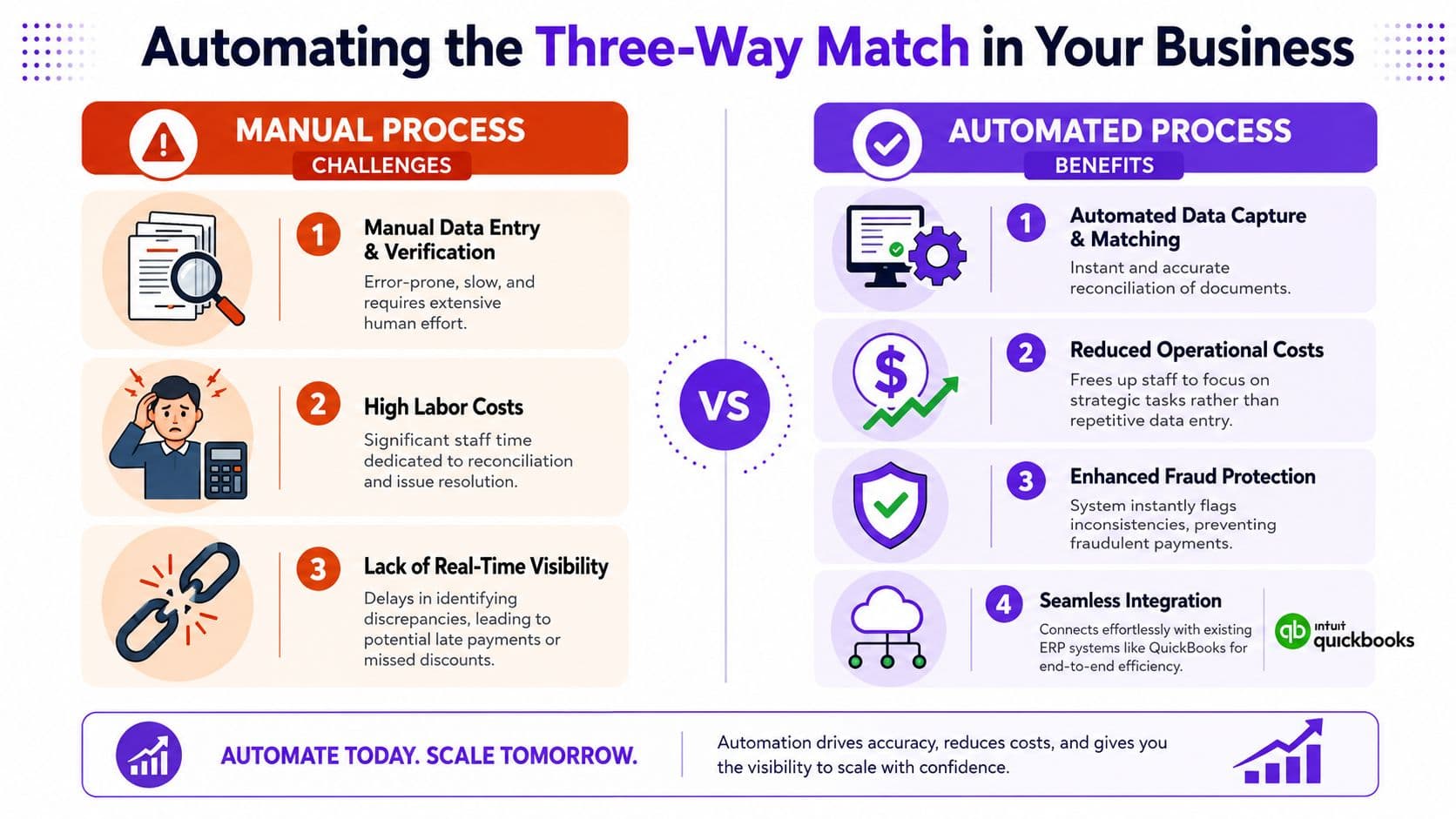
Good automation does more than read invoices. It enforces your policy before cash leaves the bank.
For product businesses, that usually means matching the invoice to the PO and receiving record. For service-based and SaaS companies, the bigger win is handling the non-PO invoice blind spot. Agency retainers, software renewals, cloud usage bills, contractors, implementation fees, milestone billing, and annual prepaid subscriptions often arrive without a clean PO trail. If your system only automates classic PO matching, it misses the spend categories that drain cash in service businesses.
Set up automation to route each invoice by spend type. A hardware invoice should match against PO, receipt, and invoice. A SaaS renewal should match against contract terms, approved owner, billing period, and price. A consulting invoice should require statement-of-work approval plus proof the milestone or service period was completed. AP should not be guessing whether the work happened.
ERP module versus specialized AP tool
| Option | Best For | Pros | Cons |
|---|---|---|---|
| Native ERP module | Businesses already running deep purchasing workflows in NetSuite or similar systems | Fewer systems, cleaner master data, tighter accounting integration | Can take longer to configure and can be too heavy for lean teams |
| Specialized AP tool | Companies on QuickBooks, Xero, or mixed systems | Faster deployment, easier invoice capture, better exception routing for non-PO spend | Requires tighter policy design and clean integration rules |
My recommendation is simple. If purchasing, receiving, and vendor management already live inside your ERP, use the native controls. If you run a service or SaaS business with scattered approvals and a high share of non-PO invoices, a specialized AP tool usually gets you to control faster.
This walkthrough is a good visual primer before you choose a path:
What to automate first
- Invoice capture: Stop keying in PDF invoices by hand
- Spend-type routing: Send product invoices, SaaS renewals, and service bills through different validation paths
- PO enforcement: Require approved spend references where POs should exist
- Contract and service validation: For non-PO invoices, require contract terms, budget owner approval, and evidence of service completion
- Exception routing: Send mismatches to the requestor or department owner, not back to AP
- Approval logs: Keep a permanent audit trail
- Sync to accounting system: Push approved bills into QuickBooks, Xero, or NetSuite cleanly
If you are evaluating policy and process implications alongside software, this SME guide to AP compliance is useful for tightening governance, especially if your business pays a large volume of subscription and service invoices.
For a broader view of workflow design, read this guide on how to automate accounts payable.
KPIs to Measure Your Accounts Payable Performance
You can't improve AP if you only look at whether bills got paid. You need metrics that show whether your process is controlled, efficient, and predictable.
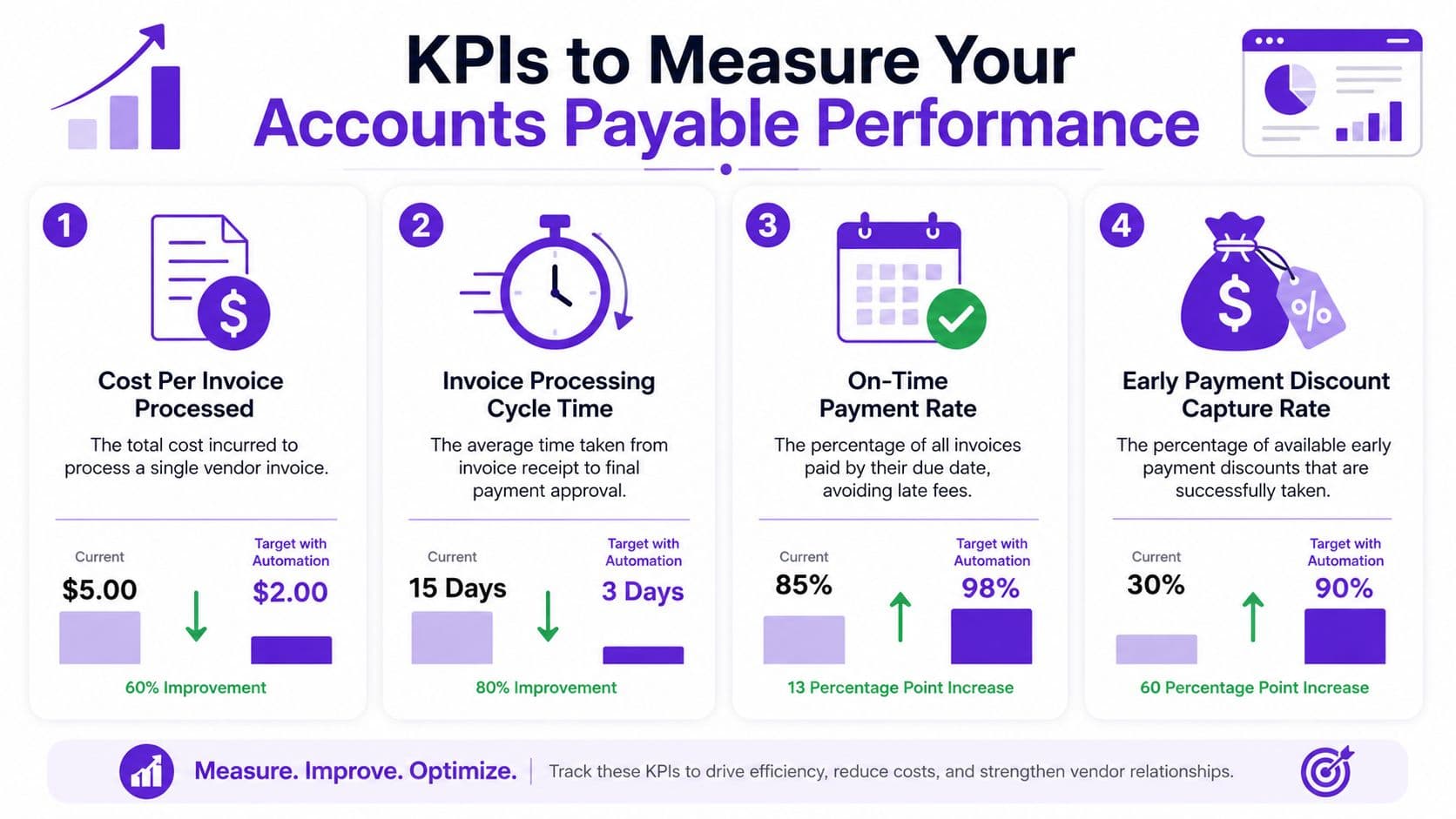
The four KPIs that actually matter
| KPI | What it tells you | What good looks like |
|---|---|---|
| Invoice exception rate | How many invoices fail the first review because something is missing or mismatched | Lower over time, with clear root-cause tracking |
| Average processing cycle time | How long invoices sit between receipt and approval | Shorter without an increase in errors |
| On-time payment rate | Whether you're protecting vendor relationships and avoiding late fees | Consistent and stable month to month |
| Early payment discount capture | Whether your process is fast enough to take available savings | Improving as workflow discipline improves |
How to use them without gaming them
Don't chase speed alone. A very fast AP process with weak controls just pays bad invoices quicker.
Instead, review these metrics together:
- Exception rate rising: Usually means bad intake, weak PO policy, or sloppy service confirmation
- Cycle time rising: Approval bottlenecks or too much manual handling
- On-time payment rate falling: Cash stress, poor workflow, or both
- Discount capture weak: Invoices are arriving late or sitting unapproved too long
Track trends by vendor category. A clean process for software subscriptions won't look the same as one for contractors or equipment purchases.
The KPI infographic above includes sample target ranges for a before-and-after automation view. Use it as a directional dashboard, not an industry benchmark source.
Your Three-Way Match Implementation Plan
A three-way match process fails or pays for itself in the first 90 days. Treat this rollout like a cash control project, not an AP cleanup exercise.
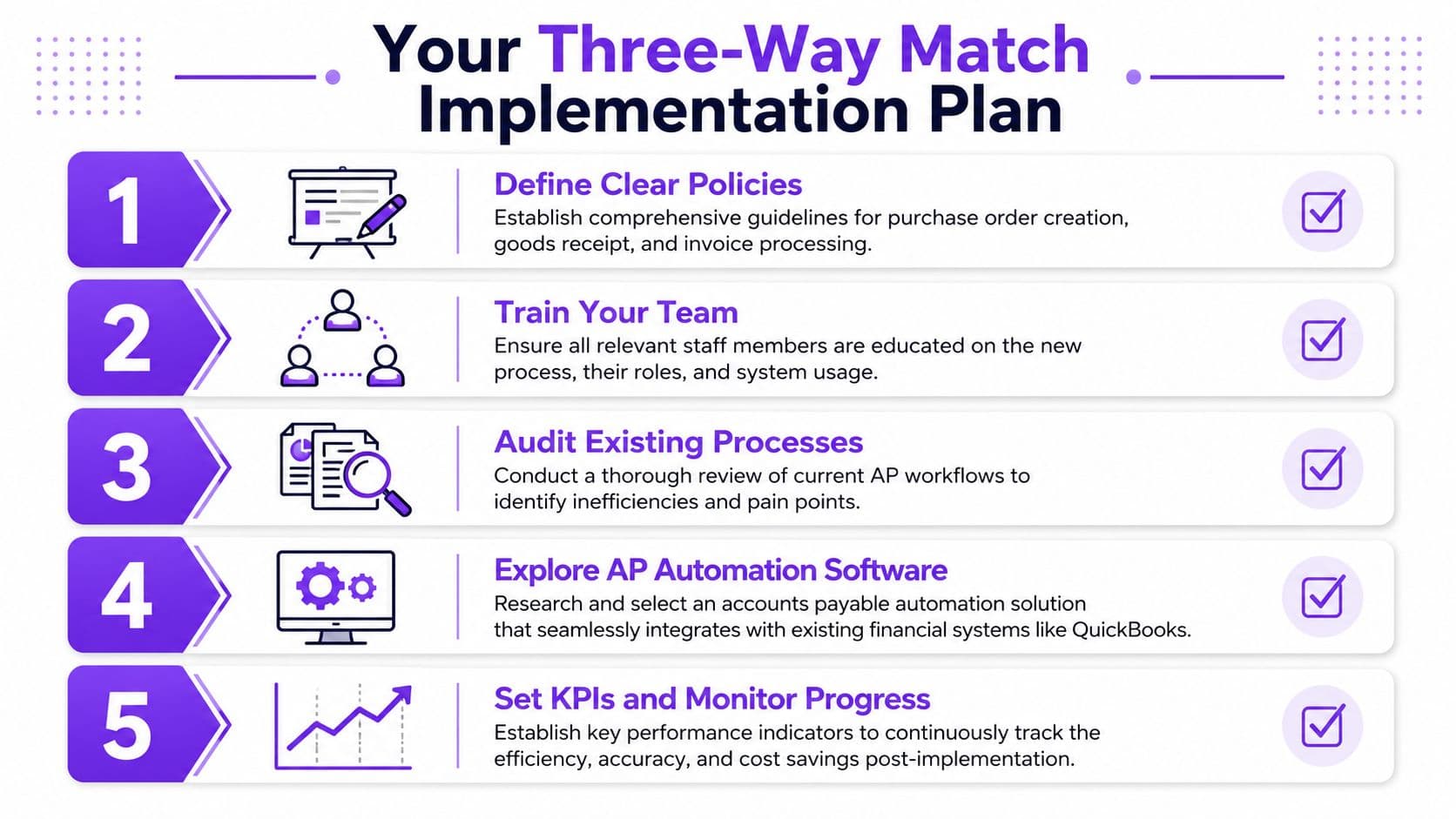
The five-step rollout
-
Map spend into control lanes
Put invoices into clear buckets: inventory or hardware, software subscriptions, contractors, agencies, utilities, and project-based services. Each bucket needs its own approval path, evidence standard, and exception rule. -
Write a payment policy with dollar limits
Set approval thresholds by risk and invoice size. Example: under $500 recurring software renewals can follow a simplified review if the vendor is approved, while contractor invoices over $5,000 require a contract check, budget owner approval, and service confirmation. -
Create a substitute for receiving on service spend
This is the blind spot in SaaS and service businesses. No warehouse receipt exists for a marketing retainer, implementation milestone, or monthly platform admin fee. Use documented proof instead: signed statement of work milestones, ticket closure, user provisioning records, timesheet approval, or department head acceptance. -
Standardize exception handling
AP should not improvise. Build rules for missing POs, rate changes, duplicate invoices, billing period overlap, partial completion, and invoices that exceed contract caps. Assign an owner and target resolution time for each exception type. -
Automate after the rules work manually
Configure software only after your approval matrix, intake rules, and service-receipt evidence are clear. Otherwise you just speed up weak decisions.
What to do in the next 30 days
Start small and force consistency.
In week one, pull the last 60 to 90 days of invoices and sort them by vendor type. You will usually find that a handful of service categories create most of the rework, especially contractors, agencies, and software vendors billing outside a PO process.
In week two, pick your top 10 vendors by spend and require one evidence standard for each. For a SaaS tool, that may be the approved order form plus admin confirmation that licenses were provisioned. For an agency, it may be the signed SOW plus monthly deliverable signoff. For contractors, it should be an approved timesheet or milestone acceptance.
In week three, set a hard rule. No invoice gets paid without the required support package. If a team wants speed, they need to submit the right documents up front.
In week four, review every exception and fix the root cause. Do not let AP become a help desk for broken purchasing behavior.
Where implementations actually win
The best rollout is not the one with the most controls. It is the one people will follow.
For goods, the classic PO, receipt, and invoice match works fine. For services, you need contract-based controls and evidence of work performed. That single change closes the non-PO invoice gap that causes sloppy approvals, duplicate payments, and ugly month-end accruals in SaaS and professional services companies.
Use one rulebook for goods and one for service spend. That is how you protect cash without slowing the business down.
If your AP process still depends on inbox approvals, missing POs, and guesswork around service invoices, it's time to fix it. Jumpstart Partners helps SaaS companies, agencies, and professional services firms build audit-ready AP workflows, solve the non-PO invoice problem, and implement scalable controls that protect cash as you grow. Book a consultation if you want a finance team that can design the policy, clean up the workflow, and make your payables process investor-ready.