Financial Operations
What a Virtual Accounting Firm Does (and Why You Need One)
Is a virtual accounting firm right for your business? This guide explains the benefits, services, and how to select the best partner for your company in 2026.
ByJumpstart Partners, CPA, QuickBooks ProAdvisor
··22 min readLet's be blunt: if your finance function is drowning in messy spreadsheets, your month-end close drags on for weeks, and you have no real grasp on your cash flow, it isn't just a nuisance—it's a liability. For founders and CEOs of growing businesses, this isn't just about getting the books done. It's about turning your finance department from a cost center into a strategic weapon with a modern virtual accounting firm.
Is Your Finance Function Costing You Growth?
Every hour you spend on manual financial tasks is an hour you're not making the strategic moves needed to scale your business. This endless cycle of chasing receipts, fixing reconciliation errors, and waiting for outdated reports is a massive opportunity cost. You started a company to build a product or serve clients, not to become a reluctant, part-time bookkeeper.
This reactive, DIY approach puts a hard ceiling on your growth. Without accurate, real-time financial data, you are just guessing at the answers to critical questions:
- What was our true Customer Acquisition Cost (CAC) last quarter?
- Do we actually have the cash runway to hire those two new engineers?
- Which of our service lines is really driving profitability?

From Cost Center to Growth Engine
A virtual accounting firm completely flips this script. It transforms your finance function from a backward-looking administrative chore into a forward-looking strategic asset. Instead of just recording history, a dedicated virtual team builds the financial infrastructure for predictable growth. They deliver investor-ready financials with a 5-day month-end close, giving you back both time and control.
This isn’t about simply outsourcing tasks. It’s about gaining a partner who understands the critical difference between a bookkeeper and a controller. A bookkeeper records transactions. A controller provides the strategic oversight to interpret that data and guide your decisions. You can learn more about the vital differences between a bookkeeper and a controller in our detailed guide.
The insights from top accounting investors all point to the same thing. They don’t just invest in an idea; they invest in a well-run business with a rock-solid financial foundation. A virtual firm gives you that foundation from day one.
What a Modern Virtual Accounting Firm Actually Does
Forget the old-school idea of a remote bookkeeper who just plugs numbers into a spreadsheet. A modern virtual accounting firm is your company’s entire finance department, built on top of a powerful, integrated tech stack. This isn't about just handing off tasks; it's about embedding a full-stack finance team directly into your operations.
This team handles everything from the foundational bookkeeping that keeps your numbers clean to the high-level strategic advice that guides your next big move. They don't just record what happened last month—they help you shape what happens next quarter.
From Foundational Bookkeeping to Strategic Insights
At its core, a virtual accounting firm has to get the fundamentals perfect. This foundational layer is non-negotiable and includes:
- Flawless Reconciliations: Making sure your bank accounts, credit cards, and payment processors like Stripe are balanced to the penny.
- Accounts Payable (A/P): Managing your bills and vendor payments so you never pay late or get overcharged.
- Accounts Receivable (A/R): Handling your invoicing and collections to keep cash flowing into the business.
But that’s just the starting line. The real value comes when this clean, accurate data becomes the fuel for higher-level strategic work. This is where a virtual Controller or CFO steps in to build your financial models, forecast cash flow, and prepare the board reports that drive your most critical decisions.
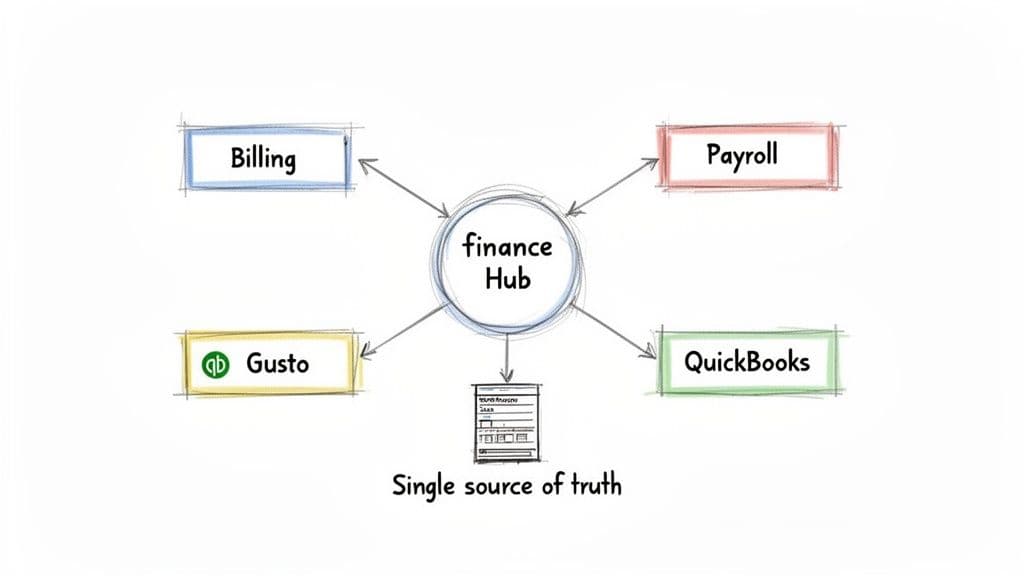
Modern firms are built around technology, using robust accounting automation to eliminate manual work. This tech-first approach is what really separates them from a traditional firm. The entire point is to create a seamless, single source of truth for your finances.
A Real-World Scenario: SaaS Revenue Recognition
Let's take a common nightmare for SaaS companies: ASC 606 revenue recognition. Trying to manage this in a spreadsheet is a recipe for disaster. It’s manual, dangerously error-prone, and completely unscalable.
A virtual accounting firm solves this by building an integrated system. They connect your billing platform (like Chargebee) directly to your accounting software (like QuickBooks Online or NetSuite). This integration automatically pulls subscription data, calculates the correct monthly recognized revenue, and manages your deferred revenue balance without anyone touching a spreadsheet. The result is an accurate, audit-ready P&L that shows your true performance.
This completely eliminates the risk of misstating revenue—a critical error that can shatter investor confidence and create a compliance firestorm.
Your Integrated Tech Stack
The power of a virtual firm is its ability to knit your entire financial ecosystem together. They are masters at connecting separate systems to give you a single, unified view of your company’s health.
| Platform Type | Example Tools | Purpose |
|---|---|---|
| Accounting | QuickBooks Online, Xero, NetSuite | The central ledger for all financial data. |
| Payments | Stripe, Square, Shopify | Captures and processes customer revenue. |
| Payroll | Gusto, BambooHR, Rippling | Manages employee compensation and taxes. |
| Billing | Chargebee, Recurly | Handles complex subscription and MRR models. |
By linking these tools, your virtual team transforms raw transactional data into strategic insights you can actually use. This is how you get a clear, real-time view of your key performance indicators (KPIs). You can see exactly how this works in practice in our deep dive on the automation of financial reporting.
Calculating the ROI of a Virtual Accounting Partner
Founders often get stuck on the idea of "cost savings," but that's a small part of the picture. Deciding to partner with a virtual accounting firm isn't about outsourcing tasks; it's a capital allocation decision. You need to know exactly what you're getting for your money and how it impacts the bottom line with a measurable return on investment (ROI).
The most direct way to measure this is to stack up the fully-loaded cost of an in-house hire against a subscription with a specialized firm. Let’s run the numbers for a typical $5M ARR SaaS company looking to hire a full-time controller.
The True Cost of an In-House Controller
Hiring an employee costs far more than just their base salary. Once you account for taxes, benefits, recruiting, and overhead, these "fully-loaded" costs often run 25-40% higher than the number on the offer letter.
Here's a realistic breakdown for a senior controller in a mid-sized US city:
Worked Calculation: Fully-Loaded Cost of an In-House Controller
| Cost Component | Annual Expense | Notes |
|---|---|---|
| Base Salary | $120,000 | A competitive salary for an experienced controller. |
| Payroll Taxes (FICA, FUTA, SUTA) | $9,900 | Approximately 8.25% of salary. |
| Health, Dental & Vision Insurance | $15,000 | Employer contribution for a comprehensive plan. |
| 401(k) Match | $4,800 | A standard 4% match. |
| Recruiting & Onboarding Costs | $24,000 | One-time cost (20% of salary), amortized over one year. |
| Software & Equipment | $3,500 | Laptop, licenses for accounting software, etc. |
| Total Annual Cost | $177,200 | The real cost to the business. |
Suddenly, that $120,000 hire actually costs your business over $177,000 a year. This doesn't even factor in intangible costs like office space, management overhead, or ongoing training.
Comparing Costs Against a Virtual Accounting Firm
Now, let's compare that number to a typical subscription with a high-quality virtual accounting firm offering controller-level services. These packages are built to give you access to an entire team of experts for a predictable monthly fee.
| Comparison Metric | In-House Controller | Virtual Accounting Firm |
|---|---|---|
| Annual Cost | $177,200 | $72,000 ($6,000/month) |
| Direct Savings | - | $105,200 |
| Percentage Saved | - | 59% |
In this scenario, switching to a virtual partner creates immediate, direct savings of over $105,000 annually—a 59% reduction in cost. For a deeper analysis of these numbers, you can explore our complete controller services ROI breakdown.
This financial benefit is substantial, but it only tells half the story. The true ROI goes far beyond simple cost-cutting.
"Investors fund businesses that have their financial house in order. When we see a company using a specialized virtual firm, it signals financial discipline and an understanding of what it takes to scale. It's a non-negotiable for us during due diligence." — Sarah Chen, Venture Partner at a SaaS-focused fund
The Strategic Value of Expert Guidance
The biggest returns come from the strategic value your virtual partner provides. They aren’t just closing your books; they are actively digging through your financials to find opportunities and flag risks. By 2026, advisory services are set to eclipse basic bookkeeping as the high-value focus for finance teams.
For instance, one study highlighted how a virtual firm helped a business identify a service line that produced 60% of its revenue but only 30% of its profit. This insight led to a strategic shift that dramatically improved the company's overall profitability. You can learn more about these emerging advisory trends.
This is where the ROI becomes exponential. A great virtual accounting firm delivers this strategic value by:
- Optimizing Cash Flow: Building a 13-week cash forecast that helps you manage runway and make smarter spending decisions before you have a problem.
- Improving Unit Economics: Providing a crystal-clear analysis of your SaaS metrics like LTV:CAC and payback periods, allowing you to fine-tune your growth engine.
- Ensuring Fundraising and Audit Readiness: Delivering investor-ready financials that stand up to the intense scrutiny of due diligence, accelerating your path to closing a round.
When you factor in these strategic benefits, the ROI of a virtual accounting firm isn't just about saving money—it's about building a more valuable, resilient, and scalable company.
How the Virtual Accounting Engagement Model Works
Switching to a virtual accounting firm isn’t just swapping out your bookkeeper. It's about installing a completely new operating system for your company’s finances. The process is built to be predictable and deeply integrated, replacing the usual chaos of messy spreadsheets and endless email threads with a structured system built for financial clarity.
The journey kicks off with a deep dive into your current financial mess. A dedicated team runs an initial audit of your tech stack to figure out what’s working, what’s broken, and what’s missing. This isn’t a sales pitch—it's a diagnostic to map out the most efficient way to connect tools like QuickBooks, Xero, Stripe, NetSuite, and your payroll provider into a single, automated financial engine.
Onboarding and Integration
The first 30 days are all about laying a clean foundation. The goal is to get your systems talking to each other and your historical data cleaned up, all with minimal disruption to your actual business operations.
A typical onboarding process follows these key steps:
| Step | Action | Business Outcome |
|---|---|---|
| 1. System Audit & Cleanup | Your new team hunts down and fixes past bookkeeping errors, reconciles historical accounts. | You start with a clean, accurate, and trustworthy set of books from day one. |
| 2. Tech Stack Integration | Core systems (accounting, payments, payroll, billing) are connected to ensure automated data flow. | Manual data entry is eliminated, dramatically reducing errors and speeding up processes. |
| 3. Process Documentation | Key workflows for A/P, A/R, and expense management are defined and documented. | Everyone on your team knows exactly what to do, creating consistency and efficiency. |
| 4. First Month-End Close | The process wraps with your first collaborative month-end close using the new system. | You experience a fast, accurate reporting cycle and get a preview of your new cadence. |
Once this foundation is in place, you’ll fall into a predictable monthly rhythm of financial reporting and strategic reviews, all managed through a transparent, collaborative workflow.
Communication and Security
A common fear founders have is losing touch with their finance team. In reality, a modern virtual accounting firm actually increases your connection to your numbers through structured communication and far better technology.
Communication runs through dedicated, secure channels. You’ll typically get a shared Slack or Microsoft Teams channel for quick questions and a project management portal for tracking tasks and deadlines. This asynchronous communication is paired with scheduled video calls—usually weekly or bi-weekly—to review financial performance and talk strategy.
“We’ve found that founders using a top-tier virtual accounting firm actually have more control and visibility, not less. With real-time dashboards and a dedicated team in a Slack channel, they can get answers in minutes, not days.” — David Rosenthal, Co-founder of Acquired.fm
This infographic shows the direct path from investing in a virtual firm to achieving measurable business growth.
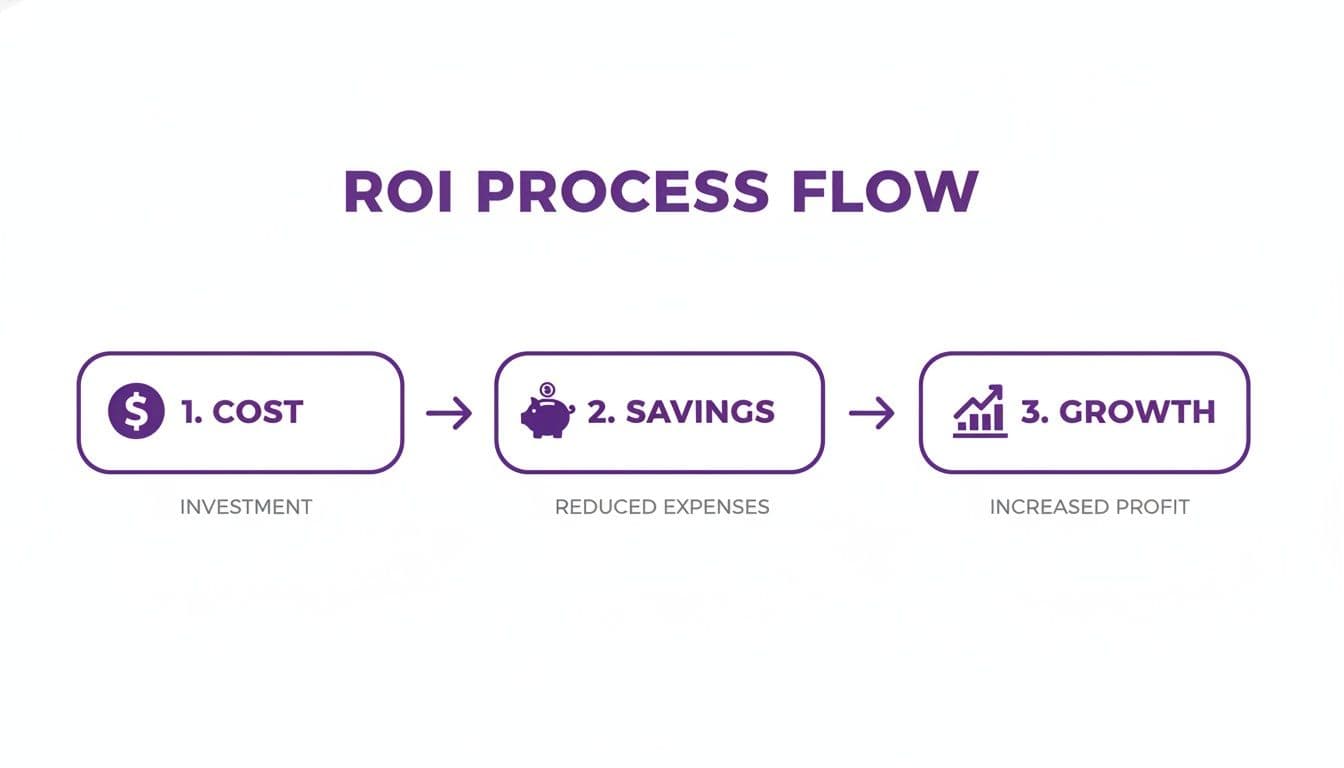
As you can see, the initial cost is quickly offset by direct savings (like lower overhead and fewer errors), then amplified by the strategic growth opportunities unlocked by having better financial data.
Of course, protecting your sensitive financial data is non-negotiable. Reputable firms operate with robust security protocols, including SOC 2 compliance. This is an independent audit verifying that the firm securely manages client data to protect the interests of your organization and the privacy of its clients. It ensures your financials are protected with bank-level security, data encryption, and strict access controls.
Demystifying the Pricing Structure
The final piece of the model is pricing. Virtual firms have largely abandoned the unpredictable, billable-hour model of traditional accounting, opting instead for transparent, value-based pricing.
You’ll typically see two common structures:
- Tiered Monthly Subscriptions: You pick a package (e.g., Starter, Growth, Scale) based on your company’s revenue, transaction volume, and the complexity of your needs. This gives you a predictable monthly expense for core bookkeeping and controller services.
- Fixed-Fee Projects: For one-off needs—like cleaning up years of messy books, setting up an accounts payable automation system, or building a 13-week cash flow model—you pay a single, agreed-upon price. This is perfect for getting targeted help without a long-term commitment. You can see some examples of these in our fixed-fee finance projects.
This model ensures you only pay for what you need and can budget your finance costs with total certainty, tying your investment directly to the value you get back.
Warning Signs Your Current Accounting Solution Is Failing
You feel it in your gut. It’s that knot in your stomach when you’re staring at a three-week-old P&L, trying to make a critical hiring decision. It’s the feeling that your cash flow forecast is more of a lottery ticket than a strategic tool.
These aren't just minor inconveniences. They are significant business risks that are actively holding back your growth. If you recognize these symptoms, your finance function isn't just underperforming—it's failing.
Your Month-End Close Drags Past Day 15
Your month-end close should not be a marathon. If you aren't getting a complete and accurate financial package by the 15th of the following month, you are making decisions with stale data. For a fast-moving business, a 15-day delay means you're steering the ship based on where you were almost two months ago.
A high-performing virtual accounting firm delivers a 5-day close. That speed isn’t a vanity metric; it’s a strategic advantage that gives you timely insights to adjust course quickly.
You Can’t Accurately Track Key Metrics
Can you, right now, confidently state your Monthly Recurring Revenue (MRR), Customer Acquisition Cost (CAC), or Lifetime Value (LTV)? If the answer involves opening a massive, color-coded spreadsheet that only one person on your team truly "owns," your metrics are fragile and almost certainly inaccurate.
For a SaaS company, this is a fatal flaw. According to OpenView's 2024 SaaS Benchmarks, a median LTV:CAC ratio of 3x to 5x is a strong indicator of a healthy, scalable business. If you can't trust your numbers, you have no way of knowing if your growth engine is efficient or just burning cash.
"A founder who can't speak fluently about their unit economics is a founder who doesn't truly understand their business. Vague answers on CAC or churn during a pitch meeting are one of the fastest ways to lose investor credibility." — Jessica Hayes, Principal at a Growth Equity Firm
If you're constantly struggling to get basic reporting, it’s a clear sign you’ve outgrown your current bookkeeping solution and need a more robust financial partner.
Finance Health Self-Assessment Checklist
Use this checklist to see where you stand. If you answer "Yes" to two or more, your finance function isn't just a minor headache; it's a critical vulnerability that needs immediate attention.
| Warning Sign | Business Impact | Is This Happening Now? (Yes/No) |
|---|---|---|
| Financials arrive after Day 15 | Decisions made on stale data; miss opportunities and risks | |
| Can't track key metrics (CAC, LTV) | Don't know if growth is profitable; can't get funding | |
| No reliable cash flow forecast | Risk of unexpectedly running out of money; can't plan hires | |
| One person "owns" the financials | High key-person risk; no institutional knowledge | |
| Board/investor questions take days | Loss of credibility; perceived lack of control | |
| No variance analysis (actual vs budget) | Can't see why you're over/under budget; no accountability | |
| Frequent errors or restatements | Financials are untrustworthy; poor decision-making |
Dismantling the “Loss of Control” Objection
A common fear we hear from founders is the idea of losing control. "How can I trust an outside team with my finances? I need my person here, in the office."
This is a fundamental misunderstanding of what modern financial control looks like. Control doesn't come from having someone down the hall; it comes from having instant access to accurate, real-time data.
A great virtual partner actually enhances your control by delivering:
- Superior Data: By integrating your tech stack—from QuickBooks and Xero to Stripe and payroll systems—they eliminate manual errors and create a single source of truth.
- Real-Time Dashboards: You get 24/7 access to custom dashboards tracking your most important KPIs, accessible from anywhere in the world.
- Expert Oversight: You gain an entire team of CPAs and finance experts who are constantly monitoring your financials, flagging risks, and providing strategic guidance you can't get from a single internal hire.
True control is having the right information at the right time to make the best possible decision. A disorganized, slow, internal process offers only the illusion of control while creating massive blind spots in your business.
How to Choose the Right Virtual Accounting Firm
You understand why you need a modern virtual firm. Now comes the hard part: picking the right one. You're not just looking for any firm; you’re looking for your firm. You need a partner who gets the unique headaches of your business model, whether you're a SaaS company wrestling with ASC 606 revenue recognition or a digital agency just trying to figure out which clients are actually profitable.
Use this checklist on your vetting calls. It will help you cut through the sales pitch and zero in on what really matters.
Deep Industry Specialization
A generic accountant can balance a checkbook. You need a specialist who lives and breathes your industry every single day. Their experience is your shortcut to dodging common pitfalls and implementing financial strategies that are already proven to work.
Ask them point-blank:
- "What percentage of your clients are in the [SaaS/digital agency] space?"
- "Walk me through how you handle complex revenue recognition (ASC 606) for a company just like ours."
- "Which industry-specific KPIs do you track for clients, and what dashboards do you build to monitor them?"
A confident, detailed answer is a green flag. Vague, hand-wavy responses are a major red flag—it means they'll be learning on your dime.
Team Credentials and Structure
You need to know exactly who is doing the work. The credentials and location of the team are direct proxies for the quality and security you can expect. Do not consider a firm that offshores your sensitive financial data to uncertified staff.
"A firm's commitment to hiring US-based, certified professionals is non-negotiable. It's a clear proxy for their dedication to quality, security, and accountability. When you're dealing with financials that will go under investor or auditor scrutiny, you can't afford any shortcuts." — Jonathan Finch, CPA and Financial Advisor
Get clarity on their team with these questions:
- "Are the bookkeepers and controllers who will manage my account all US-based employees?"
- "What certifications does the team hold? I'm looking for things like CPAs and QuickBooks ProAdvisors."
- "Will I have one person I talk to all the time? What does the rest of the support team look like?"
Technology and Security Expertise
A modern accounting firm is as much a tech company as it is a finance company. Their skill in integrating with your tech stack and locking down your data is not a “nice-to-have”—it’s essential. They must be experts in the tools you already use, not just their own.
Put their tech and security know-how to the test:
- "Our stack includes [QuickBooks, Stripe, Gusto]. Tell me about your experience integrating these specific tools."
- "Are you SOC 2 compliant? Can you provide a copy of your report?"
- "What specific protocols do you have for data encryption, access controls, and disaster recovery?"
A firm that can't give you clear, documented answers on security isn't a serious contender. End of story.
Assessing Their Track Record
Finally, past performance is the best indicator of future results. Don't just take their word for it; ask for proof. A firm that actually delivers will be excited to show you.
| Evaluation Method | What to Look For | Key Question to Ask |
|---|---|---|
| Case Studies | Quantifiable results in your industry, like "reduced month-end close from 20 days to 4 days." | "Can you share a case study from a client with a similar business model to ours?" |
| Testimonials | Specific praise about communication, strategic insights, or solving a tough problem. | "Where can I find testimonials from current or past clients?" |
| Client References | Their willingness to connect you with a current client for an honest conversation. | "Would you be open to connecting me with a client for a brief reference call?" |
You now have the exact framework to vet and select the right financial partner. The next step is to put it to use.
Your Next Steps
Building a finance function that drives growth instead of holding you back is one of the most important investments you will make as a founder. The right virtual accounting firm gives you the data, expertise, and time you need to scale effectively.
Ready to build a finance function that drives growth? Schedule a consultation with our team of US-based, CPA-certified experts to see how we can give you investor-ready financials and a 5-day close.
Frequently Asked Questions About Virtual Accounting
When founders and CEOs think about moving their finance function out of house, a few key questions always come up. Here are the straight answers to the most common concerns we hear.
What Is the Real Cost Difference?
Let’s get right to it: the cost. For a company doing around $5M in annual revenue, a full-time, in-house controller can easily cost over $177,000 a year. That’s not just salary—that’s the fully-loaded cost including benefits, payroll taxes, and recruiting fees.
In contrast, a comprehensive virtual accounting firm providing controller-level services typically lands around $72,000 annually (or $6,000/month).
That’s a hard-dollar saving of over 59%, or $105,200 per year. And this math doesn't even factor in the strategic value of having a full team of experts versus relying on a single employee.
How Can I Trust an Outside Firm with My Financial Data?
This is a non-negotiable, and the answer isn't a promise—it's verifiable security standards. Reputable firms prove their security with SOC 2 Type II compliance. This is a tough, independent audit confirming the firm has enterprise-grade controls for managing and protecting your data.
Think bank-level encryption for data in transit and at rest, strict user access controls, and detailed disaster recovery plans. Your financial data is often more secure with a SOC 2 compliant firm than it is sitting on an internal server.
What Does Onboarding Actually Look Like?
A messy transition kills momentum, so a good firm will have a clear, structured process designed to be minimally disruptive. A standard onboarding should take about 30 days.
- System Audit & Cleanup (Week 1): The first step is a deep dive into your existing books and tech stack. The goal is to find and fix historical errors before building anything new.
- Integration & Workflow Buildout (Weeks 2-3): Next, the team connects all your systems—like QuickBooks, Stripe, and Gusto—and documents your key financial workflows. This is where the foundation for an efficient finance function is built.
- First Month-End Close (Day 30): By the end of the first month, you'll experience your first streamlined, 5-day close. This delivers a fast, accurate financial package and sets the rhythm for a predictable financial cadence going forward.
This structured process guarantees a clean handoff and immediately demonstrates the value of an efficient, expert-led finance operation.
Ready to see how a dedicated Jumpstart Partners team can transform your finance function with a 5-day close and investor-ready financials? Schedule a free consultation today.