Financial Operations
What Does an Outsourced CFO Do? Your 2026 Guide
Learn exactly what does an outsourced cfo do for your business. Explore strategic roles, controller differences, & when to hire one for 2026 growth.
ByJumpstart Partners, CPA, QuickBooks ProAdvisor
··18 min readMost articles get the model wrong. An outsourced CFO usually isn't a lone financial strategist dropping into your business for a few calls each month. According to Mercadien's guide to outsourced CFO services, 68% of high-performing finance firms now use a team-based model with embedded controllers, yet only 12% of online guides explain that shift.
That difference matters because strategy without clean numbers is guesswork. If you're running a SaaS company, agency, or professional services firm in the $500K to $20M revenue range, you don't need more bookkeeping alone. You need a finance function that can close the books cleanly, interpret what the numbers mean, and tell you what to do next to protect cash, improve profit, and prepare for fundraising or a major decision.
So what does an outsourced CFO do? In practice, the answer is simple. They turn financial data into decisions. The modern version does that best when the CFO is backed by a controller and bookkeeping layer, so your reporting is accurate, your forecasts are current, and your leadership team gets useful answers instead of delayed spreadsheets.
Table of Contents
- Your Business Is Too Big for a Bookkeeper and Too Small for a Full-Time CFO
- The Five Core Functions of a Strategic Outsourced CFO
- Outsourced CFO vs Controller vs Bookkeeper
- The Right Time to Hire an Outsourced CFO
- Typical Deliverables Pricing and ROI
- The Strategic Toolkit KPIs and Tech Stack Integration
- How to Evaluate and Hire Your Outsourced CFO Partner
Your Business Is Too Big for a Bookkeeper and Too Small for a Full-Time CFO
At a certain stage, weak finance infrastructure starts costing real money.
The pattern is familiar. Revenue is climbing. Headcount is up. Payroll, software, contractors, and tax exposure all get more complicated. Yet the finance function still runs on basic bookkeeping, a month-end P&L, and a quick check of the bank balance. That setup records activity. It does not give a founder enough visibility to decide on hiring, pricing, debt, fundraising, or how much room the business has if sales slow down for a quarter.
This is usually the gap between about $1 million and $10 million in annual revenue, though it can show up earlier in companies with thin margins, uneven cash conversion, or investor pressure. A full-time CFO often does not make economic sense yet. Fully loaded cost can run well into six figures before bonuses, benefits, and recruiting time. But staying with only a bookkeeper or a basic close process creates its own cost in missed margin, late decisions, and preventable cash stress.
The Shift from a Solo Person to a Full Service
Founders often assume outsourced CFO support means hiring one experienced operator for a few hours a month. In practice, the stronger model is a finance function built in layers.
- Bookkeeping: transaction entry, bill pay, payroll support, clean categorizations
- Controller: reconciliations, month-end close, accruals, reporting accuracy, internal discipline
- CFO: forecast, scenario planning, cash management, board or lender reporting, strategic decision support
That structure matters because the work breaks in predictable ways when one person tries to do all three jobs. The books close late. Forecasts get built on bad data. Leadership spends meetings arguing about whether the numbers are right instead of deciding what to do.
A team-backed outsourced CFO model fixes that. The controller protects accuracy. The bookkeeper keeps the ledger current. The CFO uses clean numbers to advise on pricing, hiring pace, gross margin, working capital, and capital needs. The result is faster reporting and better decisions, not just more finance hours.
One practical test is simple. If your leadership team still spends too much time asking what happened last month, your finance structure is behind the business. If you need a clearer role breakdown, this guide on when to hire a bookkeeper, controller, or CFO lays out where each function fits.
Why founders wait too long
Cost is the stated objection. Usually, the bigger issue is avoiding the upgrade until the pain is obvious.
That delay shows up in familiar ways. The close drifts later every month. Cash gets tighter than expected even when revenue looks healthy. Founders cannot answer basic lender or investor questions without pulling numbers from three systems and two spreadsheets. Pricing decisions get made without a clear view of delivery margin. Hiring happens before the business knows what headcount the cash flow can support.
By that point, finance is already reacting.
The better time to bring in outsourced CFO support is before the business feels unstable. The goal is to put in a finance structure that can keep up with growth, with a CFO setting direction and a controller and bookkeeper keeping the underlying data reliable. That model gives a growing company something a solo operator usually cannot: strategic advice built on numbers you can trust.
The Five Core Functions of a Strategic Outsourced CFO
An outsourced CFO doesn't replace your bookkeeper. They use the data produced by bookkeeping and controlling to create a financial operating system for the business.
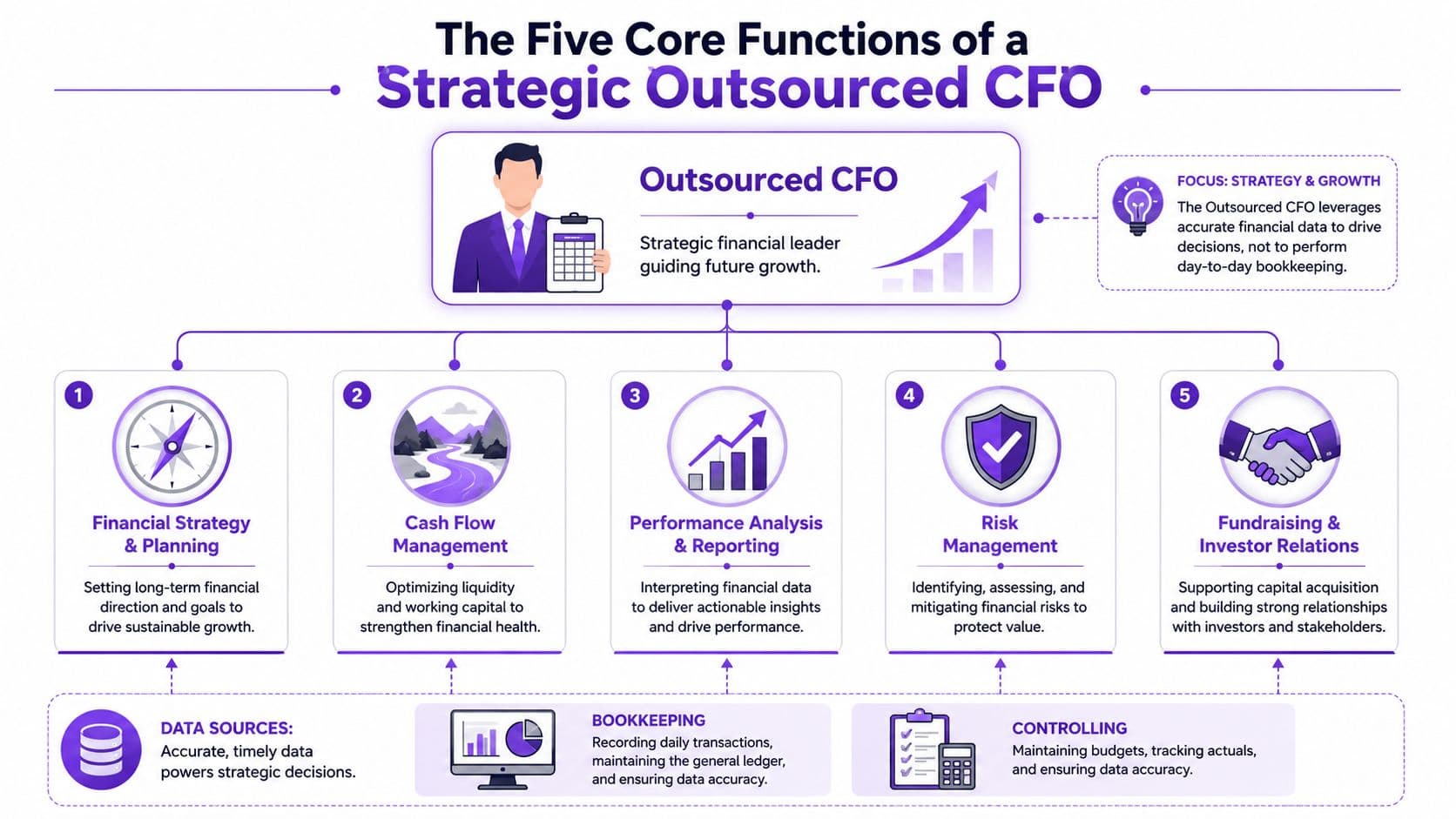
A high-impact outsourced CFO is responsible for designing and monitoring financial infrastructure, creating budgets and forecasts, and translating data into action. According to LBMC's overview of outsourced CFO responsibilities, that work can lead to a 40% improvement in cash flow visibility and the detection of over $47,000 in financial errors per client, on average.
Financial strategy and modeling
This is the core of the role. Your CFO builds the forward view.
That usually means a budget, a forecast, and a model that connects revenue, gross margin, operating spend, hiring plans, and cash. In a SaaS company, that model often ties bookings, retention, and burn together. In an agency, it usually ties utilization, realization, payroll, and client mix together.
Without this model, growth decisions become opinion-led. With it, you can test trade-offs before you commit.
Cash runway and liquidity management
Profit and cash aren't the same thing. Founders learn that the hard way.
A strategic CFO watches timing. Collections, payroll cycles, tax obligations, debt payments, software renewals, contractor spend, and working capital all affect whether you have room to operate. The job is to spot pressure early and act before you're forced into a bad decision.
Good CFO work shows up when a business avoids a cash surprise it never should have had.
Investor and board reporting
If you're raising money or reporting to a board, the numbers need to do more than reconcile. They need to tell a coherent story.
A strong outsourced CFO prepares reporting that explains performance, variance, runway, key risks, and what management is doing next. That includes board decks, lender packages, fundraising models, and the answers behind obvious investor follow-up questions.
Tech stack optimization and KPI dashboards
A CFO should understand your systems, not just your statements. That includes cloud accounting tools such as QuickBooks, NetSuite, and Xero, plus the operational platforms feeding your numbers.
The goal is one source of truth. If reporting depends on manual exports from your billing system, payroll system, and CRM every month, your team will always be late. For a practical overview of how this work fits into a broader finance engagement, see CFO services consulting for growth-stage businesses.
Risk management and compliance
This part gets ignored until it hurts. The CFO helps design internal controls, review reporting risk, pressure-test assumptions, and make sure growth doesn't outrun financial discipline.
That can include:
- Control design: Who approves spend, who records it, and who reviews it
- Revenue quality: Whether contracts, billing, and recognition match
- Decision support: Whether a new product, hire plan, or expansion has a clear financial case
“The ability to see the ‘why' behind the numbers is what empowers leaders to move through complex decisions with confidence.”
LBMC, from its outsourced CFO services overview
Outsourced CFO vs Controller vs Bookkeeper
Founders often hire the wrong role because the titles sound close. They aren't.
A bookkeeper records transactions. A controller makes sure the records are accurate and useful. A CFO turns that financial base into decisions about growth, cash, risk, and capital. If you hire a controller when your business needs a CFO, you'll get cleaner reports but not clearer direction.
The simplest way to separate the roles
- Bookkeeper: What happened?
- Controller: Was it recorded correctly and in compliance?
- Outsourced CFO: What should you do next, and why?
That distinction sounds simple, but it changes how your business runs. A bookkeeper can tell you payroll posted. A controller can tell you it reconciled correctly. A CFO can tell you whether your current payroll mix still supports your margin target.
Role comparison
| Function | Bookkeeper (Past-Focused) | Controller (Present-Focused) | Outsourced CFO (Future-Focused) |
|---|---|---|---|
| Transaction recording | Records bills, invoices, payroll, and expenses | Reviews accounting process and accuracy | Uses the output for planning and decisions |
| Month-end reporting | Produces basic financial reports | Owns close quality and reconciliations | Interprets trends and variance |
| Forecasting | Not the role | Limited support with actuals and reporting structure | Builds forecasts, scenarios, and operating models |
| Cash management | Tracks balances and payments | Monitors controls and reporting integrity | Manages runway, liquidity planning, and capital allocation |
| Compliance | Supports documentation | Enforces processes and internal controls | Assesses strategic financial risk |
| Leadership support | Provides historical records | Explains reporting accuracy | Advises CEO, board, lenders, and investors |
| Main question answered | What happened? | Is it right? | What next? |
What works and what doesn't
What works is hiring to the actual gap.
If your books are late and inconsistent, you likely need controller support before CFO strategy can work. If your reporting is accurate but you still can't answer pricing, runway, or fundraising questions, you need CFO leadership. If you're unsure where the line is, this guide on CFO vs controller gives a practical decision lens.
What doesn't work is asking one person to do all three jobs. That usually produces weak forecasting, delayed closes, and founder frustration because nobody fully owns the strategic layer.
The Right Time to Hire an Outsourced CFO
The right time isn't defined by a single revenue threshold. It's defined by complexity, stakes, and speed of decision-making.
Still, there is a clear range where outsourced CFO support becomes especially valuable. The model is most impactful for businesses in the $1M to $10M revenue range, or when they're preparing for capital fundraising, because that's the point where financial complexity usually exceeds what a controller can manage strategically.
A simple checklist helps.
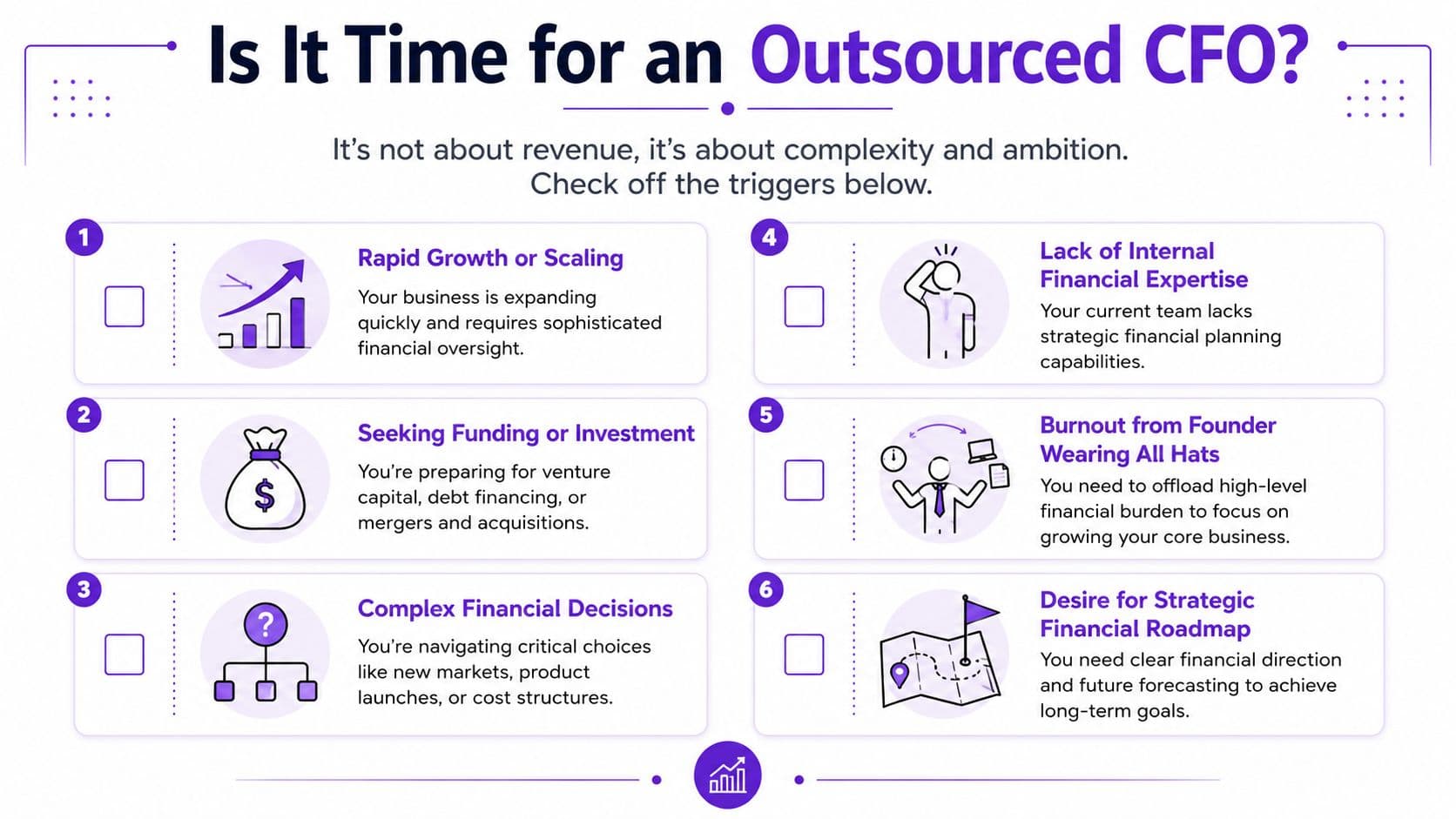
You're facing decision-heavy growth
You likely need CFO-level support when several of these are true at once:
- Fundraising is approaching: You need a model, a defensible plan, and investor-ready reporting
- Revenue streams are multiplying: Different products, service lines, contracts, or billing structures are making margin less obvious
- Margin is slipping: Sales are growing, but profitability isn't following
- The founder owns finance by default: Important financial decisions still bottleneck with you
- A major event is coming: Acquisition, expansion, restructuring, debt process, or board scrutiny
Here's a useful reality check. If your leadership team can't explain the business beyond a P&L and bank balance, you're already operating with less visibility than your growth stage requires.
A short video can help frame the decision from a founder's perspective:
Red flags you waited too long
These warning signs show up after the gap has already become expensive.
- Cash surprises keep happening: You're profitable on paper but still scrambling to cover obligations
- Investor questions expose weak prep: You can't answer clearly on runway, assumptions, margins, or forecast logic
- Reporting arrives too late to use: By the time numbers are reviewed, the month is already gone
- Your board or lenders challenge the numbers: Confidence drops when data changes from meeting to meeting
- Hiring decisions outpace financial planning: Headcount grows without a model showing the cash impact
Warning sign: If every hard decision becomes a debate about whether the data is even right, the finance function is already behind the business.
Typical Deliverables Pricing and ROI
An outsourced CFO engagement should be concrete. You shouldn't be paying for vague “strategic support.” You should know what gets delivered, when it arrives, and how it helps you make better decisions.
For Series-A SaaS companies, outsourced CFO services typically cost $3,000 to $8,000 per month. A more involved engagement can run higher. According to CFO Advisors' outsourced CFO cost benchmarks for Series-A SaaS startups, a $5M revenue SaaS company spending $15,000 per month on a tier 2 outsourced CFO can see 2.5x to 5x ROI and a 40% cash flow runway extension, based on industry benchmarks.
What you should receive each month
Typical deliverables look like this:
| Cadence | Deliverable | Why it matters |
|---|---|---|
| Weekly | Cash flow forecast updates | Shows near-term liquidity pressure before it becomes a problem |
| Monthly | Investor-ready financial package | Gives leadership and stakeholders a clean operating view |
| Monthly | Strategic review meeting | Connects actuals to forecast, hiring, pricing, and spend decisions |
| Monthly | Budget vs actual analysis | Explains variance instead of just listing it |
| Quarterly | Board or lender reporting support | Keeps external communication tight and credible |
| Annually or ad hoc | Budgeting, planning, and transaction support | Helps with fundraising, expansion, acquisitions, or resets |
A worked ROI example with real numbers
Use the lower end first.
If your business pays $3,000 per month, that's $36,000 per year. If it pays $8,000 per month, that's $96,000 per year.
Now compare that to a more involved SaaS example from the CFO Advisors benchmark. A $5M revenue SaaS company paying $15,000 per month spends $180,000 per year. Using the stated 2.5x to 5x ROI range from that benchmark, the value created would be:
- At 2.5x ROI: $180,000 × 2.5 = $450,000
- At 5x ROI: $180,000 × 5 = $900,000
That's the right way to evaluate the engagement. Not as overhead, but as a decision-support function tied to fundraising outcomes, runway, pricing, margin, and capital allocation.
For product-led and commerce businesses, profitability analysis also needs to get more granular than topline revenue. If you sell through Shopify, a practical starting point is learning how to understand your Shopify store's profit, especially when payment fees, returns, shipping, and channel mix distort the headline numbers.
If you're comparing engagement structures, this overview of fractional CFO services can help you map monthly retainer, project, and scoped advisory options to your stage.
The Strategic Toolkit KPIs and Tech Stack Integration
A strong outsourced CFO doesn't work from a spreadsheet in isolation. They build a data flow from your operating systems into a dashboard that leadership can effectively use.
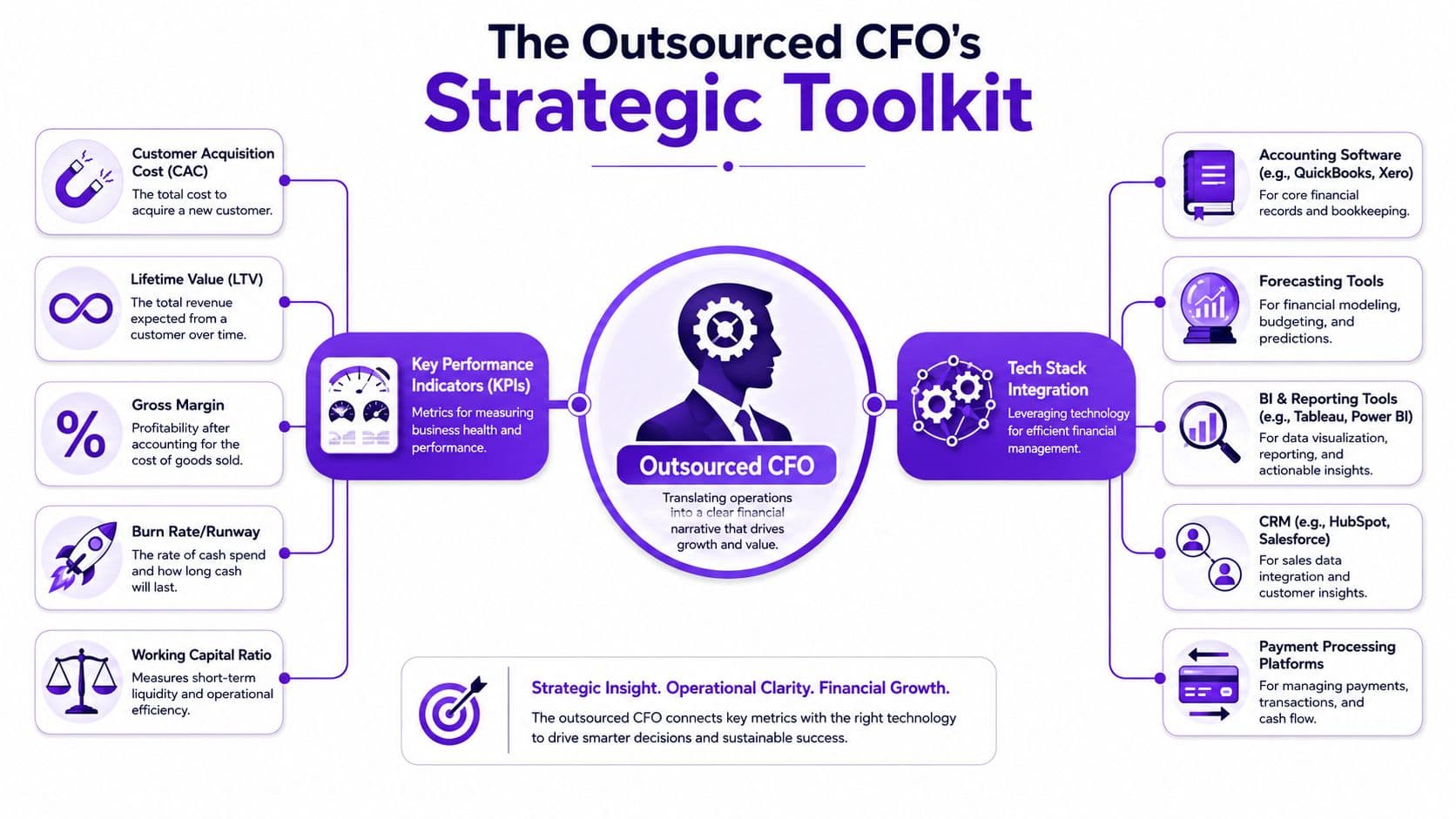
The technical side of the role includes fluency with cloud accounting platforms such as QuickBooks, NetSuite, and Xero, along with collaboration tools like Zoom and Microsoft Teams, because finance leadership now depends on real-time reporting and distributed execution.
What the dashboard should track
The right KPIs depend on the business model.
For SaaS, the dashboard usually includes MRR or ARR growth, retention trends, customer acquisition efficiency, gross margin, and cash runway. For agencies and professional services firms, it usually includes utilization, realization, project margin, client profitability, and payroll as a share of revenue. For e-commerce, you need channel-level contribution and working capital visibility, not just sales volume.
What matters is that the CFO doesn't stop at presenting metrics. They help you influence them.
- SaaS: Pricing discipline, retention focus, sales efficiency, and runway planning
- Agencies: Capacity planning, staffing mix, and client-level margin control
- Professional services: Revenue concentration, delivery economics, and collections discipline
The useful KPI isn't the one that looks sophisticated. It's the one that changes a decision this month.
How the data layer actually works
Many businesses break down under these circumstances. Data lives in the accounting platform, payroll tool, CRM, payment processor, and billing stack, but nobody has fully connected the system.
A capable outsourced CFO works across that stack. That can mean QuickBooks or Xero as the accounting core, Stripe or Shopify for payment data, Gusto for payroll, and a CRM such as HubSpot or Salesforce for pipeline context. Some firms also build dashboards in BI tools after the accounting layer is cleaned up.
If your team is still moving data manually between systems, automation becomes part of the finance conversation because less manual handling means fewer delays and fewer avoidable mistakes. This piece on less admin for your business is a useful primer on why operational data automation matters beyond pure efficiency.
One practical example is financial dashboards for CEOs and key metrics, which shows how finance data can be structured into a decision-ready view. Another example is a provider such as Jumpstart Partners, which works with systems including QuickBooks, Xero, NetSuite, Stripe, Shopify, Square, Gusto, and BambooHR to support reconciliations, revenue recognition, payroll, and KPI reporting for growing businesses.
How to Evaluate and Hire Your Outsourced CFO Partner
The hiring decision is less about résumé prestige and more about operating fit. You need a partner who can produce accurate reporting, understand your business model, communicate with leadership, and protect sensitive financial data.
The first thing to verify is structure. Ask whether you're hiring a solo consultant or a team-backed service with controller and bookkeeping support behind the CFO. For growing companies, the second model is usually stronger because it separates strategic work from transactional cleanup and review.
Questions to ask before you sign
Use a checklist, not a generic chemistry call.
- Industry fit: Have they worked with SaaS, agencies, or professional services businesses like yours? Do they understand the KPIs that drive your model?
- Scope clarity: What exactly do they own each week, month, quarter, and on special projects?
- Forecasting depth: Will they build operating forecasts and cash models, or only review reports after the fact?
- Systems capability: Can they work inside your accounting stack and integrate the reporting layer cleanly?
- Team design: Who handles bookkeeping, who handles controller review, and who presents strategic recommendations?
- Security controls: Are they SOC 2 compliant? Your financial data deserves bank-level handling, not casual file sharing.
- Communication style: Will they challenge assumptions and explain trade-offs clearly to founders, boards, and department heads?
A good outsourced CFO partner should make your business easier to run, not just more documented. You should leave meetings with a sharper view of cash, margins, hiring capacity, and what decision needs to happen next.
Common misconception: hiring an outsourced CFO means giving up control. It's the opposite. You gain control because the business stops running on instinct and stale reports.
If your company has outgrown basic bookkeeping but doesn't need a full-time finance executive, an outsourced CFO team can give you the structure, visibility, and decision support to scale with fewer surprises.
If you want to see what that looks like in practice, Jumpstart Partners provides outsourced controller, bookkeeping, and CFO support for growing businesses that need cleaner reporting, stronger cash visibility, and a finance function built for scale. A consultation is the fastest way to see whether your current gap is in bookkeeping, controllership, or CFO-level strategy.