Financial Operations
CFO vs Controller: Who to Hire for Your Growing Business
CFO vs Controller: A clear guide for CEOs at scaling SaaS & agencies. Learn the roles, costs, and when to hire each to drive profitable growth.
ByJumpstart Partners, CPA, QuickBooks ProAdvisor
··18 min readYour revenue is climbing. Your finance function isn't.
You're probably living one of two versions of the same problem. In the first, your books are mostly clean, but every planning meeting turns into guesswork because nobody can tell you what cash looks like next quarter. In the second, you know growth is real, but month-end drags, deferred revenue is messy, and investor or lender questions expose how thin your reporting really is.
That's why the CFO vs Controller decision matters so much. This isn't an org chart debate. It's the moment where a founder decides whether the next finance hire should fix the past or help shape the future. Get it right and you build a finance function that supports scale. Get it wrong and you pay executive-level money for the wrong kind of relief.
A lot of founders hit this point right after they realize they've outgrown basic bookkeeping. If that's where you are, read the signs you've outgrown your bookkeeper and what to do next. Then come back to the harder question: who should you hire first?
Table of Contents
- The Crossroads of Growth You Are Facing Right Now
- The Core Difference Looking Backward vs Looking Forward
- The Controller The Guardian of Financial Accuracy
- The CFO The Architect of Strategic Growth
- Head-to-Head Comparison Key Differences at a Glance
- Your Decision Checklist When to Hire Which Role
- The Smart Alternative The Outsourced and Fractional Solution
The Crossroads of Growth You Are Facing Right Now
You're at the stage where finance mistakes stop being annoying and start being expensive.
A founder at a growing SaaS company usually notices it this way. Revenue looks healthy. Customers are renewing. The P&L arrives every month. But when an investor asks about revenue recognition, burn, runway, or how pricing changes would affect margins, the room goes quiet. The data exists somewhere, but nobody trusts it enough to make a real decision.
An agency founder feels it differently. Utilization swings. Payroll lands on time, but cash still feels tight. You win larger contracts, then discover reporting by client, team, or service line is inconsistent. That means you can't answer the most important question in services: which work is making you money?
This is the crossroads. You don't need “more finance.” You need the right finance leadership.
Here's the blunt truth. If your numbers are late, inconsistent, or hard to reconcile, hiring a strategic CFO first is a mistake. A CFO can't build reliable forecasts on top of weak accounting. But if your books are clean and you're making pricing, hiring, fundraising, or expansion decisions without a finance partner, a controller alone won't solve the problem either.
Practical rule: Hire for the bottleneck, not the title.
Early growth companies often frame CFO vs Controller as a prestige question. It isn't. It's a sequencing question. Which problem is more dangerous right now: unreliable financial history, or lack of forward-looking financial guidance?
Use that lens and the decision gets much easier.
The Core Difference Looking Backward vs Looking Forward
At $1M ARR, one finance hire can still cover a lot of ground. By $5M ARR, that starts to break. By $10M to $20M ARR, getting this hire wrong gets expensive fast.
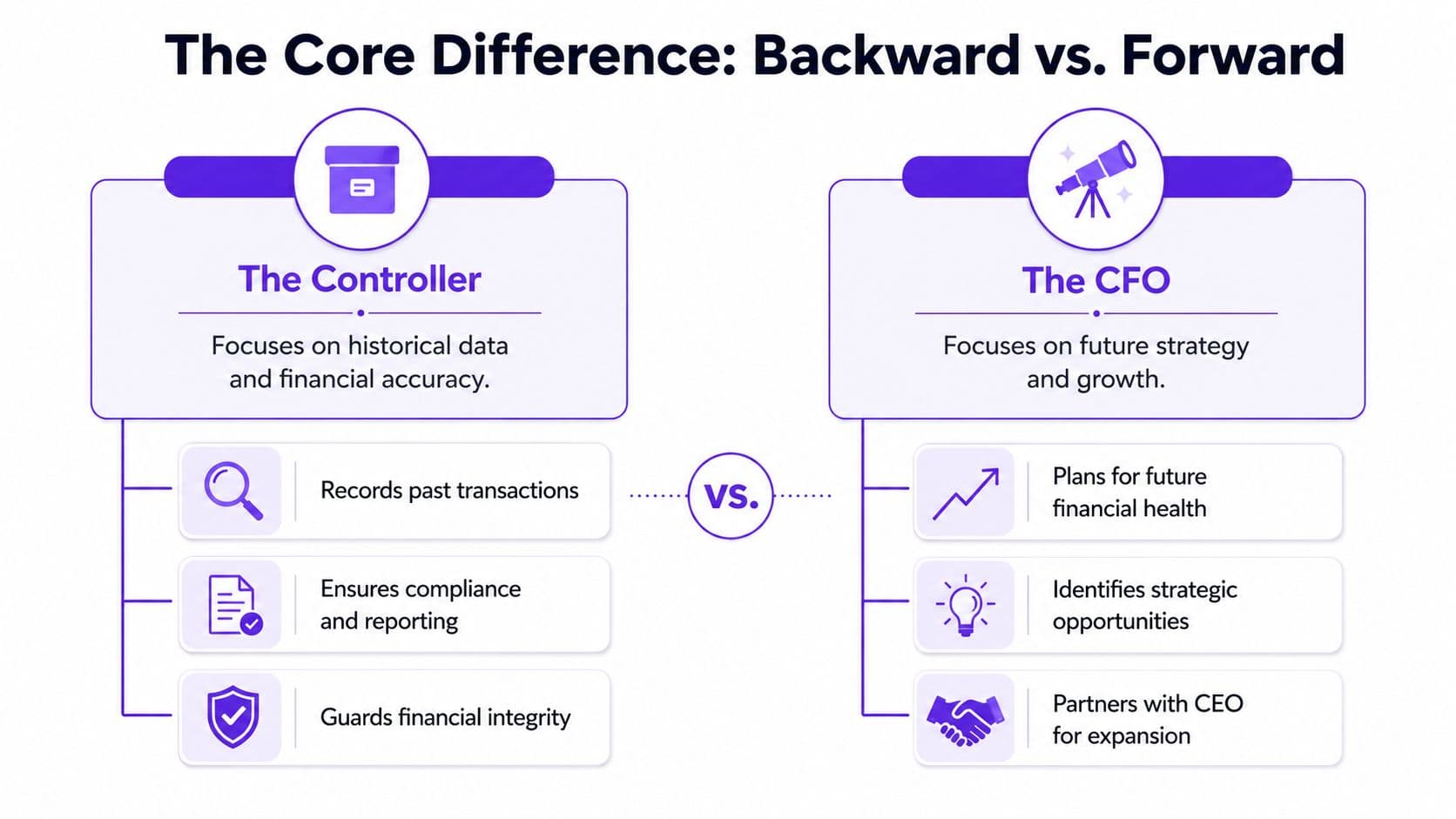
The split is simple. A controller makes sure your financial history is right. A CFO helps you decide what to do next with confidence.
Why founders mix them up
In a small SaaS company, the same person often closes the books, updates the model, sends invoices, and joins lender or investor calls. In an agency, that person may also track utilization, clean up timesheets, and explain why cash is tight despite strong top-line revenue. That setup works until volume, headcount, and reporting expectations increase.
Then the cracks show. SaaS teams run into deferred revenue, revenue recognition, and inconsistent metrics across billing, CRM, and the general ledger. Agencies run into weak project profitability reporting, messy client-level margins, and poor visibility into future cash needs. At that point, you are no longer choosing between two job titles. You are choosing which problem to fix first.
If you need cleaner accounting before you need strategy, start with the controller track. If you need help deciding pricing, hiring pace, runway, or capital strategy, you need CFO capability. If you are still sorting out the earlier handoff between basic bookkeeping and real accounting ownership, read bookkeeper vs controller.
A standard reporting structure makes the distinction clearer. Controllers usually lead accounting operations and report into the senior finance lead. CFOs report to the CEO and often the board, with responsibility for planning, capital, and executive decision support, as outlined by NetSuite's discussion of financial controller vs CFO.
| Role | Time horizon | Main output | What breaks without it |
|---|---|---|---|
| Controller | Backward-looking | Accurate financials, close process, controls | You cannot trust the numbers |
| CFO | Forward-looking | Forecasts, scenarios, cash plan, strategic guidance | You make expensive decisions with weak analysis |
The timing matters more than the title
A controller gives you clean inputs. A CFO turns those inputs into decisions.
That sequence matters a lot in the $1M to $20M ARR range. A SaaS company with sloppy revenue recognition does not need a prettier forecast first. It needs reliable monthly reporting, deferred revenue schedules, and a close process management can trust. An agency with late job-cost reporting does not need a board-ready deck first. It needs margin visibility by client, team, and service line.
Here is the practical rule. If your month-end close is late, balance sheet accounts are not reconciled, or accounts payable is still manual and error-prone, hire the controller first and tighten the finance engine. In many cases, that also means improving systems and automating accounts payable so the team can close faster and spend less time on transaction cleanup.
If the books are accurate, the KPIs are consistent, and risk sits in pricing, burn, hiring pace, covenant compliance, or fundraising prep, a controller alone is not enough. That is when a CFO changes the outcome.
Unstable reporting calls for a controller. Stable reporting with high-stakes decisions calls for a CFO.
Founders miss this because both roles sit inside finance. But they protect different parts of the business. The controller protects historical truth. The CFO helps you choose the next move before it costs you six or seven figures.
The Controller The Guardian of Financial Accuracy
A good controller doesn't just “manage accounting.” They build trust in the numbers.

What a controller actually owns
One practical benchmark for mid-market teams is straightforward: the controller owns the close and reporting engine. That includes the accuracy, completeness, and timeliness of financial statements, plus the month-end close, internal controls, AP/AR, payroll coordination, tax compliance, and audit preparation, as outlined by Glacier Lake Partners on when to hire a CFO vs controller.
For a founder, that translates into concrete outcomes:
- Faster close process: You stop waiting deep into the next month to understand the last one.
- Reliable balance sheet: Cash, receivables, deferred revenue, payroll liabilities, and debt tie out.
- Cleaner operating handoff: Sales, delivery, payroll, and accounting stop running on separate versions of reality.
- Audit and diligence readiness: When a lender, investor, or buyer asks for support, your team can produce it.
A controller also improves the plumbing underneath the books. That often means standardizing invoice approvals, syncing payroll data properly, and tightening payables workflows. If your AP process is still email-and-spreadsheet chaos, this guide on automating accounts payable is worth reviewing because AP failures often show up later as close delays and reporting errors.
For a deeper breakdown of the role itself, see what a controller does in a growing company.
A worked SaaS example using real numbers
Take a SaaS company that signs a customer on an annual contract for $24,000 paid upfront. The founder sees $24,000 hit the bank and wants to count it all as this month's revenue. That's where weak accounting creates fake confidence.
A controller applies the right treatment. If the service is delivered over 12 months, monthly revenue recognized is $2,000. On day one, cash increases by $24,000, but recognized revenue for the first month is only $2,000, and the remaining $22,000 sits as deferred revenue until earned.
That single correction changes several decisions:
| Item | Wrong treatment | Controlled treatment |
|---|---|---|
| Cash received this month | $24,000 | $24,000 |
| Revenue recognized this month | $24,000 | $2,000 |
| Deferred revenue on balance sheet | $0 | $22,000 |
If you're a founder, that difference matters immediately. Under the wrong treatment, you think growth is stronger than it is. You may hire too quickly, overspend on acquisition, or report inflated revenue to investors. Under the controlled treatment, your MRR and ARR logic are consistent with the service delivered.
Clean books don't just satisfy accountants. They prevent founders from making decisions based on money they haven't earned yet.
That's why controller work is so often the first serious finance upgrade in SaaS, agencies with retainers, and service firms with prepaid contracts.
The CFO The Architect of Strategic Growth
At about $3M ARR, the questions change. You are no longer asking, “Did we close the books correctly?” You are asking, “Can we hire two AEs before pipeline converts?” “Will annual prepaids hide a cash problem?” “Should we push upmarket or protect retention first?” Those are CFO questions.

A controller gives you confidence in the scoreboard. A CFO decides the next play.
That distinction matters most for SaaS and agency founders between $1M and $20M ARR, where one bad hiring plan or pricing mistake can burn 6 to 12 months of progress. If your controller closes clean books by the 10th business day, but nobody is pressure-testing headcount, gross margin, CAC payback, and runway under three scenarios, you have accounting coverage and a strategy gap.
What a CFO changes
A CFO owns decisions that shape the next 12 to 24 months:
- Forecasting: Build a monthly model for revenue, gross margin, headcount, and cash, then stress-test the downside.
- Hiring pace: Decide whether revenue can support sales, delivery, and leadership hires before those salaries hit the P&L.
- Pricing and packaging: Evaluate whether higher ACV, longer terms, or service bundling improve cash flow and margin.
- Capital strategy: Decide whether to fund growth with retained cash, a line of credit, venture debt, equity, or no financing at all.
- Board and investor communication: Turn financial results into a clear plan with targets, tradeoffs, and measurable risks.
A simple SaaS example makes the value obvious. Say you are at $5M ARR, growing 40%, with $500,000 in cash and a plan to hire 4 sales reps at a fully loaded annual cost of $480,000. A controller can tell you whether last quarter's numbers are accurate. A CFO models ramp time, quota attainment, onboarding cost, churn impact, and the cash dip before those hires produce enough gross profit to pay for themselves. If the model shows cash falls below two months of operating expense in month five, the right answer is not “grow at all costs.” The right answer is to stagger hiring, adjust quota assumptions, or raise capital before you create a solvency problem.
For agencies, the pattern is similar. At $2M to $8M in revenue, the trap is winning new work with low visibility into utilization, delivery margin, and staffing lag. A CFO helps you decide whether a new service line will raise contribution margin or just create more management overhead and slower collections.
If you need that level of planning but cannot justify a full-time executive, review fractional CFO services for growing companies.
A CFO turns growth plans into math. That math tells you whether the plan increases enterprise value or just increases stress.
When to hire a CFO
Do not hire a full-time CFO because the title sounds mature. Hire one when the business has enough complexity and enough financial risk to justify executive judgment.
You are ready for CFO-level support when several of these are true:
- Revenue is past the point where founder intuition can manage cash and hiring reliably.
- You are making multi-quarter bets on pricing, headcount, market expansion, or financing.
- The company has a board, lenders, or investors who expect a credible forecast, not a rough budget.
- Gross margin, retention, or utilization is starting to drift and nobody owns the corrective plan.
- You need scenario planning every month, not once a year.
For many companies, that starts before a full-time hire makes sense. Around $1M to $3M ARR, a strong controller or outsourced accounting team usually comes first. Around $3M to $10M ARR, fractional CFO support often gives founders the right mix of forecasting, capital planning, and decision support without a full executive salary. Past that point, especially as complexity rises across pricing, departments, and financing, a full-time CFO becomes easier to justify.
The cost gap exists because the value is different. A controller protects accuracy. A CFO protects cash, improves capital allocation, and helps the CEO avoid expensive mistakes. If your next decision could cost $250,000 to $1M in wasted hires, margin erosion, or avoidable dilution, CFO-level judgment pays for itself quickly. If you are not facing those decisions yet, buy the capability part-time and wait on the title.
Head-to-Head Comparison Key Differences at a Glance
Here's the simple version. In the CFO vs Controller decision, you're comparing two different types of value.
One creates operational trust. The other creates strategic advantage.
The compensation gap makes that obvious. One industry summary estimated full-time CFO compensation at $175 to $350 per hour, or about $364,000 to $728,000 annually, while controllers were estimated at $50 to $80 per hour, or about $104,000 to $166,000 annually. That same summary ties the gap directly to responsibilities: CFOs handle strategy, forecasting, and executive decision-making, while controllers focus on accounting accuracy, internal controls, and reporting, according to McCracken Alliance's comparison of CFOs and controllers.
CFO vs Controller At a Glance
| Dimension | Controller (The Historian) | CFO (The Futurist) |
|---|---|---|
| Primary focus | Historical accuracy | Forward-looking strategy |
| Main mission | Produce complete, timely, reliable financials | Turn financial data into decisions |
| Typical owner of | Close process, internal controls, reconciliations, reporting | Forecasting, capital allocation, financing, executive guidance |
| Core question answered | “Are the numbers right?” | “What should we do next?” |
| Key stakeholder relationship | Accounting team, tax, audit, operations | CEO, board, lenders, investors |
| Org chart position | Usually reports to CFO or CEO | Reports to CEO and often the board |
| Cost profile | Lower fixed cost, operations-focused | Higher fixed cost, executive-level judgment |
| Best first hire when | Books are messy or reporting is slow | Books are solid but major decisions need modeling |
Why this matters for founders
Founders often underbuy finance leadership when they need strategy, and overbuy it when they need accounting discipline.
If your close is broken, a CFO won't save you. You'll get polished conversations built on weak inputs. If your reporting is clean but your planning is shallow, a controller won't save you either. You'll know exactly what happened last month and still make the wrong call about next quarter.
Different problem, different hire. Don't pay futurist prices when you need a historian, and don't expect a historian to act like your strategist.
That's the practical heart of CFO vs Controller.
Your Decision Checklist When to Hire Which Role
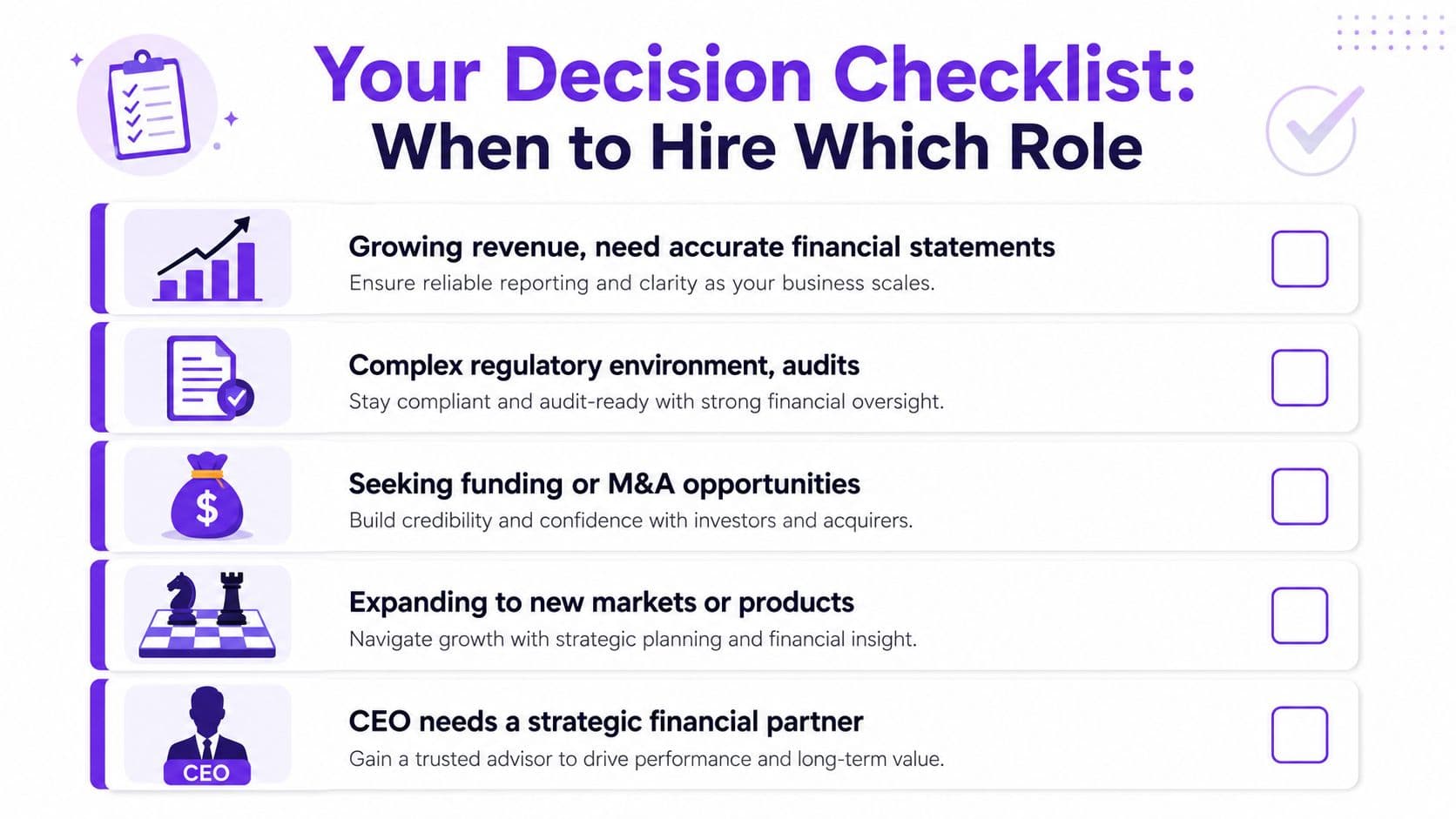
You don't need another generic “it depends” answer. You need a decision rule.
Start with the pain that is slowing the business right now. For most companies between $1M and $5M ARR in revenue, the right first finance hire is the person who removes the highest-risk constraint. Usually that's either reporting accuracy or executive decision support.
Red flags that say hire a controller first
Choose a controller first if your business is dealing with accounting complexity faster than your team can absorb it.
- Your close is unreliable: If month-end drags and every report requires manual cleanup, you need a controller.
- Revenue treatment is inconsistent: SaaS companies with annual prepaids, contract changes, credits, or implementation fees need controlled revenue logic.
- Systems don't reconcile: Stripe, QuickBooks, payroll, and your CRM should not all tell different stories.
- You're preparing for audit, diligence, or lender review: You need support files, reconciliations, and a defensible close process.
- Founders are still answering accounting questions themselves: That's a scaling problem, not founder heroics.
For a $2M ARR SaaS company, controller first is usually the right call when recurring revenue operations are getting more complex than the existing bookkeeper can handle. For a services firm with retainers, deferred revenue, and team-based delivery costs, controller first is also the right call when margin reporting by client is weak.
Red flags that say hire a CFO first
Choose a CFO first when the books are already credible enough to support real planning, but leadership still lacks financial direction.
- You're fundraising or refinancing: Investor and lender conversations need modeling, narrative, and scenario analysis.
- You're making large bets: New pricing, a new market, acquisitions, and senior hiring all need financial decision support.
- Your board or investors challenge the forecast: That's not an accounting problem. It's a finance leadership problem.
- Cash planning is reactive: If you only understand cash after it moves, you need CFO-level forecasting.
- The CEO has no strategic finance partner: At some point, the founder needs someone who can say no to a bad plan with numbers.
For a $10M agency exploring acquisition, recapitalization, or a major service-line expansion, CFO support becomes urgent. The same goes for a software company with clean books that now needs board-ready planning and capital strategy.
A lot of companies eventually need both. The only real question is sequence.
The Smart Alternative The Outsourced and Fractional Solution
For many companies in the $1M to $20M range, a full-time hire is the wrong answer even when the need is real.
That's especially true in the middle stage. You need stronger controls, better reporting, a forecast, maybe board materials, maybe fundraising help. But you don't need two full-time senior finance salaries sitting in overhead. Recent reporting shows growing use of outsourced accounting and fractional finance leadership across mid-market companies that need board-ready reporting without the cost of a full executive team, as discussed in Ramp's guide to when to hire a CFO vs controller.
What the hybrid model looks like
The practical setup is simple:
| Need | Best-fit solution |
|---|---|
| Close process, reconciliations, reporting discipline | Outsourced controller |
| Budgeting, scenario planning, board and lender support | Fractional CFO |
| Payroll, HR admin coordination | Internal ops lead or specialist partner |
| Transaction-level bookkeeping | Bookkeeper or outsourced accounting team |
This structure works because it matches the level of expertise to the actual task. You don't need a full-time CFO reviewing every AP batch. You don't need a controller leading fundraising strategy.
If payroll complexity is part of your operational mess, especially across HR and finance handoffs, this overview of PEO payroll and how it works is useful context before you redesign your back office.
Jumpstart Partners offers controller-led finance ops for founder-led B2B AI SaaS teams—monthly close, reporting, and billing support scoped after the Finance Ops Diagnostic.
The recommendation is straightforward. If you're between $1M and $20M and asking “CFO vs Controller,” you probably don't need to choose one title forever. You need the right mix of accounting discipline and strategic finance for the stage you're in right now.
If you want help diagnosing which finance hire comes first, talk to Jumpstart Partners. They work with growing companies that need outsourced controller support, bookkeeping, and fractional finance guidance without jumping straight into a full-time executive hire.