Financial Operations
What Is a Fractional Controller? The Guide for Founders in 2026
Discover what is a fractional controller. Get expert financial oversight to scale your business without the full-time cost. Learn if you need one.
ByJumpstart Partners, CPA, QuickBooks ProAdvisor
··13 min readYour financial blind spots are costing you growth.
As your business scales past the $1M revenue mark, the DIY financial systems that got you here start to break. The spreadsheets and basic bookkeeping that once felt sufficient now create massive risks. You’re likely feeling the pain directly: chaotic month-end closes that stretch for weeks, leaving you with numbers that are already stale. You have zero real visibility into your actual cash flow, making it impossible to confidently plan for hiring or marketing spend.
These issues aren't just inconvenient; they actively choke your growth. Making critical decisions with bad data is like driving blindfolded. For many founders, these are the biggest financial mistakes that stall a promising company.
This is precisely where a fractional controller steps in. They are a part-time, expert-level accountant who manages your company’s day-to-day financial operations without the $175,000+ price tag of a full-time executive. They build the processes and controls to produce timely, accurate financial intelligence you can actually use.
What a Fractional Controller Actually Does for You
A bookkeeper records what happened last month. A fractional controller ensures this month goes right.
They act as the financial operator for your business. While you’re focused on growth and product, the controller builds the financial engine under the hood. They transform your accounting from a reactive, historical chore into a forward-looking tool that helps you make smarter decisions, faster. They are the critical link between daily transactions and high-level strategy, installing the systems and financial discipline that growing companies desperately need.
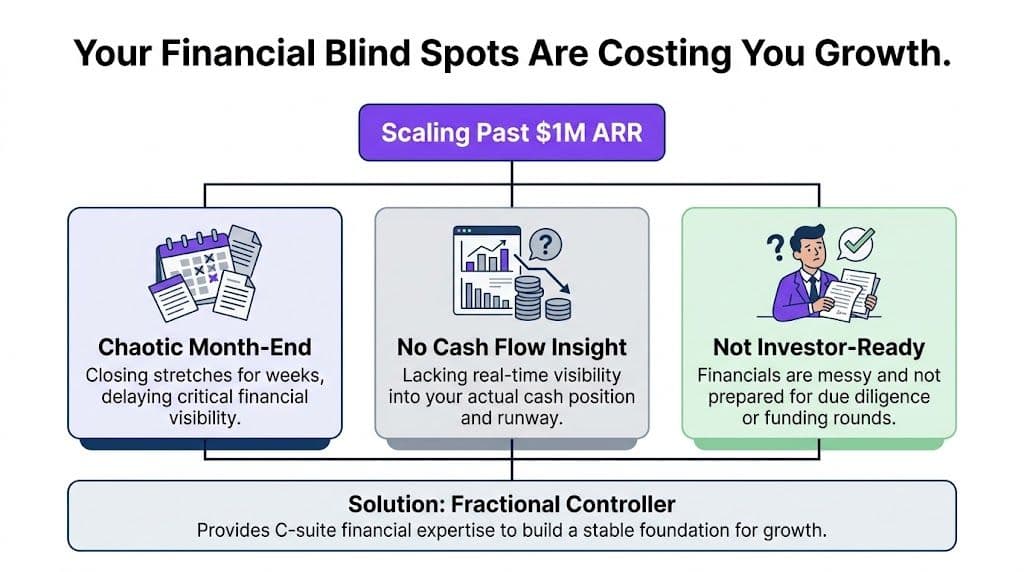
The financial blind spots shown above—slow closes, zero cash visibility, messy books—are exactly what prevent you from scaling effectively. A fractional controller is hired to fix these specific problems.
Building Your Financial Foundation
A controller’s first job is to build a reliable accounting function. This isn't just about balancing the books; it's about creating a single source of truth for every financial decision. They take ownership of the critical processes that are almost always broken in a growing company.
Key responsibilities look like this:
- Owning the Month-End Close: A controller doesn't just participate in the close process; they drive it. Their goal is to get you accurate financials within 5-10 business days of the month's end, so the data is still relevant.
- Producing Investor-Ready Financials: They generate the professional-grade financial package—a clean P&L, Balance Sheet, and Cash Flow Statement—that every investor, lender, and board member expects to see. No more apologizing for messy spreadsheets.
- Implementing Scalable Systems: They get you off those chaotic, error-prone spreadsheets and onto a robust accounting platform like QuickBooks or NetSuite. They ensure your financial tech stack can handle growth, not break under it.
Driving Operational Excellence
Once the foundation is solid, a controller shifts focus to improving your company’s financial health. This is where they become proactive, diving into the details that protect your cash and de-risk the business.
This means they’re hands-on. For example, they will manage and analyze your accounts receivable aging reports to make sure cash is actually coming in the door on time, not just sitting as a number on an invoice.
For SaaS companies, they tackle complex areas like ASC 606 revenue recognition, ensuring you are GAAP-compliant long before an auditor or investor starts asking questions. It’s about being audit-ready every single month. Ultimately, a controller provides the operational horsepower that frees you up to focus on strategy.
To see a more detailed breakdown of their responsibilities, check out our complete guide on what a controller does in a high-growth environment.
The True ROI of a Fractional Controller
The most obvious benefit of a fractional controller is the simple math: you get executive-level financial expertise without the six-figure, fully-loaded cost of a senior hire. But focusing only on the cost savings misses the bigger picture. The real value isn’t just about what you save; it’s about the financial upside a great controller unlocks.
The Cost Comparison: Full-Time vs. Fractional
Hiring a full-time controller is a massive financial commitment. A senior controller with a $175,000 salary will actually cost over $230,000 annually once you add benefits, payroll taxes, recruiting fees, bonuses, and overhead.
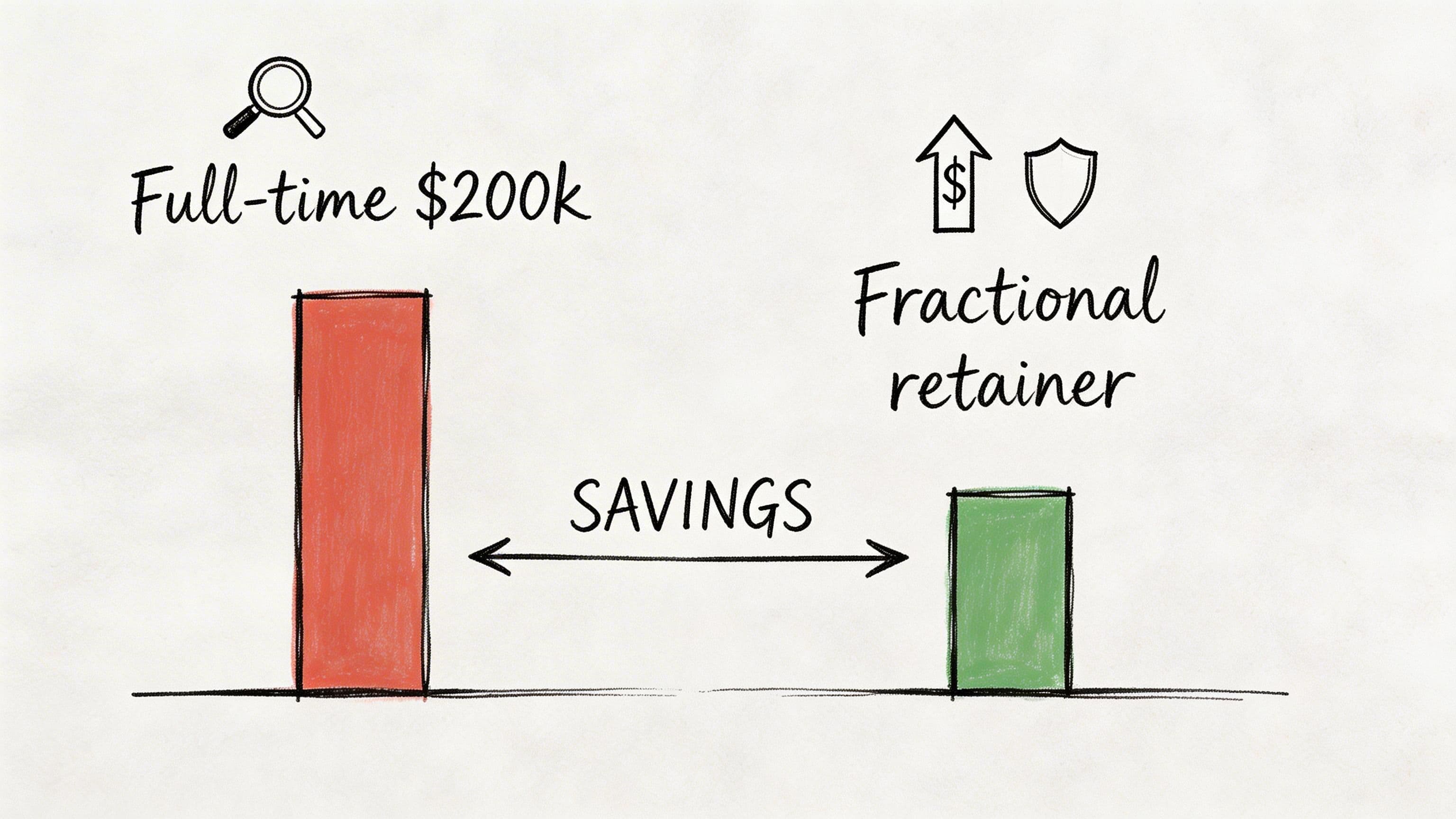
Here's how the numbers break down side-by-side:
| Cost Component | Full-Time Controller (Annual) | Fractional Controller (Annual) |
|---|---|---|
| Base Salary | $175,000 | N/A |
| Benefits & Payroll Taxes (25%) | $43,750 | Included in Retainer |
| Recruiting Fees (20%) | $35,000 (one-time) | $0 |
| Onboarding & Training | $5,000 | Included |
| Fractional Retainer | N/A | $84,000 ($7,000/mo) |
| Total Year 1 Cost | $258,750 | $84,000 |
| Annual Savings | $174,750 |
That's a direct savings of over $170,000 in the first year alone. The fractional model gives you instant access to top-tier talent for a fraction of the price.
Beyond Direct Savings: Unlocking Financial Upside
The true ROI of a fractional controller isn't just in the cost avoidance; it's in the value they actively create.
"A great fractional controller doesn't just cut costs; they find money. They'll find thousands in miscategorized expenses, fix billing errors that were leaving revenue on the table, and optimize cash flow to fund your growth without diluting your equity." – Sarah Jennings, Founder of TechScale Finance
This expertise delivers a measurable impact. A fractional controller drives value by:
- Improving Cash Flow: By overhauling your accounts receivable process and strategically managing payables, they can radically improve your cash conversion cycle. It’s common to see them free up 30-40% more working capital that was previously trapped in the system.
- Ensuring Audit & Diligence Readiness: They get your financials clean, compliant, and ready for scrutiny at all times. This prevents costly delays and embarrassing discoveries during a fundraising round, bank audit, or acquisition diligence.
For a deeper dive into the numbers, explore our Controller Services ROI Analysis.
Warning Signs You Need a Fractional Controller Now
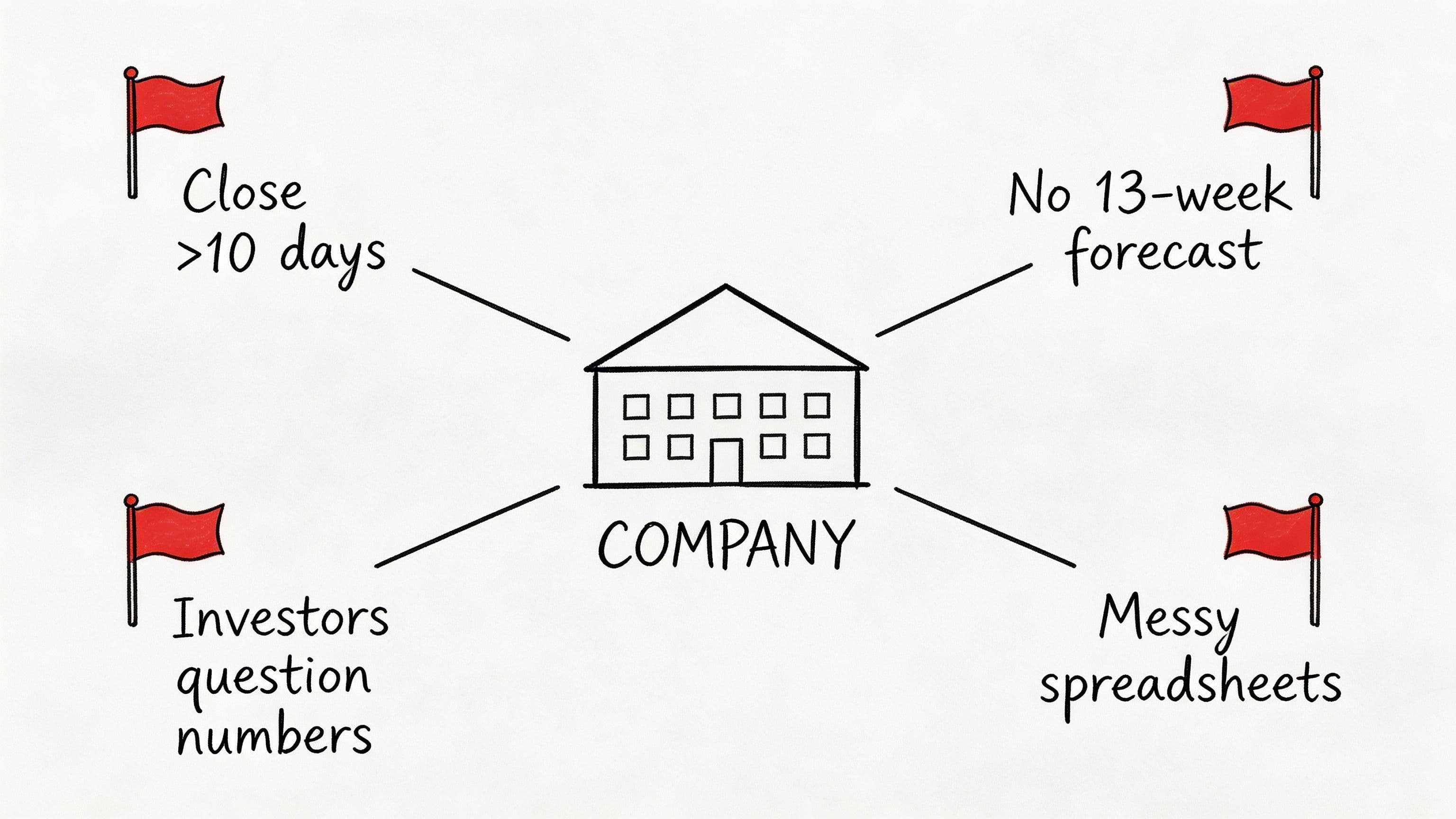
The spreadsheets and bank balance check-ins that got you your first million in revenue are the very things that will stop you from reaching your next ten. These aren't just growing pains. They are urgent red flags showing that the financial foundation of your business is unstable. If any of this sounds painfully familiar, you haven’t just outgrown your bookkeeper—you’ve outgrown your entire finance function.
1. Your Month-End Close Takes Forever
How long does it take to get last month’s financial reports? If the answer is more than 10 business days, you’re making decisions based on old news. This slow close is a symptom of broken processes and manual reconciliations. A controller’s first job is to fix this, streamlining the process to a 5-day close so you get actionable data while it still matters.
2. Your Numbers Don't Inspire Confidence
Do you get a pit in your stomach when an investor or board member asks about your financials? When you lack a single, trustworthy source of financial truth, every strategic conversation is undermined by doubt. This is a death knell for SaaS companies trying to manage complex revenue. According to OpenView's 2025 SaaS Benchmarks, 78% of SaaS companies that fail to raise a Series A do so because they can't prove a scalable, profitable model. That proof starts with clean, GAAP-compliant financials (like ASC 606) that a fractional controller builds and maintains.
3. You Have No Clear Cash Runway
Can you state, with absolute confidence, how much cash will be in your bank account 13 weeks from now? If the answer is no, you are operating with a massive blind spot. Without a reliable 13-week cash flow forecast, you’re one unexpected expense away from a payroll crisis. A controller turns cash forecasting into a weekly discipline, giving you the visibility to navigate challenges and jump on opportunities.
If these warning signs are hitting close to home, the time to fix this was yesterday. The next best time is now.
Fractional vs. Full-Time: Making the Right Strategic Choice
Deciding between a fractional and a full-time controller isn't just about budget—it’s a strategic choice about agility and access to expertise. While the cost savings are a clear win, the real advantages are speed, specialized knowledge, and focus.
The traditional hiring process is a notorious bottleneck. You can have a vetted, high-caliber fractional controller onboarded and adding value in just 5-7 days. Compare that to the 2-4 months it takes to recruit and hire a full-time controller. As you can discover more about how this impacts business momentum, that speed is make-or-break during a growth spurt or fundraising round.
Beyond a Single Hire: Accessing a Team of Experts
When you hire a full-time controller, you get one person’s brain. When you partner with a fractional firm, you get the collective knowledge of an entire team of financial experts. A single hire is extremely unlikely to have deep expertise in GAAP accounting, the nuances of ASC 606 for SaaS, and the complexities of SOC2 compliance. A fractional firm has specialists who have solved these exact problems for dozens of companies like yours.
Overcoming Common Objections
| Common Objection | The Reality |
|---|---|
| "Will an outsider be committed to our mission?" | A fractional controller's business model depends on delivering immediate, measurable impact. Their objectivity is an asset, allowing them to fix broken processes without getting bogged down in company politics. |
| "We need someone fully integrated into our team." | Professional fractional firms follow a structured onboarding process designed for rapid integration. They align on your KPIs from day one, establish clear communication channels, and start delivering value in the first week—not months down the line. |
| "Isn't this just a temporary patch?" | No. This is a strategic decision to prioritize speed, flexibility, and world-class expertise. It provides the financial discipline needed for the next stage of growth, giving you access to a level of talent you couldn't otherwise afford. |
This model is not a temporary fix; it's a strategic decision to prioritize speed and expertise. For a detailed breakdown of the numbers, check our article comparing the cost and benefits of fractional versus full-time controllers.
How to Choose the Right Fractional Controller Partner
Choosing a fractional controller is one of the most critical financial decisions you'll make. The right partner slides into your operations and builds a rock-solid foundation for growth. The wrong one creates more fires than they put out. This isn't about finding the cheapest hourly rate; it's about finding a strategic ally with a proven playbook.
Vet Their Industry and Tech Stack Expertise
Your business isn't generic, and your controller’s expertise can't be either. A controller who doesn't live and breathe ASC 606 is a liability for a SaaS company. For a digital agency, they must be fluent in project-based accounting.
Start by digging into their specific experience:
- Industry Fluency: Ask for case studies or client examples in your vertical. A firm specializing in SaaS already knows your KPIs—you won't waste time teaching them your business.
- Tech Stack Proficiency: Confirm they are experts in your exact financial software, whether it’s QuickBooks, NetSuite, Xero, or payment processors like Stripe.
- Credentials and Security: Look for non-negotiable qualifications like CPA certification and SOC2 compliance. These are proof of professional standards and a commitment to keeping your financial data secure.
Actionable Next Steps: Ask These Three Questions
Once you've confirmed the basics, it's time to see how they operate. Their answers to a few key questions will tell you everything you need to know.
-
"Walk me through your month-end close process, step-by-step. What is your exact timeline?"
- Good Answer: A detailed, structured process designed to achieve a 5-day close, including specific reconciliation and review steps.
- Red Flag: Hesitation or a vague answer like "it depends."
-
"Show me an example of a financial dashboard you've built for a company like mine."
- Good Answer: A clear, relevant example showcasing the KPIs and visualizations that matter to your business model.
- Red Flag: Generic reports or an unwillingness to share sanitized examples.
-
"How do you ensure our financial data is accurate and secure?"
- Good Answer: An immediate, detailed response referencing their internal controls, multi-level review processes, and their SOC2 compliance status.
- Red Flag: A focus on software features alone, without mentioning their own internal processes.
Making the right choice comes down to finding a partner who not only gives the right answers but demonstrates a clear, repeatable process for delivering them. To understand the full scope of what a dedicated firm provides, check out our guide to outsourced controller services.
Frequently Asked Questions
You see the value, but a few practical questions are probably still on your mind. Let's tackle the most common ones we hear from founders so you have the clarity to make a decision.
What is the typical monthly cost of a fractional controller?
The investment depends on your company's complexity and transaction volume, but you should expect a predictable monthly retainer. For businesses in the founder-led SaaS and agency teams revenue range with straightforward finances, expect to invest $2,500–$4,000 per month. As you scale into the $5M–$20M range with more moving parts, retainers typically land between $5,000–$8,000+ per month. You get an entire finance function for less than the fully-loaded cost of a single junior accountant.
How quickly will I see results?
The impact is immediate. A professional fractional controller team does not need months of hand-holding. Within the first 30 days, they will take over your close process, start untangling messy historical books, and establish a reliable reporting cadence. The ultimate goal is delivering a fast, investor-ready month-end close—typically within 5 business days—in the first 60 days of the engagement.
Is my business too small for this service?
If you’re generating between $1M and $5M ARR in annual revenue, you’re not too small—you’re in the sweet spot. Below that range, a solid managed bookkeeping service is likely all you need. Above it, you're probably ready for a full-time, in-house finance team. However, complexity matters more than revenue. If you're battling messy financials, preparing for a fundraise, or your month-end close is a disaster, your business is at the perfect stage to gain a massive advantage with a fractional controller.
Jumpstart Partners offers controller-led finance ops for founder-led B2B AI SaaS teams—monthly close, reporting, and billing support scoped after the Finance Ops Diagnostic.