Financial Operations
What Is Accounts Payable Automation in 2026? A Founder's Guide
Discover what is accounts payable automation and how it saves money, boosts efficiency, and gives you cash flow control. Your 2026 guide to scaling.
ByJumpstart Partners, CPA, QuickBooks ProAdvisor
··18 min readAs a founder scaling your business, your accounts payable process isn't just back-office paperwork—it's a hidden drain on your cash, time, and focus. If you're still processing vendor bills manually, you're not just being inefficient; you're actively slowing your company's growth.
Accounts payable automation swaps manual drudgery—data entry, chasing approvals, and cutting checks—for a smart, digital workflow. It's a system designed to give you, the leader, total control and real-time visibility over every dollar leaving your business. It's not about paying bills faster; it's about paying them smarter.
Before we dive into the "what," let's be clear about the problem it solves. For a SaaS company, digital agency, or professional services firm in the $500K-$20M revenue range, a manual AP process is a direct tax on your momentum.
The Hidden Costs of Manual Accounts Payable
You're focused on product, sales, and scaling to the next revenue milestone. It's easy to overlook how a clunky AP process quietly bleeds resources. Each manual step—from an employee opening an invoice email to someone else printing and mailing a check—is an opening for costly delays, human error, and wasted time.
That's time your team could spend on strategic financial analysis that actually improves cash flow. This isn't a small headache; it's a major operational drag holding you back.
Quantifying the Financial Drag: A Real-World Calculation
Let's look at a $5 million ARR SaaS company that processes about 200 invoices a month. Without automation, the costs add up fast.
According to OpenView's 2024 SaaS Benchmarks, top-performing companies maintain lean finance teams. However, manual AP inflates this cost. Data from the Institute of Finance & Management (IOFM) shows the average cost to process a single invoice manually is $10.37. For top performers with automation, that cost plummets to just $2.05.
Let's apply those numbers to our example company:
| Metric | Manual Process (Average) | Annual Cost |
|---|---|---|
| Invoices Per Month | 200 | 2,400 per year |
| Cost Per Invoice | $10.37 | - |
| Total Annual Cost | 2,400 invoices x $10.37 | $24,888 |
That $24,888 is a direct hit to your bottom line, spent entirely on processing bills. This calculation doesn't even touch on the hidden costs: late payment fees, missed early-payment discounts, or the hours your finance team wastes chasing down approvals instead of optimizing your financial strategy. With automation, that annual cost would drop to just $4,920—an immediate saving of nearly $20,000.
"Many founders I work with are shocked when they see the true cost of their manual AP. They think of it as a simple administrative task, but it's often a source of significant cash leakage and a major obstacle to getting timely, accurate financials." – John Davis, Fractional CFO, Jumpstart Partners
This financial drain makes improving your accounts payable process less of a "nice-to-have" tech upgrade and more of a critical business move. The time and money you get back can be poured directly into product development, sales, or marketing—the things that actually drive revenue and get you to that $20M mark.
Defining Accounts Payable Automation
Now that you've seen the painful cost of doing things by hand, let’s talk about the solution. Accounts payable automation is a system that turns your chaotic, paper-drenched AP process into a predictable digital assembly line. It’s not just about paying bills faster—it's about reclaiming control.
At its core, AP automation software takes on the mind-numbing, error-prone work that bogs down your finance team. Instead of someone manually typing numbers from a PDF invoice, chasing approvals through endless email chains, or printing and mailing physical checks, the system does the heavy lifting. This shift gives you total visibility and command over every dollar heading out the door.
This flowchart maps out the miserable journey an invoice takes in a manual system. Every single step is a source of delay, cost, and risk.
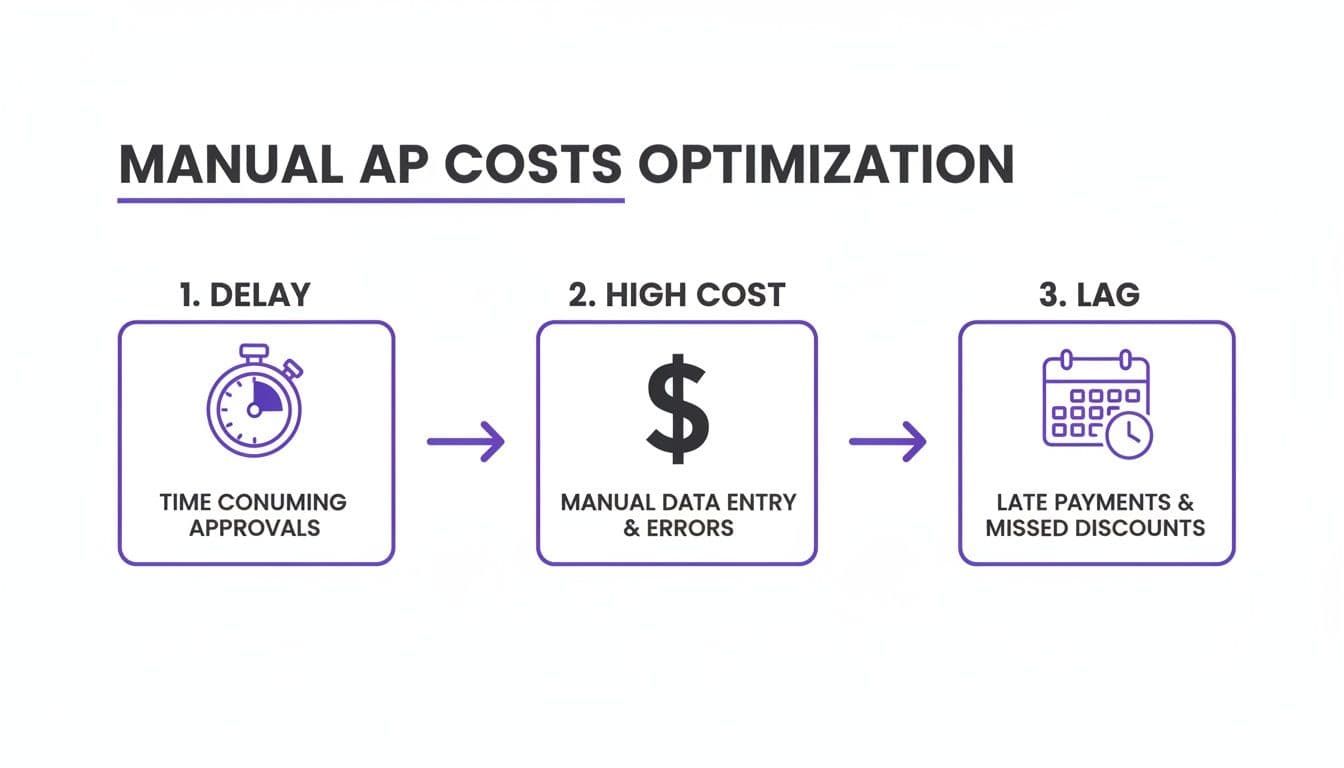
This manual grind drains your resources and introduces unnecessary risk—the very problems automation is built to solve.
The Digital AP Assembly Line: How It Works
Think of your new AP process as a series of automated checkpoints. First, the system captures and digitizes every invoice. Next, it validates the data and routes it for approval based on rules you set. Finally, it executes the payment and syncs every detail back to your accounting system, whether it's QuickBooks, Xero, or NetSuite.
The difference between the old way and the new way is night and day.
Manual AP vs. Automated AP: A Side-by-Side Comparison
This table shows the stark contrast between a traditional, paper-based AP workflow and a modern, automated one. Pay close attention to how manual work and human error are systematically removed at every stage.
| Process Step | Manual AP Process (The Old Way) | Automated AP Process (The New Way) |
|---|---|---|
| Invoice Capture | A team member manually keys in data from a PDF or paper invoice, a process prone to typos and misinterpretations. | Optical Character Recognition (OCR) technology scans the invoice and automatically extracts key data like vendor name, amount, and due date with over 99% accuracy. |
| Validation | Your finance team has to manually cross-reference the invoice against a purchase order (PO) and receiving report in a painful process called 3-way matching. | The system automatically performs 2-way or 3-way matching against POs in your accounting system, instantly flagging any discrepancies for human review. |
| Approval | The invoice gets emailed or physically handed to managers, where it often gets lost in inboxes or sits on a desk for days, creating bottlenecks. | Dynamic workflows automatically route the invoice to the correct approver based on pre-set rules (e.g., invoices over $5,000 go to the CEO). Approvals happen in seconds. |
| Payment | Someone on your team manually initiates a payment via bank transfer, ACH, or by printing, signing, and mailing a physical check. | Payments are executed directly from the platform via multiple methods (ACH, virtual card, international wires), and vendors can choose their preferred payment type. |
| Reconciliation | At month-end, each payment is manually reconciled against your general ledger—a time-consuming and tedious task that often delays your close. | All payment and invoice data is automatically synced in real-time with your accounting software, making the month-end close dramatically faster and more accurate. |
Adopting this technology is a key part of any modern financial services digital transformation, setting your company up for scalable growth. By building your finance function on sound accounts payable best practices, you create a financial foundation that supports your ambition, not one that holds it back.
The Strategic Benefits of AP Automation
AP automation makes your accounts payable process faster and more accurate. But those are just the operational wins. The real value isn't just about paying bills better; it's about fundamentally elevating what your finance function can do for the business.
This is where AP moves from a reactive, paper-pushing cost center to a proactive, strategic part of your company. For a growing SaaS company or a busy agency, this isn't just an efficiency tool. It's the financial backbone you need to scale, prep for a fundraise, or plan a clean exit.

Radical Time and Cost Savings
The first thing you'll notice is a huge drop in what it costs to pay your bills. We’re not talking about shaving off a few pennies. We're talking about a fundamental reduction in the cost and time spent processing invoices.
Let's run the numbers for a typical $10M digital agency handling 300 invoices a month.
- Manual AP Cost: Using the industry average of $10.37 per invoice, the annual cost is: 300 invoices/month x 12 months x $10.37 = $37,332 per year.
- Automated AP Cost: With an automated system, that cost plummets to $2.05 per invoice. Your new annual cost is: 300 x 12 x $2.05 = $7,380.
That’s $29,952 in direct savings straight to your bottom line. But the reclaimed time is even more valuable. Eliminating an estimated 1,750 hours of manual AP work annually—a figure reported by biotech company ImaginAb after they automated—frees up your finance team to do what you hired them for: analysis, not data entry.
"Automation turns AP from a reactive, paper-pushing function into a proactive, data-driven one. Suddenly, your team has the bandwidth to analyze spending trends, optimize payment timing, and provide the insights you need to make better decisions. It's a game-changer for any company serious about financial discipline and strategic growth." – John Davis, Fractional CFO, Jumpstart Partners
Enhanced Cash Flow Control
For any growing business, cash is king. A manual AP process means you're flying blind, with a stack of invoices and no real-time view of your upcoming cash needs. You don't know exactly what you owe or when it’s due, which makes forecasting a guessing game.
AP automation changes this completely. It gives you a single dashboard showing every outstanding bill and its due date. This delivers:
- Real-time visibility into your total accounts payable.
- The ability to strategically time payments—you can hold onto your cash longer to improve working capital or pay early to snag discounts.
- Accurate forecasting that lets you manage your cash conversion cycle instead of just reacting to it.
This level of control is non-negotiable for growth. As we detail in our guide on how to improve working capital, precise cash management is what fuels your growth engine.
Ironclad Security and Fraud Prevention
Manual AP workflows are wide open to fraud. Paper invoices can be faked, emails can be spoofed, and without a clean digital trail, it’s frighteningly easy for a fraudulent payment to get approved. For a business of your size, a single six-figure mistake can be catastrophic.
AP automation builds a fortress around your payables process.
- Digital Audit Trails: Every single action—from the moment an invoice is received to the second it's paid—is logged with a user and a timestamp. Nothing goes undocumented.
- Role-Based Permissions: You decide exactly who has the authority to approve invoices and trigger payments. No more unauthorized spending.
- Automated Validation: The system automatically flags duplicate invoices, mismatches against purchase orders, and other red flags, stopping fraud before a dollar ever leaves your bank account.
This isn't just about protecting your cash. It’s about building the institutional-grade financial controls that investors, lenders, and potential acquirers demand to see.
Effortless Audit Readiness
Whether it's a financial audit, a fundraising round, or M&A due diligence, the requests for documentation can bring your finance team to a halt for weeks. Auditors and investors need to see detailed records of your payables, and a manual system means digging through filing cabinets and scattered email chains.
With AP automation, you are audit-ready, 24/7. Every invoice, every approval, and every payment confirmation is stored in a centralized, searchable digital archive. When an auditor asks for proof of a specific payment from 18 months ago, you can pull it up—along with its complete approval history—in about 30 seconds.
This instantly signals a high level of financial maturity and operational control, building the confidence you need to close the deal.
Red Flags: Warning Signs Your Business Needs AP Automation
As a founder, you're wired to focus on product, sales, and growth—not the grinding details of the back office. But a broken accounts payable process is a silent drag on your company’s engine. The problems start as small annoyances but quickly spiral into serious operational and cash flow risks.
If you find yourself nodding along to two or more of these red flags, your manual AP process isn't just "good enough" anymore. It's actively holding you back.
Red Flag 1: Your Month-End Close Takes More Than 5 Business Days
Does your finance team dread the first week of every month? A slow, agonizing month-end close is the most glaring sign your AP process is broken. When your team is drowning in manual invoice entry, chasing down stray receipts, and reconciling payments one by one, closing the books on time is impossible. A close that drags on for two or three weeks means you're making critical business decisions based on last month's news. This data lag creates a dangerous blind spot when you need to manage cash with precision.
Red Flag 2: You Suffer From Chronic Late Payments
Are you constantly apologizing to vendors for overdue payments? Chronic late payments aren't just an administrative headache—they directly hit your bottom line and tarnish your reputation. You forfeit valuable early payment discounts and rack up frustrating late fees that eat away at your profit margin. Even worse, it makes you an unreliable partner. The best vendors—your top-tier contractors and critical software providers—will always prioritize clients who pay on time, every time.
Red Flag 3: There Is No Real-Time Visibility Into Cash Flow
If I asked you right now, "How much do we owe our vendors and when is it all due?" could you answer with confidence in under 60 seconds? If your gut reaction is "I'd have to dig through a spreadsheet" or "Let me ask the bookkeeper," you have a major visibility problem. A manual AP process leaves your liabilities scattered across email inboxes, spreadsheets, and literal stacks of paper. This makes accurate cash flow forecasting impossible. Many founders get stuck here; you can learn more about the signs you’ve outgrown your bookkeeper and what to do next.
Red Flag 4: Your Finance Team Is Buried In Data Entry
Your sharpest financial minds should be focused on strategy, not mind-numbing data entry. If your controller or senior accountant is spending a huge chunk of their week just keying invoice data from PDFs into QuickBooks, you are burning through expensive talent. Every hour your team spends on repetitive keyboard-pounding is an hour they aren't analyzing burn rate, refining your pricing, or building the financial models that win over investors. Your AP process should empower your strategy, not suffocate your team.
Common Objections & Misconceptions About AP Automation
Before moving forward, it's crucial to address the common reasons leaders hesitate. Let's tackle them head-on.
Objection 1: "We don't process enough invoices to justify the cost." This is a misconception about where the value lies. The ROI isn't just in processing volume; it's in accuracy, control, and scalability. Even at 50 invoices a month, automation eliminates hours of manual work, prevents costly errors, and provides real-time cash visibility. More importantly, it builds a financial foundation that scales with your business, so you won't have to overhaul your process and hire more people just to keep up with growth from $1M to $5M.
Objection 2: "My team can handle it. We don't need new software." Your team's time is your most valuable non-cash asset. Having a skilled finance professional spend their day on manual data entry is an expensive waste of talent. The goal of automation is not to replace your team, but to elevate them from administrative tasks to strategic work—like cash flow forecasting, budget variance analysis, and KPI tracking—that actually drives business value.
Objection 3: "Implementation will be a huge, disruptive project." This is a valid concern if you go it alone. A DIY implementation can easily become a time-consuming distraction. However, a guided, expert-led implementation is a structured, predictable project that takes just 4-8 weeks. An expert partner handles the heavy lifting—workflow design, system configuration, vendor onboarding—so you and your team can stay focused on your business, ensuring a smooth transition and immediate ROI.
How to Implement AP Automation Successfully
Switching to an automated accounts payable system is a deliberate process that maps technology directly to your business reality. The goal is to turn your chaotic AP process into a finely tuned machine that gives you real-time financial control.
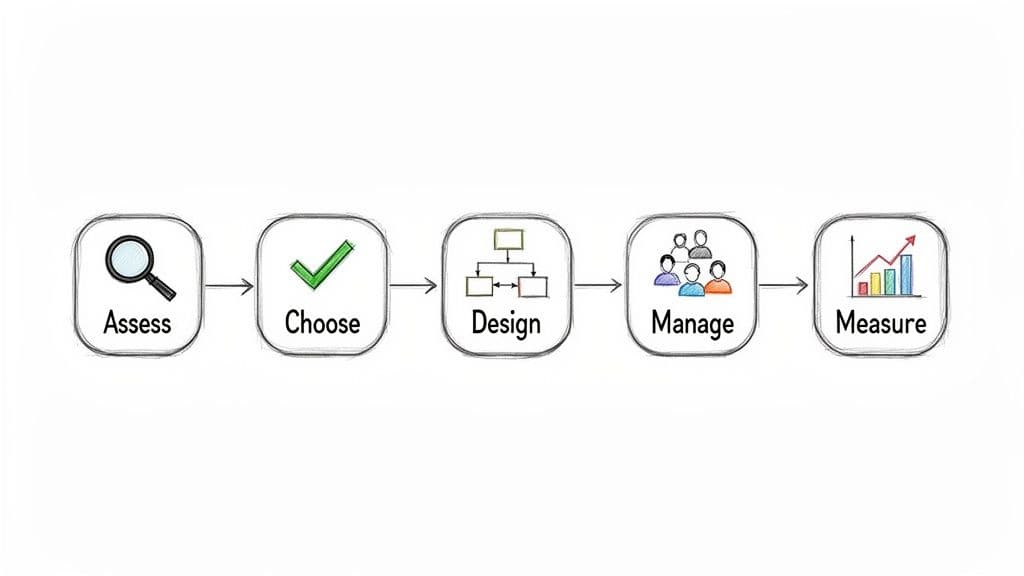
AP Automation Implementation Roadmap
Follow this roadmap for a successful rollout. This structured approach ensures you’re not just buying software, but fundamentally improving how your business operates.
| Phase | Key Actions | Success Metric |
|---|---|---|
| 1. Assess & Map | Document your current AP process from invoice arrival to payment. Pinpoint the exact bottlenecks—where invoices get stuck, who spends hours on data entry, and what the true cost-per-invoice is. | A process map that clearly identifies a path to a 50%+ reduction in manual touchpoints. |
| 2. Select & Integrate | Choose software that solves your specific problems and integrates seamlessly with your accounting system (QuickBooks, Xero, NetSuite). Insist on seeing a live demo with a proven, bi-directional sync. | A vendor is chosen that proves native, bi-directional sync with your general ledger in a live demo. |
| 3. Design & Configure | Build your new approval rules directly into the system. Set up automatic routing based on dollar amounts, departments, or project codes so invoices go to the right person without anyone lifting a finger. | Approval workflows are built to slash the average approval time from several days to under 24 hours. |
| 4. Train & Onboard | Frame the new system as a tool that elevates your team from data entry to strategic analysis. Simultaneously, provide simple instructions to your key vendors for submitting invoices to the new system. | 100% of your AP team and 80% of your top 20 vendors are successfully using the new system within the first 30 days. |
| 5. Measure & Optimize | Establish clear Key Performance Indicators (KPIs). Track metrics like cost-per-invoice, invoice cycle time, and early payment discounts captured to prove the system is delivering a tangible ROI. | A dashboard showing measurable improvements in your target KPIs, like a 75% reduction in invoice cycle time, within 90 days of going live. |
The single biggest mistake we see is failing to get your team on board. You must frame automation as a tool that frees them from mind-numbing data entry so they can focus on higher-value financial work. For a more detailed breakdown, this guide on how to automate accounts payable provides a great overview.
Making this transition is a major project, but the payoff in saved time, money, and strategic clarity is enormous. To see how we guide clients through this exact process, check out our expert-led AP Setup & Automation service.
Your Actionable Next Steps Toward AP Automation
You’ve seen the real costs of manual AP, the strategic upside of automation, and the warning signs that your process is holding you back. The data is clear. Now it’s about making a decision. As a founder or CEO, you have two paths forward.
Path 1: The DIY Approach
You can lead the implementation yourself—researching software, negotiating contracts, configuring the system, and training the team.
- Pros: This path appears cheaper upfront because you avoid implementation fees.
- Cons: This route is slow and risky. Your time is your most valuable asset, and a DIY project diverts dozens of hours from running your business to managing a software setup. This often leads to configuration mistakes, poor adoption, and a tool that never delivers its promised ROI.
Path 2: The Expert-Guided Route
You can bring in a dedicated expert who manages the entire process for you from start to finish. This is the path for leaders who prioritize speed, certainty, and getting 100% of the value from their investment from day one.
"A common mistake I see is founders trying to be their own implementation specialists. They end up with a poorly configured system that creates more work than it saves. A guided implementation isn't a cost; it's an investment in getting it right the first time." – Sarah Chen, CPA, Fractional CFO at Jumpstart Partners
This is exactly where Jumpstart Partners comes in. Our Accounts Payable Automation service is a completely managed implementation led by US-based, CPA-certified finance professionals. We handle everything: vendor selection, negotiation, workflow design, system integration, and team training.
Because we do this work every day, we ensure your system is perfectly tuned for your business—whether you're a SaaS company navigating ASC 606 compliance or a digital agency managing complex project billing.
Your First Step
Ready to see exactly what AP automation could save your business? The first step is a simple conversation. Book a free, no-obligation consultation with our team. In this call, you will get:
- A personalized analysis of your current AP process.
- A clear ROI projection based on your specific invoice volume and costs.
- A straightforward implementation plan showing the path to full automation.
You will leave the call knowing exactly what a move to automation means for your bottom line.