Financial Operations
What Is Unit Economics And Why It Determines Your Profitability
Learn what is unit economics for SaaS and agency founders. A founder's guide to calculating LTV, CAC, and payback to drive sustainable growth in 2026.
ByJumpstart Partners, CPA, QuickBooks ProAdvisor
··18 min readLet's get straight to the point. Your business has a fundamental, make-or-break question to answer: for every dollar you spend to get a customer, how many dollars do you get back in profit? That's it. That's unit economics.
It’s the essential math that separates companies that scale sustainably from those that just burn through cash on their way to failure. If you're a founder, CEO, or finance leader of a $500K-$20M business, ignoring this is not an option.
Why Unit Economics Dictates Your Company’s Fate
This isn't an academic exercise; it's your compass for navigating growth. Unit economics pushes past top-line revenue to answer the only question that really matters: are you actually making money on each new subscription, project, or sale? Or is your impressive revenue chart just masking a deep, unsustainable profitability problem?
Ignoring your unit economics is like flying an airplane without an instrument panel. You might feel like you're gaining altitude, but you have no idea if you're about to run out of fuel or fly straight into a mountain. A firm grasp on these numbers gives you the clarity to lead with confidence, not just hope.
The Strategic Impact of Knowing Your Numbers
When you know your unit economics cold, you make sharp, data-driven decisions instead of going with your gut. This knowledge empowers you to:
- Optimize Marketing Spend: Confidently double down on acquisition channels that deliver profitable customers and cut the ones bleeding you dry.
- Refine Your Pricing Strategy: See exactly how pricing changes will affect your profitability on a per-customer basis.
- Forecast Cash Flow Accurately: Predict how much capital you'll need to fuel growth without creating a cash crunch.
- Secure Funding with Confidence: Walk into investor meetings with a clear, defensible story of how their capital will generate profitable returns.
As Neeraj Agrawal, a General Partner at Battery Ventures, puts it, a viable business model depends on a simple balance.
"A healthy LTV/CAC ratio is at least 3, meaning for every dollar you spend to get a customer, you make at least three dollars in profit from them."
This simple truth is the bedrock of scalable growth. In this guide, we'll move beyond theory and give you the specific calculations and frameworks you actually need. We'll break down each component, from customer lifetime value (LTV) to contribution margin. To learn more about how individual metrics feed into your overall unit economics, you can check out our guide on understanding contribution margin.
Ultimately, mastering your unit economics is what gives you the financial discipline to build a real business, not a house of cards. Below is a quick look at the core metrics that form the building blocks of this entire analysis.
Key Unit Economics Metrics At A Glance
Here’s a quick summary of the core metrics that define your business's unit-level profitability.
| Metric | What It Tells You | Why It Matters For You |
|---|---|---|
| Customer Lifetime Value (LTV) | The total profit you'll earn from an average customer. | Determines the maximum you can profitably spend to acquire a customer. |
| Customer Acquisition Cost (CAC) | Your fully-loaded cost to acquire one new customer. | Measures the efficiency of your sales and marketing engine. |
| LTV to CAC Ratio | The return on investment from your customer acquisition spending. | The ultimate indicator of your business model's health and scalability. |
| CAC Payback Period | How many months it takes to earn back your acquisition cost. | Directly impacts your cash flow and capital efficiency. |
Think of these as the vital signs for your business model. If they are healthy, you have a clear path to scale. If not, you know exactly where to focus your efforts.
Calculating the Two Pillars: LTV and CAC
Let's get down to the two numbers that will make or break your business: Customer Lifetime Value (LTV) and Customer Acquisition Cost (CAC). In simple terms, LTV is the total profit you’ll make from a customer, and CAC is what you paid to get them in the door.
Getting these two metrics right isn't just a bookkeeping exercise—it’s the first real test of your business model's viability. The entire game boils down to this fundamental relationship: you spend money (your cost) to get more money back (your return).
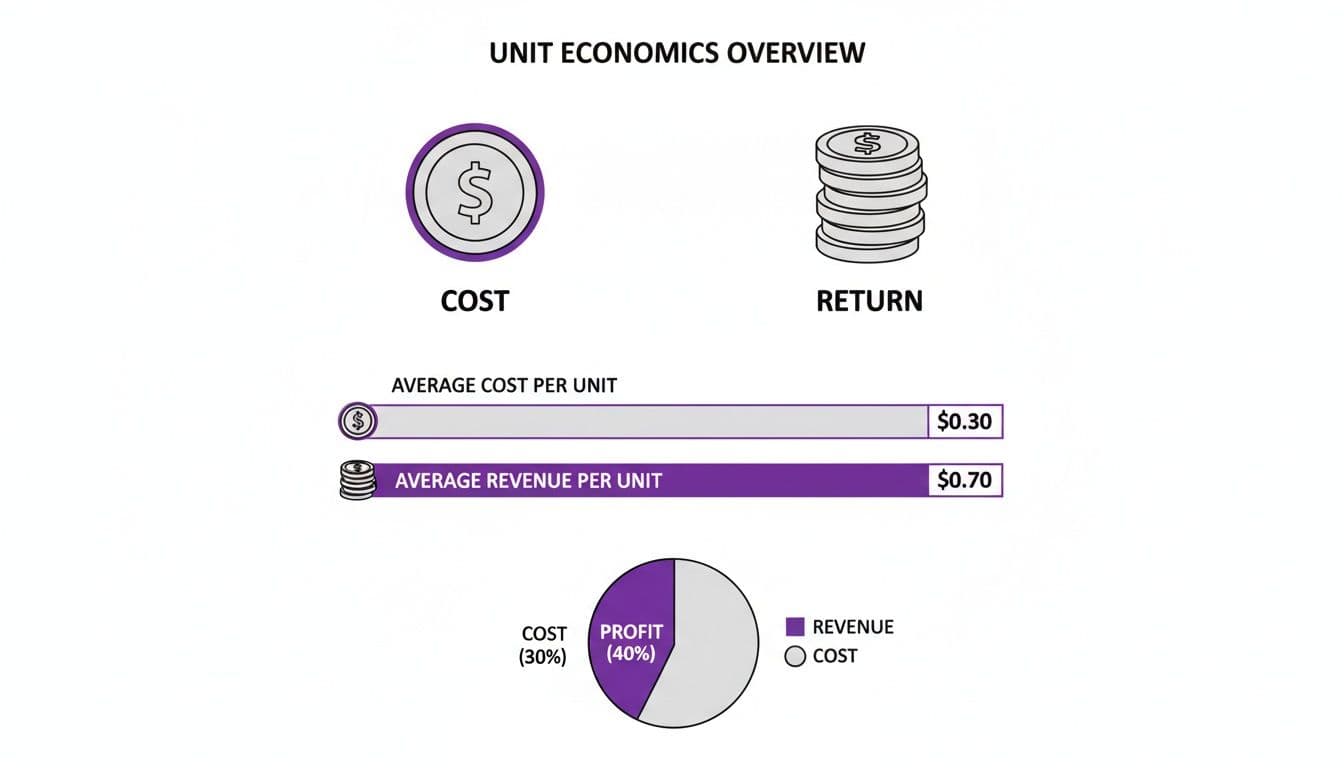
Your LTV and CAC calculations tell you if that return is big enough to build a scalable company or if you're just lighting cash on fire.
Calculating Customer Lifetime Value (LTV)
LTV tells you exactly what a customer is worth. But be careful—a simple revenue-based LTV is a vanity metric. Smart operators and every investor on the planet only care about one thing: Gross Margin-Adjusted LTV.
This version factors in the direct costs of serving your customer (your Cost of Goods Sold, or COGS), showing the actual profit each customer brings you.
The formula is straightforward:
LTV = Average Revenue Per Account (ARPA) x Gross Margin % x Average Customer Lifetime
Let's use a fictional but typical SaaS company, SaaSy Co. They have three tiers: 100 basic customers paying $50/month (average lifetime: 12 months), 250 professional customers at $100/month (average lifetime: 18 months), and 75 enterprise customers paying $500/month (average lifetime: 24 months).
First, we find the revenue-based LTV across all 425 customers: [(100 customers × $50 × 12 months) + (250 customers × $100 × 18 months) + (75 customers × $500 × 24 months)] / 425 customers = a blended LTV of $3,318 per customer.
Now, let's make it real. Assume SaaSy Co. has a healthy 80% gross margin after accounting for hosting, support staff, and third-party software.
The investor-ready, Gross Margin-Adjusted LTV is: $3,318 (Revenue LTV) x 80% (Gross Margin) = $2,654
This is the number that matters. To make this easier, you can use a dedicated tool like an LTV (Customer Lifetime Value) calculator to speed up the process. For a deeper dive, our guide on how to calculate SaaS LTV has you covered.
Calculating Customer Acquisition Cost (CAC)
CAC measures how efficiently you can grow. The single biggest mistake founders make here is only counting ad spend. A true, “fully-loaded” CAC includes every single dollar spent to win a new customer. To get this right, you have to be brutally honest with your expenses.
| Expense Category | Included Costs |
|---|---|
| Marketing Expenses | Ad spend, content creation, SEO consultants, event sponsorships |
| Sales Expenses | Sales commissions, sales team travel, trial onboarding costs |
| Salaries & Benefits | A portion of salaries for your marketing, sales, and BD teams |
| Tools & Overhead | CRM software, marketing automation platforms, analytics tools |
The formula looks simple, but the inputs are key:
CAC = Total Sales & Marketing Expenses / Number of New Customers Acquired
Let's stick with SaaSy Co. In one quarter, they spent the following to acquire 150 new customers:
- Marketing Team Salaries: $75,000
- Sales Team Salaries & Commissions: $120,000
- Ad Spend (Google, LinkedIn): $50,000
- Software (CRM, HubSpot): $5,000
- Total Quarterly Spend: $250,000
Now, we can calculate their true CAC:
$250,000 (Total Spend) / 150 (New Customers) = $1,667 per customer
This fully-loaded number gives you the real cost of growth. If your books are a mess, finding an accurate CAC is next to impossible. We dive deep into this metric in our complete guide on calculating customer acquisition cost.
Now you have the two core pillars of your business model: a Gross Margin-Adjusted LTV of $2,654 and a Fully-Loaded CAC of $1,667. With these two numbers, you can finally see if you have a business built to last.
Mastering The LTV To CAC Ratio
Calculating your LTV and CAC individually is just data entry. The real strategic insight—the number that dictates your company’s future—comes from smashing them together into the LTV to CAC ratio. This single metric is the ultimate health indicator for your business model.
Think of it as your return on investment for growth. For every dollar you spend to acquire a new customer, how many dollars in gross profit do you get back over their lifetime? Answering this question correctly separates businesses that are truly scaling from those that are just spending money to look busy.
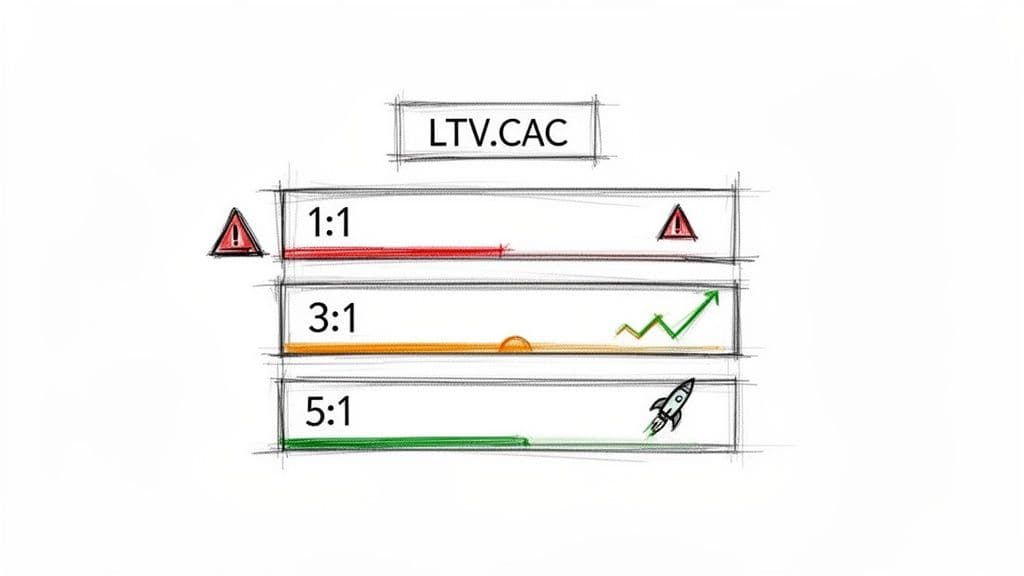
The math is dead simple:
LTV to CAC Ratio = Lifetime Value / Customer Acquisition Cost
Let's go back to our friends at SaaSy Co. They had a Gross Margin-Adjusted LTV of $2,654 and a Fully-Loaded CAC of $1,667.
Their LTV to CAC Ratio is: $2,654 / $1,667 = 1.59:1
This number is a huge red flag. It tells us that for every dollar they pour into growth, they only get $1.59 back in profit. While technically profitable on paper, this razor-thin margin leaves zero room for error and makes scaling incredibly slow and capital-intensive. You can’t build a market leader on a 1.6x return.
SaaS LTV to CAC Ratio Benchmarks
Your ratio isn’t just a number; it’s a direct order from your business on what to do next. Investors fixate on this metric because it instantly tells them if your growth engine is a finely-tuned machine or a leaky bucket. Here’s what your LTV:CAC ratio means for your business.
| LTV:CAC Ratio | Health Status | Your Next Move |
|---|---|---|
| Less than 3:1 | Red Flag | Your business model is leaking money or is dangerously inefficient. You're spending too much to acquire customers relative to their value. Action: Freeze spending on unprofitable channels immediately. Shift focus to improving retention and pricing. |
| 3:1 to 5:1 | Healthy | You have a strong, scalable business model. This is the gold standard for most SaaS companies and a sign of efficient growth. Action: Confidently invest in your proven growth channels. You know that each dollar spent generates a solid return. |
| Greater than 5:1 | Excellent, but... | Your growth engine is extremely efficient, but this ratio signals you might be underinvesting in sales and marketing. Action: It's time to press the accelerator and capture more market share before a competitor with a 4:1 ratio outspends and outgrows you. |
A healthy LTV:CAC ratio is your green light to grow. A poor one is a flashing red light telling you to fix the engine before you run out of road. Digging deeper into these analytics reveals the truth behind your numbers, a topic we explore further in our article on the SaaS metrics that actually matter.
Warning Signs: CAC Payback Period & Cash Flow
A great LTV:CAC ratio is a wonderful thing, but it won’t save you if you run out of cash before your customers become profitable. This is where the CAC Payback Period comes in.
This metric answers a simple, brutal question: How many months does it take to earn back the cash you spent to acquire a new customer? A fantastic LTV:CAC ratio means nothing if you go bankrupt waiting for the payoff. A long payback period creates a cash flow gap that can be a killer for high-growth SaaS companies and agencies.
Calculating Your CAC Payback Period
The formula itself is straightforward, but your inputs have to be spot-on. You'll need your fully-loaded CAC, your average monthly recurring revenue (MRR) per customer, and your gross margin percentage.
CAC Payback Period (in months) = CAC / (Average MRR per Customer x Gross Margin %)
Let’s go back to SaaSy Co. from our last example. Here were their numbers:
- Fully-Loaded CAC: $1,667
- Blended Average MRR per Customer: $115
- Gross Margin %: 80%
Now, let's plug those into the formula:
$1,667 / ($115 x 0.80) = $1,667 / $92 = 18.1 months
This is a massive insight. It will take SaaSy Co. more than a year and a half just to break even on a new customer. This painfully long payback period is exactly why their 1.59:1 LTV:CAC ratio felt so tight—the company has a major cash flow problem disguised as a growth story.
Why Payback Period Is Your Key To Survival
For most SaaS businesses, the industry benchmark for a healthy payback period is under 12 months. According to OpenView's 2024 SaaS Benchmarks, the best-performing companies often get this down to just 6-9 months.
- Under 12 Months (Ideal): Your growth engine is capital-efficient. You can recycle cash quickly to fund new customer acquisition without constantly needing outside funding.
- 12-18 Months (Caution): The model works, but it's cash-intensive. You’ll need significant funding to fuel growth, and there's little room for error if churn ticks up or sales slow down.
- Over 18 Months (Danger Zone): You have a serious cash flow problem. Your growth is likely burning through cash at an unsustainable rate. Without a major strategic change or a large capital injection, survival is at risk. Managing every dollar is critical here; a great tool for this is a 13-week cash flow forecast that helps you navigate these tight periods.
Think of a short payback period as a powerful growth flywheel. The faster you get your money back, the faster you can reinvest it into acquiring the next customer, which compounds your growth rate.
Are your unit economics investor-ready?
Three quick questions. No email — see your finance-ops readiness signal instantly, then get a personalized workflow map.
Start the diagnosticActionable Next Steps: How to Improve Your Unit Economics
Knowing your numbers is the starting line. Actually improving them is how you win the race. Your unit economics aren't static—they’re the direct result of the decisions you make every day. Positive unit economics are engineered.
As a leader, your job is to find and pull the highest-impact levers that move these core metrics in the right direction. Let's break down the playbook.
Levers to Increase LTV
A higher LTV gives you more breathing room to spend on customer acquisition and drastically shortens your path to profitability. It’s the most powerful lever for improving your overall LTV:CAC ratio.
-
Optimize Your Pricing and Packaging: Don't set your prices and forget them. This is a fatal error. You should be revisiting your pricing tiers at least quarterly. Build your pricing around a clear "value metric"—like per user, per contact, or per gigabyte—that allows revenue to scale as your customer’s usage grows.
-
Engineer Effective Upsell and Cross-sell Paths: Your best, most profitable new revenue comes from the customers you already have. You need to map out a crystal-clear journey for a customer to upgrade from a basic tier to a professional or enterprise plan. What specific features or usage limits will trigger that need to upgrade?
-
Implement a Proactive Customer Success Program: A customer success manager is not a cost center; they are a revenue-driving asset. Proactive outreach, regular business reviews, and a genuine focus on helping customers achieve their goals will crush churn and unlock expansion revenue.
Levers to Decrease CAC
While increasing LTV adds value, cutting your CAC makes your growth engine more efficient. A lower CAC means you acquire more customers for the same budget, accelerating your market penetration.
"To have a viable business, the cost to acquire a customer (CAC) must be less than the money you make from that customer (LTV). It's as simple as that." — David Skok, General Partner, Matrix Partners
Achieving this balance demands a ruthless focus on efficiency.
-
Double Down on High-Performing Channels: Not all acquisition channels are created equal. You have to analyze your CAC on a per-channel basis. Cut the spend on channels with a poor LTV:CAC ratio and immediately reallocate that budget to your proven winners.
-
Refine Your Ideal Customer Profile (ICP): Stop trying to sell to everyone. A tighter, more focused ICP leads to higher conversion rates at every single stage of the funnel, from ad clicks to closed deals. This brings your blended CAC down significantly.
-
Use Product-Led Growth (PLG): Let your product do the selling with a free trial or a freemium model. PLG tactics slash sales and marketing costs by using the product itself as the primary acquisition channel, leading to a dramatically lower CAC than traditional, high-touch sales models.
-
Optimize Your Sales Funnel: Every point of friction in your sales process drives up your CAC. Streamline your demo request forms, reduce the number of steps it takes to sign up, and automate your follow-ups. A 10% improvement in your conversion rate directly translates to a 10% reduction in CAC.
Turning Messy Data Into An Investor-Ready Dashboard
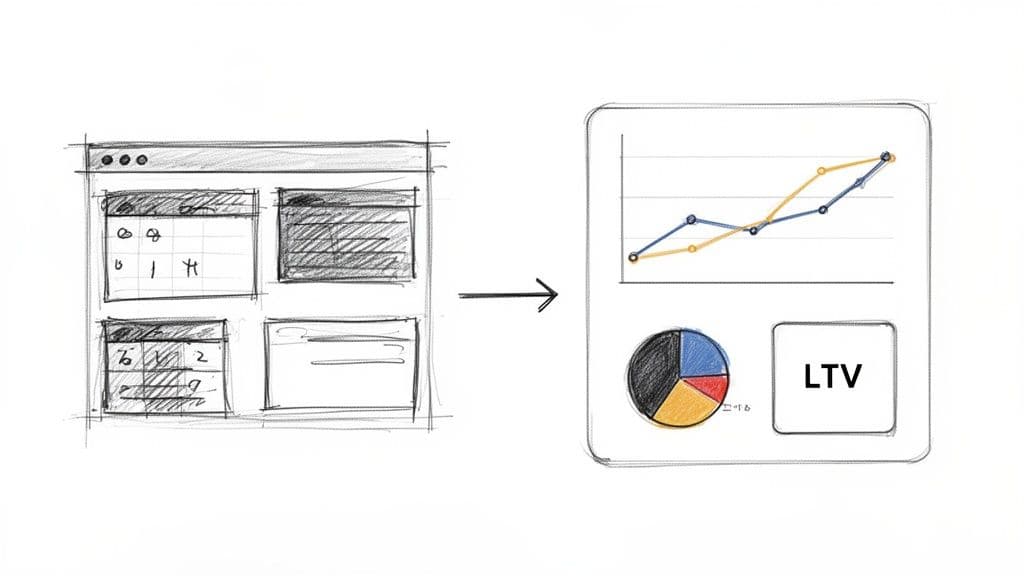
The biggest roadblock to mastering your unit economics isn't the math—it's the messy, disorganized financial data hiding in your spreadsheets. You can't trust your LTV or CAC calculations if you can't trust the numbers they're built on. It's the oldest rule in data: garbage in, garbage out.
An accurate LTV is impossible if you're recognizing revenue improperly. A true CAC is a fantasy when expenses aren't allocated correctly. This is the moment when disciplined financial operations stop being a back-office chore and become your most powerful competitive edge.
Building Your Single Source of Truth
Transforming that chaos into a reliable source of truth starts with clean, rigorous bookkeeping. This isn't just about categorizing receipts; it's about building an automated system that delivers trustworthy metrics on demand. The process boils down to three non-negotiable steps:
| Step | Why It's Critical for Unit Economics |
|---|---|
| 1. Implement Accrual-Basis Accounting | This is the only way to accurately match revenue and expenses to the correct period, which is essential for calculating true MRR, churn, and payback period in a SaaS model. |
| 2. Integrate Your Tech Stack | Your payment processor (Stripe), CRM (HubSpot), and accounting software (QuickBooks) must talk to each other. This automates data flow and eliminates manual entry errors that corrupt your CAC and LTV calculations. |
| 3. Achieve a 5-Day Month-End Close | A rapid close means your data is always fresh. You can make decisions based on what’s happening now, not what happened two months ago, allowing you to react quickly to poor unit economics. |
This financial discipline is what powers an always-on, investor-ready dashboard with metrics you can actually stand behind. You go from guessing your CAC to knowing it.
From Data to Decisions
The goal isn't just a pristine spreadsheet; it's to unlock the strategic insights buried in your numbers. When your data is accurate and timely, your financial dashboard becomes the cockpit of your business, giving you the controls to steer with confidence. To learn more, check out our guide on building effective financial dashboards for CEOs.
An investor-ready dashboard tells a clear, defensible story about your growth and profitability. When you can instantly pull up a cohort analysis showing improving LTV, or a channel-by-channel breakdown of your CAC, you’re demonstrating a level of operational mastery that gives investors immense confidence. This financial rigor isn't a "nice-to-have" anymore—it's a prerequisite for serious funding and sustainable growth.
Common Misconceptions & Objections
As a founder, you're making bets every day that determine your company's future. Here are the straight answers to the most common—and critical—objections we hear from leaders trying to master their unit economics.
"We're growing revenue fast, so we must be doing something right."
This is the most dangerous misconception. Fast revenue growth can easily mask fatal unit economics. If you spend $2 to make $1, growing faster just means you burn through cash faster. VCs call this "getting high on your own supply." You're funding unprofitable growth with investor money, which always ends badly. Profitability at the unit level is what proves your business model is sustainable; revenue growth alone does not.
"We're too early-stage to worry about this. We just need to get customers."
This thinking is a trap. While you don’t need a perfect 3:1 LTV:CAC ratio on day one, you absolutely need to be tracking the trend line. Are your unit economics improving over time as you find product-market fit and optimize channels? If your ratio is stuck at 1:1 or trending downward, you don't have a scaling problem—you have a fundamental business model problem that no amount of growth can fix. Early-stage is precisely when you should be building the discipline to track these numbers.
"Calculating a fully-loaded CAC is too complicated."
This is an excuse, not a reason. Yes, it requires disciplined bookkeeping and a clean chart of accounts. But avoiding it is a choice to operate blindly. If you don't know your true, fully-loaded CAC, you have no idea if your growth strategy is profitable. You're making budget decisions based on fantasy numbers. Complexity is not an excuse for ignoring the most critical driver of your business's financial health. The cost of getting it wrong is far higher than the effort required to get it right.
Ready to stop guessing and start knowing your true unit economics? The expert team at Jumpstart Partners provides investor-ready financials and the clarity you need to scale profitably. Schedule your free consultation today.
Finance Ops Scorecard
How healthy is your finance ops?
Three quick questions identify the first likely break. No email is required. A deeper three-step review is optional after your result.
Answer all three questions to reveal your first likely break.