Financial Operations
Accounts Payable Automation Case Study: 7 Results for 2026
Explore seven Accounts Payable Automation Case Study examples with worked savings math, timelines, and next steps for SaaS, agency, and services firms.
ByJumpstart Partners, CPA, QuickBooks ProAdvisor
··18 min readYou paid a vendor twice last month. You also let a 2/10 net 30 bill ride to day 30, and a bank-change email that looked like a long-standing supplier sent $38,000 to an account you do not control. None of those losses posted under a label called bad process. They posted as cash that left.
Each leak has a price you can compute before you buy software. A duplicate is the invoice amount. A missed 2% discount is two cents on every eligible dollar. A fraudulent redirect is whatever you fail to recover. The seven accounts payable automation case studies below are illustrative composites for SaaS companies, agencies, and professional services firms between $500,000 and $20 million in revenue. Each one prices a single control and shows where the dollars come from.
Manual payables stay expensive because the work hides in inboxes. In 2024, the share of accounts-payable professionals who described their teams as only partially automated reached 74%, up from 62% in 2023, according to the Accounts Payable Automation Trends 2024 research report. Just 5% reported being fully automated. Manual invoice keying into accounting or ERP systems fell from 85% in 2023 to 60% in 2024, and it is still widespread. If you want to improve cash flow through payables, price the leaks first.
Table of Contents
- 1. Case Study 1 Invoice Capture and OCR Intake for a 40-Person Digital Agency
- 2. Case Study 2 Three-Way Matching for a Vendor-Heavy SaaS Company
- 3. Case Study 3 Approval Routing with Spend Thresholds for a Professional Services Firm
- 4. Case Study 4 Early-Payment Discount Capture for a Direct-to-Consumer Brand
- 5. Case Study 5 Payment Fraud Controls and Bank Detail Verification for a Growth-Stage Company
- 6. Case Study 6 Vendor Master Cleanup and 1099 Automation for a Construction and Trades Business
- 7. Case Study 7 Multi-Entity AP Consolidation for a PE-Backed Services Roll-Up
- How the seven AP automation case studies compare by company profile and headline benefit
- Where to Start Your Own AP Automation Project
1. Case Study 1 Invoice Capture and OCR Intake for a 40-Person Digital Agency
A 40-person digital agency at about $6 million in revenue keyed roughly 1,400 vendor invoices a year. Bills landed in project-lead inboxes. Finance often learned about a bill when the vendor sent a past-due notice.
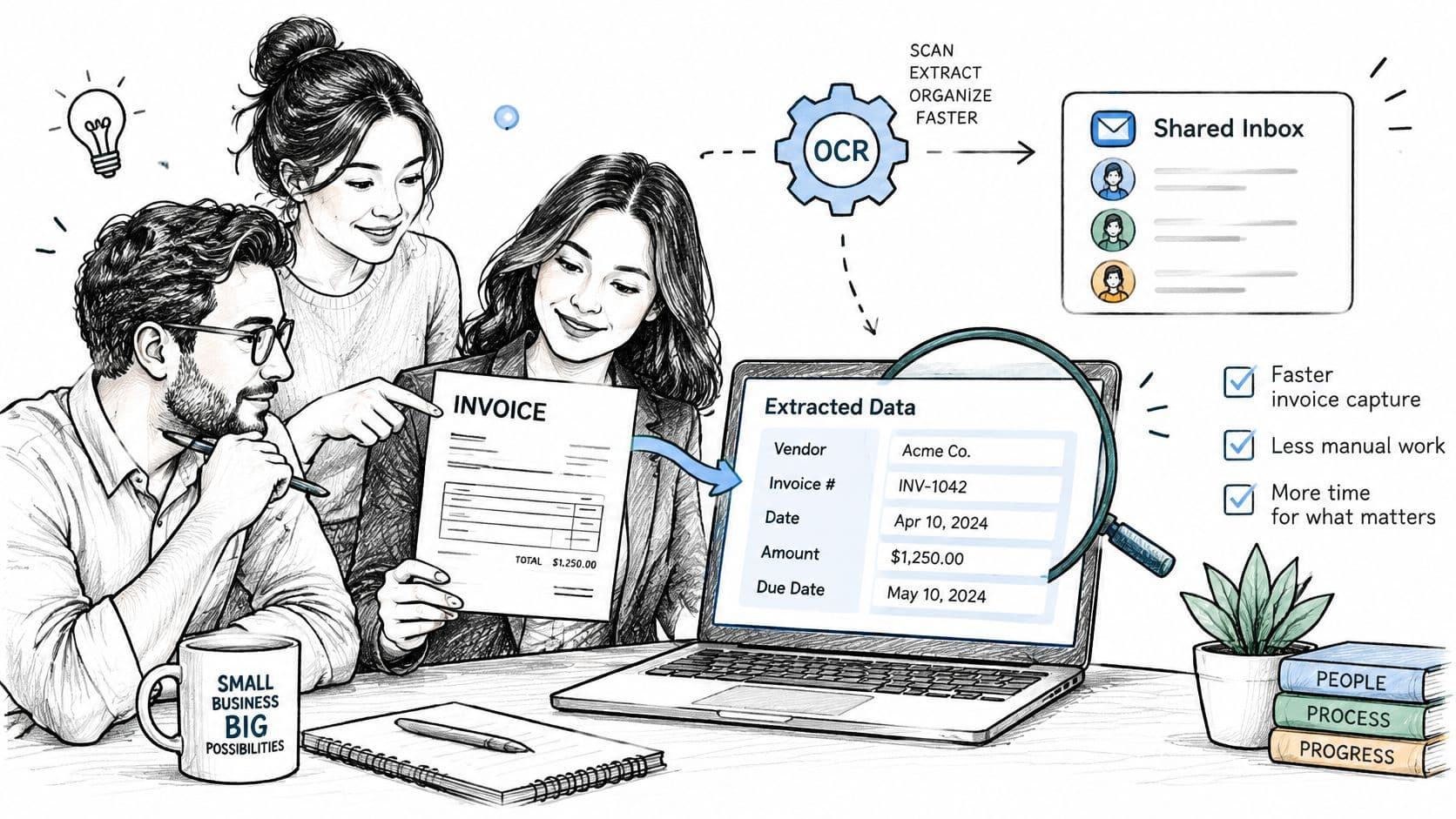
The fix was one shared AP address plus capture software with optical character recognition. The tool reads vendor, amount, date, and line items from that inbox and creates a draft bill in QuickBooks. Your team checks exceptions. They stop typing every field. Intake is where most of the manual cost sits, so it is the control I would fund first.
The intake screen is where the hours disappear.
The dollar math
Fully loaded manual cost was $11 per invoice. That is 1,400 × $11 = $15,400 a year. After automation the cost is $3.50, or 1,400 × $3.50 = $4,900. Annual savings are $15,400 − $4,900 = $10,500. Two recovered late fees at $180 each add $360. First-year benefit is about $10,860.
Keying time fell from about 6 minutes to under 1 minute. Five minutes on 1,400 bills is 7,000 minutes, or roughly 120 hours a year. Vendor past-due notices dropped from 9 per quarter to 1 per quarter once bills were logged within 24 hours.
Practical rule: If the exception rate stays above 15% for two weeks, fix vendor templates before you blame the software.
What to lock in during the first 60 days
- One invoice channel: Create a single AP email and make it the only accepted path within 60 days.
- A 24-hour review target: Measure receipt to draft bill, not receipt to payment.
- A weekly exception log: Track the rate every Friday so a bad template does not sit for a month.
OCR that does not post a draft bill is a scanner with a monthly fee. Pair capture with your ledger the way a proper invoice processing automation setup does, or the keying just moves one screen to the right.
2. Case Study 2 Three-Way Matching for a Vendor-Heavy SaaS Company
A vendor-heavy B2B SaaS company can pay a correct invoice at the wrong rate. Matching the invoice to both the purchase order and proof of service catches the difference before payment.
The company had $9 million in annual recurring revenue and paid about $1.1 million a year to cloud, marketing, and contractor vendors. Finance checked invoices against purchase orders, but did not verify service delivery or contract rates. Three-way matching holds a bill until the purchase order, receipt or service confirmation, and invoice agree. The team set a 2% price tolerance and zero quantity tolerance for software seats. A seat that was not purchased should not clear.
Where the 1.8% went
Rate drift and duplicate seats accounted for estimated overpayments of 1.8%. The calculation is 0.018 × $1,100,000 = $19,800 a year. Matching recovered $16,500 in the first year, including a $6,200 credit memo for duplicate seats in quarter one.
After the controls were in place, overpayments fell to 0.3%: 0.003 × $1,100,000 = $3,300. The reduction from 1.8% to 0.3% equals 1.5 percentage points, or $16,500 a year on the same spend. Count the credit memo as a one-time recovery and the lower overpayment rate as a recurring saving. Do not combine them as an ongoing annual benefit.
Usage-based cloud invoices needed a wider rule. A 5% tolerance cut exceptions on those bills by about half. Exceptions still need a queue: a 2025 benchmark puts best-in-class invoice exceptions at 11.1%, compared with 20.9% for other organizations, as summarized by Nexus AP. Across 1,000 invoices a month, those rates mean 111 versus 209 exceptions.
How to tune the rules
Start with the top 10 vendors, then adjust rules to the bills they send. This focuses review on the suppliers that make up much of the company's AP spend without assuming every vendor has the same risk.
- Split tolerance by bill type: Set 0% for fixed subscriptions and 3% to 5% for usage-based bills.
- Review the queue every Tuesday for the first 90 days, then freeze the rules.
A three-way match control that auto-approves every variance is a rubber stamp, not a check.
3. Case Study 3 Approval Routing with Spend Thresholds for a Professional Services Firm
At a 55-person consulting firm with $12 million in revenue, almost every bill went to the managing partner by email. That single approval queue kept receipt-to-payment time at 9 days.
The partner spent about 4 hours a week reviewing bills. At a billing-equivalent rate of $350 an hour, the calculation is 4 × $350 × 52 = $72,800 in annual capacity. Routing cut approval time to 40 minutes weekly, or (40/60) × $350 × 52 = about $12,100. The difference is $72,800 − $12,100 = $60,700 in redirected partner time. Receipt-to-payment time fell from 9 to 4 days.
Best-in-class teams process invoices in 3.1 days on average, compared with 17.4 days at other organizations. The Hyland AP automation ROI summary reports that the latter take 461% longer. Four days is not best in class, but it clears the email backlog faster.
Thresholds that match real bills
Bills under $1,000 went to the project manager. Those from $1,000 to $10,000 went to the department lead. Bills above $10,000 required approval from both the controller and the partner. Since 78% of the firm's bills were under $1,000, most cleared in one business day. Alerts also caught two over-budget projects with unapproved subcontractor bills in the same month.
Use the last 12 months of invoices to set the low threshold near the 80th percentile of invoice amounts. A guessed round number can leave the partner buried in routine approvals or allow a large bill through without the right review.
Send any vendor added in the last 30 days to a second approver, regardless of invoice amount.
Review the approval log with the controller every quarter. If one person still approves most of the dollars, revise the routing rules.
4. Case Study 4 Early-Payment Discount Capture for a Direct-to-Consumer Brand
An e-commerce brand at $7 million in revenue buys $1.6 million of inventory a year on 2/10 net 30. That term is a 2% discount if you pay within 10 days, otherwise the full amount is due on day 30. Cash was tight, so the brand paid on day 30 and left the discount behind.
If it took the discount on every eligible dollar, savings would be 0.02 × $1,600,000 = $32,000 a year. It captured the discount on 60% of that spend, which is 0.60 × $32,000 = $19,200. The other $12,800 stayed on the table because warehouse receiving slipped in Q4 and nobody saw the deadline.
The return versus your line of credit
Paying 20 days early for 2% is not a 2% decision. The annualized return is (0.02 / 0.98) × (365 / 20) = 37.2%. The simple version, 2% × (365 / 20), is about 36.5%. Either way it clears this brand's line-of-credit rate of about 12%. Early payment wins when the annualized discount beats the cost of cash. It loses when the discount pushes you into a draw you did not plan.
Run the annualized return before you accept any term. A discount that looks generous on the invoice can be worse than waiting if your cash is already spoken for.
Two suppliers later moved to net 45 with no discount after volume dropped. The brand reran the math and took the longer terms. That is the right call when the 2% is gone.
Keep the deadline off a shared inbox
- Flag seven days out: A rule that only alerts on day 10 is already late.
- Put the decision on the 13-week cash sprint: Discount or hold is a cash choice, not an AP preference.
- Name one owner for the discount calendar so a warehouse backlog does not erase the savings.
5. Case Study 5 Payment Fraud Controls and Bank Detail Verification for a Growth-Stage Company
A company at $4.5 million in revenue updated a vendor's bank details from an email and paid a $38,000 invoice to the wrong account. The message looked like a long-standing supplier. Recovery came back only in part, and only after weeks.
Warning signs before the payment leaves
- A new account on an old vendor, especially right before a large invoice.
- Urgency in the email, with a request not to call the usual contact.
- A domain that is one character off the legitimate supplier address.
- A clerk who can change the master and release the payment with no second person.
Year-one control cost was $2,400 to set up plus $300 × 12 = $3,600 in software and reporting, or $6,000. Divide the loss by that cost: $38,000 / $6,000 = 6.3. One prevented incident covers more than six years of that year-one spend. After setup, the run rate is $3,600 a year, so the bar gets easier, not harder. You do not need a fraud event every year for this to be rational.
Callback to a phone number stored on the vendor master blocked a second attempt when the number on the email did not match. The insurer later asked for a written callback procedure. The company already had one.
Build the control as segregation of duties. The person who edits bank details does not release the payment. New destinations stay blocked for 30 days unless two people approve.
Governance cost is real, and teams underestimate it. In the Vic.ai AI Momentum findings, 69% of surveyed organizations had tried to build AP automation internally and ran into integration, security, resources, and inconsistent results. Data privacy led concerns at 47%, ahead of incorrect outputs at 40% and implementation or maintenance cost at 38%.
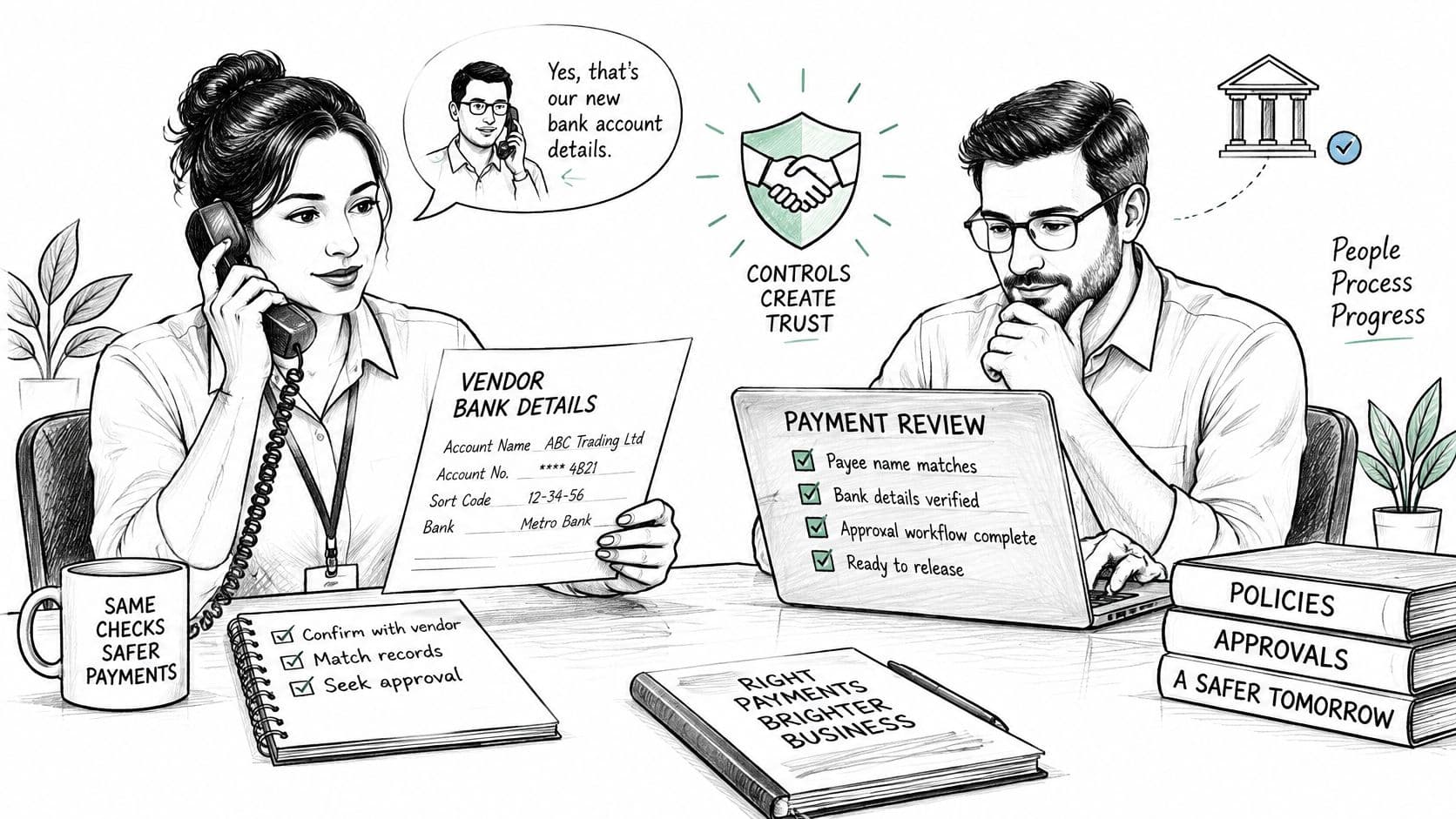
Never accept a bank change by email alone. Store vendor phone numbers in the master and re-verify them yearly. Once a quarter, send a fake change request and record whether anyone pays it.
6. Case Study 6 Vendor Master Cleanup and 1099 Automation for a Construction and Trades Business
A specialty contractor at $11 million in revenue used subcontractors across 14 states. The vendor list had grown to about 640 records, with roughly 180 duplicates, missing tax IDs, and old addresses. Every January the bookkeeper spent three weeks chasing W-9s.
The bookkeeper spent 120 hours a year on 1099 prep and vendor cleanup at an internal cost of $48 an hour. That is 120 × $48 = $5,760. After onboarding rules, the same work took 25 hours, or 25 × $48 = $1,200. Annual labor savings are $5,760 − $1,200 = $4,560. The company also avoided about $2,000 in IRS penalties for bad or late information returns from the prior year. Combined first-year benefit is about $6,560, and the labor save repeats.
A separate deployment cut 1099-processing time from 15 days to 2, as documented in Tungsten Automation's AP automation case studies. Calendar time and labor hours are different measures. Track both.
What the system now refuses to do
No bill pays until a W-9 and tax ID are on file. Vendors dedupe on tax ID, not on the name someone typed. Payments tag as 1099-eligible as they post, so January is a review, not a reconstruction. In three weeks this company merged 180 duplicate records and drove repeat-vendor payment errors to near zero. Two subcontractors were paid through the wrong entity type. That was fixed before filing.
Confirm the filing rules with your CPA every year. Thresholds move, and a rule you hardcoded in the software will not update itself. Run the duplicate check monthly. A once-a-year cleanup is how the list reached 640 records.
7. Case Study 7 Multi-Entity AP Consolidation for a PE-Backed Services Roll-Up
Three acquired firms had $18 million in combined revenue, three QuickBooks files, and separate methods for paying the same insurance vendor. Shared purchasing had not produced common terms or volume savings.
Combined vendor spend was $2.4 million. 28 vendors billed all three entities, representing $840,000 in overlapping spend. A 4% reduction on that spend equals 0.04 × $840,000 = $33,600 in annual savings. Replacing three AP routines with a shared team of two added $42,000 in processing savings. Total annual benefit was $33,600 + $42,000 = $75,600. Against a one-time integration cost of $30,000, payback was $30,000 / $75,600 = 0.40 years, or about five months, assuming the 4% reduction holds at the first renewal.
The shared vendor list exposed one insurer charging three different rate schedules. The companies corrected the rates at renewal. Board reporting also shifted from a three-week manual process to a two-day automated report. Published AP case studies describe similar benefits from consolidating processes, including this Datamatics accounts payable case study. Treat freed AP capacity as time available for accruals and close, not automatic headcount reduction.
Sequence that keeps the books clean
- Start with overlapping vendors: These create the opportunity for cash savings before work expands to the long tail.
- Align the chart of accounts before connecting files. Different coding schemes will not reconcile on their own.
- Run weekly intercompany checks for ninety days before treating the rollout as complete.
A shared vendor master needs entity-level coding and one approval matrix. Retaining a separate master for each company can preserve duplicate records and inconsistent controls. See this guide to multi-entity accounting.
How the seven AP automation case studies compare by company profile and headline benefit
The cases produce different kinds of value: lower processing costs, fewer overpayments, recovered approval capacity, captured discounts, reduced fraud exposure, cleaner vendor records, or consolidated operations. Compare the control each change targets with its annual benefit, and keep one-time recovery separate from recurring savings.
| Item | Company Profile | Headline Annual Benefit | Primary Lever |
|---|---|---|---|
| Invoice Capture and OCR Intake | 40-person digital agency; $6M revenue; 1,400 invoices yearly | About $10,860 in first-year benefit | OCR invoice capture and draft bill creation |
| Three-Way Matching | B2B SaaS company; $9M ARR; $1.1M annual vendor spend | $16,500 in annual overpayment reduction, plus $16,500 recovered in year one | Match purchase orders, service receipts, and invoices |
| Approval Routing with Spend Thresholds | 55-person consulting firm; $12M revenue; most bills approved by one partner | About $60,700 in redirected partner time | Route bills by amount, department, and project |
| Early-Payment Discount Capture | E-commerce brand; $7M revenue; $1.6M annual supplier inventory spend | $19,200 in annual discount savings | Schedule payments to capture worthwhile discounts |
| Payment Fraud Controls | Growth-stage company; $4.5M revenue | $38,000 loss avoided per prevented incident; controls cost $6,000 annually | Verify bank changes by callback and require dual approval |
| Vendor Master Cleanup and 1099 Automation | Construction and trades company; $11M revenue; 640 vendor records | About $6,560 in annual savings and avoided penalties | Automate W-9 collection, vendor deduplication, and 1099 tagging |
| Multi-Entity AP Consolidation | PE-backed holding company; $18M combined revenue across three firms | $75,600 in annual benefit | Consolidate shared vendors, approvals, and AP operations |
Treat each figure according to what it measures. The matching case separates annual overpayment reduction from first-year recovery, while fraud controls compare an avoided loss per incident with an annual control cost. These are not interchangeable ROI measures. The table shows the headline benefit and the specific AP control behind it, so the next decision is which failure point costs your business most.
Where to Start Your Own AP Automation Project
Start with intake cost, bank changes, and who approves the bill. Those three controls cover the cash you lose every month. Do not begin with a platform demo.
Pull 60 days of invoices. Count them. Multiply by a fully loaded cost that includes the bookkeeper, the manager who chases approvals, and the rework, not just an hourly wage. A company processing 1,000 invoices a month that moves from €12 to €3 per invoice cuts €9,000 a month, or €108,000 a year, using the ranges in Deloitte's note on finance's automation paradox. Even 300 invoices a month at a €9 save is €2,700 a month, or €32,400 a year, before any control gain. Separate purchase-order bills, non-PO bills, credits, duplicates, and exceptions so a vendor's best-case rate is not applied to every transaction.
Then test the bank-change path. If one person can edit the vendor master and release payment from an email, that is the first workflow to break, regardless of invoice volume.
Map approvals against the actual distribution, the way the consulting firm did. If one partner still sees most dollars, thresholds are wrong. Set the split from the last 12 months, then name a second approver for any vendor added in the last 30 days.
We run a complimentary ROI assessment when you want those three numbers on your own bills, and a Finance Ops Diagnostic when you want the operating design. You share your ARR band, billing model, current stack, and where the month feels messy. A controller reviews close, reporting, billing, cost, and the handoffs that make the numbers hard to explain. The diagnostic runs five business days and ends with a written workflow map, covering the current stack, where it breaks, the missing owners, and the monthly routine, before either side commits to a retainer. Engagements are CPA-led, and Steven runs that diagnostic himself.
Do the intake math this week. Call one vendor back on a stored phone number. Pull the approval log. If those three steps already show leaks, the software conversation is the second meeting, not the first.
Jumpstart Partners builds accounts payable automation into controller-led finance for SaaS companies, agencies, and other businesses from $500,000 to $20 million in revenue, including fixed-fee AP setup when you want the workflow before a retainer. We tie invoice intake, approvals, and payment controls to a close you can explain to a board or an auditor. Visit Jumpstart Partners to book a complimentary ROI assessment and see whether the controls in these case studies pay back on your own invoice volume.