Financial Operations
ASC 606 Accounting: The Practical Guide for Founders
Master ASC 606 accounting with the five-step model, SaaS revenue examples, and implementation checklist. Learn what investors and auditors actually require.
ByJumpstart Partners, CPA, QuickBooks ProAdvisor
··13 min readASC 606 was issued in May 2014, and for U.S. public companies it became effective for annual reporting periods beginning after December 15, 2017. For nonpublic entities, the timing came later, with annual periods beginning after December 15, 2018 and interim-period requirements beginning after December 15, 2019.
That matters because revenue has to be recognized in a way that depicts the transfer of promised services to customers in an amount reflecting the consideration you expect to be entitled to in exchange for those services. If your books don't do that cleanly, your valuation, your diligence process, and your audit posture all take the hit.
Table of Contents
- Why ASC 606 Is Your Silent Valuation Risk
- Breaking Down the Five-Step Model
- Applying the Rules to SaaS and Agency Models
- Key Differences Between Industry Applications
- Red Flags and Common Implementation Pitfalls
- Your Path to Audit and Investor Readiness
Why ASC 606 Is Your Silent Valuation Risk

If you run a SaaS company, agency, or services firm, ASC 606 accounting is not a back-office technicality. It's the difference between revenue that investors trust and revenue that triggers follow-up questions, pricing pressure, or a longer diligence cycle.
The transition itself showed how broad the impact was. Among nearly 4,000 public companies under SEC oversight, only 32 adopted the new revenue standard early during the 2017 calendar year, which was less than 1% of that population, and that made the 2018 transition highly consequential for the public-company market. The point isn't the number alone, it's the fact that almost everyone moved together onto the same model, which raised the cost of getting it wrong (Deloitte's Heads Up on ASC 606 adoption).
Practical rule: If your revenue schedule can't survive a cold read from an auditor, it won't survive a buyer's quality-of-earnings review either.
A restatement or a messy revenue memo doesn't just create accounting work. It signals that your finance function can't consistently explain how contract terms turn into recognized revenue. That's a valuation issue because buyers and lenders price risk into uncertainty, and revenue uncertainty is one of the fastest ways to create it.
The good news is that the standard gives you a defensible framework. The bad news is that the framework only works if you keep your contract data, pricing support, and judgments current. That's why founders who treat revenue recognition as a system, not a spreadsheet, usually end up with cleaner audits and smoother fundraising.
For a plain-English overview of the mechanics, the intro to ASC 606 revenue recognition is a useful starting point, but the work starts when your contracts stop looking simple.
Breaking Down the Five-Step Model
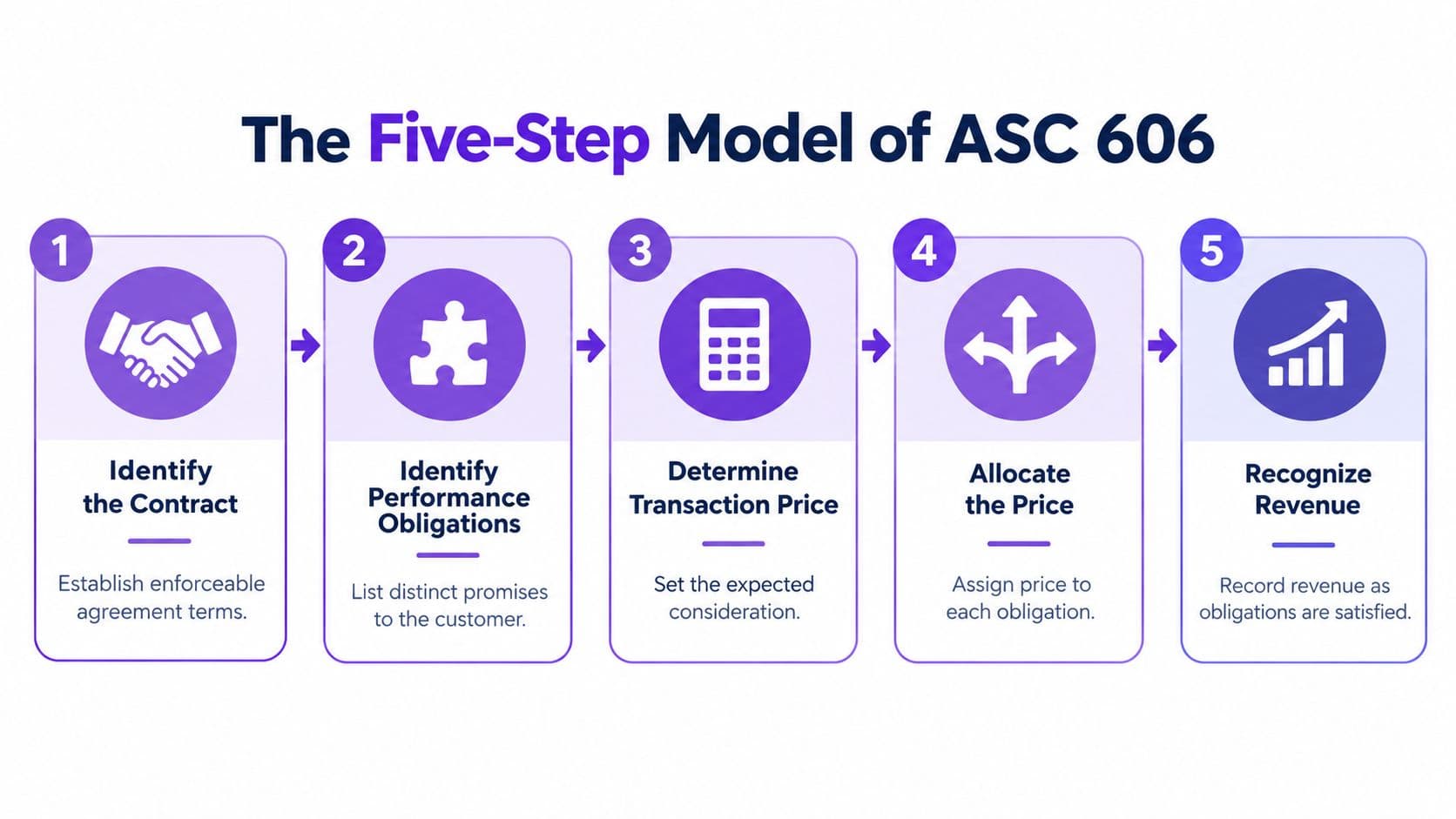
The five-step model is simple to say and easy to break in practice. ASC 606 requires you to identify the contract, identify the performance obligations, determine the transaction price, allocate that price, and recognize revenue when or as the obligations are satisfied (SEC filing summary of the five-step model).
Step 1 and Step 2 define what you actually sold
A contract isn't just an invoice or a signed PDF. It has to create enforceable rights and obligations, and then you have to separate the distinct promises inside it. In a software deal, those promises might include access to the platform, onboarding, implementation, and support.
Practical rule: If the customer can benefit from a promised item on its own or with other readily available resources, treat it as a separate performance obligation and document why.
That distinction matters because the promise you sold determines the timing of revenue. A bundle can look like one sale commercially while still being multiple accounting obligations. If you collapse everything into one line item just because sales did, your ledger starts lying about delivery.
Step 3 and Step 4 are where most systems break
The transaction price is the amount of consideration you expect to receive, including any variable pieces that need judgment. Then you allocate that price to each performance obligation based on relative standalone selling price, which is the price at which you would sell the item separately. If you don't have an observable standalone price, you estimate it using observable inputs (Deloitte guidance on standalone selling price).
That's the mechanics behind splitting software, implementation, and support correctly. It also explains why contract design matters so much. The way you package the deal affects how revenue moves across months, even when cash comes in upfront.
Step 5 turns delivery into revenue
Revenue gets recognized when you satisfy the obligation, not when the invoice goes out. That's why annual prepayments often sit in deferred revenue and then move into revenue over the service period, while some setup or distinct professional services can be recognized as the work is completed.
If you need a broader business-finance lens on how revenue and cost flow together, the framework in company financial health frameworks is a useful companion read. It helps finance teams think about revenue recognition as part of operating discipline, not just compliance.
Applying the Rules to SaaS and Agency Models
A SaaS contract and an agency retainer can look similar in the CRM, but they often behave very differently in accounting. The question isn't what the salesperson called the deal. It's what you promised, when each promise transfers, and whether the pricing data supports your allocation.
SaaS bundle example
Say you sell a 12-month software subscription plus implementation for a single package price of $12,000. Your standalone prices are $9,600 for the subscription and $3,600 for implementation, so the total standalone value is $13,200. The allocation is based on relative standalone selling price, so the subscription gets 72.7% of the bundle and implementation gets 27.3%.
That means the subscription carries $8,724 of the transaction price, and implementation carries $3,276. If implementation is a distinct obligation satisfied upfront, you recognize that portion when the implementation work is done. The subscription portion is recognized over the service period as access is delivered.
Weak pricing support causes headaches here. If your pricing book changes every quarter, your allocation memo has to change with it. Otherwise, the numbers on the revenue schedule drift away from the commercial terms.
Agency retainer example
Now take a digital agency retainer that includes monthly strategic support, creative production, and ad hoc hourly work. The retainer portion is often recognized over time because the customer receives and consumes the service as you perform it. The hourly work can be separate if it is clearly distinct and documented as such in the contract.
That said, agencies often blur scope on purpose, which is where revenue work gets messy. If your contract says “monthly marketing support” but your team also delivers discrete campaign builds, you need a policy for deciding whether those deliverables are separate performance obligations or part of one combined service.
A useful operating test is whether the deliverable changes the pattern of transfer. If the work is continuous and the customer benefits throughout the month, your recognition pattern should reflect that. If it's a separate project with a defined handoff, it needs separate treatment.
For more practical examples in both models, the ASC 606 revenue recognition examples page is a good reference point.
| Business model | Typical contract shape | Recognition pattern | Common control issue |
|---|---|---|---|
| SaaS subscription plus setup | Bundle with distinct deliverables | Over time for access, point in time or as complete for setup | Standalone selling price support |
| Agency retainer plus projects | Ongoing service with add-on deliverables | Often over time, with project work assessed separately | Scope creep and modification tracking |
| Usage-based SaaS | Base subscription plus variable fees | Base over time, usage as consumed or when measurable | Variable consideration estimates |
Key Differences Between Industry Applications
SaaS and agency revenue both rely on the same standard, but the risk sits in different places. SaaS teams usually struggle with allocation, usage, credits, and bundled implementation. Agencies more often struggle with scope changes, contract modifications, and whether “extra work” is a separate obligation or just part of the retainer.
| Issue | SaaS impact | Agency impact |
|---|---|---|
| Usage fees | Can create variable consideration and timing complexity | Less common, but may appear in media or paid-performance retainers |
| Refund rights | Can affect estimated consideration and reserves | Often tied to cancelable retainers or milestone disputes |
| Multi-period terms | Common in annual subscriptions and support contracts | Common in recurring retainers and long-term campaigns |
| Contract modifications | Frequent with upgrades, downgrades, and add-ons | Frequent with expanded scope and change orders |
| Distinct deliverables | Software access, onboarding, support, consulting | Strategy, creative assets, campaign builds, reporting |
The trap is using one policy template for both. A SaaS team can't borrow an agency rule that treats everything as one service stream, and an agency can't blindly apply software-style allocation without checking whether the deliverables are distinct.
The cleaner the contract language, the cleaner the revenue memo.
That sounds obvious until a sales team starts using custom terms. If renewals, credits, usage caps, or implementation promises aren't written clearly, finance has to reconstruct intent from emails and redlines. That's how clean revenue work turns into a forensic exercise.
You also need consistency across entities and geographies if you operate outside one market. The disclosure and judgment burden only grows when subsidiaries book similar services differently. If you're comparing agency accounting approaches, the accounting for agencies resource helps you think through where that line usually sits in practice.
Red Flags and Common Implementation Pitfalls
ASC 606 problems rarely start with the journal entry. They start with the data layer underneath it. If your contract intake, pricing support, and modification review are inconsistent, the accounting will look unstable even when the business is healthy.
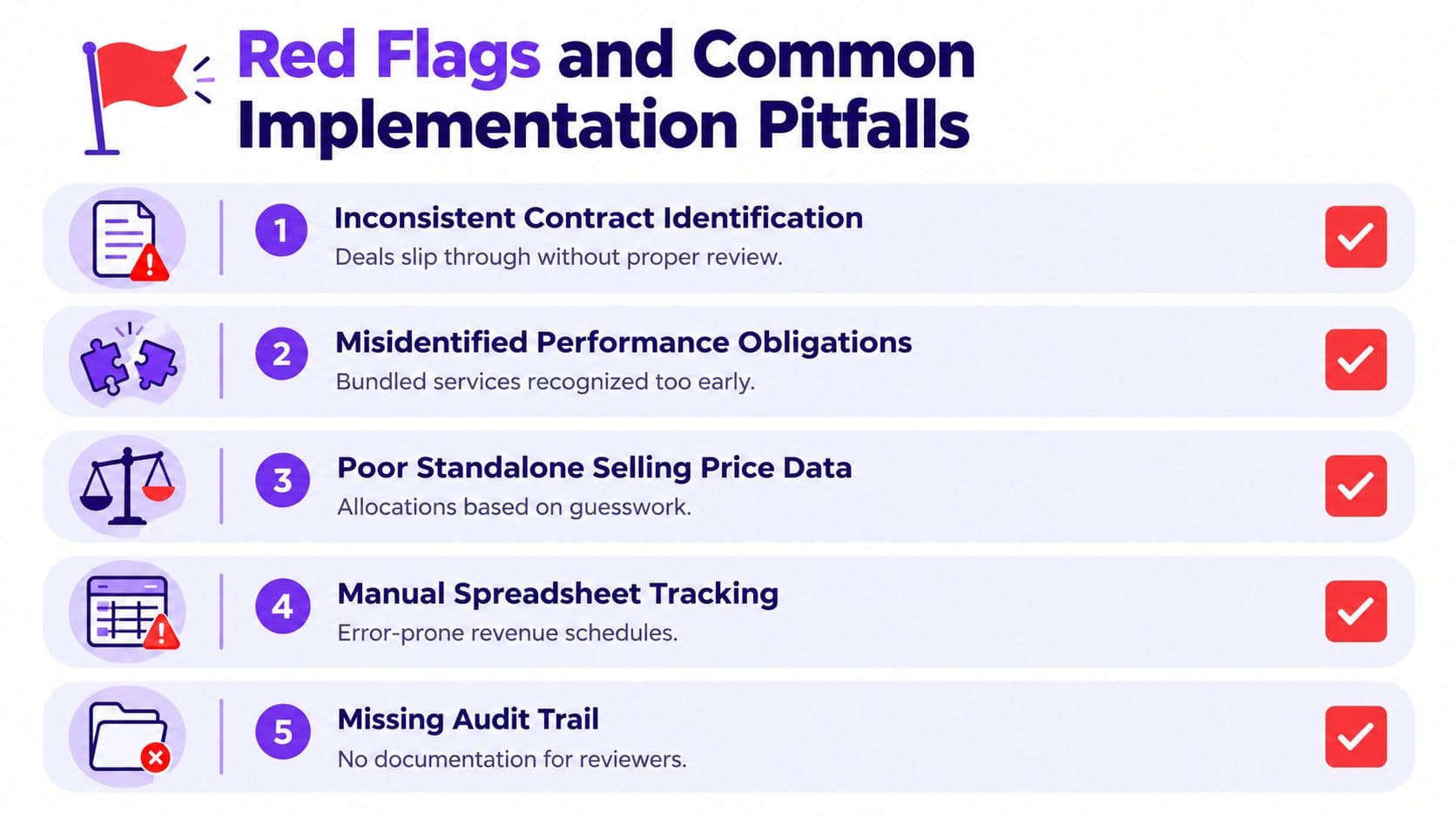
Red flags that deserve immediate attention
- Contracts enter close with no review: Sales closes deals in CRM, but finance doesn't see the final terms until month-end, so modifications and side letters slip through.
- Standalone selling prices are guessed: Allocation memos use last quarter's numbers, generic ratios, or “management judgment” with no source support.
- Variable consideration changes without a policy update: Credits, rebates, usage fees, and refunds are handled ad hoc instead of through a documented method.
- Deferred revenue and backlog don't reconcile: The balance sheet, revenue schedule, and disclosure package tell different stories.
- Audit questions repeat every quarter: If the same judgment gets challenged over and over, your documentation is the problem, not the auditor.
Those are not theoretical risks. Recent public discussion has flagged revenue recognition as a recurring SEC comment-letter topic in 2024 and 2025, and the SEC's 2026 accounting enforcement focus explicitly names revenue recognition, which makes stale policies a real compliance issue (RightRev on SEC revenue recognition enforcement focus).
The biggest misconception is that adoption is a one-time project. It isn't. Your policies need version control, your principal-vs-agent conclusions need to stay current, and your estimates for variable consideration need periodic reassessment. If your product packages change and your revenue memo doesn't, you're inviting trouble.
That's also why contract modifications deserve more than operational approval. A change counts as a separate contract only when the added goods or services are distinct and priced at their standalone selling price at the modification date. If not, the remaining revenue gets reallocated under the existing contract, so the accounting event is real even when the deal team treats it like routine paperwork (Deloitte on contract modifications).
For a practical lens on estimates, credits, and judgment calls, the variable consideration guidance is worth reviewing before your next close.
Your Path to Audit and Investor Readiness
You don't need a giant accounting department to get this right. You need a clean policy, disciplined data flow, and a file that explains your judgment in plain English. That's what keeps revenue recognition from becoming a recurring fire drill.
Build the control package first
Start with a revenue recognition policy memo that covers contract intake, performance obligation identification, allocation logic, and treatment of modifications. Then make sure every recurring revenue stream has a supporting schedule tied back to the signed contract and billing records.
- Document the contract basis: Keep the signed agreement, any amendments, and the final commercial terms together.
- Write the judgment once: Define how you decide whether deliverables are distinct, how you estimate standalone selling price, and how you treat usage or credits.
- Reconcile the numbers monthly: Tie deferred revenue, billed revenue, and recognized revenue to the general ledger and subledger.
- Version the policy: When product packaging changes, update the memo instead of leaving old logic in place.
- Prepare the disclosure trail: Track judgments so you can explain them cleanly in diligence or an audit review.
Practical rule: If you can't explain a revenue line to a lender in two minutes, your documentation is too thin.
Prepare for diligence before diligence starts
Buyers and investors want to see that the accounting follows the business, not the other way around. That means your team should be able to show how contracts map to obligations, how modifications are captured, and how judgments changed over time.
Use an audit-prep checklist to pressure-test the file before anyone asks for it. The audit preparation checklist should point your team toward missing support, inconsistent treatment, and recurring exceptions before they become a management letter issue.
If you want outside help, bring in a controller-level operator who knows how revenue systems fail in real life, not just in theory. For many founder-led teams, that means tightening the policy, cleaning the data, and making the close repeatable before the next board meeting.
Jumpstart Partners helps growing SaaS, agency, and services businesses build controller-level revenue recognition workflows, clean monthly closes, and investor-ready financials. If you need help turning ASC 606 into a working process instead of a recurring audit problem, visit Jumpstart Partners to see how their team supports revenue policy, reconciliation, and close discipline.