Financial Operations
ASC 606 Compliance for SaaS and Agencies
Master ASC 606 compliance for your SaaS or agency. Learn the five-step model, common pitfalls, and how an outsourced controller streamlines revenue recognition.
ByJumpstart Partners, CPA, QuickBooks ProAdvisor
··17 min readASC 606 compliance is a subledger reconciliation problem, not a policy exercise. You're probably recognizing revenue on the invoice date even though the standard requires recognition when you satisfy distinct performance obligations.
The pattern is familiar. Your CRM records the closed deal, billing issues an invoice, and the general ledger posts the entry. The close looks clean until an auditor asks which promised service was delivered, how the transaction price was allocated, and why the revenue schedule agrees with the contract. At that point, finance discovers that the invoice date became the revenue date by default.
ASC 606 was issued by the FASB in May 2014. It became mandatory for public business entities for annual reporting periods beginning after December 15, 2017, so calendar-year public companies first applied it in 2018. Nonpublic entities generally followed one year later, with interim reporting required after their respective effective dates, as described in this Deloitte ASC 606 background.
Table of Contents
- Why ASC 606 Compliance Fails in Practice
- The Five-Step Revenue Recognition Model Explained
- SaaS and Agency Contract Scenarios That Trip Up Recognition
- What Audit-Ready Revenue Evidence Actually Looks Like
- ASC 606 Implementation Checklist for Growing Businesses
- Red Flags and Common Pitfalls to Watch For
- How an Outsourced Controller Speeds Up Compliance
Why ASC 606 Compliance Fails in Practice
A SaaS renewal closes, billing issues the invoice, and the general ledger posts revenue. The audit problem appears later: CRM or CPQ captured the deal, billing captured the charge, but no system preserved the link between promised services, satisfaction dates, and the revenue schedule.
That gap distorts timing. Bundled onboarding is recognized with platform access, usage charges post when billed instead of when consumed, and a scope change enters as a new sale without reassessing the existing contract. The failure sits at the connection between CRM or CPQ, billing, the revenue subledger, and the GL.
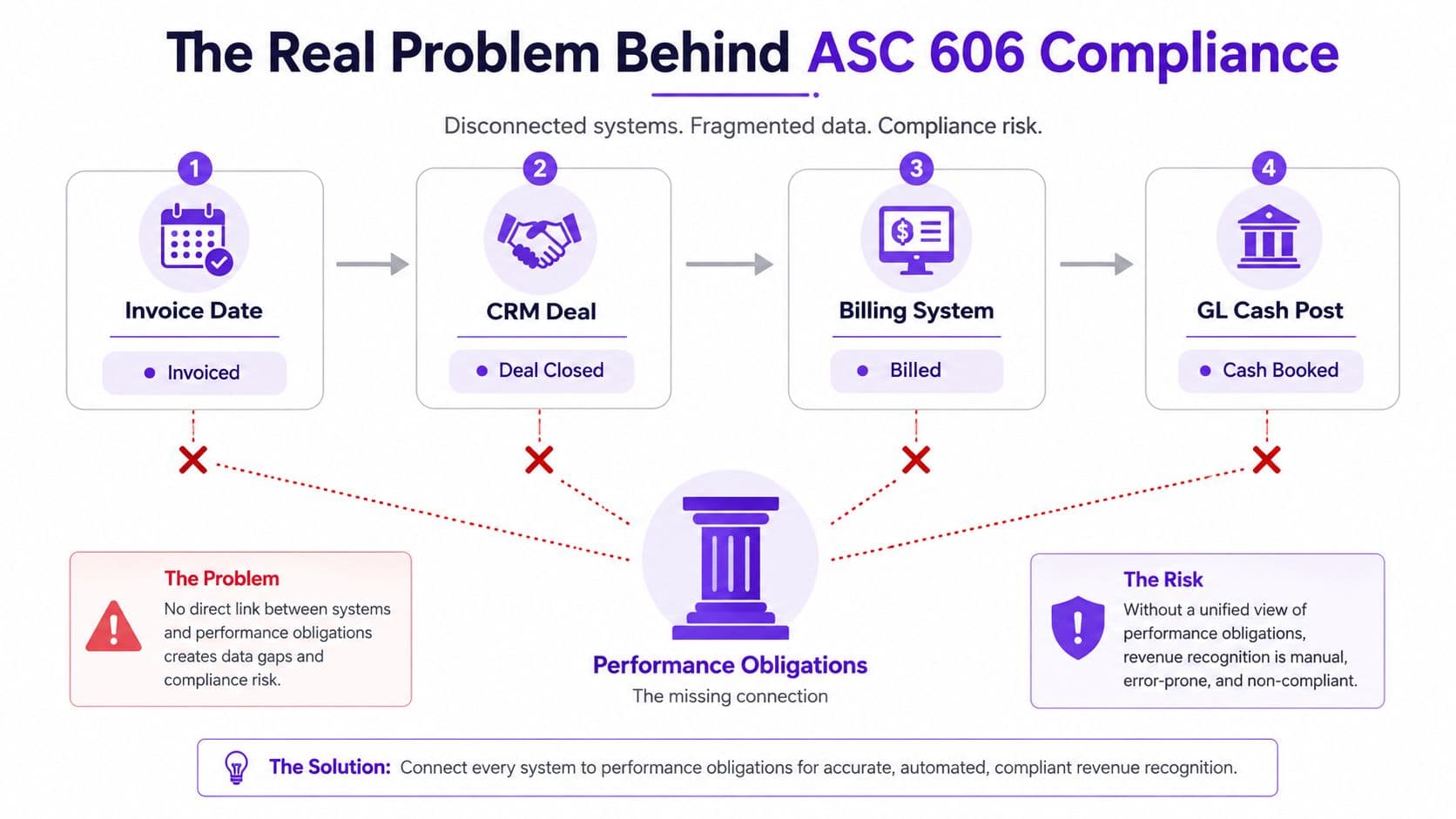
Why the invoice-driven close fails
The five-step model gives you the accounting framework. Operations must still move contract terms into a structured revenue process. Without that handoff, the subledger cannot identify distinct performance obligations, allocate consideration, or support the timing of recognition. Review these ASC 606 revenue recognition examples against your own modifications, usage terms, and bundled onboarding arrangements.
Early adoption history shows the implementation burden. A Columbia study identified only 30 U.S.-listed firms out of 3,397 adopting firms that voluntarily adopted ASC 606 early in 2017. Another academic dataset identified 50 early adopters and 1,757 non-early adopters among materially affected firms. The study describes broad adoption in 2018, after the effective date was delayed by one year to address complexity concerns. See the Columbia study on ASC 606 adoption.
Controller's rule: If you cannot trace revenue from the executed contract to an obligation-level schedule and then to the GL, your revenue process is not controlled.
Close the seam, not just the policy memo
Set one contract ID across CRM or CPQ, billing, the revenue subledger, and the GL. At approval, capture promised goods and services, standalone selling prices, discount treatment, variable consideration terms, modifications, and the expected satisfaction pattern.
Reconcile the schedule every month. Your reconciliation should explain billed revenue, recognized revenue, deferred revenue, contract assets, credits, modifications, and remaining obligations. A policy memo documents the conclusion. The subledger and reconciliation show that your team applied it consistently.
The Five-Step Revenue Recognition Model Explained
Use a $60,000 annual SaaS subscription with onboarding and a usage cap. The invoice alone tells you almost nothing about the correct revenue pattern. You need to determine what you promised and when you deliver it.
The five-step model is summarized in this plain-language guide to performance obligations.
| Step | Definition | SaaS Example | Finance Action |
|---|---|---|---|
| 1 | Identify the contract | Confirm approved terms, rights, payment terms, and collectability for the $60,000 subscription | Store the executed order form, approval record, contract ID, and collectability assessment |
| 2 | Identify performance obligations | Separate platform access, onboarding, and usage overages when each provides a distinct service | Tag each obligation in CPQ and document the distinctness conclusion |
| 3 | Determine the transaction price | Start with fixed consideration and estimate usage-based consideration, subject to the variable consideration constraint | Maintain the estimate, method, assumptions, and reporting-date reassessment |
| 4 | Allocate the transaction price | Allocate consideration using relative standalone selling prices, not invoice line items | Refresh the SSP analysis and generate an obligation-level allocation schedule |
| 5 | Recognize revenue when obligations are satisfied | Recognize platform access ratably over twelve months, onboarding when completed, and usage as delivered | Reconcile the revenue waterfall to billing and the GL each close |
Step 1 identifies an enforceable arrangement
A signed order form isn't enough if the terms are incomplete or collectability isn't supportable. Your intake process should capture the customer, start date, renewal terms, payment terms, cancellation rights, promised services, and approval status.
The finance action is simple but mandatory. Don't let a deal enter billing until required contract fields are complete and the contract ID follows it into the revenue schedule.
Step 2 separates the promises
Platform access is usually a continuous service. Onboarding can be distinct when the customer can benefit from it separately and it doesn't significantly modify the hosted platform. Usage overages represent consideration tied to future consumption, and the accounting treatment depends on the contract terms and the underlying promise.
Your obligation matrix should identify the service, delivery pattern, evidence of satisfaction, and owner responsible for confirming completion. A journal entry cannot substitute for that analysis.
Steps 3 and 4 determine the amount and allocation
Variable consideration enters the transaction price only to the extent that it's probable a significant reversal of cumulative revenue won't occur. ASC 606 permits the expected value and most-likely amount methods for estimating variable consideration, as explained in this Deloitte analysis of variable consideration.
Once estimated, consideration is allocated on a relative standalone selling price basis when the contract has more than one performance obligation. That means your $60,000 invoice doesn't dictate the split. The SSP evidence does.
Step 5 follows satisfaction, not cash
If platform access is satisfied ratably, the fixed amount allocated to that obligation becomes revenue over the service period. If onboarding is satisfied when implementation is complete, that allocation is recognized then. Usage revenue follows delivered consumption and the evidence supporting it.
When SSPs change, document the reason and evaluate whether the allocation requires reallocation. Store the schedule in the subledger, link it to contract evidence, and post summarized entries to the GL.
SaaS and Agency Contract Scenarios That Trip Up Recognition
The hardest contracts aren't always the largest. They're the ones where billing labels hide multiple promises, usage data arrives after invoicing, or a salesperson changes scope without routing the amendment through finance.
| Scenario | Contract Value | Wrong Recognition | ASC 606 Treatment | Month-One Impact |
|---|---|---|---|---|
| Bundled onboarding | $120,000 annual contract, including $20,000 onboarding | Recognize the full invoice or full monthly amount without separating onboarding | Allocate consideration between onboarding and platform access using relative SSPs, then recognize onboarding when satisfied and access over time | Revenue shifts out of month one when onboarding is not yet satisfied, with the deferred balance increasing by the portion not earned |
| Usage overage | $50,000 base subscription plus usage charges | Recognize estimated or invoiced overages without applying the reversal constraint | Estimate variable consideration, constrain it, and recognize delivered usage when the related service is provided | Month one includes only supportable delivered usage, while unsupported estimates remain excluded or constrained |
| Mid-contract scope change | $40,000 change order | Book the added amount as a new sale automatically | Assess whether added goods or services are distinct and whether the modification is separate, a termination and replacement, or part of the existing contract | Timing follows the modification conclusion, not the amendment invoice date |
| Agency retainer | Contract value varies by strategy, media, and reporting hours | Treat the retainer as one undifferentiated monthly service | Assess whether each promised deliverable is distinct and recognize each obligation according to its transfer pattern | Month-end reclassification separates earned services from deferred amounts and contract assets |
Bundled onboarding pulls revenue forward
Assume the invoice is $120,000, and it includes $20,000 of onboarding. If your team recognizes the entire contract ratably as platform access, it records revenue for a service that hasn't been delivered.
The correct allocation still requires standalone selling prices. If the SSP evidence supports assigning $20,000 to onboarding, that amount is recognized when onboarding is complete. The remaining $100,000 allocated to the platform is recognized ratably across the annual service period, subject to the actual allocation analysis. If onboarding isn't complete at month one, the GL should show the unearned portion in deferred revenue, not platform revenue.
The allocation rule for bundled obligations is explained in this Deloitte guidance on standalone selling prices.
Usage charges require evidence and restraint
A $50,000 base subscription with overages creates two control questions. What usage occurred, and how much of the related consideration can you include without creating a significant reversal risk?
Use the expected value method when the contract has a range of possible outcomes and the most-likely amount method when one outcome best predicts the consideration. Reassess at each reporting date. The controller should expect a usage report tied to the customer and contract ID, a calculation of eligible consideration, and a reconciliation between the operational usage record, billing, deferred revenue, and recognized revenue.
Modifications change the accounting path
A $40,000 scope increase isn't automatically a new contract. If the added services are distinct and priced consistently with their standalone selling price, the modification can be accounted for separately. If not, you need to determine whether the modification changes the existing contract prospectively or requires a cumulative adjustment.
That conclusion affects the revenue waterfall. It also determines whether the new schedule begins independently, replaces the old schedule, or updates remaining obligations. Use a formal modification log, and require finance review before billing issues the change order. The Deloitte contract modification guidance explains why an amendment isn't an administrative update.
Agency retainers need a deliverable map
Strategy, media management, and reporting hours may not transfer in the same pattern. Some services are delivered continuously, while others are satisfied when a defined deliverable reaches the customer.
At month-end, map billed amounts to completed work, remaining obligations, and any contract asset created by earned but unbilled services. The GL reclassification should be traceable to time records, delivery evidence, approval records, or campaign reporting, not a manually typed spreadsheet balance.
What Audit-Ready Revenue Evidence Actually Looks Like
A controller preparing an annual $240,000 SaaS contract for audit shouldn't start by searching email for explanations. The evidence should already exist in the transaction record.
The executed order form identifies the customer, term, consideration, and promised services. CPQ tags the performance obligations and retains the SSP price list used for allocation. Billing supplies invoices, credits, and usage records. The revenue subledger generates the deferred revenue waterfall and remaining performance obligation schedule.
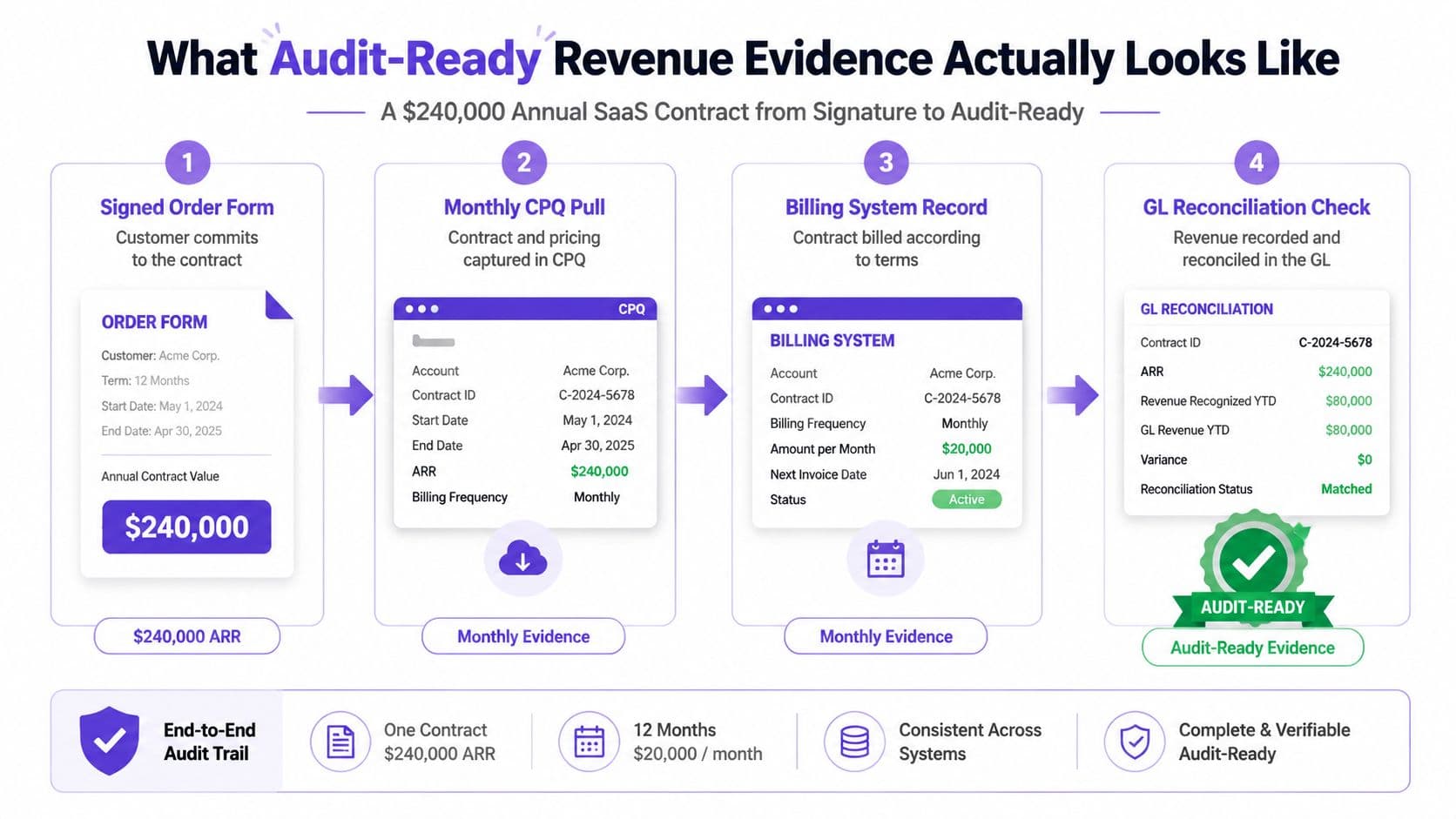
The monthly evidence package
For this contract, store the following as a linked package:
- Executed contract: Keep the approved order form, amendments, renewal terms, and contract ID together.
- Allocation support: Preserve the SSP price list, discount allocation, assumptions, and approval.
- Satisfaction evidence: Link onboarding completion, service-period dates, usage delivery, or accepted deliverables to the schedule.
- Waterfall and reconciliation: Tie opening deferred revenue, billings, recognized revenue, adjustments, and ending deferred revenue to the GL.
- Journal entry support: Include the contract ID, obligation, revenue amount, accounting period, and satisfaction evidence.
The auditor will ask what changed, who approved it, and when the evidence was created. Role-based access, approval timestamps, locked accounting periods, and an amendment log show that the file wasn't retrofitted during fieldwork.
A practical audit trail also needs a clear reconciliation owner. Use this financial records audit guide to structure the evidence index and monthly review.
This video provides a visual supplement for finance teams reviewing the revenue process:
ASC 606 Implementation Checklist for Growing Businesses
Your implementation plan should fit inside the current quarter. Assign one owner for each track, set a completion date, and retain evidence as each control goes live.
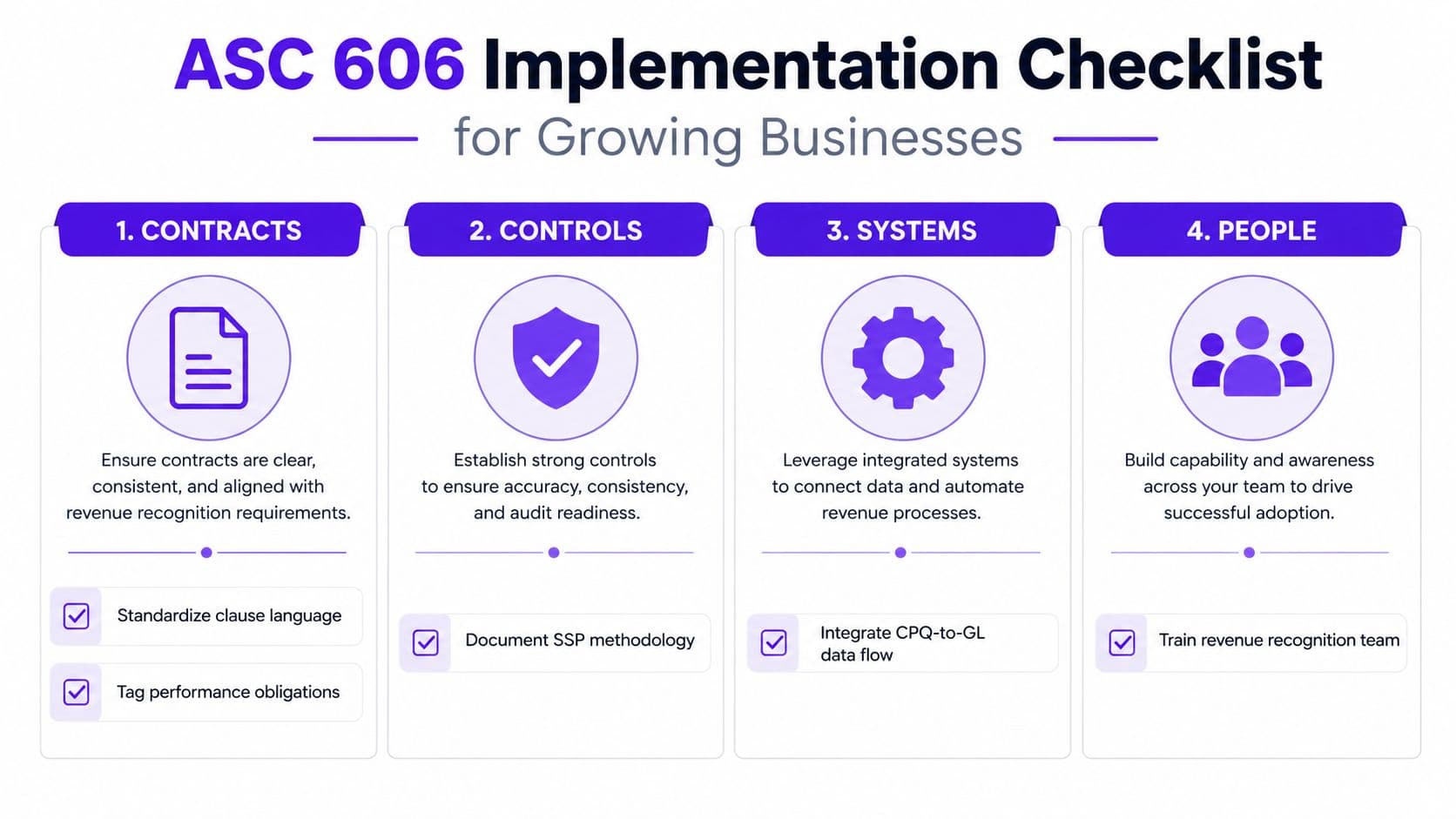
Contracts
Start at the order form. Standardize language for onboarding, implementation, support, usage charges, rebates, credits, renewals, cancellation rights, and scope changes.
- Tag obligations at signature: Require sales operations to identify every promised good or service before the deal reaches billing.
- Route amendments through finance: Maintain a redline log for every change order, renewal, downgrade, credit, and cancellation.
- Preserve contract lineage: Keep the original agreement, amendment, approval, and resulting revenue schedule under one contract ID.
Controls
Controls should produce evidence during the close, not after an auditor asks for it.
Document your SSP methodology, including source data, refresh triggers, discount treatment, and approval. Establish a monthly deferred revenue reconciliation between the subledger and GL, and require an explanation for every unreconciled balance.
Formalize variable consideration estimates. The reviewer should assess usage, rebates, refunds, service-level credits, and renewal incentives at each reporting date, then document why the estimate is included, constrained, or excluded.
Systems
Your systems need consistent identifiers and controlled handoffs.
- Connect the data flow: Move obligation tags, pricing, terms, and modification status from CRM or CPQ into billing and the revenue subledger.
- Enforce standing IDs: Reject invoices and journal entries without a valid customer and contract reference.
- Lock automation rules: Restrict changes to allocation, recognition, and modification logic, with documented approvals and change history.
- Reconcile interfaces: Compare CRM bookings, billing activity, subledger schedules, and GL postings after each close.
Use month-end close automation guidance to design the reconciliation calendar around these handoffs rather than around invoice batches.
Documentation and people
Maintain a policy memo that explains your judgments, an evidence index that points to transaction support, and a quarterly close package that summarizes exceptions and changes. Train sales operations, billing, implementation, and finance on the same obligation definitions.
A policy that lives only with one controller creates a single-point failure. Put the decision tree, examples, review sign-offs, and escalation path in a shared controlled repository.
Red Flags and Common Pitfalls to Watch For
Revenue errors leave recognizable fingerprints. Review these warning signs before your next close.
- Usage estimates never change: Stale overage assumptions create refund cliffs, usage credits, and revenue reversals when actual consumption arrives. Recalculate and document the variable consideration estimate at every reporting date under the ASC 606 variable consideration constraint.
- Amendments enter as new contracts: A scope increase gets booked independently even though the added service isn't distinct or isn't priced at its standalone selling price. Stop billing release until a reviewer documents the modification conclusion.
- Onboarding shares the subscription line: A bundled implementation fee is recognized with hosted access because the invoice has one line. Separate the obligation, support the SSP allocation, and recognize it according to satisfaction.
- Deferred revenue has no allocation key: The balance rolls forward, but nobody can explain which obligation it belongs to. Require obligation-level schedules and link every movement to contract evidence.
- Resold licenses are booked gross automatically: If your company acts as an agent rather than a principal, gross presentation can overstate revenue. Add a principal-versus-agent review to contract intake.
- Series services are split inconsistently: A series of distinct goods or services can be one performance obligation when the goods are substantially the same and transfer in the same pattern. If variable consideration relates only to selected items, allocate it only where the criteria support that treatment, as described in Deloitte's series accounting guidance.
How an Outsourced Controller Speeds Up Compliance
If your CRM records a signed amendment, billing issues an invoice, and the GL posts revenue without tying either event to a performance obligation, ASC 606 compliance slows at the exact point auditors test. You need technical judgment, system design, reconciliations, documentation, and audit support, not just another person posting entries.
For businesses between $500,000 and $20 million in revenue, hiring internally carries a substantial operating cost. A senior SaaS controller runs roughly $130,000 to $180,000 loaded, requires 4 to 6 months to ramp on revenue recognition standards, and may still require Big Four support at $25,000 to $60,000 per audit cycle, based on the planning assumptions for this comparison. A lean team also creates concentration risk when one employee owns SSP analysis, modification assessments, and deferred revenue reconciliations.
An outsourced controller engagement gives you a defined operating process across CRM, billing, and the GL. A specialist team can deliver SSP studies, performance obligation mapping, subledger-to-GL reconciliations, and audit support inside 30 days, at a predictable monthly fee, using repeatable workflows for SaaS and agency contracts.
| Factor | In-House Controller | Outsourced Controller |
|---|---|---|
| Ramp time | 4 to 6 months to build revenue recognition knowledge and internal workflows | Delivery inside 30 days under the stated engagement model |
| Direct cost | Roughly $130,000 to $180,000 loaded | Predictable monthly fee rather than a full loaded hire |
| Audit validation | Big Four support at $25,000 to $60,000 per audit cycle may still be required | Audit support and documentation are part of the operating workflow |
| Technical output | Depends on one hire's experience and available systems | SSP analysis, obligation mapping, reconciliations, and audit support |
| Key risk | Single point of failure inside a lean finance team | Shared process ownership and documented handoffs |
The benefit is faster control over contract-level evidence and a revenue close that does not rely on one person remembering how a prior amendment was treated. Require the provider to trace transactions from CRM through billing to the GL, document the handoffs, and assign ownership for exceptions.
Jumpstart Partners provides outsourced controller and bookkeeping support for growing businesses, including ASC 606 workflows, deferred revenue reconciliations, KPI reporting, and audit-ready financial packages. Review outsourced controller services to assess the support model, then map your contract patterns and identify the subledger gaps blocking a clean revenue close.
If your systems do not reconcile to performance obligations, Jumpstart Partners can map the handoffs, build allocation and deferred revenue controls, and prepare the evidence your auditor will request. Visit Jumpstart Partners to schedule a focused ASC 606 scoping conversation.