Financial Operations
Month End Close Automation: A Practical Playbook
Learn month end close automation step by step. Build a 5-day close with reconciliations, ASC 606 workflows, integrations, KPIs, and ROI for growing businesses.
ByJumpstart Partners, CPA, QuickBooks ProAdvisor
··15 min readA fast close is not primarily an accounting labor problem. It's a data dependency problem. Survey evidence shows that 56% of finance teams cite interdepartment dependencies, 50% still rely on Excel-heavy processes, only 18% report a three-day close, and half take six or more business days to finish the books. Those findings are summarized in 2025 month-end close benchmark coverage.
For a SaaS company, agency, or professional services firm generating $1M to $5M ARR in revenue, the consequence is familiar. Cash reporting arrives late, revenue schedules remain fragile, and the board package gets assembled under pressure. The right answer isn't to buy another platform and hope the close improves. You need to repair the data handoffs, standardize the workflow, and then automate the repetitive work.
Table of Contents
- Why Month End Close Automation Matters Now
- Mapping Your Current Close Process
- Integrations and Automations to Build First
- Building Reconciliations and ASC 606 Workflows
- Staffing Roles Controls and KPIs
- Red Flags When Automation Is Failing
- 90-Day Rollout Plan and Next Steps
Why Month End Close Automation Matters Now
A 2022 financial close benchmark survey found that 74% of organizations remained in the basic or developing stages of automation, while fewer than 10% had reached best-in-class, end-to-end financial close automation. The same survey found that two-thirds of respondents wanted a shorter monthly close but lacked the time to implement the process and technology changes required. Core reconciliation adoption lagged too, with 38% of organizations automating balance sheet reconciliations and 37% automating high-volume transaction matching (financial close automation benchmark survey).
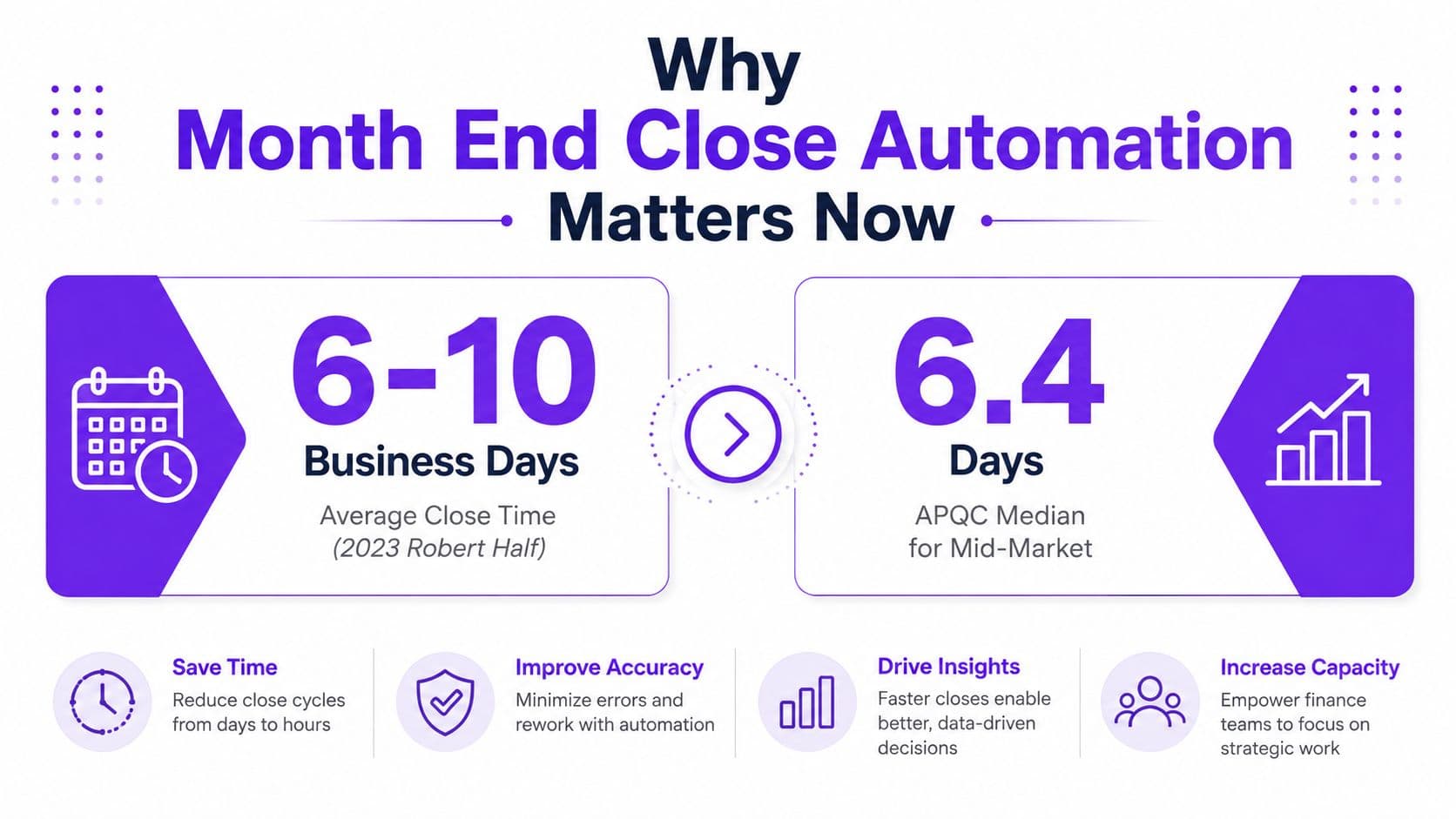
That gap matters because a slow close delays decisions, not just reports. Your cash forecast stays provisional, department leaders wait for actuals, and senior accountants spend their best working hours chasing evidence instead of reviewing exceptions. Survey respondents identify the recurring breakdowns clearly: 54% cite obtaining information from other departments, 44% cite reconciliation across multiple systems, 44% cite disparate or nonstandardized processes, and 31% cite insufficient resources (Journal of Accountancy coverage of month-end close pressures).
Where the hours disappear
Before you evaluate software, inspect four repeat offenders:
- Bank and card feeds: Teams still download CSV files, clean columns, and upload transactions into the general ledger.
- ASC 606 schedules: Accountants rebuild deferred revenue from contract screenshots and billing exports.
- Intercompany entries: Staff type eliminations and due-to or due-from entries manually, then investigate mismatches after posting.
- Approvals: Slack and email requests trail into the night because no one can see the full approval queue in one place.
A $20M ARR SaaS company taking twelve days to close can burn 380 accountant hours per close. That isn't a bookkeeping inconvenience. It's a recurring operating cost and a management visibility problem.
Operating rule: Fix the source-system handoff before you automate the accounting task that depends on it.
The target is a five-day close, a 60% reduction in close hours, and audit-ready workpapers with clear preparer, reviewer, source, and approval evidence. A connected financial reporting automation framework can help you think through the reporting layer, while custom fintech solutions are relevant when your standard tools don't handle the required data flow.
Mapping Your Current Close Process
Don't start with a software shortlist. Start with the last three closes.
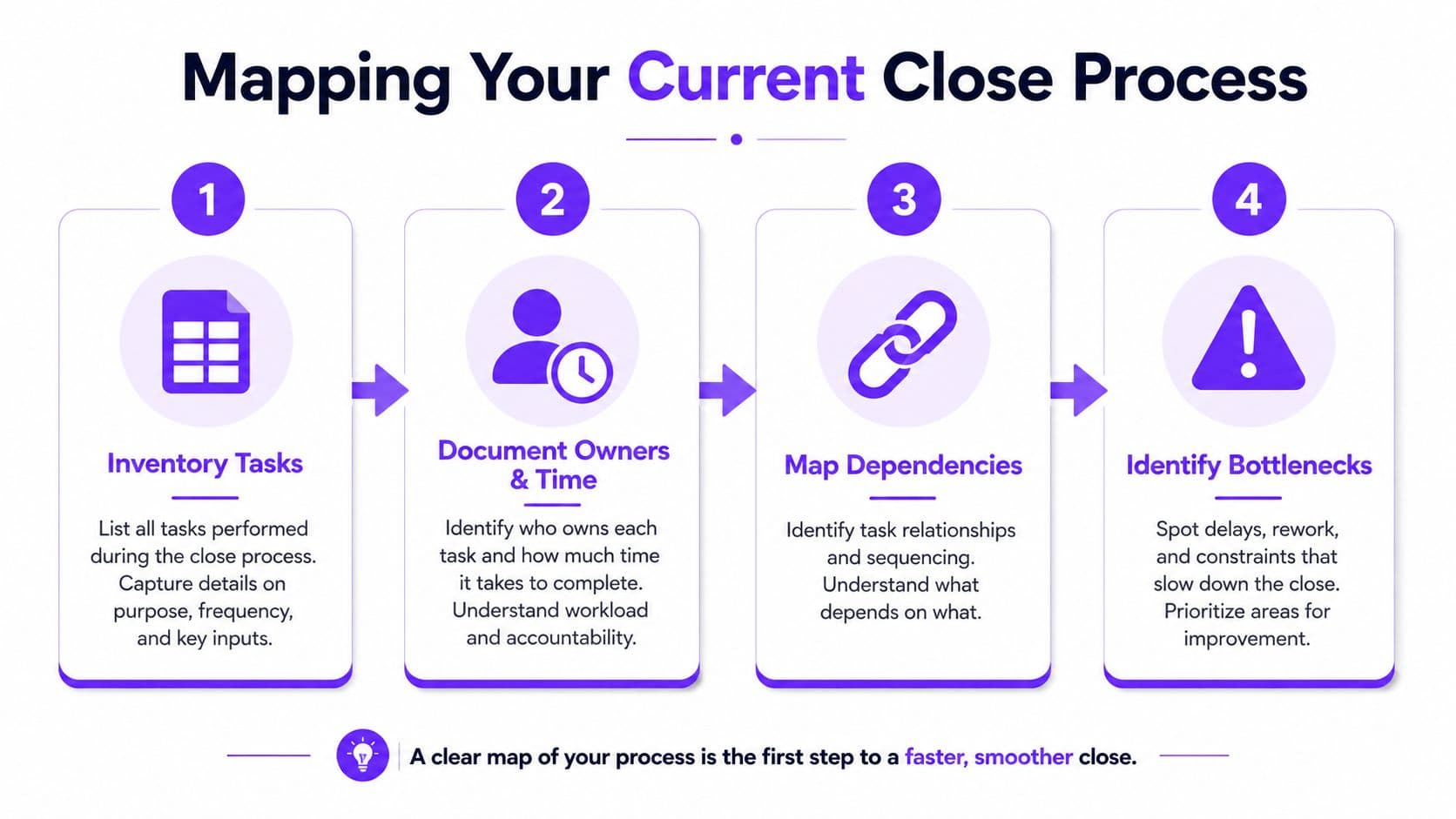
Create one shared spreadsheet and inventory every recurring task. Record the owner, source system, manual minutes, upstream dependency, downstream dependency, reviewer, and evidence location. If a task changes every month, write down the variation instead of hiding it. Variation is usually a process defect, not a reason to accept more manual work.
Four deliverables before implementation
- Task inventory: Capture bank reconciliations, billing imports, payroll accruals, prepaid amortization, intercompany entries, flux analysis, and reporting deliverables.
- Swimlane map: Place tasks into five phases, preliminary work on days 1 and 2, cut-off on day 3, reconciliation on day 4, review and flux on day 5, and reporting on day 6.
- Ownership matrix: Name the preparer, reviewer, approver, and escalation owner. Identify every task that stops when one employee is unavailable.
- Prioritization score: Rate each task from 1 to 5 for automation potential, error risk, audit significance, and cycle-time impact.
The map should expose the difference between a manual and automated state:
| Workflow | Manual state | Automated state |
|---|---|---|
| Bank reconciliation | CSV upload and transaction-by-transaction review late in the close | Connected feed with rule-based coding and exception review |
| Deferred revenue | Excel schedule rebuilt from contract screenshots | Contract and billing data drive the revenue schedule |
| Intercompany | Entries typed by entity and matched afterward | Standardized entries and automated balance comparison |
| Close checklist | Status scattered across email and Slack | Assigned tasks, due dates, dependencies, and approvals in one workflow |
The critical checkpoint is simple: if this person is on vacation, does the close still happen? If the answer is no, document the procedure, move ownership, or automate the dependency. Resources on close people and process gaps are useful when the bottleneck isn't technology but operating readiness.
Use a month-end close checklist template as a starting structure, then customize it to your chart of accounts, billing model, entity structure, and reporting deadlines.
Integrations and Automations to Build First
Build integrations in the order that improves data reliability. For most growing finance teams, that means the general ledger and cash first, revenue second, payroll third, and expenses and accounts payable fourth.
Start with the transaction sources
GL and bank feeds connect Plaid, Ramp, Mercury, or Brex to QuickBooks, Sage Intacct, or NetSuite. The practical benefit is fewer CSV handoffs and more consistent rule-based coding. A connected feed won't fix a bad chart of accounts, but it will make coding rules visible and exceptions reviewable.
Revenue and billing integrations connect Stripe, Chargebee, Maxio, or Recurly with invoices, refunds, credits, and contract data. The objective isn't merely to import revenue. It's to make the day-four revenue reconciliation a controlled review instead of a rebuild.
Payroll and HR connections bring Gusto, Rippling, or ADP data into wage accruals, commissions, benefits, and prepaid schedules. Payroll timing often creates post-close adjustments, so define the cut-off and approval rules before you turn on the integration.
Expense and AP automation uses platforms such as Ramp and BILL to capture receipts, match transactions to policy, and assign the correct cost center. That reduces accrual guesswork, but only if department owners approve expenses promptly.
The requested cost, savings, and payback comparison can't be stated responsibly from the verified evidence provided. Tool pricing, hours saved, and payback vary by transaction volume, entities, configuration, and implementation scope.
| Integration Layer Comparison at $20M ARR | Example Tools | Monthly Cost Range | Hours Saved per Close | Typical Payback |
|---|---|---|---|---|
| GL and bank feeds | Plaid, Ramp, Mercury, Brex, QuickBooks, Sage Intacct, NetSuite | Validate with vendor quotes | Measure during baseline close | Calculate from measured hours and implementation cost |
| Revenue and billing | Stripe, Chargebee, Maxio, Recurly | Validate with vendor quotes | Measure revenue reconciliation time | Calculate after billing integration is stable |
| Payroll and HR | Gusto, Rippling, ADP | Validate with vendor quotes | Measure accrual and commission preparation | Calculate after payroll cut-off testing |
| Expense and AP | Ramp, BILL | Validate with vendor quotes | Measure receipt, coding, and accrual review | Calculate after approval adoption |
Two anti-patterns create expensive rework. Don't connect systems before fixing the chart of accounts, and don't skip the reconciliation between the source system and the GL. Automation that imports bad classifications faster only creates a larger cleanup project.
For teams focused on recurring entries and approvals, journal entry automation guidance provides a useful design reference. The principle is straightforward: automate preparation and matching, but retain review checkpoints for entries that require judgment.
Building Reconciliations and ASC 606 Workflows
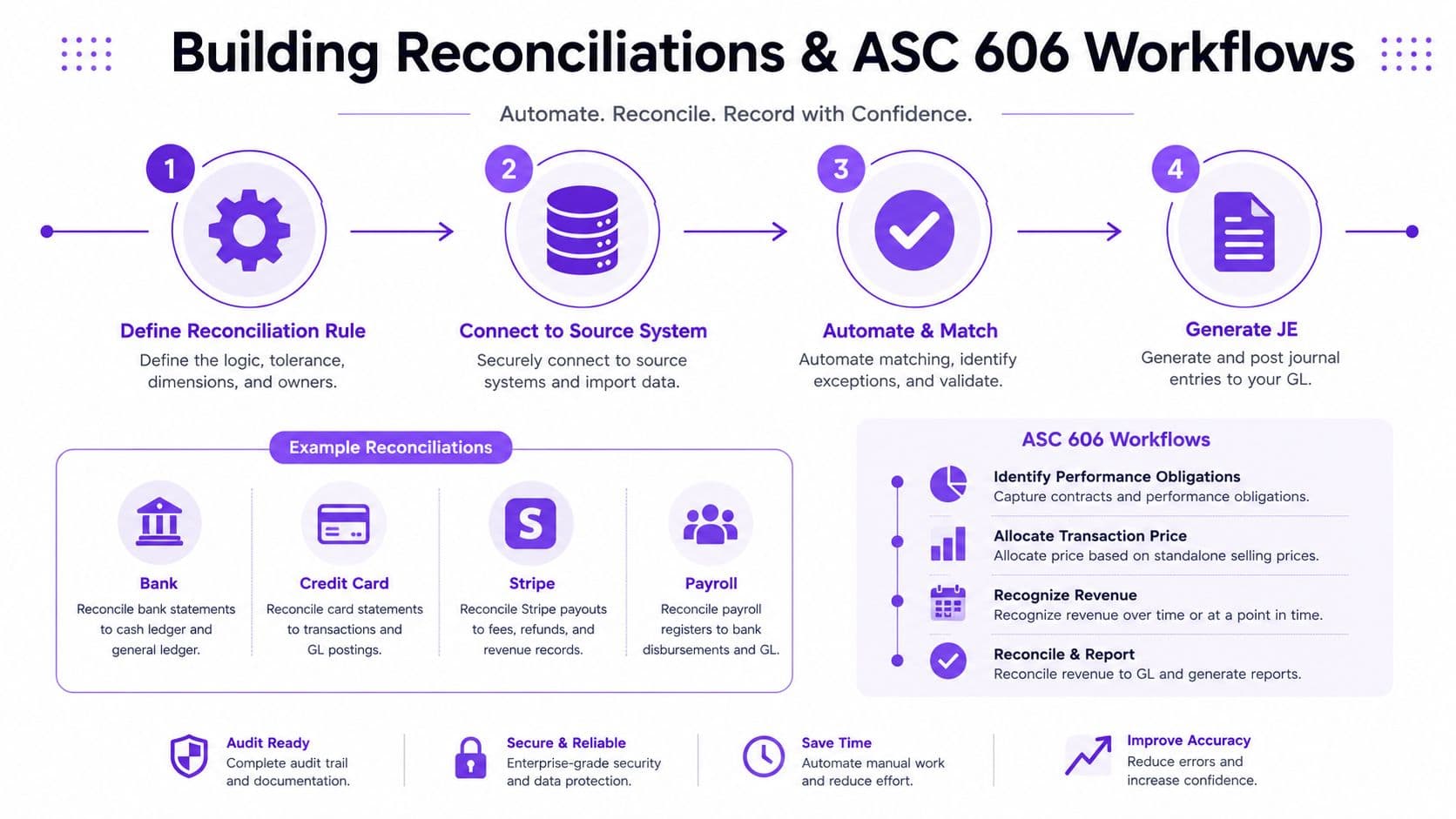
Reconciliations are the backbone of a fast close. Each one needs a source system, a named owner, a documented tolerance, an aging rule, and an escalation path. Without those elements, “automated reconciliation” often means an automated file transfer followed by manual detective work.
Design the reconciliation backbone
| Reconciliation | Source | Frequency | Owner | Review focus |
|---|---|---|---|---|
| Bank | Bank feed and GL cash account | Continuous, finalized at close | Staff accountant | Unmatched items, stale transactions, unusual cash movements |
| Credit card | Card platform and GL | Continuous, finalized at close | AP or expense owner | Missing receipts, policy exceptions, coding |
| Stripe or billing | Billing platform and GL | During the month and at close | Senior accountant | Gross billings, refunds, credits, fees, settlement timing |
| Payroll | HR and payroll platform | Each payroll cycle | Senior accountant | Payroll register, accruals, benefits, commissions |
| Intercompany | Entity ledgers and intercompany schedule | Before close review | Controller | Counterparty agreement and elimination balance |
| Accrued versus paid expense | AP ledger, invoices, and payment data | During the month and at close | Staff accountant | Reversals, uninvoiced services, aging |
For bank accounts, document the matching rule and the treatment of outstanding items. A practical reference such as Wistec's guide to bank reconciliation can help establish the mechanics, but your policy still needs company-specific tolerance and aging rules.
Build ASC 606 from the contract outward
For SaaS revenue, the workflow should follow the contract, not an Excel reconstruction:
- Identify the performance obligations, such as subscription access, implementation, support, or other promised services.
- Determine the transaction price, including approved discounts, credits, and variable consideration.
- Allocate the transaction price to the performance obligations using the documented allocation basis.
- Generate the deferred revenue waterfall from contract and billing data.
- Post the monthly revenue and contract liability journals.
- Tie the schedule back to the trial balance and investigate every unexplained difference.
A simplified monthly entry for earned subscription revenue is:
- Debit deferred revenue
- Credit subscription revenue
A cash billing entry before revenue is earned is commonly structured as:
- Debit accounts receivable or cash
- Credit deferred revenue
The exact accounts and timing depend on your contract terms, billing events, and accounting policy. Use a documented ASC 606 revenue recognition workflow and require controller review for unusual arrangements.
A five-day control sequence
- Day 1: Lock the period, import final cash and billing activity, and resolve source-system exceptions.
- Day 2: Complete payroll, AP, card, and prepaid schedules.
- Day 3: Finalize revenue, intercompany, accruals, and recurring journals.
- Day 4: Complete reconciliations, investigate variances, and review deferred revenue.
- Day 5: Approve journals, finalize flux commentary, issue financials, and archive workpapers.
The binding constraint is usually source-data quality, not journal logic. A perfect revenue formula can't produce a reliable close from incomplete contracts, late credits, or inconsistent customer identifiers.
Staffing Roles Controls and KPIs
A five-day close needs decision rights, not just task assignments. The controller owns policy, materiality, escalations, and the final sign-off. The senior accountant owns complex reconciliations and journal preparation. Staff accountants execute recurring work, while AR/AP specialists control the operational inputs that accounting depends on. FP&A receives an agreed reporting package and challenges unusual movements.
A fractional or outsourced finance partner adds value when the business needs controller discipline before it needs a full internal finance department. Jumpstart Partners can fit that role for businesses in the roughly $5M to $50M ARR range, but the internal owner still needs authority over policies and approvals.
Layer controls by risk
Preventive controls sit in source systems, such as required dimensions, approval routing, customer identifiers, and billing fields. Detective controls operate through reconciliations and exception reports. Review controls belong to the weekly close meeting, where the controller examines aging, late tasks, unusual entries, and unresolved variances.
| Close Operating Model: Roles, Controls, and KPI Targets | Primary Responsibilities | Controls Owned | Key KPI Target |
|---|---|---|---|
| Controller | Policy, materiality, close sign-off, audit coordination | Review and approval controls | Five-day close with no unexplained critical exceptions |
| Senior accountant | Revenue, intercompany, complex reconciliations | Detective controls and journal review | Reconciliations completed within policy aging |
| Staff accountant | Cash, card, prepaid, recurring entries | Source-to-GL matching | Declining manual journal count |
| AR/AP specialist | Billing, collections support, invoices, expenses | Preventive coding and approval controls | Days-to-invoice tracked against the close calendar |
| FP&A partner | Variance interpretation and management reporting | Review of business explanations | Reporting package delivered on the agreed date |
Track close cycle days, manual journal count, reconciliation aging, restatement frequency, audit adjustments, and days-to-invoice. Assign every metric to one owner and one dashboard. If a KPI has no owner, it isn't a control.
A practical controller role overview can help founders distinguish accounting execution from controller-level accountability. Automation should move people from data entry to exception review, not remove responsibility for the final numbers.
Red Flags When Automation Is Failing
Buying close software doesn't shorten a close by itself. The system only accelerates the rules, data, and ownership you give it.
Watch for these warning signs:
- Recurring reconciliation breaks: The same bank, billing, or intercompany differences return every month.
- Manual journal backlog: Automation drafts entries, but reviewers still rebuild or rekey them.
- Deferred revenue fails to tie: The schedule and GL disagree, and no one owns the root-cause analysis.
- Audit adjustments rise: More automation exists, but supporting evidence and review trails remain weak.
- CSV exports continue: The controller still downloads, cleans, and uploads source data by hand.
The usual causes are poor source data, unclear ownership, over-customized ERP workflows, and automation layered over a broken process. AI won't repair an inconsistent chart of accounts or force sales operations to provide complete contract data.
Survey evidence reinforces the control issue. 97% of organizations still rely on human effort to finalize the close, and only 2% report a fully automated end-to-end process (retrieved close automation research). The correct design is selective automation with documented human review, especially for accruals and revenue recognition.
During the first 90 days, review whether exceptions decline, ownership is clear, users complete acceptance testing, and the controller can explain every automated journal. If those behaviors don't improve, reset the process before adding more software.
90-Day Rollout Plan and Next Steps
Sequence the rollout around dependencies. Don't deploy advanced workflow logic while your source systems still produce incomplete or inconsistent data.
| 90-Day Rollout Phases, Owners, and ROI Levers | Weeks | Owner | Exit Deliverable | ROI Lever |
|---|---|---|---|---|
| Source inventory and calendar | 1 to 2 | Controller | Approved process map, owners, cut-off calendar | Removes dependency ambiguity |
| Core integrations | 3 to 6 | Senior accountant and systems owner | GL, bank, payroll, and expense feeds tested | Reduces manual imports |
| Reconciliations and ASC 606 | 7 to 10 | Controller and revenue owner | Reconciliation rules and deferred revenue schedule | Moves work from rebuild to review |
| Controls and pilot close | 11 to 13 | Controller | Five-day pilot, sign-offs, KPI baseline | Proves speed without losing auditability |
For the requested ROI example, a $15M ARR SaaS company closing on day 12 and reaching day 5 would free roughly 280 controller hours per year, valued at about $42,000 at a $150 hourly loaded cost, plus four additional days of cash visibility on $3M of monthly receipts, valued at another $25,000 in working capital float. Those assumptions should be replaced with your actual hours, loaded cost, receipts, and treasury economics before approval.
Avoid five predictable rollout mistakes:
- Scope creep: Don't include CRM customizations in the close automation project.
- Weak acceptance testing: Test journal templates with real edge cases before posting.
- Payroll timing gaps: Align payroll cut-off dates with the close calendar.
- Over-automation: Keep pre-revenue entities on an appropriately controlled process.
- Missing executive ownership: Assign a controller-level owner with authority to resolve cross-functional delays.
Start with a 30-minute scoping call with Jumpstart Partners to benchmark your current close, identify the data handoffs that are slowing it down, and draft a Day 1-to-Day 90 implementation backlog.
Jumpstart Partners offers controller-led finance ops for founder-led B2B AI SaaS teams—monthly close, reporting, and billing support scoped after the Finance Ops Diagnostic.