Financial Operations
Bank Reconciliation Process for Small Business
Master the bank reconciliation process with a step-by-step guide built for growing businesses. Learn timing, tools, common errors, and KPIs that matter.
ByJumpstart Partners, CPA, QuickBooks ProAdvisor
··16 min readA bank reconciliation that takes four hours isn't a harmless bookkeeping nuisance. It's a signal that your cash-control system is too slow for the business you're running. CFO's APQC-based benchmark puts a single reconciliation at about 2.6 hours for top performers, 4 hours at the median, and more than 5 hours for bottom performers. Manual workflow reporting cited by the same source puts the average at 47 minutes per reconciliation when downloading, sorting, matching, handling exceptions, and reviewing are included.
For a SaaS company, agency, or professional services firm generating $500K to $20M, monthly reconciliation is too late for operating accounts that drive payroll, vendor payments, and runway decisions. You need a weekly bank reconciliation process, supported by automation and independent review, so your reported cash reflects reality before the next payment cycle.
Table of Contents
- Why the Bank Reconciliation Process Matters More Than You Think
- Frequency, Timing, and the Pre-Reconciliation Checklist
- Mapping Transactions Step by Step
- Identifying and Resolving Reconciliation Exceptions
- QuickBooks vs Xero vs NetSuite Reconciliation Workflows
- Connecting Reconciliation to a Fast Month-End Close
- When to Outsource Reconciliation to a Controller Service
Why the Bank Reconciliation Process Matters More Than You Think
Bank reconciliation compares your internal cash records with the bank's statement. Done correctly, the final unreconciled difference should be $0. That isn't administrative perfectionism. It's the point at which you can trust the cash balance in your general ledger.
The process also protects you from two different failures. A timing difference, such as a deposit in transit or an outstanding check, needs documentation and tracking. A duplicate payment, missing fee, unauthorized withdrawal, or incorrect posting needs investigation and correction. Treating both categories as “bookkeeping cleanup” delays the information you need to manage the business.
QuickBooks' bank reconciliation guidance describes a workflow that includes identifying cleared transactions, adjusting deposits in transit and outstanding checks, and obtaining a second-person review and sign-off. It also frames reconciliation as a key internal control activity, which is why accounting systems automate matching while retaining human review for exceptions.
Cash visibility is an operating control
A founder doesn't need another report that looks precise but rests on stale entries. You need to know whether cash is available for payroll, whether a customer payment cleared, and whether a vendor payment was posted once or twice.
A weekly cadence gives your finance team a short exception window. That makes the work easier to investigate and gives you a more reliable cash position for forecasting. It also creates a consistent evidence trail for lenders, investors, and auditors.
Controller's rule: If nobody can explain the difference between the bank balance and book balance, you don't have a cash position. You have an assumption.
Reconciliation supports audit readiness
The history of reconciliation follows the development of formal financial controls. NetSuite's overview of bank reconciliation connects the practice's long arc from 15th-century double-entry bookkeeping through the creation of the U.S. Securities and Exchange Commission in 1934 and later internal-control frameworks.
That history matters because auditors still want the same basic proof: the balance is complete, transactions are supported, reconciling items are explained, and someone independent reviewed the work. Escrow Consulting Group's bank reconciliation guide is useful background if you're formalizing the process across multiple accounts or jurisdictions.
Your reconciliation file should show the statement period, preparer, reviewer, adjusted balances, each reconciling item, supporting documentation, and the resolution status of open exceptions. Don't wait for an audit request to assemble that evidence. Build it into the weekly close routine.
Frequency, Timing, and the Pre-Reconciliation Checklist
Use a risk-based cadence, not a universal monthly rule. Reconcile operating accounts above a $250K average balance weekly and all other accounts monthly. The cadence and threshold are operating recommendations for this company profile, not universal accounting requirements.
Close the prior week by Tuesday at 10 a.m. That gives your team time to resolve exceptions before accounts payable runs and payroll cuts. A Friday transaction cutoff followed by a Monday morning reconciliation also keeps the process tied to a clear period boundary.
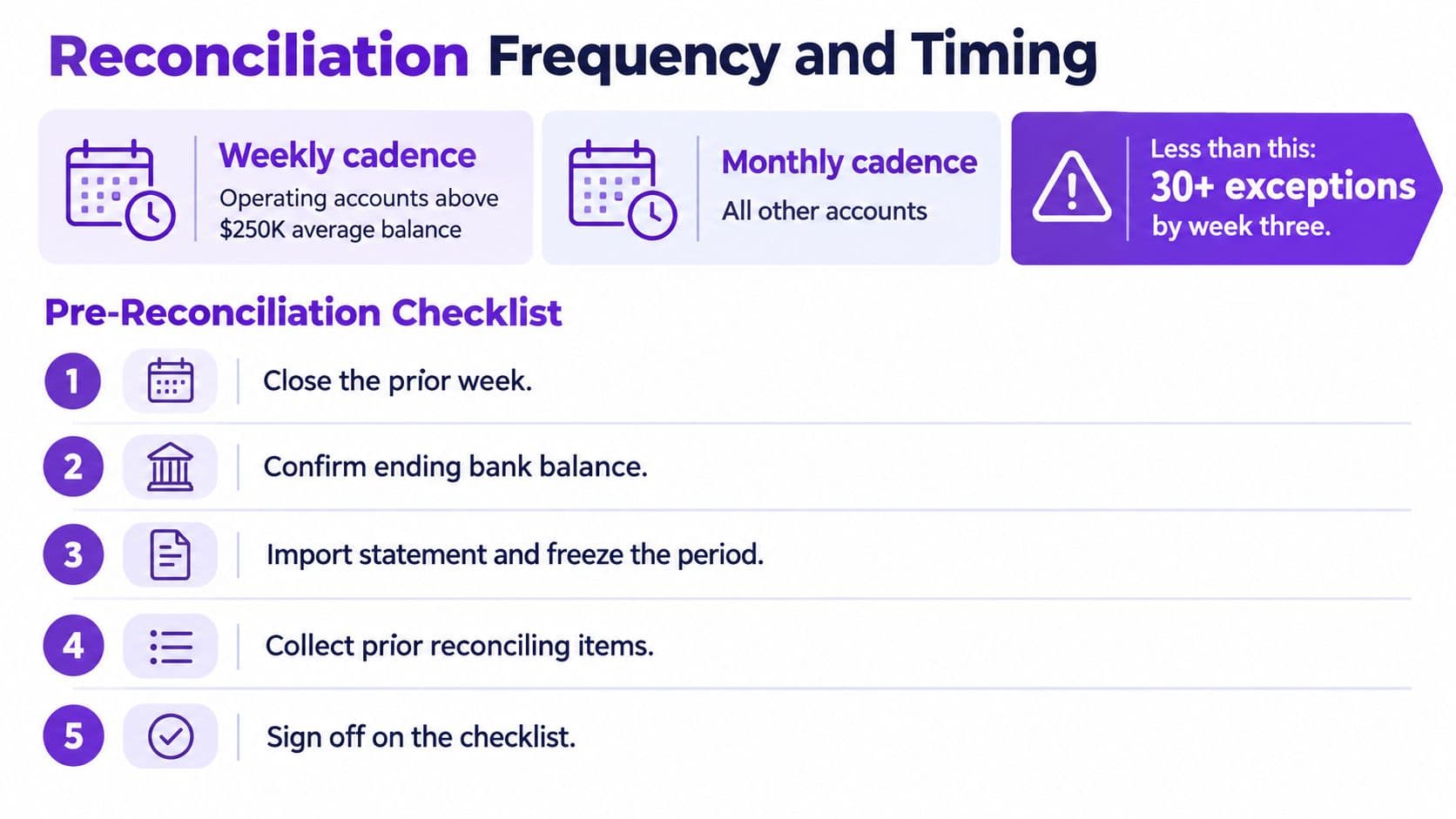
Run this checklist before matching
Don't open individual transactions first. Confirm that the data is complete, or you'll waste time diagnosing false variances.
- Validate the bank feeds. Confirm every feed pulled successfully and that the last five days of transactions are present.
- Tie the opening point to the GL. Verify that the ending book balance matches the general ledger cash control account.
- Check the register. Ensure every check has a recorded payee and amount.
- Confirm payment batches. Review merchant payouts, Stripe activity, and ACH batches for posting.
- Review pending transfers. Identify transfers between accounts that are initiated but not yet posted on both sides.
Skipping one of these checks creates phantom variances. A missing Stripe payout can look like an unexplained deposit. A pending transfer can make two accounts appear wrong at the same time. A feed error can make a clean ledger look incomplete.
Put the checklist in your accounting close calendar and require the preparer to sign it before matching begins. The reviewer should verify the checklist, not just approve the final balance.
Mapping Transactions Step by Step
Start with the ending bank balance and work backward through the period. Your objective is not to force the book balance to the statement. Your objective is to explain every difference and post only the adjustments supported by evidence.
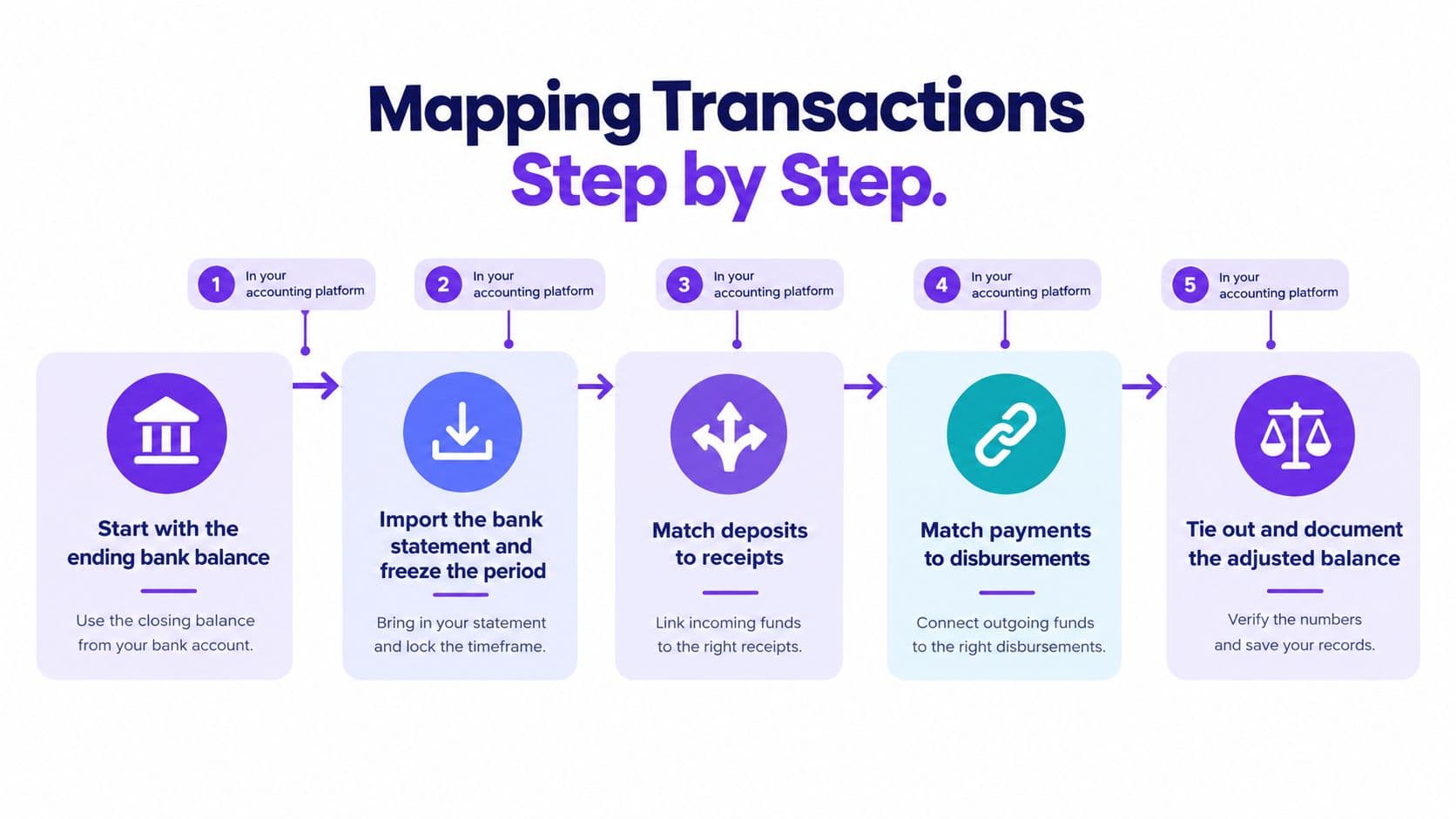
The matching sequence
- Import and freeze the period. Load the bank statement for the exact period and lock the cutoff date. Late-posting transactions should remain in the correct subsequent period, not contaminate the reconciliation you're reviewing.
- Match cleared transactions one to one. Begin with the largest 20 items. They typically cover 80% of volume, so clearing them first reduces the search area quickly.
- Separate unmatched items. Put each difference into a defined category rather than leaving it in an uncategorized queue.
- Post supported adjustments. Record bank-only items and correcting entries in the ledger with a memo.
- Tie out the adjusted balances. The adjusted bank balance and adjusted book balance must match exactly, with the remaining difference at $0.
Use four buckets for unmatched items:
| Bucket | What it means | Treatment |
|---|---|---|
| Deposits in transit | Recorded in the books but cleared by the bank later | Keep as a timing difference and track to clearance |
| Outstanding checks | Issued in the books but not yet cleared | Keep on the outstanding list and investigate aging |
| Bank-only items | Fees, interest, NSF charges, or other statement activity absent from the books | Post an appropriate journal entry |
| Book-only items | Entries recorded in the ledger before the bank posts them | Confirm the transaction and monitor the bank feed |
Suppose your customer payment is $15,000, dated June 28, and the bank clears it on July 1. That's a deposit in transit. It isn't a revenue-recognition error merely because the bank statement shows it in July. Your reconciliation should identify the item, preserve the June book entry, and clear it when the bank posts the deposit.
Set a $100 materiality threshold for line-item investigation and use $500 for immaterial variances written to a clearing account, but document the policy and apply it consistently. Every clearing-account entry needs a memo that references the underlying transaction. That turns the next review into a short verification exercise instead of a reconstruction project.
For accounts with payment processors, use a dedicated mapping layer rather than matching gross customer receipts directly to net bank deposits. A guide to financial data integration can help when bank, accounting, and processor data need a controlled flow into one ledger. For card-specific work, use the credit card reconciliation workflow as a separate operating procedure rather than mixing card liabilities into bank cash matching.
Identifying and Resolving Reconciliation Exceptions
Most reconciliation failures fall into a small set of recurring categories. Your team should diagnose the pattern, assign an owner, and fix the source transaction. Repeatedly clearing the same exception without changing the workflow is not resolution.
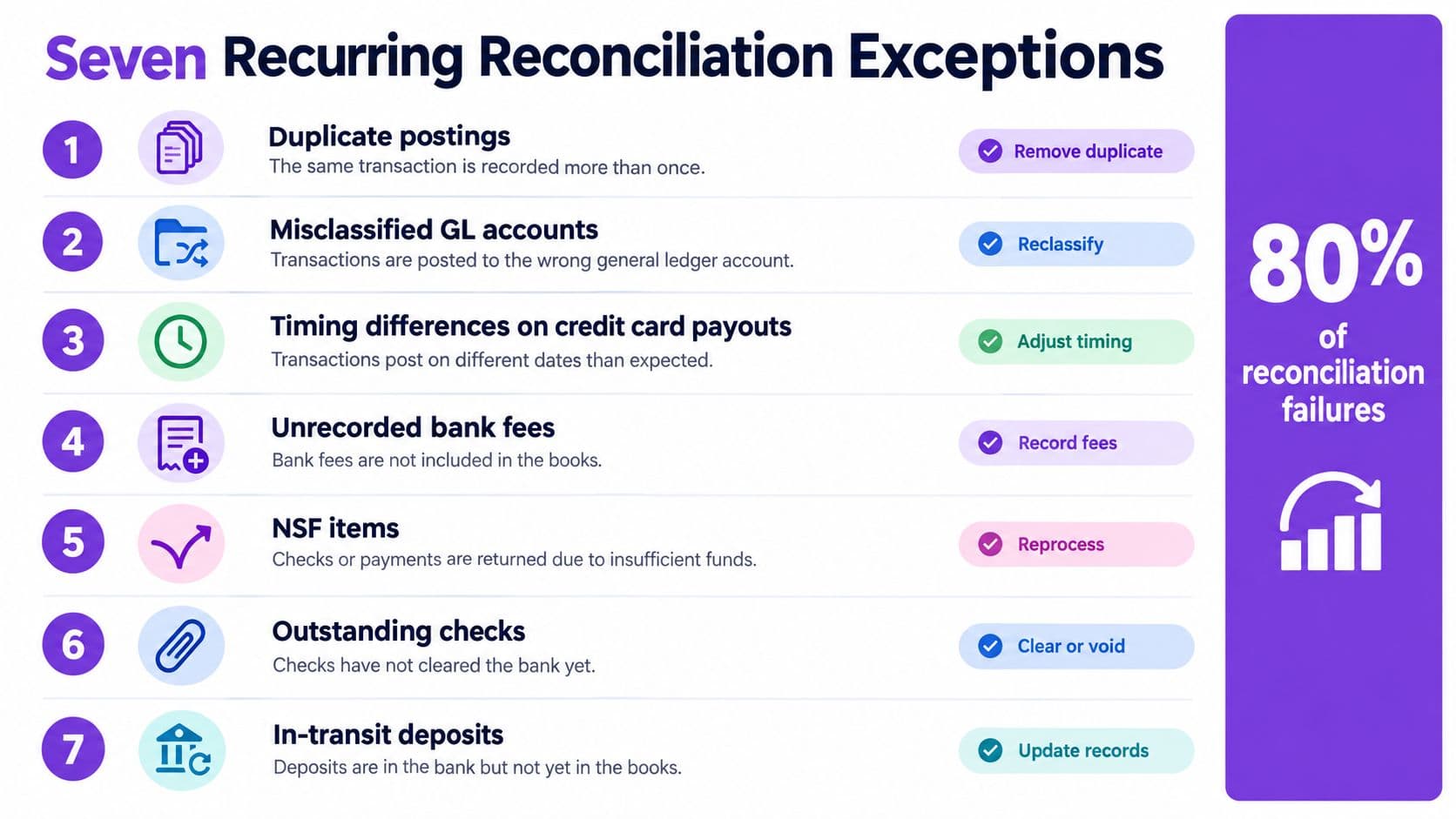
Red flags and fixes
| Exception | Red flag | Exact fix |
|---|---|---|
| Duplicate postings | Two book entries match one bank transaction | Void or reverse the duplicate, then document the source |
| Misclassified GL account | Amount matches, but expense, asset, or liability coding is wrong | Reclassify with a correcting journal entry and memo |
| Credit card payout timing | Processor payout appears in a different period from the underlying batch | Match the batch report to the settlement date |
| Unrecorded bank fees | Bank statement contains a fee absent from the ledger | Post the fee to the approved expense account |
| NSF reversal | Original receipt and returned payment create opposing movements | Match both entries and update receivables |
| Intercompany mismatch | One entity records a transfer before the other entity does | Confirm both sides and post mirrored entries |
| Stale outstanding check | A check remains open beyond 60 days | Contact the payee, void or reissue under policy, and update the register |
The recurring categories above should live in your exception log. Give each item an owner, an expected close date, a source document, and a status. Don't let preparers resolve their own high-risk exceptions without review.
Use a consistent resolution playbook
Pause the match when the evidence doesn't support the proposed entry. Create a ticket, assign the owner, and state what would close the item. Then post the correcting journal entry with a clear memo, attach the support, and rerun the reconciliation.
For small differences, use a written policy rather than personal judgment. Items under $25 can be written off when the policy allows it and the trend is monitored. Items above that threshold require investigation, while controlled accounts and unusual activity deserve controller review regardless of amount.
Escalate three conditions immediately:
- Payroll variance above $500. Payroll errors affect employees, taxes, and trust.
- Any item touching a controlled account. Don't waive review because the amount looks small.
- An unexplained balance open for more than 15 days. Aging indicates that the team's workflow, ownership, or source data is failing.
Your controls should be documented alongside the reconciliation, not buried in an email thread. A practical implementation guide for financial controls in growing businesses can help you formalize ownership, approvals, and evidence as the team expands.
QuickBooks vs Xero vs NetSuite Reconciliation Workflows
Choose the platform based on transaction complexity, entity structure, review requirements, and the quality of your integrations. Don't choose software because a salesperson promises automation. Automation only helps when the source data, cutoff rules, and exception ownership are sound.
| Feature | QuickBooks Online | Xero | NetSuite |
|---|---|---|---|
| Bank feed coverage | Broad coverage for small-business banking, subject to feed availability | Strong bank-feed workflow, subject to bank and region | Enterprise connections and integration-led workflows |
| Auto-match rules | Straightforward rules for recurring transactions | Flexible matching and strong user access model | Advanced saved searches, scripts, and configurable workflows |
| Exception handling | Best for simpler exception queues | Suitable for growing service businesses | Built for high-volume, multi-entity exception management |
| Multi-entity support | Limited compared with enterprise platforms | Better suited to growing organizations, with add-ons as needed | Native multi-entity and intercompany capabilities |
| Audit trail depth | Appropriate for smaller teams with disciplined review | Stronger collaboration through unlimited users | Deep audit trails, approvals, and reporting controls |
| Per-user cost | Lower-cost option, with plans ranging from $30 to $180 per month | Plans range from $33 to $78 per month and include unlimited users | Starts at $999 per month plus $99 per user |
The pricing ranges and product distinctions above come from the stated platform comparison, not from the verified bank-reconciliation sources. Confirm current pricing, account limits, currency support, and bank connections before signing a contract because vendor plans change.
Make the decision by operating model
For a business below $1M in revenue with one entity, stay in QuickBooks Online if the transaction volume and controls fit. Its simplicity and lower price are useful when your process doesn't require complex consolidation.
At $1M to $5M with multi-currency requirements, Xero is a stronger candidate when unlimited users and bank-feed collaboration matter. At $5M or above with subsidiaries and audit requirements, NetSuite's intercompany workflows, saved searches, and configurable matching justify an implementation project.
Before migrating, export the chart of accounts, open reconciling items, bank rules, historical statements, and user permissions. Test Plaid connections and direct bank APIs in a sandbox or parallel period, and document API limits, feed gaps, duplicate handling, and cutoff behavior. The accounting software selection guide for growing businesses gives you a useful framework for comparing the wider finance stack.
Connecting Reconciliation to a Fast Month-End Close
Weekly reconciliation changes what happens at month-end. Instead of discovering every bank fee, timing item, transfer, and missing payout after the period ends, your team carries forward a controlled list of known exceptions.
The operating target for a $5M to $20M business is a five-business-day close, an unreconciled variance below 0.05% of cash, and an auto-match rate above 92%. These are management targets, not facts established by the verified sources, so use them as internal scorecard thresholds and adjust them for your risk profile.
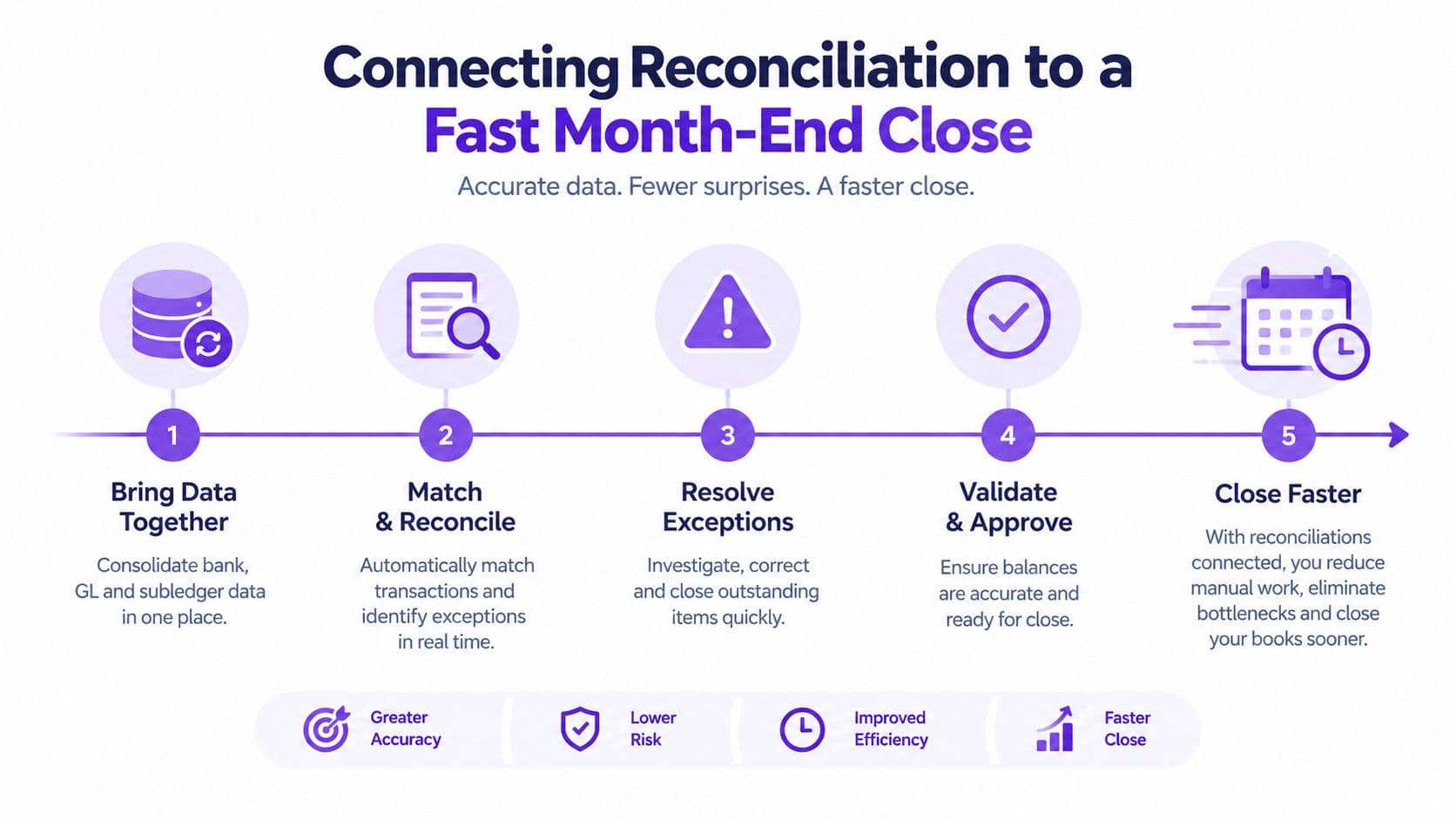
Use a five-day close calendar
| Day | Owner action | Required output |
|---|---|---|
| Day 1 | Cut off the period and confirm source-system completeness | Locked period and data checklist |
| Days 2 to 3 | Complete bank reconciliations and clear documented items below $1,000 | Signed reconciliation package |
| Day 4 | Finalize accruals, prepaid balances, deferred revenue, payroll, and intercompany entries | Posted close journals |
| Day 5 | Controller review and executive sign-off | Approved financial statements and variance commentary |
Clean cash-to-GL mapping also supports revenue accounting. Under ASC 606, deferred revenue and contract assets depend on accurate billing, receipt, and ledger records. Reconciliation doesn't determine the revenue conclusion by itself, but it gives the revenue team a dependable cash and settlement trail.
Track three KPIs every close:
- Days to close, measured from period cutoff to approved financials.
- Unreconciled variance as a percentage of cash, reviewed by account and entity.
- Percentage of auto-matched transactions, separated from items approved through manual overrides.
Use this short close-the-books workflow to assign owners and deadlines. For a visual explanation of how the sequence fits together, review the embedded walkthrough below.
When to Outsource Reconciliation to a Controller Service
Outsource when reconciliation consumes senior finance time, creates audit exposure, or delays the close. The clearest triggers are $1M or more in revenue, multiple entities, audit pressure, or a close cycle stretching beyond 10 days.
A staff bookkeeper earning $65K to $85K and spending 12 hours per month on reconciliation represents roughly $1,800 to $2,500 in monthly labor before rework, training, and error leakage. That calculation is based on a simple monthly allocation of salary cost, not a claim about total outsourcing savings. The larger issue is opportunity cost: every hour a founder or controller spends reviewing bank recs is an hour unavailable for forecasting, board preparation, or vendor negotiations.
A capable outsourced controller engagement should define deliverables, owners, review standards, and response times. Expect weekly reconciled books, a five-day close SLA, documented exception logs, audit-ready workpapers, and fractional-controller technical review. Use 98% or higher match rates, 24-hour exception turnaround, and sub-48-hour variance resolution as evaluation criteria only when the provider can show how it measures them.
Decision matrix by revenue stage
| Revenue Stage | In-House Fit | Outsourced Fit | Monthly Cost Range | Target Close Speed |
|---|---|---|---|---|
| Under $500K | Founder or bookkeeper using QuickBooks automation | Usually unnecessary unless books are distressed | Internal labor cost | Set a consistent monthly target |
| $500K to $5M | Works when books are clean and transaction volume is manageable | Part-time controller support for review and close discipline | Compare internal allocation with quoted fee | Aim for five business days |
| $5M to $20M | Requires experienced finance ownership and documented controls | Full outsourced reconciliation often fits multi-channel or multi-entity operations | Obtain a fixed scope and SLA | Aim for five business days |
Ask for sample workpapers, evidence of SOC 2 coverage, the exception workflow, and the named reviewer. No SOC 2, no sample workpapers, or month-end-only delivery should disqualify a provider. Month-end-only service reproduces the problem this process is meant to solve.
Fractional controller services can fit a business that needs technical review without hiring a full-time controller. Jumpstart Partners is one option that provides outsourced bookkeeping and controller support for SaaS, agencies, professional services firms, and other businesses in the $500K to $20M revenue range.
Jumpstart Partners provides weekly bank, credit card, and payment-processor reconciliation, documented exception logs, and controller review connected to a five-day month-end close. Visit Jumpstart Partners to discuss a reconciliation workflow built around your accounting platform, entities, and audit-readiness needs.