Financial Operations
How to Close the Books in 5 Days
Learn how to close the books in 5 days with this step-by-step month-end close guide for SaaS, agencies, and growing businesses. Includes checklists and ASC 606
ByJumpstart Partners, CPA, QuickBooks ProAdvisor
··15 min readMost advice about how to close the books starts in the wrong place. It tells you to buy close-management software, demand a three-day close, or push your accounting team to work faster. That approach treats the symptom as the problem.
For a growing SaaS company, agency, or professional services firm, the constraint usually sits upstream. Sales submits contract changes late. Operations approves vendor bills after the cutoff. Payroll corrections arrive after the ledger should be locked. Finance then spends the close chasing missing data, rebuilding schedules, and deciding what other teams should have documented.
A five-day close is a useful operating target, but it isn't a race record. It means your management team receives accurate, traceable, decision-ready financials on a dependable cadence. The practical benchmark is broad: APQC data cited by CFO places top performers at 4.8 calendar days or less, the median at 6.4 days, and the bottom quartile at 10 days or more. Your goal should be a controlled close that matches your company's complexity, not an impressive number produced by skipping review.
Table of Contents
- The Real Cost of a Slow Month-End Close
- Why Your Close Is Slow
- The 5-Day Close Timeline and Checklist
- Mastering ASC 606 Revenue Recognition
- Automation Tools Versus Outsourced Controllers
- Red Flags That Signal You Need Expert Help
The Real Cost of a Slow Month-End Close
A slow close doesn't hurt because your accountants spend extra days posting entries. It hurts because every important decision waits for information you don't trust yet. Hiring plans, spending approvals, pricing decisions, fundraising materials, lender reporting, and board discussions all become slower when your financials remain provisional.
The popular three-day-close narrative creates the wrong incentive. A rushed close can leave deferred revenue misstated, accruals incomplete, balance sheet accounts unreconciled, and allocations inconsistent from month to month. You may receive a draft income statement quickly, but speed without an audit trail gives you a number that still needs to be rebuilt.
Controller's rule: A clean five-day close beats a chaotic three-day scramble every time.

What a reliable close protects
A disciplined close gives you more than an income statement. It creates a clean cutoff between reporting periods, which is why the process supports tax filings, investor reporting, audits, and management reporting across markets. The accounting workflow traditionally includes posting journal totals to the general ledger, preparing and adjusting a trial balance, generating financial statements, and recording closing entries so revenue and expense accounts reset for the next period. Modern guidance describes the process as ending with a post-closing trial balance containing only balance-sheet accounts, as explained in Wolters Kluwer's overview of closing the books.
The business consequences are practical:
- Board reporting: Your board sees current performance instead of stale estimates.
- Fundraising diligence: Investors can trace revenue, cash, and liabilities back to supporting schedules.
- Debt compliance: You identify covenant pressure before a reporting deadline.
- Audit readiness: Reviewers find reconciliations and explanations instead of unexplained movements.
- Operating control: Department leaders learn that accurate source data is part of their job.
For basic account control, finance leaders should also understand the bank reconciliation basics, particularly the difference between an unexplained balance and a documented timing item. A reconciliation isn't complete because the ending balance looks familiar. It's complete when the ledger, bank activity, outstanding items, and supporting evidence agree.
The five-day standard
A five-day close works when you define “finished” precisely. All material balance sheet accounts need reconciliations. Revenue needs a documented recognition schedule. Accruals need evidence or a repeatable estimation method. Variances need owners and explanations. The final reporting package needs a reviewer who wasn't responsible for every underlying entry.
If those controls aren't in place, compressing the calendar only hides the weakness. Use a structured reconciliation service workflow when your team needs ownership, deadlines, and review standards rather than another general productivity push.
Why Your Close Is Slow
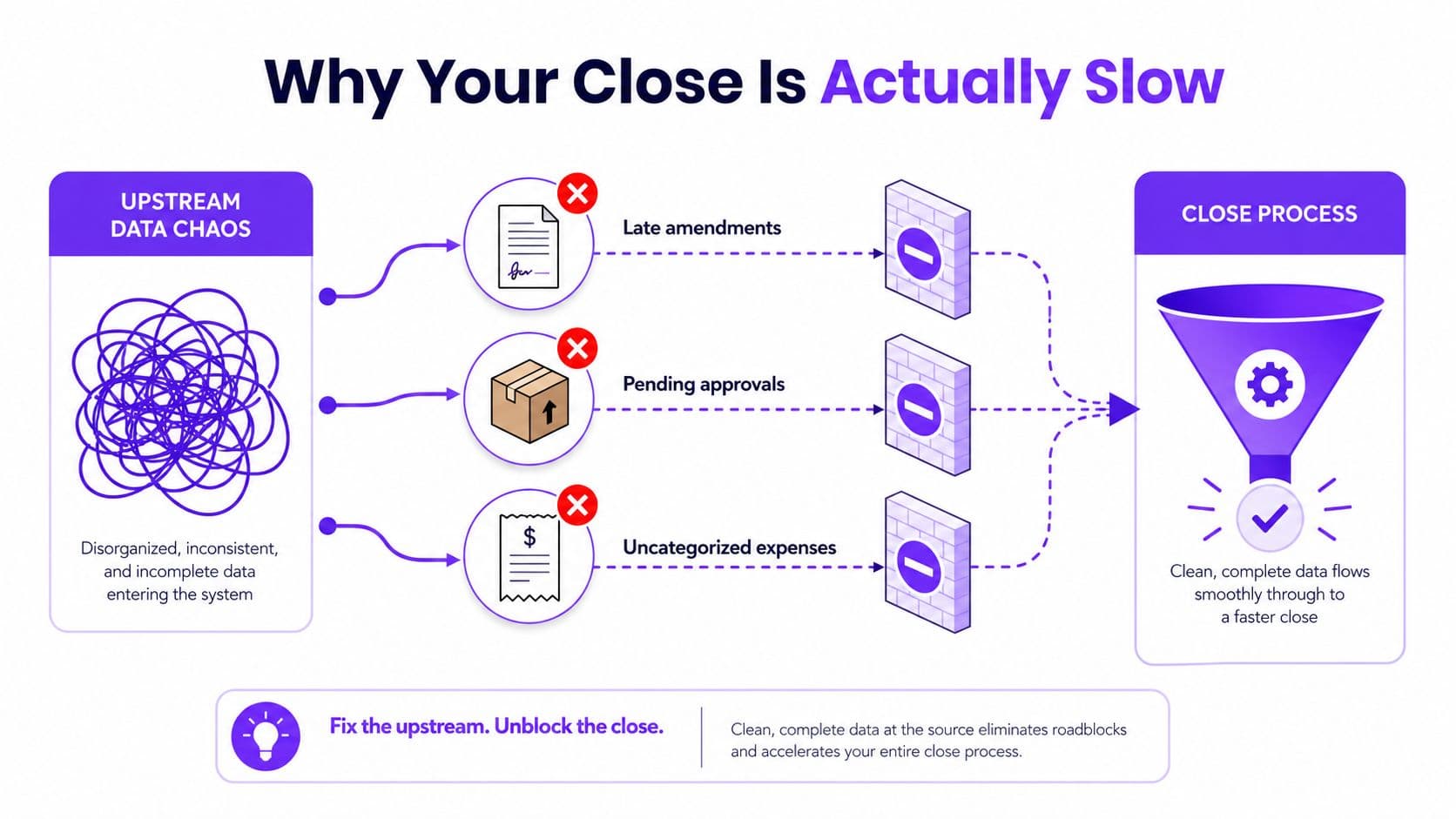
Your accountant rarely owns the bottleneck. Finance works at the end of a chain of decisions made by sales, operations, people teams, procurement, and department managers. When those teams submit incomplete or late information, accounting cannot close the period cleanly, regardless of how quickly the bookkeeper posts entries.
A 2025 benchmark identified inter-departmental dependencies as a blocker for 56% of finance teams, followed by Excel-driven processes at 50%, outdated systems at 40%, and staffing gaps at 37%, according to Ledge's 2025 month-end-close benchmark. The same coverage reports that cash reconciliation consumed 20–50 hours per month across 3–5 systems. Those figures point to a workflow problem rather than an accounting-capacity problem.
The three upstream failures
Sales creates revenue ambiguity. A signed contract does not give finance the full accounting picture. The team needs the executed agreement, amendments, discounts, implementation terms, renewal details, usage terms, and delivery status. If sales changes commercial terms in a spreadsheet or email without updating the revenue schedule, accounting must reconstruct the contract during close.
Operations controls the payable cutoff. Vendor invoices, contractor approvals, purchase orders, and recurring service confirmations often remain with budget owners. Finance cannot record a defensible accrual until someone confirms whether the service was received or an invoice is still pending.
Department managers push coding decisions to finance. A card charge may be obvious to the employee who made it and unclear to the accountant reviewing it later. Require a business purpose, cost center, project, and receipt. Without them, finance spends close time investigating transactions instead of reviewing results.
Assign ownership in the close calendar. Sales owns contract completeness. Operations owns invoice approval. People operations owns payroll inputs. Department heads own expense coding. The controller owns the ledger and escalation process.
Map the critical path
List every close deliverable and identify the source-data owner, the person posting the entry, and the reviewer. Mark dependencies that can block other tasks. A late contract file or missing payroll correction can affect several downstream schedules at once.
Set a cutoff, define the required evidence, and escalate exceptions immediately. Finance should not absorb late work. A documented exception can be managed. An invisible dependency becomes a recurring close delay.
Automation helps after ownership is clear. Tools can match transactions, route approvals, and preserve evidence, while journal entry automation can reduce repetitive posting work. Neither replaces the judgment required to assess whether a contract modification changes its accounting treatment. The close gets faster when upstream teams deliver complete, timely data and finance receives entries it can support.
The 5-Day Close Timeline and Checklist
A five-day close begins before Day 1. Your finance team should use the final days of the month to collect source documents, confirm cutoffs, and clear known exceptions. If you wait until the period ends to ask for contracts, invoices, or payroll changes, the schedule is already broken.
Pre-close preparation
| Timing | Owner | Required action | Escalation trigger |
|---|---|---|---|
| Day -3 | Controller | Publish the close calendar and account-owner list | Any owner or deadline is unclear |
| Day -2 | Sales and finance | Submit signed contracts, amendments, renewals, and pricing changes | A commercial change lacks documentation |
| Day -2 | Department heads | Approve invoices and submit expense support | A material purchase lacks an approver |
| Day -1 | People operations | Confirm payroll inputs, bonuses, commissions, and corrections | Payroll data remains provisional |
| Day -1 | Staff accountant | Review open reconciling items and recurring entries | An old item has no documented owner |
Day-by-day operating cadence
| Day | Primary owner | Work completed | Deliverable |
|---|---|---|---|
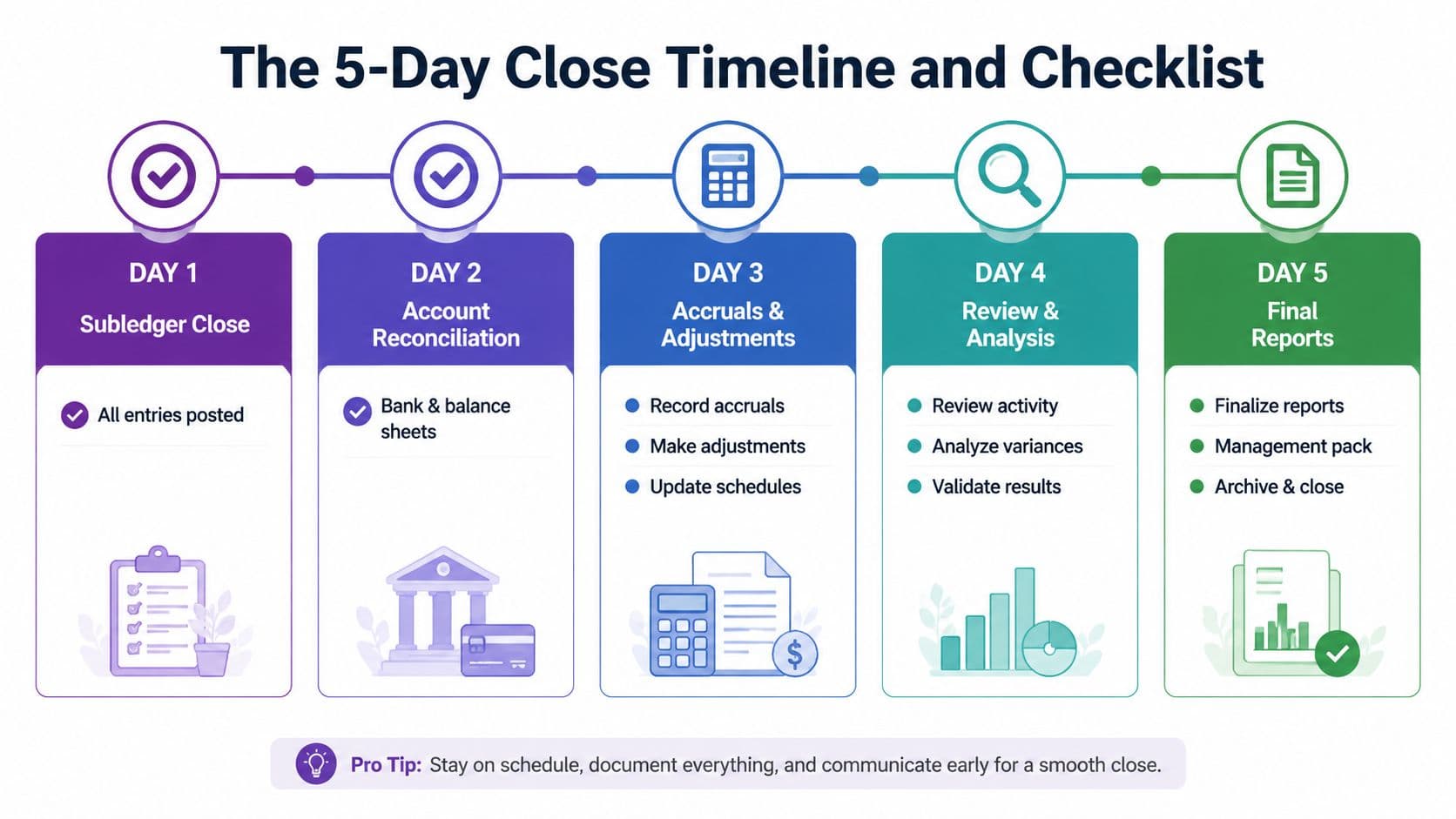
| Day 1, subledger lockdown | Staff accountant and department heads | Apply accounts payable cutoff, finalize expense submissions, post payroll, record recurring accruals, and lock source subledgers | All expected entries are posted or exceptions are documented |
| Day 2, account reconciliation | Staff accountant and controller | Reconcile bank, credit card, payment processor, loan, and other balance sheet accounts | Reconciliation package with zero unexplained variances |
| Day 3, revenue and adjustments | Controller | Post revenue recognition, update deferred revenue, review accruals, and record approved adjustments | Revenue schedule agrees to the general ledger |
| Day 4, consolidation and review | Controller | Complete intercompany eliminations, prepaid amortization, fixed asset depreciation, and preliminary variance review | Consolidated trial balance and exception list |
| Day 5, reporting and approval | Controller and CEO or CFO | Prepare financial statements, explain material variances, review cash and KPIs, and lock the period | Approved management reporting package |
Day 1 is about stopping the inflow of uncontrolled transactions. Department heads shouldn't continue approving prior-period expenses indefinitely. Day 2 is where finance proves that the cash and balance sheet are real, not merely carried forward.
Day 3 deserves special attention in SaaS and service businesses because revenue schedules often contain the most judgment. Day 4 removes consolidation and allocation noise before leadership sees the numbers. Day 5 is for analysis, not cleanup. If your controller is still searching for missing receipts on Day 5, the earlier controls failed.
Escalation rules that keep the calendar intact
Use simple rules. A missing document gets an owner and deadline. An unexplained reconciliation difference doesn't roll forward without a note. A revenue exception goes to the controller, not back to sales for an informal opinion. A department that misses the cutoff receives an exception report and must explain the impact.
Your close checklist should live in one system, whether that's your ERP, a close-management platform, or a controlled task board. Don't maintain one version in email, another in Excel, and a third in the controller's notebook.
Use this cadence as a baseline, then adjust task order for your systems. The definition of success is not that every business performs identical work on identical days. It's that each deliverable has an owner, evidence, reviewer, and deadline.
Mastering ASC 606 Revenue Recognition
Revenue recognition delays the close because SaaS and service contracts don't always line up with invoices or cash receipts. ASC 606 requires a five-step sequence: identify the contract, identify performance obligations, determine the transaction price, allocate that price to the obligations, and recognize revenue when or as each obligation is satisfied. BDO's ASC 606 blueprint lays out that model for practical application.
Consider a 12-month software contract billed upfront for $120,000. If the customer receives one continuous software service, the basic monthly revenue calculation is:
$120,000 ÷ 12 months = $10,000 per month.
Cash arrives first, but the company earns the revenue as it provides the service. At billing, the balance sheet records cash or accounts receivable and deferred revenue. Each month, the company recognizes $10,000 from deferred revenue into subscription revenue, assuming there are no separate performance obligations or variable consideration adjustments.
A contract with onboarding
Now add a $15,000 onboarding fee. You can't automatically recognize that fee when invoiced. First determine whether onboarding is a separate performance obligation or whether it only enables the customer to receive the ongoing SaaS service. If onboarding isn't distinct, allocate the transaction price to the combined service and recognize it over the service period.
The total contract consideration is:
$120,000 + $15,000 = $135,000.
Spread across 12 months, the combined monthly recognition is:
$135,000 ÷ 12 months = $11,250 per month.
The table below shows the simplified allocation when the software service and onboarding are treated as one combined performance obligation. The standalone prices are shown to make the allocation logic visible, but the example assumes the onboarding isn't separately distinct.
| Performance Obligation | Standalone Price | Allocated Amount | Recognition Period | Monthly Revenue |
|---|---|---|---|---|
| SaaS service and non-distinct onboarding | $120,000 plus $15,000 consideration | $135,000 | 12 months | $11,250 |
| Total | $135,000 | $135,000 | 12 months | $11,250 |
If onboarding is distinct, you need standalone selling prices and an allocation based on the relative value of each obligation. Don't force a straight-line answer because it is convenient. The SEC's ASC 606 example emphasizes measuring transaction price, considering variable consideration constraints, allocating the price, and recognizing revenue only when each obligation is satisfied.
Build a monthly revenue control
Your contract schedule should capture the original agreement, amendments, renewal terms, implementation work, discounts, usage-based pricing, and delivery status. Reconcile billed cash to earned revenue every month. Investigate differences before the reporting package goes to management.
Common failure points include treating invoice date as revenue date, recognizing an onboarding fee immediately without assessing distinctness, ignoring contract modifications, and failing to constrain usage-based consideration. A consistent contract-to-ledger workflow prevents quarter-end reconstruction.
For broader accounting reading, Cloudvara's favorite accounting titles can help your team build a reference shelf, but books won't replace a documented contract review policy. Put the policy into your close checklist and assign the controller responsibility for exceptions. For a process-specific reference, see ASC 606 revenue recognition.
Automation Tools Versus Outsourced Controllers
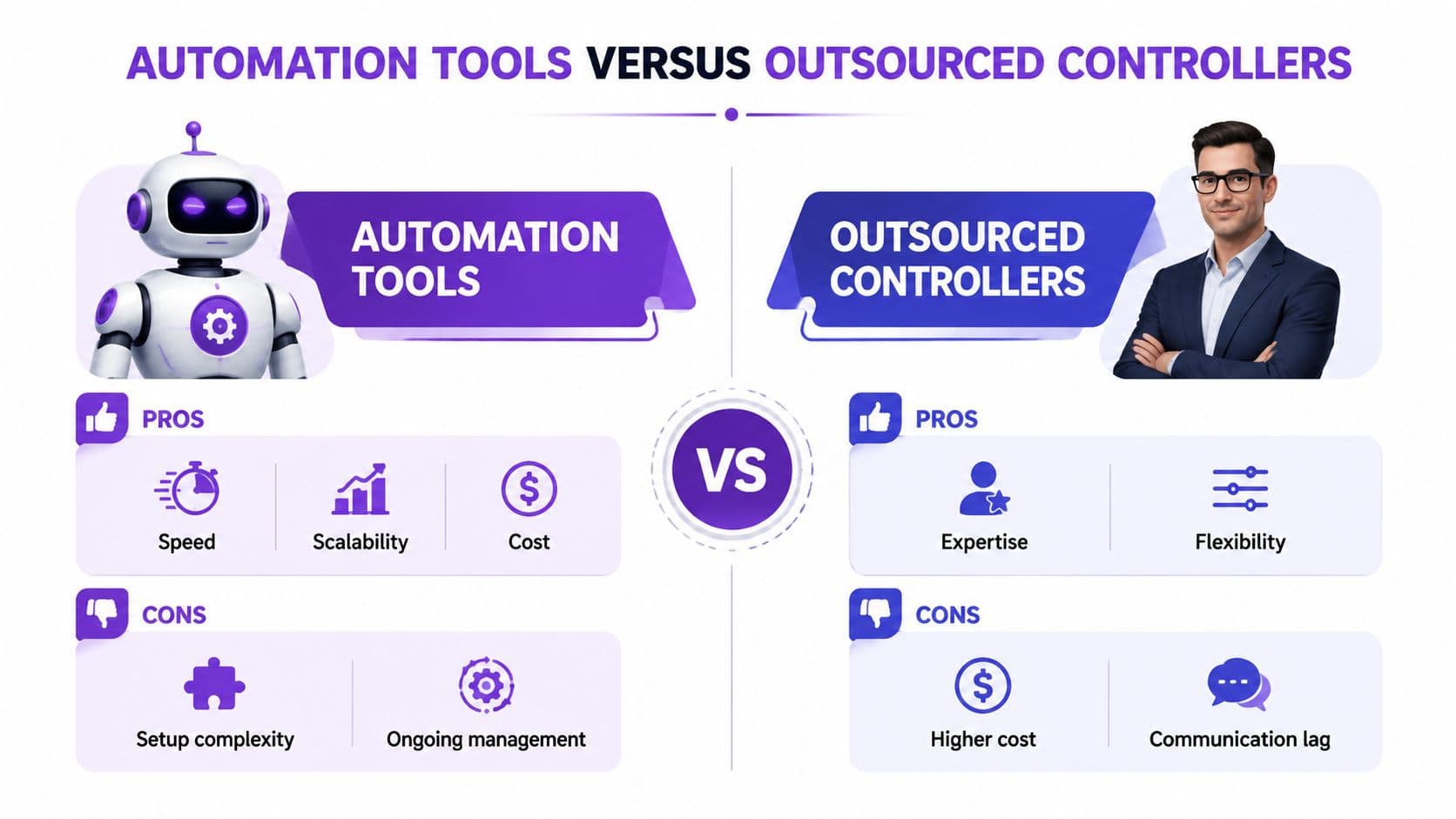
Automation is useful when the process is already defined. It won't repair unclear ownership, incomplete contract data, or judgment-heavy revenue decisions. Buying FloQast, BlackLine, Trullion, or an ERP close module before fixing those issues gives you a faster way to track a broken workflow.
The right choice depends on what your company lacks.
| Option | Best fit | Strength | Limitation |
|---|---|---|---|
| Automation with existing staff | Stable process with repetitive reconciliations | Speed, repeatability, and scalable task tracking | Your team still owns setup, exceptions, and accounting judgment |
| Full-time controller | Complex, sustained finance workload with internal leadership needs | Deep company context and direct accountability | Hiring takes time, and one person may not cover every technical specialty |
| Outsourced controller and bookkeeping provider | Growth-stage company needing immediate process ownership | Flexible capacity, technical review, and close execution | Requires clear communication routines and access to source systems |
At the $3M to $15M revenue stage, don't treat software and expertise as substitutes. A close tool can assign tasks and preserve sign-offs. A controller decides whether an unexplained balance requires an entry, a policy change, or an operational correction.
You can also hire a remote bookkeeper for transaction processing when the workload exceeds internal capacity. That role works best with controller oversight, clear coding rules, and a documented escalation path for issues that require judgment.
Choose based on the constraint
If reconciliations are repetitive but accurate, automate them. If your books contain unresolved balances, revenue complexity, or multi-entity reporting issues, add controller expertise first. If fundraising or audit preparation is approaching, prioritize an owner who can produce support schedules and defend the accounting treatment.
A hybrid model often fits a scaling business: software handles evidence collection and task visibility, a bookkeeper handles routine posting, and a controller reviews judgment areas and the final reporting package. See financial close automation for the workflow considerations before selecting a platform.
Jumpstart Partners is one outsourced option for businesses in this range, providing bookkeeping and controller support around reconciliations, revenue recognition, reporting, and close execution. Evaluate any provider against your chart of accounts, contract complexity, reporting requirements, security expectations, and required response time.
Red Flags That Signal You Need Expert Help
DIY bookkeeping stops working when the business requires judgment, coordination, and repeatable review. The warning isn't one bad month. It's a pattern that leaves leadership unsure whether the numbers are final.
Financial warning signs
- The close exceeds ten business days: You can't make timely decisions or prepare confidently for diligence.
- Revenue changes after reporting: Your first result isn't reliable because schedules, contract terms, or accruals remain unresolved.
- Balance sheet accounts grow without explanation: Old reconciling items indicate that nobody owns the cleanup.
- Deferred revenue doesn't tie to the ledger: Your contract schedule and general ledger tell different stories.
- The chart of accounts reflects an old business model: A pivot, new revenue stream, or new entity has made historical classifications confusing.
Operational triggers matter too. A fundraising process, an audit, a new revenue model, a new entity, or the hiring of a finance executive requires stronger controls before the pressure arrives. Don't wait for an investor or auditor to identify weaknesses your team can see every month.
Use the signs you've outgrown your bookkeeper as a screening framework, then ask potential providers who will own the close, who reviews revenue recognition, how they document exceptions, and what your final reporting package includes. Request a sample close calendar and a clear transition plan. The right engagement should reduce dependence on founder memory, not create another black box.
Jumpstart Partners provides outsourced bookkeeping and controller support for SaaS, agencies, and other growing businesses that need accurate, investor-ready financials without building the entire function in-house. Visit Jumpstart Partners to discuss a five-day close workflow, QuickBooks cleanup, revenue recognition, reconciliations, or cash-flow reporting for your systems and growth stage.