Financial Operations
Financial Close Automation Guide for Growing Companies
A practical financial close automation guide for $1M-$5M ARR businesses. Learn benefits, ROI, workflows, and how to implement in 90 days.
ByJumpstart Partners, CPA, QuickBooks ProAdvisor
··15 min readMature financial close automation cuts an 8 to 10 day close to 3 to 5 days, and mature deployments can deliver roughly 379% ROI within 12 to 18 months. That is not a software story, it's a sequencing story. If your controller is still reconciling Stripe payouts by hand while the investor update is due Friday, you're paying for delay, rework, and bad timing, not just accounting labor.
Table of Contents
- Why Your Month-End Close Is Costing You Real Money
- What Financial Close Automation Actually Means
- Calculating the ROI of Financial Close Automation
- The Core Workflows You Automate First
- The Case for Moving Work Out of the Close
- A 90-Day Implementation Roadmap
- Build, Buy, or Outsource the Close Function
- Red Flags and Your Next Step to a 5-Day Close
Why Your Month-End Close Is Costing You Real Money
A slow close is a direct cash leak. Analysts in industry analysis show that AI-enabled close setups cut month-end close time by 40% to 60%, often taking teams from an 8 to 10 day close to a 3 to 5 day close. Those days matter because every extra one delays decisions, keeps founders guessing, and drags finance back into cleanup work instead of analysis.

For a founder, the damage shows up the same way every month. The books are late, the board deck is half-finished, and the team is stuck arguing over whether a balance is wrong or just undocumented. If that sounds familiar, read what process automation means and then apply it to your close, because the problem is usually repetitive work being handled in the wrong sequence.
The cost of a slow close is concrete. It surfaces as late investor reporting, surprise audit questions, and management meetings where nobody trusts the numbers enough to act. Jumpstart Partners has a useful breakdown of the cost of accounting, and the point is simple, messy accounting always costs more than it appears on paper.
Practical rule: if your close depends on memory, Slack threads, and spreadsheet archaeology, you do not have a close process, you have a recurring fire drill.
The right way to think about financial close automation is through three decisions, not a single software purchase. First, decide what to automate. Second, decide what should move out of close entirely. Third, decide when outsourcing beats internal tooling. That sequence keeps you from buying technology before you have fixed the work that belongs outside the close.
What Financial Close Automation Actually Means
Financial close automation is the orchestration of recurring accounting work so the close runs on rules, evidence, and approvals, not spreadsheet memory. In practice, that means your team stops treating reconciliations, journal entries, cutoff checks, and reporting as separate monthly chores and starts running them as connected workflows.
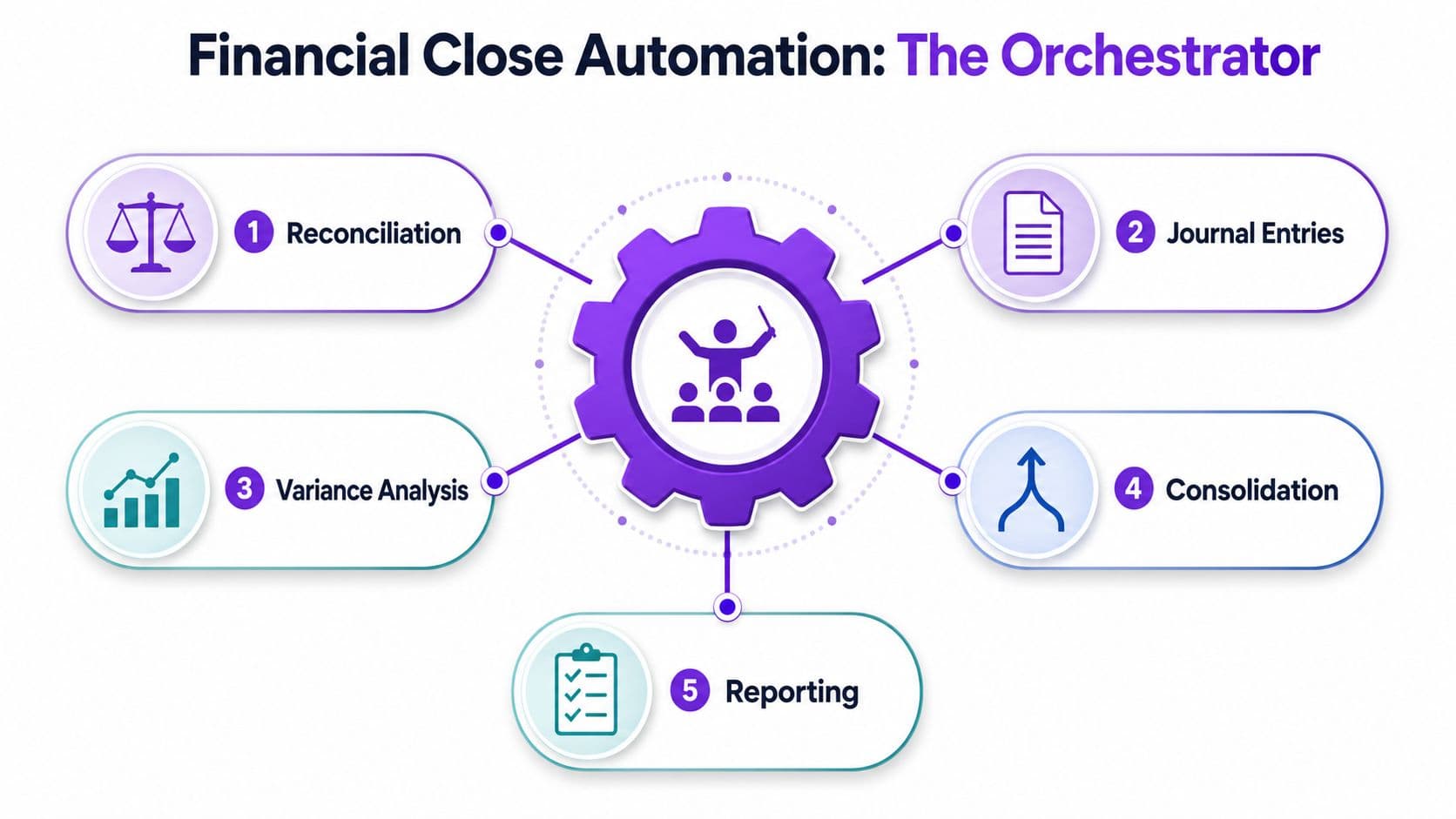
The workflows that actually matter
A working close system usually centers on five areas, reconciliation, journal entries, variance analysis, consolidation, and reporting. The point is not to automate everything blindly. The point is to make each workflow produce an auditable output that another person can review quickly.
A manual close looks like status meetings, chase emails, and untied journal entries sitting in a spreadsheet until someone remembers to post them. An automated close runs those rules nightly or on schedule, pushes exceptions into a queue, and leaves a dated trail for sign-off. That's a massive operational shift, because the close becomes a review event instead of a hunting expedition.
For a useful integration example, see how Hopted pulls Amazon SP API financials. The underlying principle is the same whether your source system is Shopify, Stripe, payroll, or a marketplace feed, connect the source, standardize the data, and let the exception handling be the human work.
What this looks like in real life
Automation is to your close what direct deposit is to payroll, once it runs in the background, you stop thinking about it.
That analogy matters because founders often overcomplicate this. You do not need a “digital transformation initiative” to get value. You need fewer manual touches, clearer evidence, and tighter control over recurring tasks that should never depend on one person's memory.
Jumpstart Partners' financial reporting automation overview fits this definition well because it ties automation to actual outputs, not just software dashboards. If your close still needs a human to retype the same balances every month, you're not automating the process, you're just dressing it up.
Calculating the ROI of Financial Close Automation
Most buyers ask the wrong question first. They ask how many days they can shave off the close. That matters, but it's not the full business case, and it's not how you should approve the investment.
A better ROI model includes cycle time, error reduction, and audit-prep time. Trullion's financial close automation guidance recommends measuring those items before and after automation, because close value comes from more than speed alone, and autonomous close programs only work when people, process, and technology are assessed together.
A worked ROI example for a $5M ARR SaaS company
Use this as a board-ready starting point. I'm keeping the math simple on purpose, because executives need a model they can challenge.
| Cost line | Manual close annually | Automated close annually |
|---|---|---|
| Controller time spent on reconciliations, entries, and follow-up | Higher, recurring monthly labor | Lower, because exceptions only |
| Audit-prep time | Higher, because evidence is scattered | Lower, because evidence trails are centralized |
| Error correction and rework | Higher, because issues are caught late | Lower, because rules catch variances earlier |
| Reporting delay cost | Higher, because decisions wait for numbers | Lower, because numbers land sooner |
| Control quality | Inconsistent, spreadsheet-dependent | Stronger, because approvals and evidence are explicit |
The annual-value logic is straightforward. If you remove even a modest amount of manual cleanup from every close, the hours add up fast across twelve months. The business case gets stronger when you look at the controller's time as a real operating cost, not a soft efficiency goal, and Jumpstart Partners' controller services ROI analysis is a useful reference for that framing.
Don't sell cycle time alone
A faster close is valuable, but speed is not the only win. If your team still spends time rebuilding support for the auditor, the tool hasn't solved the core problem. The better question is whether automation reduces the number of handoffs, the number of exceptions, and the number of decisions made on stale data.
Controller-grade rule: if the automation business case doesn't include audit-prep time and error correction, it's incomplete.
That same discipline keeps the ROI discussion honest. Founders want a shorter close, but CFOs need fewer manual touchpoints, fewer late surprises, and cleaner evidence for board reporting, fundraising, and revenue discipline.
The Core Workflows You Automate First
Start with the work that is repetitive, rules-based, and painful to review manually. That's where automation pays back fastest, and it's also where bad process design is easiest to expose.
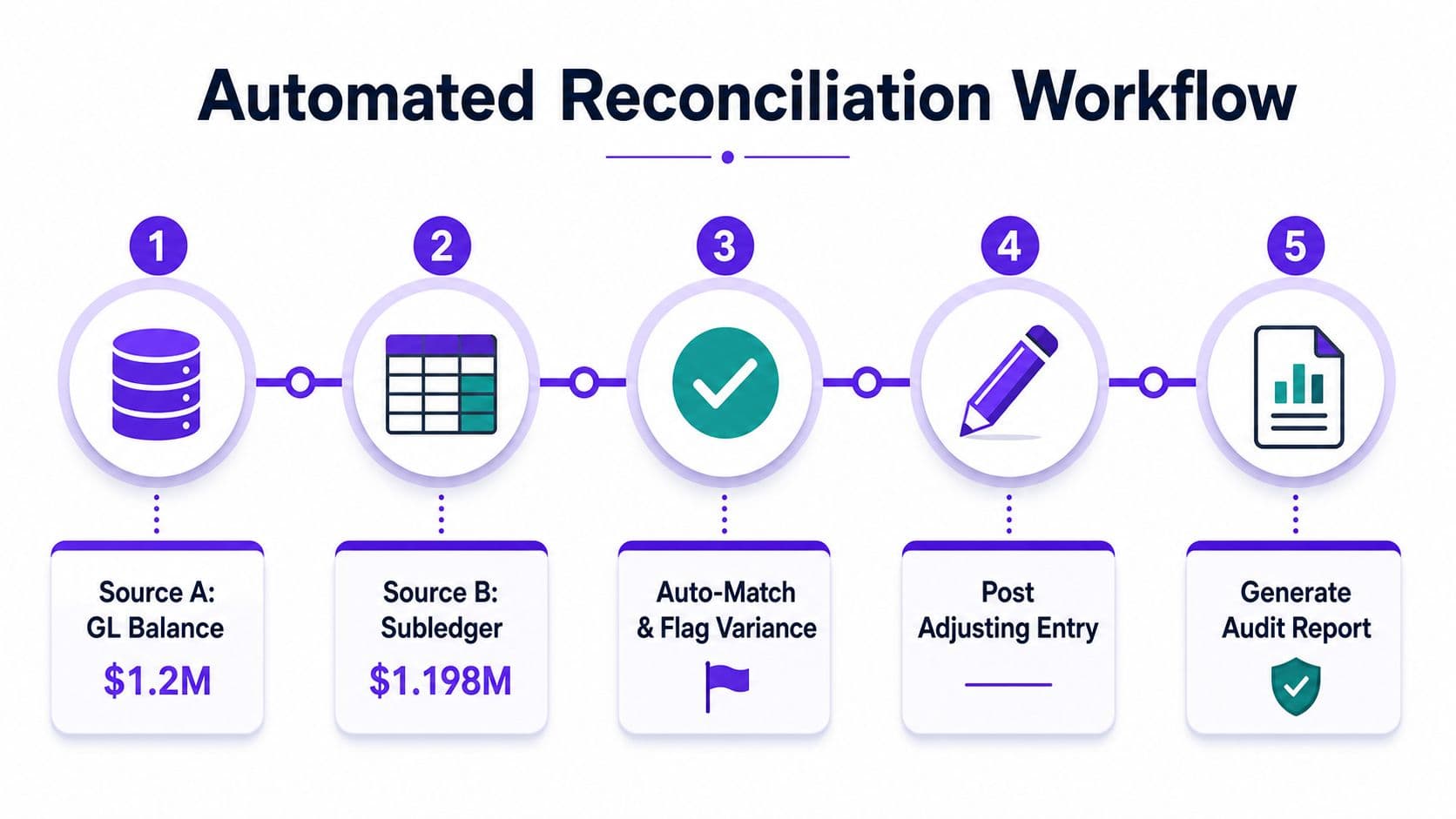
Reconciliation first, because it creates control
Automate the most rule-based reconciliation first. Define the two source balances, apply a threshold rule, and write a dated evidence record with the balances, variance, disposition, and reviewer sign-off. That single pattern turns reconciliation from a spreadsheet task into an auditable control.
Here's a simple example. If your GL balance is $1.2M and your subledger is $1.198M, the variance is $2,000. If your threshold is 1%, that difference is well below the limit, so the system can route it to review instead of forcing the team into unnecessary manual cleanup.
Then move to journal entries, variance analysis, and reporting
Revenue recognition matters next for SaaS businesses, especially around contract assets, deferred revenue, and MRR cutoffs. Period-end cutoffs matter too, because accruals and prepaid amortization should not depend on who happened to be in the office at 6 p.m. Approval routing is the next obvious layer, since segregation of duties should be built into the workflow rather than managed by reminders.
Reporting is the last piece, but it's the piece founders see first. Once the close data is clean, you can produce MRR, ARR, and CAC views without rebuilding the same numbers every month. That's the point, the reporting layer should consume the close, not recreate it.
Useful standard: if a task repeats every month and has the same inputs, the same threshold, and the same approver, it belongs in automation before it belongs in a human inbox.
If you want a practical implementation reference, the reconciliation automation tools guide shows how to structure these workflows without turning the finance team into system administrators. For a team like yours, that matters more than flashy features.
I'd also use the following checkpoint list to decide where to begin:
- Bank and merchant reconciliations: automate early, because they're repetitive and exception-driven.
- Revenue recognition: automate once your source data is clean, because bad upstream mapping will create garbage output.
- Approvals: automate after rules are stable, because sign-off routing without process discipline just moves the bottleneck.
- Reporting: automate after the underlying numbers are trustworthy, because dashboards built on sloppy data only look faster.
The Case for Moving Work Out of the Close
The biggest mistake I see is teams trying to automate work that shouldn't happen during close at all. That is how companies end up with an expensive, complicated process that still feels broken.
Use a continuous-close model
Run bank, merchant, and intercompany reconciliations daily or weekly. That removes low-risk variance from the month-end crunch and gives your team time to handle exceptions while the context is still fresh. Then reserve the final close for revenue recognition, accruals, and board-ready reporting.
The soft-close model makes sense. You don't need every task to land on the last day of the month. In fact, forcing everything into the same window is usually a sign that the team hasn't designed the calendar well.
Stop doing monthly work just because it's always been monthly
A lot of reconciliations don't need to be completed during close except high-risk items like bank accounts and, in some cases, revenue. That's a sharper approach than the common “automate everything” pitch, and it's the one I'd recommend for most growing companies.
Move recurring, low-risk work out of close. Save the close window for judgment, review, and sign-off.
This is also where founder discipline matters. If a task exists only because the current close calendar creates it, question the calendar before you buy software. A clean process often beats a bigger tool.
For teams comparing options, addressing the layers of chaos makes the same underlying point, simplify the sequence before you try to scale it. That's the difference between a faster close and a more expensive version of the same mess.
A 90-Day Implementation Roadmap
A good rollout is boring in the best way. It starts with connectivity, proves the data model, and only then adds automation logic.
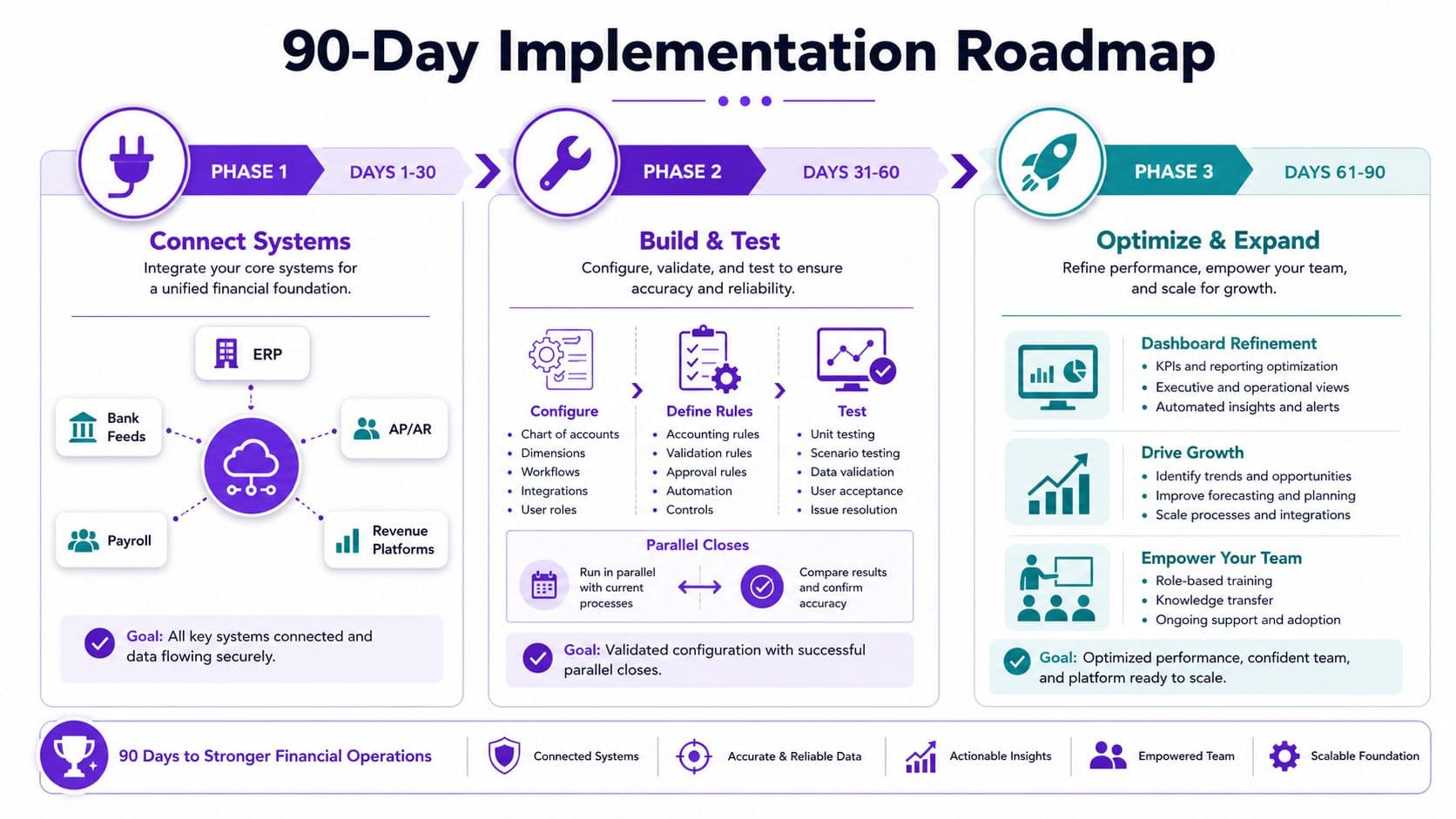
Days 1 to 30, connect and baseline
Connect the ERP or GL, bank feeds, AP and AR subledgers, payroll, fixed assets, and revenue systems. Then pull the last 12 months of close data and study accrual patterns, variance types, and reconciliation time before you automate anything else (implementation guide).
Your owner here should be the controller, with support from whoever manages the accounting stack. The exit criterion is simple, the data feeds are stable and the baseline is documented. Do not start trying to redesign every workflow in this phase.
Days 31 to 60, automate the repeatable work
Take the most rule-based reconciliation first and stand up the evidence-trail pattern. Run it in parallel with the manual process until the exceptions are understood and the sign-off trail is reliable.
The owner here should still be the controller, but the focus shifts from connection to control. Do not start revenue recognition automation yet if your source systems are not clean, because that is how teams create confidence in bad numbers.
Days 61 to 90, expand and standardize
Automate revenue recognition and approval routing, then move the team to a continuous-close cadence. That's the point where the process stops feeling like a project and starts behaving like an operating system.
Use this internal resource to keep the team organized, month-end close checklist template. It helps because good implementation is mostly about sequencing and accountability, not chasing every possible feature.
A simple rule applies across all 90 days, if a workflow doesn't have clean inputs, don't automate it yet. Fix the input first.
Build, Buy, or Outsource the Close Function
Don't default to software. First decide who should own the work.
If you're a $1M ARR to $2M company, I recommend outsourcing first. At that stage, the biggest constraint is usually not the lack of a platform, it's the lack of process maturity and finance bandwidth. A fractional controller or bookkeeping partner can produce a faster result than a drawn-out tool rollout.
For $2M to $10M, I prefer a hybrid. Let the partner own reconciliation and close mechanics while your in-house team owns reporting and business partnering. That keeps control close to the business without forcing you to build everything yourself.
For $10M to $20M, buy a dedicated platform and keep an internal controller. At that stage, the complexity justifies the software layer, especially if you're dealing with multi-entity activity, more approvals, and sharper audit expectations.
| Option | Best fit | Control | Time to value |
|---|---|---|---|
| Build | Teams with strong internal finance ops | High | Slower |
| Buy | Larger, more complex finance teams | High, but with implementation overhead | Medium |
| Outsource | Smaller growth companies that need speed | Lower day-to-day control, higher execution leverage | Fast |
If you're still evaluating the service side of the equation, find your IT partner for 2026 can help you think through systems support alongside finance operations. I'd rather see a company choose the right operating model than force a software-first decision that the team can't sustain.
Red Flags and Your Next Step to a 5-Day Close
You know the close is under-automated when the same symptoms show up every month. If reconciliations finish after the 10th, your process is too slow. If recurring accruals still require manual journal entries, your rules are too weak.
If investor updates are built from bank balances, your reporting layer is not trustworthy enough. If audit prep runs past 60 days, you're storing evidence in too many places. If SOC-relevant controls live in someone's email, you don't have a control system, you have a memory problem.
Warning sign: if the controller cannot explain where every recurring number comes from without opening five files, the process needs redesign, not more effort.
Here's the fix pattern I'd use:
- Late reconciliations: move routine accounts to daily or weekly cadence.
- Manual recurring entries: automate the rule or move the task into pre-close.
- Investor reporting chaos: separate operational reporting from close sign-off.
- Long audit prep: centralize evidence trails and approval logs.
- Email-based controls: move approvals into a system that captures timestamps and reviewers.
The next move is straightforward. Book a close diagnostic, map the current sequence, and identify the first three automations that shorten the close without adding complexity. If the process can be compressed into a 5-day close, you should know that inside one quarter, not after another year of spreadsheets.
Jumpstart Partners helps growing companies tighten the close, clean up reporting, and remove the manual work that keeps finance teams stuck in month-end triage. If you want a sharper path to a faster close, visit Jumpstart Partners and book a 30-minute diagnostic to map your current process and identify the first three automations that will move the needle.