Financial Operations
Best Reconciliation Automation Tools: Streamline Finance
Discover 10 top reconciliation automation tools for SaaS, agencies & e-commerce in 2026. Compare features, integrations, ROI to streamline finance.
ByJumpstart Partners, CPA, QuickBooks ProAdvisor
··20 min readYou're losing time, accuracy, and control every month you keep reconciling by hand. Reconciliation automation tools fix that by matching transactions faster, tightening audit trails, and giving you a cleaner close. The market is expanding fast because finance teams need this infrastructure at scale, with one forecast putting reconciliation software at USD 2.53 billion in 2024 and USD 7.54 billion by 2033 at a 13.1% CAGR from 2025 to 2033, while another places it at USD 2.30 billion in 2025 and USD 8.10 billion by 2034 at 15.0% CAGR (Grand View Research). For founders and finance leaders, that growth says one thing clearly, this is no longer a niche back-office upgrade, it's core finance infrastructure.
The right choice depends on your size and your stack. If you're running SaaS, agency, or services finance on QuickBooks, Xero, Stripe, or Shopify, you need a tool that shortens close without creating a heavier admin burden. AI reconciliation tools are already reported to reach 85% to 95% match rates, cut reconciliation time by 70%, and reduce error rates to under 0.5% in the source set available for this guide (AI bank reconciliation statistics). That's the business case you should care about, less manual work, fewer surprises after close, and more reliable numbers for investors and operators.
If you've been asking whether software alone fixes control risk, the answer is no. Good implementation matters just as much as matching speed, which is why the tools below are ranked for real-world fit, not vendor hype. For workflow context, see the broader case for benefits of Shopify workflow automation, because the same principle applies here, automation works best when the process is designed well.
Table of Contents
- 1. BlackLine – Account Reconciliations
- 2. Trintech – Adra (Mid-Market) and Frontier (High-Volume/Daily Recs)
- 3. FloQast – Automated Reconciliations (AutoRec) + Close Management
- 4. ReconArt – End-to-End Reconciliation and Close Automation
- 5. Duco – Data-Driven Reconciliation
- 6. AutoRek – Reconciliation, Controls, and Regulatory Assurance
- 7. Oracle Cloud EPM – Account Reconciliation (ARCS)
- 8. OneStream – Account Reconciliations
- 9. Redwood – Automated Account Reconciliation
- 10. A2X – E-commerce Channel Reconciliation for QBO/Xero
- Top 10 Reconciliation Automation Tools, Feature Comparison
- Next Steps: Automate Your Reconciliation Process
1. BlackLine – Account Reconciliations
BlackLine is the safest pick when your team needs standardized, auditable reconciliations at scale. It fits multi-entity finance teams, SOX environments, and companies that need a mature workflow layer around the close. The platform's own product page centers account reconciliation templates, automated matching, status tracking, and audit trails, which is exactly what you want if you're formalizing controls across several balance sheet accounts (BlackLine Account Reconciliations).
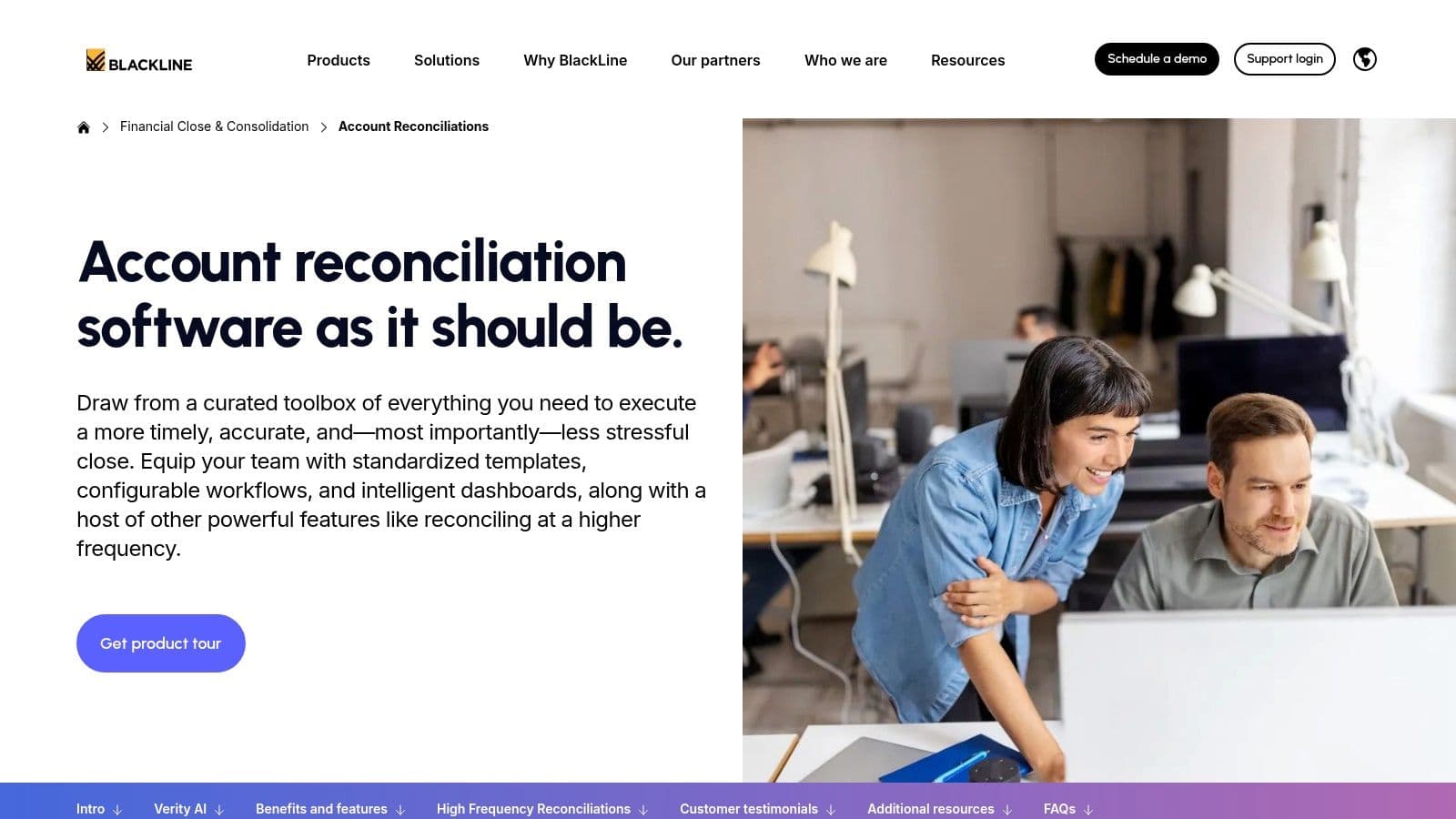
Why BlackLine wins for control-heavy teams
BlackLine's strength is governance, not light setup. If you're closing multiple entities, handling recurring sign-offs, and building a defensible audit trail, this is the right category leader to evaluate first. It's built for teams that want policy-driven templates, attachments, and approval steps instead of a loose spreadsheet process.
The tradeoff is implementation weight. The platform is premium, quote-only, and usually too heavy for a founder-led team that still needs flexibility more than centralized control. If you're under about 50 employees, you should not start here unless you already know your close process is breaking under complexity.
Practical rule: choose BlackLine when your accounting team needs control standardization more than convenience.
For setup discipline, pair any enterprise-style rollout with a clear reconciliation policy and documented bank rec process, like the framework in how to reconcile bank accounts.
Best fit and direct recommendation
Choose BlackLine if you're preparing for an audit, formalizing close controls, or running a finance org where one bad reconciliation has real downstream risk. Don't choose it if you need a fast, founder-friendly path to cleaner books. For smaller businesses, the implementation burden outweighs the benefits.
2. Trintech – Adra (Mid-Market) and Frontier (High-Volume/Daily Recs)
Trintech gives you a sharper split than most vendors. Adra is the mid-market choice for close and reconciliation workflows, while Frontier targets daily, high-volume operational and bank reconciliations. That matters because you don't want to overbuy an enterprise suite when your real problem is daily matching around payments, cards, or merchant flows (Trintech account reconciliations).
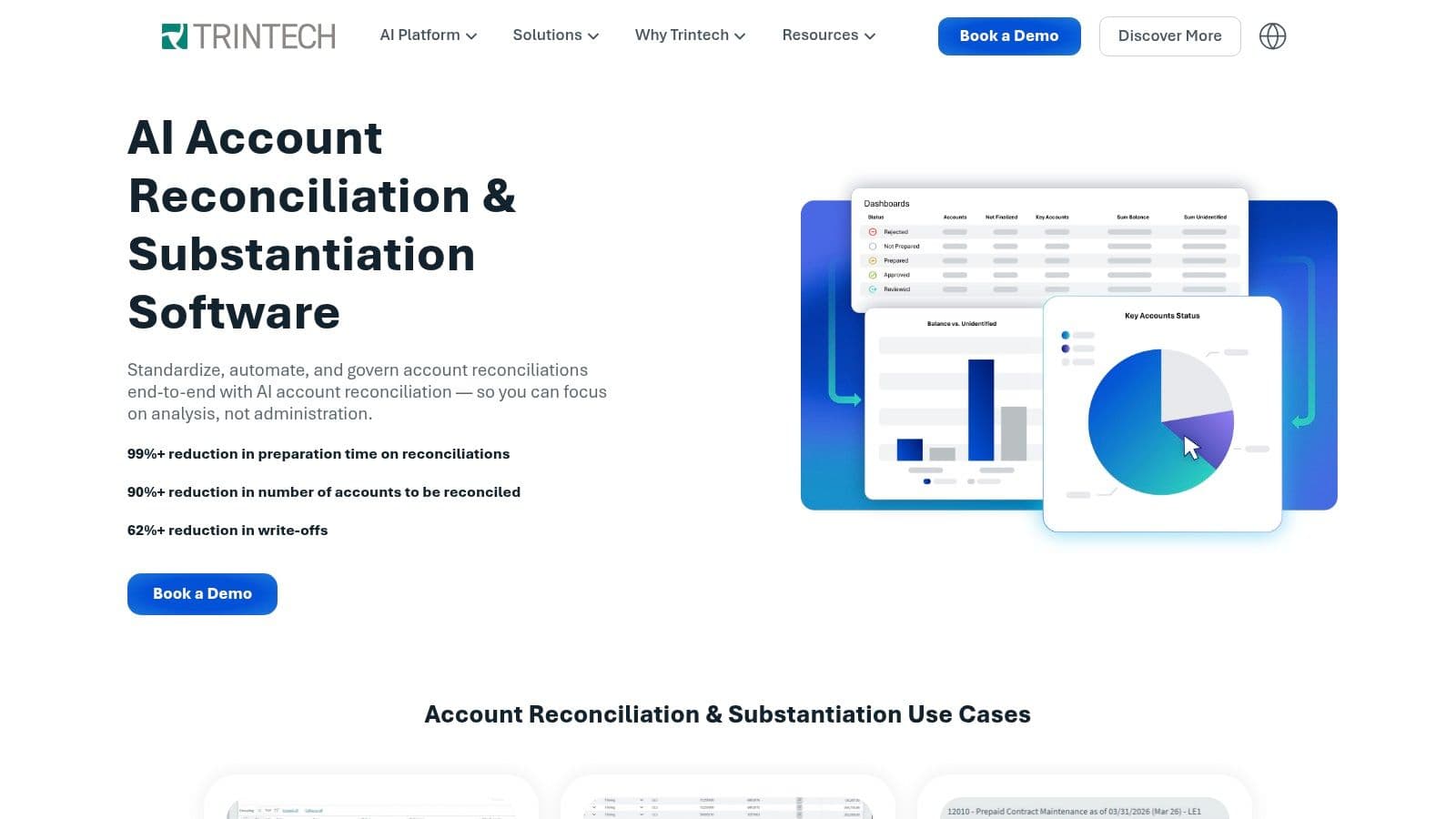
Pick the right Trintech product, or you'll waste evaluation time
Adra fits teams that want balance sheet certification, task management, and automated matching without jumping into a giant implementation. Frontier is the better call when volume is the story, especially if you're reconciling daily and can't wait for month-end to spot breaks.
That product split is also the biggest objection buyers should watch. If your team is still trying to decide whether it needs close automation or transaction-heavy reconciliation, the evaluation can drag. Be blunt with your requirements. If the issue is monthly workflow discipline, Adra is enough. If the issue is daily payment or bank matching at scale, Frontier is the better fit.
Use case guidance
- Choose Adra if your close process needs structure, certification, and managed workflows.
- Choose Frontier if daily matching and exception handling define your workload.
- Skip both if you need a lighter, faster deployment and your books are not yet complex.
Best fit and direct recommendation
Trintech is a strong shortlist vendor for finance leaders who already know their volume profile. It is not the easiest first move for a smaller founder-led company, but it is a smart fit when your reconciliation pain is clearly tied to either close rigor or daily transaction matching.
3. FloQast – Automated Reconciliations (AutoRec) + Close Management
FloQast is the best choice when your team lives in spreadsheets but needs real process discipline. It was built by accountants, and that shows in the workflow design. The platform combines close management with reconciliation status tracking and its AutoRec module, which is the part that gives you AI-assisted matching for higher-volume accounts (FloQast Automated Reconciliations).
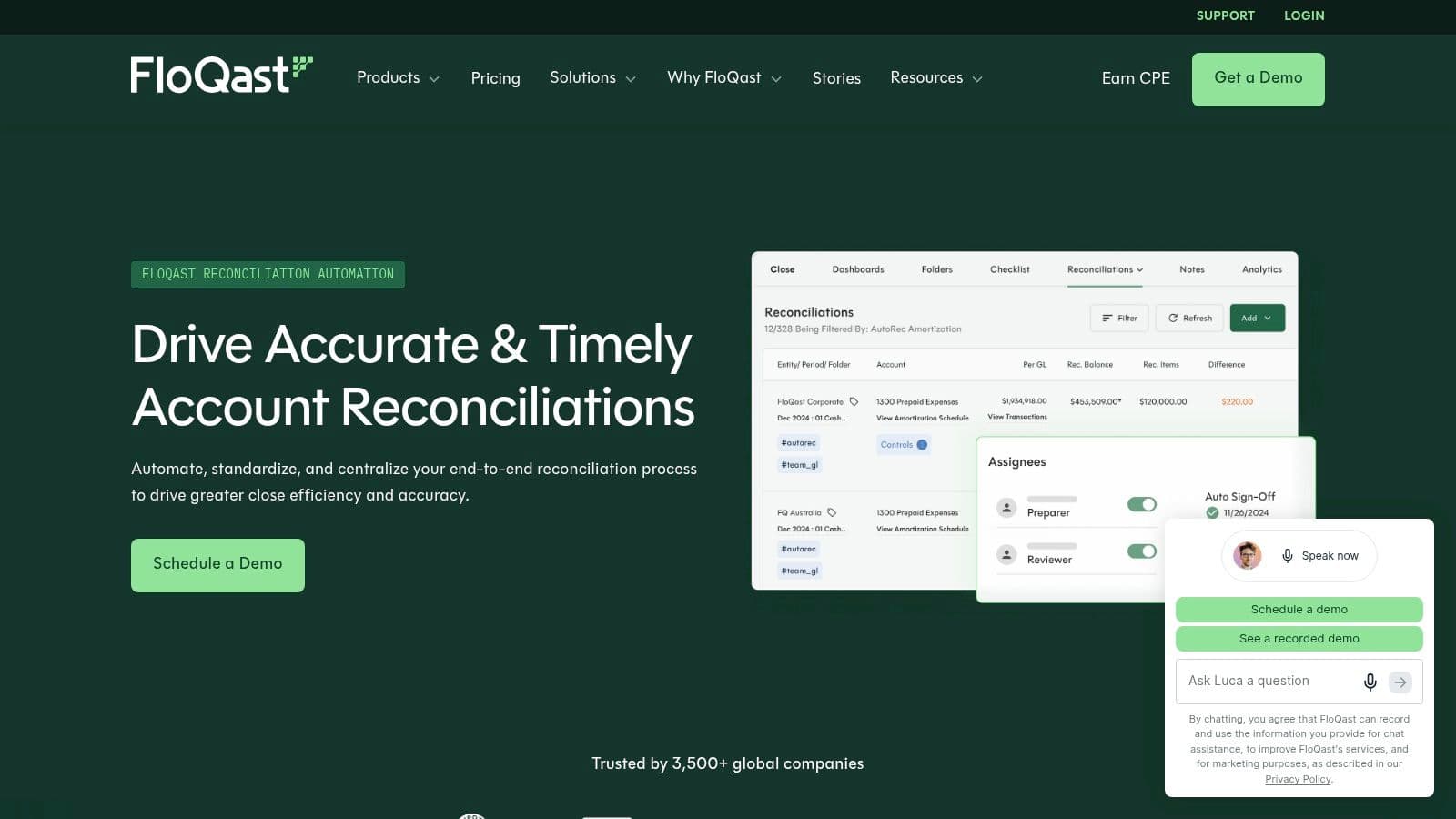
Why FloQast works for spreadsheet-native teams
FloQast is the right bridge between manual work and full automation. If your team is already comfortable with Excel or Google Sheets, adoption is easier than with heavier enterprise suites. It integrates with NetSuite, QuickBooks Online, Xero, and Sage Intacct, so it fits the stack many growing companies already use.
The limitation is simple. If you want deep transaction-level investigation inside the tool, FloQast is not the strongest answer. It gives you close visibility and control, but not the same forensic depth you get from more specialized matching platforms.
Direct advice: use FloQast when your biggest problem is close coordination, not exotic matching logic.
For operators who need tighter month-end rhythm, the workflow discipline in month-end close best practices pairs well with this platform.
Quick ROI example
If your team spends 160 hours a month on reconciliations at a blended $40 per hour, that is $6,400 per month in labor. A 75% reduction saves $4,800 per month, or $57,600 a year. That calculation comes directly from the time-savings example in the research set, and it's the cleanest way to judge whether a tool like FloQast pays for itself.
Best fit and direct recommendation
Choose FloQast if you want strong usability, better visibility, and a smoother path for a mid-market accounting team. Don't choose it if you need specialist transaction-level debugging. It is the right move for founders who want cleaner closes without forcing their team to abandon familiar workflows.
4. ReconArt – End-to-End Reconciliation and Close Automation
ReconArt is the dedicated engine on this list. It is built for teams that need more than bank recs, especially if you reconcile across bank, GL, payments, e-commerce, and intercompany flows. The platform's value is in flexible rules, multi-source ingestion, and exception handling, which fits companies that already feel the pain of messy operational data (ReconArt).
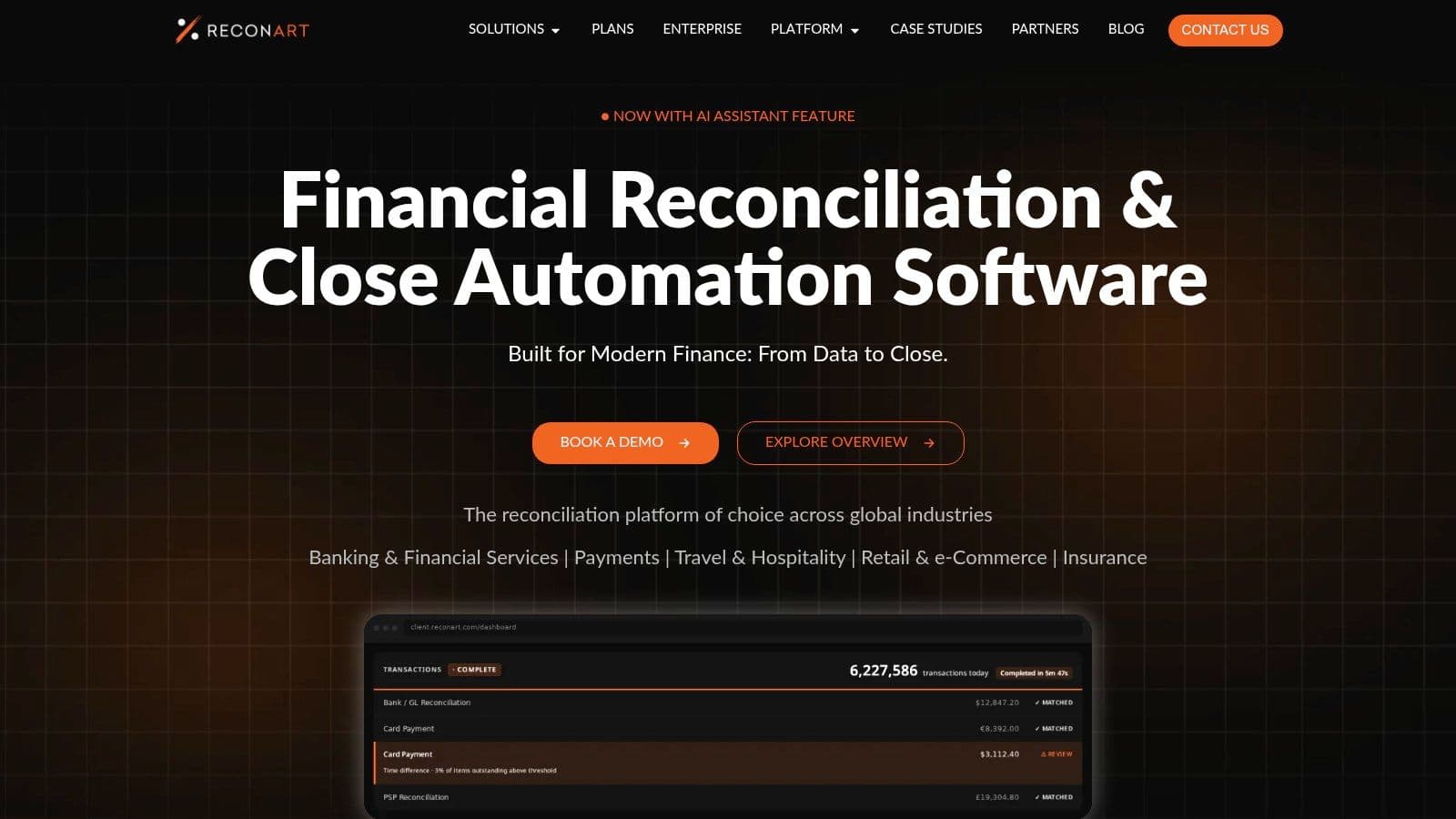
Why focused reconciliation engines matter
You should favor ReconArt when the problem is reconciliation complexity, not just month-end checklists. It is purpose-built for automated matching and exception workflows, so it makes sense for finance teams that need broad use cases under one reconciliation layer.
The tradeoff is usability ramp. Dedicated reconciliation engines usually demand more setup and training than lighter close tools. That's fine if your finance team is serious about standardization. It's a bad fit if you want a plug-and-play answer for a small accounting team.
Where ReconArt is the smart choice
- Multi-source finance flows: If your data comes from several systems and not just one ledger.
- Operational reconciliations: If payments, payouts, and intercompany need regular matching.
- Control-heavy processes: If audit trails and exception routing matter as much as speed.
For firms that outgrow ad hoc cleanup, reconciliation services can sit alongside software during the transition period.
Best fit and direct recommendation
Choose ReconArt if your finance pain is broad, repetitive, and data-heavy. It gives you a stronger reconciliation engine than a general close tool. Skip it only if you want a simpler interface and your use case is mainly bank-to-GL matching.
5. Duco – Data-Driven Reconciliation
Duco is the right answer when your reconciliation problem is really a data quality and normalization problem. It is built for messy, fast-changing datasets, and that makes it especially useful in financial-services-style environments where formats shift and data rarely arrives clean. The product page positions it as a cloud reconciliation platform for data-driven matching and normalization (Duco).
Why Duco stands out
Duco is strongest when standard rules are not enough. If you have heterogeneous feeds, changing source formats, or a lot of transformation before matching, this is the tool that earns a look. Its mix of rules-based and machine-learning-assisted matching helps teams deal with complexity without rewriting the process every time a source changes.
That same strength is also its limitation. If your problem is straightforward QuickBooks to Stripe bank reconciliation, Duco is more platform than you need. Use it when the data itself is the bottleneck.
Bottom line: buy Duco for normalization complexity, not for basic bookkeeping cleanup.
Best fit and direct recommendation
Choose Duco if your reconciliation team spends too much time reshaping data before it can even match. It is a strong fit for technically demanding finance operations. It is not the first choice for a founder who mainly wants to automate a clean SMB close.
6. AutoRek – Reconciliation, Controls, and Regulatory Assurance
AutoRek is built for regulated environments that need reconciliation and control discipline together. Its positioning around controls, governance, and explainable-AI style support makes it stronger for oversight than for light bookkeeping. The product page emphasizes reconciliation, controls, and regulatory assurance on Azure delivery (AutoRek).
Why governance-first teams like AutoRek
AutoRek works when you need more than matching. It supports exception workflows, data quality controls, attestation, and AI-assisted classification, which is exactly the mix you want when controls matter as much as throughput. That makes it attractive for high-volume teams that operate under tight regulatory pressure.
For smaller businesses, it is usually too much. If you don't need formal attestation and structured control oversight, you'll end up buying capability you don't use.
For implementation planning, the logic in automation of financial reporting applies here too, because control design should happen before rollout, not after.
Best fit and direct recommendation
Choose AutoRek if you run a regulated finance function and need stronger control posture, not just faster matching. Do not choose it for a light SMB setup. The tool is built for serious assurance work.
7. Oracle Cloud EPM – Account Reconciliation (ARCS)
Oracle ARCS is the right move if you already live inside Oracle Cloud EPM. It is not a standalone point tool first, it is part of a broader close, consolidation, and reporting stack, which is exactly why some finance leaders prefer it. Oracle's own positioning ties account reconciliation to the rest of the EPM environment, including enterprise journals and consolidation (Oracle ARCS).
Why ARCS makes sense inside Oracle
The main advantage is linkage. If your close process spans reconciliations, journals, and reporting, ARCS keeps those steps in one ecosystem. That reduces data movement and helps finance teams avoid stitching together multiple point tools.
The downside is obvious. If you're not already on Oracle Cloud EPM, this is not the easiest or cheapest way to solve reconciliation. The platform makes sense for existing Oracle customers, not for companies shopping for a standalone automation layer.
Best fit and direct recommendation
Choose Oracle ARCS if you want reconciliations unified with your broader enterprise close and consolidation stack. Skip it if you're looking for a nimble, best-of-breed reconciliation tool for a growing business.
8. OneStream – Account Reconciliations
OneStream is what you choose when reconciliation is part of a much larger finance architecture decision. It combines close, consolidation, reporting, analytics, and reconciliation in one unified CPM platform, which is powerful for complex multi-entity organizations (OneStream account reconciliations).
Why OneStream is an enterprise platform, not a point tool
The benefit is one data model and one audit trail across the finance stack. That is valuable when you want reconciliations tied directly to balance-sheet reporting and broader financial governance. Embedded AI support adds another layer of automation, but the primary benefit is platform unification.
The drawback is implementation gravity. OneStream is a major enterprise project, and it's overkill for most founder-led businesses under the $20M revenue range. If you need fast value, this is not your first call.
Best fit and direct recommendation
Choose OneStream only when your company has enterprise complexity, multiple entities, and the resources for a full platform rollout. For everyone else, it's too much platform for too little immediate payoff.
9. Redwood – Automated Account Reconciliation
Redwood is best for teams that want to automate the close, not just a single reconciliation step. Its finance automation suite orchestrates balance-sheet reconciliations, transaction matching, and related record-to-report tasks, which makes it attractive when you're trying to remove repetitive work across the close cycle (Redwood finance automation account reconciliation).
Why orchestration matters
Redwood is strong when reconciliation is tied to accruals, subledger roll-ups, and close scheduling. If your team keeps chasing the same repetitive tasks every month, orchestration is where substantial efficiency lies. That's more valuable than narrow matching alone.
It's not the best first purchase if all you need is QuickBooks or Xero reconciliation cleanup. Redwood becomes compelling when you want finance automation beyond the ledger.
Best fit and direct recommendation
Choose Redwood if your goal is broader close automation with reconciliation as one piece of the stack. Don't choose it if your only pain is simple bank matching.
10. A2X – E-commerce Channel Reconciliation for QBO/Xero
A2X is the clearest recommendation on this list for e-commerce and marketplace sellers. It is built for Amazon, Shopify, eBay, Walmart, and Etsy reconciliation, and it summarizes sales, fees, refunds, and tax into journals that reconcile cleanly to bank deposits in QuickBooks Online or Xero (A2X). For direct-to-consumer teams, that specificity is the reason to buy it.
Why A2X is the founder-friendly e-commerce answer
If you sell across marketplaces, your reconciliation problem is not a generic GL problem. It is the volume and complexity of payouts, fees, and refunds. A2X reduces that work by translating channel activity into summarized journals that fit your accounting system.
That matters for ROI. Finance teams spend less time forcing marketplace data into the ledger, and controllers review cleaner entries instead of repairing broken detail. The result is faster closes, fewer manual corrections, and less dependence on spreadsheet cleanup. It also makes outsourced bookkeeping easier to manage because the entries are cleaner before a controller ever reviews them. For sellers on multi-channel platforms, the internal guidance in e-commerce accounting multi-channel is the right companion read. It also creates a clean transaction history, which is a key part of a strong financial process as explained in this guide to audit trails for Shopify stores.
A2X is also the right fit when you want a practical bridge between channel data and your accountant. If your QuickBooks to Stripe flow is part of a broader e-commerce stack, A2X helps keep the reporting clean before the numbers hit month-end. That is the point where many founders should decide whether to keep reconciliation in-house or add outsourced bookkeeping support for routine coding and review.
Best fit and direct recommendation
Choose A2X if you run e-commerce or marketplace revenue through QuickBooks Online or Xero. Use it when your pain is channel payout reconciliation, not broad enterprise close automation. It is the strongest specialized option here for DTC and marketplace businesses.
Use it with outsourced bookkeeping when your team needs cleaner transaction prep, faster month-end close, or tighter review of multi-channel entries. Keep the process in-house only if your accounting team already has the bandwidth to handle channel-level detail without slowing the close.
The wrong tool turns reconciliation into a monthly cleanup project. The right tool turns it into a controlled accounting process.
Top 10 Reconciliation Automation Tools, Feature Comparison
| Solution | Core features | UX / Quality (★) | Pricing / Value (💰) | Target audience (👥) | Unique selling point (✨ / 🏆) |
|---|---|---|---|---|---|
| BlackLine – Account Reconciliations | Standardized reconciliations, auto-matching, dashboards, audit trails | ★★★★, robust controls; enterprise maturity | 💰 Quote-only, premium | 👥 Large multi-entity, SOX/IPO-ready | ✨ Enterprise-grade controls & best-practice content 🏆 |
| Trintech – Adra / Frontier | Adra/Frontier auto-matching, daily high-volume matching, workflows | ★★★★, proven for daily bank/merchant recs | 💰 Quote-based; product choice by volume | 👥 Mid-market to high-volume ops | ✨ Choice of products tuned to volume & complexity |
| FloQast – AutoRec + Close Mgmt | Reconciliation workflows, AI AutoRec matching, close checklists | ★★★★, accountant-friendly; fast adoption | 💰 Quote/tiered; mid-market focus | 👥 Mid-market accounting teams (NetSuite/QBO/Xero) | ✨ Usability + AI-assisted matching for quick time-to-value |
| ReconArt – Reconciliation Engine | Multi-source ingestion, multi-way matching, exception workflows | ★★★, powerful rules; steeper training | 💰 Quote-based; flexible deployment | 👥 Teams needing a focused recon engine | ✨ Highly configurable matching rules |
| Duco – Data-Driven Reconciliation | Data prep/normalization, ML-assisted matching, data lineage | ★★★★, excels with messy/heterogeneous data | 💰 Quote; geared to complex data use cases | 👥 Financial services & fast-changing data environments | ✨ Best-in-class data normalization & matching 🏆 |
| AutoRek – Controls & Assurance | Multi-way matching, data quality controls, AI classification | ★★★, strong governance; regulated focus | 💰 Quote; enterprise/regulatory fit | 👥 Regulated industries, high-volume finance | ✨ Explainable-AI for controls and attestation |
| Oracle Cloud EPM – ARCS | Balance-sheet recs, certification, FCC & journal integration | ★★★, integrated if on Oracle; heavyweight | 💰 Part of EPM subscription; enterprise | 👥 Oracle Cloud customers, complex consolidations | ✨ Tight linkage to consolidation & reporting |
| OneStream – Account Reconciliations | Reconciliations linked to reports, native matching, embedded AI | ★★★★, unified platform, strong governance | 💰 Enterprise pricing; platform value | 👥 Organizations wanting one finance data model | ✨ Single-platform audit trail across the financial stack 🏆 |
| Redwood – Record-to-Report Automation | Reconciliation workbench, orchestration, scheduling, capture | ★★★, strong orchestration beyond recon | 💰 Quote; best when automating broad R2R | 👥 Teams automating end-to-end close processes | ✨ Orchestrates multiple close workflows |
| A2X – E‑commerce Channel Reconciliation | Summarized payout journals, multichannel mapping, COGS support | ★★★★, lightweight, e‑commerce friendly | 💰 Volume-based tiers; scales with orders | 👥 DTC & marketplace sellers (QBO/Xero) | ✨ Purpose-built for marketplaces and Shopify/Amazon 🏆 |
Next Steps: Automate Your Reconciliation Process
The right reconciliation tool should reduce manual cleanup, tighten controls, and fit the way your finance team already works. Enterprise platforms like BlackLine, Oracle ARCS, and OneStream belong with control-heavy teams that need strong governance and complex matching. Mid-market tools like FloQast, Trintech Adra, and ReconArt fit companies that need better workflow discipline without buying a full enterprise stack. Specialized tools like A2X solve a narrow reconciliation problem better than a general suite.
Start with the work that hurts most, not the software demo. If your team loses hours at month-end, list the accounts that consume the most time and the sources that feed them. If your business runs on QuickBooks, Xero, Stripe, or Shopify, map those integrations first. Integration fit decides whether automation removes work or adds another layer of it. Modern reconciliation software should pull in data from multiple systems, normalize formats, match records with rules and AI, and send exceptions to the right owner without manual chasing.
Use real numbers before you buy.
If your team spends 160 hours a month on reconciliation and your blended labor rate is $40 an hour, that is $6,400 a month in labor cost. Cut that effort by 75%, and you free up $57,600 a year. If the software replaces even part of a staff accountant's workload, the return improves again because avoided hiring cost adds to the savings.
Control design still decides whether automation works.
Clean policies, clear ownership, and reliable source data come first. A messy chart of accounts creates messy matching rules, then messy exceptions. That is the point to bring in outsourced bookkeeping or controller support, especially if you need a fast cleanup, a tighter close, or SOC2-grade process discipline without building the function in-house.
If you are choosing between software and outsourced finance help, talk to Jumpstart Partners. Their team supports SaaS, agencies, and other growing businesses with outsourced bookkeeping and controller services, QuickBooks cleanup, 13-week cash flow sprints, AP automation, and platform integrations across QuickBooks, Xero, NetSuite, Stripe, and Shopify. Book a consultation if you want a cleaner close, investor-ready financials, and a direct plan for the reconciliation stack that fits your business.