Financial Operations
Bank Reconciliation Services That Scale with You
Bank reconciliation services for growing businesses. Learn the workflow, pricing, red flags, and how to choose a provider that closes fast.
ByJumpstart Partners, CPA, QuickBooks ProAdvisor
··16 min readManual reconciliation is still where finance teams lose the most time, and the opening number should make that obvious. Industry benchmarks cited in a 2026 report say automation cuts reconciliation time by 70% on average, which turns 500 transactions from 3.5 hours to about 1 hour, and month-end close can shrink from 8.2 days to 3.5 days when AI reconciliation tools are in place (2026 reconciliation automation benchmarks). That's not a clerical tweak. It's the difference between a finance team that scrambles at close and one that runs a controlled, evidence-backed process.
The mistake most founders make is treating reconciliation as cleanup work. It isn't. It's an operating control that tells you whether cash, revenue timing, fees, chargebacks, and payroll activity line up across the systems you use every day. When the file is weak, the close drags, auditors ask more questions, and investors lose confidence in the numbers.
For a growing SaaS company, agency, e-commerce brand, or professional services firm, the core issue isn't whether the books “balance” eventually. It's whether you can prove, quickly and cleanly, why they balance. That's what strong bank reconciliation services do, and that's what this guide is written for, founders and finance leaders at $500K to $20M revenue businesses who need faster closes, cleaner cash visibility, and a reconciliation process that scales.
Table of Contents
- Why Reconciliation Is the Lever Most Growing Companies Miss
- What Outsourced Bank Reconciliation Services Actually Include
- The Reconciliation Workflow From Statement Pull to Signed-Off File
- Integrations and Security Requirements That Actually Matter
- Pricing Models and What Reconciliation Costs
- What Outsourced Reconciliation Looks Like in Practice
- How to Evaluate Providers and the Red Flags That Should Kill the Deal
- Your Next Step to a Faster, Cleaner Close
Why Reconciliation Is the Lever Most Growing Companies Miss
The cost of manual reconciliation is bigger than most leaders admit. One AICPA-based benchmark cited in industry analysis says bank reconciliation averages 11.3 hours per client per month for bookkeeping firms, and a 50-client firm would spend about 565 hours monthly, or roughly 3.5 full-time employees, on transaction matching alone (industry analysis). The same source estimates $389,892 in annual direct reconciliation labor and $633,592 in total annual cost once hidden losses like delayed close, undetected fraud, churn, turnover, and opportunity cost are included. If you're running a growing business, that's not a nuisance. That's a material operating expense.
Practical rule: If reconciliation still depends on one bookkeeper and a pile of spreadsheets, you don't have a process. You have a bottleneck.
The shift is that reconciliation is no longer just a comparison exercise. It's an evidence-based control that proves your ledger, bank, and platform data agree, or explains exactly why they don't. That matters because the process has to resolve timing differences like outstanding checks, deposits in transit, and unrecorded bank fees, not just line up balances (NetSuite on bank reconciliation). A clean file doesn't just say “balanced.” It shows the unmatched item, the reason it's unmatched, and the documentation that resolves it.
That's why founders underestimate reconciliation until they need a fast raise, a sale process, or a serious audit. Then the weak file shows up immediately. Cash visibility gets fuzzy, the close slows down, and every answer takes longer because the evidence trail is thin. BBVA Spark puts it plainly, reconciliation is designed to ensure the balances and transactions in your books match the bank's details, so discrepancies, errors, and omissions can be identified and corrected (BBVA Spark).
If you're still thinking about reconciliation as back-office cleanup, you're behind. The companies that scale cleanly treat it as a core control layer, right next to revenue recognition, AP, and reporting. That's the right frame for SaaS, agencies, e-commerce, and professional services firms with real complexity in the books.
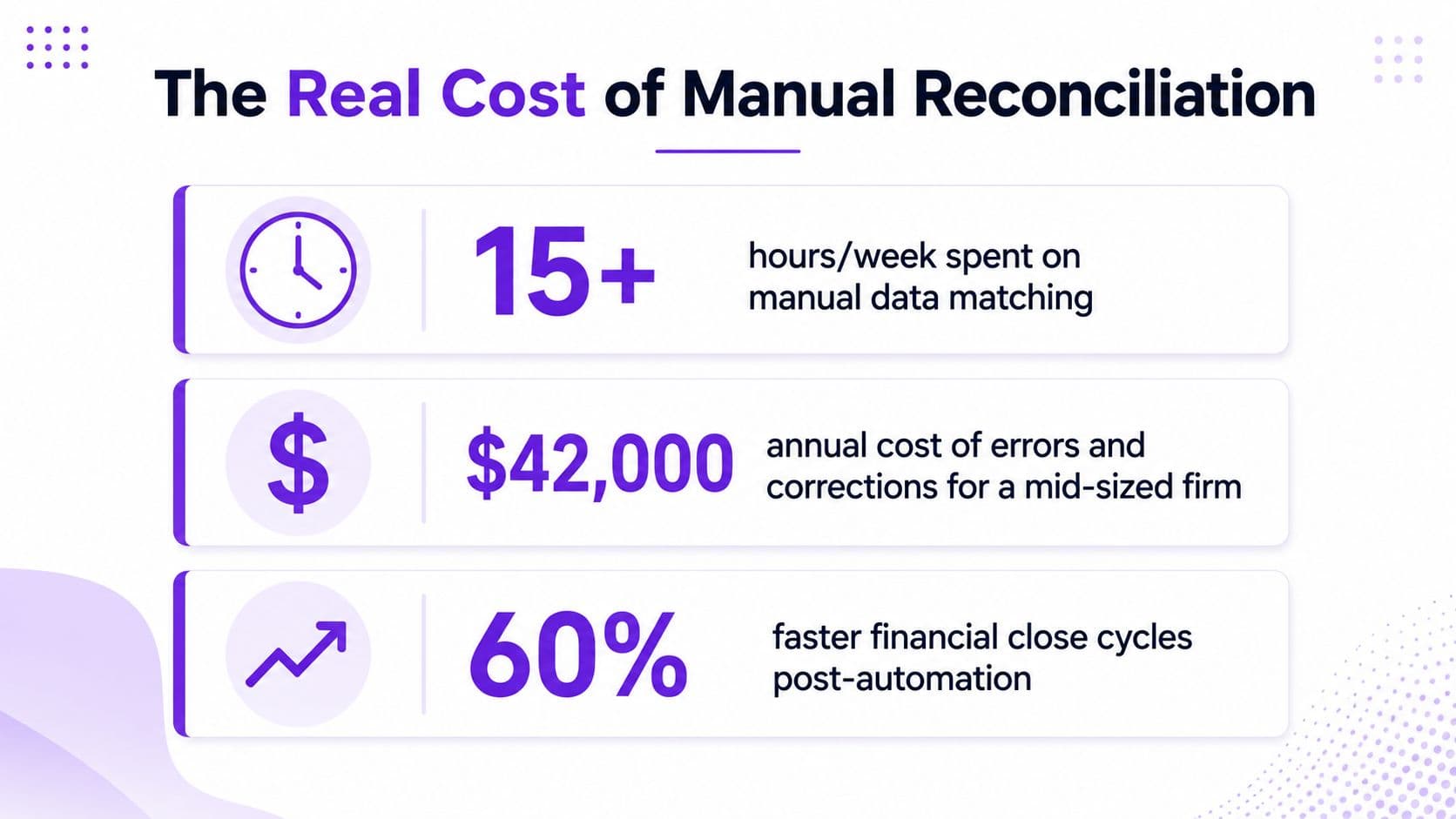
For teams trying to tighten the month-end process, the right operating benchmark is to treat reconciliation as part of close design, not a side task. A practical reference point is month-end close best practices, because reconciliation quality directly affects whether close is controlled or chaotic.
What Outsourced Bank Reconciliation Services Actually Include
Outsourced reconciliation should be boring in the best way. You hand off the matching, the exception chasing, and the evidence trail, and you get back a file that a controller, lender, or auditor can review without a scavenger hunt. Anything less is just data entry with a finance label on it.
The three deliverables that matter
The service should always include transaction matching, exception investigation, and a documented adjustment trail. Matching is the mechanical part, where bank, card, payroll, and platform transactions are tied to ledger entries. Exception investigation is where the provider explains the breaks, such as timing gaps, fee netting, partial settlements, or chargebacks. The adjustment trail is the part that matters most, because auditors and investors care about what changed, why it changed, and who approved it.
If a provider can't explain the adjustment path, you're buying pretty reports, not controls.
A helpful external reference for people who also need the financials wrapped properly is SA export financial statement help, because reconciliation is only one piece of investor-ready reporting. Once the reconciliations are clean, the statements still need to be prepared correctly and tied out to the source records.
What's in scope and what isn't
| In Scope | Out of Scope |
|---|---|
| Matching bank, credit card, payroll, and platform transactions to the ledger | Full bookkeeping cleanup for every account in the general ledger |
| Investigating exceptions and documenting the reason each item stayed unmatched | Revenue recognition policy design |
| Posting routine bank fees, settlement legs, and similar reconciling items | Intercompany policy redesign |
| Maintaining an audit-ready adjustment trail | Tax filing preparation |
| Handling platform timing issues across Stripe, Shopify, Square, and payroll systems | Strategic controller advisory beyond reconciliation |
| Managing multi-currency operational reconciliation where feeds support it | Replacing a full CFO function |
| Supporting integrations that feed the reconciliation process | Owning every downstream accounting judgment |
That boundary matters. Bank reconciliation services are not the same thing as full bookkeeping, and they're definitely not the same thing as controller work. A strong provider handles the control process, while the controller still owns policy decisions, unusual judgments, and review. If you need broader month-end support, that belongs in a different workstream, which is why reconciliation services need to be defined cleanly before anyone signs a contract.
The Reconciliation Workflow From Statement Pull to Signed-Off File
A real reconciliation process follows a disciplined path. It doesn't start with a spreadsheet and hope for the best. It starts with source data, then moves through normalization, matching, exception handling, documentation, and sign-off.
The seven steps that should be present every month
- Pull bank and platform feeds. The provider should ingest bank statements, processor feeds, payroll data, and platform outputs rather than relying on manual exports alone.
- Normalize the transaction data. Dates, descriptions, currencies, and reference fields need to be standardized so the matching engine isn't comparing apples to oranges.
- Match against ledger entries. The team ties each external item to the internal record using amount, date, reference, or defined matching logic.
- Post fees and settlement legs separately. Processor fees, bank fees, and settlement entries should be broken out, not buried.
- Flag and investigate exceptions. Anything that doesn't match cleanly gets a human review queue.
- Document resolutions with evidence. Every unmatched item should show the reason, the support, and the adjustment, if one was needed.
- Sign off the file with reviewer notes. The final file should show who prepared it, who reviewed it, and what was approved.
That workflow is consistent with the engineer-style reconciliation flow described by Formance, where banks and internal systems are normalized, matched, fees and settlement legs are posted separately, and unresolved items are pushed through exception queues (Formance on bank reconciliation).
A clean file is not one with zero exceptions. It's one where every exception has a reason, support, and owner.
The best outside explanation of the matching step itself is the bank statement matching process, because the mechanics only work when you understand how matched and unmatched items flow through the review. In practice, a month-end file should include the unmatched items list, the reason each item remained open, and the documentation that proves the item was timing-related, corrected, or intentionally left for the next period.
Here's the standard I use as a controller: if an investor or auditor can't read the file in five minutes and understand what happened, it's not done. A balanced account isn't enough. The file has to be defensible.
Later in the process, a proper close package should connect the reconciliation work to the broader month-end close process flowchart, because reconciliation is only useful when it feeds the close, not when it sits in isolation.
Integrations and Security Requirements That Actually Matter
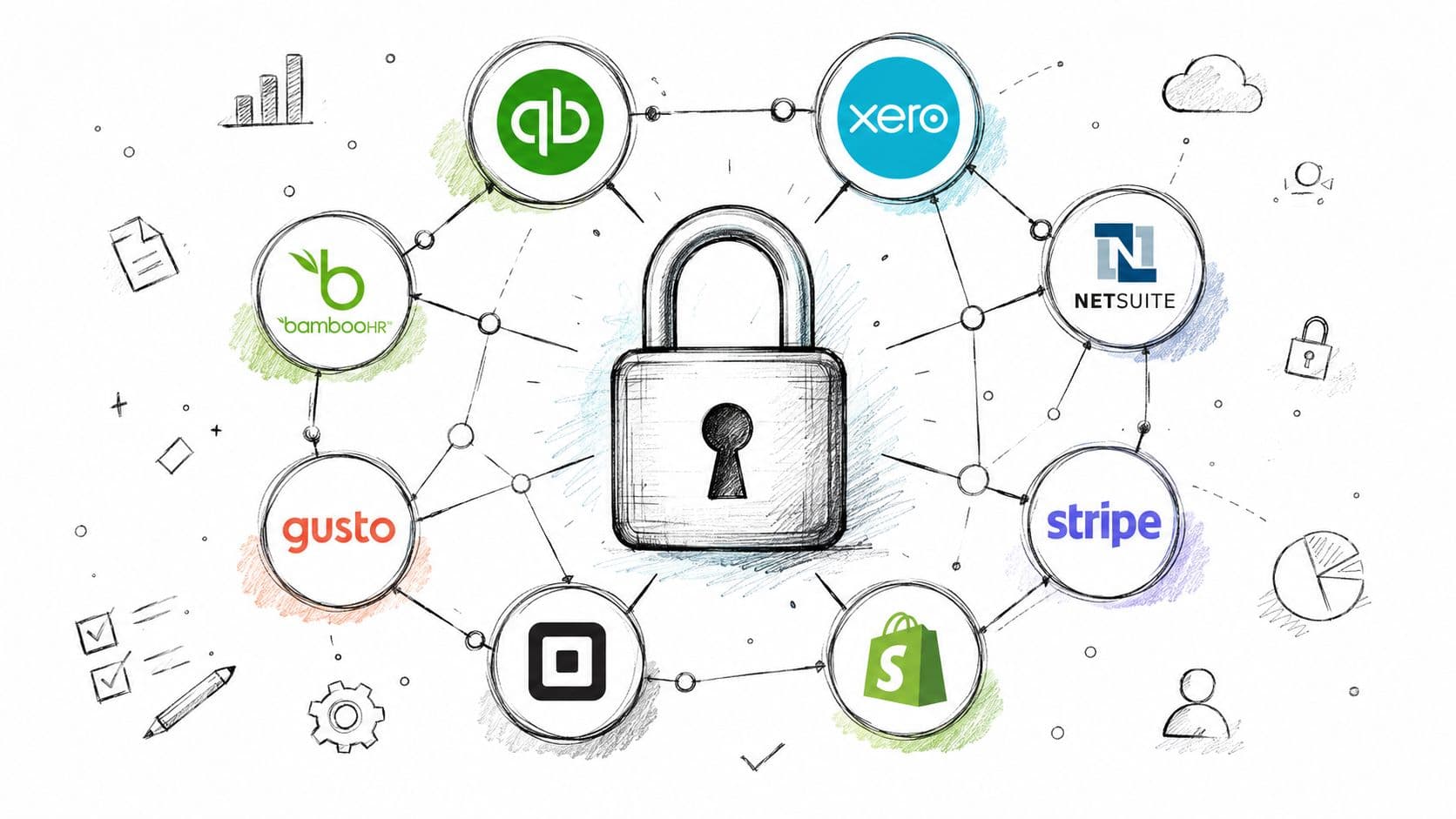
Most providers advertise “bank feed integrations” like that's enough. It isn't. If you're reconciling a modern business, the provider has to connect to the systems where your money moves, QuickBooks, Xero, NetSuite, Stripe, Shopify, Square, Gusto, BambooHR, and the major bank APIs. A provider that only sees the bank feed will miss the exceptions, because the problem often starts upstream in the platform.
Why the platform matters
Stripe payout timing creates timing gaps that don't appear as simple one-to-one bank matches. Shopify fee netting changes what lands in the bank versus what appears in the sales record. Square chargebacks show up as workflow exceptions, not just transaction differences. Payroll pre-funding through Gusto or BambooHR-linked processes needs to be tied to the bank outflow and the payroll register, not guessed at later.
That's why the content gap around modern payment stacks matters. The reconciliation job is no longer just bank statement versus ledger. It's bank, card, merchant, payroll, and platform statement versus ledger across multiple systems. The moment money moves through intermediaries, someone has to trace what happened at each layer.
Security shouldn't be a sales slide
If a provider touches real financial data, the requirements are SOC 2 Type II, bank-level encryption, role-based access, MFA, and a documented incident response plan. Nothing less belongs in a live finance workflow. The internal controls matter even more because reconciliation creates audit evidence, and that evidence has to stay protected.
Before you sign, ask these questions:
- Who has access to the data, and how is access revoked?
- Is the team operating under SOC 2 Type II controls, not just planning for them?
- How are exceptions documented and stored?
- What happens if a feed breaks during close?
- Who owns incident response, and how fast do you notify clients?
If you want a deeper baseline on the trust framework, review a proper SOC 2 Type II compliance guide before you let any provider near your close process. The bar is simple. If they can't prove control over access, documentation, and response, they're not ready for finance data.
Pricing Models and What Reconciliation Costs
Reconciliation pricing usually falls into three buckets, and each one reveals how the provider thinks about your close. Per-account monthly pricing rewards complexity and punishes scale. Per-transaction volume pricing rewards efficient matching and punishes messy flow patterns. Fixed monthly tiers reward predictable budgeting, but they punish fast growth if the scope is not defined tightly.
The three common models
| Pricing Model | What It Rewards | What It Punishes |
|---|---|---|
| Per-Account Monthly | Complex account structures | Simple high-volume scale |
| Per-Transaction Volume | Efficient matching operations | Inconsistent, noisy data flows |
| Fixed Monthly Tier | Predictable budgeting | Rapid growth without scope controls |
For a $3M ARR SaaS company with Stripe, a corporate card, and a payroll account, the monthly cost under each model depends on volume and control depth. Using the illustration in the pricing asset, 10 accounts x $150 = $1,500/mo under a per-account model, and 10,000 transactions x $0.15 = $1,500/mo under a per-transaction model (Jumpstart pricing reference). In a fixed-tier setup, the number only matters if the provider defines what is included, because the tier only works when exceptions, reviewer time, and platform support are clear upfront.
For a $6M digital agency with five client trust accounts plus operating and savings, per-account pricing usually bites harder because the account count is higher relative to transaction density. A firm like that should expect the quoted price to move with the number of accounts and the amount of exception work, not just the ledger size. The all-in annual figure matters more than the monthly sticker price, because exception investigation hours and cleanup time are where weak providers hide their real cost.
The 2026 automation benchmark shows why the cheapest quote often costs more later. If automation cuts reconciliation time by 70% on average and reduces month-end close from 8.2 days to 3.5 days, a manual shop charging less may be pushing the labor burden back to your team. I'd rather pay a fair rate for a controlled process than save a little cash and spend the savings on cleanup.
The pricing model you choose should match your operating reality. If the provider cannot explain what drives the fee, they probably cannot explain what drives the exceptions either.
What Outsourced Reconciliation Looks Like in Practice
A SaaS company at $4M ARR came in with a 14-day close and two bookkeepers trying to keep up with Stripe activity. The first quarter after outsourcing, the finance team moved to a 5-day close with a US-based controller team, and the reconciliation work surfaced $47K in misclassified Stripe fees and unrecognized revenue. That wasn't a bookkeeping polish job. It was a detection system catching errors that had been hiding inside the payout flow.
The lesson was blunt. The team didn't have a data problem alone. It had a control problem. Once the reconciliations were structured around fees, timing, and review, the close stopped depending on memory and spreadsheet heroics.
Why the agency case looked different
A digital agency at $7M revenue was reconciling five client trust accounts plus operating and savings in separate threads. Once those accounts were brought into a single workflow, the team found a $22K duplicate payout and a stale vendor credit that had been sitting open. The issue wasn't volume. It was fragmentation.
The agency's problem is common in services firms. Money flows through multiple accounts, each one with its own timing and purpose, and the unreconciled items hide in the handoffs. Centralizing the workflow gave the CFO a clearer view of cash and reduced the drag on month-end.
Reconciliation catches operational leakage that never shows up in a clean-looking bank balance.
These examples tie back to the manual cost problem in the opening section. When a team spends hours matching transactions by hand, the work tends to stop at “close enough.” Outsourced reconciliation changes that behavior. It forces the exceptions into the open, which is where the cash visibility lives.
How to Evaluate Providers and the Red Flags That Should Kill the Deal
You should evaluate reconciliation providers the same way you evaluate any controller-grade finance partner, by control quality, not by polished sales language. The minimum standard is a US-based team, CPA oversight, SOC 2 Type II, a named account lead, a documented SLA on close timing, and an accuracy guarantee with actual teeth. If they can't point to those items in writing, keep looking.
For context on what disciplined provider selection looks like in adjacent services, a solid MSP selection guide for Indiana shows the same principle, you're not buying friendliness, you're buying accountable execution. Finance services deserve the same standard.
Provider evaluation scorecard
| Criterion | What to Look For | Red Flag |
|---|---|---|
| Team location | US-based reviewers and client-facing leads | Offshore-only delivery |
| Oversight | CPA supervision on exceptions and final review | No named reviewer |
| Security | SOC 2 Type II, encryption, MFA, access controls | “We take security seriously” with no proof |
| Service ownership | Named account lead and escalation path | Generic inbox support |
| Close timing | Documented SLA for delivery and review | Vague turnaround promises |
| Exception handling | Clear process for breaks and adjustments | No written exception workflow |
| Platform coverage | QuickBooks, Xero, NetSuite, Stripe, Shopify, Square, payroll | Bank feeds only |
| Pricing logic | Clear scope tied to accounts and volume | Price that looks unrealistically low |
The biggest red flags are easy to spot if you know what you're looking for. Offshore-only teams without reviewer accountability usually behave like data-entry shops. A quote priced below a realistic per-transaction floor usually means weak controls or hidden scope creep. No documented exception process means the file will look neat until something breaks.
The three questions that separate a real partner from a transaction processor are simple. Who reviews exceptions, how are they documented, and what happens when timing gaps or platform mismatches show up? If the answers sound vague, walk away.
Your Next Step to a Faster, Cleaner Close
The questions finance leaders ask at the end are the right ones. How long until the first clean close? What happens during onboarding? How does switching from an existing bookkeeper work? How does reconciliation feed investor-ready reporting? A serious provider answers those directly, because reconciliation is only useful if it shortens close, strengthens the audit trail, and improves cash visibility.
The right standard is simple. Your reconciliation partner should help you run a controlled close, not a heroic one. You want a team that can handle modern payment stacks, document exceptions properly, and keep the file clean enough for lenders, investors, and auditors.
If you're ready to replace spreadsheet-driven reconciliation with a tighter operating control, book a 30-minute scoping call and pressure-test your current process against a controller-led workflow.
Jumpstart Partners provides outsourced controller and bookkeeping support for growing businesses that need a faster, cleaner close, including reconciliation work tied to QuickBooks, Xero, NetSuite, Stripe, Shopify, Square, Gusto, and BambooHR. If you want a US-based team with SOC 2 Type II controls, a 5-day close, and a 99.8% accuracy guarantee, visit Jumpstart Partners and start the conversation.