Financial Operations
8-Step Checklist for Month End Closing: A 5-Day Plan
Use this 8-step checklist for month end closing to reconcile cash, accrue expenses, and lock your books in five business days. Includes worked examples.
ByJumpstart Partners, CPA, QuickBooks ProAdvisor
··18 min readYour close can stall even when your accounting team is fully staffed. Dependencies on other departments or regions are one of the most common reasons a close stalls: a missing payroll file, an unapproved customer credit, or a sales team that hasn't delivered contract changes can hold up the whole sequence. Hiring another bookkeeper fixes none of those.
For founders and finance leaders at $500K–$20M revenue businesses, a slow close delays hiring, spending, and cash decisions. Review revenue and margins before cash is reconciled, and you're deciding from incomplete numbers.
A close that takes fourteen business days calls for a dependency review before a headcount request. This checklist for month end closing puts the work in an approval sequence: each step carries a named owner, a dollar-denominated worked example, and a red flag at the handoff. Every figure is an illustrative scenario you can rerun against your own books.
Practical rule: Prepare independent schedules in parallel. Approve dependent results only after their inputs are reconciled.
Use a five-day close as your operating target, not permission to skip controls. Assign actual names beside the roles below, including a reviewer who didn't prepare the work. You don't need a full-time controller to coordinate the sequence. You do need someone with the authority to resolve exceptions and approve the final package.
Table of Contents
- 1. 1. Reconcile Every Bank and Credit Card Account to Zero Unexplained Differences
- 2. 2. Recognize Revenue Under ASC 606 With a Deferred Revenue Schedule
- 3. 3. Accrue Unrecorded Expenses and Review Accounts Payable for Cutoff
- 4. 4. Reconcile Payroll and Accrue Unpaid Wages, Taxes, and Benefits
- 5. 5. Amortize Prepaid Expenses and Book Monthly Depreciation
- 6. 6. Clear Suspense, Clearing, and Intercompany Accounts to Zero
- 7. 7. Run Flux Analysis to Explain Every Material Variance
- 8. 8. Lock the Period, Publish KPIs, and Deliver a Dated Close Package
- How Each Month-End Step Protects Your Numbers
- Run the Close Once, Then Make It Repeatable
1. 1. Reconcile Every Bank and Credit Card Account to Zero Unexplained Differences
Owner: Bookkeeper or staff accountant. Reviewer: Finance lead or founder. Timing: First close day.
Start with statements, not the bank-feed dashboard. A feed imports transactions; a reconciliation proves that the ledger agrees with independent records after documented timing differences.
For an illustrative bank reconciliation, start with a $248,310.45 statement balance, add $12,500.00 of deposits in transit, and subtract $6,840.20 of outstanding checks. The adjusted bank balance is $253,970.25. If book cash equals that amount, the unexplained difference is zero.
If the ledger instead shows $254,120.25, investigate the $150.00 difference. Don't assume it's a fee, and don't post an adjustment just to make the reconciliation agree.
Prove the balance before approving it
Use QuickBooks or Xero matching tools, then inspect the proposed matches. Transfers, duplicate imports, and processor deposits need particular attention. If you need a refresher, understand bank account reconciliation basics before approving the first account.
- Cash evidence: Attach the statement, reconciliation report, and support for outstanding items.
- Card evidence: Match purchases, payments, refunds, and statement credits using a consistent credit card reconciliation process.
- Separation of duties: Have someone other than the payment preparer review the reconciliation.
Red flag: The account agrees only after an unexplained journal entry, or the preparer keeps carrying the same unsupported outstanding item.
For a SaaS business, reconcile Stripe deposits through a processor clearing account rather than treating net deposits as gross revenue. Initial cash approval establishes what reached the bank. The later clearing-account review proves how gross customer payments became those deposits.
Handoff: Release reconciled cash and the exception log to the revenue and expense owners. Keep unresolved differences visible.
2. 2. Recognize Revenue Under ASC 606 With a Deferred Revenue Schedule
Cash collected isn't automatically revenue earned. Your revenue owner needs the contract, service dates, billing activity, credits, and evidence of delivery before approving the month's revenue.
Owner: Revenue accountant or finance lead. Input owner: Sales operations. Timing: After cash matching, with contract preparation running in parallel.
The SEC-filed revenue recognition disclosure describes ASC 606's five-step process: identify the contract, identify performance obligations, determine the transaction price, allocate that price, and recognize revenue as obligations are satisfied.
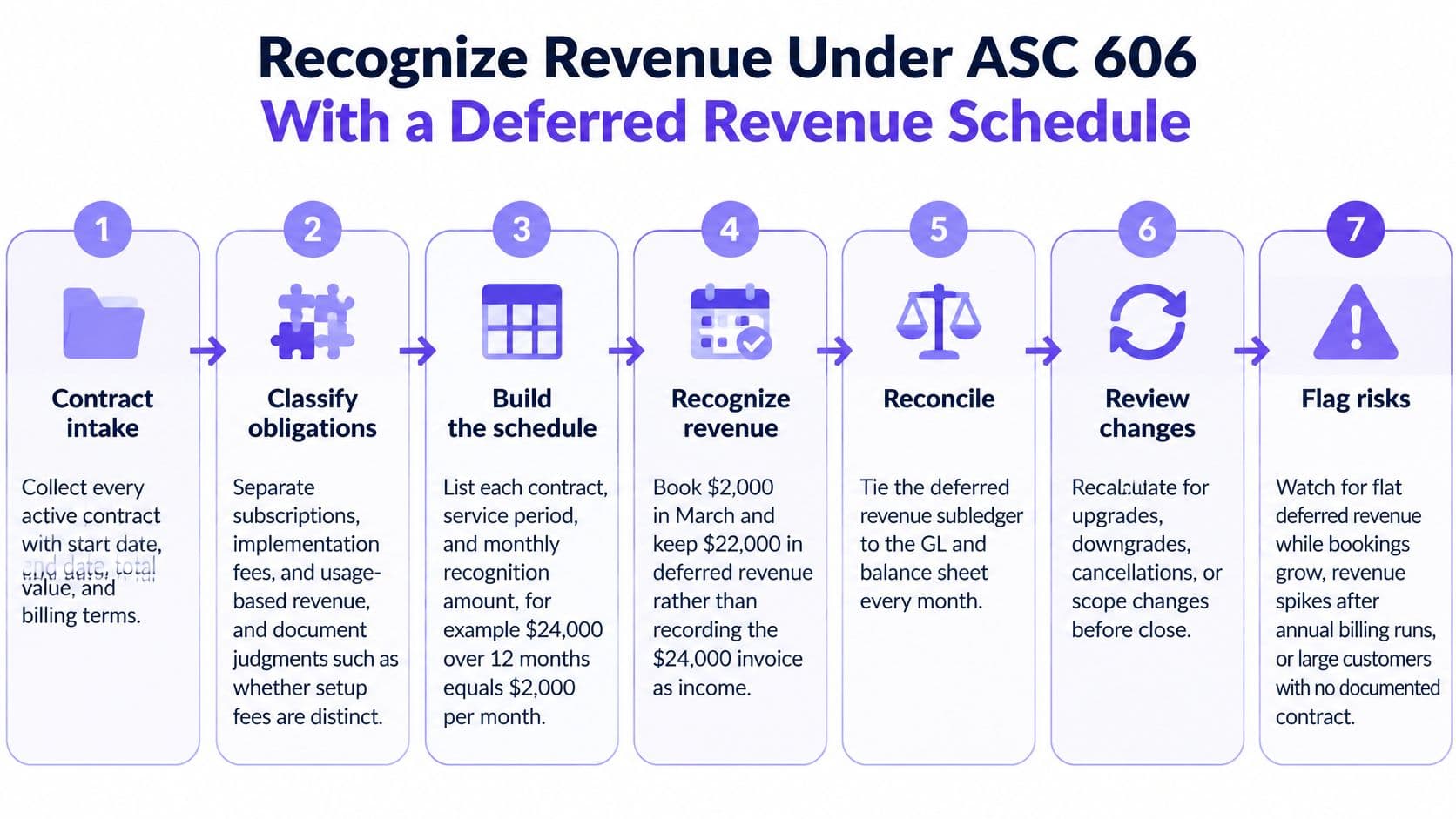
Use the workflow below to organize the supporting review.
Calculate what you delivered
Say a customer prepays $24,000 for a twelve-month subscription beginning March 1, with a single service obligation delivered evenly. Monthly revenue is $24,000 ÷ 12 = $2,000. At March-end, recognize $2,000 and retain $22,000 as deferred revenue.
Booking the entire payment as March revenue would overstate revenue and understate liabilities by $22,000. Your deferred revenue schedule should reconcile opening liability, advance billings, revenue recognized, adjustments, and closing liability to the ledger.
An agency retainer needs the same contract-level attention. Don't spread every invoice evenly if the agreement contains distinct deliverables or a different pattern of performance.
Red flag: Revenue follows invoice dates automatically, or sales changes contract terms without notifying finance.
Use this video as a companion explanation, then document your own contract conclusions.
Handoff: Send approved revenue, receivables aging, customer credits, and deferred revenue to the reviewer before anyone interprets gross margin.
3. 3. Accrue Unrecorded Expenses and Review Accounts Payable for Cutoff
Your margin is wrong if you record customer revenue but leave the related contractor invoice until next month. Expense cutoff means recording services received in the month they were incurred, even when the supplier hasn't sent the bill.
Owner: Accounts payable lead or bookkeeper. Input owners: Department heads and project managers. Timing: Begin collection before month-end; approve after cash and vendor-payment matching.
Collect the unpaid bill queue, vendor statements, open purchase commitments, contractor timesheets, and cloud-usage reports. Match the accounts payable aging to the general ledger before adding accruals, so you don't accrue a bill that's already recorded.
Keep the supporting documents beside the accrual schedule.

Accrue the work, not the missing invoice
Suppose a contractor completed 80 hours at $95 per hour before month-end. Record 80 × $95 = $7,600 as contractor expense and accrued liabilities. At $300,000 of monthly revenue, omitting that cost overstates margin by approximately 2.53 percentage points.
Reverse the accrual in the following period and record the actual invoice. If the final bill differs, document whether the difference reflects an estimate change, additional work, or an error.
- Recurring vendors: Maintain a standing schedule for hosting, legal work, contractors, and other arrears billing.
- Subsequent invoices: Inspect bills received during the close for services belonging to the closing month.
- Materiality: Write down your accrual threshold and apply it consistently.
Red flag: The team records expenses by invoice arrival date, or reverses accruals without checking whether replacement invoices arrived.
A fast close doesn't require waiting indefinitely for every invoice. It requires supported estimates, explicit approval, and a process for comparing estimates with actual bills.
4. 4. Reconcile Payroll and Accrue Unpaid Wages, Taxes, and Benefits
Owner: Payroll accountant or bookkeeper. Input owner: HR or payroll administrator. Reviewer: Finance lead. Timing: Prepare alongside accounts payable; approve before margin analysis.
Start with the payroll register from Gusto or your provider. Reconcile gross wages, employee deductions, employer taxes, benefits, and net cash payments separately. A withdrawal from your bank account won't equal payroll expense because it includes amounts that belong in liability accounts.
Confirm the pay-period end date, not just the payday. A payment date alone doesn't tell you which wages remain unpaid at month-end.
Separate earned wages from payment timing
Suppose your biweekly gross payroll is $210,000 across ten working days, and employees have earned five additional unpaid working days after the last covered payroll period. Accrued gross wages equal $210,000 × 5 ÷ 10 = $105,000.
For this illustration, assume employer taxes equal 8%, producing $8,400 of additional expense and liability. The combined accrual is $113,400, before applicable benefits. Use your actual payroll tax calculations and benefit arrangements, not the illustrative percentage.
Reconcile payroll expense, payroll liabilities, and bank payments separately. Agreement in one place doesn't prove the others are correct.
Review commissions and bonuses under the applicable compensation terms and accounting policy. Don't automatically expense every commission when paid, or assume bookings always determine recognition.
Red flag: Payroll liabilities stay unchanged despite payments, provider migration entries duplicate taxes, or payroll expense equals only the bank debit.
Handoff: Give the expense reviewer a payroll reconciliation, the unpaid-wage calculation, benefit support, and commission conclusions. For an agency, include consistent delivery-versus-administration classifications so gross margin reflects the people doing client work.
5. 5. Amortize Prepaid Expenses and Book Monthly Depreciation
A large payment isn't always a large current-month expense. Prepaid expenses represent future service, while fixed assets require a supported policy for allocating cost over their useful lives.
Owner: Staff accountant or bookkeeper. Reviewer: Finance lead. Timing: Prepare schedules in parallel; finalize after accounts payable cutoff.
Consider an illustrative $36,000 annual software contract paid July 1. If service is delivered evenly, monthly expense is $36,000 ÷ 12 = $3,000. By October-end, four months produce $12,000 of expense, leaving $24,000 as a prepaid asset.
For equipment costing $60,000, assume a five-year straight-line useful life, no residual value, and a full month in service. Monthly depreciation is $60,000 ÷ 60 = $1,000. Missing that entry overstates both net assets and monthly profit.
Maintain schedules that explain the balances
- Prepaid schedule: Record the vendor, invoice, service dates, original payment, current expense, and remaining asset.
- Fixed-asset register: Record the purchase, in-service date, useful life, residual value, depreciation method, and disposals.
- Policy consistency: Apply your written capitalization threshold rather than changing treatment to smooth earnings.
Match both schedules to the ledger. Then inspect additions against the accounts payable and card activity already reviewed.
Red flag: A canceled subscription keeps amortizing without a contract review, a disposed laptop remains in service, or the schedule contains unsupported opening balances.
Cancellation doesn't automatically eliminate an expense. Determine whether you have a refund, an enforceable future benefit, or a write-off. Deleting a schedule line without resolving the underlying asset hides the issue.
Handoff: Release reconciled prepaid and fixed-asset balances, with approved entries, to the balance-sheet reviewer.
6. 6. Clear Suspense, Clearing, and Intercompany Accounts to Zero
Owner: Senior bookkeeper or finance lead. Input owners: Billing operations and related-entity accountants. Timing: After cash, revenue, and expense entries are substantially complete.
This is an exception-clearing step, not an instruction to force every account to zero. Suspense items need classification. Processor clearing accounts can retain supported settlement timing differences. Intercompany balances must agree between entities and eliminate correctly in consolidation.
Research attributed to Ventana/ISG and summarized by Orb found that 50% of organizations automating most or all reconciliations completed quarterly close within six business days, compared with 33% using little or no reconciliation automation. That comparison concerns quarter-end, but it supports prioritizing reconciliation work over cosmetic dashboard improvements.
Follow the money through the clearing account
In an illustrative Stripe reconciliation, $16,100 of gross charges − $1,780 of fees − $0 of refunds = $14,320 deposited. Once the deposit and fees are recorded against the clearing account, that settled batch should leave no residual balance.
An unsettled batch is different. Keep it as a supported receivable from the processor rather than inventing an expense to clear it.
- Processor accounts: Use separate clearing accounts for Stripe, Shopify, and Square.
- Suspense items: Assign a transaction-level owner, explanation, and resolution date.
- Related entities: Match both sides before posting intercompany elimination entries.
Red flag: The same unexplained balance survives each close, or someone clears intercompany differences to miscellaneous expense.
Require approval for every true-up. Attach the original transaction and explain the destination account.
Handoff: Give the reviewer a complete balance-sheet reconciliation index, including debt, equity, taxes, and other liabilities relevant to your business. Every remaining exception needs an explicit disposition.
7. 7. Run Flux Analysis to Explain Every Material Variance
$18,500 last month and $27,400 this month means an $8,900 increase, or approximately 48.1%. That illustrative software-expense variance needs an explanation, not a comment saying spending increased.
Owner: Finance lead or fractional controller. Input owners: Budget holders. Timing: After adjusting entries and balance-sheet reviews.
Suppose you discover a $9,000 annual security subscription charged entirely to expense. If the current month contains one full month of evenly delivered service, current expense should be $750, with $8,250 recorded as prepaid.
Corrected software expense becomes $19,150, leaving a $650 increase, approximately 3.5%, versus the prior month. Finding the invoice wasn't enough. You needed to correct its accounting treatment and rerun the comparison.
Explain the cause and the action
Compare actual results with the prior month, budget, and forecast using a consistent budget-versus-actual review. Add prior-year comparisons when seasonality matters.
- Cause: Name the contract, customer, hiring change, or coding error.
- Amount: Quantify the driver and reconcile it to the reported variance.
- Recurrence: State whether the effect continues and whether the forecast needs updating.
Use both an absolute-dollar threshold and a percentage threshold. A large percentage change in a tiny account shouldn't consume the same attention as a material delivery-cost increase.
Review standard: An explanation is complete when another reviewer can trace it to evidence and understand the resulting decision.
Red flag: Commentary repeats the account name, explains only favorable variances, or ignores changes in gross margin.
For SaaS, compare hosting and delivery costs with the relevant revenue groups. For agencies, inspect contractor costs, delivery payroll, unbilled work, and project completion together.
Handoff: Send corrected statements and concise commentary for final approval. Don't circulate an outdated dashboard after posting review adjustments.
8. 8. Lock the Period, Publish KPIs, and Deliver a Dated Close Package
Owner: Finance lead or controller. Approver: CFO or founder. Timing: Final close day, after documented review.
A five-day target is demanding, not universal. A 2025 DataHubPro survey of 100 finance professionals across SaaS/technology, healthcare, and manufacturing found that 32% completed month-end close in four to five business days, while 27% took more than seven business days.
Measure completion when the financial statements are approved, not when the bookkeeper finishes posting entries. Lock the accounting period and require approval for subsequent changes.
Your close package should make that approval visible.

Publish metrics that reconcile
For an illustrative subscription business, $180,000 MRR × 12 = $2.16 million ARR. If recognized monthly revenue is also $180,000 and cost of revenue is $27,000, gross margin is ($180,000 − $27,000) ÷ $180,000 = 85%.
Don't substitute MRR for accounting revenue without checking the difference. Define each KPI, including treatment of credits, usage revenue, cancellations, and nonrecurring services.
Deliver the income statement, balance sheet, cash flow statement, reconciliation summary, variance commentary, and relevant operating metrics. Include cash, runway, receivables aging, and revenue movement, not just a profit figure.
Red flag: Leadership receives conflicting versions, KPI definitions change without disclosure, or someone backdates entries after publication.
Store the approved package with its reporting period, release date, and version. Track post-close adjustments separately so you can distinguish genuine improvement from premature sign-off.
Use a separate year-end close checklist for expanded annual procedures. A completed monthly close doesn't replace tax, audit, or year-end reporting work.
How Each Month-End Step Protects Your Numbers
| Item | Key Benefit | Main Drawback | Core Red Flag |
|---|---|---|---|
| Reconcile Every Bank and Credit Card Account to Zero Unexplained Differences | Verifies cash balances and catches errors or fraud early | Manual matching can be time-consuming | Unreconciled differences carry over from prior months |
| Recognize Revenue Under ASC 606 With a Deferred Revenue Schedule | Makes revenue and investor metrics more reliable | Contract changes and billing-system mismatches add complexity | Revenue spikes during annual billing runs |
| Accrue Unrecorded Expenses and Review Accounts Payable for Cutoff | Reports expenses and margins in the correct period | Estimates require judgment and ongoing vendor tracking | Large invoices are repeatedly booked after the service period |
| Reconcile Payroll and Accrue Unpaid Wages, Taxes, and Benefits | Keeps payroll costs accurate and supports headcount budgeting | Provider reports and GL categories may require mapping | Payroll expense does not match the payroll register |
| Amortize Prepaid Expenses and Book Monthly Depreciation | Matches costs to the periods they benefit | Schedules require maintenance and consistent capitalization policies | Prepaid balances grow without amortization entries |
| Clear Suspense, Clearing, and Intercompany Accounts to Zero | Improves balance-sheet reliability and prevents errors from accumulating | Multi-processor clearing and intercompany work can be time-consuming | Suspense balances grow without explanation |
| Run Flux Analysis to Explain Every Material Variance | Turns financial results into actionable management insights | Commentary takes time and may lack evidence | Variances are labeled “timing” but never resolved |
| Lock the Period, Publish KPIs, and Deliver a Dated Close Package | Gives leadership and investors a consistent, finalized set of figures | Late entries require a controlled reopening process | Entries are posted to a closed period without documented approval |
Run the Close Once, Then Make It Repeatable
Start this week with the steps carrying the most immediate risk: reconcile cash, investigate suspense balances, and protect your last approved period from unauthorized changes. Don't lock an unfinished period merely to claim completion. Resolve material issues or document their treatment before approval.
Then build the close calendar backward from your reporting date. Assign a named preparer, reviewer, input owner, and escalation contact to each task. A role label such as finance isn't enough when everyone assumes someone else requested the missing file.
Put the handoffs on a calendar
- First close day: Reconcile cash and cards, collect billing records, and identify missing operational inputs.
- Second close day: Approve revenue schedules and assemble expense and payroll accruals.
- Third close day: Finish prepaids, depreciation, clearing accounts, and balance-sheet tie-outs.
- Fourth close day: Complete variance analysis, resolve review questions, and rerun corrected reports.
- Fifth close day: Approve statements, lock the period, and release the dated package.
This is an operating design, not a promise that every business can adopt it immediately. Complex contracts, multiple entities, or unreliable opening balances require cleanup before the routine becomes dependable. Prepare independent work in parallel, but don't approve downstream reports while their source balances remain unresolved.
The objection that you're too small for these controls misses the trade-off. You don't need an enterprise close platform to attach a statement, document an accrual, or ask someone independent to review a journal. You do need enough review capacity to challenge the work rather than just mark it complete.
Track close duration alongside overdue inputs, unresolved reconciliations, review exceptions, and post-close adjustments. When the deadline slips, name the blocked handoff and fix its cause. Pressuring the bookkeeper won't resolve an absent contract amendment or an unapproved commission calculation.
If you can't staff that sequence internally, our Controller-led Finance Ops retainer includes monthly close ownership and a management reporting package. Our Finance Ops Diagnostic costs a fixed $3,500, runs five business days, and ends with a written workflow map before either side commits to a retainer. It identifies stack problems, spreadsheet dependencies, missing owners, and review gaps so you can decide what your team should retain and what to hand over.
Make the next close repeatable before trying to make it faster. Your standard is an approved, evidence-backed operating view that leadership can use without rebuilding the numbers.
Jumpstart Partners provides outsourced controller and bookkeeping support for reconciliations, revenue review, monthly close ownership, and management reporting. Visit Jumpstart Partners to book a consultation and identify which close steps your team should own and which need controller-led support.