Financial Operations
Data Security Compliance: A Founder's Guide for 2026
Master data security compliance. This guide explains GDPR vs. SOC2, core controls, and a roadmap for SaaS and agencies to achieve and maintain audit readiness.
ByJumpstart Partners, CPA, QuickBooks ProAdvisor
··20 min readA $10.22 million average U.S. data breach cost should end the debate about whether data security compliance is “an IT project” or “something to deal with later.” For a company doing $1M to $5M ARR in revenue, that number is existential, not theoretical, according to Swif.ai's 2025 cyber security compliance statistics.
If you're a founder, CEO, or finance leader, the practical question isn't whether compliance matters. It's whether you'll build it before a customer, auditor, insurer, or regulator forces the issue at the worst possible time.
Table of Contents
- Why Data Security Compliance Is a Financial Imperative
- What Data Security Compliance Actually Means for Your Business
- Choosing Your Compliance Framework GDPR vs SOC2 vs ISO 27001
- The Essential Technical and Organizational Security Controls
- Your 5 Step Roadmap to Achieving Data Security Compliance
- How Your Finance Team Becomes Your Compliance Secret Weapon
- Data Security Myths That Put Your Business at Risk
Why Data Security Compliance Is a Financial Imperative
A single security failure can cost more than an early-stage company has on hand. Founders who treat compliance as an IT project miss the core problem. This sits in the finance lane because it affects cash flow, close rates, and enterprise value.
Here's the CFO view. Data security compliance protects three assets that decide whether the business compounds or stalls: cash, deals, and valuation.
Compliance protects cash before a breach ever happens
The breach itself is only one line item. The bigger financial hit usually comes from customer churn, delayed collections, outside counsel, incident response, higher insurance costs, and management time pulled away from growth. For a company doing $5 million in annual revenue, a serious incident is not a nuisance. It can force a hiring freeze, push a fundraise forward on bad terms, or put the company into a liquidity squeeze.
That is why smart operators budget for compliance early. The cost of documented controls, evidence collection, and periodic reviews is far lower than the cost of scrambling after a failed customer review or a live incident.
Practical rule: If a customer can stop your deal over security, security belongs in sales. If an investor can cut your valuation over weak controls, security belongs in finance.
Revenue feels control gaps first
Enterprise buyers do not wait until the contract is ready to ask security questions. They ask during evaluation, procurement, and renewal. If your team cannot produce policies, access logs, vendor records, and incident response documentation quickly, the deal slows down. Sometimes it dies unacknowledged in procurement after your champion says, “We'll come back next quarter.”
That is a revenue problem, not a legal footnote.
The same issue shows up in fundraising and M&A. Investors and acquirers read control gaps as evidence of weak operating discipline. If you are preparing for a raise, review your security posture with the same seriousness you give contracts, taxes, and revenue recognition before investor due diligence.
Weak compliance reduces valuation
Buyers pay more for companies that look predictable. Compliance helps create that predictability. It shows the business can control access, manage vendors, respond to incidents, and retain evidence without chaos.
Poor compliance does the opposite. It signals future cleanup costs, a higher risk of customer loss, and more friction in scaling upmarket. That lowers strategic options. You get fewer qualified buyers, longer sales cycles, and tougher diligence.
Compliance is not overhead. It is operating infrastructure that supports sales efficiency and protects company value.
What Data Security Compliance Actually Means for Your Business
Security and compliance aren't the same thing. Founders mix them up all the time, and it leads to bad decisions.
Security is the locks, alarms, cameras, and keycards in your building. Compliance is the building inspection that proves those controls meet a recognized standard so tenants, lenders, and insurers will do business with you.
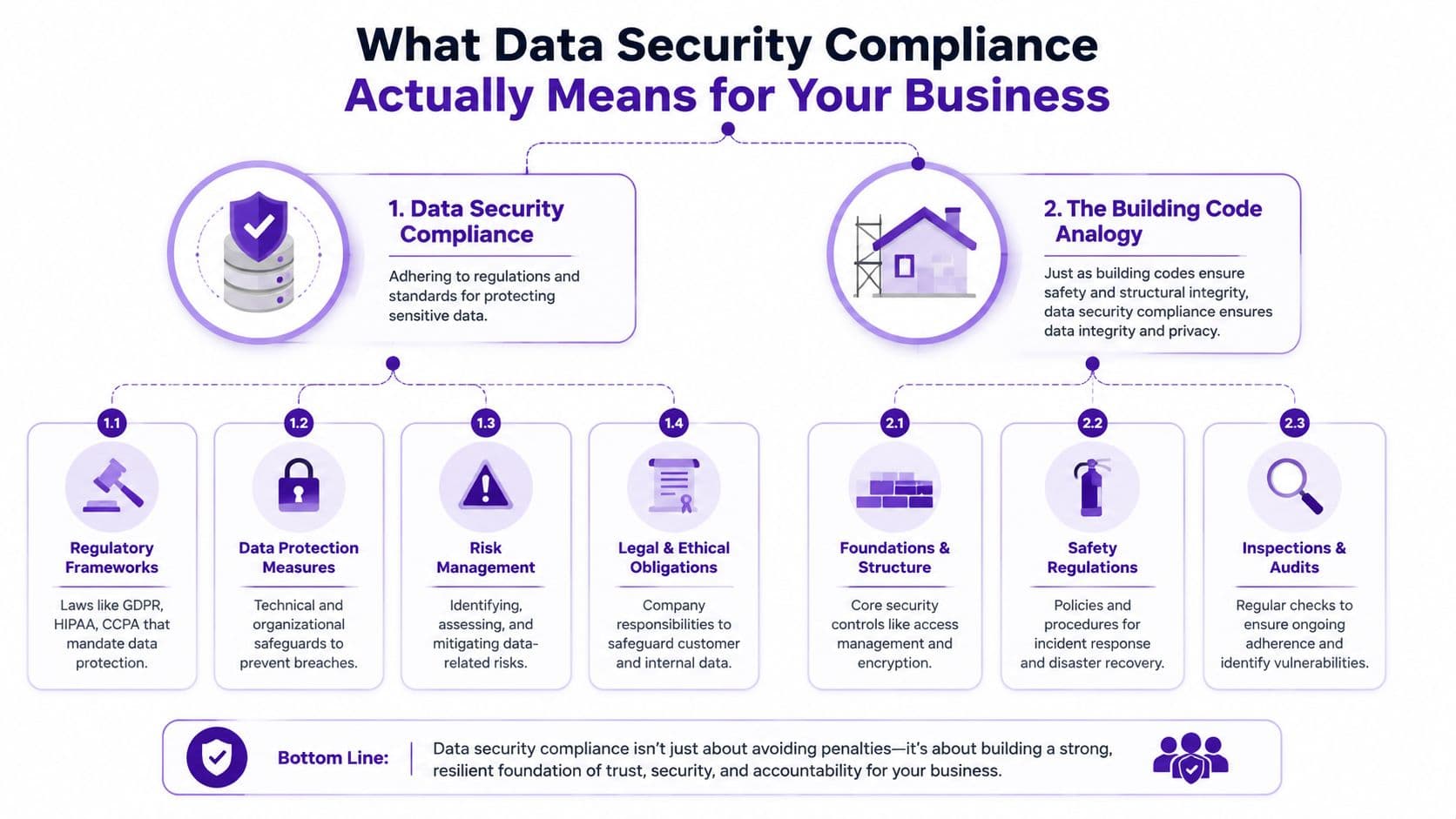
Security is the control. Compliance is the proof.
You can have encryption, password policies, and vendor approvals in place and still fail a compliance review. Why? Because nobody documented the policy, nobody retained evidence, or nobody can show the control operated consistently.
That distinction matters in every customer security questionnaire. Buyers aren't asking whether you “take security seriously.” They're asking whether you can prove who had access, when access changed, what happened to sensitive files, and how exceptions were handled.
A clean audit trail is what turns internal good intentions into external trust.
Think like a landlord, not a tenant
If you owned a commercial building, you wouldn't tell a prospective tenant, “Trust me, the wiring is probably fine.” You'd produce inspection records, permits, maintenance logs, and proof of remediation.
That's what data security compliance does for your business. It packages your controls into something a customer, auditor, or regulator can evaluate.
“At its core, GDPR compliance means an organization that falls within the scope of the GDPR meets the requirements as defined by the law for properly collecting, using, sharing, and protecting personal data, and can demonstrate that it does.”
That language comes from OneTrust's GDPR compliance guide, and the key phrase is “can demonstrate that it does.” That's the whole game.
What this means in practice
For a SaaS company, digital agency, or professional services firm, compliance usually means you need to show:
- Who can access sensitive data: Access is role-based, reviewed, and removed when people leave.
- How data is protected: Data is encrypted in transit and at rest, not just “stored in the cloud.”
- How incidents are handled: There's a real response process, not a slide deck nobody follows.
- How vendors are governed: You know which third parties touch customer or employee data and what standards they meet.
If you remember one thing, remember this: data security compliance isn't buying software. It's building a repeatable system of controls and evidence that other people can verify.
Choosing Your Compliance Framework GDPR vs SOC2 vs ISO 27001
Most founders ask the wrong question. They ask, “Which framework is best?” The better question is, “Which framework do my customers, markets, and regulators require?”
You don't choose a framework like a preference. You choose it based on how your business sells, where your users are, and what proof buyers expect.
Start with the trigger, not the acronym
As of 2025, 172 countries have enacted data protection legislation, and cumulative GDPR fines reached €7.1 billion by January 2026, according to StationX's data privacy statistics. If your business has an international footprint, waiting to “figure out compliance later” isn't a strategy. It's negligence.
For most companies in the $1M to $5M ARR range, the practical decision set looks like this:
| Framework | Primary Focus | Business Driver | Applies To |
|---|---|---|---|
| GDPR | Privacy law governing personal data | Legal obligation when handling relevant personal data tied to EU residents | Companies with exposure to EU personal data |
| SOC2 | Control effectiveness and trust for service organizations | Enterprise sales, procurement reviews, partner requirements | SaaS companies, agencies, service firms handling customer data |
| ISO 27001 | Formal information security management system | International credibility, procurement requirements, structured governance | Companies selling globally or needing a broad security management standard |
When GDPR is non-negotiable
GDPR isn't a badge. It's a legal requirement if your activities fall within its scope. If you market to EU users, serve EU customers, or process relevant personal data tied to them, you need a defensible privacy program.
Founders often underestimate this because they assume GDPR is only for European companies. It isn't. If your revenue model crosses borders, privacy law follows the data.
When SOC2 becomes the sales unlock
For U.S.-based SaaS and service businesses, SOC2 is often the standard enterprise buyers expect first. It gives procurement teams a familiar way to evaluate whether your controls are designed and operating effectively.
If you want a plain-English overview of System and Organization Controls, that resource is a useful primer before you get pulled into auditor jargon. For a more direct look at the work involved, especially for growing companies, review what goes into documented financial controls.
Where ISO 27001 fits
ISO 27001 is useful when buyers want an internationally recognized management system rather than a U.S.-centric attestation model. It's especially relevant if your customer base spans regions or your procurement counterparts operate globally.
Pick the framework that removes the next bottleneck in your business. Legal exposure, enterprise sales friction, and cross-border credibility are different bottlenecks. Treat them differently.
A simple decision filter
Use this sequence:
- Check legal exposure first: If privacy law applies, start there.
- Check sales friction next: If enterprise buyers stall on security reviews, SOC2 usually moves to the top.
- Check market positioning: If global credibility matters, ISO 27001 may belong in the plan.
Many companies need more than one framework over time. That's normal. The mistake is pretending one framework covers every commercial and regulatory need.
The Essential Technical and Organizational Security Controls
A failed security review does not just create risk. It delays revenue, extends legal costs, and forces your team into expensive cleanup work. Controls are the proof that your company can protect customer data, close enterprise deals, and defend its valuation under diligence.
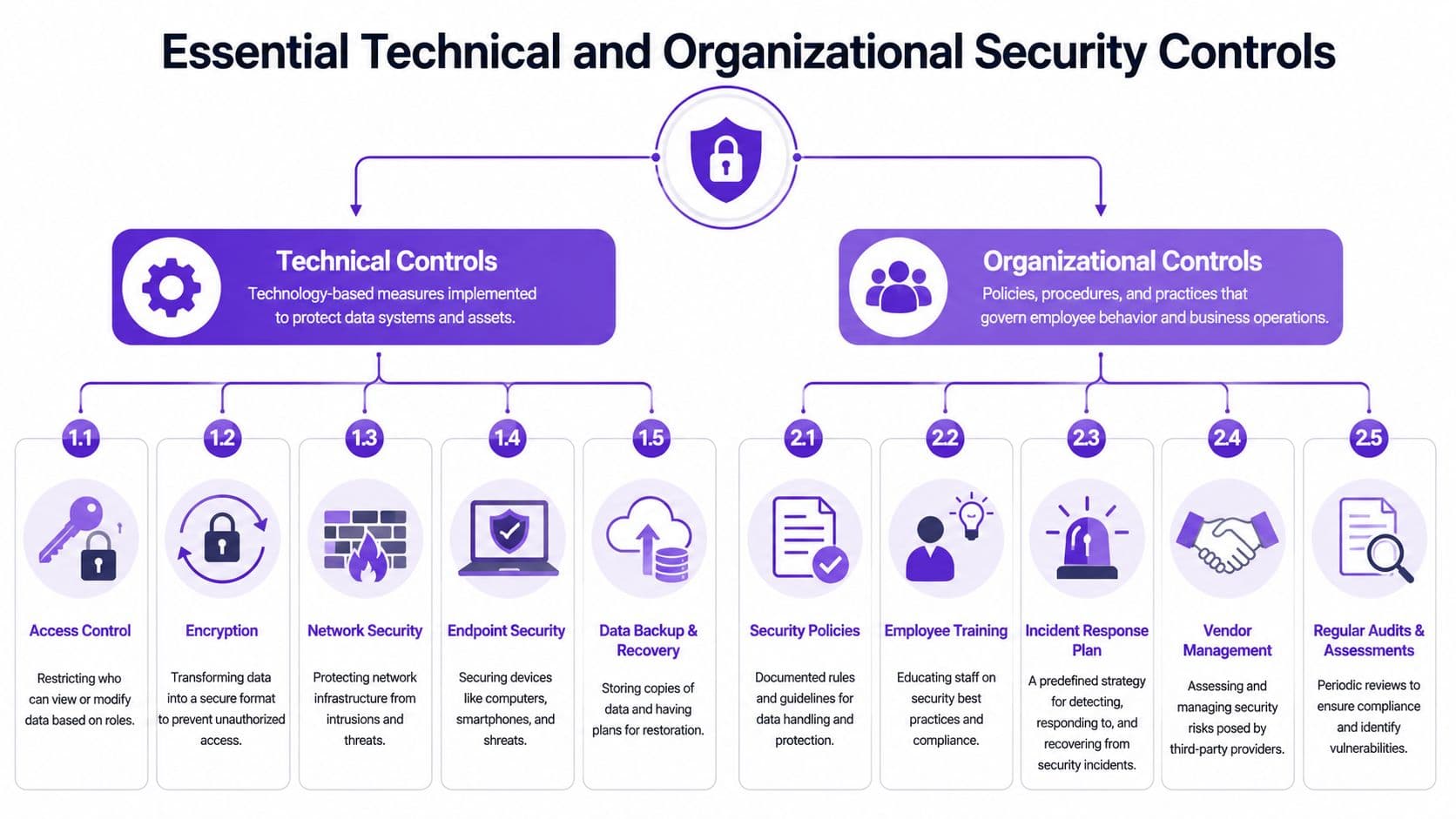
Buyers and auditors want two things. They want to see that the controls exist, and they want evidence that people follow them. Founders often fund the first part and ignore the second. That is a costly mistake.
Technical controls that reduce real business risk
Start with access. Every user should have the minimum access needed for their job, admin rights should be tightly limited, and access reviews should happen on a set schedule. If a departed employee can still log in or a finance contractor can reach production systems, your control environment is weak.
Then lock down the basics that break deals when they are missing:
- Multi-factor authentication: Required for email, finance systems, admin accounts, cloud infrastructure, and any system holding customer or employee data.
- Encryption: Protect data in transit and at rest. Pay close attention to exported files, shared folders, and attachments, because that is where sensitive data often escapes normal controls.
- Centralized logging and monitoring: Collect logs across core systems, retain them, and review alerts. Gaps in log coverage create audit findings and make incident investigations slower and more expensive.
- Endpoint management: Company laptops need device encryption, patching, remote wipe capability, and standard security settings. One unmanaged machine can create a reportable incident.
- Backup and recovery: Backups should be tested, not just configured. A backup that has never been restored is not a control.
- Document integrity controls: If your team moves contracts, approvals, or regulated records outside the core app stack, tools built for enterprise document security help verify file integrity and reduce tampering risk.
Technical controls need evidence. Keep screenshots, system exports, review logs, approval records, and policy acknowledgments organized from the start. This audit evidence checklist for growing companies will save your team time when diligence starts.
Organizational controls decide whether the technical controls hold up
Small companies usually do not fail because they bought the wrong tool. They fail because no one owns the process, reviews the exceptions, or keeps evidence current.
Use this standard:
| Control area | What good looks like |
|---|---|
| Security policies | Policies match current systems, named owners maintain them, and reviews happen on a defined schedule |
| Training | Employees know how to handle phishing, credentials, confidential files, and incident escalation |
| Incident response | The response team has assigned roles, escalation paths, and a tested process |
| Vendor management | Security and data handling are reviewed before vendors receive access or data |
| Change management | Production changes require review, approval, and records that can be shown later |
| Access reviews | Managers and system owners regularly confirm who still needs access |
| Evidence retention | The company keeps approvals, logs, tickets, and review records in one place |
This is where finance matters. Finance owns systems full of payroll data, bank details, billing records, tax documents, and board materials. Finance also controls approvals, segregation of duties, and document retention in ways auditors care about. If the CFO or controller is not involved, the company usually misses half the evidence base.
The control gap many leadership teams miss
AI use widened an existing problem. Employees now move sensitive data into prompts, summaries, spreadsheets, and external tools faster than policy can catch up. If your company allows customer data, employee records, or financial data into AI tools without rules, approvals, and monitoring, your compliance posture is outdated.
Set a hard policy. Define which AI tools are approved, what data is prohibited, who can authorize exceptions, and how usage is reviewed. Then enforce it through access controls, vendor review, and training.
The standard is simple. If a control cannot be shown, tested, and repeated every month, it will not hold up in an audit, a buyer security review, or a breach investigation.
Your 5 Step Roadmap to Achieving Data Security Compliance
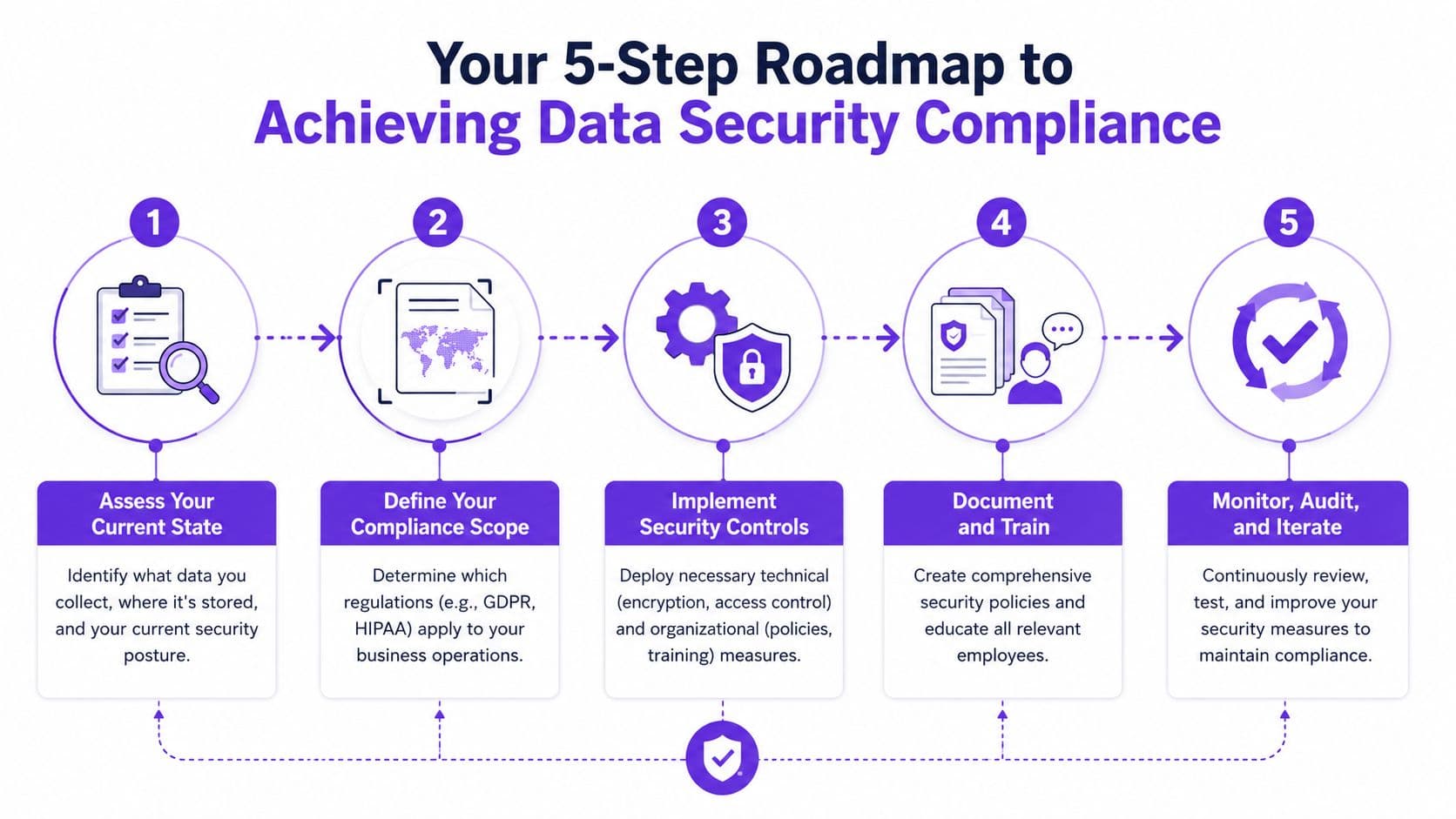
Most companies fail because they treat compliance as a paperwork sprint right before an audit. That approach breaks immediately. Data security compliance is an operating system. You build it in stages, then you run it every month.
Start with a serious inventory, not a vague assumption.
A quick walkthrough can help frame the work:
Step 1 Scope and discover
A common point of failure is the data inventory. Ninety percent are incomplete because they exclude exports, reports, shared folders, and test data, according to Privacy Management's analysis of compliance gaps leaders often miss.
Don't ask IT, “Do we have a data map?” Ask where data moves.
Check these locations first:
- HR systems and payroll exports: Offer letters, onboarding forms, payroll files, benefits data.
- Finance workflows: Billing exports, bank reports, AP attachments, revenue workbooks.
- Shared storage: Google Drive, SharePoint, Dropbox, team folders, archived reports.
- Testing and support: Sandbox data, customer screenshots, debug logs, QA environments.
- Contractor channels: Email attachments, downloaded CSVs, ad hoc file transfers.
Step 2 Define scope and framework
Once you know where data lives, define which obligations apply. That includes customer commitments, privacy law exposure, and framework requirements from procurement or partners.
Write it down in plain English. Example: “We need GDPR-aligned privacy controls for EU-related data and SOC2 evidence for enterprise sales.” That sentence is more useful than a fifty-page policy nobody reads.
Step 3 Implement control fixes
Close obvious gaps. Tighten access rights. Enforce MFA. Standardize approvals for system changes. Document vendor reviews. Lock down file-sharing paths that bypass core systems.
Prioritize fixes that reduce real risk and generate usable evidence. Fancy tooling doesn't matter if basic joiner, mover, and leaver controls are broken.
Use a working checklist, not a consultant deck. Every control should have an owner, evidence source, review cadence, and backup owner. If any one of those is missing, the control is fragile.
If you're preparing for external review, keep your documentation package aligned with what auditors typically request in a practical checklist for auditors.
Step 4 Collect evidence as you operate
Smaller teams often get lazy and then panic later. Evidence should be generated during normal operations, not fabricated before fieldwork.
Examples include signed access reviews, approved change tickets, onboarding and offboarding records, vendor approvals, policy acknowledgments, and incident logs. If a control happens but nobody keeps the proof, the control effectively doesn't exist.
Step 5 Monitor and repeat
Compliance isn't done when the audit ends. People change roles. Vendors change terms. Teams adopt new AI tools. File-sharing habits drift. Controls decay unless someone reviews them on a schedule.
A simple recurring cadence works better than a heroic annual scramble:
| Monthly | Quarterly | Ongoing |
|---|---|---|
| Review exceptions, access changes, incidents | Access reviews, vendor reviews, policy refresh checks | Evidence retention, employee training, change approvals |
A worked budget view
If your company produces $10 million in annual revenue, every month represents about $833,333 in revenue. If a stalled enterprise deal pushes closing by even one month because your security review falls apart, the cash flow impact is immediate. You don't need a breach to lose money. Weak compliance creates sales friction long before it creates a headline incident.
How Your Finance Team Becomes Your Compliance Secret Weapon
Compliance reviews fail in back-office processes long before they fail in your firewall. Founders who hand this work to IT alone usually discover the problem late, during customer diligence, renewal reviews, or the audit itself.
Your finance team controls a large share of the records auditors trust. It owns approvals, payment workflows, system access boundaries, vendor files, close reviews, and the timing discipline that proves controls occurred.
Why auditors care about finance operations
Auditors test whether your company followed its stated process over time. That means they ask for dated approvals, access reviews, onboarding and offboarding records, change history, exception handling, and evidence that someone with authority reviewed the right items on schedule.
A weak finance function creates control failures fast.
Finance and HR sit in the middle of several high-risk workflows:
- Onboarding and offboarding: Start dates, payroll setup, role changes, and termination timing
- Approval chains: Vendor setup, software spend, reimbursements, contract exceptions
- Access governance: Billing, banking, ERP, payroll, and reporting tools
- System ownership: Clear accountability for who reviews users, settings, and changes
- Segregation of duties: Separation between requesting, approving, processing, and reconciling transactions
If one employee can create a vendor, approve the payment, release funds, and reconcile the account, you have already created a control gap. That gap affects fraud risk, audit readiness, and customer trust at the same time. Founders should treat segregation of duties in finance operations as a compliance requirement, not just an accounting preference.
Finance owns the evidence trail
Security teams manage technical controls. Finance proves the business is operating with discipline.
That distinction matters because enterprise buyers and auditors do not accept policy documents alone. They want records that show the policy was followed by real people, on real dates, with clear approvals and retained support.
| Finance activity | Compliance evidence it supports |
|---|---|
| New hire setup and termination coordination | User lifecycle records |
| Monthly close reviews | Review cadence and supervisory control evidence |
| Vendor onboarding | Third-party review and approval documentation |
| Approval matrices | Authority limits and least-privilege boundaries |
| Finance system change logs | Change management support |
| Reconciliations and exception reviews | Evidence that anomalies were identified and resolved |
This is a common founder mistake. They spend on security tools, then ignore the operating discipline that makes those tools auditable. Missing approvals, delayed offboarding, undocumented exceptions, and shared admin access can stall a deal even when your technical stack is solid.
Good compliance evidence is simple. It is dated, approved, retained, and easy to retrieve.
What the finance lead should do this quarter
Set clear ownership and make the paper trail routine.
- Assign an owner for every finance, HR, and customer-data system. One system, one accountable reviewer.
- Document approval authority in writing. Define who can request access, approve it, change it, and review it.
- Connect HR events to IT actions. No hire, transfer, or termination should happen without a tracked access change.
- Store support in one place. Keep approvals, screenshots, tickets, and review sign-offs in a central repository.
- Review exceptions every month. Temporary access, manual workarounds, and policy deviations should expire or be renewed with written approval.
Done well, finance turns compliance from a late-stage scramble into an operating system. That protects revenue, shortens security reviews, and raises enterprise value because buyers, auditors, and investors can see that your controls are real, repeatable, and managed.
Data Security Myths That Put Your Business at Risk
The costliest compliance failures usually start with a bad belief, then turn into delayed deals, higher audit costs, and preventable exposure.
Founders often treat security myths like harmless shortcuts. They are not. They distort budget decisions, weaken control discipline, and create gaps that show up at the worst time: during customer diligence, renewal reviews, fundraising, or an incident.
Red flags to fix immediately
- “We're too small to be a target.” Smaller companies get hit because they are easier to breach and slower to recover. If one outage freezes billing, customer support, or payroll, the financial damage is immediate.
- “Our cloud provider handles security.” Your provider secures its infrastructure. You still own access approvals, data retention, exports, vendor permissions, and how employees use the system.
- “Our AI tools are secure enough.” AI creates a new control problem. Teams paste sensitive data into prompts, use unsanctioned tools, and assume the vendor will contain the risk. That is weak governance, not security.
The finance risk is straightforward. Bad assumptions lead to underfunded controls, sloppy evidence, and long remediation cycles. That slows sales because enterprise buyers do not care whether the gap sits with IT, legal, or finance. They care whether your company can prove control over sensitive data.
Treat compliance as an operating discipline tied to revenue quality. Set policy, assign owners, review exceptions, and make evidence retrieval routine. That is how you protect margin, keep deals moving, and avoid expensive cleanup later.
If you want your finance operations structured for audit readiness instead of constant cleanup, talk to Jumpstart Partners. They help growing SaaS companies, agencies, and service businesses build clean financial processes, strong control discipline, and the documentation backbone you need before customers, investors, or auditors start asking hard questions.