Financial Operations
The Ultimate Guide: What Is Audit Trail for Founders
Discover what is audit trail, why it matters for financial controls, SOC2 compliance, and investor readiness. Get our comprehensive guide for founders.
ByJumpstart Partners, CPA, QuickBooks ProAdvisor
··13 min readYou don't lose investor trust when your numbers are slightly messy. You lose it when you can't prove how those numbers were produced.
That happens constantly in growing SaaS companies, agencies, and services firms. A founder walks into diligence with a decent P&L, a balance sheet that looks mostly right, and a lot of confidence. Then the investor, lender, or auditor asks a basic follow-up: who changed pricing, who approved a credit, what happened to a contract value, why revenue moved between periods. Your team starts pulling screenshots from Stripe, exports from QuickBooks, CRM notes, and Slack messages. At that point, your problem isn't reporting. Your problem is evidence.
If you're asking what is audit trail, the right answer isn't "it's a log." It's the control that makes your numbers believable. Without it, you can't defend revenue recognition, investigate fraud, explain margin swings, or move through due diligence without friction. If you want clean fundraising, faster close, and audit-proof financials, you need a defensible trail behind every critical transaction.
Table of Contents
- Your Next Investor Meeting Is Doomed Without This
- What an Audit Trail Actually Is And What It Is Not
- How Audit Trails Drive Compliance and Prevent Fraud
- Audit Trail Examples in Your Tech Stack
- Red Flags That Your Audit Trail Is Deficient
- Building a Defensible Audit Trail The Right Way
- How Jumpstart Builds Your Audit-Ready Financial Engine
Your Next Investor Meeting Is Doomed Without This
You're in diligence. The investor asks for a clean report showing every material discount, refund, or contract change over the last six months, tied to user activity and supporting evidence. Your team says the data exists, but it's split across Stripe, your CRM, and an internal admin tool. No one can produce one trustworthy answer.
That meeting goes sideways fast.
Investors don't just want financial statements. They want to know your controls are strong enough to support scale. If your revenue can be changed without a clear record of who made the change, when they made it, and why they made it, your numbers stop looking like a system and start looking like a guess.
This is a control problem, not a software problem
Founders often treat audit trails like a technical feature buried in settings. That's a mistake. An audit trail is part of your financial infrastructure. It determines whether your team can defend revenue, investigate exceptions, and answer diligence questions without days of cleanup.
A weak trail also creates hidden profitability problems. If discounts, credits, write-offs, or manual journal entries aren't traceable, you can't separate real operating performance from preventable noise. That makes margin analysis weaker and board reporting less credible.
Practical rule: If you can't show the full history of a financial change on demand, your process isn't investor-ready.
Before any formal audit or fundraising process starts, review your systems against an auditor preparation checklist. If your documentation depends on heroic manual work, you're already behind.
What an Audit Trail Actually Is And What It Is Not
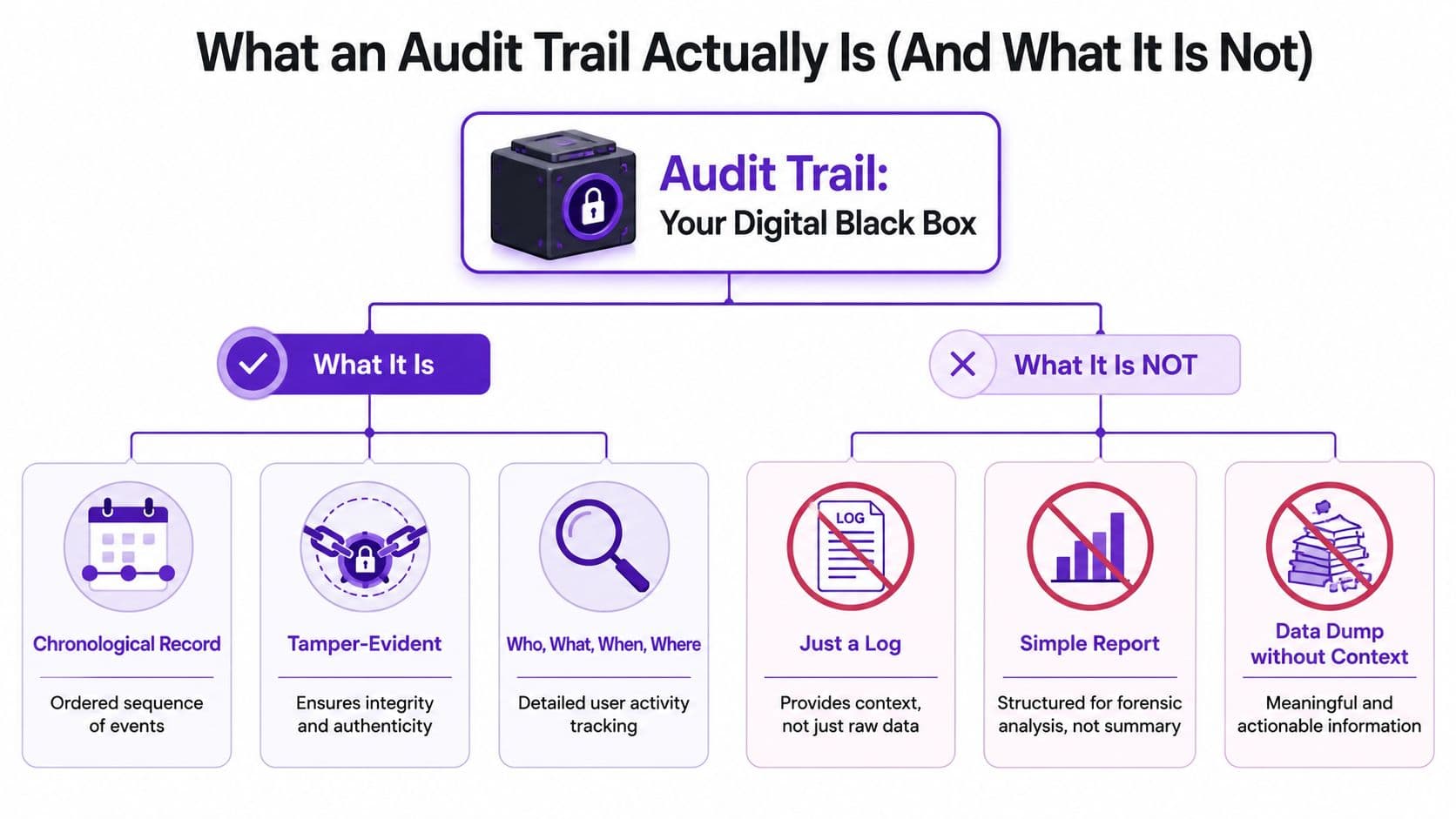
An audit trail is a chronological, timestamped record that shows who did what, when, and how across a business system. NIST's foundational guidance says audit trails should capture the time of the event, the user ID, the program or command used, and the result, helping organizations detect security violations and reconstruct events after the fact, as outlined in NIST Special Publication 800-12.
The definition founders should care about
For a founder or finance leader, that means one thing. An audit trail is the evidence chain behind your numbers.
A proper trail doesn't just say that something changed. It shows the sequence of events around that change. In stronger implementations, it also includes before and after values, supporting documents, and tamper-evident protections so the record itself can be trusted.
Here's the practical version.
| Weak record | Real audit trail |
|---|---|
| Subscription updated | User changed subscription terms with timestamp, system record, result, and reason |
| Refund issued | Refund linked to customer, amount, approval, source system, and related invoice |
| Journal entry posted | Entry tied to preparer, approver, date, source support, and change history |
Why a log is not enough
Many companies have logs. Fewer have trails.
Some sources make a useful distinction between the two. A log is the raw event record. A trail is the reconstructable sequence of events tied to a business process or session, as explained in this discussion of the difference between audit logs and audit trails.
That difference matters because raw logs don't answer business questions on their own. They don't tell your auditor why revenue changed. They don't tell an investor whether a discount was approved. They don't tell your controller whether an error came from billing, CRM sync, or manual override.
This short walkthrough helps make the distinction concrete.
You also need retention discipline. If your team can't retrieve historical records when needed, the trail fails when it matters most. That's why recordkeeping policy matters as much as system setup. This guide on how long to keep business records is a useful operating reference.
How Audit Trails Drive Compliance and Prevent Fraud
If you handle customer data, financial reporting, payroll, contracts, or subscription billing, compliance depends on evidence. Not good intentions. Not screenshots. Evidence.
Compliance runs on evidence
Auditors, investors, and security reviewers all ask versions of the same question: can you prove this process happened the way you say it happened?
An audit trail is what answers that question. It supports accountability, shows who accessed sensitive data, and gives reviewers a way to reconstruct events without relying on memory or email archaeology.
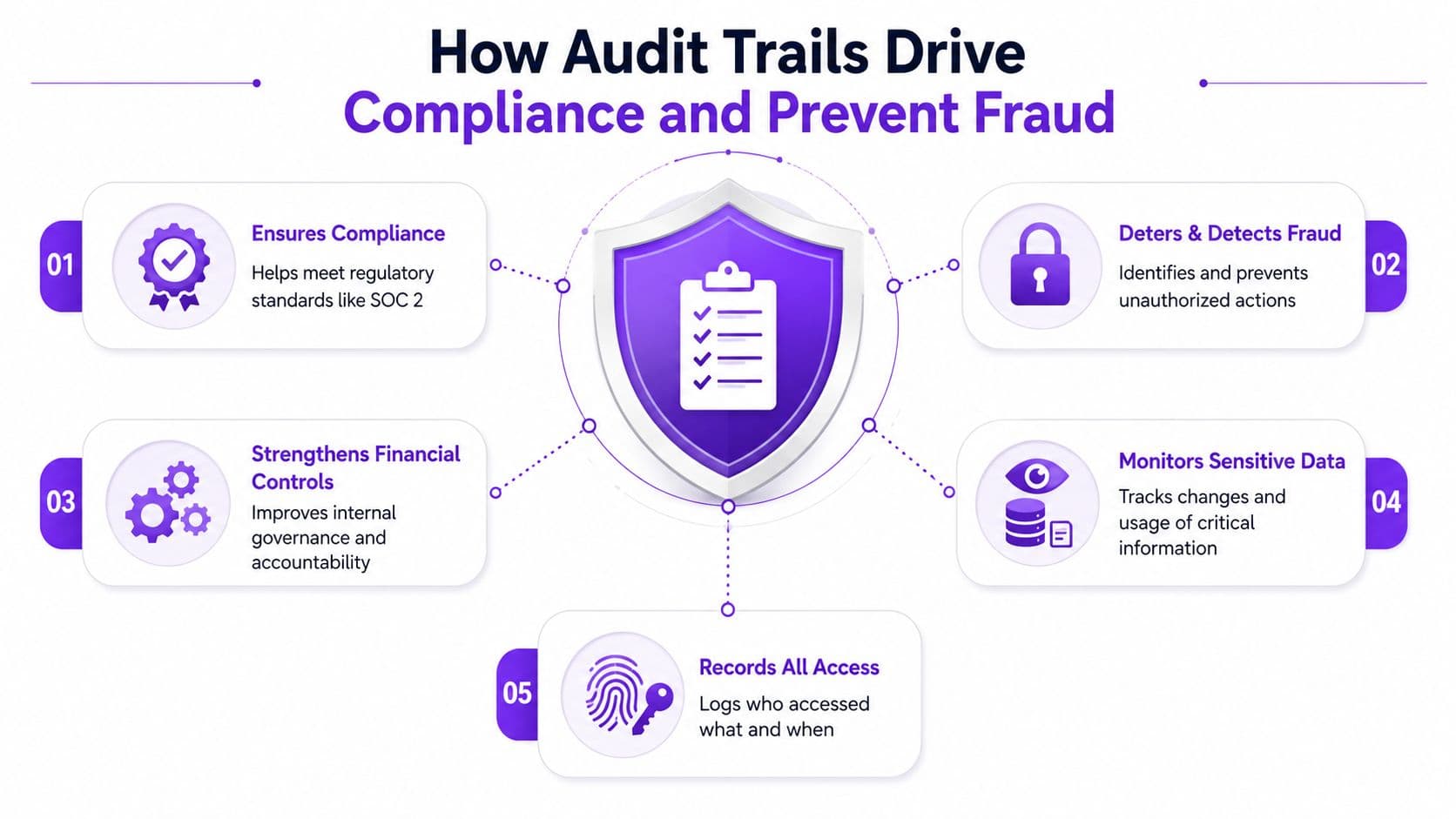
For finance teams, this matters most in high-risk workflows:
- Revenue adjustments: Credits, discounts, cancellations, and contract edits need attribution and support.
- Manual journal entries: If someone can post entries without reviewable history, your close is exposed.
- Access changes: Permission edits in billing, ERP, and payroll systems need tracking.
- Approval flows: The approver, timing, and underlying documentation need to stay attached to the transaction.
If you're tightening controls, pair your audit trail work with better segregation of duties in finance processes. A strong trail shows what happened. Segregation reduces the chance that one person can create and hide the problem.
Fraud gets expensive fast
Fraud doesn't need a dramatic scheme. It only needs weak oversight and a missing trail.
Use a simple example. An employee issues a fraudulent refund of $5,000 to an accomplice. That happens twice a month for a year. Your loss is easy to calculate:
| Item | Calculation | Total |
|---|---|---|
| Fraudulent refund amount | $5,000 | $5,000 |
| Events per month | 2 | $10,000 monthly |
| Months per year | 12 | $120,000 annual loss |
That kind of leakage undermines profit. A proper audit trail makes the first event visible and attributable. You can review it, trace it to the user, and stop the pattern before it compounds.
The broader fraud case is strong too. According to the ACFE 2024 Report to the Nations, organizations with proactive data monitoring and analysis detect fraud 60% faster and experience 50% lower median losses than those without. Audit trails are a core input into that monitoring.
When people know their actions are traceable, control stops being a policy document and starts being real.
Audit Trail Examples in Your Tech Stack
You already have audit trails in your business. The issue is that they're usually scattered, inconsistent, and ignored until something breaks.
Where the trail already exists
A typical growth-stage SaaS or services stack generates several different trails:
- Stripe or QuickBooks transaction records: Charges, refunds, invoices, payment attempts, and customer references form the revenue trail.
- Salesforce or HubSpot change history: Contract value edits, discount changes, stage movements, and ownership changes create a sales operations trail.
- NetSuite or QuickBooks journal history: Manual entries, edits, approvals, and posting history create your accounting trail.
- AWS, Google Workspace, or Microsoft admin records: Login activity, permission changes, and configuration edits create the security trail.
- Your own product database: Admin exports, role changes, and sensitive customer actions create an application trail.
Each system tells part of the story. None of them tells enough on its own.
Where founders get into trouble
The problem starts when one business event spans multiple systems.
A customer signs an annual contract in your CRM. Your team applies a discount in the billing tool. Finance books revenue in the general ledger. Support later issues a partial credit. If those events aren't connected, you can't explain what happened from source to financial statement.
That's why the trail has to map to the process, not just the app.
A simple way to look at it is:
| Business event | System involved | What you need to trace |
|---|---|---|
| New subscription | CRM, billing, GL | Contract terms, invoice, posting |
| Refund or credit | Billing, support, GL | Initiator, approval, reason, accounting effect |
| Contract change | CRM, billing, rev rec | Before value, after value, timing, approver |
| Vendor payment | AP tool, bank, GL | Request, approval, payment, posting |
If you're still grounding your accounting team in the basics, this overview of what a general ledger is helps connect system activity to the final books.
Red Flags That Your Audit Trail Is Deficient
A bad audit trail is dangerous because it looks like control without delivering control.
Five warning signs you should treat seriously
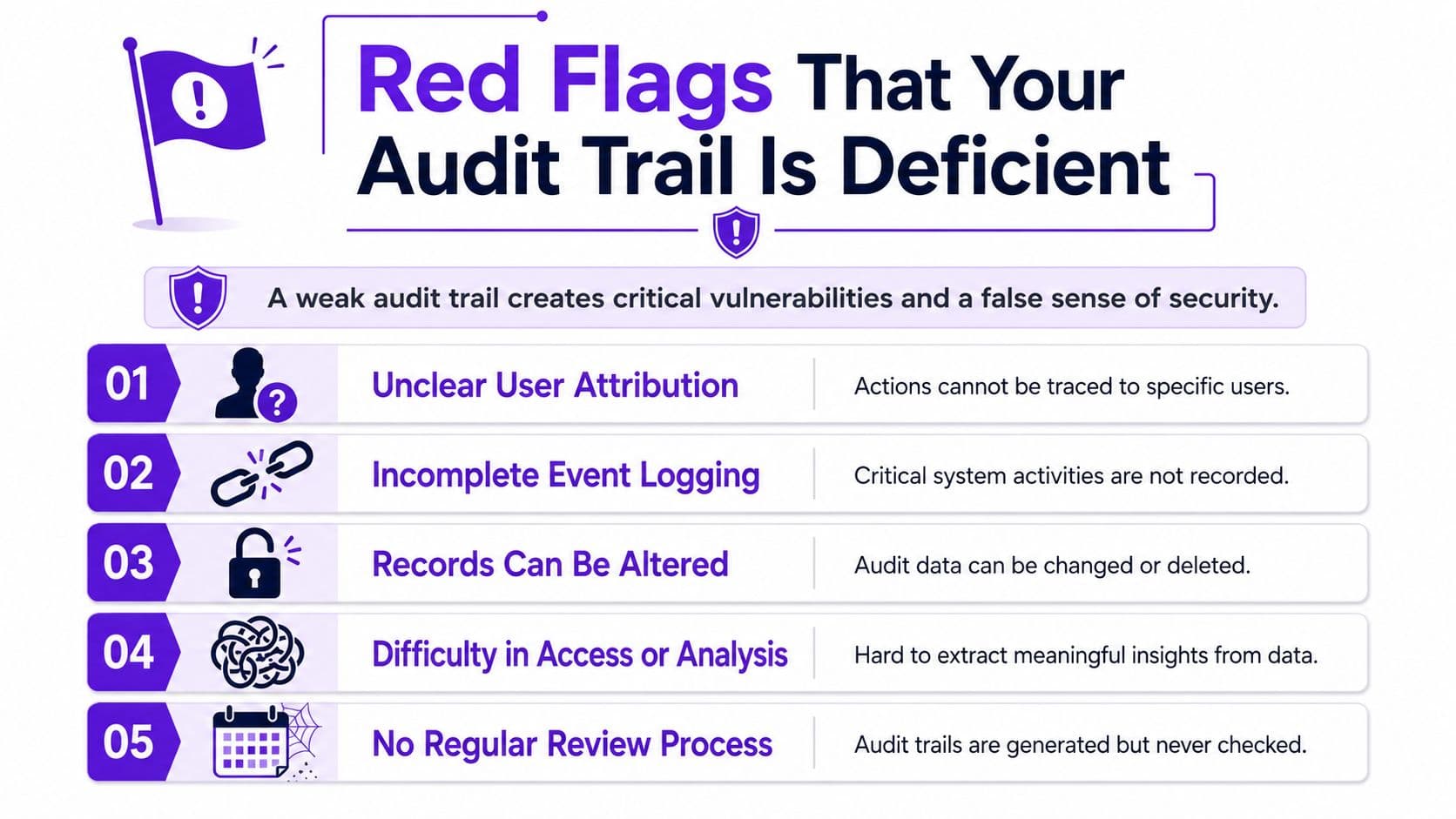
If any of these are true in your business, fix them now.
-
You only see the after state
Your system shows a contract is now at a new value, but it doesn't show the prior value. That makes financial review weaker and slows investigations. -
Multiple people use the same login
Shared credentials destroy accountability. If three people use one admin account, you don't have user attribution. -
Admins can edit or delete logs
If the record can be changed after the fact, it isn't defensible. -
Your trail lives in silos
Billing is in one app, approvals are in email, and accounting is in another system. Every investigation becomes a manual reconstruction project. -
The system captures what, not why
A discount, refund, or journal entry exists, but the business rationale and supporting file are missing.
Stronger implementations go further. They add before and after values, linked supporting documents, and tamper-evidence such as immutable safeguards or cryptographic hashes. A record that only says something changed is much weaker than one that shows exactly what changed, why, and whether the record itself was altered, as discussed in this guide to stronger audit trail design.
Warning sign: If you need Slack, inboxes, and tribal knowledge to explain a transaction, your audit trail isn't doing its job.
Building a Defensible Audit Trail The Right Way
You don't need a giant transformation project. You need standards, ownership, and the discipline to stop accepting weak systems.
What to implement now
Start with the controls that directly affect revenue, cash, and close quality.
- Require unique user logins: Shared credentials need to end immediately.
- Choose systems with real audit history: Before buying or renewing software, test whether it records user activity, field changes, and approvals in a non-editable way.
- Capture before and after values: Mature audit trail implementations must include them. When pre-modification values aren't logged, root cause analysis during an audit takes 30% to 40% longer, based on the verified technical guidance you provided.
- Attach support to the event: Contracts, invoices, approvals, and receipts should sit with the transaction or be directly linked.
- Review high-risk activity on a schedule: Refunds, credits, manual journals, permission changes, and write-offs should be reviewed monthly or quarterly.
A simple priority order
Don't try to boil the ocean. Fix the highest-value workflows first.
| Priority | Area | Why it goes first |
|---|---|---|
| 1 | Revenue and billing | Direct effect on investor reporting and ASC 606 support |
| 2 | Cash disbursements and refunds | High fraud and leakage risk |
| 3 | Manual journal entries | High impact on financial statement accuracy |
| 4 | User permissions | Prevents unauthorized financial changes |
| 5 | Supporting document linkage | Speeds review and strengthens evidence |
As one blunt operating principle: if you can't trust the trail, you can't trust the numbers.
How Jumpstart Builds Your Audit-Ready Financial Engine
Most founders don't need more dashboards. They need cleaner underlying evidence.
That means connecting the transaction in Stripe, the contract in the CRM, the payroll or vendor support, and the general ledger entry into one reviewable chain. It also means designing the close process so issues are found before financial statements go out, not after.
Organizations with fragmented audit trails catch revenue recognition errors post-close, while those with complete trails linked to source documents can improve month-end close speed by up to 5 days, based on the verified SaaS revenue recognition guidance you provided. That's not an abstract accounting win. It gives you faster board reporting, cleaner lender conversations, and fewer surprises during diligence.

For companies that also need stronger payables controls, these finance team P2P insights are useful because procurement-to-pay is another workflow where weak evidence creates downstream accounting risk.
One practical option is financial reporting automation tied to tighter controller review. That's where Jumpstart Partners fits. It works as an outsourced controller function for growing businesses, using source-system records and accounting evidence to support close, reconciliations, and investor-ready reporting.
If your team is still stitching together screenshots to answer basic financial questions, it's time to fix the control environment behind your numbers. Jumpstart Partners helps SaaS companies, agencies, and service businesses build audit-ready financial operations with stronger reconciliations, cleaner month-end close, and evidence you can defend in diligence.