Financial Operations
What Is a General Ledger? Your Company's Financial Source of Truth
Discover what is a general ledger and how it underpins accurate financials, investor-ready reports, and scalable growth for your business.
ByJumpstart Partners, CPA, QuickBooks ProAdvisor
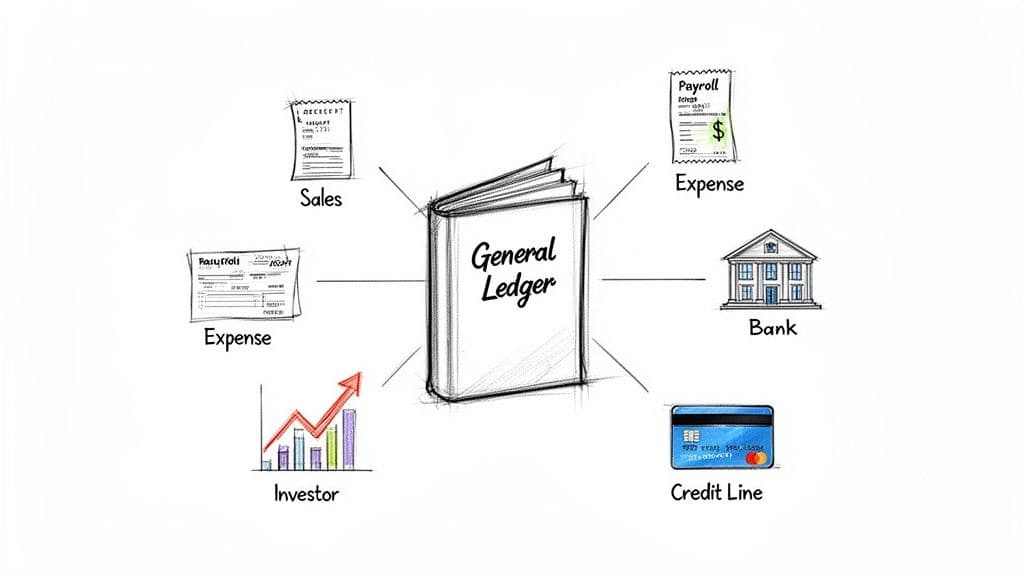
··16 min readAs a founder or CEO, you make critical decisions daily: Should you hire another engineer? Can you afford a bigger marketing budget? Is that new client actually profitable? The answers aren't just in your gut; they're in your financial data. The general ledger (GL) is the master record book where that data is organized into a single source of truth.
Think of it as the central nervous system for your company’s finances. Every dollar that flows in or out is tracked, giving you a complete, historical record of every move the business makes.
Without a reliable general ledger, you're flying blind. You’re left making decisions based on your bank balance and gut feelings instead of hard data. For a scaling business, that's not just risky—it's a recipe for disaster.
Your Business Runs on Numbers. The General Ledger Owns Them All.
A clean general ledger isn’t a "nice-to-have" for your accounting team; it’s the engine that produces accurate financial statements like your balance sheet, income statement, and statement of cash flows. This is non-negotiable when you’re trying to:
- Secure a new credit line or loan. Lenders demand pristine, up-to-date financials. No exceptions.
- Impress investors during a fundraising round. VCs will scrutinize your numbers for accuracy and consistency. A messy ledger is an immediate red flag that kills deals.
- Make strategic growth decisions. Reliable data is how you understand unit economics, calculate customer lifetime value (LTV), and manage cash burn effectively.
On the flip side, a messy ledger creates massive business risk. It leads to compliance nightmares, eye-wateringly expensive cleanups during an audit, and a fundamental lack of trust in your own numbers. This is where many scaling companies stumble. They can't answer basic questions about their own performance, which cripples their ability to act decisively.
To give you a clear picture, here’s a breakdown of the core components and why they matter to your business.
The General Ledger at a Glance
This table breaks down the core components and their function within your financial ecosystem.
| Component | What It Is | Why It Matters to You |
|---|---|---|
| Chart of Accounts | The structured index of every financial category (e.g., Cash, Sales, Rent Expense). | Tells you exactly where your money is coming from and where it's going with the right level of detail. |
| Journal Entries | The initial record of a transaction before it's posted to the ledger. | Provides a chronological log of all business activity, making it easy to trace errors back to their source. |
| Debits & Credits | The two sides of every entry in double-entry bookkeeping. | This system ensures your books are always balanced and provides a self-checking mechanism for accuracy. |
| Trial Balance | A summary report listing all account balances to verify if total debits equal total credits. | Acts as a quick health check to ensure the fundamental math of your bookkeeping is correct before generating financial statements. |
These pieces come together to form the complete financial story of your company. You can learn more about building this solid financial base in our guide on bookkeeping basics for small businesses.
Owning Your Financial Data
To truly own your numbers, you must understand how all your systems feed into this central record. For instance, the role of an ERP in finance is often to act as the core system that houses the general ledger itself, integrating data from sales, operations, and HR.
Ultimately, a well-maintained general ledger isn’t just about bookkeeping. It’s about control. It’s the difference between reacting to problems and building a proactive, data-driven strategy.
How the General Ledger Powers Double-Entry Bookkeeping
Think of the general ledger as the official record-keeper for your business, the single source of truth that tracks every dollar. It’s powered by a 500-year-old system called double-entry bookkeeping, a method so brilliantly simple and effective it’s remained the gold standard for finance.
For every single business transaction, this system demands that two entries are made: a debit in one account and an equal credit in another. This isn't just about making things complicated; it's a built-in, self-balancing mechanism. If the debits don't equal the credits, you know immediately there's an error somewhere that needs fixing.
While the idea has roots in ancient Mesopotamia, it was an Italian mathematician, Luca Pacioli, who formalized it in 1494. This system was so robust it powered the Industrial Revolution, and its core logic is still what runs every piece of modern accounting software today. You can see how these principles have held up over centuries, evolving from ancient clay tablets to today's cloud software.
A Practical Example: Debits and Credits in Action
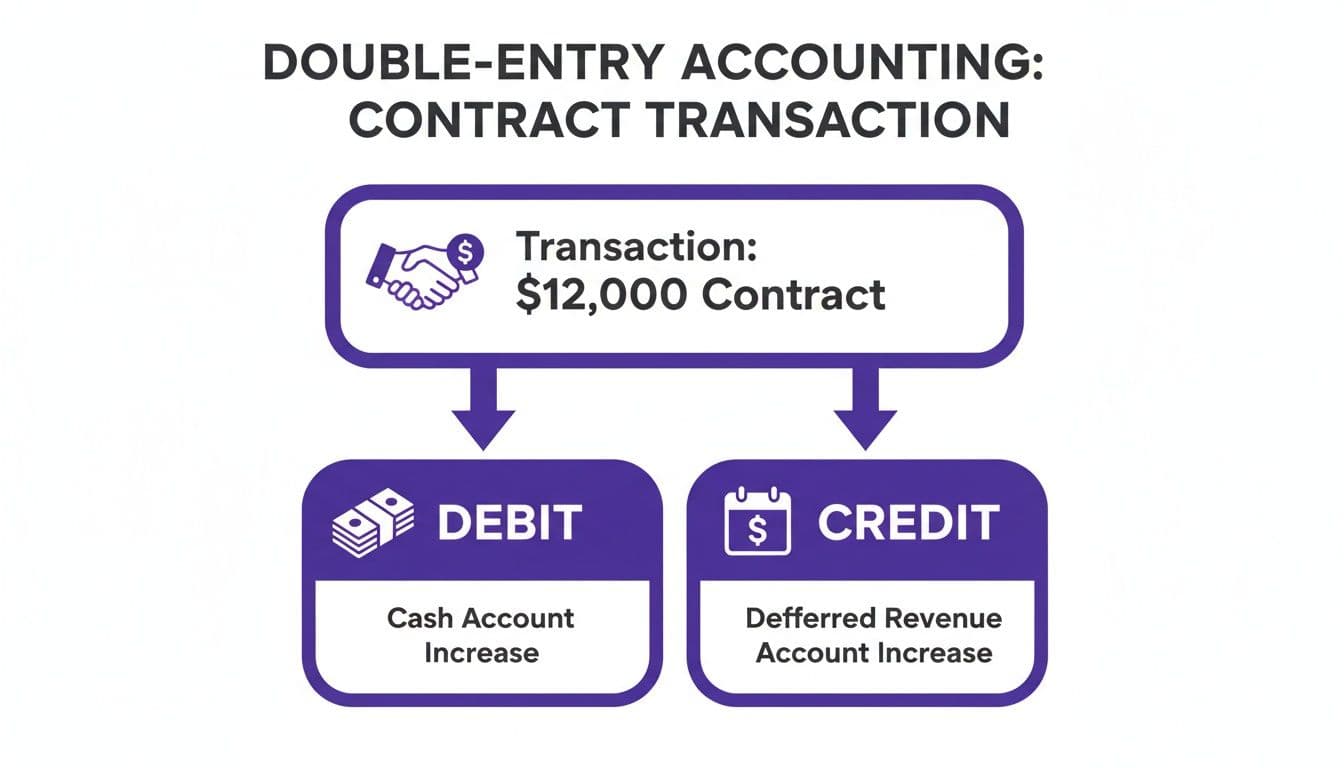
Let's see how this works for a SaaS company. Imagine your sales team closes a new client on a $12,000 annual contract, and they pay the full amount upfront.
One event, two entries. Your general ledger records this to keep the fundamental accounting equation (Assets = Liabilities + Equity) perfectly in balance.
- Debit
Cashfor $12,000: This increases your assets because cash came into your bank account. - Credit
Deferred Revenuefor $12,000: This increases your liabilities because you now owe the customer one year of service. You haven't earned this money yet.
Then, as you deliver your service each month, you make adjusting entries. After month one, you've earned 1/12th of that contract.
- Debit
Deferred Revenuefor $1,000: This decreases your liability by $1,000. - Credit
Service Revenuefor $1,000: This increases your earned income by $1,000.
This isn't just a bookkeeping exercise. It's how you comply with Generally Accepted Accounting Principles (GAAP), specifically revenue recognition rules like ASC 606. This process creates a clean, logical audit trail for every dollar, giving you the financial integrity that investors and lenders absolutely require.
The Unbreakable Rule of Double-Entry
The core principle is powerful because it's non-negotiable: for any transaction, total debits must equal total credits. If they don't, your books are "out of balance," which is the financial equivalent of a warning light on your dashboard.
This rigid structure is what makes your financial statements reliable. It ensures every number on your balance sheet and income statement is interconnected and traceable back to a specific transaction. You’re not just recording what happened; you're building a trustworthy financial story that underpins every strategic decision you make. This concept is also fundamental to accrual accounting, which is the standard for growing businesses.
Organizing Your Financials: Chart of Accounts and Sub-Ledgers
If the general ledger is the complete library of your company’s financial story, the chart of accounts (COA) is its index. It’s a structured list of every single account where a transaction can live—think ‘Cash,’ ‘Accounts Receivable,’ ‘Software Subscriptions,’ and ‘Salaries.’
A well-built COA is the difference between a shoebox full of receipts and a system that generates clear, useful financial reports. For a growing SaaS or services firm, a generic, off-the-shelf COA from QuickBooks is a disaster waiting to happen. It won't give you the specific accounts you need—like Recurring Software Revenue, Professional Services Revenue, or COGS - Hosting Fees—to actually understand your business.
Diving Deeper With Sub-Ledgers
The COA gives you the main categories, but some accounts get so much traffic they need their own detailed records. That’s the job of a sub-ledger. Think of it as a separate, detailed notebook for a single, high-volume account in your general ledger.
For example, your general ledger's 'Accounts Receivable' account might show a single summary number: $250,000. That tells you the total amount customers owe you, but it's not actionable. It doesn't tell you who owes you, or who's late.
The Accounts Receivable sub-ledger contains that critical detail:
- Customer A: Owes $50,000 on Invoice #101, due in 15 days.
- Customer B: Owes $120,000 on Invoice #102, due in 30 days.
- Customer C: Owes $80,000 on Invoice #103, which is now 10 days past due.
The same logic applies to Accounts Payable. The GL shows the total you owe vendors, while the AP sub-ledger tracks every single bill, vendor name, and due date. This keeps your general ledger clean and high-level, while all the messy, granular detail needed for day-to-day operations lives in the sub-ledgers.
At the end of the month, the totals from each sub-ledger are posted as a single summary entry into the general ledger. This process makes sure your master record stays accurate without getting bogged down by thousands of individual invoices and bills. For more on setting these up, check out the principles in our guide to building a customized nonprofit chart of accounts template, which apply to nearly any business.
Red Flags: Warning Signs Your General Ledger Is a Liability
Your general ledger isn't just an accounting report; it's the foundation of your entire financial picture. When it's messy, it’s not a minor headache—it’s a serious business risk. As a founder, you cannot afford to be ambushed by bad data during a fundraise, an audit, or tax season.
Here are the most common red flags that your GL has become a liability.
Common Objections and Misconceptions
One common misconception is that "as long as the bank balance is right, we're fine." This is dangerously wrong. Your GL tracks crucial non-cash items like deferred revenue, accrued expenses, and accounts receivable, which are essential for understanding your true profitability and financial health. Relying only on your bank balance is how companies run out of cash despite being "profitable."
“A general ledger is not just a record of the past; it's the GPS for your company's future. If the data is wrong, every strategic turn you make is based on a faulty map.” — David Worrell, CPA & Financial Controller
Critical Warning Signs
| Red Flag | Why It's a Major Problem | Industry Benchmark |
|---|---|---|
| Delayed Financials | You're making decisions based on stale data. If it takes more than 10 business days to get an income statement, your GL is a bottleneck. | High-performing teams close the books in 5 business days or less. |
| Constant Surprises | Your actual cash burn or profit margins are consistently different from your projections. This means your plans are based on fiction. | According to a KPMG report, 70% of major projects fail due to poor forecasting and financial mismanagement. |
| Large "Suspense" Balances | A large balance in "Miscellaneous" or "Suspense" accounts signals that you have no real visibility into where your money is going. | These accounts should have a zero balance at the end of every closing period. A persistent balance is a sign of systemic issues. |
| Unreconciled Accounts | The cash balance in your GL never matches your bank, or your A/R sub-ledger doesn't match the GL. This is a fundamental breakdown of controls. | Monthly reconciliation is mandatory. According to OpenView's 2024 SaaS Benchmarks, investor due diligence requires clean, reconciled accounts. |
If you recognize these signs, you must act. A deep dive with a professional QuickBooks cleanup is often the first and most critical step to turning your ledger from a liability into a strategic asset.
Turn Your General Ledger From a Mess Into a Strategic Asset
A pristine general ledger is more than just clean books. It's the engine of strategic finance, giving you the data to drive real growth. If your GL feels more like a source of stress than a source of truth, there’s a clear three-step path to turn it into your company’s most valuable asset.

Here’s your action plan:
| Step | Action | Why It Matters |
|---|---|---|
| 1. Cleanse and Reconcile | Perform a deep cleanup of your historical data. Fix miscategorized transactions and reconcile every balance sheet account (Cash, A/R, A/P, Deferred Revenue) to third-party statements. | This establishes a reliable foundation. Without a clean history, your financial reports and KPIs are meaningless. |
| 2. Redesign Your Chart of Accounts | Overhaul your COA to reflect your business model. Use specific accounts like Recurring Software Revenue and COGS - Hosting Fees instead of generic ones. | A custom COA enables you to track key metrics directly from your financials, giving you actionable insights into profitability and performance. |
| 3. Automate and Integrate | Connect your GL to your core operational systems: payment processors (Stripe), payroll (Gusto), and bank feeds. Leverage modern AI bookkeeping solutions. | This eliminates manual data entry, the #1 source of errors. Automation speeds up your close, improves accuracy, and frees up your team for strategic analysis. |
By automating your GL, you do more than just save time on data entry. You unlock advanced capabilities that are critical for any business that wants to scale.
“As a startup founder and a mom, I literally have no time. The automation Digits brings just makes everything easier for us... If you want to save time, and really trust the numbers, choose Digits. It’s been a huge weight off my shoulders, it’s invaluable.” — Sara Beykpour, Co-founder and CEO of Particle
This speed gives you immediate access to real-time dashboards for tracking the KPIs that matter—MRR, LTV, and churn. Your general ledger stops being a historical record of what happened last month and becomes a forward-looking tool that gets you ready for any board meeting, fundraising round, or audit.
When to Outsource Your General Ledger Management
As a founder, you can do anything, but you can't do everything. In the early days, managing the general ledger yourself might seem manageable. But once your business hits the $1M-$5M ARR revenue range, this critical function needs specialized expertise—not a tired effort on a Friday afternoon.
Keeping the books for a growing company is far more complex than simple data entry. It demands a real understanding of GAAP, tricky revenue recognition rules like ASC 606, and how to build a Chart of Accounts that actually gives you the insights you need to make smart decisions. Get this wrong, and your entire financial picture is distorted.
Key Inflection Points for Outsourcing
So, how do you know when it’s time to call in the experts? The signs are usually crystal clear. If any of these sound familiar, you have outgrown DIY bookkeeping or the capabilities of a junior-level hire.
- You're spending more than 5 hours a month on bookkeeping. Your time is infinitely more valuable when spent on strategy, sales, or product development. The opportunity cost of you doing this work yourself is enormous.
- Your month-end close drags on for more than a week. A slow close means you're flying blind, making decisions on last month's old news. High-performing finance teams close their books in 5 days or less.
- You're gearing up for a fundraise or an audit. Investors and auditors require pristine, investor-ready financials. A messy general ledger is a giant red flag that will kill a deal or trigger an expensive, time-consuming cleanup project.
For most growing companies, outsourcing offers a massive strategic advantage. You get immediate access to a full bench of specialists—from meticulous bookkeepers to seasoned controllers—for a fraction of what it costs to hire a single, qualified full-time employee. To see the numbers broken down, check out our guide comparing an in-house vs. outsourced controller.
Outsourcing your general ledger management lets you get back to leading your company, confident that your financial foundation is solid, accurate, and ready for whatever opportunity comes next.
Your General Ledger Questions, Answered
As your business grows past the early startup days, you’ll inevitably run into questions about how the general ledger actually works in practice. We hear the same questions from founders leading companies in the $1M to $5M ARR revenue range. Here are the straight answers.
What Is the Difference Between a General Ledger and a Trial Balance?
Think of your general ledger (GL) as the complete, unabridged financial history of your company—the master book where every single transaction is recorded in detail. Every sale, every software subscription payment, every payroll run… it all ends up here.
A trial balance, on the other hand, is just a quick report you pull from the general ledger. Its only job is to check the math at the end of a period (like a month or quarter). It lists all your accounts and their final balances to confirm one simple thing: that your total debits equal your total credits.
The GL is the source of truth. The trial balance is the quick spot-check you run before building your real financial statements.
Can I Use a Spreadsheet as My General Ledger?
Technically, yes—if you’re a solo founder with just a few dozen transactions a month. But the moment you have any real traction (anything over $1M ARR ARR), a spreadsheet becomes a massive liability.
Spreadsheets are a breeding ground for human error. Formulas break, numbers get fat-fingered, and there's absolutely no audit trail to trace mistakes. More importantly, they don't scale. You can't securely integrate them with your bank, your credit cards, or your payment processors, which means endless manual data entry.
Purpose-built accounting software like QuickBooks or NetSuite is designed to be a secure, automated, and scalable general ledger. For any business serious about growth, moving off spreadsheets isn't a suggestion; it's a requirement.
How Often Should My General Ledger Be Reconciled?
Monthly. This isn't just best practice; it's a non-negotiable part of any legitimate month-end close process.
Reconciliation is how you prove your books are real. It’s the process of matching the balances in your GL accounts (like Cash, Accounts Receivable, or credit card debt) against outside proof from third-party statements (your bank statement, a Stripe payout report, a credit card statement).
This is where you catch everything—bank errors, missed invoices, duplicate charges, and even potential fraud. Waiting any longer than a month turns this crucial check into a massive, error-prone cleanup project and means you're flying blind, making decisions with numbers you can't trust.
Jumpstart Partners offers controller-led finance ops for founder-led B2B AI SaaS teams—monthly close, reporting, and billing support scoped after the Finance Ops Diagnostic. to see how we can give you complete confidence in your numbers.