Financial Operations
How to Calculate Deferred Revenue: Worked Examples
Learn how to calculate deferred revenue with the ASC 606 roll-forward, worked journal entries and a monthly close checklist for SaaS and agency finance teams.
ByJumpstart Partners, CPA, QuickBooks ProAdvisor
··16 min readA wire hitting your bank account can make the month look profitable while you still owe the customer the work. For a SaaS company, a digital agency, or a professional services firm in the $500K to $20M range, annual prepay is normal, and that timing gap is where profit gets overstated. How to calculate deferred revenue is the control that keeps cash, billings, and earned revenue from being treated as the same number.
Table of Contents
- Why Cash Received Is Not Revenue Yet
- How to Run the Monthly Deferred Revenue Calculation
- When Contracts Have Multiple Obligations or Usage Fees
- Red Flags and Misconceptions That Corrupt Your Balance
- Confirm Your Roll-Forward Before the Next Close
Why Cash Received Is Not Revenue Yet
Cash can arrive before the service it pays for. If a customer prepays $240,000 for a year of service, recording the entire amount as revenue on payment day overstates what you have earned and hides the work still owed.
Under IFRS 15, as explained in Deloitte's IFRS 15 guide, deferred revenue is consideration received, or unconditionally due, that exceeds revenue recognized to date. The unearned amount is a contract liability on the balance sheet until you satisfy the related performance obligation. US reporters follow the same principle under ASC 606: an advance payment is a contract liability until the performance obligation is satisfied. The timing rule applies to subscriptions, maintenance, implementation, and prepaid professional services.
The working equation
The roll-forward works like a running account: start with the prior balance, add new unearned billings, subtract revenue earned, and subtract refunds or contract reductions. FASB's revenue materials support keeping the liability balance separate from the revenue recognized.
Ending deferred revenue = beginning deferred revenue + billings or cash for undelivered obligations − revenue recognized − refunds or contract reductions.
Suppose the opening balance is $80,000. You collect $150,000 for undelivered service, recognize $110,000 of revenue, and refund $10,000. The calculation is $80,000 + $150,000 − $110,000 − $10,000 = $110,000 ending deferred revenue. That balance represents service still owed, not profit or cash available to treat as margin.
The opening balance matters even more when new billings exceed revenue earned. A SaaS company begins the month with $120,000 deferred, bills $240,000 for a 12-month subscription paid upfront, and recognizes $20,000 as the service is provided evenly across the year. Its ending balance is $120,000 + $240,000 − $20,000 = $340,000. Omitting the opening balance would understate the obligation by $120,000, even if the current-month billing and revenue entries were correct.
Read every line as a sentence
| Line | What it covers | Example value |
|---|---|---|
| Beginning deferred revenue | Balance carried from the prior close | $80,000 |
| Plus: billings or cash for undelivered obligations | New annual prepayments received | $150,000 |
| Less: revenue recognized | Revenue earned in the period | $110,000 |
| Less: refunds or contract reductions | Cancellations, credits, and refunds | $10,000 |
| Ending deferred revenue | Balance reported on the balance sheet | $110,000 |
Read each row as part of the same proof. The beginning balance is the obligation carried forward. Add new amounts billed for service not yet delivered, then subtract what you earned and what you refunded or reduced. The ending figure is the liability that remains.
A rising deferred balance does not prove the schedule is right. It can also hide a missed revenue release, an omitted refund, or an incorrect opening figure. Tie the opening balance to the prior close, then use the revenue recognition principle to assess when each obligation has been satisfied.
How to Run the Monthly Deferred Revenue Calculation
Run the same sequence every month. The roll-forward is the proof. A single journal entry is not.
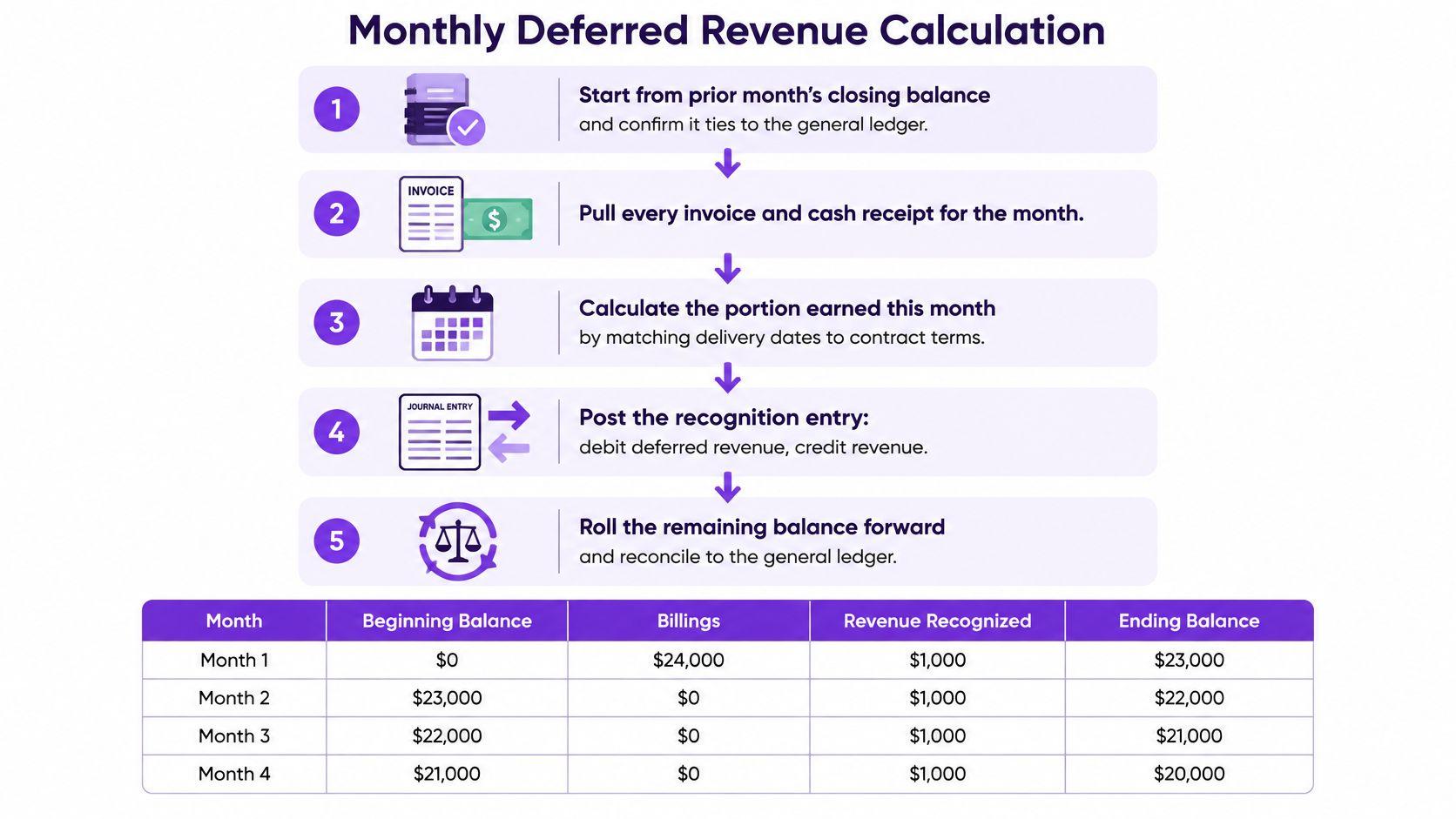
Under ASC 606, you present deferred revenue as a contract liability when you receive consideration, or when payment becomes due, whichever comes first, and you have not yet transferred the promised goods or services. The FASB revenue recognition TRG memo is explicit that the balance is your remaining obligation, not earned income.
Seven close steps
-
Start from last month's close. Confirm the opening deferred revenue ties to the general ledger in QuickBooks, Xero, or NetSuite before you add this month's activity. A plugged opening balance hides last month's error inside this month's revenue.
-
Pull invoices and cash for service you have not delivered. Include annual prepayments and any invoice whose service period is still open. Leave out amounts you already earned. The slip here is dumping the whole billing register into the liability, including work you finished last month.
-
Post the billing entry for the full unearned amount. A customer pays $12,000 on January 1 for 12 months. You record Dr. Cash $12,000, Cr. Contract liability (deferred revenue) $12,000. Do not credit revenue on that entry. Recognizing the whole invoice at billing is the error that inflates the month the contract is signed.
-
Set the monthly release from the service period. When the subscription is a stand-ready service spread evenly across the year, monthly revenue is $1,000 ($12,000 ÷ 12). Match the start date. A contract that starts on January 16 is not a full January month.
-
Post the release. Dr. Contract liability $1,000, Cr. Revenue $1,000. On January 31 the balance sheet shows $11,000 of deferred revenue and the income statement shows $1,000 of revenue. Those two statements have to move together. If revenue goes up and the liability does not go down, the entry is incomplete.
-
Deduct refunds and contract reductions approved this month. A cancellation, a credit, or a downgrade reduces the liability. Skipping this line leaves dead contracts on the balance sheet and overstates what you still owe. Book the refund against the liability first, then recognize only the portion you had already earned.
-
Calculate the close and reconcile. Tie the ending balance to the ledger, then tie each material contract to its billing schedule, service dates, and renewal terms. The revenue recognition journal entries only hold up if this tie-out is part of the close, not a year-end cleanup.
The twelve-month proof
For that $12,000 contract, cumulative revenue plus the closing liability equals $12,000 at every month-end. If it doesn't, you double-counted a release or skipped one.
| Month-end | Opening balance | Revenue recognized | Closing deferred revenue | Cumulative revenue |
|---|---|---|---|---|
| Jan 31 | $12,000 | $1,000 | $11,000 | $1,000 |
| Feb 28 | $11,000 | $1,000 | $10,000 | $2,000 |
| Mar 31 | $10,000 | $1,000 | $9,000 | $3,000 |
| Jun 30 | $7,000 | $1,000 | $6,000 | $6,000 |
| Dec 31 | $1,000 | $1,000 | $0 | $12,000 |
June is the midpoint check founders skip. Opening $7,000, release $1,000, close $6,000, cumulative revenue $6,000. Half the contract is earned and half is still owed. December must land at zero if the customer used the full term and you issued no refund. A leftover balance in January of the next year means you never finished the release.
Watch a short walk-through of the billing entry and the monthly release before you build the schedule in your ledger.
Build the schedule in a contract-level sheet, then post only the monthly totals. Stripe or your billing tool can list invoices. It will not tell you which dollars are earned unless you attach service dates and a recognition rule to each contract.
When Contracts Have Multiple Obligations or Usage Fees
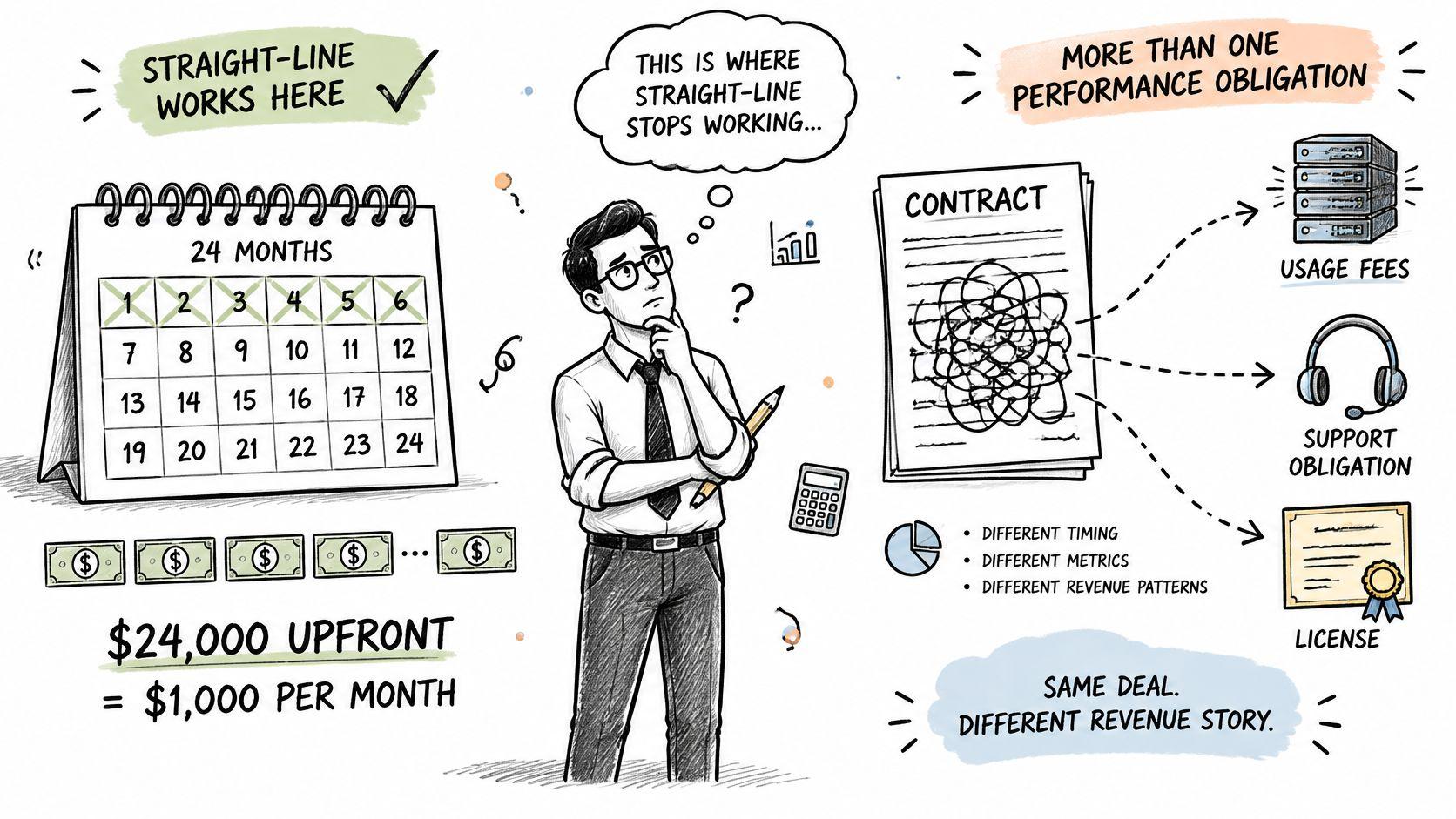
A tidy monthly schedule can still hide a bad allocation. Straight-line recognition works for one even service, but contracts that bundle implementation, subscriptions, or usage require separate recognition patterns. The roll-forward is the control: for each obligation, its opening liability, additions, revenue recognized, and closing liability must reconcile.
Even service versus measured progress
For a customer who pays $24,000 upfront for 24 months of service, with no refunds, discounts, extensions, or separate obligations, the monthly revenue is $1,000. After six months, cumulative revenue is $6,000 and deferred revenue is $18,000.
A professional-services engagement follows progress rather than the calendar. If a $60,000 implementation is 40% complete at month-end and the customer has paid in full, recognize $24,000 and retain $36,000 as a contract liability. Dividing the fee by 12 would produce an arbitrary monthly amount. The liability is reclassified to revenue only as the related performance obligation is satisfied.
A $120,000 annual contract does not automatically produce $10,000 of revenue each month. Implementation may be a separate obligation, usage fees may depend on consumption, and a renewal option may require its own allocation. List the obligations and allocate the transaction price before building the schedule. The guide to identifying and allocating performance obligations explains that first step.
Elements that break a flat monthly amount
| Contract element | Recognition pattern | Worked figure |
|---|---|---|
| Annual SaaS subscription with even service | Straight-line over the service term | $24,000 over 24 months = $1,000 per month; $18,000 deferred after six months |
| Implementation engagement | Measured progress at month-end | $60,000 at 40% complete = $24,000 recognized, $36,000 remaining |
| Usage-based fees | As usage occurs | Recognize the fee in the month the customer consumes it, at the contracted rate, and do not spread it across the term |
| Renewal discount or customer option | Separate obligation, recognized when exercised or expired | Hold the allocated amount as a liability until the customer exercises the option, it expires, or you transfer the related service |
| Refund right or expired credit | Liability until the refund right or breakage is resolved | Keep the amount deferred until you refund it or recognize breakage you can support with history |
Review the contract terms alongside the billing export. Start with deals that bundle implementation and subscription, then check contracts with usage fees, credit banks, or renewal options. A single straight-line row can place implementation revenue in the subscription line, or subscription revenue in implementation, while the total still appears to reconcile.
Practical rule: Allocate the price to each obligation first. A schedule built from the invoice total alone can release the wrong amount, even when its arithmetic is tidy.
An agency retainer that includes a website build and monthly support has the same split. The build follows progress; support follows the months the agency stands ready to provide it. One blended monthly figure obscures both patterns.
Red Flags and Misconceptions That Corrupt Your Balance
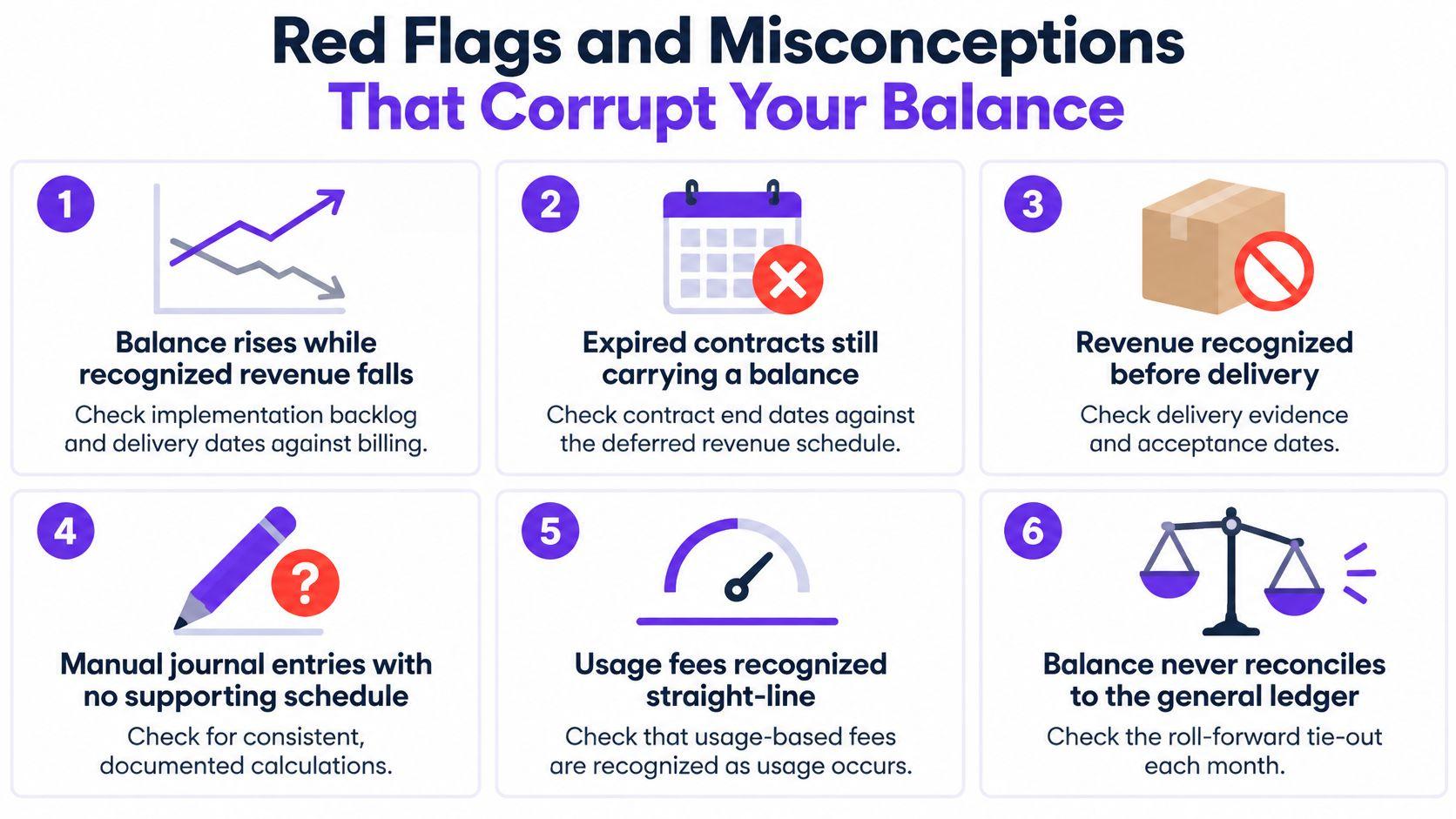
A rising deferred-revenue balance can signal stronger bookings, or it can hide delivery delays and stale contract records. The roll-forward is the control that distinguishes those stories: each month's ending balance must be explainable by opening obligations, new billings, revenue recognized, and reductions.
ASC 606 guidance summarized by EY describes a contract liability as an obligation to transfer goods or services in the future or refund consideration. The balance therefore reflects what remains owed, not what cash has arrived. Unused prepaid seats, expired credits, and canceled annual subscriptions each need to be assessed against the relevant contract terms.
Six signs the balance is wrong
The balance rises for several months while recognized revenue falls. Billing growth can increase the liability even as delivery slows. Compare invoice dates with implementation and service dates. If invoices are ahead of go-live, the balance may reflect work not yet delivered, while the falling revenue points to a separate operating trend.
Expired credits or canceled annual subscriptions still sit in the liability. Compare contract end dates with the schedule. Release amounts as obligations are satisfied, refund amounts when the contract requires it, and retain any remaining liability only when the contract supports it. A stale balance may be a missed release or an unresolved refund, not a cushion.
The roll-forward does not tie to the general ledger. Rebuild the movement from the opening balance, add billings for unsatisfied obligations, subtract recognized revenue, and account for refunds or contract changes. A public SEC filing's contract-liability presentation shows contract liabilities as part of the company's financial reporting. To find a difference in your own books, trace the underlying contracts and changes rather than treating cash receipts as a substitute for the liability schedule.
The closing balance exceeds the unexpired value of open contracts. Reconstruct the liability from the contract schedule and compare it with the remaining service or other obligations. If the ledger is higher, look for deferred amounts no longer supported by a contract, or revenue that should have been released.
Refunds hit revenue with no modification review. Record each refund, credit, upgrade, or downgrade in a modification log before posting it. A refund of unearned fees reduces the liability; a refund of fees already earned reduces revenue. Posting every refund to revenue understates the liability when unearned amounts are returned.
Nobody has written a breakage policy. Breakage is the portion of prepaid rights customers do not use. When the expected amount can be estimated from relevant history, it may be recognized in proportion to the pattern of rights exercised. Otherwise, the related amount remains a liability until the obligation or refund right is resolved. Document how cancellations, credits, and breakage are handled so the schedule does not rely on an informal straight-line rule.
A public six-month roll-forward illustrates how billings and revenue can move the liability in opposite directions. For the six months ended June 30, 2025, an unnamed SEC registrant reported beginning deferred revenue of $589,913, billings of $3,609,015, revenue recognized of $3,859,198, and ending deferred revenue of $339,730, as shown in the registrant's contract-liability roll-forward. The arithmetic is $589,913 + $3,609,015 − $3,859,198 = $339,730. Because recognized revenue exceeded new billings, the liability fell. The roll-forward proves the ending balance by accounting for each movement.
Three ideas that mislead founders
Cash received is not necessarily earned revenue. An advance remains a contract liability until the related obligation is satisfied. Recording the wire as sales immediately overstates revenue and understates what the business still owes.
A larger deferred balance is not automatically good news. It may reflect stronger bookings, delayed delivery, implementation backlogs, cancellations, or errors in the schedule. Compare it with recognized revenue and delivery dates before presenting the movement as a sign of growth.
Straight-line recognition does not fit every subscription. Customer options, discounts, and renewal rights may leave part of the original payment deferred until an option is exercised, expires, or the related goods or services are transferred. Usage fees and variable consideration depend on consumption and the contract terms, not the order form's anniversary date.
Assign clear ownership for the contract list, billing bridge, ledger tie-out, and modification and breakage log. When those records have different owners, the roll-forward brings their changes together and exposes gaps that a rising balance can conceal.
Confirm Your Roll-Forward Before the Next Close
Rebuild the deferred-revenue roll-forward and tie it before the next close. A schedule that only matches this month's invoices will not catch a bad opening balance, a missed refund, or a mixed contract released on a flat line.
Do these four things in order.
-
Rebuild last month from the five lines. Opening balance, new billings for undelivered work, revenue recognized, refunds and reductions, ending balance. If you can't reproduce last month, don't post this month on top of it.
-
Tie the ending balance to the general ledger. The contract schedule and the balance-sheet account have to match to the dollar. A rounding plug is a sign the population of contracts is incomplete.
-
Tie each material balance to the contract, the invoice, and the service period. Credits, cancellations, and renewal terms belong in that same file. The month-end closing checklist should include this tie-out as a required step, not an optional workbook.
-
Write the policy. Cover cancellations, refunds, upgrades, downgrades, credits, and breakage in one page your close team can apply without a debate. Name who approves a release that isn't straight-line.
When the numbers still won't tie
If the roll-forward still doesn't tie after one full cycle, or your book includes implementation, usage fees, or several obligations in one contract, get a structured review rather than another manual pass. Our Finance Ops Diagnostic is a $3,500 fixed-fee review delivered in 5 business days. It ends with a written workflow map before either side commits to a retainer, and there is no sales call before that map is in your hands. We also offer complimentary ROI assessments so you can judge whether controller services make financial sense for your billing model.
Bring your opening deferred-revenue balance, last month's billings, the recognition schedule, and the refund log to the kickoff. That is enough to see whether the liability on your balance sheet is the service you still owe.
Jumpstart Partners runs controller-led closes for SaaS companies, agencies, and professional services firms that bill before they deliver, including deferred-revenue roll-forwards and ASC 606 schedules your board can read. If your liability and your contract list don't tell the same story, visit Jumpstart Partners and book a diagnostic before the next close locks the error in.