Financial Operations
Revenue Recognition Journal Entries: The Founder's Guide
Master revenue recognition journal entries for SaaS and agencies with ASC 606 templates, deferred revenue examples, and month-end posting procedures.
ByJumpstart Partners, CPA, QuickBooks ProAdvisor
··19 min readUnder ASC 606, the core revenue recognition journal entries are: debit cash and credit deferred revenue at billing, debit deferred revenue and credit revenue each period as performance obligations are satisfied, and debit contract asset and credit revenue when revenue is earned before invoicing. Those three patterns cover the basic cash-first, performance-first, and allocation-driven workflows you need to control.
You're probably seeing the symptoms already. Cash collections look strong, but monthly revenue swings. Your MRR report doesn't match the income statement. A customer prepays for an annual subscription, an agency finishes work before billing, or a bundled contract includes implementation and support, and the bookkeeping system produces entries that nobody can explain at close.
For a business between $1M-$5M ARR, revenue recognition isn't a technical footnote. It affects board reporting, fundraising diligence, tax planning, lender confidence, and the credibility of every forecast built on recurring revenue. The right question isn't just, “What entry should I post?” It's, “What event earned the revenue, which balance sheet account holds the timing difference, and what evidence supports the entry?”
Table of Contents
- Why Revenue Recognition Journal Entries Break Growing Companies
- The ASC 606 Framework Every Founder Needs to Know
- Deferred Revenue Entries for Annual SaaS Subscriptions
- Contract Asset Entries for Earned but Unbilled Revenue
- Multi-Element Contracts and Allocation Entries
- Contract Modifications, Refunds, and Variable Consideration
- The Month-End Posting and Review Procedure
- Audit-Ready Documentation and Internal Controls
- Red Flags That Signal Your Revenue Entries Are Wrong
- Quick-Reference Journal Entry Lookup
- Your Next Steps and When to Bring in a Controller
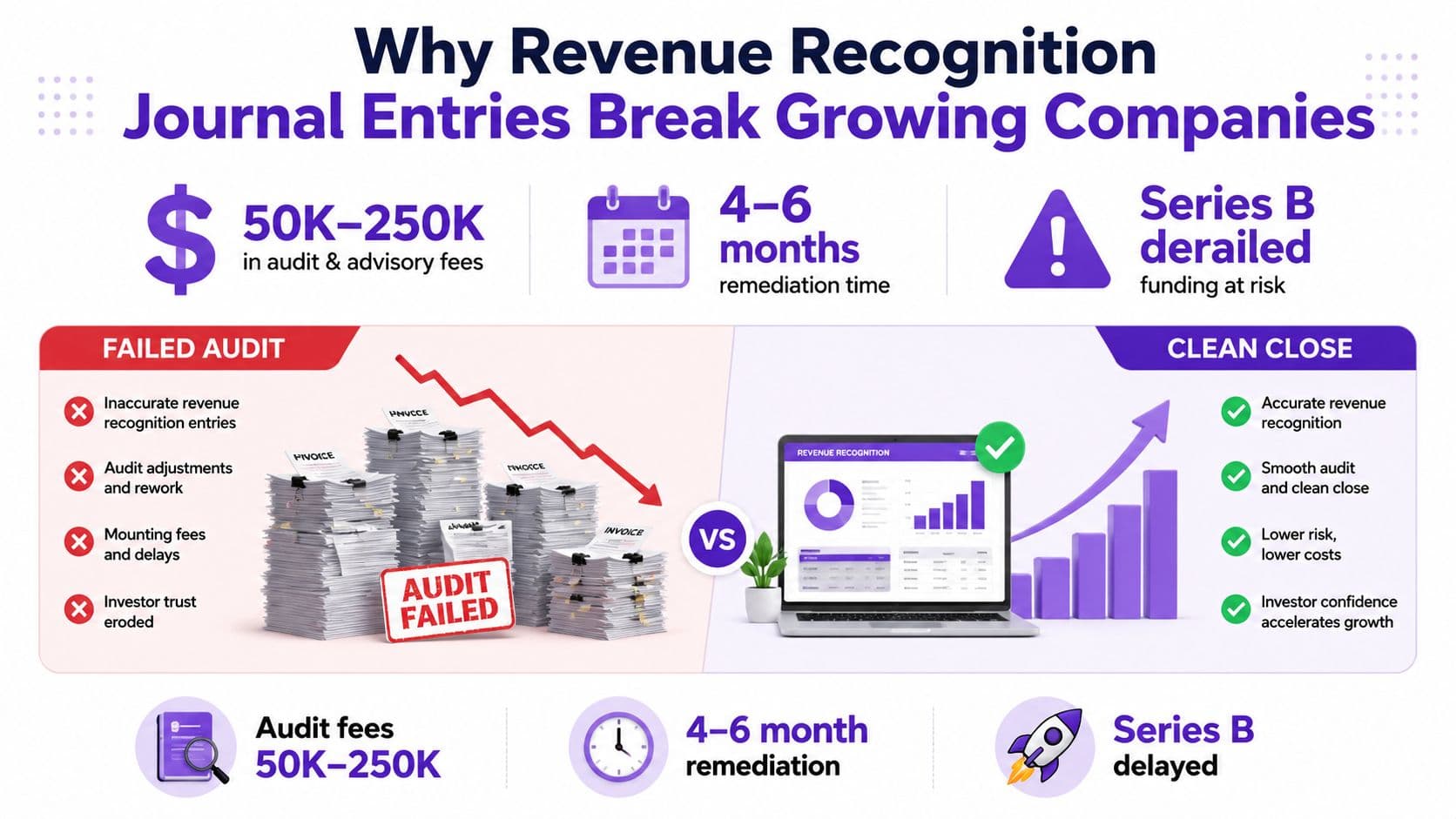
Why Revenue Recognition Journal Entries Break Growing Companies
Incorrect revenue recognition creates more than an untidy ledger. It can distort MRR, ARR rollforwards, gross margin, cash conversion, and the deferred revenue schedule investors review during diligence. If an audit identifies a material error, the company may need to restate financials, remediate controls, and explain why management reporting didn't catch the problem.
The three failure patterns are predictable:
- Cash becomes revenue too early. A founder books the full customer invoice to revenue instead of deferred revenue. Current-period revenue is overstated, then later periods show an artificial decline.
- Earned work stays invisible. A SaaS company or agency completes billable work before sending an invoice but never records a contract asset. Revenue and gross margin are understated.
- Bundled services stay bundled. A company records one revenue line for software, implementation, and support even though the obligations transfer at different times. The entry no longer reflects the contract economics required by ASC 606.
The three entry patterns to control
Bill, then recognize. At billing or collection, debit cash or accounts receivable and credit deferred revenue. As service is delivered, debit deferred revenue and credit revenue.
Earn, then bill. When performance occurs before invoicing, debit contract asset and credit revenue. When billing becomes unconditional, debit accounts receivable and credit contract asset.
Allocate, then recognize. Split the transaction price across distinct performance obligations. Each deferred revenue sub-account releases according to its own delivery schedule.
A controller shouldn't spend several days rebuilding these relationships in spreadsheets every month. Your billing system, contract repository, revenue schedule, and general ledger need to agree before the close begins.
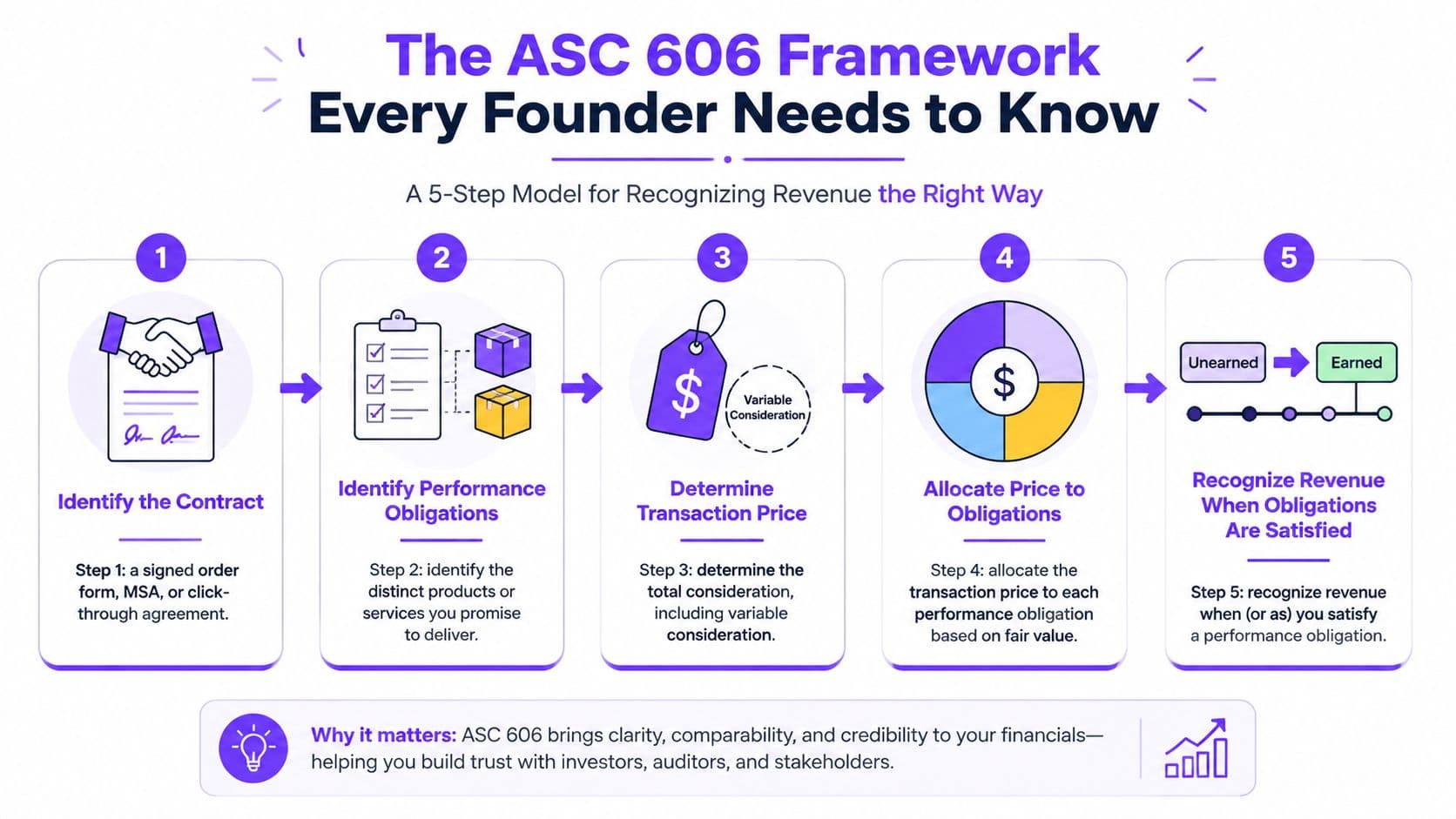
The ASC 606 Framework Every Founder Needs to Know
ASC 606 replaced older, industry-specific guidance with a single five-step model. The standard was issued in May 2014 and became effective for public companies for annual reporting periods beginning after December 15, 2017, and for other entities for annual reporting periods beginning after December 15, 2018, according to the ASC 606 adoption timeline and framework overview. Earlier application was permitted for public companies for annual periods beginning after December 15, 2016.
The model gives you a practical decision sequence:
- Identify the contract. Use the signed order form, master services agreement, or click-through arrangement. Confirm the parties' rights, payment terms, and promised deliverables.
- Identify performance obligations. Separate distinct promises. A SaaS contract may include platform access, implementation, training, and support. An agency agreement may include strategy, creative production, and campaign management.
- Determine the transaction price. Start with fixed consideration, then assess usage fees, bonuses, credits, refunds, and other variable amounts. Constrain variable consideration when recognizing it would create a significant risk of reversal.
- Allocate the transaction price. Assign consideration to each obligation using relative standalone selling prices. The price a customer would pay for each item separately is the starting point.
- Recognize revenue as obligations are satisfied. Recognize a one-time deliverable when control transfers. Recognize subscription access or ongoing services over time as you provide them.
IFRS 15 is the international counterpart. It became effective for annual periods beginning on or after January 1, 2018, with early adoption permitted, as stated in the IFRS 15 issued standard. In a sample of 396 Australian and New Zealand firms, 21.97% used full retrospective adoption, 45.71% used modified retrospective adoption, and 32.32% didn't explicitly disclose the transition method, based on the IFRS 15 transition-method research.
The five steps determine the shape of your entries. Cash receipt alone creates a liability. Performance before billing creates an asset. Multiple promises create multiple schedules.
For a plain-English reference, use this ASC 606 revenue recognition guide when you're documenting the policy behind your recurring entries.
Deferred Revenue Entries for Annual SaaS Subscriptions
For a subscription billed upfront, the cash receipt and the revenue event are different events. The cleanest example is an annual SaaS contract billed on January 1 for $12,000.
Initial billing entry
At billing or collection, post:
- Debit Cash, $12,000
- Credit Deferred Revenue, $12,000
The full amount sits on the balance sheet because you still owe the customer platform access. Under IFRS 15, consideration received before transfer is presented as a contract liability, which is the same economic role deferred revenue plays in this workflow.
At each month-end, recognize the service delivered:
- Debit Deferred Revenue, $1,000
- Credit Subscription Revenue, $1,000
The calculation is straightforward: $12,000 divided across 12 months equals $1,000 per month.
Monthly schedule
| Date | Debit | Credit | Deferred Revenue Balance |
|---|---|---|---|
| January 1 | Cash, $12,000 | Deferred Revenue, $12,000 | $12,000 |
| January 31 | Deferred Revenue, $1,000 | Subscription Revenue, $1,000 | $11,000 |
| February 28 | Deferred Revenue, $1,000 | Subscription Revenue, $1,000 | $10,000 |
| March 31 | Deferred Revenue, $1,000 | Subscription Revenue, $1,000 | $9,000 |
| April 30 | Deferred Revenue, $1,000 | Subscription Revenue, $1,000 | $8,000 |
| May 31 | Deferred Revenue, $1,000 | Subscription Revenue, $1,000 | $7,000 |
| June 30 | Deferred Revenue, $1,000 | Subscription Revenue, $1,000 | $6,000 |
| July 31 | Deferred Revenue, $1,000 | Subscription Revenue, $1,000 | $5,000 |
| August 31 | Deferred Revenue, $1,000 | Subscription Revenue, $1,000 | $4,000 |
| September 30 | Deferred Revenue, $1,000 | Subscription Revenue, $1,000 | $3,000 |
| October 31 | Deferred Revenue, $1,000 | Subscription Revenue, $1,000 | $2,000 |
| November 30 | Deferred Revenue, $1,000 | Subscription Revenue, $1,000 | $1,000 |
| December 31 | Deferred Revenue, $1,000 | Subscription Revenue, $1,000 | $0 |
Set up deferred revenue by customer, product line, subsidiary, or class so you can explain the rollforward without exporting a giant spreadsheet. QuickBooks, NetSuite, and Sage Intacct can support recurring or system-generated schedules, but you still need to verify the start date, end date, product mapping, and posting period.
Mid-year starts require a schedule tied to the actual service period. Don't force every customer into a calendar-month template when the contract begins partway through a month. The first and last periods should reflect the service delivered in those periods.
The founder mistake is posting the entire $12,000 to revenue on January 1. That makes January look excellent, depresses the following months, and breaks the relationship between recognized revenue and the remaining customer obligation. Use this deferred revenue accounting guide to document the account structure and monthly release policy.
Contract Asset Entries for Earned but Unbilled Revenue
Deferred revenue gets the attention because prepaid subscriptions are easy to visualize. Contract assets are the mirror image, and they're where many agencies and professional services businesses lose accuracy.
Suppose you have a $24,000 professional services engagement. The work is recognized monthly, but the customer is billed quarterly. In month one, you've earned $8,000 of service revenue before issuing the invoice:
- Debit Contract Asset, $8,000
- Credit Service Revenue, $8,000
The contract asset represents your conditional right to consideration. You've performed, but billing depends on the contractual billing date or another condition.
Lifecycle of the balance
| Month | Debit | Credit | Contract Asset Balance |
|---|---|---|---|
| Month 1 | Contract Asset, $8,000 | Service Revenue, $8,000 | $8,000 |
| Month 2 | Contract Asset, $8,000 | Service Revenue, $8,000 | $16,000 |
| Month 3, revenue earned | Contract Asset, $8,000 | Service Revenue, $8,000 | $24,000 |
| Month 3, invoice issued | Accounts Receivable, $24,000 | Contract Asset, $24,000 | $0 |
The invoice entry doesn't create new revenue. It reclassifies the balance from contract asset to accounts receivable. Collection later debits cash and credits accounts receivable.
That distinction matters in your AR aging report. A contract asset isn't the same as an overdue invoice because the customer may not yet owe an unconditional amount. Don't present every unbilled balance as AR, and don't hide earned work inside deferred revenue.
Practical rule: Contract assets decrease when billing converts the conditional right into receivables, not when the customer pays.
A contract asset that remains outstanding beyond the normal billing cycle deserves immediate review. Check the statement of work, delivery evidence, billing trigger, and project status. For the accrual-accounting foundation behind this workflow, see the accrual accounting guide.
Multi-Element Contracts and Allocation Entries
A bundled contract shouldn't produce one undifferentiated revenue schedule. ASC 606 requires you to identify distinct performance obligations and allocate consideration based on relative standalone selling prices.
Use a $100,000 contract with three obligations:
| Performance Obligation | Standalone Price | Initial Deferred Revenue | Recognition Pattern |
|---|---|---|---|
| SaaS license | $60,000 | $60,000 | Ratably over 12 months |
| Implementation | $30,000 | $30,000 | Milestone or progress basis |
| Premium support | $10,000 | $10,000 | Evenly over support term |
At billing, the entry is:
- Debit Cash, $100,000
- Credit Deferred Revenue, SaaS License, $60,000
- Credit Deferred Revenue, Implementation, $30,000
- Credit Deferred Revenue, Premium Support, $10,000
The entries become distinct as delivery occurs. The license releases according to the access period. Implementation releases when the specified work or milestone is complete. Support releases as the support service is provided.
A published example also shows how allocation can create different deferred balances and recognition entries. In that example, an invoice of $100,000 was allocated to deferred revenue balances of $10,000, $5,000, and $85,000, with later recognition entries including $10,000 and $7,083, as documented in this multi-element revenue recognition example.
What your schedule must preserve
Each obligation needs its own:
- Account or subledger dimension
- Standalone selling price support
- Service or delivery period
- Recognition trigger
- Modification and cancellation history
Don't recognize implementation revenue simply because the customer signed the software agreement. If the implementation work isn't complete, that portion remains deferred. Review your allocation policy whenever pricing, packaging, or standalone selling prices change. The detailed performance obligations guide is useful when sales bundles products that finance previously treated as one deliverable.
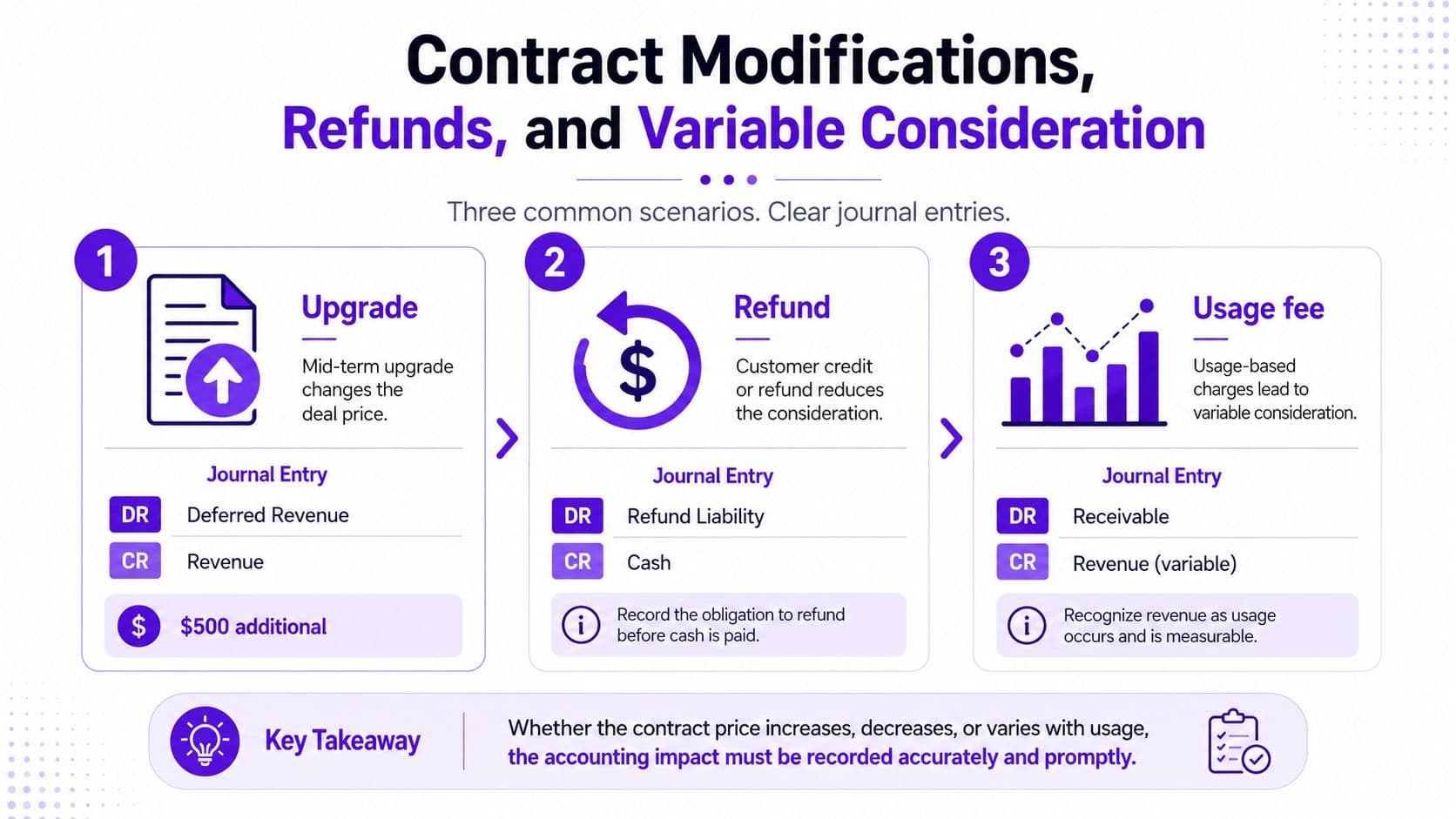
Contract Modifications, Refunds, and Variable Consideration
Real contracts change after signature. Customers upgrade, reduce scope, request credits, or generate usage charges that aren't known at the start of the service period. Your policy must determine whether the change creates a separate contract, modifies the existing contract prospectively, or requires a cumulative catch-up adjustment.
Separate contract for an added service
If a modification adds distinct services at a price reflecting their standalone selling price, treat it as a separate contract. For an added $18,000 service package:
- Debit Cash or Accounts Receivable, $18,000
- Credit Deferred Revenue, $18,000
Create a separate schedule rather than editing the original contract history. The recognition trigger remains delivery of the added service.
Customer credit or refund
For a $5,000 credit issued because of a service issue, a same-period entry may be:
- Debit Sales Returns and Allowances, $5,000
- Credit Accounts Receivable, $5,000
If the customer prepaid, the correction may reduce deferred revenue or establish a refund liability, depending on whether the company owes cash or future service. Document the reason, approval, affected obligation, and period of the adjustment.
Variable consideration
Usage fees and performance bonuses require an estimate that won't create an inappropriate reversal. If you recognize an amount subject to refund, record revenue with the corresponding refund liability or receivable based on the contract facts. The controller must document the estimation method, constraint, source data, and true-up process before posting.
This short video provides a visual explanation of the contract-accounting decisions involved:
The key control is consistency. Your sales team can negotiate the change, but finance must classify it before the journal entry posts. Keep the policy details in your variable consideration guidance.
The Month-End Posting and Review Procedure
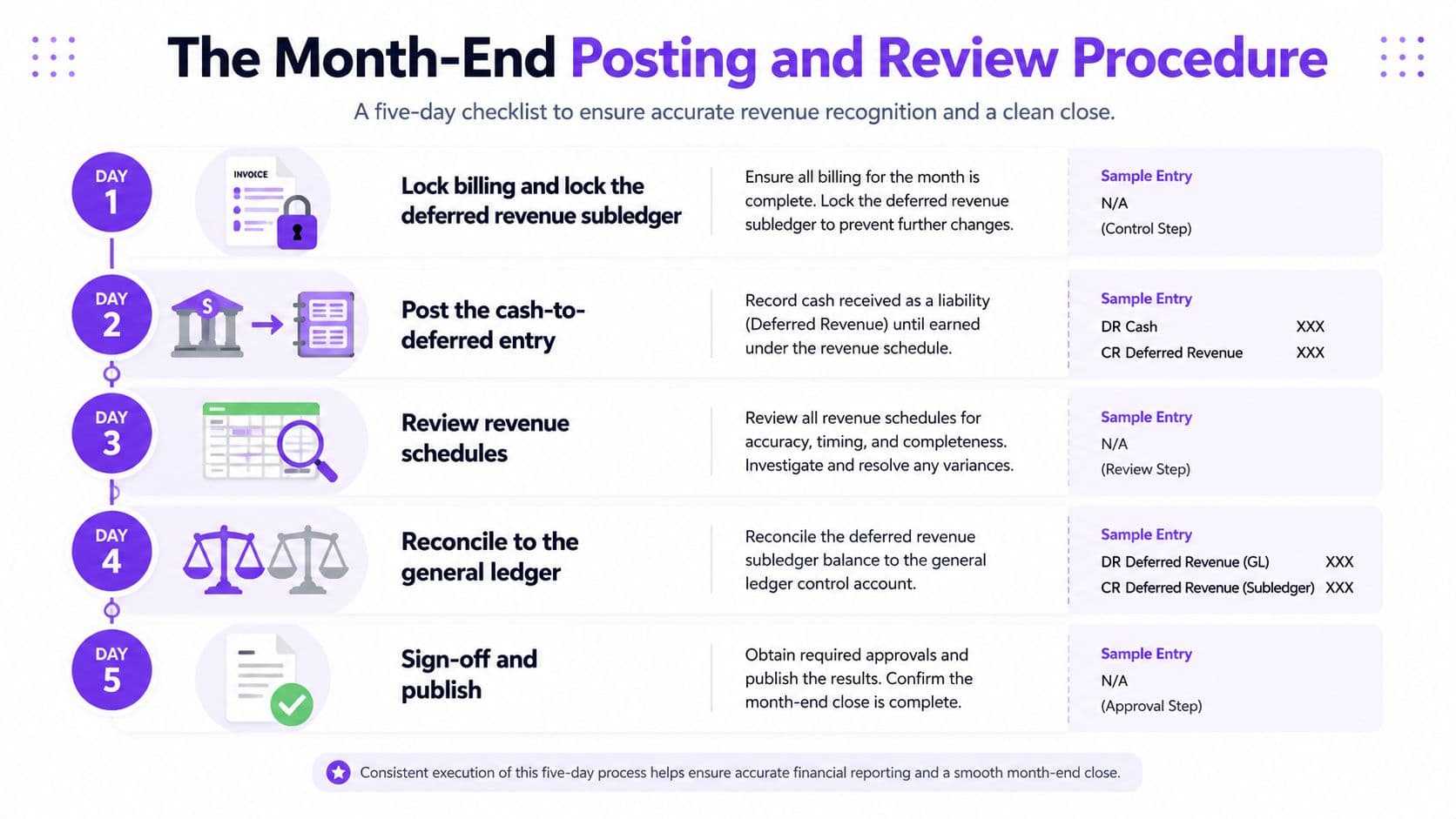
A reliable close treats revenue recognition as a controlled operating process, not a recurring spreadsheet exercise. Use a five-day sequence and assign an owner for each handoff.
Day 1 and Day 2
Day 1 locks the inputs. Lock billing activity and the deferred revenue subledger. After the lock, invoice edits require documented approval because a change can alter the schedule and the period's revenue.
Day 2 posts the billing entries. Record new cash-to-deferred or receivable-to-deferred activity, then run the recurring recognition batch. The basic entries should be system-generated, but the accounting team must review the source contracts and schedule status.
Day 3 through Day 5
| Day | Action | Required review |
|---|---|---|
| Day 3 | Post earned-but-unbilled revenue | Match delivery evidence to contract assets |
| Day 4 | Reconcile subledgers | Tie deferred revenue and contract assets to the GL |
| Day 5 | Approve and publish | Store controller or CFO sign-off |
Review the deferred revenue rollforward, contract asset aging, recognition schedule, and revenue by product or subsidiary. Oracle NetSuite documentation shows that revenue recognition journal entries can be system-generated and filtered by posting period, subsidiary, approval status, and schedule status, which makes the review workflow as important as the entry itself. See the NetSuite revenue recognition journal documentation for the system behavior.
Flag automated entries that exceed your documented materiality threshold, contracts without signed support in the repository, and contract assets that haven't converted to AR within 90 days. Hard-close the period by the seventh business day. Automation handles calculation and posting, but it doesn't replace judgment about contract terms, cutoff, or approval.
Audit-Ready Documentation and Internal Controls
Auditors usually test whether the contract exists, whether the amount is accurate, and whether the entry belongs in the reported period. Your documentation should answer those questions without requiring a finance team member to reconstruct the transaction from email threads.
Evidence by control objective
| Control Objective | Documents to Retain | Reviewer / Approver |
|---|---|---|
| Existence | Signed order form, MSA, SOW, change orders | Controller |
| Accuracy | Allocation memo, standalone selling prices, schedule calculation | Revenue accountant and controller |
| Cutoff | Invoice report, delivery evidence, service-period reconciliation | Controller or CFO |
| Completeness | Contract register, billing export, subledger-to-GL reconciliation | Finance manager |
| Manual-entry governance | Entry support, exception explanation, approval record | Controller and designated approver |
Separate duties wherever your team allows it. The person posting cash and billing entries shouldn't approve the recognition batch. Manual entries above your documented threshold should receive dual approval, with the support attached to the journal in the GL rather than stored in an unsearchable inbox.
Investors ask for much of the same material during diligence. Maintain revenue by performance obligation, a deferred revenue rollforward, contract asset aging, and the policy memo describing recognition judgments. Assemble the package quarterly. Rebuilding it during a fundraise is an avoidable distraction.
The system should preserve the original schedule when someone edits a posted journal. If a manual correction changes the GL without changing the underlying recognition plan, the next close can recreate the error unless the team documents the correction and updates the source schedule.
Red Flags That Signal Your Revenue Entries Are Wrong
Your revenue process is leaking if the balance sheet and operating reports tell incompatible stories. Watch for these signals:
- Deferred revenue grows faster than collections. Rebuild the deferred rollforward and compare new billings, recognized revenue, refunds, cancellations, and foreign or intercompany activity.
- Manual recognition entries recur every month. Recurring manual work usually means the schedule isn't connected to billing or the GL. Automate the ratable release and retain an exception queue for unusual contracts.
- Contract assets are missing. If your team delivers services before billing and never records contract assets, revenue is likely understated or misclassified. Add an unbilled-work memo tied to delivery evidence and billing dates.
- Approvals remain stale. An approval that never triggers, or auto-approves after 30 days, weakens the audit trail. Enforce escalation rules and require a named reviewer for exceptions.
The fix should match the symptom. Don't just post a correcting entry and move on. Find the broken contract mapping, schedule, cutoff rule, or approval control that created it.
A clean close is not a pile of balanced debits and credits. It's a traceable chain from contract terms to delivery evidence to approved GL entry.
Quick-Reference Journal Entry Lookup
Use this table during close. Each row gives you the debit, credit, timing trigger, and ASC 606 step that controls the entry.
| Scenario | Debit | Credit | Timing | ASC 606 Step |
|---|---|---|---|---|
| Annual subscription billing | Cash | Deferred revenue | At billing or collection | Step 3 |
| Monthly subscription release | Deferred revenue | Subscription revenue | As access is provided | Step 5 |
| Earned but unbilled | Contract asset | Service revenue | Before invoice issuance | Step 5 |
| Invoice converts asset | Accounts receivable | Contract asset | When billing is unconditional | Step 5 |
| Multi-element allocation | Cash or AR | Obligation deferred accounts | At contract billing | Step 4 |
| Implementation delivery | Deferred revenue | Implementation revenue | At milestone or completion | Step 5 |
| Contract modification | Cash or AR | Deferred revenue | When approved and classified | Step 1 |
| Customer credit | Returns and allowances | AR or refund liability | When credit is approved | Step 3 |
| Usage-based consideration | Contract asset or AR | Revenue and refund liability | When estimate is supportable | Step 3 |
| Common error | Revenue | Deferred revenue | Never net the accounts | Avoid |
| Common error | Accounts receivable | Contract asset | Don't reclassify before billing | Avoid |
Two errors deserve special attention. Never net revenue against deferred revenue as a shortcut. The debit to deferred revenue and credit to revenue should remain visible so the release schedule can be reconciled.
Also, don't post contract assets as accounts receivable before the right to payment becomes unconditional. The contract asset records earned consideration that still depends on something in the contract, often invoicing or a milestone.
A reviewer should be able to compare the draft entry to this lookup quickly, then inspect the contract and schedule when the scenario doesn't fit.
Your Next Steps and When to Bring in a Controller
Start with the ledger, not the software purchase. This week, review your chart of accounts and confirm you have separate lines for deferred revenue, contract assets, accounts receivable, refund liabilities, and revenue by material product or service category.
Then test one complete customer journey:
- Pull the signed contract and invoice.
- Confirm the billing entry debits cash or AR and credits deferred revenue when appropriate.
- Verify the recognition schedule follows the service period.
- Trace the monthly entry into the GL.
- Reconcile the ending balance to the subledger.
- Store the approval and supporting evidence with the entry.
During the first quarter, formalize allocation policies for bundled contracts, modification classifications, variable consideration constraints, credits, and refunds. Build the audit-ready packet described earlier, then test it on a customer with multiple obligations. If your accounting platform can't preserve contract-level schedules, dimensions, approvals, and exception history, replace the spreadsheet layer before transaction volume makes the cleanup harder.
Bring in an outsourced controller when you reach an annual revenue level above $2M, prepare for your first external audit, start an institutional fundraise, rely on recurring manual journal entries, or see deferred revenue grow faster than recognized revenue for two consecutive quarters. Each trigger signals a different risk, but all point to the same need, someone must own the revenue architecture instead of treating it as bookkeeping cleanup.
Jumpstart Partners offers controller-led finance ops for founder-led B2B AI SaaS teams—monthly close, reporting, and billing support scoped after the Finance Ops Diagnostic.