Financial Operations
How to Track Business Expenses for Investor-Ready Financials
Learn how to track business expenses with our guide for founders. Build an automated system for clean financials, a faster close, and investor confidence.
ByJumpstart Partners, CPA, QuickBooks ProAdvisor
··17 min readA robust system for tracking business expenses isn't about collecting receipts. It's about combining a clear policy, a strategically designed chart of accounts, and the right software to translate every dollar spent into actionable intelligence. This is how you stop just "doing the books" and start managing your finances—ensuring your data is always clean, accurate, and ready to guide your next strategic move.
Why Your Messy Expense Tracking Is a Direct Threat to Your Valuation

For the founder of a growing company, messy expense tracking isn't a minor bookkeeping headache. It's a direct threat to your valuation, runway, and the trust you've built with investors. When your financials are a black box, you are losing credibility with every uncategorized transaction.
You cannot accurately calculate mission-critical metrics like Customer Acquisition Cost (CAC) or Gross Margin. You are forced to make significant strategic bets completely blindfolded. We see it constantly: a disorganized P&L is a massive red flag that derails funding rounds and kills M&A deals before they even start. Inaccurate data is a self-inflicted wound.
The core of this is what expense management is and how it works: the complete process your business uses to handle spending, from purchase to reporting.
Warning Signs: The Hidden Costs of Inaccurate Data
The hidden costs of bad expense tracking go far beyond wasted time. Sloppy numbers create major strategic and financial risks that undermine your company’s growth.
- Flawed Strategic Planning: Without accurate expense data, your budgets are just guesswork. You will pour money into an unprofitable marketing channel or fail to cut costs in a bloated department simply because you cannot see the real numbers.
- Eroded Investor Confidence: During due diligence, investors will tear your financials apart. A pile of uncategorized expenses or an inability to explain spending patterns screams operational weakness and a lack of financial discipline. This is a deal-killer.
- Compromised Valuations: A classic, costly mistake is misclassifying Cost of Goods Sold (COGS) as a general operating expense. For a SaaS company, this artificially inflates your gross margins—a key metric for valuation. When an investor finds this (and they will), they will correct it, and your valuation will instantly drop.
- Cash Flow Blindness: Disorganized expenses mean you have no real-time view of your cash burn. This makes it impossible to accurately forecast your runway, leaving you wide open to surprise cash crunches that can kill the business.
"A well-defined expense policy isn't about control; it's about clarity and speed. It eliminates the guesswork for employees and the back-and-forth for finance, allowing everyone to focus on their actual jobs." – Sarah Jennings, Controller-led finance ops
Strong financial controls are the absolute bedrock of sustainable growth. Mastering how to track business expenses is one of the highest-leverage activities you can undertake to build a resilient, fundable, and valuable company.
Your Financial Blueprint: Chart of Accounts & Expense Policy
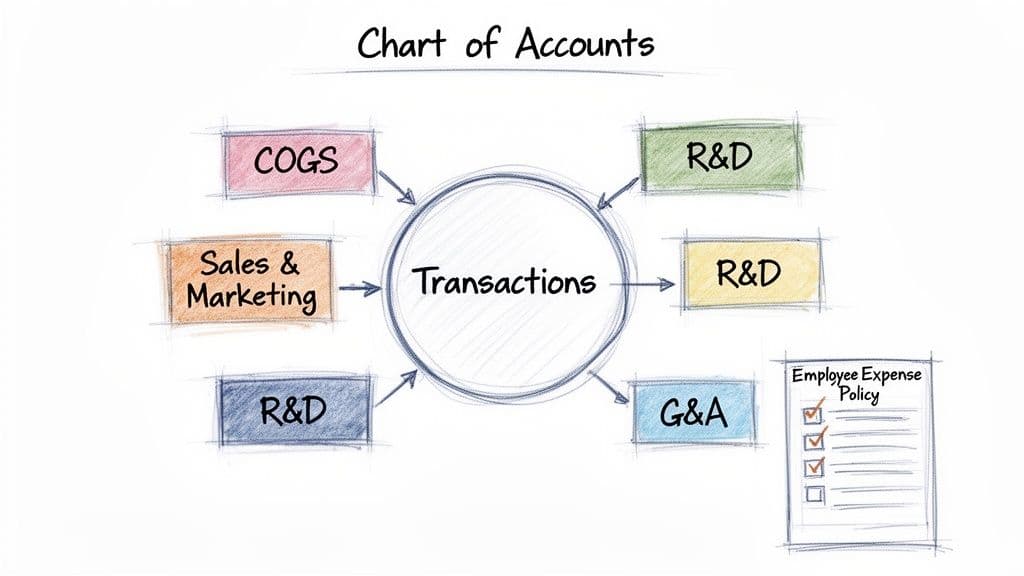
Before you can track a single expense, you need a financial blueprint. Skipping this step is like building a house without a plan—it only guarantees a painful and expensive cleanup project later. This blueprint has two parts: a well-designed Chart of Accounts and a clear employee expense policy. Getting this foundation right from day one prevents 90% of future bookkeeping headaches.
Common Misconception: "An Expense Policy Creates Bureaucracy"
This is fundamentally wrong. A simple, clear policy does the exact opposite: it empowers your team by giving them clear guardrails, which removes ambiguity and speeds everyone up. Your expense policy does not need to be a 50-page legal document. A one-page guide is all you need. It must clearly define three things: what’s reimbursable, spending limits, and the submission process.
For example, your policy must state that any software subscription over $100/month requires manager approval. Or that a client lunch is reimbursable up to $75 per person. This clarity prevents awkward conversations and ensures spending stays aligned with your budget without constant oversight. It also sets the expectation that without a receipt submitted within 7 days, reimbursement will not happen. No exceptions.
Design a Chart of Accounts for Your Business Model
The default Chart of Accounts (COA) in accounting software like QuickBooks or Xero is fatally flawed for any modern SaaS or services company. It’s a generic template that mixes up the costs of delivering your service with the costs of running your business. This makes an accurate Gross Margin calculation—one of the first metrics any investor will scrutinize—completely impossible.
Your COA is the organizing framework for every dollar that moves through your company. To build a strong financial foundation, it's critical to master the bookkeeping basics for small business. For SaaS and services firms, that means customizing your COA to map every expense into four key buckets:
- Cost of Goods Sold (COGS): Expenses directly tied to delivering your product. For a SaaS company, this means server hosting (AWS), third-party data APIs, and salaries for your customer success team.
- Sales & Marketing (S&M): All costs associated with acquiring new customers. This bucket holds everything from sales commissions and CRM software to ad spend and conference sponsorships.
- Research & Development (R&D): Expenses related to building and improving your product. Think engineer salaries, product management tools, and prototyping costs.
- General & Administrative (G&A): The overhead required to keep the lights on. This includes rent, legal fees, accounting costs, and executive salaries.
This structure immediately shows you where your money is going and lets you calculate the metrics that actually matter. You can see a detailed example of this structure in our guide on what makes up a general ledger.
Sample Chart of Accounts with Calculations
This table shows a simplified but effective Chart of Accounts structure, differentiating between Cost of Goods Sold and standard Operating Expenses for clear SaaS metric reporting.
| Category | Account Name | Example & Monthly Cost |
|---|---|---|
| Cost of Goods Sold | Hosting Costs | Expenses for cloud infrastructure. Ex: $8,000 for AWS. |
| Cost of Goods Sold | Customer Support Salaries | Base pay for support team members. Ex: $12,000. |
| Sales & Marketing | Digital Advertising | Paid campaigns on Google/LinkedIn. Ex: $15,000 ad spend. |
| Sales & Marketing | Sales Commissions | Variable compensation for your sales team. Ex: $25,000. |
| R&D | Engineering Salaries | Base pay for your developers and product team. Ex: $60,000. |
| G&A | Office Rent | Lease payments for your physical office space. Ex: $10,000. |
| G&A | Professional Fees | Costs for legal or accounting services. Ex: $5,000. |
With this structure, every dollar has a specific home. Now you can automate the capture and categorization process, confident that the underlying data is accurate and strategically sound.
Your Automated Expense Management Tech Stack
If your team is wrestling with spreadsheets, chasing receipts, or using personal cards for business buys, you're not just being inefficient—you're actively capping your company's ability to scale. Your best people should focus on growth, not data entry. Automating how you track business expenses isn't a luxury; it's a non-negotiable step in building a modern finance function.
The right tech stack stops expense management from being a reactive, messy chore and turns it into an automated, strategic workflow. It connects every dollar spent directly to your general ledger, giving you a real-time, accurate view of your cash position.
Core Components of a Modern Tech Stack
For any scaling SaaS or services company, your tech stack is an ecosystem, not a single tool. The goal is a seamless flow of data from the point of purchase to your financial statements, with almost no human touch required.
- Corporate Card & Expense Platform: The heart of your spend management. Modern platforms like Ramp or Brex bundle corporate cards with software to automate receipt capture, expense categorization, and policy enforcement as spending happens.
- Accounting Software: Your system of record. Think QuickBooks Online, Xero, or NetSuite. It's the final destination for all your clean, categorized transaction data.
- Payment Processor: Platforms like Stripe are a huge source of both revenue and expense data (like processing fees). A direct integration is critical for accurate accounting.
- Payroll & HRIS Provider: Systems like Gusto manage your single largest expense: people. Integrating payroll ensures that salary, benefits, and tax costs are booked correctly every time.
Legacy tools like Expensify are reactive—they focus on reimbursing employees after they’ve already spent the money. Modern platforms are proactive; they control spending at the source. For a scaling company, there is no debate: you need proactive control.
"A modern expense platform doesn't just record what happened; it dictates what can happen. By embedding policy rules directly into the card, you eliminate out-of-policy spend before it even occurs. It's the difference between cleaning up a mess and preventing it entirely." – Finance Executive at a Series B SaaS Company
Tech Stack Comparison: Proactive vs. Reactive
When you evaluate platforms, zero in on features that solve the real-world headaches of a growing business.
| Feature | Modern Platforms (Ramp, Brex) | Legacy Platforms (Expensify) |
|---|---|---|
| Spending Control | Proactive: Enforce rules at swipe. | Reactive: Flags violations after spend. |
| Receipt Matching | Automated via SMS, email, or app. | Manual upload and matching required. |
| GL Sync | Direct, deep integrations with QBO, Xero. | Requires manual export/import. |
| Business Impact | Prevents out-of-policy spend. | Creates cleanup work for finance. |
| Best For | Scaling companies seeking total control. | Companies with traditional T&E models. |
A Real-World Automation Workflow
Let’s walk through how this actually works. Your marketing manager needs a new $500/month subscription for a market intelligence tool.
- Request: The manager logs into Ramp and requests a new virtual card with a $500 monthly limit and a pre-set expiration date.
- Approval: Their director gets a Slack notification and approves the request with a single click. No emails, no meetings.
- Purchase & Capture: The manager immediately uses the virtual card. The moment the transaction goes through, Ramp texts them: "Reply with a photo of your receipt for this $500 purchase at Semrush." They snap a picture, and the receipt is automatically matched.
- Coding & Syncing: Because you’ve already set up rules, Ramp automatically codes this expense to your "S&M: Software" GL account and syncs it directly to QuickBooks Online overnight.
The entire process took minutes and required zero work from your finance team. The expense was captured, categorized, and synced correctly without anyone ever touching a spreadsheet. When you’re ready to apply this same thinking to your vendor payments, our guide to accounts payable best practices can show you how to apply similar automation principles.
How to Achieve a Repeatable 5-Day Month-End Close
If your month-end close takes 20 days, you’re steering your company with a two-week-old map. You're flying blind, making strategic decisions with outdated information. A fast, accurate close isn't a vanity metric; it's the ultimate proof of a well-oiled financial machine. The goal is to turn a chaotic scramble into a predictable routine that delivers investor-ready financials by the fifth business day of every month.
The secret isn’t working faster during the close. It's having the right systems in place before the month even ends. A successful close is simply the result of disciplined daily and weekly financial habits, all powered by automation. It transforms bookkeeping from a mad dash into a systematic verification process.
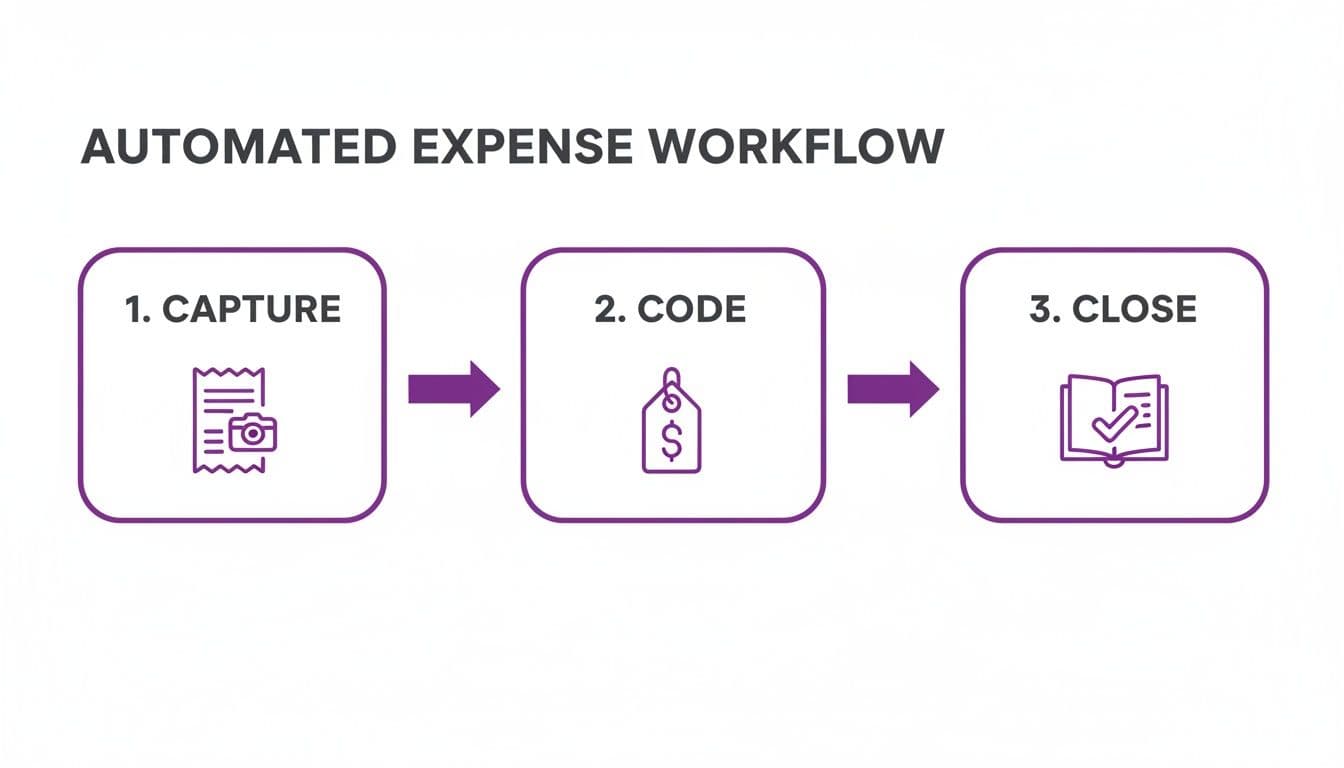
When the heavy lifting is automated in real-time, your close becomes a simple process of reconciliation and review.
The 5-Day Month-End Close Checklist
A compressed close is a tightly choreographed sequence of events. It demands clear ownership and a non-negotiable timeline. This checklist is a roadmap that assigns clear ownership and deadlines, ensuring everyone knows their role.
| Day | Key Tasks | Owner |
|---|---|---|
| Day 1-2 | Pre-Close & Final Data Sync: - Ensure all bank and card feeds are fully synced. - Send final reminders for missing receipts. - Post recurring journal entries (e.g., depreciation). | Bookkeeper / Finance Team |
| Day 2-3 | Reconciliation & Accruals: - Reconcile all bank, credit card, and payment processor accounts. - Review and book payroll and benefits entries. - Accrue for major unbilled expenses. | Controller / Senior Accountant |
| Day 4 | Review & Adjustments: - Perform a variance analysis (Actuals vs. Budget). - Make final adjusting journal entries. - Review preliminary P&L, Balance Sheet, and Cash Flow Statement. | Controller / Controller-led finance ops |
| Day 5 | Final Reporting & Close: - Lock the books for the period. - Generate the final financial reporting package for leadership. - Distribute reports. | Controller-led finance ops / Head of Finance |
This timeline is only possible when the foundational work is automated. For a deeper look at the systems that make this possible, explore our guide on automating your financial reporting.
Worked Example: Reconciling a Stripe Payout
Let's walk through a classic reconciliation headache that grinds the month-end close to a halt. Your company receives a $50,000 payout from Stripe. But the deposit in your bank is only $48,550. Without a proper process, that missing $1,450 becomes a painful mystery.
Here’s how to handle it cleanly:
- Start with Gross Revenue: Your Stripe dashboard confirms $50,000 in gross sales. Record this full amount. Do not start with the net deposit.
- Isolate the Fees: Stripe’s reporting will detail the $1,450 in processing fees. This belongs in your Cost of Goods Sold (COGS).
- Book the Correct Journal Entry:
- Debit (Increase) Cash: $48,550 (money in the bank).
- Debit (Increase) COGS - Processing Fees: $1,450 (the cost to process the sale).
- Credit (Increase) Revenue: $50,000 (the full sale amount).
This single entry ensures your revenue is stated correctly, your COGS are accurate (which protects your Gross Margin calculation), and your bank account reconciles perfectly.
Turn Your Financial Data Into Strategic Insights
Clean data is just the beginning. The real value is unlocked when you translate numbers into smarter decisions for your leadership team, board, and investors. This is how you shift from reactive bookkeeping to proactive financial strategy.
Calculating Your True Customer Acquisition Cost
One of the most powerful things you can do with clean expense data is calculate a true Customer Acquisition Cost (CAC). A vague CAC is a guess; a precise CAC is a strategic weapon. With a properly categorized Chart of Accounts, you can finally isolate every dollar spent on acquiring customers.
This isn't just your ad spend. It’s the sum of all your sales and marketing expenses for a specific period, including:
- Sales and marketing team salaries and commissions
- Digital advertising spend (Google, LinkedIn, etc.)
- CRM and sales software costs (Salesforce, HubSpot)
- Conference and trade show expenses
Worked Example: Calculating True CAC In Q1, your total sales and marketing expenses, pulled directly from QuickBooks or Xero, were $50,000. During that same quarter, you acquired 50 new customers.
- Calculation:
$50,000 (Total S&M Expenses) / 50 (New Customers) = $1,000 CAC
Now you have a hard number. Compare this to your Customer Lifetime Value (LTV) to determine if your business model is viable. If your LTV is $4,000, your LTV:CAC ratio is 4:1. According to OpenView's 2024 SaaS Benchmarks, a target LTV:CAC ratio is 3x or higher, so a 4:1 ratio signals a healthy and efficient growth engine to investors.
Monitoring Budget vs. Actuals and Burn Rate
Accurate expense tracking gives you the power to manage your cash with precision. When real-time data flows into your accounting software, running a Budget vs. Actuals report becomes a powerful exercise. This isn't about blaming department heads. It's about having informed conversations. Why did Engineering spend 20% more on cloud hosting? Is it due to a new feature launch driving up usage (a good thing), or an unmanaged cost overrun (a bad thing)? Our guide on mastering actuals vs budget analysis dives deeper into how to have these strategic conversations.
This same data feeds directly into your net burn rate—the speed at which you are spending cash.
"Investors don't just want to see your revenue; they want to see your command of the numbers. Demonstrating a clear understanding of your burn rate, departmental spending, and unit economics is what separates a company that has financials from a company that understands its finances." – Alex Williams, Venture Partner
If your monthly recurring revenue is $100,000 and your total expenses are $130,000, your net burn is $30,000 per month. If you have $300,000 in the bank, you have 10 months of runway. This clarity is non-negotiable for managing growth and planning your next funding round.
Actionable Next Steps: Your 30-Day Implementation Plan
Reading about a good system is one thing. Building it is another. This is your practical, 30-day plan to install a rock-solid expense tracking system and generate financials that are clean, accurate, and investor-ready.
| Week | Action Items & Goals |
|---|---|
| Week 1 | Define the Blueprint: 1. Customize your Chart of Accounts. Decide exactly what goes into COGS, S&M, R&D, and G&A. 2. Draft a one-page expense policy with clear spending limits (e.g., "$250/mo software limit") and submission rules ("receipts within 3 days"). |
| Week 2 | Build Your Tech Backbone: 1. Select and set up your core expense platform (Ramp, Brex). 2. Integrate it directly with your accounting software (QuickBooks, Xero). 3. Configure your policy rules into the software to automate enforcement. |
| Weeks 3-4 | Train, Test, and Go Live: 1. Schedule a mandatory 30-minute team training. Show them how to submit expenses in 30 seconds on their phone. 2. Run a full trial month-end close to find and fix friction points. 3. Go live and enforce the "no receipt, no reimbursement" rule. |
Common Objections & Questions
My team hates submitting receipts. How do I get them to comply? You remove the friction. They hate it because your process is broken. Implement a tool like Ramp where submitting a receipt is as easy as replying to a text. Then, make the policy non-negotiable: no receipt, no reimbursement. When getting paid back is tied to a process that takes 10 seconds, compliance sorts itself out.
How often should I really reconcile my accounts? Do not wait for month-end. That's a recipe for an error-prone fire drill. With modern software syncing transactions daily, you must reconcile key accounts weekly. This takes 30-60 minutes and prevents a massive cleanup project, ensuring you’re always operating with a near-real-time view of your cash.
At Jumpstart Partners, we implement the policies, technology, and workflows to build a tighter month-end close routine and investor-ready financials so you can focus on scaling your business. If you're ready to get this handled by experts, schedule a free consultation with us today.