Financial Operations
Internal Controls Assessment: Guide for Growing Businesses
Run a defensible internal controls assessment with our practical guide. Covers scoping, testing, documentation, findings, and remediation for growing
ByJumpstart Partners, CPA, QuickBooks ProAdvisor
··18 min readA single failed reconciliation can do more damage than most founders expect. It can stall an audit, delay a fundraise, or expose a control gap that makes investors wonder what else is off. That's why an internal controls assessment is not a Big Four ritual for public companies, it's a recurring operating discipline for any business that's trying to grow without losing control.
The standard still starts with COSO's five components, formalized in 1992, because it gives you a common way to map risks to controls and test whether those controls are designed properly and operating effectively (KPMG practical guide on internal control). And the work is not quick. KPMG's 2024 benchmarking report says an enterprise-wide review can take six to nine months (KPMG SOC reporting benchmarking factsheet). If your business is moving fast, that timeline is exactly why you need a plan, not a spreadsheet scramble.
Table of Contents
- Why Weak Internal Controls Cost Founders Real Money
- How to Scope an Assessment for a SaaS or E-Commerce Business
- The Control Areas That Matter Most in a Growing Business
- Testing Controls Step by Step Without an Audit Team
- Common Findings and How to Remediate Them Fast
- DIY, In-House, or Outsourced Controller Which Model Fits
- Your 90-Day Internal Controls Assessment Plan
Why Weak Internal Controls Cost Founders Real Money
Weak controls do not show up as one giant disaster. They show up as a chain of expensive misses, a bad close, a delayed audit, a contract that never gets reviewed, a payout that does not tie, a payroll exception nobody catches until the vendor calls. In a $1M to $5M ARR business, those misses hit cash, credibility, and time at the same time.
The clean way to think about this is direct. An internal control exists to protect an objective, and the assessment tells you whether that protection holds up. Standard control guidance breaks the work into a disciplined sequence, identify the relevant controls, evaluate design adequacy, test implementation, and verify that transactions are properly documented (KPMG practical guide on internal control). That sequence matters because founders often confuse “we do this every month” with “we can prove it works.”
Practical rule: If a control cannot survive a sample test, it is not a control, it is a habit.
Founders usually treat internal controls as optional until they need audit readiness, investor diligence, or clean financials. That order is backward. A structured assessment protects financial reporting, fraud prevention, and noncompliance risk before those issues surface. The COSO framework exists for exactly that reason, with its five components giving you a standard reference point for assessing both design and operating effectiveness.
This also gets practical fast. If you are preparing for a lender review, fundraising, or a first formal audit, you do not want to find out late that approvals were informal, access was never reviewed, or transaction support lived in scattered inboxes. A strong audit preparation checklist helps you compare your process against the records finance teams should already have ready.
A good assessment does more than catch errors. It shows whether your business can scale without adding hidden risk to every close.
The point is not perfection. The point is repeatability. Once your controls can be described, tested, and monitored, you stop relying on memory and heroics.
How to Scope an Assessment for a SaaS or E-Commerce Business
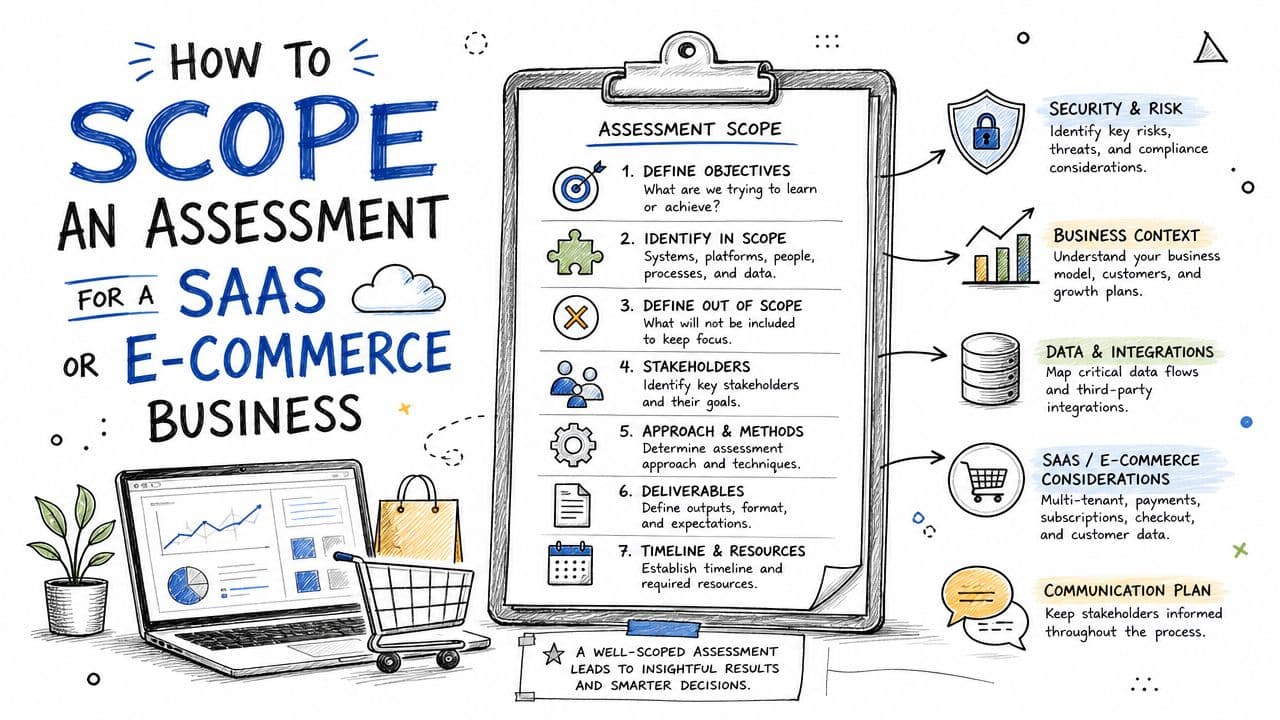
Scoping is where small finance teams either get disciplined or burn time on the wrong work. You do not assess every process at once. You start with the entities, systems, and accounts that can distort reporting, then expand from there. A control assessment should begin by defining the objective and scope, ranking the risks, mapping each risk to a control, and testing the highest-risk items first, as GAO internal control guidance lays out.
Start with the systems that actually move money
For a SaaS or e-commerce business, the scope usually sits in a short list of core systems, not the full tech stack. The general ledger, billing platform, payroll system, and any sales or fulfillment system that feeds financial reporting belong in scope before anything cosmetic does. KPMG's SOC benchmarking work shows that a broad review can stretch for months, so a small business needs a tighter scope or the work will drift.
Use the revenue model to set the scope. A subscription business should center on billing, revenue recognition, cash application, refunds, and access to customer and finance data. An e-commerce company should center on order flow, payout reconciliation, inventory, returns, and tax handling. That is how you keep the assessment tied to reporting risk instead of a generic checklist.
The fastest way to control the work is with a matrix. Map each risk to one owner, one frequency, and one piece of evidence. If a control cannot fit in that format, it is too vague to manage.
Anchor the scope to business reality
Scope differently if you are pre-audit, pre-fundraise, or already under investor pressure. If the board wants clean numbers next quarter, test the accounts and processes that feed the board pack first. If you are chasing a lender or buyer, bring every process that touches revenue, cash, and payroll into view.
For a $6M ARR SaaS company, the practical scope is narrow, Stripe billing, ASC 606 revenue recognition, payroll through Gusto, and QuickBooks Online as the general ledger. This is the reporting chain that matters without pretending the team has Big Four headcount. Jumpstart Partners' accounting for SaaS guidance is useful here if you need a clean way to decide which SaaS processes deserve priority.
Scope the assessment around the reporting chain, not around org charts. Money flows, data flows, and risk follows both.
Use a simple rule. Start with the processes that feed revenue, cash, payroll, and tax, then pull in supporting controls around access and approvals. In a headcount-constrained business, that usually means compensating controls too, manager review, owner sign-off, and a documented check where full segregation of duties is not realistic.
The Control Areas That Matter Most in a Growing Business
A weak control environment does not announce itself. It shows up as sloppy approvals, stale access, missed reconciliations, and one founder carrying too much of the financial process. For a headcount-constrained SaaS or e-commerce company, the goal is not a Big Four-style control tower. It is a small set of controls that stop obvious errors before they hit the books and catch the rest fast enough to fix them.
The control framework still comes back to the same five parts, control environment, risk assessment, control activities, information and communication, and monitoring (HUD internal control framework). Keep that structure in mind, then strip it down to the few controls that matter in a growing business. If a control does not protect revenue, cash, payroll, tax, or system access, it is usually noise.
Put the highest-risk processes in one matrix
| Risk Area | Key Control Activity | Control Type | Owner | Frequency | Sample Evidence |
|---|---|---|---|---|---|
| Revenue recognition | Reconcile Stripe payouts to QuickBooks and tie deferred revenue or billed revenue to the contract terms | Detective | Controller or finance lead | Monthly | Stripe payout report, GL tie-out, revenue schedule |
| Access management | Review user access and remove unused or excessive permissions | Preventive and detective | Ops or finance system owner | Quarterly | Access review log, user list, deprovisioning record |
| Cash and tax | Require dual approval on wires and review tax filings before submission | Preventive | CFO or founder, with finance support | Per transaction and monthly | Wire approval trail, filed return, checklist |
| Payroll | Separate payroll setup from payroll approval, then review exceptions | Preventive and detective | Finance manager or outsourced controller | Each payroll cycle | Payroll register, approval evidence, exception log |
The matrix should stay tight. A founder-led team does not need thirty control points. It needs a short list of repeatable checks that map to the processes most likely to create a bad number or a cash leak. Start with the reporting chain, then tie each control to a clear owner and a piece of evidence you can save and review.
Many small companies need compensating controls. You may not have enough people to fully separate duties, so the answer is not to pretend the risk disappears. The answer is to build a second line of defense through review, documentation, and exception tracking, exactly the kind of approach described in segregation of duties guidance. If one person sets up the vendor, enters the bill, and releases the payment, an independent review of the vendor master, payment run, or bank activity has to catch the gap.
The internal-control guidance is plain on smaller teams. You will not separate every function cleanly, and that means monitoring has to do more work. Use access reviews, owner sign-off, and exception reports to cover known weak spots. A control that depends on hope is not a control.
Bottom line: In a small company, weak access control and sloppy approvals are financial reporting problems, not admin problems.
For a growing business, the highest-value controls are the ones that are easy to run every month without drama. If the process cannot be owned, tested, and evidenced by a finance team that is already stretched thin, it is too complex for the stage of the company.
Testing Controls Step by Step Without an Audit Team
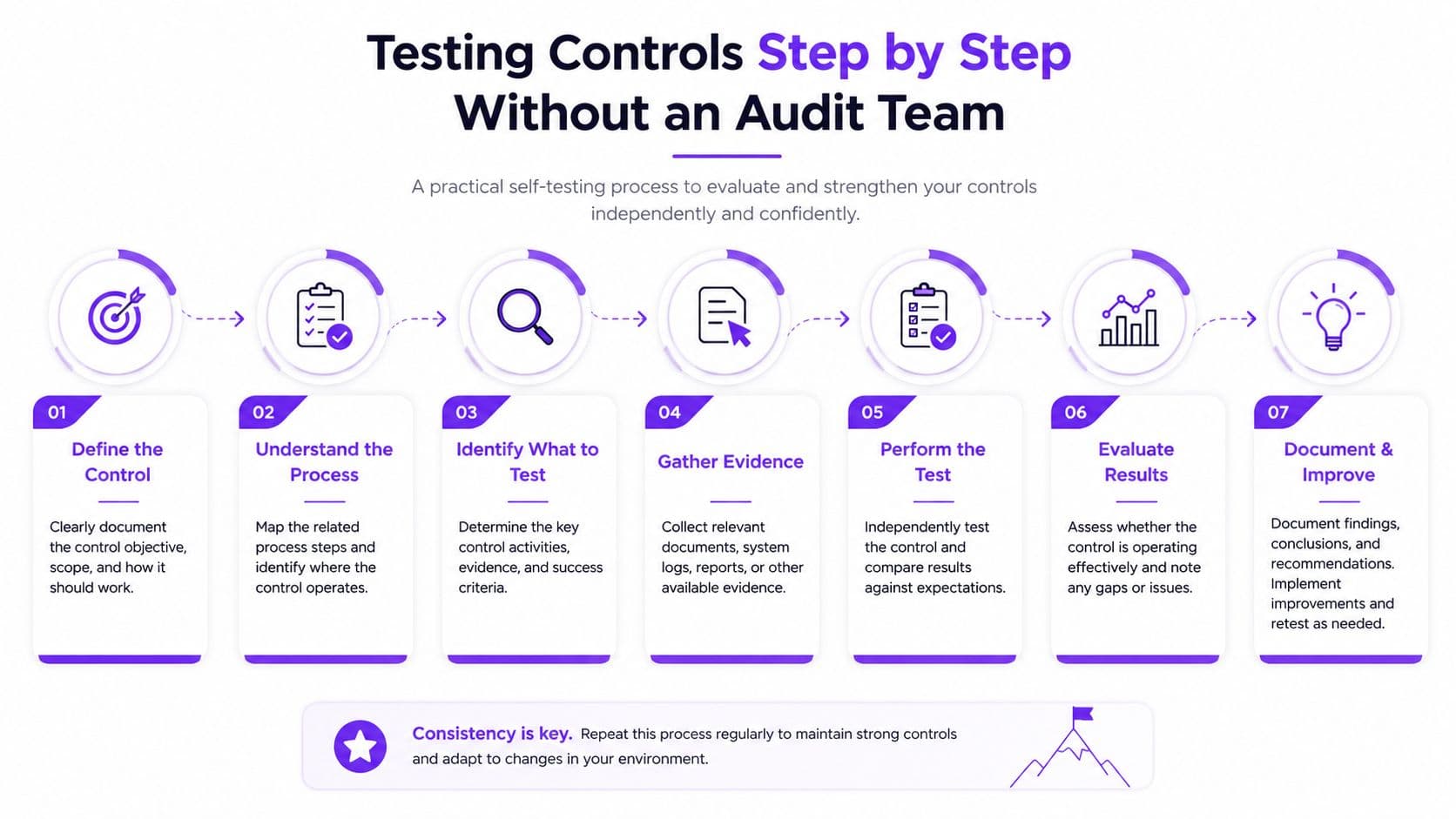
Testing controls is where theory gets expensive if you skip the evidence. A process can look fine in a meeting and still fail when you pull a sample. For a small SaaS or e-commerce company, the right approach is plain, define the control objective, walk the process, test whether the control is designed to catch the risk, then test whether it ran and left proof behind. That is the discipline described in the GAO internal control guidance.
Use the right test for the right control
The State of Washington's internal-control assessment template is useful because it forces a clean classification of each control as manual, automated, or manual using system-generated information. It also asks you to record the test objective, the procedures performed, the sample deficiencies, and whether the control is reliable (Washington internal controls assessment template). That matters in a real finance stack. A manual reconciliation needs human evidence. A system edit check needs proof of configuration. A hybrid control needs both.
For a headcount-constrained team, testing should follow a simple sequence.
- Walk the process. Follow one transaction end to end and note who touches it, where the data changes, and what evidence remains.
- Test design. Confirm the control would stop the risk or catch it quickly if performed the way it is written.
- Test operating effectiveness. Pull a sample from the period and verify the control was performed, not just described.
- Review exceptions. Tie each miss back to the root cause and assign the fix.
Use the right sample for the control frequency and the size of the population. If a team processes a monthly population and the sample shows repeated misses, the control is not reliable enough to carry the close. Wolters Kluwer's internal control testing guidance recommends defining the population clearly, sizing the sample to the frequency and transaction volume, and using full-population testing where that makes more sense than random sampling (Wolters Kluwer internal control testing guidance). That is the right posture for a SaaS or e-commerce business where a small number of transactions can still move cash or revenue in a material way.
A control is only as good as the proof behind it.
Don't confuse a good design with a good result
A control can be well designed and still fail in practice. A revenue review might require the reviewer to check contract terms, but if that person signs the report without opening the contract, the control fails even though the checklist looks complete. That is the difference between design effectiveness and operating effectiveness, and it is why a walkthrough alone does not tell you enough.
Rule of thumb: If the person performing the control cannot show the evidence in under a minute, the control is probably too weak or too informal.
Small companies do not need a full audit team to do this well. They need a repeatable process, a sample that matches the volume, and the discipline to write down failures exactly as they happened. For teams that still struggle with bank tie-outs, how to reconcile bank accounts is a practical reference for the reconciliation mechanics. For documentation discipline that will stand up when someone else reviews the file later, use Preparing logistics records for buyers as a model for how to keep records complete, legible, and easy to retrieve.
Common Findings and How to Remediate Them Fast
The same defects show up over and over in SaaS, agency, and e-commerce finance stacks. They're boring, which is why they're dangerous. Most of them come from one of three places: a process that wasn't written down, a control that nobody performs, or a system that produces data no one reviews.
Fix the finding, then fix the habit
- Stripe payout timing differences not reconciled monthly. The symptom is a cash balance that looks off by a small amount every month. The root cause is usually a delayed tie-out between processor payouts and the general ledger. Fix it by assigning one monthly owner, pulling the payout report, and reconciling every settlement until the timing difference is explained.
- Missing dunning and churn logs. Revenue recognition breaks when the team can't prove what happened to failed payments, cancellations, or refunds. The fix is to archive those logs in a predictable folder or system export and require a monthly review before close.
- Ghost contractor payments. This usually points to weak vendor onboarding or payment approval. The fix is a vendor master review and a second approver on any new contractor setup or bank detail change.
- Capitalized software that should have been expensed. The symptom is a balance sheet asset that doesn't hold up to scrutiny. The root cause is often a loose policy on what counts as software development cost. The fix is a written capitalization policy and a monthly review of coded project spend.
- Access reviews that haven't happened since onboarding. This is a control failure, not a paperwork issue. The fix is a quarterly access review with deprovisioning tracked to completion and escalated if the owner misses the deadline.
For an adjacent lens on documentation discipline, Preparing logistics records for buyers shows the same principle in a different context, keep the records clean enough that an outside party can understand them without a rescue mission.
The remediation pace should be aggressive. If the finding is small and obvious, close it fast and document the fix. If it keeps coming back, you have a design problem, not an employee problem. That means the control itself is wrong, or nobody owns it, or the system makes it too hard to perform.
Practical advice: Don't write a long memo about the deficiency before you change the process. Fix the control, then write the memo.
A clean remediation plan should name one owner, one deadline, and one evidence requirement. Anything fuzzier turns into open-ended follow-up, and founders never have time for that.
DIY, In-House, or Outsourced Controller Which Model Fits
You have three ways to run this. The wrong choice wastes time, the right choice compresses months of cleanup into a repeatable operating rhythm. The best model depends on how much control maturity you need right now, not on what feels cheapest in the moment.
Compare the operating models honestly
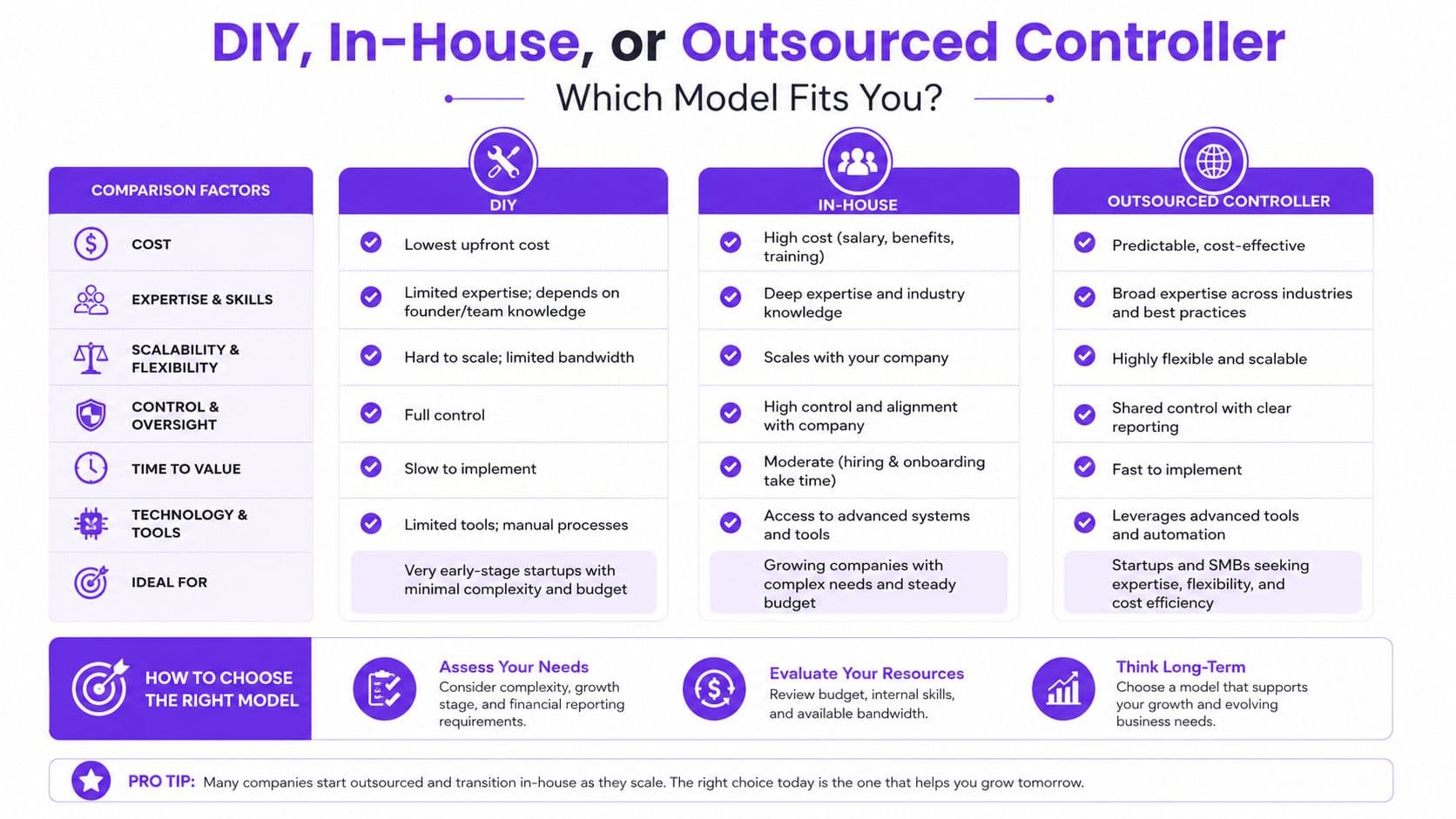
| Model | Indicative Monthly Cost | Time to Reliable Assessment | Best-Fit Stage | Audit-Readiness Outcome |
|---|---|---|---|---|
| DIY | Lowest cash outlay, but highest founder time | Slowest | Under $1M revenue with no planned audit | Uneven, fragile, hard to defend |
| In-house controller | Highest fixed overhead | Moderate | Around $5M+ revenue with a fundraise or audit ahead | Strong if the hire is experienced |
| Outsourced controller | Middle ground on cash, fast on deployment | Fastest for most growing teams | $1M to $5M ARR businesses that need investor-ready financials | Stronger structure without a full-time hire |
The timing guidance matters. Use DIY only when the business is small, the risk is low, and there's no external scrutiny coming. Bring in an in-house controller once the company has enough complexity to justify a full-time owner and the runway to support that hire. Use an outsourced controller when you need speed, structure, and evidence collection without adding headcount.
That outsourced model works well because it connects to the systems you already use, QuickBooks, Xero, NetSuite, Stripe, Shopify, Square, Gusto, and BambooHR. Jumpstart Partners is one option in that category, and its service model centers on outsourced controller and bookkeeping support for growing businesses that need reconciliations, revenue recognition, payroll, and reporting under control.
If you want the decision framework in a cleaner format, Jumpstart Partners' in-house vs outsourced controller decision guide gives you the tradeoffs without the fluff.
My position: If you're still stitching together controls in spreadsheets and your team is under pressure from investors or auditors, outsourced controller support is usually the fastest way to get stable.
Don't buy a model because it sounds strategic. Buy the model that gets you reliable evidence, clear owners, and a close you can defend.
Your 90-Day Internal Controls Assessment Plan
Ninety days is enough if you stay disciplined. It's not enough if you keep widening the scope every time someone finds a loose thread. The goal is to finish with a control matrix, a tested set of high-risk controls, and a remediation log that a board member can read without a follow-up meeting.
Build in weeks, not someday
| Timeframe | Owner | Deliverable |
|---|---|---|
| Weeks 1 to 2 | Founder, CFO, or finance lead | Define scope, systems, entities, and key risks |
| Weeks 3 to 4 | Controller or outsourced controller | Build the control matrix and assign owners |
| Weeks 5 to 6 | Finance team | Perform walkthroughs and confirm design |
| Weeks 7 to 8 | Finance team with independent reviewer | Test operating effectiveness and collect evidence |
| Weeks 9 to 10 | Controller | Remediate failures and retest fixes |
| Weeks 11 to 12 | Founder and finance lead | Summarize results for board, lender, or investors |
Keep the red flags visible. If the control matrix keeps changing, the work isn't scoped. If nobody can produce evidence, the control isn't real. If the same exception shows up twice, you're not dealing with a one-off mistake.
A good assessment ends with fewer surprises in the close, faster answers for investors, and better accountability inside the team. It also gives you a cleaner path to audit readiness because you've already done the hard part, you've identified the control gaps, tested them, and fixed the ones that mattered.
The fastest way to lose momentum is to treat the assessment like a one-time cleanup project. Don't do that. Turn it into a monthly operating rhythm, with ownership, evidence, and review built into the close.
If you want a straight answer on where your controls stand, book a conversation with Jumpstart Partners. They help growing SaaS, e-commerce, and services businesses build controller-level processes, close the gaps in internal controls, and get the books into shape for audits, fundraises, and board reporting.