Financial Operations
8-Step IPO Readiness Checklist for Growing Businesses
Use this IPO readiness checklist to prepare financials, ASC 606, controls, governance, systems, metrics, tax, and compliance for diligence.
ByJumpstart Partners, CPA, QuickBooks ProAdvisor
··20 min readAn IPO can be delayed by weaknesses that seem minor during private-company operations, including incomplete financials, inconsistent revenue recognition, weak access controls, and metrics that change depending on who prepared the report. The SEC review process can expose those gaps quickly. Recent IPO review data cited in the S-1 Readiness Handbook found that the median first SEC comment letter contained 22 comments, compared with 16 before 2022. Half of recent deals took 115 days to clear review, while the slowest quartile took more than 211 days.
That's why an IPO readiness checklist should function as a staged operating plan, not a last-minute audit exercise. This guide is designed for founders, CEOs, and finance leaders at SaaS companies, digital agencies, professional services firms, ecommerce businesses, and other companies generating $500K to $20M in revenue.
Use the timeline to separate urgent cleanup from longer-lead governance work. Major advisory guidance generally places IPO preparation 12 to 24 months before the offering, with many programs beginning 12 to 18 months before filing and some recommending core systems and processes no later than 9 to 12 months before the target IPO date. The Mintz IPO chronology also describes a staged path from organizational meeting to confidential Form S-1 submission, SEC comments, and pricing.
A SaaS company with annual subscriptions must prove that revenue is recognized over the service period. A project-based agency must prove that revenue follows completed work or client-approved milestones. Both businesses need reliable books, but their evidence will look different. Use this checklist alongside a structured M&A due diligence guide to identify missing contracts, approvals, financial support, and corporate records before investors or auditors request them.
Table of Contents
- 1. Establish a 5-Day Month-End Close Process
- 2. Build Investor-Ready Financial Dashboards and KPI Tracking
- 3. Implement Audit-Ready Revenue Recognition Under ASC 606
- 4. Establish SOC 2 Type II Compliance and Data Security Controls
- 5. Establish Separate Controller and CFO Functions With Documented Segregation of Duties
- 6. Build a 13-Week Rolling Cash Flow Forecast and Variance Analysis
- 7. Benchmarks, Sources, and Cross-Workstream Evidence for IPO Readiness
- 8. Use External Support and a Practical Implementation Path
- 8-Item IPO Readiness Comparison
- Turn the Checklist Into an IPO Readiness Roadmap
1. Establish a 5-Day Month-End Close Process
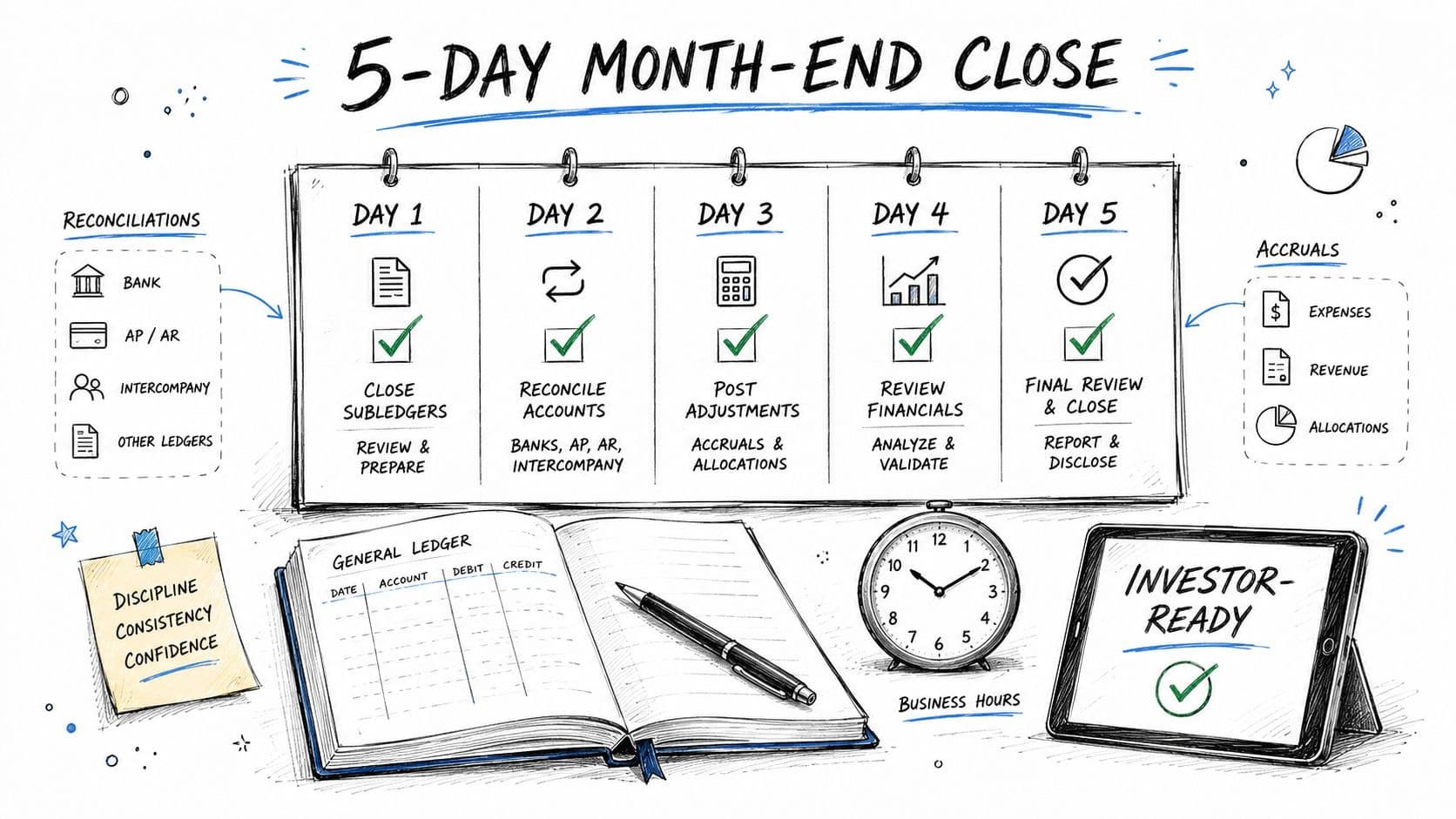
A five-day close gives founders and finance leaders reliable answers about revenue, spending, receivables, and cash. The DFIN IPO readiness checklist identifies timely month-end close and public-company reporting capability as core readiness requirements. Build this discipline early, before filing preparation begins.
Prioritize the revenue and cost areas that create the most risk. A SaaS company should control billing, subscription schedules, deferred revenue, payroll, cloud costs, and collections. A digital agency should reconcile project billing, contractors, payroll, work in progress, and client accruals. A professional services firm needs accurate time records, retainers, milestone billing, partner compensation, and accounts receivable reconciliations.
Create one close calendar with named owners, due dates, and documented approvals. Sales can finalize MRR reporting by day one, finance can reconcile bank accounts by day one, operations can submit accruals by day two, and the controller can review the trial balance by day four. Configure the accounting platform's audit log and approval workflow to preserve supporting evidence.
Practical rule: If you cannot reproduce a reported number from its transaction, contract, reconciliation, or approval, the close is not audit-ready.
Compare actual results with the forecast and prior month each close. Investigate material variances, record explanations in a close memo, and test the workflow under audit conditions each quarter. Review financial close automation when redesigning a process that needs stronger controls and faster review.
2. Build Investor-Ready Financial Dashboards and KPI Tracking
Your dashboard should give the board and finance team one consistent version of performance. It should connect to source systems such as Stripe, QuickBooks, Gusto, Shopify, and your CRM, then show actual results against plan, historical trends, customer cohorts, and the operational drivers behind revenue.
For SaaS, define MRR, ARR, churn, net revenue retention, gross margin, customer acquisition cost, and payback consistently. For agencies and professional services firms, track utilization, realization, project margin, backlog, revenue per employee, and accounts receivable aging. Ecommerce companies need product-level revenue, returns, supplier costs, contribution margin, and inventory exposure.
A metric becomes investor-ready only when leadership can explain its calculation quickly and reconcile it to the general ledger. Your dashboard shouldn't depend on unexplained spreadsheet adjustments. If a manual adjustment is unavoidable, document the reason, approver, date, and underlying transaction set.
Make the dashboard prove the operating story
Use cohort analysis instead of relying only on blended averages. A blended churn figure can hide whether recent customers are leaving faster than earlier cohorts. Likewise, an agency's overall margin can conceal an unprofitable service line or client concentration problem.
Publish a 12-month historical trend for every key metric and investigate spikes, drops, and definition changes. Your board package should use the same definitions as your investor materials and audit support. For a practical reporting structure, use these financial reporting package examples as a reference point.
The capital-markets guide for software companies identifies common IPO-stage SaaS screens, including a Rule of 40 result above 40%, ARR of $150M to $250M or more, net revenue retention above 115% to 120%, gross margin above 70%, and CAC payback below 18 months. Treat these as market reference points, not substitutes for a clear operating model.
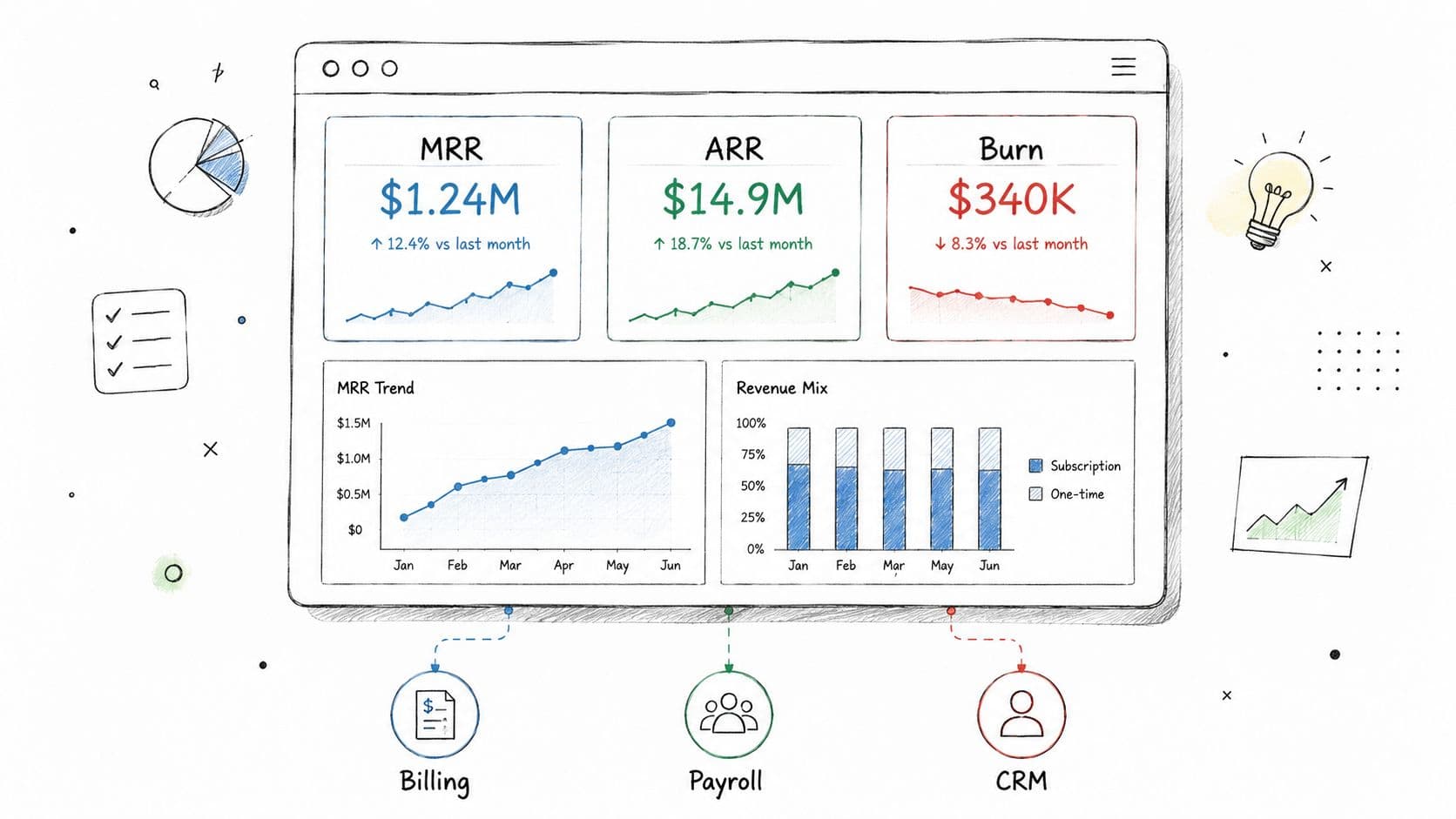
A useful test is whether your dashboard's revenue story agrees with new contracts, cancellations, invoices, cash collections, and the general ledger. If those records disagree, stop presenting the metric until finance documents the cause.
3. Implement Audit-Ready Revenue Recognition Under ASC 606
Revenue recognition errors create more than accounting adjustments. They can affect growth rates, deferred revenue, gross margin, taxes, covenants, investor materials, and management credibility. ASC 606 requires you to recognize revenue when control of promised goods or services transfers to the customer, in an amount that reflects what you expect to receive.
Begin with a contract audit. Sample your 20 largest active contracts, document the economic substance of each agreement, identify performance obligations, and map billing terms to delivery. A SaaS company needs subscription schedules for annual and multi-year contracts. A professional services firm needs evidence that work was performed, milestones were achieved, or deliverables were accepted.
Consider a SaaS contract billed annually for $120,000. If the customer receives a continuous service over 12 months, straight-line recognition produces $10,000 per month, while the remaining balance sits in deferred revenue until earned. Recognizing the full invoice at signing would overstate the current period and understate future obligations. This calculation is an illustration of the accounting treatment, not a company-specific result.
Tie recognition to evidence
Create a policy for every material revenue type and obtain review from your CFO and external auditor. Set contract review thresholds so unusual discounts, implementation services, usage-based fees, renewals, refunds, and termination rights receive finance approval before recognition.
- SaaS contracts: Maintain subscription schedules and reconcile them to invoices, cancellations, upgrades, and the general ledger.
- Agency projects: Tie recognition to approved milestones, time incurred, or documented client acceptance.
- Professional services: Reconcile time records, deliverables, retainers, and billing terms.
- Ecommerce sales: Model returns, refunds, discounts, and chargebacks so reported revenue reflects expected consideration.
Variable consideration requires particular care. Review the variable consideration guidance and document estimates, assumptions, approvals, and subsequent true-ups. For broader process design, compare your controls with this revenue reconciliation guide for software teams.
4. Establish SOC 2 Type II Compliance and Data Security Controls
Enterprise customers, auditors, and investors will examine how you protect financial data, customer information, production systems, and administrative access. SOC 2 Type II evaluates documented and tested controls across security, availability, processing integrity, confidentiality, and privacy. Start early because the program requires control design, evidence collection, testing, remediation, and an examination period.
A SaaS company should map production access, code deployment, backups, incident response, vendor risk, and customer data handling. A digital agency needs controls for shared client credentials, employee offboarding, file repositories, subcontractors, and client financial information. A professional services firm should address document permissions, email security, payroll records, and confidential client workpapers.
Build evidence while you operate
Assign one internal SOC 2 lead. That person should coordinate technology, human resources, finance, and vendor controls, then maintain a control register showing purpose, owner, frequency, evidence, exceptions, and remediation status.
- Access controls: Require MFA, use role-based permissions, and review user access regularly.
- Change management: Record who approved, tested, and deployed system changes.
- Incident response: Maintain a tested plan with escalation paths, decision rights, and communications procedures.
- Vendor oversight: Keep contracts, security assessments, and renewal reviews in one controlled location.
- Evidence management: Store screenshots, logs, approvals, tickets, and review records with clear dates.
Security controls aren't complete when you write the policy. They're complete when an independent reviewer can see that the control operated and produced evidence.
Your finance systems belong in the scope. Review QuickBooks, NetSuite, Stripe, payroll platforms, CRM permissions, and bank access. A data security program should also connect to IPO disclosure readiness. The cybersecurity and privacy IPO guidance emphasizes designated owners, tested incident response, materiality assessment, privacy updates, and board expertise where cybersecurity, AI, or ESG risks are material. Use data security compliance support to organize the finance and operational controls that sit inside this wider program.
5. Establish Separate Controller and CFO Functions With Documented Segregation of Duties
Your CFO and controller perform different jobs. The CFO leads planning, capital strategy, investor communication, and executive decision-making. The controller owns the close, accounting policies, reconciliations, compliance, audit coordination, and evidence supporting the numbers.
Even a smaller company needs separation between recording, approving, reconciling, and reviewing transactions. A person who enters a vendor payment shouldn't be the only person approving it. The person who reconciles the bank account shouldn't have unrestricted authority to initiate and release payments without review.
Create a segregation-of-duties matrix that covers revenue, payables, payroll, banking, journal entries, expenses, refunds, customer credits, and user administration. Assign a preparer, approver, reconciler, and reviewer for each process. Then enforce those roles inside QuickBooks, NetSuite, payroll software, banking platforms, and expense tools.
Apply proportional controls to a small team
A $500K business may not need a full public-company finance department today, but it does need independent review. Combine internal and external resources deliberately. An internal bookkeeper can prepare transactions, a finance manager can review them, and an outsourced controller can own close quality and audit coordination.
For a digital agency, the founder may approve client contracts while a finance manager reviews billing and an external controller reconciles revenue. For a SaaS company, the accounting team may manage subscription schedules while the CFO approves unusual concessions and the controller reviews deferred revenue. For a professional services firm, partners can approve time and project completion, but finance should control recognition and collections reporting.
Review access rights quarterly. Remove former employees immediately, document exceptions, and retain approval history. The segregation-of-duties framework provides a practical structure for separating responsibilities without adding unnecessary bureaucracy.
6. Build a 13-Week Rolling Cash Flow Forecast and Variance Analysis
Profit doesn't guarantee liquidity. A 13-week rolling cash forecast forces you to map the timing of collections, payroll, taxes, vendor payments, debt service, inventory purchases, and planned investments. Update it every Monday using actual prior-week cash activity, then replace the completed week with a new future week.
Use weeks across the columns and cash categories down the rows. Keep the first version simple. A SaaS company should separate recurring collections, annual prepayments, payroll, cloud infrastructure, customer acquisition, and tax payments. A digital agency needs client milestone receipts, contractor payments, payroll cliffs, and retainer timing. An ecommerce brand must model supplier deposits, freight, inventory purchases, refunds, and marketplace settlement delays.
Work from actual collection behavior
Pull accounts receivable aging every week. Forecast collections based on customer payment behavior, not only invoice terms. If a customer regularly pays late, place the cash receipt in the week it usually arrives and document the assumption.
Build scenarios for slower collections, unplanned hires, revenue shortfalls, inventory commitments, and delayed projects. A forecast that shows one outcome creates false confidence. A forecast with documented assumptions gives the executive team time to act.
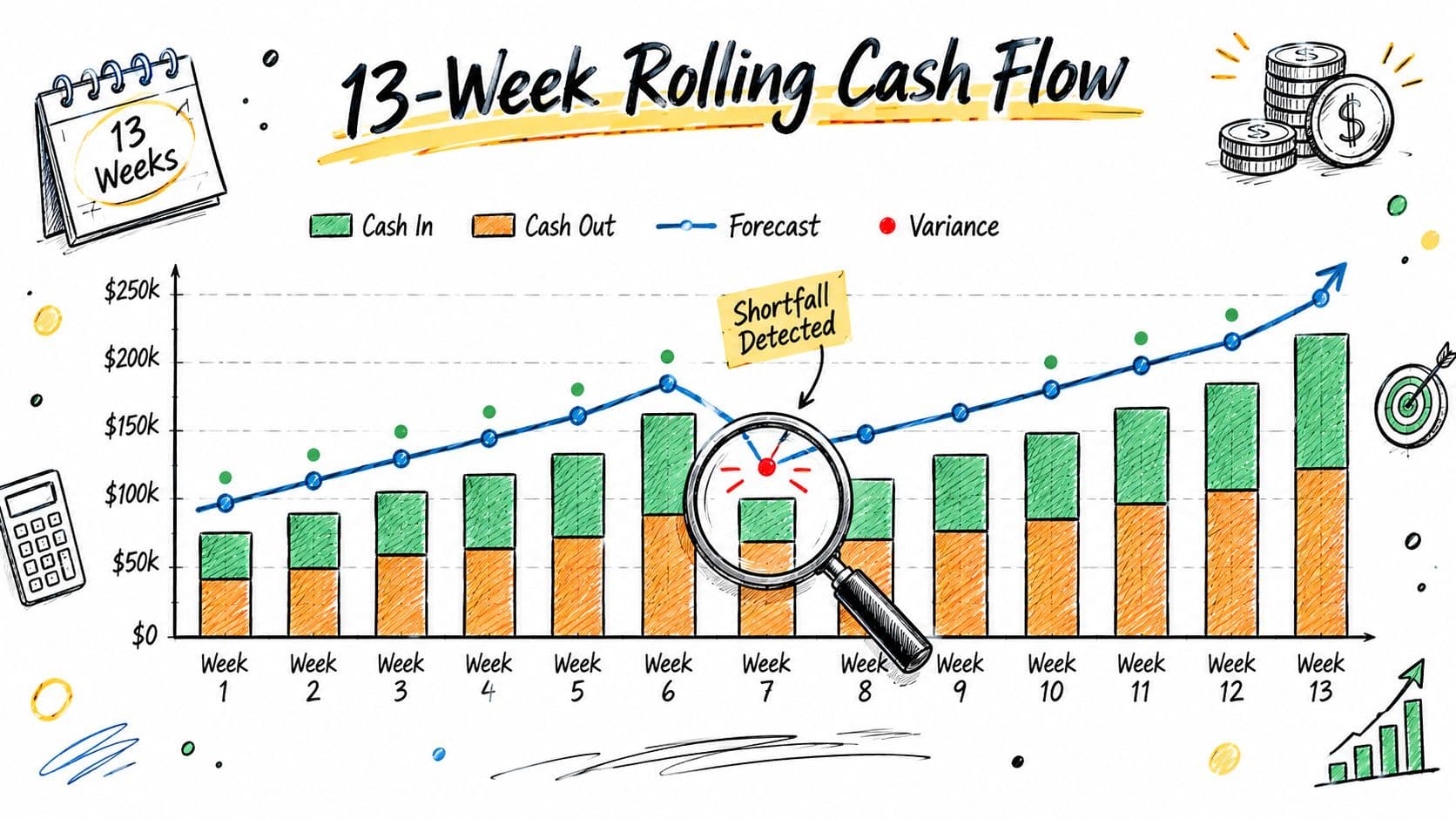
Use variance analysis to compare forecast and actual cash every week. Investigate the cause, assign an owner, and update the model. If collections are weaker than planned, accelerate customer follow-up. If payroll rises, revise hiring timing. If inventory requires a major outlay, arrange financing before the cash need becomes urgent.
A credible forecast also supports going-concern analysis and board decisions. Investors don't need a perfect prediction. They need to see that you understand the drivers, monitor changes, and respond before a liquidity problem becomes a crisis.
7. Benchmarks, Sources, and Cross-Workstream Evidence for IPO Readiness
An IPO readiness checklist matters only when every item produces usable evidence. Finance leaders should connect financial data, operating metrics, governance decisions, security controls, and disclosure statements to repeatable owners, systems, and review steps.
An IPO registration statement generally includes three years of audited annual financial statements. An emerging growth company can present two years, along with interim financial statements for the latest period and the comparable prior-year period, as explained in Deloitte's IPO financial statement guidance.
The audit basis also changes. IPO financial statements must follow PCAOB standards, rather than private-company AICPA standards, and the auditor must be a PCAOB-registered public accounting firm, according to this U.S. financial statements guide.
Build the evidence map
The Ansarada IPO readiness checklist groups readiness into legal and corporate, financial and audit, operational, ESG, disclosure and regulatory, and diligence workstreams. Build a shared evidence register covering audited historical financials, a permissioned virtual data room, board and committee records, related-party registers, and regulatory support.
For a SaaS company, link contracts, billing records, revenue schedules, customer metrics, and access logs. A digital agency or professional services firm should connect signed statements of work, time records, milestone approvals, invoices, collections, and project margins. Smaller businesses in the $500K–$20M range should start with these transaction flows, then expand controls as systems and reporting mature.
ICFR needs its own plan. A practitioner guide estimates that a mid-size IPO-bound company may document 15 to 20 processes and 300 to 500 controls before testing and remediation, as described in the ICFR IPO preparation guide. Use those figures for planning, then define controls from actual risks, systems, transaction flows, and reporting assertions.
The S-1 Readiness Handbook reports that 83% of companies had scalable ERP and financial reporting systems at least one year before the IPO. Set system ownership and disclosure review well before filing, and require each workstream to retain dated evidence.
8. Use External Support and a Practical Implementation Path
External advisers should close defined gaps while executives retain accountability for numbers, controls, disclosures, and decisions. Assign each workstream a clear owner, deliverable, reviewer, and deadline. A controller or accounting partner can rebuild the close, a security adviser can document control evidence, and tax, audit, and securities specialists can address technical requirements.
Start with a diagnostic. Inventory the chart of accounts, contracts, reconciliations, close calendar, KPI definitions, user permissions, board records, tax filings, and data-room documents. Score every gap by audit impact, remediation complexity, dependency, and lead time. For a SaaS company, prioritize billing-to-ledger and contract-to-revenue evidence. For an agency or professional services firm, test statements of work, time records, milestones, invoices, collections, and project margins before expanding the review.
Match support to the workstream
- Close and bookkeeping: Clean the ledger, standardize reconciliations, and produce a repeatable close package.
- Revenue recognition: Review contracts, document ASC 606 policies, and automate subscription or milestone schedules.
- Reporting: Build board-ready income statements, balance sheets, cash flow statements, KPI dashboards, and variance commentary.
- Cash planning: Launch a 13-week forecast with weekly actual-versus-plan analysis.
- Controls: Document owners, approvals, access rights, evidence requirements, and remediation status.
- Data-room preparation: Organize investor-formatted exports, contracts, financial support, and corporate records.
Use fixed-scope support for a defined cleanup, then recurring controller support when the business needs a durable close and reporting rhythm. Jumpstart Partners describes a “Data-Room-Ready Financials in 21 Days” package with a 10-item document checklist, chart-of-accounts cleanup, revenue recognition cleanup, and investor-formatted financial exports. Treat that offering as a scoped implementation option, not a substitute for management review and approval.
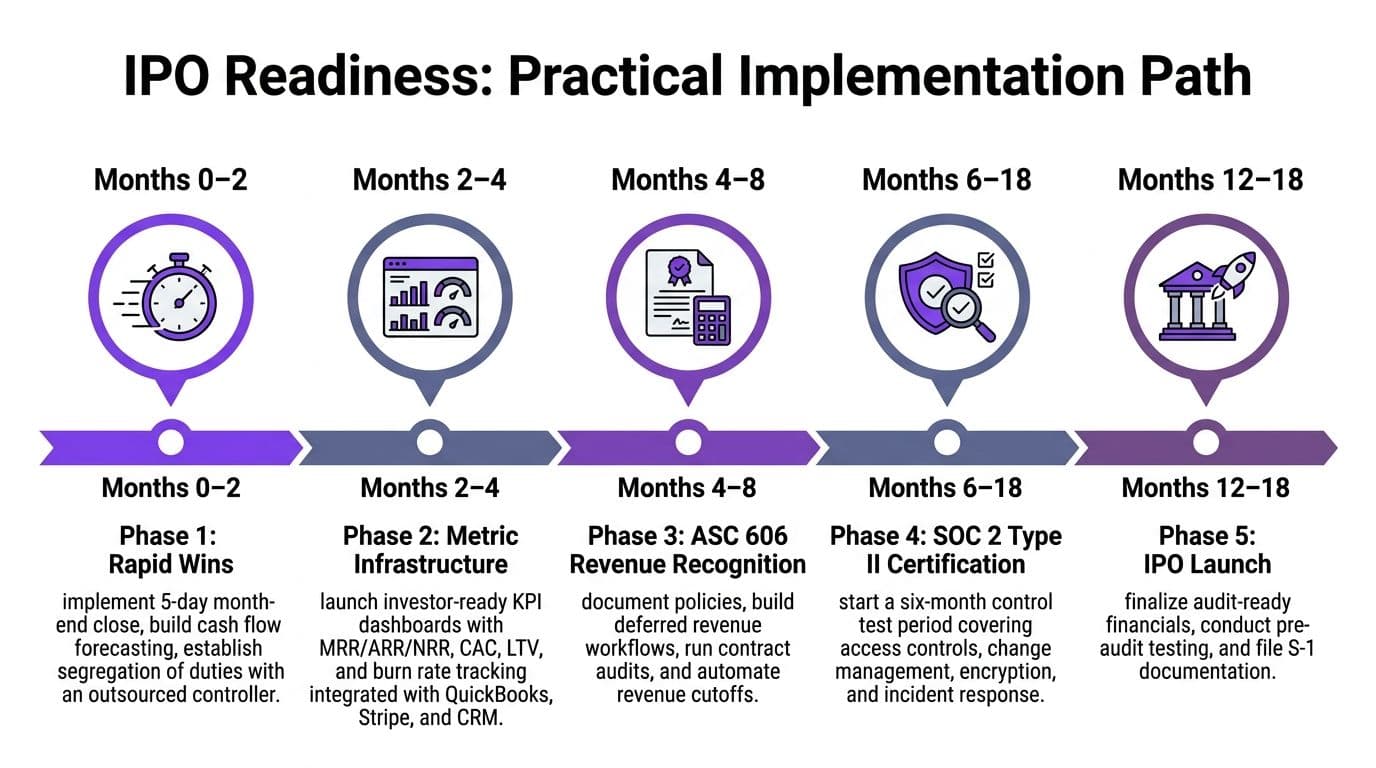
Plan support against filing dependencies. Confidential Form S-1 submission usually follows the organizational meeting by 4 to 6 weeks, and the SEC has 30 calendar days to respond with comments. The path from organizational meeting to pricing is roughly 4 months, excluding market conditions. Another readiness guide places the full execution phase at 4 to 12 months, depending on company readiness. Secure specialists before these milestones, then track evidence, open issues, and approvals in one implementation plan.
8-Item IPO Readiness Comparison
| Item | 🔄 Implementation Complexity | 💡 Resource Requirements | ⚡ Speed / Efficiency | ⭐ Expected Outcomes | 📊 Ideal Use Cases & Key Advantages |
|---|---|---|---|---|---|
| Establish a 5‑Day Month‑End Close Process | High, process redesign, automation, strict deadlines 🔄 | Medium–High, accounting systems, trained staff, possible outsourced support 💡 | Very fast, investor‑ready financials by day 5 ⚡ | Very high, predictable, auditable monthly financials; fewer audit adjustments ⭐ | Pre‑IPO / fundraising: improves capital access, cuts audit prep time, frees finance for analysis 📊 |
| Build Investor‑Ready Financial Dashboards & KPI Tracking | Medium, integrations and data modeling work 🔄 | Medium, BI tools, connectors, data owners, maintenance 💡 | High, automated updates (weekly/monthly) enable quick answers ⚡ | High, clearer metrics for investors; faster diligence and scenario modeling ⭐ | SaaS, agencies, e‑commerce: exposes churn/margin issues, speeds fundraising conversations 📊 |
| Implement Audit‑Ready Revenue Recognition (ASC 606) | High, contract reviews, policy docs, automated workflows 🔄 | High, accounting expertise, auditor involvement, billing integration 💡 | Moderate, accurate reporting after implementation but time‑intensive to set up ⚡ | Very high, eliminates revenue-related audit findings; clean historicals and unit economics ⭐ | Subscription/multi‑element contracts: prevents restatements, critical for pre‑IPO audits 📊 |
| Establish SOC 2 Type II & Data Security Controls | High, cross‑functional controls, long test period 🔄 | High, security tooling, policies, training, audit fees 💡 | Low (long lead), 6–12 month audit timeline but speeds enterprise sales later ⚡ | High, demonstrates operational maturity and reduces cyber risk; required by many buyers ⭐ | Enterprise customers / compliance-driven sales: shortens sales cycles, required for large deals 📊 |
| Establish Separate Controller & CFO Functions (Segregation of Duties) | Medium, org design, role definitions, workflows 🔄 | Medium, hire or outsource controller, configure system roles and approvals 💡 | Medium, faster audit response and clearer workflows once implemented ⚡ | High, reduces fraud/errors, improves governance and audit readiness ⭐ | Growing companies: removes single‑person risks, improves board/investor confidence 📊 |
| Build a 13‑Week Rolling Cash Flow Forecast & Variance Analysis | Low–Medium, template + disciplined weekly updates 🔄 | Low–Medium, finance time, AR data, optionally integrated tools 💡 | High, weekly updates identify shortfalls early ⚡ | High, prevents cash crises; supports going‑concern assessments and decisions ⭐ | All companies prepping for funding/IPO: early warning system for cash, informs hiring/spend decisions 📊 |
| Benchmarks, Sources & Cross‑Item Evidence for IPO Readiness | Low, compile and reference existing studies 🔄 | Low, research and documentation time 💡 | Medium, quick reference accelerates prioritization ⚡ | Medium, strengthens board/investor materials with cited evidence ⭐ | Board packs / diligence: prioritize workstreams, justify timelines and claims with sources 📊 |
| Jumpstart Offerings & Practical Implementation Path | Medium, vendor coordination, customization of templates/workflows 🔄 | Medium, budget for services, external project management, templates 💡 | High, accelerates time‑to‑compliance via prebuilt templates and outsourced execution ⚡ | High, faster implementation of close, ASC 606, SOC2, dashboards; reduced internal burden ⭐ | Companies seeking to outsource IPO readiness: turnkey plans, templates, and managed services to shorten timelines 📊 |
Turn the Checklist Into an IPO Readiness Roadmap
An IPO readiness checklist only creates value when someone owns every task and reviews the evidence on a fixed schedule. Build an owner-and-deadline matrix covering finance, operations, legal, security, tax, and executive leadership. Rank each gap by audit impact and lead time, then review progress monthly with the same discipline you use for the board package.
The first five actions are straightforward. Establish the close calendar, review revenue contracts under ASC 606, create the segregation-of-duties matrix, approve KPI definitions, and launch the 13-week cash forecast. Then create a permissioned data room and place every supporting document under an owner, version, and review date.
Don't accept the objection that a $500K to $20M company is too small to formalize controls. A smaller business has fewer people and systems, which makes it easier to assign responsibilities, remove unnecessary access, and create a clean evidence trail. The cost of formalization is visible. The cost of discovering unreliable books during diligence is delayed financing, distracted leadership, and reduced confidence.
Don't wait until you select bankers. The Mintz chronology shows that filing and review milestones compress quickly once the formal process begins. Your close, controls, revenue policies, board records, security governance, and disclosure infrastructure need to operate before the transaction team starts asking detailed questions.
Jumpstart Partners can support outsourced controller work, QuickBooks cleanup, ASC 606 workflows, investor-ready reporting, and cash flow planning for growing SaaS, agency, professional services, and ecommerce businesses. Visit Jumpstart Partners to discuss your current finance gaps, define the first remediation sprint, and build an IPO readiness roadmap around your actual systems and deadlines.
Jumpstart Partners provides outsourced controller and bookkeeping support for growing businesses that need a reliable close, clean revenue recognition, investor-ready reporting, and clear cash visibility. Visit Jumpstart Partners to request consultation on your IPO readiness checklist and choose the right next step, from QuickBooks cleanup to recurring finance support.