Financial Operations
What "Month to Date" Really Means for Your Bottom Line
Go beyond the basic month to date meaning. Learn how to use MTD metrics to make faster, smarter decisions that drive real revenue growth for your business.
ByJumpstart Partners, CPA, QuickBooks ProAdvisor
··12 min readAs a founder or CEO, you can't afford to drive your business by looking in the rearview mirror. Waiting for a month-end financial report is exactly that—it tells you where you’ve been, not where you're going or how to navigate the road ahead. This is where mastering Month to Date (MTD) metrics becomes a competitive advantage.
The Month to Date (MTD) meaning is the period starting from the first day of the current month right up to today. While the definition is simple, its application is transformative. It shifts your leadership from reactive damage control to proactive, real-time course correction.
Stop Making Decisions on Last Month's News
If you only get financial data once a month, you're making critical decisions based on information that is weeks out of date. This leaves you blind to cash flow gaps, lagging sales, and expense overruns until it's too late to fix them. MTD isn't just an accounting term; it's your forward-looking operational dashboard.

By tracking MTD performance on revenue, expenses, and new Monthly Recurring Revenue (MRR), you gain the intra-month visibility needed to make agile decisions, correct your course instantly, and tackle issues before they derail your entire quarter.
This approach delivers three critical advantages:
- Proactive Problem-Solving: Spot a dip in MTD sales by the 10th of the month, and you have 20 days to fix it. Wait for the month-end report, and the opportunity is gone.
- Improved Cash Management: Monitoring MTD cash flow helps you anticipate shortfalls and manage payables more strategically. This is a core part of building a resilient 13-week cash flow forecast model.
- Accurate Goal Pacing: Know exactly where you stand against your monthly targets at any given moment. This lets you motivate your sales team with real data or reallocate marketing spend where it's needed most.
This guide will show you how to move from reacting to last month’s news to proactively shaping this month’s success. You'll learn exactly how to calculate, interpret, and act on MTD data.
How to Calculate Key Month to Date Metrics
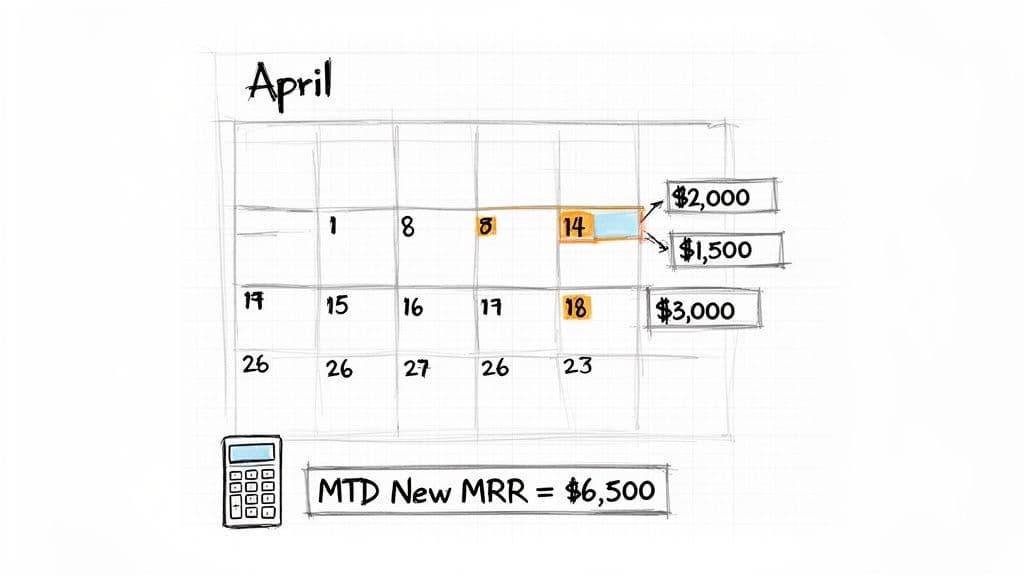
The theory behind MTD is a running total from day one of the month until today. The real power comes when you stop thinking about it as a definition and start applying it to the KPIs that run your business. This is how you shift from abstract goals to concrete, daily progress tracking.
Let’s walk through a specific calculation for a SaaS company.
MTD New MRR Calculation: A Worked Example
Imagine your monthly sales goal is to sign $25,000 in New Monthly Recurring Revenue (MRR). Today is April 15th, and you need to know if your team is on track.
You pull the new contracts signed so far this month:
- April 1 (Client A): $5,000 MRR
- April 8 (Client B): $2,500 MRR
- April 14 (Client C): $4,000 MRR
The MTD calculation is a straightforward sum:
$5,000 + $2,500 + $4,000 = $11,500 MTD New MRR
You’re halfway through the month, but you’ve only secured 46% of your target. This isn't a cause for panic, but it is a clear, data-backed signal for your head of sales. You now have an objective starting point for your weekly check-in to diagnose the issue and get the team focused on closing the remaining $13,500 gap.
"Founders often mistake activity for progress. MTD reporting forces an honest, data-backed conversation about performance against actual targets, which is where real growth happens.” — Dan DeMeyere, Co-Founder & CTO, Appcues
MTD Revenue and Expense Tracking
The same logic applies to your entire profit and loss (P&L) statement. You track MTD recognized revenue to see if top-line growth is hitting its marks. But tracking MTD expenses is just as crucial.
Let's say your MTD revenue is at 50% of the monthly goal, but your MTD marketing spend is already at 80% of its budget. You have a potential profitability problem brewing. This early warning gives you time to adjust spending before it tanks your margins. For more detail, read our complete guide on how to calculate gross margin.
By looking at MTD revenue and MTD expenses together, you create a dynamic, real-time view of your profitability. It’s worlds more effective than a static month-end report that’s ancient history by the time it lands in your inbox.
Using MTD Insights for Agile Financial Management
MTD metrics are your weapon for proactive leadership. They empower you to spot trends and pivot long before a problem spirals into a crisis. If you’re waiting for month-end reports to make decisions, you’re always reacting. With MTD, you’re always leading from the front.
For businesses in the $1M-$5M ARR revenue range, these intra-month check-ins are non-negotiable. It’s the difference between catching a cash flow dip mid-month versus explaining a missed target to your board after the fact.
Turn Real-Time Data into Action
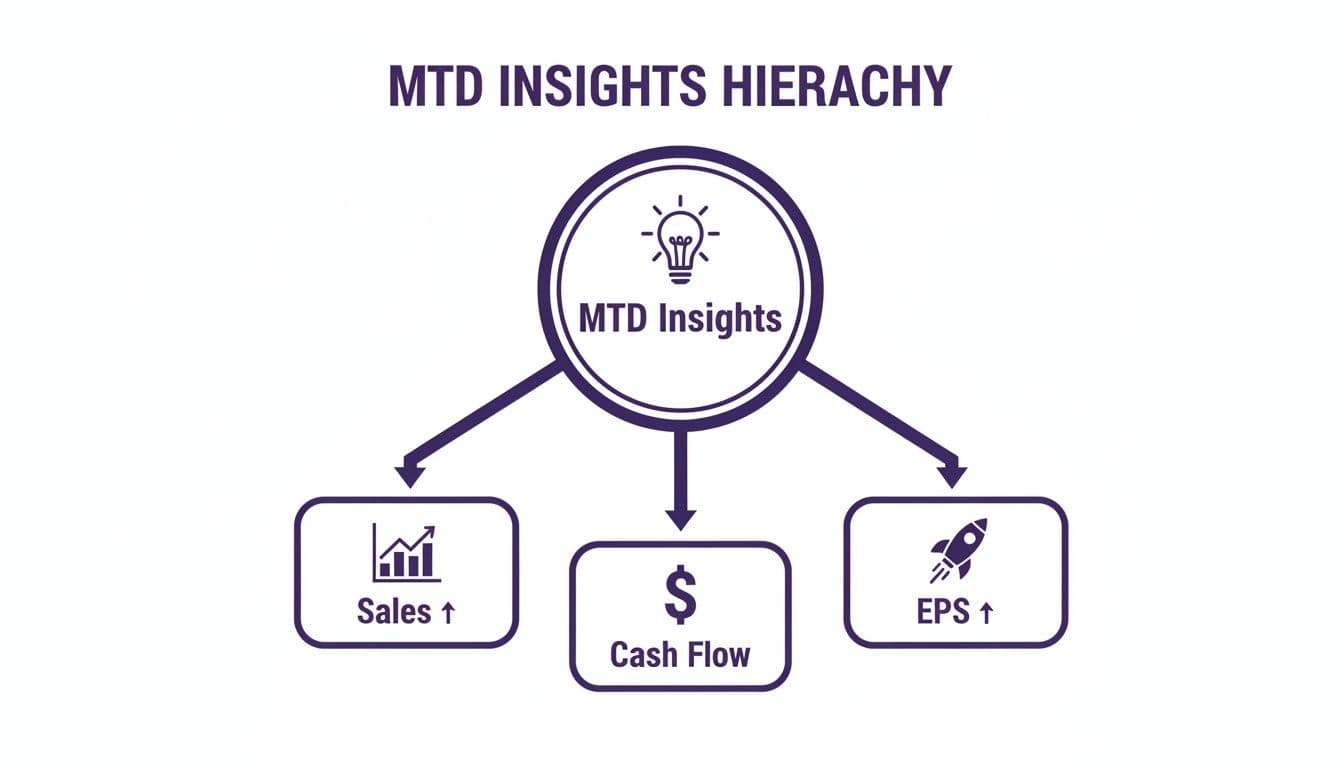
MTD insights are what make true data-driven decision making possible. Just look at the real-world performance of Mettler-Toledo International Inc. (NYSE: MTD). While the company name is a coincidence, their reporting is a perfect example. In their fiscal Q4 2026, their MTD sales jumped 8% year-over-year to $1.13 billion, a huge leap compared to their full-year growth of only 4%.
That MTD snapshot captured a critical acceleration period that a quarterly or annual view would have missed. You can dig into their financials on the StockTitan financial data page for MTD.
This level of detail shows exactly where growth is coming from, turning raw data into real intelligence. For your business, this means identifying which service lines are crushing it or which sales channels are underperforming this week, not last month.
If your MTD cash collections are lagging behind your forecast, you can immediately jump into your accounts receivable aging report and start chasing payments. Our guide on cash flow forecasting best practices can help you set up the right systems for this. This proactive stance is what prevents minor issues from snowballing into major financial headaches.
MTD vs. QTD vs. YTD: Choosing the Right View for Your Question
Knowing your Month-to-Date numbers is step one. The real strategic insight comes when you place that data in context by comparing it to Quarter-to-Date (QTD) and Year-to-Date (YTD) performance.
Think of these as different zoom levels for your business.
- MTD is your ground-level, tactical view of what’s happening right now.
- QTD and YTD pull back to give you the broader perspective needed for strategic planning.
This is how you connect daily actions to long-term results. The small adjustments you make based on MTD data are what ultimately drive your quarterly and annual success.
A Framework for Strategic Reporting
The reporting period you choose depends entirely on the question you're trying to answer. Are you trying to fix this week's sales slump, or are you evaluating if your annual strategy is working?
Use this table to pick the right metric for the right conversation.
| Metric | Time Frame | Primary Use Case | Strategic Question It Answers |
|---|---|---|---|
| MTD | From the 1st of the month to today | Daily operational management and course correction | "Are we on pace to hit our sales and cash goals this month?" |
| QTD | From the 1st of the quarter to today | Tracking progress against quarterly board/investor commitments | "Will we meet the quarterly targets we promised our stakeholders?" |
| YTD | From Jan 1st to today | Annual strategic evaluation and budget variance analysis | "How is our performance tracking against last year and our annual plan?" |
For example, a fast-growing SaaS company should have a median Annual Growth Rate of 40-60%, according to OpenView's 2024 SaaS Benchmarks. You use your YTD metric to see if you are meeting that strategic benchmark, and your MTD metrics to make the daily and weekly adjustments needed to get there. For a deeper dive, use a budget vs. actual analysis to see how your performance stacks up.
Red Flags: When MTD Data Lies to You
Bad MTD data is worse than no data at all—it gives you the confidence to make flawed decisions. Understanding the month to date meaning is only half the battle; the real win comes from ensuring that data is clean, reliable, and properly interpreted.
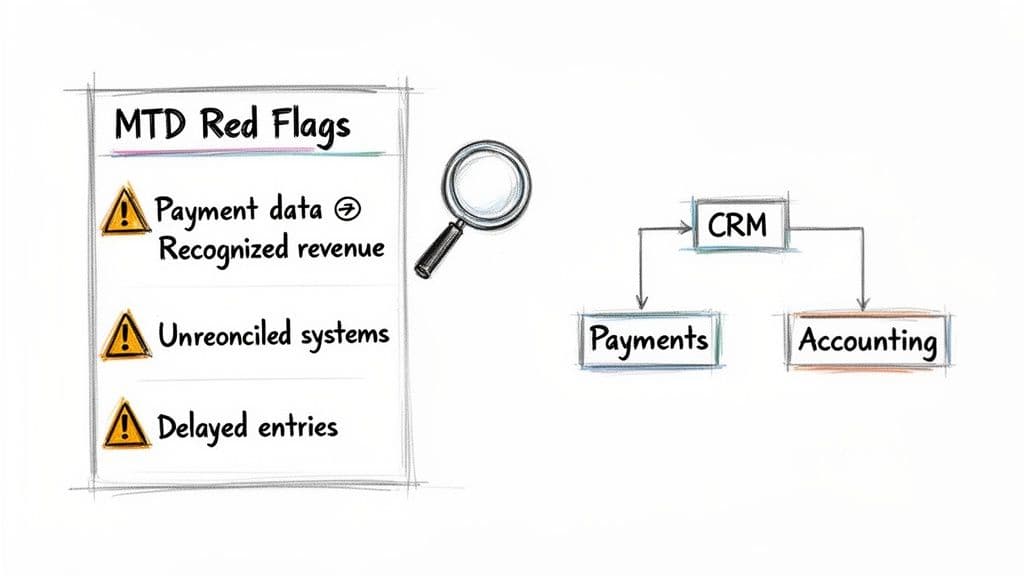
Here are the most common pitfalls that will distort your financial picture and how you can sidestep them.
Misconception #1: Cash Collected = Revenue Earned
This is the single most dangerous mistake a SaaS or professional services founder can make. The cash that hits your Stripe account is not recognized revenue. Accounting standards (ASC 606) require you to recognize revenue as it’s earned over the contract term, not when the cash lands in your bank.
Worked Example: A client pays $12,000 upfront for an annual subscription on April 10th.
- Your MTD cash flow jumps by $12,000 on that day.
- Your MTD recognized revenue for April only increases by $1,000 ($12,000 / 12 months).
If you mistake cash for revenue, you will have a dangerously inflated view of your company’s performance and make poor decisions about hiring, marketing spend, and runway.
Misconception #2: My Platform Dashboards Are My Financials
Your CRM and payment processor dashboards are operational tools, not financial records. Relying on unconsolidated data from HubSpot or Salesforce without reconciling it against your accounting software like QuickBooks or Xero is a recipe for disaster.
“Relying on raw platform data without proper bookkeeping reconciliation is like navigating with an uncalibrated compass. Your direction will feel right, but you’ll end up miles off course.” — Scott Fritz, Founder & CEO, Jumpstart Partners
Your MTD reports are only trustworthy if the data from your payment processors, bank accounts, and CRM are synced and reconciled daily with your accounting system. This process creates a single source of truth for financial decision-making.
Your Action Plan for Implementing MTD Reporting
You understand the "why." Now you need the "how." The goal is to build an automated system that gives you a fresh look at your business every morning. This shifts financial oversight from a reactive, month-end scramble into a proactive, strategic advantage.
4-Step Checklist for Actionable MTD Reporting
Getting MTD reporting live doesn’t require ripping and replacing your entire finance stack. Focus on these high-impact steps to build momentum and prove the value of real-time data.
| Step | Action | Why It Matters |
|---|---|---|
| 1. Pinpoint Critical Metrics | Select 3-5 KPIs that truly drive your business. For SaaS, this is New MRR, Cash In, and Bookings. For agencies, it's Billings, Utilization, and Project Margin. | Focus is key. Trying to track everything means you track nothing. Start with the vital signs of your business. |
| 2. Automate Data Feeds | Set up daily, automated reconciliation from your key platforms (CRM, payment processor, payroll) into your accounting software. | Manual data entry is slow, error-prone, and unsustainable. Automation ensures your data is timely and trustworthy. See our guide on financial reporting automation. |
| 3. Build a Visual Dashboard | Use your accounting software's dashboard (e.g., QuickBooks Online) or a BI tool to visualize your MTD actuals next to your monthly targets. | Visual comparison drives action. Seeing "we're at 45% of our goal on day 12" is a powerful motivator for your team. |
| 4. Set a Weekly Review Cadence | Book a recurring 30-minute huddle with your leadership team to review MTD trends and agree on corrective actions. | This is non-negotiable. Accountability ensures you're making quick, data-backed decisions instead of letting problems fester. |
Common Questions About MTD Reporting
Knowing the definition of month to date is one thing. Using it to make smart decisions is another. Here are the most common questions leaders have when they start working with MTD data.
How Often Should I Review My MTD Reports?
As the CEO or founder, you need a daily pulse check. A five-minute scan of top-level MTD metrics like cash, revenue, and new bookings every morning is non-negotiable. It tells you immediately if the month is on track.
For department heads (e.g., Head of Sales), a weekly review is more practical. It provides enough data to analyze MTD performance against team goals and make tactical changes for the weeks ahead without getting lost in daily noise.
Can I Trust the MTD Number in My Payment Processor?
Absolutely not. This is a common and dangerous mistake. The MTD number you see in Stripe or another payment processor is cash collected, not revenue.
That figure is a cash flow metric. True MTD revenue, according to accounting standards like ASC 606, must be calculated based on when you deliver the service, not when you get paid. Your reconciled accounting system is the only source of truth for actual MTD revenue.
What Is the Difference Between MTD and a Rolling Forecast?
This is a critical distinction between looking backward and looking forward.
- MTD is a historical fact. It's a report card of your exact performance from the first of the month until today. It's what has happened.
- A rolling forecast is a forward-looking prediction. It uses MTD data plus your sales pipeline and historical trends to project where you will end the month or quarter. It’s what you think will happen.
You use MTD to see if you’re on track; you use a forecast to adjust your plan to hit the goal.
Jumpstart Partners offers controller-led finance ops for founder-led B2B AI SaaS teams—monthly close, reporting, and billing support scoped after the Finance Ops Diagnostic.finance)