Financial Operations
Nonprofit CFO Services: What They Do and When to Hire
Learn what nonprofit CFO services include, when to hire, what they cost, and how to choose the right provider for your mission-driven organization.
ByJumpstart Partners, CPA, QuickBooks ProAdvisor
··17 min readMost nonprofits don't have a bookkeeping problem. They have a liquidity problem disguised as a reporting problem. A restricted grant can look healthy on the statement of activities while payroll is due before the grant becomes available, and recent nonprofit outlooks found that the share of organizations reporting a budget deficit nearly doubled from 22% to 39% in four years. Another survey found that nearly half had used unrestricted reserves to keep operating, while a large majority had less than six months of unrestricted reserves available. (Wiss State of Nonprofits 2026)
That's why the right nonprofit CFO services engagement doesn't start with “How quickly can you close the books?” It starts with “Which cash is available, when does it arrive, what does it fund, and what decision must the board make before the next payroll?” For founders, CEOs, and finance leaders managing organizations from $500K to $20M in revenue, the highest-value CFO work is decision infrastructure: cash forecasting, reserve policy, scenario planning, fund accounting, grant compliance, and dashboards that connect spending to mission results.
Table of Contents
- What Nonprofit CFO Services Actually Include
- Core Responsibilities Every Nonprofit CFO Owns
- Full-Time, Fractional, and Outsourced Models Compared
- Liquidity-First Finance for Cash-Strapped Nonprofits
- Nonprofit KPIs, Dashboards, and Financial Health Benchmarks
- Vendor Selection Checklist and Interview Questions
- Case Examples Plus Next Steps to Engage a Provider
What Nonprofit CFO Services Actually Include
Payroll runs on schedule. Restricted grants often don't. At the same time, your board may ask for a dashboard that shows whether programs are financially sustainable, while Form 990 season and the annual audit are approaching. A professional nonprofit CFO turns those competing pressures into a financial operating system leadership can use now.
Nonprofit CFO services provide senior financial leadership designed for mission-driven organizations. The scope usually includes fund accounting, grant compliance, budgeting, cash flow forecasting, audit preparation, board reporting, reserve policy, internal controls, and finance-system design. The work should produce outcomes your executive director can act on this quarter: a clean audit file, a current 13-week forecast, a documented reserve policy, and a board dashboard that clearly separates restricted from unrestricted resources.
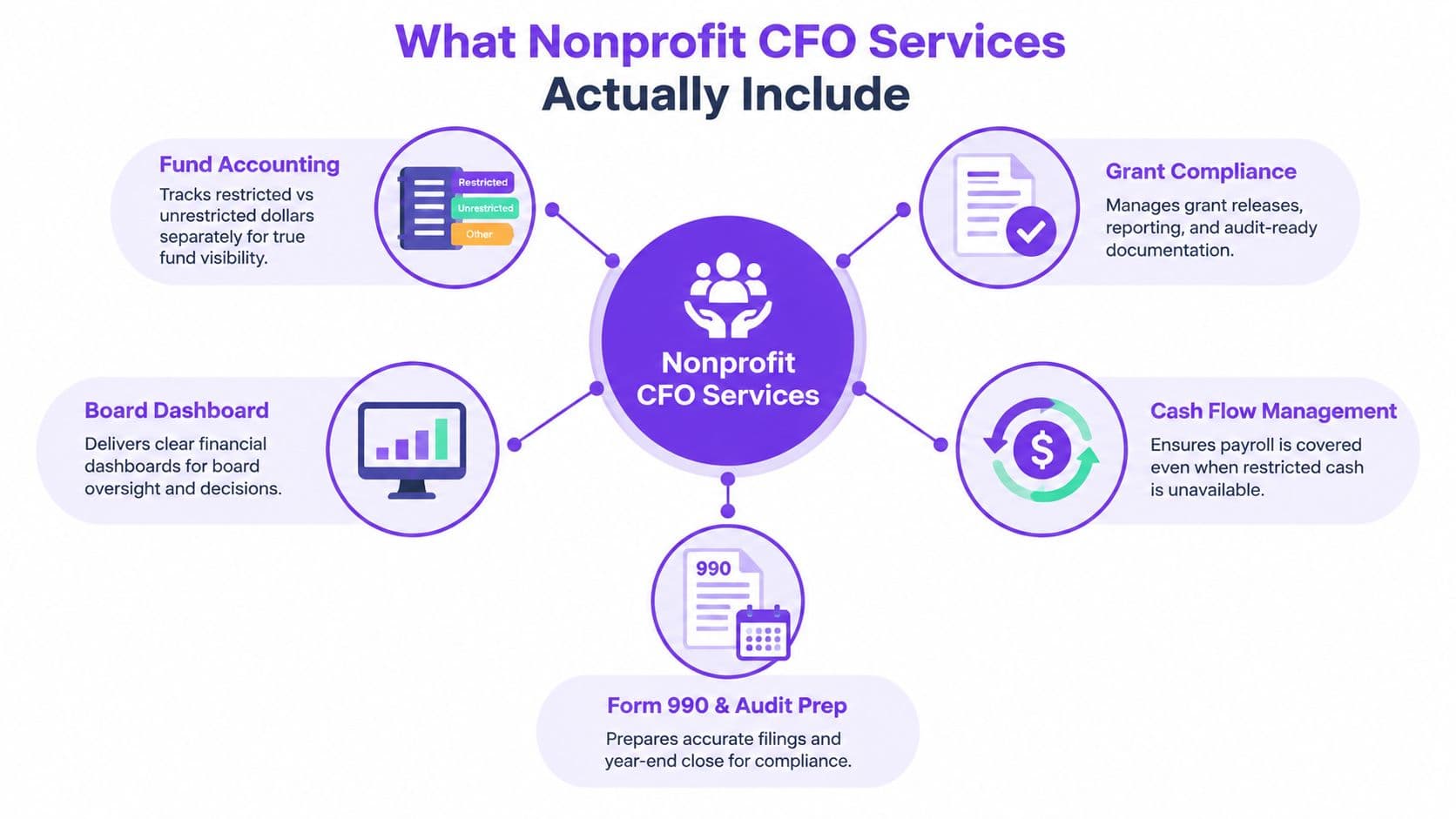
The difference between bookkeeping, controllership, and CFO leadership
A bookkeeper records transactions, pays bills, reconciles accounts, and maintains the accounting records. A controller owns the close, financial statement preparation, accounting policies, and day-to-day control environment. A CFO sets financial strategy, owns liquidity, evaluates funding and program trade-offs, and translates financial information into decisions for the CEO and board.
Those roles work best together. A CFO shouldn't replace a capable bookkeeper just to create more senior-sounding work. The CFO should improve the system around that person, define reliable reporting, test controls, and make sure the organization can answer questions about cash, grants, reserves, and impact.
Practical rule: If your finance provider only reports what happened last month, you've hired accounting support, not a CFO function.
You can compare the strategic layer with this overview of what an outsourced CFO does. The immediate test is simple. Ask whether the provider can show you what cash will look like in the next thirteen weeks, which restricted funds remain unavailable, and what action leadership should take if a grant payment is delayed.
Core Responsibilities Every Nonprofit CFO Owns
A nonprofit CFO's responsibilities show up in ordinary management decisions, not just in year-end financial statements. On Monday, the CFO may review whether a program manager can spend against a grant. On Wednesday, the CFO may explain a variance to the finance committee. By Friday, the CFO may revise the cash forecast because a reimbursement request moved.
The technical history matters. In 1960, there was “no recognized nonprofit sector” and no nonprofit-wide accounting standards. The AICPA established the first generic national nonprofit accounting standards in 1974, and by 1980, the National Accounting Standards Board had accepted jurisdiction for all private nonprofit organizations. (Historical analysis of nonprofit accounting standards) That framework supports the fund accounting, standardized reporting, and audit-ready management that modern nonprofit CFOs maintain.
What the CFO should own in practice
-
Fund accounting: A $50,000 foundation grant should be tracked as restricted net assets and released only as eligible program expenses post. The CFO makes sure the accounting treatment matches the donor restriction and the program's actual activity. For a practical explanation of this discipline, see fund accounting for nonprofits.
-
Grant compliance: If a federal pass-through award requires reconciliation by September 30, the CFO coordinates the financial schedules, supporting documentation, and expenditure review needed to avoid a single-audit trigger. The CFO doesn't operate as a substitute for a grant manager, but financial data must support the grant team's compliance work.
-
Budgeting: A $1.2 million program budget should connect expected costs to the logic model, staffing plan, and development pipeline. A budget that has no relationship to program outputs is a spreadsheet exercise, not financial leadership.
-
Cash flow management: The CFO maps restricted and unrestricted cash separately. That prevents the executive director from treating a capital campaign pledge or unreleased grant as cash available for payroll, rent, or general operations.
-
Audit preparation: The finance function should close the books within 30 days of year-end and assemble the schedules, reconciliations, policies, and supporting documents auditors request in the PBC binder. A CFO also coordinates Form 990 support, finance committee review, and officer sign-off.
-
Governance and systems: The CFO prepares board finance reports, supports investment policy oversight, documents internal controls, and connects QuickBooks or Sage Intacct with the development CRM so finance and fundraising teams work from consistent information.
The control environment deserves special attention. Auditors evaluate segregation of duties, independent reconciliations, transaction authorization, asset safeguarding, and complete, accurate, timely recording. (Nonprofit internal controls guidance) For small and mid-sized organizations, cash receipts, cash disbursements, payroll, and financial reporting deserve priority because failures in these areas directly affect reliability and compliance. (Texas Society of CPAs guidance on nonprofit internal controls)
| Responsibility | Typical Deliverable | Primary Audience | Cadence |
|---|---|---|---|
| Fund accounting | Restricted and unrestricted fund schedules | Finance team, auditors, grant managers | Monthly |
| Grant compliance | Award reconciliations and support files | Grantors, auditors, program leadership | Per award and reporting cycle |
| Budgeting and forecasting | Budget-to-actual analysis and scenarios | CEO, department leaders, board | Monthly and quarterly |
| Cash management | Rolling liquidity forecast | CEO, CFO, finance committee | Weekly |
| Audit and Form 990 support | PBC binder and filing schedules | Auditors, committee, board, officers | Annual |
| Governance reporting | Board-ready dashboard and narrative | Board and finance committee | Each meeting |
Full-Time, Fractional, and Outsourced Models Compared
The right model depends on complexity, not title. A growing nonprofit may need senior financial judgment without needing a full-time executive. Another organization may need a team because federal awards, multiple states, audit preparation, and transaction processing exceed what one fractional CFO can handle.
| Model | Typical Monthly Cost | Best Fit (Revenue) | Strengths | Trade-Offs |
|---|---|---|---|---|
| Full-time CFO | $15,000–$18,333 in base salary equivalent, before burden | Above roughly $3M, or organizations with complex awards | Deep institutional memory and daily leadership | Highest fixed cost, hiring risk, and limited access to outside specialists |
| Fractional CFO | $4,000–$9,000 | $500K–$3M | Senior strategy with a flexible retainer | Limited availability and more dependence on internal execution |
| Outsourced CFO firm | $6,000–$15,000 | Organizations needing broader finance capacity | Partner, controller, and senior accountant coverage | More onboarding coordination and less single-person continuity |
The full-time range above comes from a $150,000–$220,000 base salary plus a 25%–30% burden, while the fractional range typically covers one to three days a month. The decision becomes clearer with a worked example. A $1.2 million human services nonprofit spending $7,500 monthly on a fractional CFO plus controller support spends $90,000 annually. An equivalent full-time hire loaded at $18,000 monthly costs $216,000 annually, creating a $126,000 annual difference before considering recruiting or transition costs.
Those figures aren't a universal price list. They're a decision frame. If your organization needs one senior person to attend board meetings and shape forecasts, fractional support is efficient. If the finance team needs close management, grant schedules, audit preparation, and control implementation, an outsourced firm provides more hands.
Choose based on the work that must get done
Institutional memory is the strongest argument for a full-time CFO. A full-time leader knows the organization's funders, program economics, staff dynamics, and history. The trade-off is that you bear the entire employment cost and still may need outside specialists for technical accounting, systems, or audit support.
A fractional arrangement works when internal staff can execute routine finance work and need experienced direction. An outsourced model works when you need layered capacity without building every role internally. Review fractional CFO services with one question in mind: does the provider offer a defined operating cadence, or are you buying disconnected hours?
Liquidity-First Finance for Cash-Strapped Nonprofits
A monthly income statement can show whether the organization was profitable, but it cannot show whether payroll is safe in week seven. A 13-week rolling cash forecast can. Update it weekly, organize expected inflows and fixed and variable outflows by week, and identify the lowest projected unrestricted cash point before leadership approves new spending. Use this 13-week cash flow framework to establish a consistent operating cadence.
Consider a $1.4 million-budget community nonprofit with three restricted grants. It starts with $85,000 in unrestricted cash, expects $42,000 in unrestricted donations and $28,000 in grant release during weeks one through four, and carries monthly committed outflows of $38,000 for payroll plus $12,000 for rent and programs. The finance team must exclude $95,000 of restricted grants sitting unreleased from available cash. The forecast shows an ending balance of $62,000 in weeks five through thirteen, while flagging a cash gap in weeks nine and ten. (Nonprofit cash flow management guidance)
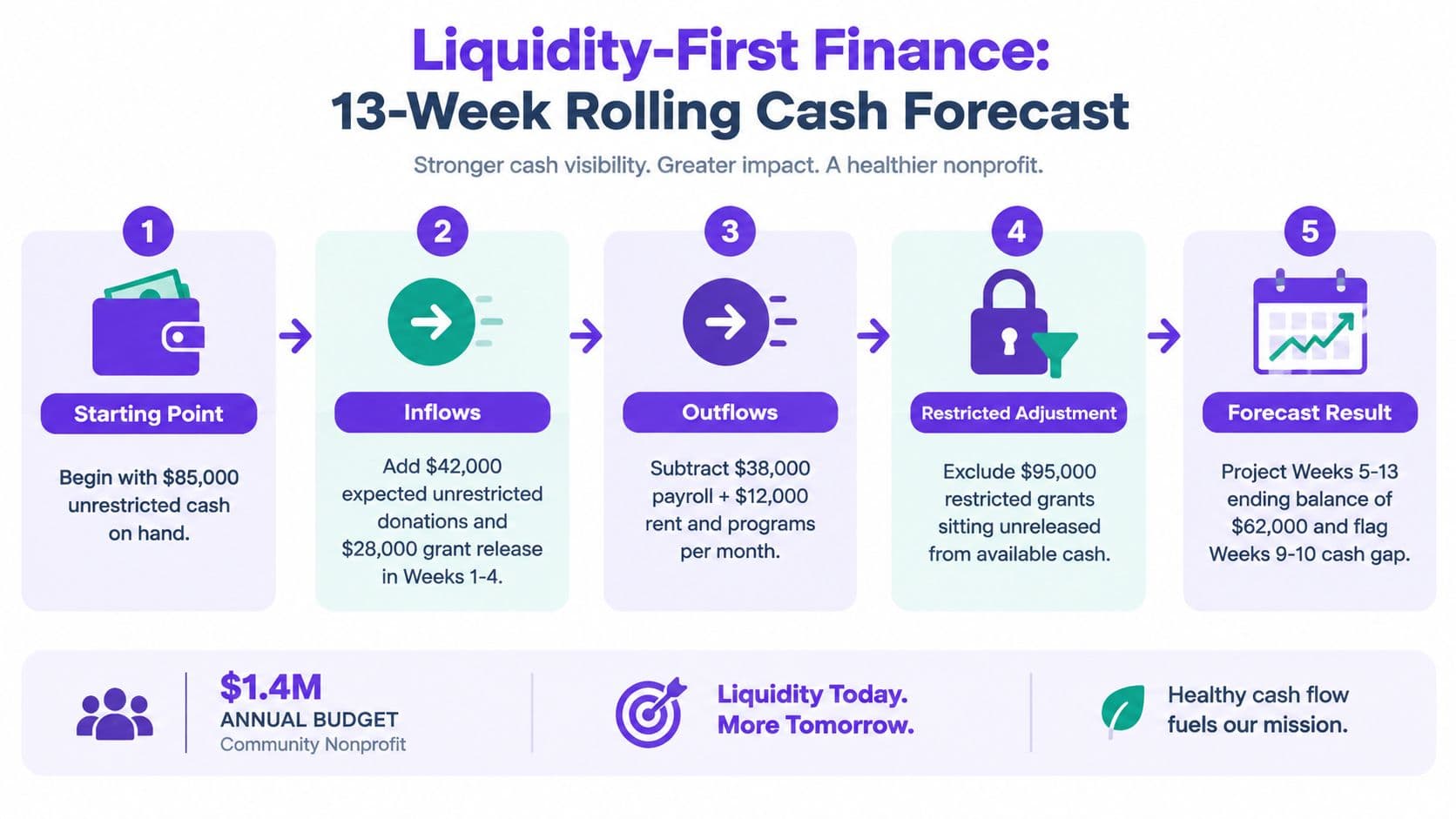
How the forecast changes decisions
The forecast does not close the gap. It gives leadership time to act. In this example, I would pause hiring connected to discretionary expansion, discuss drawing on an available line of credit, and renegotiate the funder's reimbursement schedule before weeks nine and ten.
It also gives the board a practical reserve policy. Independent nonprofit guidance commonly uses three to six months of operating expenses in unrestricted, liquid reserves, while another benchmark says unrestricted reserves should not exceed about three times annual expenses. For annual operating expenses of $1.2 million, the three-to-six-month target equals $300,000 to $600,000 in liquid unrestricted reserves. (Nonprofit financial benchmarks) Treat that range as a guardrail, then test it against delayed grants, weaker donations, and unexpected program costs.
Keep restricted cash separate in the forecast. Run downside scenarios for delayed government payments, slower donations, and reimbursement claims that take longer to process. Organizations operating across currencies or countries can also review cross-border cash flow with OneSafe for additional modeling context.
Board question: What is the lowest unrestricted cash week, and which decision prevents that low point from becoming a crisis?
Review the forecast weekly, not monthly. Refresh it every Friday using beginning cash, expected inflows, fixed outflows, variable outflows, and ending cash. Revisit it mid-week if a major expected receipt is delayed, payroll or another committed payment changes materially, or a new restriction, reimbursement issue, or emergency expense affects available cash.
Pair the cash forecast with an impact-plus-finance dashboard. Show how liquidity decisions affect funded programs, service capacity, and grant commitments, so the board can protect cash without losing sight of mission delivery.
Here's a short visual resource to reinforce the mechanics of rolling cash management:
Nonprofit KPIs, Dashboards, and Financial Health Benchmarks
A nonprofit dashboard should drive decisions, not merely display month-end results. Put liquidity, sustainability, grant health, and program impact on one board-ready page, with each KPI tied to an owner, threshold, trend, and management response. Financial statements remain necessary, but directors also need signals that show whether performance is improving or deteriorating.
The current nonprofit outlook emphasizes forward-looking indicators, stronger board questions, and reporting that connects financial condition with mission delivery. (BDO 2026 nonprofit sector outlook)
Use three KPI groups:
-
Liquidity: Display unrestricted operating reserves, days of cash on hand, and restricted cash as a share of total cash. These indicators show how much usable cash exists and whether donor restrictions limit management's options. Reference the 13-week forecast and reserve policy from the previous section rather than reproducing their mechanics here.
-
Sustainability: Track program expense ratio, fundraising efficiency, and administrative overhead. Use sector benchmarks as context, not as automatic targets. A changing program mix, shared-cost allocation, or restricted grant structure can make an apparently weak ratio reasonable, or make a healthy-looking ratio misleading.
-
Grant health: Show expenditure-to-budget by award, indirect cost recovery, and cost-share burn rate. A grant can appear profitable while unrecovered overhead or slow spending creates pressure elsewhere. Flag awards that are underspent, overspent, or failing to cover the cost of delivery.
A dashboard needs explicit thresholds. Set green, yellow, and red bands with the board, then attach an action to every yellow and red result. A nonprofit dependent on government reimbursements may need a tighter warning trigger than one funded mainly by recurring individual donations. Show the current result beside its prior trend and approved target, so directors can distinguish a temporary variance from a developing problem.
| KPI Category | KPI | Healthy Range | Watch | Action Required |
|---|---|---|---|---|
| Liquidity | Unrestricted operating reserves | Board-approved policy range | Below policy range | Approve a documented response |
| Liquidity | Unrestricted cash forecast | Positive through the forecast period | Lowest projected week is tightening | Re-time spending and accelerate collections |
| Sustainability | Program expense ratio | Consistent with the approved program model | Materially below plan | Review program economics and allocations |
| Sustainability | Fundraising cost | Within the organization's approved fundraising target | Above target | Reassess campaign channels and staffing |
| Grant health | Expenditure-to-budget | Aligned with the award plan | Persistent under- or overspend | Reforecast and contact the funder |
| Grant health | Cost-share burn rate | Tracked against commitment | Falling behind or accelerating | Escalate with program and grant leadership |
Put impact measures beside financial measures. Pair restricted and unrestricted spending with service volume, grant milestones, donor retention signals, and delivery results. The board should see whether a cost reduction protects cash while reducing capacity, or whether additional spending supports a funded outcome. For a complementary church and nonprofit-oriented financial health check for CEFs, apply the same discipline: convert stewardship questions into visible indicators, assigned owners, and defined actions.
Vendor Selection Checklist and Interview Questions
A provider can produce accurate books and still fail the CFO test. You're hiring for judgment under pressure, especially when restricted cash is unavailable, a grant reimbursement is late, or the board needs to decide whether to expand a program.
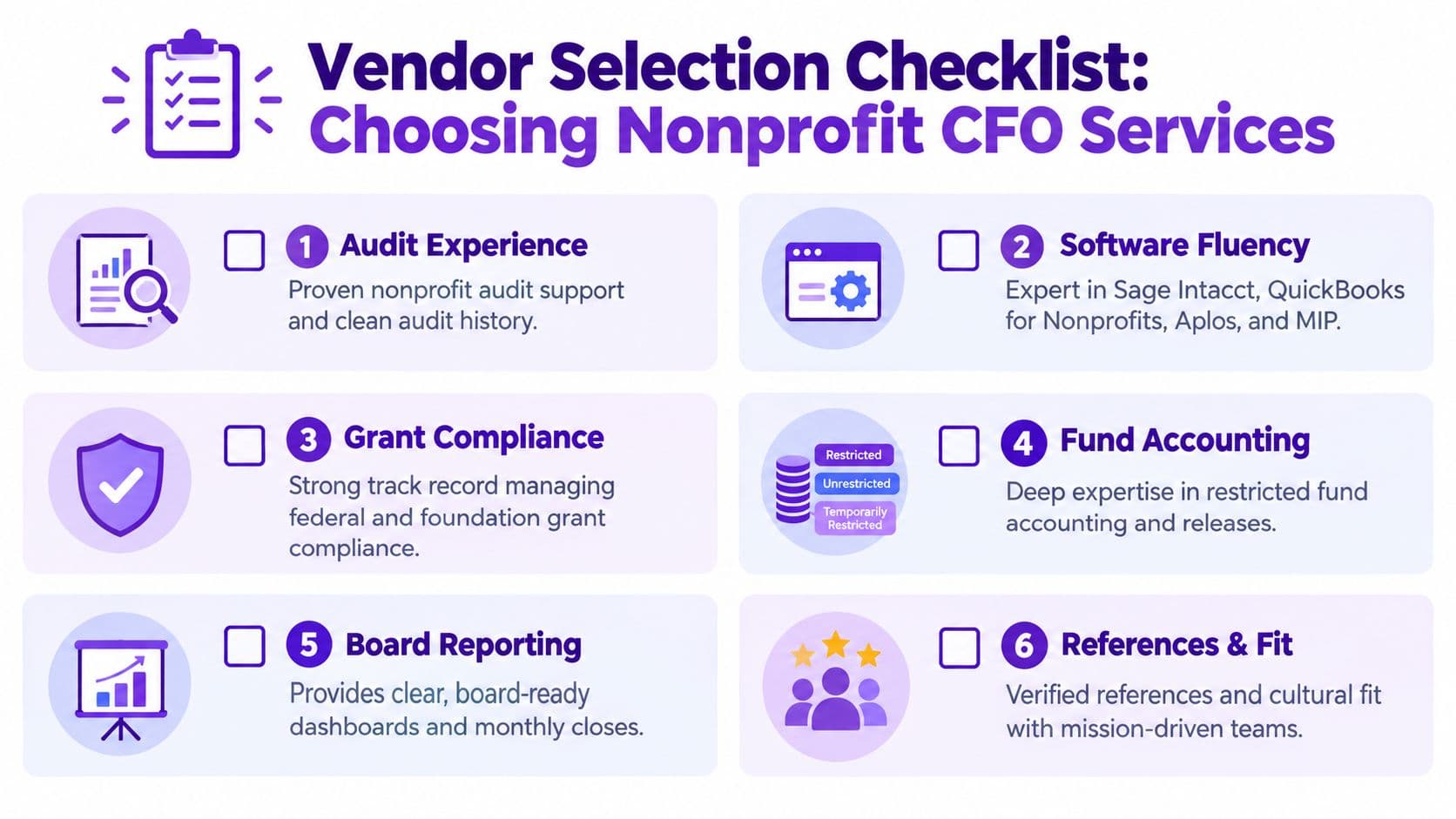
Screen the provider before you discuss price
- Audit experience: Ask for evidence of nonprofit audit support, PBC organization, and clean audit processes.
- Software fluency: Confirm working knowledge of Sage Intacct, QuickBooks for Nonprofits, Aplos, and MIP.
- Grant compliance: Look for experience with federal and foundation requirements, award reconciliations, and funder audits.
- Fund accounting depth: Test whether the team understands restricted funds, releases, net assets, and donor intent.
- Board communication: Require a sample board-ready dashboard, not just a general ledger export.
- References and fit: Speak with similarly sized 501(c)(3) organizations and ask how the provider handled disagreement or bad news.
- Controls and security: Review separation-of-duties design, role-based access, payment approvals, data handling, and cyber policies.
- Pricing transparency: Get the cadence, deliverables, response expectations, and out-of-scope fees in writing.
Use these interview questions to distinguish liquidity-first CFO work from bookkeeping with a higher fee:
- Walk me through a 13-week cash forecast you built. What changed after leadership saw it?
- How do you handle restricted cash and net-asset releases?
- What reserve policy would you recommend for a $2 million nonprofit with volatile grants?
- How do you prepare a board for a difficult cash conversation?
- Describe a near-miss cash crisis you solved.
- What's your approach to indirect cost recovery?
- How do you coordinate with a bookkeeper rather than unnecessarily replace one?
- Which KPIs go on your standard dashboard, and how do you set thresholds?
- How do you handle funder audits and supporting documentation?
- What does your first 90 days look like?
Ask for the first-month deliverables in advance. A credible provider should name the data request, control review, forecast build, close assessment, and board-reporting plan. Outsourced accounting for nonprofits is one reference point, but your final selection should depend on demonstrated nonprofit experience and the provider's ability to make forward-looking decisions visible.
Case Examples Plus Next Steps to Engage a Provider
A $1.4 million housing nonprofit entered a cash crisis after restricted funding failed to arrive on the expected schedule. The CFO intervention began with the last three bank statements, the current grant list, and a weekly cash rebuild. Within 90 days, leadership had a funded 13-week forecast, a reserve response plan, and a board process for approving hiring and program commitments. The measurable outcome was not a faster report. It was a board-level view of days of cash on hand, grant compliance closeout time, and audit adjustments before the next reporting cycle.
A $5.8 million youth services organization had a different trigger. Its restricted grant structure didn't match the timing of program costs, so the fractional CFO helped renegotiate the grant and built a dashboard the board read. The outcome was a clearer view of available liquidity, grant compliance closeout time, and audit adjustments, with program and finance leaders reviewing the same information instead of debating conflicting reports.
These examples illustrate the right sequence. Diagnose liquidity first, then repair reporting and controls around the decisions leadership must make. Don't begin by buying a dashboard. Begin by confirming the cash, restrictions, obligations, and grant terms behind every dashboard number.
A practical engagement sequence
- Collect the baseline: Pull the last three bank statements, current grant list, latest budget, outstanding receivables, and upcoming committed payments.
- Request a 30-minute liquidity diagnostic: Ask the provider to identify the lowest-cash risk, unavailable restricted funds, forecast gaps, and immediate decisions.
- Compare models on one page: Show the expected deliverables, cadence, monthly cost, internal responsibilities, and first-90-day milestones for full-time, fractional, and outsourced options.
- Schedule board sign-off: Give the finance committee a short decision memo explaining the risk, recommended model, reserve implications, and approval needed.
Your first provider conversation should end with a sample 13-week forecast template and a clear list of data required to build it. If the provider can't explain how the forecast changes hiring, program timing, grant negotiations, and reserve policy, keep interviewing.
Jumpstart Partners provides outsourced controller and bookkeeping support, cash flow forecasting, reporting, and CFO-level finance help for growing organizations, including nonprofits. Visit Jumpstart Partners to book a liquidity diagnostic and request a sample 13-week forecast template.