Financial Operations
Outsourced Accounting for Nonprofits: A Complete Guide
Outsourced accounting for nonprofits explained: fund accounting, grant tracking, pricing, vendor selection, and a 5-day close playbook for mission-driven teams.
ByJumpstart Partners, CPA, QuickBooks ProAdvisor
··15 min readOutsourced nonprofit accounting has moved from a stopgap to a standard operating model because the economics are hard to ignore. One cited analysis says outsourcing can cut nonprofit accounting costs by 50% to 70% versus internal staffing, while the average full-service outsourced bill sits around $1,850 per month compared with an in-house accounting manager at $54,000 plus benefits source. If you're still treating accounting as a back-office admin task, you're already behind.
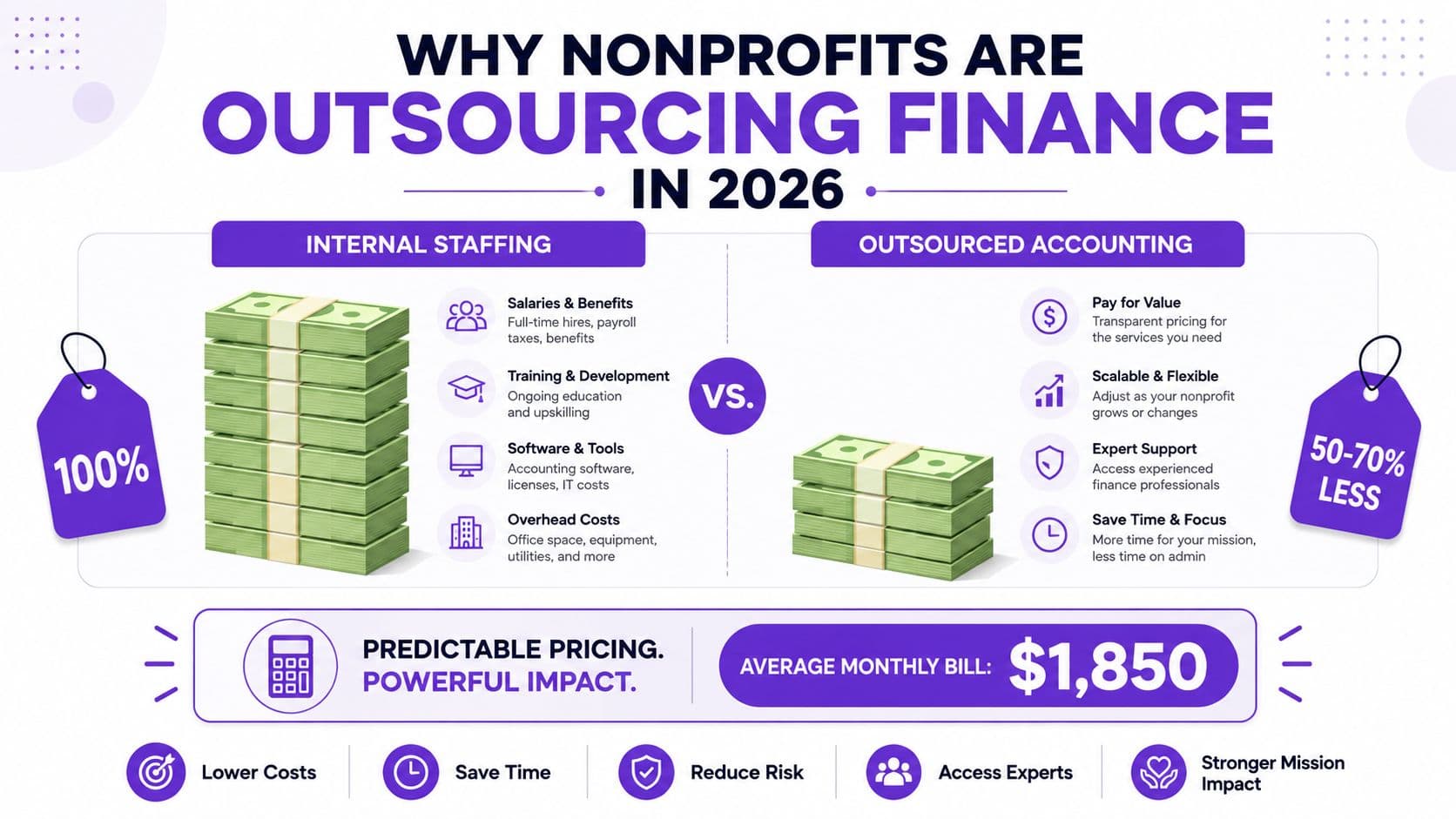
The shift is bigger than labor savings. A scaled market report valued global nonprofit outsourced accounting services at US$29.919 billion in 2024 and projected US$55.359 billion by 2031 at a 9.2% CAGR source. That's not a niche bookkeeping trend, it's a finance operating model that boards, CEOs, and finance leads are choosing because it improves control, reporting, and close discipline.
Table of Contents
- Why Nonprofits Are Outsourcing Finance in 2026
- What Fund Accounting Actually Means for Your Team
- Real Cost Math and Pricing Models You Can Compare
- The Nonprofit Month-End Close Playbook
- Grant Reporting, Donor Reporting, and Compliance Work
- Risks, Red Flags, and Controls You Must Keep
- Vendor Selection Checklist and Shortlist Criteria
- Implementation Plan, FAQs, and Next Steps
Why Nonprofits Are Outsourcing Finance in 2026
A nonprofit finance function breaks down fast when one person is expected to manage bills, reconciliations, grant coding, close work, and board reporting at the same time. Outsourcing becomes attractive when the organization needs cleaner controls and better reporting without carrying the full burden of an in-house team. The key question is whether the finance process can support fund accounting, restricted-fund tracking, grant reporting, and cost allocation without constant firefighting.
The decision is really about control and reporting
A serious outsourced partner is not just lower-cost labor. RSM's nonprofit finance guidance says many organizations lack the systems or internal skill set to produce accurate financial information, and it frames the outsourced scope as AP, AR, payroll, general ledger, month-end close, board reporting, and grant-specific reporting. That scope matters because the work has to produce statements you can use with auditors, grantors, and the board, not just a clean-looking ledger.
The market also keeps moving in this direction. Analysts tracking nonprofit outsourced accounting services report that organizations using a finance and accounting partner see measurable improvement, and many close the month in a tighter window than they did before source. That is the benchmark to demand. If a vendor cannot improve close discipline, tighten reporting, and keep restricted dollars clearly separated, the engagement is too thin.
Use this fund accounting guide for nonprofits when you want the accounting structure to match donor restrictions and functional reporting. If the provider cannot explain how they handle fund-level mapping, month-end review, and cost allocation, they are selling bookkeeping, not finance leadership.
Practical rule: if a provider talks only about bookkeeping hours and never mentions close cadence, fund-level reporting, or board packs, they are selling labor, not finance leadership.
| Dimension | In-House Accounting Manager | Outsourced Accounting Partner |
|---|---|---|
| Cost structure | Salary, benefits, recruiting, training, software overhead | Fixed monthly fee or scoped project pricing |
| Coverage | One person's bandwidth and skill set | Team coverage across bookkeeping, close, and reporting |
| Nonprofit expertise | Depends on who you hire | Typically built around fund accounting and compliance |
| Close discipline | Often informal and person-dependent | Usually standardized with deadlines and review steps |
| Scalability | Slow and expensive to expand | Easier to add scope as complexity grows |
What Fund Accounting Actually Means for Your Team
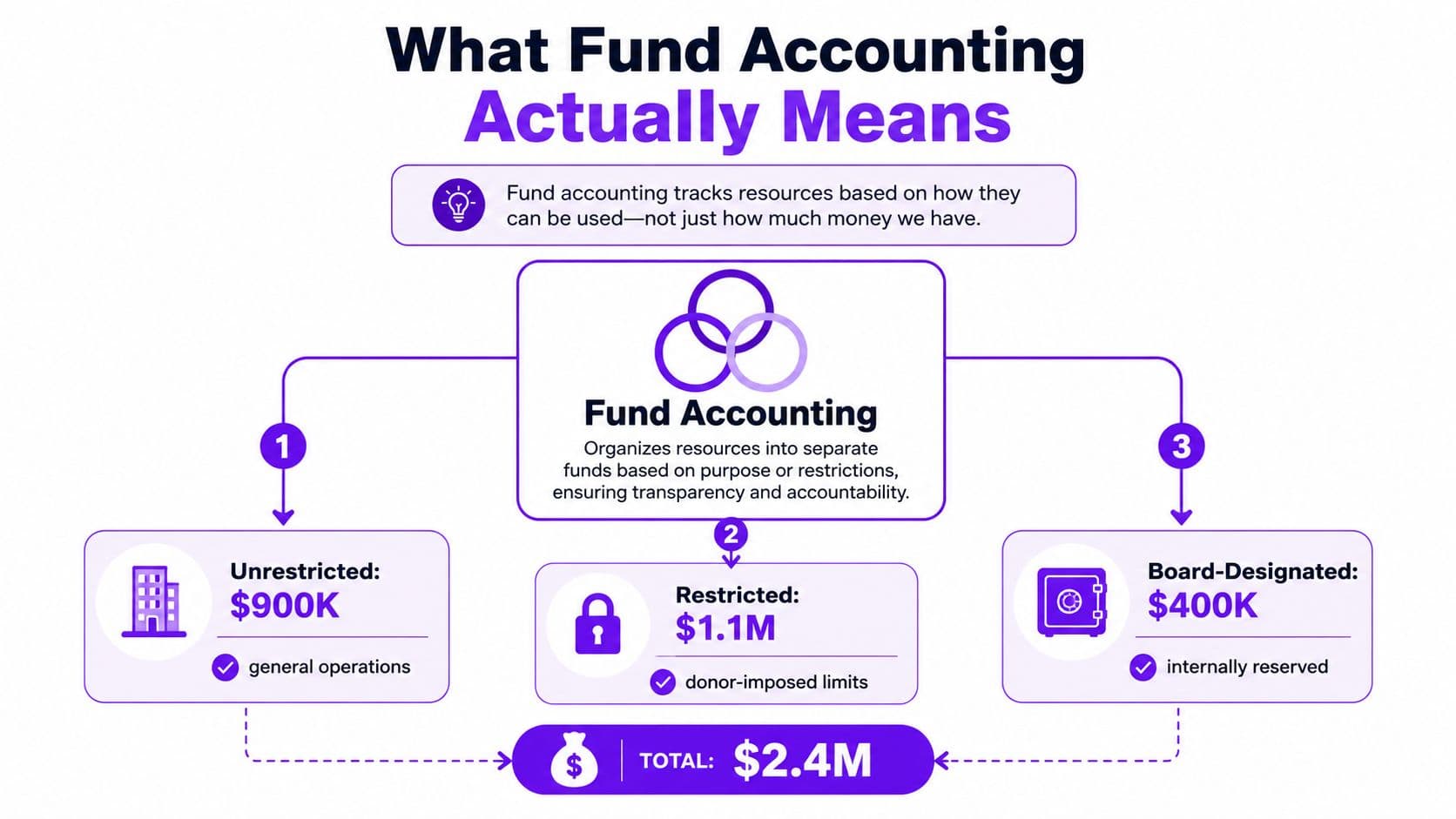
Fund accounting is the line between a clean nonprofit ledger and a messy one. In a for-profit company, the main question is profit. In a nonprofit, the question is whether each dollar stayed inside the right restriction, purpose, and reporting bucket. That's why the chart of accounts has to be fund-first, not department-first.
A simple worked example shows why this matters
Use a $2.4M nonprofit with three buckets, $900K unrestricted, $1.1M temporarily restricted, and $400K permanently restricted. If a program staff member earns $25,000 for a month, that salary doesn't live in one tidy line and disappear. Part of it lands in program expense, part may be allocated across management and fundraising, and the restriction on the underlying funds determines what can legally pay the cost.
The key rule is blunt. Donor-restricted dollars can't cover rent unless the donor agreement allows that use. If the restricted grant is for direct program delivery, the office lease stays outside that bucket. Net assets then show up in the proper classes, with donor restrictions and without donor restrictions, so the statement of activities tells the truth about what the organization can spend.
A clean nonprofit chart of accounts should answer three questions at once, what fund was used, what function the cost served, and whether donor conditions still apply.
The reports you should demand from day one are the statement of financial position, statement of activities by fund, statement of cash flows, and statement of functional expenses. Those reports are the minimum proof that the provider understands nonprofit accounting instead of merely entering transactions. For a deeper technical reference, use the structure in this fund accounting guide.
Real Cost Math and Pricing Models You Can Compare
Start with loaded cost, not the sticker price on a proposal. Outsourced accounting that looks cheap on paper can still beat an internal hire once you add payroll taxes, benefits, software access, training, supervision, and the time spent cleaning up errors after a volunteer or overworked staff member. If the outside firm charges $1,850 per month, annual spend is $22,200. A full-time accounting manager at $54,000 plus benefits usually costs more than the salary line alone suggests, and the gap can widen fast once turnover and remediation enter the picture.
Compare pricing models against the work you actually need
Use the pricing model that matches the work, not the one that sounds tidy in a sales deck. A monthly retainer fits the recurring work a nonprofit cannot skip, bank reconciliations, monthly close, restricted-fund tracking, and reporting. A fixed fee fits a defined deliverable like Form 990 prep, audit support, or a cleanup project with a known endpoint. Hourly billing makes sense only for messy backlog work where nobody can define the scope cleanly before the first transaction is reviewed.
| Pricing model | Best fit | What it should cover |
|---|---|---|
| Monthly retainer | Ongoing finance operations | Reconciliations, close support, reporting, recurring allocations |
| Fixed fee project | One-time deliverables | Form 990 prep, audit support, cleanup, system migration |
| Hourly work | Unstructured cleanup | Historical corrections, backlog reduction, special investigations |
Demand a line-item scope before you compare quotes. Bank and credit card reconciliations, payroll journal entries, allocation entries, grant reporting, board package support, and 990 prep support should all be named. If the vendor leaves those items vague, the proposal is incomplete, and the comparison is useless.
Practical rule: compare quotes only after both vendors list the same deliverables. Otherwise you are comparing a full finance function to a narrow bookkeeping feed.
For a clear breakdown of recurring service costs versus one-time cleanup work, use this accounting cost guide.
The Nonprofit Month-End Close Playbook
A mature outsourced close has a rhythm. It does not depend on one tired bookkeeper working from memory. It runs on cutoff rules, reconciliations, and a review sequence that forces every fund to balance before the board sees numbers.
A ten-business-day close should look like this
Day 1 and 2 should lock AP and AR, capture payroll accruals, and stop late coding from leaking into the prior month. Day 3 should reconcile bank, credit card, and Stripe or Square activity across all funds. Day 4 should post allocation entries for program, management, and fundraising, then code grant expense properly.
Day 5 should produce draft financial statements, including the statement of financial position, statement of activities by fund, statement of cash flows, and statement of functional expenses. Day 6 and 7 should package grant reports and track restricted-fund draws. Day 8 through 10 should cover variance analysis, the board package, and CFO or ED review.
| Close day | Core work | Why it matters |
|---|---|---|
| 1 to 2 | Cutoff, AP/AR freeze, payroll accruals | Prevents prior-period distortion |
| 3 | Bank, card, Stripe or Square reconciliations | Confirms cash truth across funds |
| 4 | Allocations and grant coding | Preserves functional and fund accuracy |
| 5 | Draft statements | Gives leadership something reviewable |
| 6 to 7 | Grant reporting and restricted draws | Keeps funders aligned with reality |
| 8 to 10 | Variance review and board package | Turns accounting into decisions |
Nonprofit close work differs from for-profit close work in a few places that matter. Functional expense allocation isn't optional. In-kind revenue recognition has to be handled correctly. Releases from restriction must be recorded when donor conditions are met, not whenever the cash shows up.
If a provider can't walk you through those steps in order, they don't have a real close process. They have monthly bookkeeping.
For a practical close template, reference this month-end close checklist.
Grant Reporting, Donor Reporting, and Compliance Work
A generic bookkeeper can post transactions. A nonprofit-capable partner has to explain the money trail to a funder, an auditor, and the IRS without changing the underlying truth. That means grant-specific reporting, donor reporting, and compliance support all sit in the core scope, not as extras.
The contract has to name the outputs
The deliverables should include budget-to-actual reporting by grant, match documentation, indirect cost allocation, donor acknowledgment support, pledge tracking, Form 990 prep support, and the statement of functional expenses. If your provider can't produce those outputs, you're paying for a ledger, not nonprofit accounting.
Here's a simple allocation example. If a $1.1M restricted grant carries a 15% indirect cost rate, then $165K is allocated to indirect cost and $935K remains direct program expense. That structure has to show up in the journals, in the grant report, and in the board materials so the restriction is tracked correctly.
| Required output | Why it matters |
|---|---|
| Form 990 support | Keeps tax-exempt reporting complete |
| 990-T support, if applicable | Covers unrelated business tax exposure |
| Schedule A support | Supports public charity reporting |
| Statement of functional expenses | Documents administrative, fundraising, and program use |
| Grant-specific reports | Shows funder compliance and spend progress |
BPM's nonprofit guidance also emphasizes that grant-specific reporting and compliance are not polished extras, they're part of the accounting workload itself source. The cleanest contracts spell out who prepares the schedules, who reviews them, and who signs off before submission.
For a standards-focused checklist, use these nonprofit accounting standards notes.
Risks, Red Flags, and Controls You Must Keep
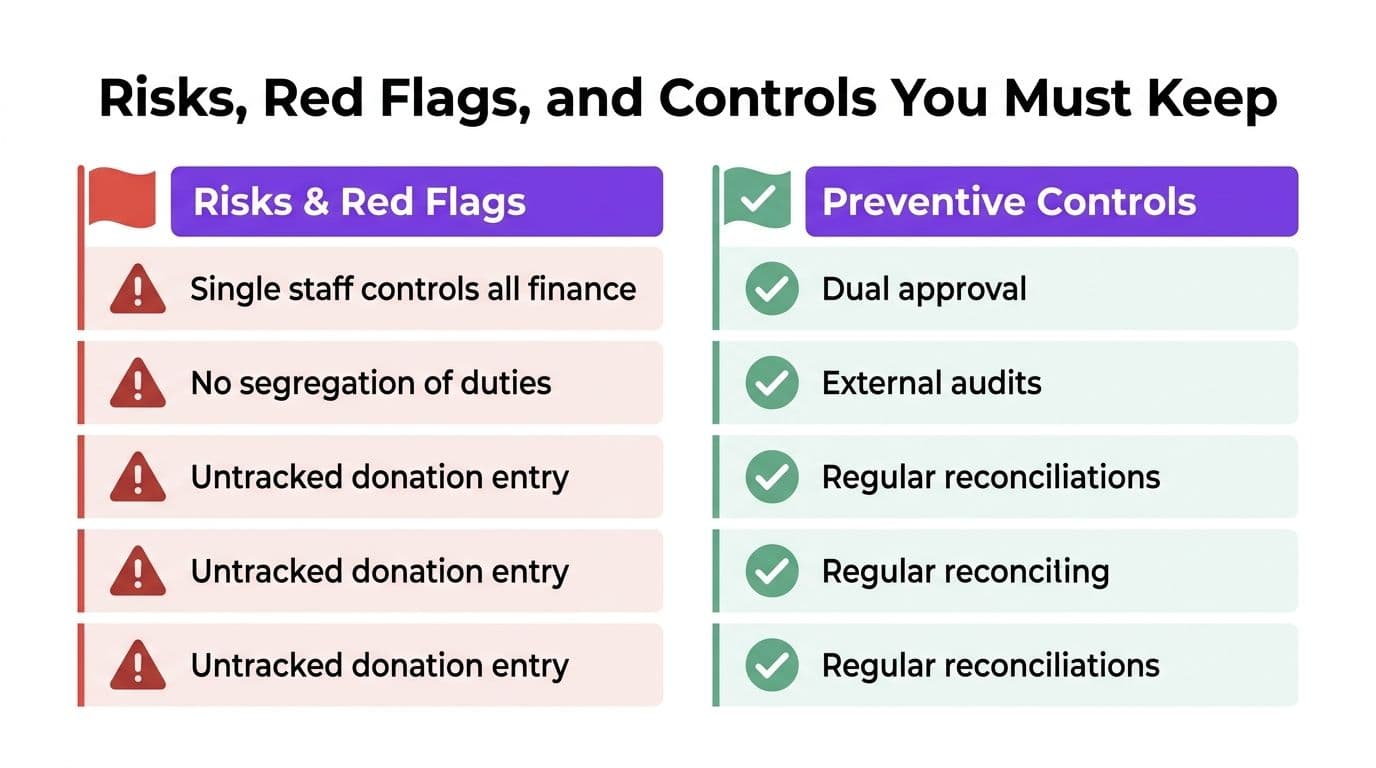
The biggest control failure in nonprofit finance is still the same one I've seen in volunteer-led setups and underbuilt internal teams. One person collects donations, records entries, reconciles the bank, and prepares reports. That's a segregation-of-duties problem, and outsourcing only helps if the structure forces separation and oversight.
These are the red flags I would reject fast
- Provider holds bank signing authority: that crosses the line from support into control.
- No SOC 2 Type II report: you're taking security claims on faith.
- No fund-level trial balance: they're not running nonprofit books.
- No approval workflow for journal entries: corrections will be undocumented.
- Unclear data ownership: you can't leave cleanly if the relationship sours.
Those contract clauses matter just as much as the software. You need data ownership language, right-to-audit rights, real-time access to source documents, approval thresholds for journal entries, a defined fund-level reporting cadence, and a board oversight role that stays intact. Nonprofit Risk Management Center warns boards to preserve oversight and access to accounts, which is exactly the right posture source.
Practical rule: if the provider can move money, edit records, and approve adjustments without a second human in the loop, the contract is too loose.
The best outsourcing setup reduces fraud exposure because it splits tasks, documents review, and keeps the board informed. The worst setup just moves weak controls offsite and calls it modernization.
Vendor Selection Checklist and Shortlist Criteria
You need a vendor screen that filters out generic firms fast. Don't start with price. Start with nonprofit competence, reporting discipline, and the ability to survive an audit season without drama.
Use this checklist in the first sales call
- Fund accounting experience: ask for real nonprofit clients, not one-off charity work.
- SOC 2 Type II: require it, don't treat it as a nice-to-have.
- GAAP and ASC 958 fluency: they should speak nonprofit accounting without translating every term.
- Form 990 support: they should prepare or support the return cleanly.
- Grant reporting track record: ask for funder-ready reports and allocation examples.
- US-based team: you want continuity and clear accountability.
- Integrations: QuickBooks, Xero, or NetSuite should fit your stack.
- Pricing model: fixed-fee or tiered pricing beats vague hourly estimates.
- Close timeline: target a five-day close if the vendor claims maturity.
- Client retention: ask for retention history and what causes churn.
- Comparable references: same size, same funding mix, same reporting demands.
- Transition support: they should own cleanup, handoff, and reopening balances.
| Criteria | Boutique Nonprofit Specialist | Mid-Tier Generalist | Jumpstart Partners |
|---|---|---|---|
| Fund accounting depth | Usually strong | Often inconsistent | Strong emphasis on nonprofit and growth finance |
| Compliance support | Good if specialized | Basic to moderate | Built for audit- and investor-ready reporting |
| Integrations | Often selective | Broad but less tailored | QuickBooks, Xero, NetSuite, Stripe, and more |
| Pricing clarity | Typically clear | Varies widely | Tiered monthly plans or fixed-fee projects |
For a decision framework that helps you compare in-house and outsourced ownership, use this controller decision guide.
If you take references, ask one blunt question first, how fast did the team close the books, and what broke when reporting deadlines got tight? Then ask how they handled grant reporting accuracy and audit support. Weak vendors sound polished in sales calls and vague in reference calls.
Implementation Plan, FAQs, and Next Steps
A good transition doesn't begin with the first reconciliation. It begins with cleanup, system mapping, and an agreement on who owns what during the handoff.
A 30-60-90 day rollout keeps the switch controlled
Days 1 to 30 should rebuild the chart of accounts, clean up prior periods, reconcile opening balances, and connect integrations like QuickBooks, Stripe, payroll, and the donor CRM. Days 31 to 60 should produce the first close under the new model, push fund-level reports into production, and build the grant reporting calendar. Days 61 to 90 should lock the board package, assemble the audit-ready file, and turn on a KPI dashboard for days to close, restricted cash ratio, and program expense ratio.
If your organization also runs program or community platforms, integration planning matters. A useful example is automating church tasks with integrations, because it shows how connected systems reduce manual work instead of creating another inbox problem.
FAQ
How long does the transition take? A clean handoff usually takes one implementation cycle plus a first close. If your books are messy, the cleanup work comes first and the reporting cadence follows after.
Can you outsource during an active audit? Yes, but only if the provider can produce source documents quickly and keep the audit trail intact. That's where real document control matters more than speed.
How do you know the engagement is working after 90 days? You should see a stable close cadence, fund-level reports that make sense, and fewer emergency questions from leadership and the board. If the team still can't explain allocations or restricted spending, the relationship is too shallow.
For nonprofit leaders who want a hard look at the books, the controls, and the handoff plan, Jumpstart Partners can scope the finance function and tell you exactly what needs to change before you switch.