Financial Operations
Nonprofit Accounting Standards: Simplify Compliance
Master nonprofit accounting standards. Get clear FASB guidance, grant rules, financial statement insights, & audit readiness. Scale your organization.
ByJumpstart Partners, CPA, QuickBooks ProAdvisor
··22 min readYour nonprofit is probably at the point where simple bookkeeping no longer holds up. Donations arrive with different restrictions. Grants come with reporting conditions. Someone on your team records an in-kind gift as revenue but forgets the matching expense. Your board wants cleaner financials. Your auditor wants support. Your month-end close drags because restricted and operating cash keep getting mixed together.
That's the moment when nonprofit accounting standards stop feeling theoretical.
If you're still managing the books with a generalist process, a basic QuickBooks file, and a lot of spreadsheet memory, compliance gaps start showing up fast. The hard part isn't just “keeping good books.” It's applying the right rules to the right transaction at the right time, then producing financial statements that donors, auditors, regulators, and board members can confidently rely on.
Finance leaders usually need to shift from DIY bookkeeping to controller-level oversight. Not because the organization failed, but because the financial model got more complex than a cash-in, cash-out system can handle.
Table of Contents
- Recognizing the Stakes of Nonprofit Financial Compliance
- Understanding FASB ASC 958 and Key ASUs
- Impact on Financial Statements and Audit Readiness
- Explaining Common Accounting Treatments
- Navigating Federal Grant Accounting Rules
- Building Your Compliance Checklist
- Transition Strategies for Outsourced Controller Support
- Next Steps for Ensuring Compliance and Growth
Recognizing the Stakes of Nonprofit Financial Compliance
Your program director says a new grant will cover the next three months of hiring. Your bookkeeper shows enough cash in the bank to move ahead. Then your auditor asks a simple question. How much of that cash is available for payroll, and how much is tied to donor restrictions or grant conditions?
That moment is where many nonprofits realize the compliance risk. The problem usually is not math. It is classification, timing, and documentation.
A restricted gift recorded in the wrong net asset category can make operations look healthier than they are. An in-kind donation entered as revenue without the offsetting expense can overstate activity. A conditional grant recognized before the barrier is met can pull future revenue into the current year. Once those entries flow through the books, the issue reaches board reporting, grant reporting, audit support, and Form 990 preparation.
This gets harder when a nonprofit outgrows DIY bookkeeping but still uses a setup built for a much smaller organization. The bank balance may be accurate while the accounting story is wrong. A founder sees $250,000 in cash and assumes it can all be spent. An outsourced controller looks at the same $250,000 and separates it into amounts available now, amounts restricted for a purpose, and amounts that cannot be recognized as revenue yet. That difference changes decisions.
The National Council of Nonprofits notes in its guidance on restricted and unrestricted funds in nonprofit accounting that nonprofits must track donor restrictions carefully so financial reports reflect what is available to use. If your team is still learning that distinction while closing the month, you have already found a common fault line.
A simple way to test your system is to ask whether one transaction can be explained from gift letter to journal entry to board report. If the trail breaks, compliance risk rises fast. This is why many organizations eventually need stronger nonprofit fund tracking rather than general bookkeeping alone. A well-built nonprofit fund accounting structure helps your reports show both where cash sits and what each dollar is allowed to do.
Common warning signs usually appear before the audit:
- Restricted cash confusion: No one can state, with support, how much cash is available for general operations this month.
- Revenue timing errors: Grants, pledges, or contracts are recorded based on expected cash instead of the actual recognition rules.
- Weak documentation: In-kind gifts, releases from restriction, and allocations cannot be tied back to agreements, calculations, or approvals.
- Board report gaps: Internal financials do not match the categories and balances that will appear in year-end statements.
- DIY close process strain: The monthly close depends on one staff member's memory, spreadsheet workarounds, or year-end cleanup from an outside CPA.
Compliance protects more than filing requirements. It protects planning. When leadership knows which dollars are usable, which are restricted, and which have not been earned yet, hiring, program spending, and cash forecasts become far more reliable. That is often the point where outsourced controller support stops feeling optional and starts looking like a practical control.
Understanding FASB ASC 958 and Key ASUs
FASB ASC 958 is the core framework for nonprofit accounting in the United States. It sets the rules that make nonprofit reporting consistent across organizations. According to Sage's overview of nonprofit accounting standards, the foundational framework for nonprofit accounting in the United States is FASB ASC 958 (Not-for-Profit Entities), which mandates two net-asset categories, three functional expense buckets, and four required financial statements for sector-wide consistency.
That standard matters because nonprofit accounting isn't built around profit. It's built around accountability. You're not asking, “Did we earn money?” You're asking, “What resources came in, what restrictions came with them, and how were they used?”

Why ASC 958 matters in day-to-day accounting
The easiest way to understand ASC 958 is to picture two jars on your finance desk.
One jar is without donor restrictions. The other is with donor restrictions. Every contribution goes into one of those jars based on donor intent. That sounds simple, but many DIY bookkeeping systems fail at this point. Teams often create dozens of ad hoc classes, funds, and bank account workarounds without building a clean net asset framework.
ASC 958 also requires expenses to be presented by function. That means every expense needs to land in one of three buckets:
| Functional bucket | What belongs here |
|---|---|
| Program services | Direct mission-related work |
| Management and general | Finance, HR, governance, office administration |
| Fundraising | Campaigns, donor outreach, event fundraising costs |
If you want a practical operating model for setting up those buckets inside the general ledger, this guide to nonprofit fund accounting is a useful companion.
What changes under ASU 2016-14
ASU 2016-14 sharpened the way nonprofits present net assets and liquidity. Instead of the older three-part model, organizations now classify net assets into exactly two categories: with donor restrictions and without donor restrictions, as explained in this overview of nonprofit accounting standards and ASU updates.
That change sounds technical. It isn't. It changes how leadership reads available resources.
Here's a simple example using real numbers:
| Item | Amount | Classification |
|---|---|---|
| General operating donations | $100,000 | Without donor restrictions |
| Building campaign gift | $50,000 | With donor restrictions |
| Board-designated reserve | $20,000 | Without donor restrictions |
Your total net assets are $170,000. But only $120,000 is without donor restrictions. If your team mistakenly treats the building campaign gift as available for operations, your cash planning is wrong even if the bank balance looks healthy.
Misclassifying a restricted contribution doesn't just distort a report. It changes what management believes it can spend.
ASU 2016-14 also ties reporting more closely to liquidity disclosure. Finance leaders need to explain what financial assets are available for use within one year. That pushes accounting beyond recordkeeping. It forces a cleaner conversation between the ledger, grant agreements, and actual operating cash.
Impact on Financial Statements and Audit Readiness
Your audit doesn't start when the auditors arrive. It starts with the way your monthly close is structured.
Nonprofits have a different reporting burden than for-profit businesses. According to Aplos's guide to nonprofit financial statements, nonprofit accounting standards universally require four financial statements, including the unique Statement of Functional Expenses, whereas for-profits typically produce only three statements. That difference is why finance leaders coming from SaaS, agencies, or services firms often underestimate nonprofit close complexity.
What your reporting package must include
Here's the clean comparison.
| Required Financial Statements for Nonprofits vs For-Profits | Nonprofit | For-Profit |
|---|---|---|
| Statement of Financial Position | Required | Balance Sheet used instead |
| Statement of Activities | Required | Income Statement used instead |
| Statement of Cash Flows | Required | Required |
| Statement of Functional Expenses | Required as the standard mechanism for functional expense analysis | Not a standard required statement |
Each statement answers a different question:
- Statement of Financial Position: What do you own, owe, and hold in net assets right now?
- Statement of Activities: What changed over the reporting period?
- Statement of Cash Flows: How did cash move?
- Statement of Functional Expenses: Where did spending go by mission, administration, and fundraising?
If you work with international funders, multilingual boards, or foreign grant documents, precise support materials matter. A specialized resource on expert financial document translation can help finance teams preserve terminology and compliance meaning across reports.
Where audits usually get harder
Audit readiness breaks down in the handoff between bookkeeping and judgment. The software can store entries. It won't decide whether shared rent belongs partly in program services and partly in management and general. It won't tell you whether a donor letter created a restriction. It won't fix weak documentation.
Here's where teams usually get flagged:
- Expense allocation support: You assigned payroll, rent, or software across functions, but there's no written basis for the split.
- Restriction releases: Funds were spent for the intended purpose, but the release entry wasn't recorded correctly.
- Cash availability confusion: Internal reports present all cash as available, even when part of it is restricted.
- Audit trail gaps: The journal entry exists, but the donor letter, grant agreement, or valuation memo is missing.
A strong month-end file should let a reviewer move from financial statement line item to source support without guesswork. If you need to tighten that process, a practical workflow for how to audit financial records can help your team prepare documentation before year-end pressure hits.
Clean audits usually come from boring monthly discipline. They don't come from heroic cleanup in the final week.
Explaining Common Accounting Treatments
The hardest part of nonprofit accounting standards isn't reading the rule. It's deciding which rule applies to the transaction in front of you.
A pledge, a grant, a sponsorship, an in-kind donation, and a fee-for-service contract can all look like “revenue” in the bank. They are not accounted for the same way.
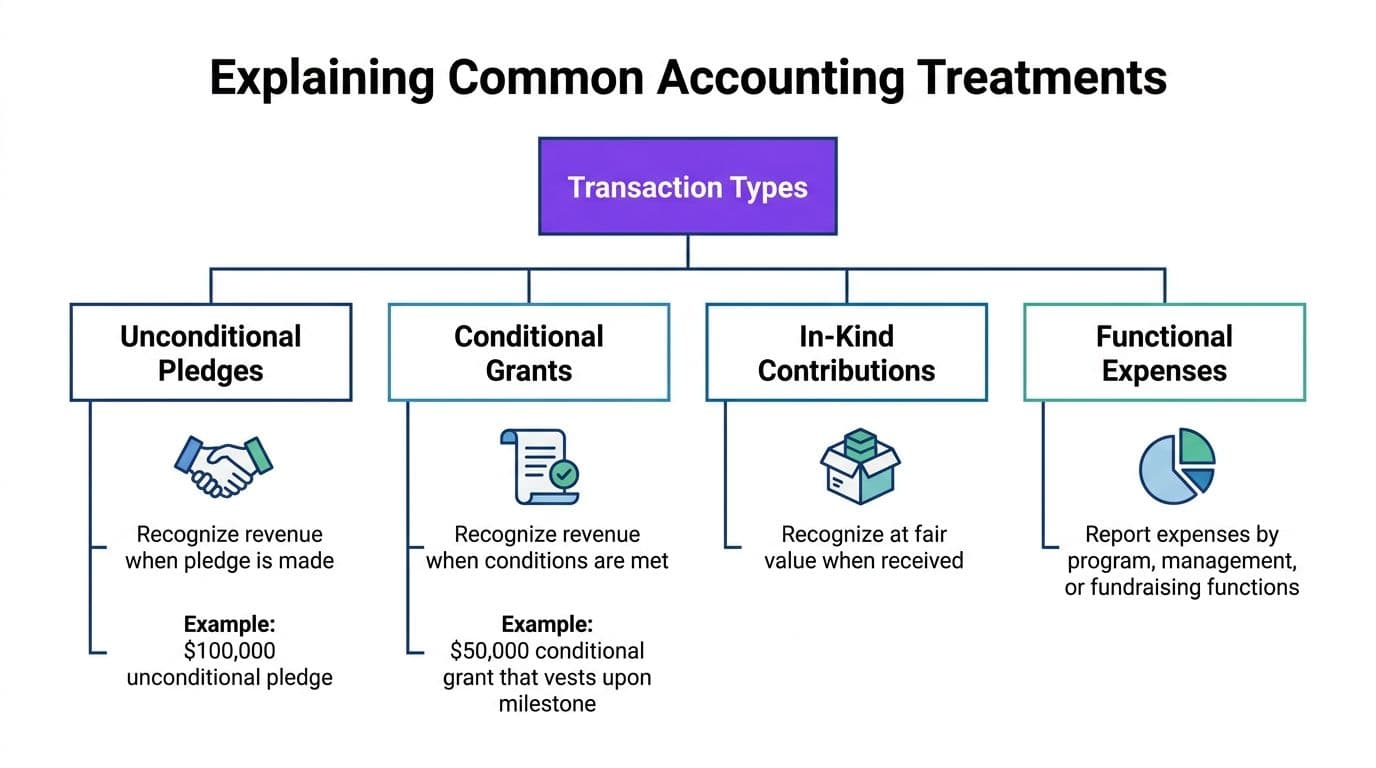
How to treat pledges grants and exchange revenue
Start with the basic split.
If the funder does not receive goods or services of commensurate value, you're usually in contribution accounting under ASC 958-605. If the other party does receive commensurate value, the transaction is an exchange under ASC 606, as explained in Bonadio's comparison of ASC 606 and contribution accounting.
Under ASC 606, revenue follows a defined 5-step process: identify the contract, identify performance obligations, determine the transaction price, allocate that price, and recognize revenue when obligations are satisfied, according to The Charity CFO's ASC 606 overview.
Here are the worked examples most leaders need.
| Transaction | Amount | Recognition approach |
|---|---|---|
| Unconditional pledge | $100,000 | Recognize when pledged |
| Conditional grant tied to milestone | $50,000 | Recognize only when condition is met |
| Exchange transaction with commensurate value | Use ASC 606 | Recognize as obligations are satisfied |
Example 1. Unconditional pledge of $100,000
A donor signs a binding pledge with no performance condition.
Journal entry when pledged:
- Debit Pledges Receivable $100,000
- Credit Contribution Revenue $100,000
If the pledge is donor restricted for a scholarship program, the revenue sits in net assets with donor restrictions until used for that purpose.
Example 2. Conditional grant of $50,000
The grant says your nonprofit earns the funds only after completing a stated milestone. Until the milestone is met, you do not record grant revenue.
Before the milestone: no revenue entry.
When the milestone is met:
- Debit Grants Receivable or Cash $50,000
- Credit Grant Revenue $50,000
That treatment is where many teams get tripped up. They treat a signed award letter like earned revenue. It isn't, if the grant is conditional.
For cleaner coding at the ledger level, a nonprofit chart of accounts template helps you separate pledges, grants, exchange income, and restricted activity from the start.
A quick walkthrough can help if your team needs a visual explanation before rebuilding the process:
How in-kind gifts affect the books
In-kind contributions confuse even experienced finance teams because they affect revenue without changing cash. According to Jitasa's GAAP guide for nonprofits, GAAP requires recording in-kind contributions at fair market value as both revenue and expense, resulting in zero net income impact.
Use a direct example.
Your nonprofit receives donated design services with a fair market value of $20,000.
Journal entry:
- Debit Professional Services Expense $20,000
- Credit In-Kind Contribution Revenue $20,000
Net effect on change in net assets from this single transaction: $0.
That's why adding the contribution to revenue is wrong. You'd overstate activity and understate expenses.
Controller's lens: In-kind accounting is a mirror entry. If you can't explain both sides of it, the transaction isn't finished.
A few common misconceptions need to go:
- “If no cash moved, we can ignore it.” Wrong. If it meets recognition requirements, it belongs in the books.
- “We'll record it when the donor sends a receipt.” Wrong. Recognition follows the accounting event, not the convenience of paperwork timing.
- “Every sponsorship is a donation.” Wrong. If the sponsor receives commensurate value, you need to test it under ASC 606.
Navigating Federal Grant Accounting Rules
Your bookkeeper closes the month and the numbers look fine. Then a federal reimbursement request is due, and suddenly three basic questions stall the process. Which payroll hours belong to this grant? Why was part of the rent charged here? Do the expenses in the general ledger match the approved budget categories in the award?
That is the moment many nonprofits realize regular bookkeeping and federal grant accounting are not the same job.
A general ledger can tell you what you spent. Federal grant reporting has to show what you spent, why it was allowable, which award paid for it, and what support sits behind the number. If DIY bookkeeping is a household check register, grant accounting is a job-cost file with rules attached to every line.
How to track grants without losing control
The cleanest setup gives each transaction more than one label. One expense may need four pieces of identity at once:
- Grant source: which award funded it
- Program or department: which activity incurred it
- Natural expense type: payroll, travel, supplies, contractors
- Allowability status: whether the cost is permitted under the award terms
Here is a practical example.
A program manager attends an approved training related to Grant A. The airfare is $420, the hotel is $610, and meals are $96. In a basic bookkeeping system, those costs may land in travel and be done. In a grant-ready system, they also need to be tied to Grant A, matched to the correct budget line, and supported by the award terms and receipts. If meals exceed the grant policy or federal limits, part of that entry may need to be excluded from reimbursement even though it still belongs in the books.
That distinction trips up founder-led finance teams all the time. The accounting record and the reimbursement record often overlap, but they are not always identical.
A simple operating routine helps:
- Set up a grant-specific tracking dimension in your accounting system, such as class, location, customer, project, or a dedicated grant code.
- Save the signed award agreement and amendments in the monthly close file, not just in email.
- Map the grant budget to your chart of accounts before spending starts so reporting categories tie out cleanly.
- Review grant activity every month against both the approved budget and the award rules.
- Write down allocation methods for shared costs before you post them.
The last step is where DIY systems usually break.
Shared payroll, rent, software, and admin support often start with a reasonable guess. Federal grant accounting needs a method you can defend later. If 30 percent of a program director's time is charged to a grant, keep the timesheets or time allocation support. If rent is split across grants, keep the square footage or staffing basis. A reviewer should be able to follow the trail without asking your team to reconstruct it from memory.
Red flags in grant compliance
The books usually show warning signs before an audit or monitoring review does.
| Red flag | What it usually means |
|---|---|
| Large journal entries posted right before a grant report is due | The team is rebuilding grant activity after the fact |
| Grant costs sitting in broad overhead accounts | Coding is too vague for supportable reporting |
| Shared expenses with no written allocation memo | Charges may be questioned even if the math is correct |
| Cash received before revenue treatment is clear | Conditional grant recognition may be incorrect |
| Different versions of the budget in email, spreadsheets, and reports | Finance and program staff are working from inconsistent assumptions |
One more warning sign deserves attention. The same person who approves spending, codes transactions, and prepares the reimbursement request has too much control in one spot. Federal grant compliance is not only about expenses. It is also about process discipline, document retention, and basic internal controls. That is one reason organizations often tighten finance procedures around grants while also reviewing related risk controls such as vendor approval, user access, and even background checks for nonprofits in sensitive roles.
Where outsourced controller support changes the picture
This is often the line between bookkeeping and controller work.
A bookkeeper can record a payroll entry. A controller sets the rule for how payroll gets split across grants, checks that the method matches the award terms, and makes sure the support is saved in the close file. A bookkeeper can post rent. A controller decides whether that rent should hit one grant, several grants, or none of them.
For nonprofits shifting out of a DIY setup, outsourced controller support usually improves three things first:
- monthly grant reconciliations
- documented allocation policies
- a close process with evidence attached to each reported balance
That structure matters at year-end. If grant files are scattered across inboxes and spreadsheets, close takes longer and audit requests multiply. A documented monthly process shortens cleanup work. This year-end close checklist for nonprofit finance teams helps turn that monthly discipline into an audit-ready file.
Good federal grant accounting is built before the report is due. The goal is simple: every number on a grant report should tie to the ledger, every ledger charge should tie to support, and every shared cost should tie to a written method your team can explain clearly.
Building Your Compliance Checklist
Most nonprofits don't need more accounting theory. They need a live checklist that turns nonprofit accounting standards into recurring tasks with owners and evidence.
That's where many competitors stop too early. They explain the rules, then leave your team to translate them into a workflow. You need the workflow.
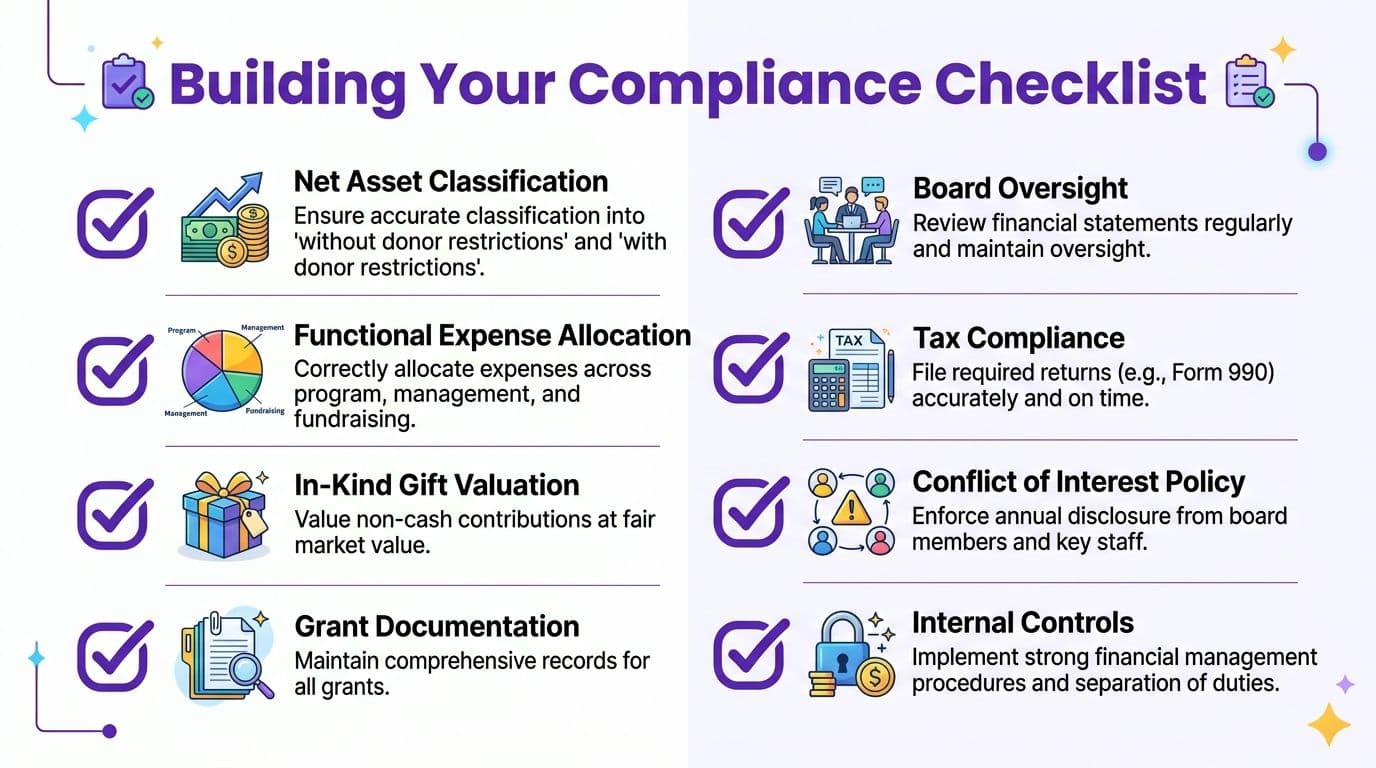
A practical owner-based checklist
Use this as a compliance-ready starting point.
| Checklist item | Owner | Frequency | Documentation to attach |
|---|---|---|---|
| Net asset classification review | Controller or finance lead | Monthly | Donor letters, grant agreements, release support |
| Functional expense allocation update | Controller | Monthly | Allocation workbook, payroll basis, rent methodology |
| In-kind gift valuation review | Finance lead | As received and month-end | Fair market value support, donor correspondence |
| Grant file reconciliation | Grants manager and finance | Monthly | Award documents, invoices, budget-to-actual report |
| Board reporting package tie-out | CFO or controller | Monthly or quarterly | Final financial statements and internal reporting pack |
| Year-end audit file assembly | Finance team | Annually, prepared monthly | Lead schedules, reconciliations, policy memos |
Keep the checklist in the same place as your close process. If it lives in a separate document no one opens, it won't change behavior.
Add adjacent controls too. For nonprofits with volunteer-heavy programs, finance leaders often coordinate with HR or operations on screening and governance records. A practical directory of background checks for nonprofits can help if your compliance environment overlaps with volunteer management and safeguarding obligations.
A year-end package gets dramatically easier when the monthly close already includes compliance evidence. This year-end close checklist is useful for turning monthly habits into an audit-ready archive.
The best checklist is the one your team can complete without debating what the item means.
Transition Strategies for Outsourced Controller Support
DIY bookkeeping works until the accounting requires judgment. That's the breaking point.
The first sign usually isn't an error message in QuickBooks. It's operational drag. Your close stretches. Grant reports take too long. Board packets need manual cleanup. No one feels confident answering whether a gift is restricted, conditional, exchange-based, or in-kind. At that stage, you don't just need data entry. You need someone who can own accounting policy, review classifications, and structure the close.
When DIY bookkeeping stops working
These conditions usually signal the transition point:
- Your bookkeeper records transactions well, but doesn't own accounting decisions.
- Leadership relies on spreadsheets outside the accounting system to explain donor restrictions or grant balances.
- Month-end requires memory instead of process.
- Audit preparation turns into a document hunt.
A controller brings a different level of discipline. They define the monthly review cadence, document allocation methods, set revenue recognition rules, and make sure the financial statements tell the same story as your grant files and board reports.
What a clean transition looks like
A smooth handoff starts with scope, not software.
First, map what's already happening: reconciliations, close steps, grant tracking, board reporting, Form 990 support, and audit prep. Then separate bookkeeping tasks from controller tasks. The team posting bills shouldn't also be the only layer reviewing donor restrictions and release entries.
A simple transition model looks like this:
| Phase | Focus |
|---|---|
| Cleanup | Fix chart of accounts, classes, and historical coding issues |
| Policy setup | Define revenue recognition, restrictions, allocations, and close checklist |
| Monthly control | Review statements, reconciliations, grant balances, and supporting schedules |
| Reporting rhythm | Deliver board, audit, and compliance-ready packages consistently |
If you're evaluating what controller-level support should include, this overview of outsourced controller services gives a practical benchmark.
The right outsourced controller relationship should reduce ambiguity. If it only gives you more reports without cleaner accounting decisions behind them, it's not solving the underlying problem.
Next Steps for Ensuring Compliance and Growth
Start with the parts of your system that affect every report.
Update your chart of accounts so restricted activity, grant revenue, in-kind contributions, and functional expenses have clear homes. Review active donor and grant agreements, then confirm your net asset classifications reflect actual restrictions. Rebuild your month-end close so every key balance ties to documentation, not memory.
After that, put your compliance checklist into motion. Assign an owner to each item. Set a monthly review date. Keep the support files with the close folder. That single operating change does more for audit readiness than most year-end scramble sessions ever will.
If your board is working through long-range sustainability planning alongside compliance work, a thoughtful resource on building a 2026 nonprofit financial plan can complement the accounting side with strategic planning ideas.
Nonprofit accounting standards aren't just a reporting requirement. They're the operating system for donor trust, grant compliance, and better financial decisions. Once the rules are built into the close, your finance function gets calmer, faster, and far more reliable.
If your nonprofit has outgrown DIY bookkeeping and needs stronger controller oversight, Jumpstart Partners can help you tighten your close process, improve compliance documentation, and build audit-ready financial reporting with a CPA-led outsourced finance team.