Financial Operations
Revenue Recognition for Software as a Service
Master revenue recognition for software as a service under ASC 606. Learn the five-step model, journal entries, MRR impact, and system integration
ByJumpstart Partners, CPA, QuickBooks ProAdvisor
··18 min readMost advice about revenue recognition for software as a service starts with the ASC 606 five-step model. That's necessary, but it isn't where most operating failures begin. The fundamental breakdown usually happens earlier, when a sales contract, billing platform, deferred revenue schedule, and general ledger each hold a slightly different version of the deal.
A customer can pay upfront, receive invoices in arrears, upgrade mid-term, consume variable services, and receive onboarding under one commercial relationship. Your accounting team still has to produce one defensible revenue story. If the systems don't share contract dates, obligations, pricing changes, credits, and usage data, the resulting error can sit unnoticed until an audit, fundraising process, or diligence request exposes it.
ASC 606 and IFRS 15 created a common five-step framework for contracts with customers. The standards were issued in May 2014, IFRS 15 became effective on January 1, 2018, and ASC 606 applied to public-company annual reporting periods beginning after December 15, 2017. Non-public companies had an original effective date for annual reporting periods after December 15, 2019. This overview of ASC 606's SaaS timeline and five-step model explains why subscription businesses moved away from cash or invoice timing and toward recognition that follows service delivery.
Table of Contents
- Why Cash Collected Is Not Revenue Earned
- The ASC 606 Five-Step Model Applied to SaaS
- The Hardest Judgment Calls in SaaS Contracts
- Journal Entries and Deferred Revenue Waterfalls
- Integrating Revenue Recognition with Your Systems
- Red Flags That Your Revenue Recognition Is Broken
- Your Implementation Roadmap and Next Steps
Why Cash Collected Is Not Revenue Earned
If $120,000 lands in your bank account from an annual prepayment, you haven't earned $120,000 on the day of collection. You've received cash for a service you'll deliver across the contract term. Until that service is provided, the amount generally sits as deferred revenue, a liability on the balance sheet.
The practical distinction is simple:
- Cash tells you when money moved.
- Invoicing tells you when you asked the customer to pay.
- Revenue tells you how much of the promised service you delivered.
That separation matters because SaaS companies routinely use annual prepayments, monthly billing, implementation fees, credits, renewals, and usage charges. Management metrics such as MRR and ARR help you understand recurring commercial performance, but they don't replace GAAP revenue schedules. MRR, ARR, billings, cash, and recognized revenue answer different questions.
The risk hides in the balance sheet
The danger isn't limited to one incorrect journal entry. If you recognize an annual prepayment immediately, you overstate revenue and profit in the first period, understate deferred revenue, and create an opening balance that contaminates every later close. The error can compound undetected because each monthly schedule starts from the wrong contract position.
That's why deferred revenue deserves more attention than a line item reviewed only at year-end. A useful primer on what deferred revenue means for SaaS companies reinforces the operating point: the liability is a record of service still owed to customers, not an accounting nuisance to clear whenever someone has time.
Controller's rule: Never let the invoice date determine the revenue date unless the invoice and service delivery happen to align for a documented reason.
What happens when teams ignore the gap
Auditors typically trace revenue back to signed contracts, service periods, fulfillment evidence, billing records, and the deferred revenue roll-forward. If those records disagree, the audit issue isn't merely that a spreadsheet has a formula problem. It signals that your revenue policy isn't consistently operating across the order-to-cash process.
For a founder, the consequences can reach beyond the income statement. A revenue adjustment can affect covenant calculations, investor reporting, sales commission analysis, forecast credibility, and the timing of a fundraising process. The accounting standard exists to make revenue reflect the transfer of service, but the business case is stronger: accurate recognition gives you a reliable view of what you earned, what you still owe, and what your contracts will produce in future periods.
The ASC 606 Five-Step Model Applied to SaaS
The five steps are easier to apply when you treat them as a contract-to-schedule workflow instead of a memorized accounting definition. Consider an annual SaaS agreement with a total contract price of $60,000 and a separate $12,000 implementation fee.
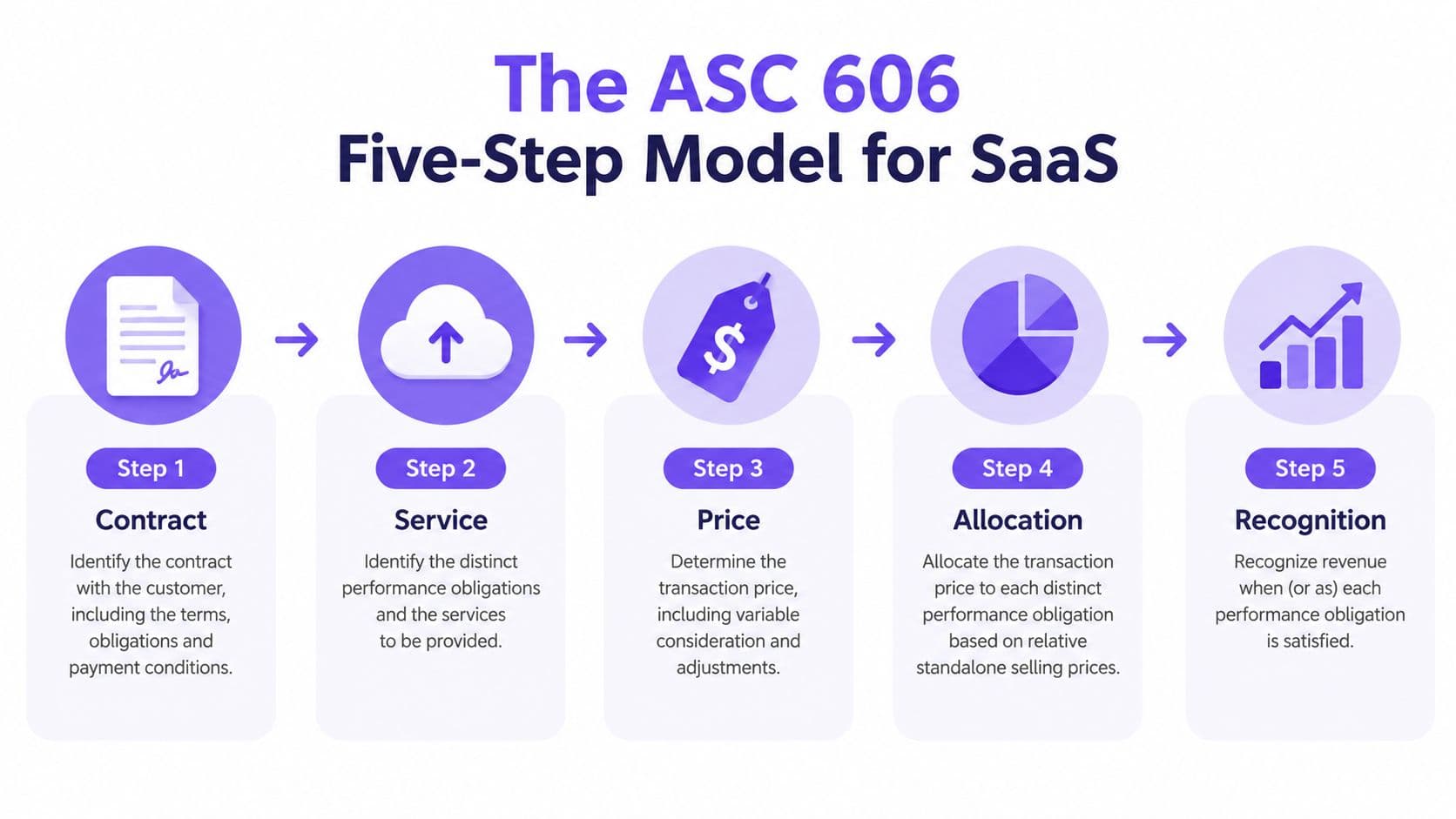
Step 1, identify the contract
First, confirm that both parties approved the arrangement, each party's rights are identifiable, payment terms are clear, the arrangement has commercial substance, and collection is probable. A signed order form usually provides stronger evidence than an unsigned proposal or an internal sales forecast.
Your contract repository should capture the executed agreement, start date, go-live terms, renewal language, cancellation rights, discounts, credits, and amendments. If the billing platform contains one service start date and the signed order form contains another, the accounting team needs a controlled resolution before creating a schedule.
Step 2, identify performance obligations
Next, determine what you promised to transfer. Platform access is usually a service delivered over time. Implementation requires a separate assessment. If the customer can benefit from the implementation independently and it isn't inseparable from the hosted service, it can be a distinct performance obligation. If the work only enables your team to provide the ongoing hosted service and has no separate benefit, it may be combined with that service and recognized over the service period.
Your conclusion belongs in a written policy memo. The practical test for identifying performance obligations is not whether the contract lists separate line items. It is whether the promised goods or services are distinct in the context of the arrangement.
Steps 3 and 4, determine and allocate the price
The transaction price is the consideration you expect to receive. In this example, the stated amount is $72,000, consisting of the $60,000 annual subscription and $12,000 implementation fee. You then allocate that price based on the relative standalone selling prices, not automatically according to the invoice lines.
Assume your observable standalone selling prices are $60,000 for annual platform access and $12,000 for implementation. The allocation remains $60,000 to the subscription and $12,000 to implementation because those values already represent the relative selling prices. If you sell only bundles, you'll need a documented estimation method.
Step 5, recognize revenue as obligations are satisfied
If implementation is distinct and completed at the start of the arrangement, recognize its allocated amount when that obligation is satisfied. Recognize the $60,000 subscription allocation over the annual service period, which produces $5,000 per month when service is provided evenly.
| Contract element | Allocated amount | Recognition pattern |
|---|---|---|
| Platform access | $60,000 | $5,000 per month over the annual service period |
| Distinct implementation | $12,000 | When the implementation obligation is satisfied |
| Total contract consideration | $72,000 | Split by obligation, not invoice timing |
The schedule should preserve the reasoning behind each amount. Auditors don't just inspect the final monthly release. They test whether the contract assessment, SSP analysis, service dates, and fulfillment evidence support the schedule.
The Hardest Judgment Calls in SaaS Contracts
The five-step model becomes difficult when a contract contains several promises and the commercial terms change after signing. A common arrangement includes platform access, premium support, and usage overages for a stated contract value of $100,000.
The stated price doesn't tell you the recognition pattern. You need to determine whether premium support is distinct, whether usage fees are variable consideration, and whether the customer receives a combined service rather than separate deliverables.
Bundled services need a real analysis
Platform access is generally delivered over time because the customer receives access throughout the service period. Premium support may also be recognized over time if it represents a stand-ready service. Implementation or other setup work requires a distinctness assessment, while usage overages depend on actual consumption and the constraint on variable consideration.
| Contract Component | Distinct Obligation? | Recognition Timing | Common Mistake |
|---|---|---|---|
| Hosted platform access | Usually, subject to the contract facts | Over the service period | Recognizing the full invoice at billing |
| Premium support | Assess whether it is a stand-ready service | Over the support period | Treating support as free because it has no separate invoice |
| Usage overage fees | Variable consideration requires estimation and constraint | As the related service is delivered and consideration becomes supportable | Recognizing billed usage without checking credits, refunds, or reversal risk |
| Implementation services | Distinct only when the customer can benefit independently and the promise is separately identifiable | Point in time if distinct and satisfied then, otherwise over the related service period | Automatically recognizing every setup fee upfront |
The allocation must use standalone selling price. If you don't sell support separately, estimate its SSP with a consistent method and preserve the assumptions. The operational treatment of variable consideration deserves its own workflow because consumption data, credits, refunds, and amendments can change the transaction price after the original schedule exists.
Variable consideration needs a constraint
Usage-based fees, tiered pricing, credits, refunds, and performance bonuses require an estimate. Under IFRS 15 and ASC 606, include variable consideration only to the extent it is highly probable that a significant revenue reversal won't occur. That makes forecast quality and contract data quality accounting controls, not merely finance planning concerns.
If the $100,000 arrangement includes a fixed subscription and uncertain overages, don't treat the full commercial potential as earned revenue. Track usage data, determine what is supportable, apply the constraint, and update the estimate as uncertainty resolves.
Modifications change the schedule logic
An approved change in scope or price is a contract modification. If the customer adds distinct services at standalone selling price, account for the change as a separate contract. If the added services are distinct but priced below SSP, account prospectively for the remaining obligations. If the modification changes an obligation that isn't distinct from what has already been delivered, remeasure the remaining arrangement and record the required catch-up.
An upgrade from a $10,000 monthly plan to a $15,000 monthly plan isn't automatically a new contract. The accounting depends on what the customer receives, whether the added service is distinct, and whether the price reflects SSP. Revenue already recognized through the modification date isn't reversed on the basis of the customer's upgrade alone. The remaining schedule receives the treatment supported by the modification analysis, consistent with Deloitte's guidance on contract modifications.
Journal Entries and Deferred Revenue Waterfalls
A clean revenue schedule starts with a clean entry. Take an annual SaaS contract priced at $120,000, billed monthly at $10,000. The billing cadence doesn't change the service pattern. Each month, the company earns $10,000 if the service is provided evenly and no modification changes the arrangement.
For a monthly invoice, the entry is:
| Account | Debit | Credit |
|---|---|---|
| Accounts receivable | $10,000 | |
| Deferred revenue | $10,000 |
When the customer pays:
| Account | Debit | Credit |
|---|---|---|
| Cash | $10,000 | |
| Accounts receivable | $10,000 |
At the end of the service month, release the earned amount:
| Account | Debit | Credit |
|---|---|---|
| Deferred revenue | $10,000 | |
| SaaS revenue | $10,000 |
For an annual prepayment, the initial entry debits cash and credits deferred revenue for $120,000. You then post the monthly release of $10,000 from deferred revenue to SaaS revenue. The customer's payment timing changes the balance sheet path, but it doesn't change the recognition pattern when the service is delivered evenly.
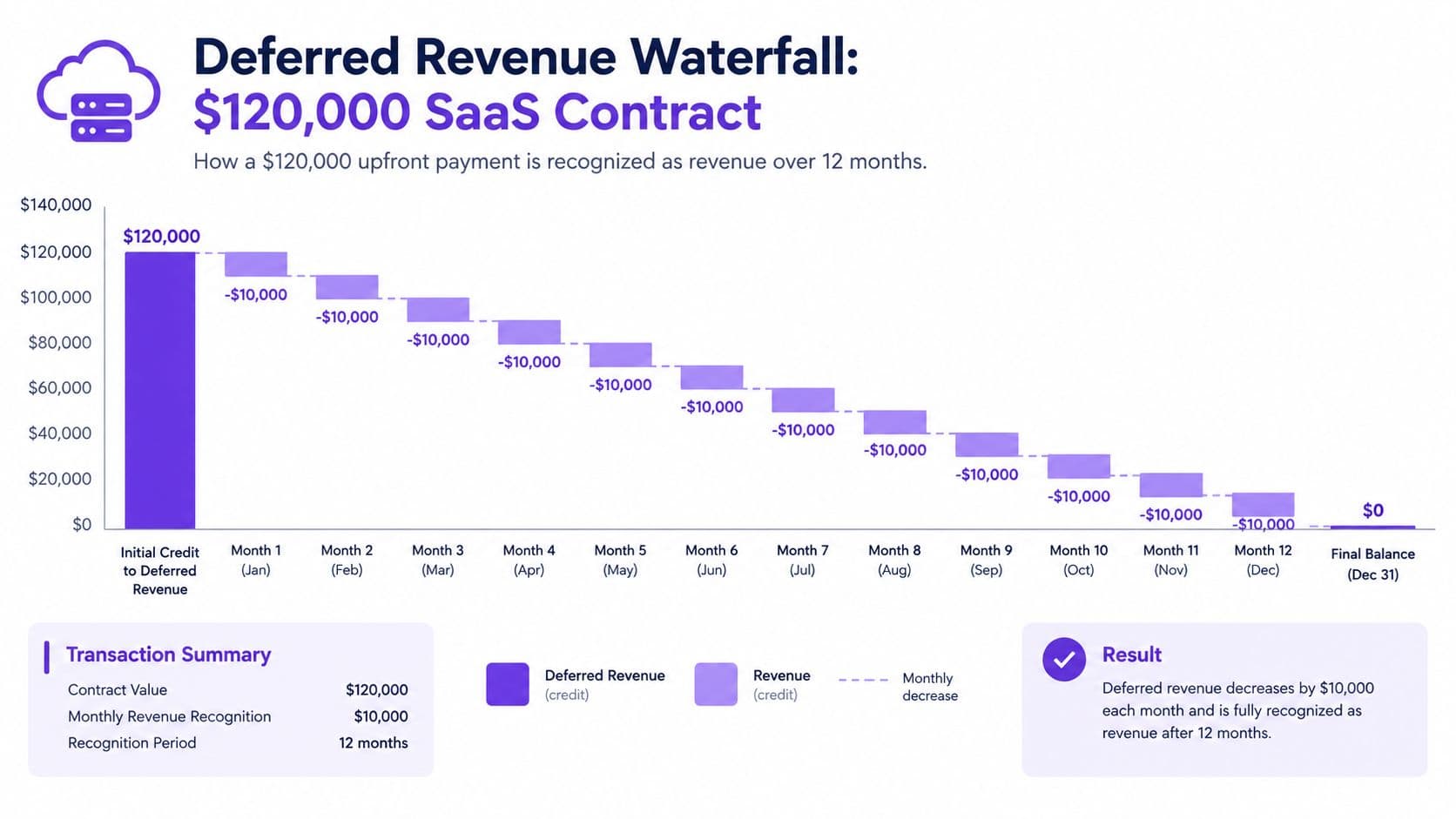
Build the roll-forward, not just the journal entry
Your schedule should show beginning deferred revenue, new billings, revenue released, credits or refunds, and ending deferred revenue. For this contract, the ending balance declines by $10,000 after each monthly release and reaches zero after the final service month, assuming there are no changes.
A controller should be able to select any month and answer three questions quickly:
- What contract terms created the balance?
- What service was delivered during the month?
- Why does the release agree to the general ledger?
A useful reference for revenue recognition journal entries can help standardize the mechanics, but the schedule still needs contract-level evidence.
Handling a mid-contract upgrade
Suppose the customer moves from $10,000 per month to $15,000 per month. The accounting team first classifies the modification. If the additional service is distinct and priced at SSP, create a separate schedule for the added obligation. If the price is discounted or the added service isn't distinct, reallocate the remaining transaction price and calculate the required prospective adjustment or cumulative catch-up.
Don't post a generic debit or credit to revenue just to make the deferred revenue balance match the invoice. The modification memo should show the original terms, effective date, added or removed service, SSP evidence, treatment selected, and the resulting schedule. When transaction price changes, ASC 606 allocates that change to earlier obligations when attributable to variable consideration from those obligations, or otherwise to unsatisfied or partially satisfied obligations in the modified contract. This allocation guidance for transaction price changes explains why a plug entry is not an acceptable substitute for analysis.
Integrating Revenue Recognition with Your Systems
Most growing SaaS businesses connect a billing platform such as Stripe or Zuora to accounting software such as QuickBooks, Xero, or NetSuite. The connection often transfers invoices and payments successfully while failing to transfer the contract logic needed for revenue recognition.
That creates a dangerous illusion. Your books may reconcile to the bank and still fail to reconcile to the service periods, performance obligations, usage records, and modifications in customer contracts.
The data flow must preserve contract meaning
A reliable workflow begins with the executed contract, not the invoice:
- Contract capture: Store the signed agreement, order form, start date, go-live evidence, SSP analysis, and modification history.
- Billing setup: Map products, quantities, billing cadence, discounts, credits, and usage terms to the approved contract.
- Revenue configuration: Create obligations, allocation rules, service periods, and variable consideration controls.
- Subledger posting: Generate revenue releases and deferred revenue balances with an audit trail.
- General ledger reconciliation: Tie subledger activity to the GL, investigate exceptions, and approve journal entries.
Stripe is effective for payment collection and billing data, but finance teams often need an additional revenue layer for complex obligations and schedules. Zuora is designed around subscription billing and can support more elaborate billing structures, while QuickBooks and Xero generally serve as accounting ledgers rather than full contract revenue subledgers. NetSuite can support broader revenue workflows, but configuration, controls, and implementation discipline determine whether the result reflects the contracts accurately.
| Platform | Deferred Revenue Tracking | Revenue Schedules | Contract Modification Support | Best For |
|---|---|---|---|---|
| Stripe | Billing and payment data, with revenue workflows depending on configuration | Often requires an integrated revenue solution for complex arrangements | Requires controlled integration and review | Payment collection and subscription billing |
| Zuora | Strong subscription billing data and configurable revenue workflows | Supports structured schedules when properly configured | Better suited to subscription changes, with accounting review required | Complex recurring billing environments |
| QuickBooks | Basic accounting ledger treatment | Commonly depends on an external schedule or controlled journal process | Manual review is usually required | Smaller finance teams with simpler contracts |
| NetSuite | Can support deferred revenue and revenue management workflows | Configurable schedules and subledger processes | Supports modifications when contract data and rules are configured correctly | More mature finance operations |
| Maxio or Chargebee revenue layers | Purpose-built revenue scheduling depends on product configuration | Designed to centralize contract schedules and releases | Requires accurate inputs and documented rules | Teams outgrowing spreadsheet-based recognition |
The right answer isn't “automate everything.” Automation without contract controls produces incorrect schedules faster. The more useful question is whether each system preserves the fields needed for revenue recognition automation, including service dates, obligation classifications, SSP inputs, usage data, credits, and modification trails.
Where manual work still belongs
Finance should retain human review for non-standard contracts, SSP judgments, unusual concessions, material variable consideration, and modification classifications. Automate recurring monthly releases, standard invoice mapping, exception reports, and reconciliations.
Your control should also identify failed data transfers. A billing record with no revenue schedule, a schedule with no source contract, an invoice credit not reflected in deferred revenue, or usage billed in arrears without a corresponding estimate should create an exception before close.
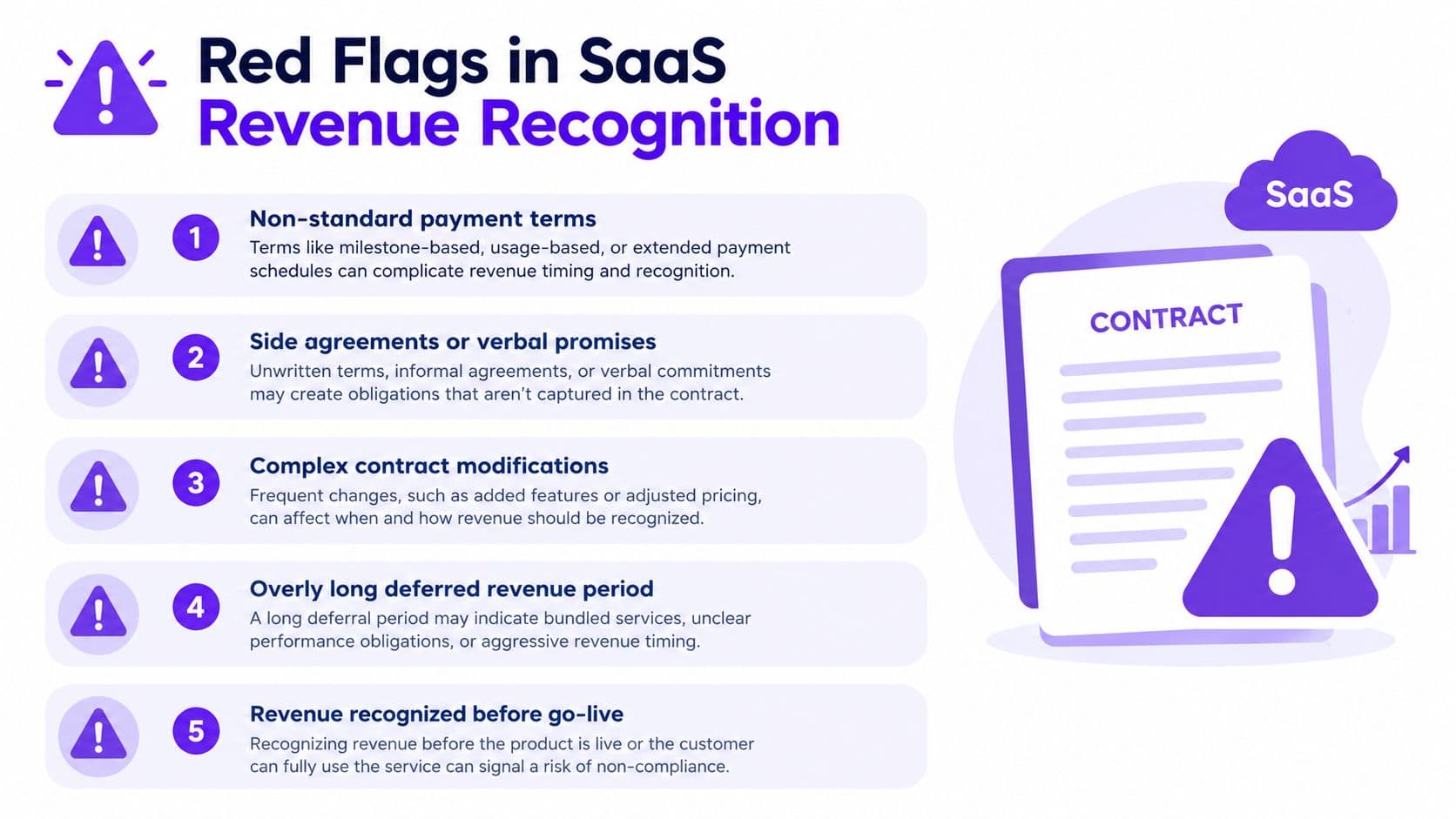
Red Flags That Your Revenue Recognition Is Broken
A broken process rarely announces itself with a dramatic error. It shows up as small inconsistencies between systems, reports, and contract files. Founders often notice the problem when the MRR dashboard, recognized revenue, deferred revenue balance, and cash collections tell different stories about the same customer base.
Audit specialist's warning: “Contract-to-system mismatches, billing and revenue reconciliation failures, and modification accounting are recurring audit issues for SaaS companies.” (PwC's SaaS revenue recognition Q&A discusses these practical judgment areas.)
Use this diagnostic checklist
- Deferred revenue doesn't reconcile: The ending subledger balance cannot be tied to the GL, contract population, or monthly release activity.
- MRR and recognized revenue diverge without explanation: The metrics use different populations, dates, exclusions, or treatment of implementation and usage revenue, but nobody has documented the bridge.
- Modifications bypass accounting: Sales upgrades, downgrades, renewals, credits, and cancellations change billing but don't trigger a modification assessment.
- Usage fees appear only when invoiced: The team records consumption charges from invoices without evaluating variable consideration, constraints, credits, or refunds.
- Go-live dates are inconsistent: Billing starts on contract signature while revenue starts on implementation completion, or the reverse, without a documented performance-obligation conclusion.
- SSP evidence lives in email: Allocation decisions depend on one person's memory instead of an approved methodology and supporting analysis.
- The schedule is rebuilt at audit time: If the team can't reproduce a prior-month schedule and its source data, the process lacks a durable audit trail.
The fix begins with a contract population reconciliation. Compare signed contracts to billing records, billing records to the revenue subledger, the subledger to the GL, and the GL to management reporting. Investigate every unmatched item, then assign an owner and resolution date. Don't wait for the auditor to find the exception.
Your Implementation Roadmap and Next Steps
Start with the contracts that create the greatest judgment risk, not the easiest invoices to import.
- Review bundled contracts: Finance and operations should identify distinct obligations, variable fees, incentives, and non-standard terms.
- Map the data flow: The controller should document how contract fields move from sales or legal systems into billing, the revenue subledger, and the GL.
- Reconcile deferred revenue: Perform a contract-level roll-forward and investigate every difference before the next close.
- Document SSP methodology: Finance should record observable prices or the estimation approach used for bundled services.
- Create a modification workflow: Sales operations must route upgrades, downgrades, credits, renewals, and cancellations to accounting before billing changes become journal entries.
Give each step a named owner, a defined deliverable, and a target completion date. If your team can't maintain those controls alongside close responsibilities, outsourced controller support can provide the implementation discipline, revenue schedules, reconciliations, and audit-ready close package your business needs.
Jumpstart Partners provides outsourced controller and bookkeeping support for growing SaaS, agency, and professional services businesses, including ASC 606 workflows, deferred revenue reconciliations, revenue schedules, and audit-ready financial reporting. Visit Jumpstart Partners to discuss your contract-to-cash process and build a revenue recognition workflow that your finance team can defend.