Financial Operations
Revenue Recognition Automation for SaaS
Revenue recognition automation that books ASC 606 right. Practical steps for SaaS finance teams to map contracts, integrate QuickBooks, and close faster.
ByJumpstart Partners, CPA, QuickBooks ProAdvisor
··17 min readManual revenue recognition isn't merely slow. It creates an audit problem that grows with every contract amendment, usage charge, discount, and bundled service. The counterintuitive point is that revenue recognition automation is primarily a data-governance project, not a software purchase. Independent research found that bad upstream data hygiene blocks 39% of teams, lack of integrations blocks 36%, 79% need a higher level of automation, and 74% still make daily manual interventions (Zuora's State of Revenue Accounting report).
For founders, CEOs, and finance leaders running businesses between $1M-$5M ARR, that distinction matters. A new platform won't fix inconsistent contract dates, missing performance-obligation metadata, or a billing system that disagrees with the CRM. You need a reliable contract model first, then an automation layer that applies it consistently and leaves an audit-ready trail.
Table of Contents
- The Real Cost of Manual Revenue Recognition
- How ASC 606 Works for Subscription Businesses
- Choosing the Right Automation Stack
- Mapping the Contract-to-Cash Data Flow
- Implementing Automation Without Breaking the Close
- KPIs That Prove Your Automation Is Working
- Red Flags and Common Pitfalls to Avoid
The Real Cost of Manual Revenue Recognition
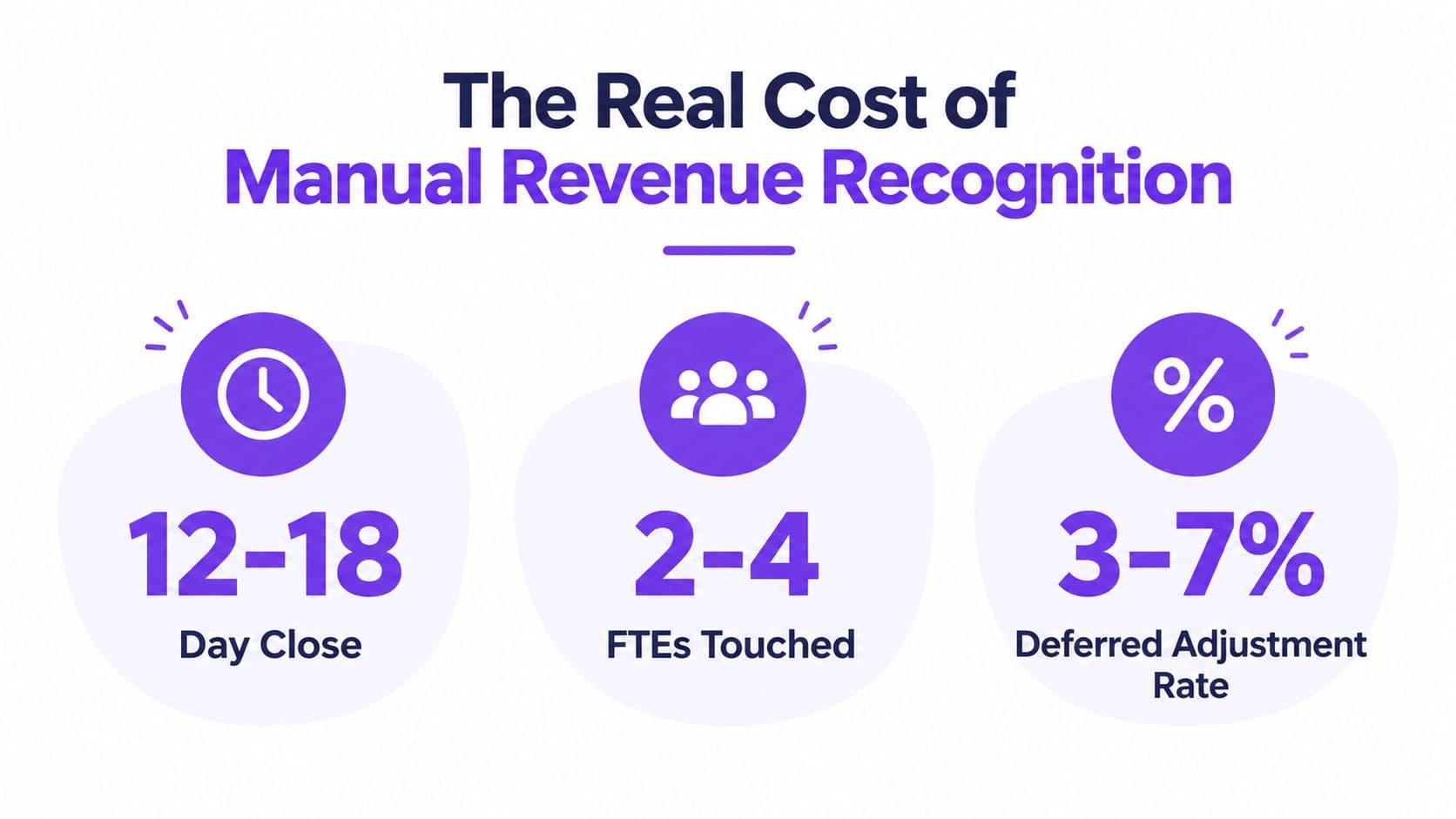
A manual close often consumes 12 to 18 days, touches 2 to 4 full-time-equivalent employees, and produces a 3% to 7% deferred-revenue adjustment rate at year-end. Those figures are the operating assumptions behind the infographic below. They aren't just accounting inconveniences. A long close delays board reporting, weakens cash and revenue forecasting, and forces your team to explain adjustments after the fact.
Where the spreadsheet breaks
The recurring errors are predictable:
- Mid-term upgrades stay on the original schedule. A customer expands usage or adds seats, but the accountant doesn't reallocate consideration across the remaining obligations. The deferred balance no longer reflects the amended contract.
- Usage-based add-ons get booked as one-shot revenue. The invoice arrives, and the team treats billing as recognition even though the service is delivered over time or depends on measured usage.
- Multi-element arrangements get split incorrectly. Onboarding, implementation, support, and the subscription may have different satisfaction patterns. A spreadsheet often applies one convenient schedule to all of them.
- Contract dates drift between systems. A CRM start date, billing start date, and revenue start date can disagree. That discrepancy creates unexplained timing differences in the general ledger.
- Commission amortization follows the wrong horizon. The accounting team capitalizes a sales commission but links amortization to the wrong contract term or expected renewal pattern.
Each failure creates a different consequence. The board sees revenue that doesn't reconcile to operational activity. The auditor requests support for a catch-up entry. Your controller spends close week reconstructing decisions that should have been captured when the contract changed.
Controller's rule: If you can't explain why the system recognized revenue, using the contract data and policy applied at that moment, you don't have a defensible control.
ASC 606 made this standard of control unavoidable. Public business entities applied it to annual reporting periods beginning after December 15, 2017, so calendar-year companies applied it in 2018. Other entities followed for annual periods beginning after December 15, 2018, with interim reporting after December 15, 2019. The standard replaced industry-specific guidance with a single five-step model, forcing complex-contract businesses to redesign processes, controls, and systems (SEC filing documenting ASC 606 adoption).
For a SaaS business above $1M ARR in revenue, spreadsheets stop scaling because they stop proving what happened. The objective isn't just a faster close. It's a close that one accountant can review, reconcile, and defend in 3 to 5 days, rather than a process that requires several people to remember every exception.
How ASC 606 Works for Subscription Businesses
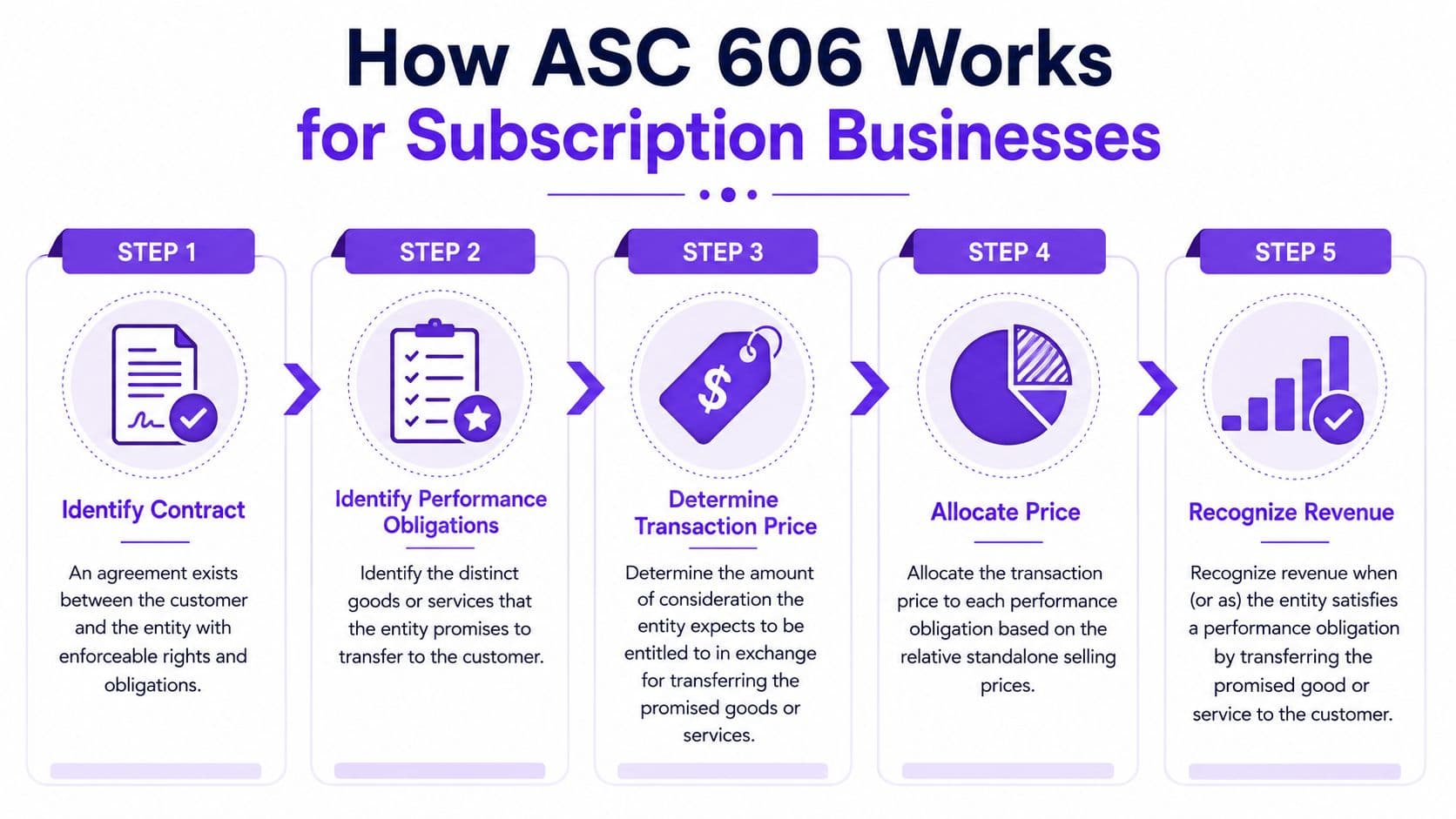
ASC 606 requires you to follow five steps for contracts with customers. SaaS automation works only when it preserves the data needed at each step, from signed terms through the journal entry.
Consider an annual subscription with a $36,000 subscription price and a $5,000 onboarding fee, plus a usage credit. The stated consideration is $41,000 before applying the credit's accounting treatment. You can't allocate that amount correctly until you know which promises are distinct and how the credit affects transaction price.
The five steps in a real contract
| Step | What you determine | Data the system must retain |
|---|---|---|
| 1. Identify the contract | Confirm the parties, approved terms, rights, payment terms, and commercial substance. | Customer, signature date, effective date, term, renewal terms, billing terms |
| 2. Identify performance obligations | Decide whether the SaaS access, onboarding, and usage-related promises are distinct. | Product or service components, delivery obligations, satisfaction method |
| 3. Determine transaction price | Establish fixed consideration and evaluate usage, credits, discounts, refunds, or other variable elements. | Price, discount, credit, usage measure, constraint methodology |
| 4. Allocate the price | Allocate consideration based on relative standalone selling prices. | SSP by obligation, allocation method, allocation result |
| 5. Recognize revenue | Recognize each obligation as it's satisfied. | Service dates, milestones, usage data, schedule, journal-entry mapping |
The $5,000 onboarding fee isn't automatically revenue at billing. If onboarding creates a distinct service, the system needs a separate satisfaction trigger. If it doesn't, the fee may be combined with the SaaS obligation and recognized over the related service period. The usage credit also requires explicit treatment. A system that only syncs invoices to the ledger can't make these decisions reliably.
For subscription businesses, the system must map each billing event to the correct contract and performance obligation. KPMG's SaaS revenue recognition guidance describes this contract-aware application of the five-step model. For a practical explanation of how to identify distinct promises, use this guide to model performance obligations.
Mid-term upgrades create another test. Suppose a customer expands the subscription after several months. The engine must determine whether the modification is treated prospectively, through a cumulative catch-up, or as a separate contract. It must then preserve the assumptions, dates, allocation, and reviewer decision that produced the new schedule.
ASC 606 also changes the timing profile of revenue. Independent research found that 56 cents of next-year revenue are recognized for every dollar recognized in the current year after ASC 606 adoption, compared with 100 cents under the pre-606 model (Columbia Business School's ASC 606 research). That timing difference is why your automation design must handle modifications, allocation, and disclosure evidence, not just monthly straight-line schedules.
The workflow in motion is easier to understand visually:
Choosing the Right Automation Stack
A $2M ARR SaaS company doesn't need the same revenue architecture as a multinational with multiple legal entities, product families, and complex billing arrangements. Buying the largest platform available is usually a mistake. So is assuming QuickBooks or Xero recurring transactions can perform standalone-selling-price allocations.
Compare the tiers before you buy
| Tier | Examples | ASC 606 Coverage | QuickBooks/Xero Sync | Implementation | Annual Cost |
|---|---|---|---|---|---|
| Native accounting tools | QuickBooks Online, Xero recurring transactions and classes | Basic recurring schedules. Weak for SSP allocation, complex modifications, and variable consideration | Good for standard journal entries and reporting exports | Short | Lower |
| Mid-market revenue tools | Maxio, Sage Intacct revenue module, NetSuite ARM | Stronger contract modeling, allocations, modifications, deferred-revenue waterfalls, and audit trails | Available through native connectors, exports, or middleware | Moderate | Mid-range |
| Enterprise suites | Zuora, Oracle RMCS | Deep multi-element, multi-entity, usage, currency, and contract-modification support | Strong, but implementation usually needs dedicated systems work | Long | Higher |
For a $2M ARR SaaS, choose the mid-market tier when you have bundled offerings, usage pricing, contract amendments, or audit pressure. Maxio can fit subscription-led businesses. Sage Intacct's revenue module fits teams already committed to that ERP. NetSuite ARM makes sense when NetSuite is already the operational backbone.
Use QuickBooks or Xero native functionality only when your arrangements are simple and your team can document the policy outside the ledger. These tools are useful accounting systems, but they aren't a substitute for a contract-aware recognition engine when SSP allocations and modifications matter.
Enterprise suites such as Zuora or Oracle RMCS belong in environments that need deep billing, multi-entity, multi-currency, and complex contract support. A sub-$5M business that buys enterprise capability without the systems staff to operate it often inherits an implementation burden instead of a faster close.
Your decision checklist
Before selecting a vendor, answer these questions:
- Can it model every performance obligation in your current contracts?
- Can it process prospective treatment and cumulative catch-up for modifications?
- Does it preserve contract dates, discounts, credits, and usage inputs?
- Can it reconcile to QuickBooks, Xero, Sage Intacct, or NetSuite without fragile exports?
- Can an auditor trace a journal entry back to the contract and rule applied?
- Can your controller own the configuration without depending on a developer?
Good finance infrastructure should drive efficiency with automation, but efficiency comes after the data model works. If you're also automating reporting workflows, document the boundary between the recognition engine and financial reporting automation. They're connected, but they solve different control problems.
Mapping the Contract-to-Cash Data Flow
Take a $1,200-per-month annual SaaS contract signed in HubSpot. The customer's contract value is $14,400 before considering discounts, credits, or variable amounts. The accounting result depends on whether every system carries the same dates and terms.
Follow the record, not the invoice
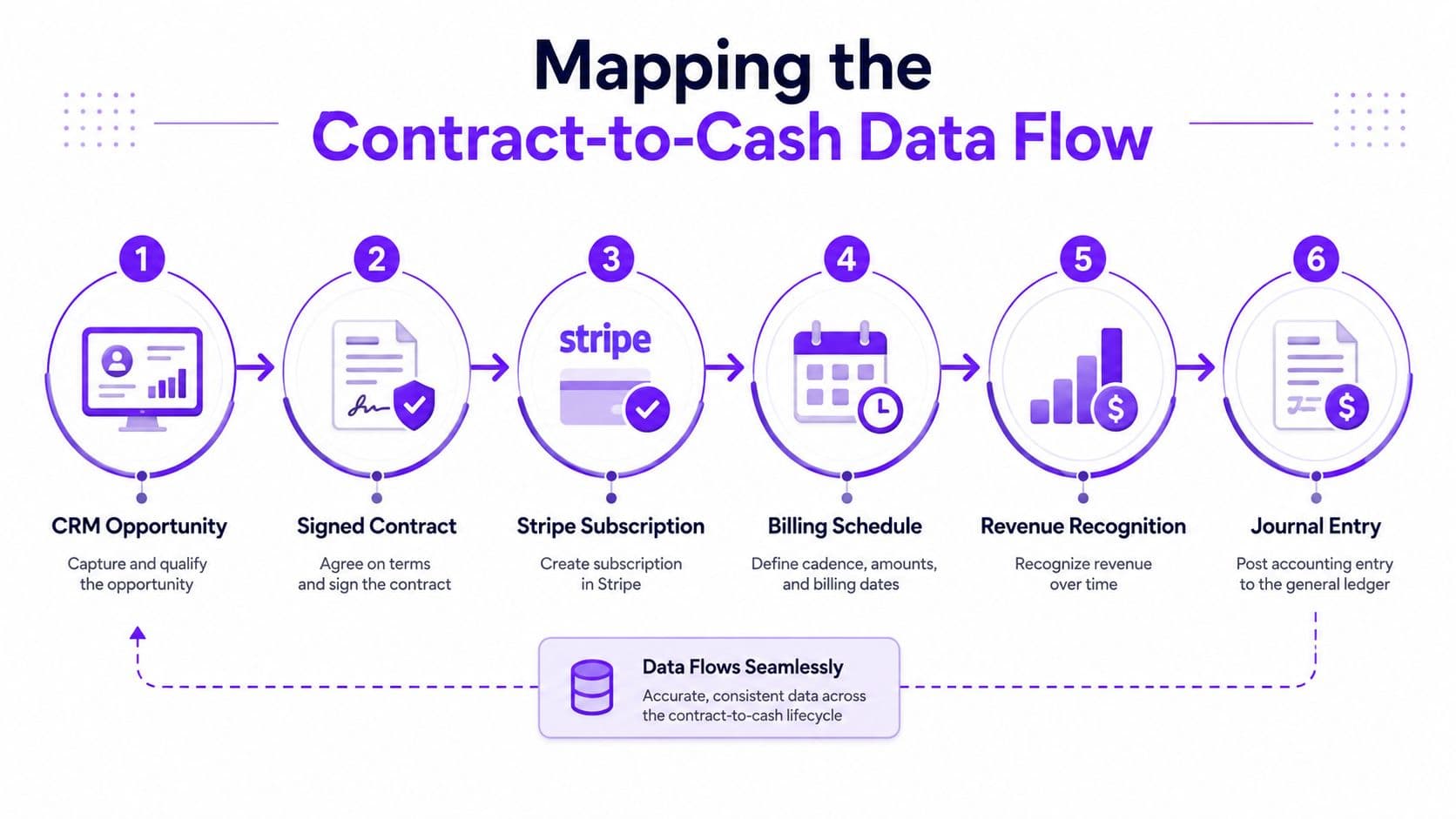
The flow should look like this:
- CRM opportunity. HubSpot stores the customer, product, price, discount, proposed start date, end date, billing frequency, and renewal terms.
- Signed contract. The approved agreement becomes the canonical commercial record. Capture the effective date, service term, auto-renewal language, upgrade clauses, and any implementation or usage promises.
- Stripe subscription. Stripe receives the approved billing terms and creates the recurring subscription. It should not become the place where accounting policy is reinterpreted.
- Billing schedule. The billing layer calculates invoices, payment dates, credits, prorations, and adjustments.
- Revenue schedule. The recognition engine maps billing events to obligations and produces the deferred-revenue waterfall.
- Journal entry. The engine exports or posts the period activity to QuickBooks, with accounts, amounts, dates, dimensions, and supporting detail.
Each handoff needs a field-level check. At minimum, preserve:
- Contract dates: Start date, end date, and effective modification date.
- Commercial terms: Billing frequency, term length, price, discount treatment, and auto-renew status.
- Accounting terms: Performance obligations, SSP references, upgrade clauses, credits, and variable consideration.
- System identifiers: CRM opportunity ID, contract ID, Stripe subscription ID, invoice ID, and revenue-schedule ID.
Practical rule: One contract needs one durable identifier across HubSpot, Stripe, the revenue engine, and QuickBooks. Without that key, reconciliation becomes a matching exercise based on descriptions and guesswork.
The common failure occurs when the CRM says service began on one date while Stripe begins billing on another. The billing schedule then feeds a revenue engine that starts recognition from a third date. Your general ledger may still balance, but the deferred-revenue roll-forward won't explain itself.
Use native integrations where they preserve the canonical record. Use middleware where you need transformation, validation, or exception routing. Don't build an integration that moves bad fields faster. A detailed treatment of the Stripe handoff is available in this guide to Stripe revenue recognition.
Before choosing tools, map every touchpoint and assign an owner:
- Who approves the contract?
- Which system owns the effective date?
- Where are discounts and credits recorded?
- How do upgrades reach billing and revenue?
- Which system holds SSP methodology?
- How are exceptions reviewed?
- How does the journal entry reach the GL?
- What report proves the deferred balance reconciles?
Implementing Automation Without Breaking the Close
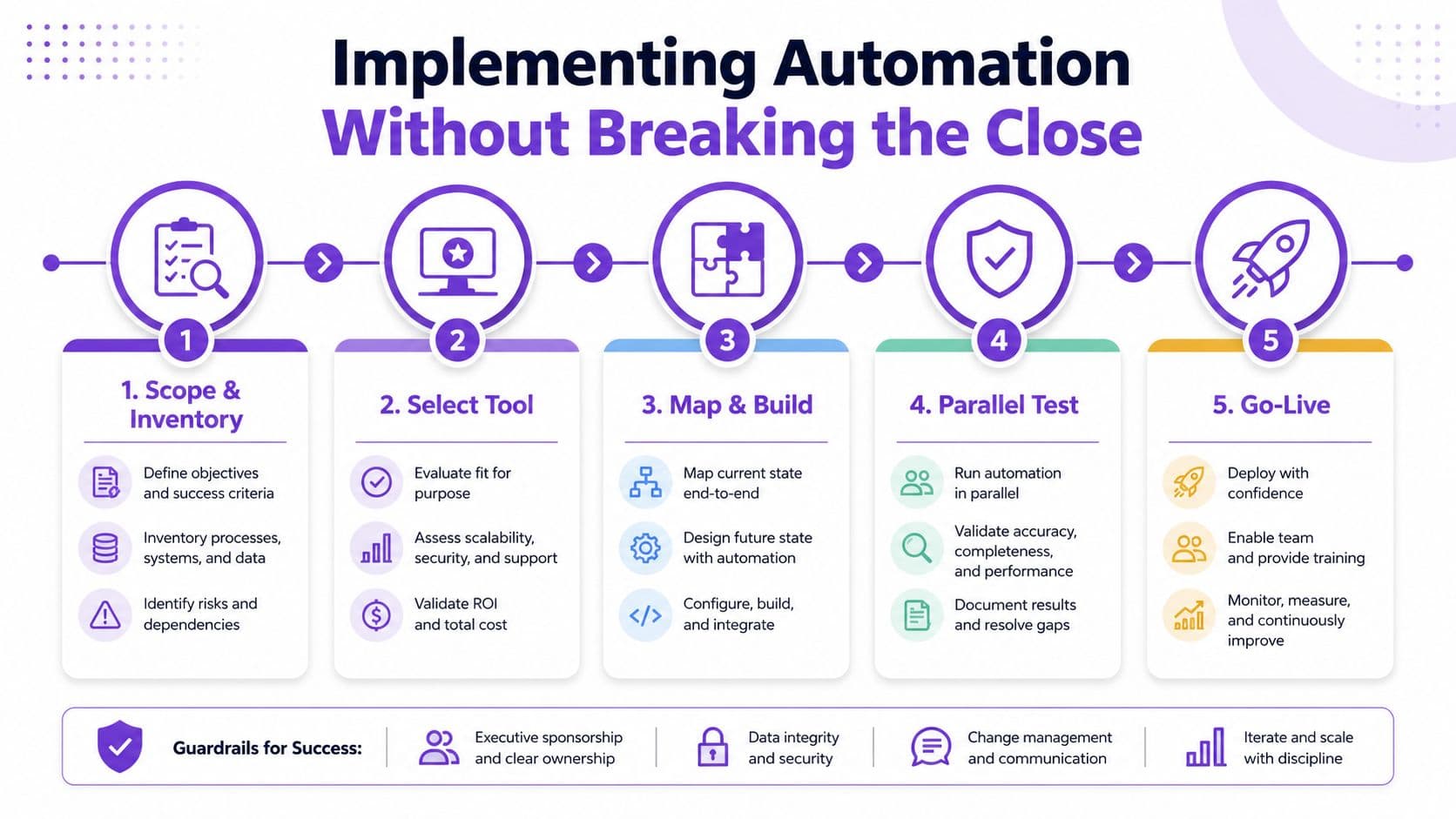
Don't switch recognition systems during a pressured year-end close. Build the process in phases, keep the manual schedule available for one cycle, and make the automated output prove itself before you retire the spreadsheet.
A practical rollout for a $2M to $10M ARR SaaS business takes roughly 6 to 10 weeks end to end, with the first three phases consuming about half the calendar. The implementation needs a controller, a systems administrator, and 25% of one accountant's time throughout the project.
Use five controlled phases
| Phase | Primary work | Deliverable |
|---|---|---|
| 1. Scope and inventory | Classify active contracts, amendments, pricing models, obligations, and exceptions | Contract taxonomy and revenue-policy memo |
| 2. Select the tool | Score vendors against contract complexity, integrations, controls, and ownership | Shortlist and documented selection criteria |
| 3. Map and build | Define field mappings, account mappings, data validation, and integration rules | Tested integration and transformation map |
| 4. Parallel test | Run automated schedules against manual schedules and investigate variances | Variance report with resolved differences |
| 5. Go-live | Cut over with approvals, exception routing, and retained backup schedules | Clean cutover and one-cycle manual backup |
Phase one deserves more attention than is often given. Inventory the contracts before you configure anything. Separate standard subscriptions from usage arrangements, onboarding, implementation, renewals, discounts, credits, and modifications. Then write the policy memo that tells the system what to do.
During parallel testing, don't compare only the final revenue number. Compare contract classification, obligation assignment, transaction price, allocation, monthly schedule, deferred roll-forward, and journal-entry mapping. A matching total can hide a wrong schedule.
Contract modifications need special documentation. Depending on the facts, the treatment may be prospective, a cumulative catch-up, or separate-contract accounting. Worked examples and reviewer sign-off are essential because judgment remains part of the process (contract modification implementation guidance).
A 30-day shadow close gives your team evidence across different contract events. Keep the manual backup for one cycle, but don't let it become a second permanent system. For broader close design, see this framework for financial close automation.
KPIs That Prove Your Automation Is Working
Automation succeeds when it improves control and close performance at the same time. Track the output in the revenue engine, then reconcile it to QuickBooks, Xero, Sage Intacct, or NetSuite reports. Don't rely on vendor dashboards alone.
The most useful measures are operational:
| KPI | Manual Baseline | Post-Automation Target |
|---|---|---|
| Days to close | 10 to 15 days | 3 to 5 days |
| Journal-entry error rate | 2% to 4% | Under 0.5% |
| Deferred-revenue reconciliation time | Manual, recurring schedule work | Under 2 hours monthly |
| ASC 606 audit adjustment frequency | Recurring adjustments | Zero recurring adjustments |
| Finance hours per $1M revenue | Manual processing burden | 50% lower year over year |
The baseline and target figures above are operating targets from the implementation framework, not universal outcomes. Use them as management thresholds, then adjust them to your contract mix and reporting requirements.
Independent data gives finance leaders a separate reality check. AI-assisted revenue recognition reduced revenue-related month-end close time at mid-market firms from 6.8 days to 3.8 days, an average reduction of 44%, while 71% of finance leaders with deployed AI automation reported measurable close-cycle acceleration within 12 months (AI revenue recognition automation statistics).
Instrument the leading indicators
Lagging metrics tell you that the close failed. Leading indicators tell you why it's heading there:
- Contract completeness: Percentage of active contracts with dates, terms, obligations, SSP references, and modification flags populated.
- Integration sync lag: Time between a CRM or billing change and its arrival in the revenue engine.
- Exception aging: Time unresolved contracts remain in review.
- Waterfall-to-GL variance: Difference between the recognition schedule and the posted ledger balance.
- Modification coverage: Percentage of amendments routed through the formal accounting workflow.
Review these indicators monthly. For a broader SaaS operating view, connect revenue results to SaaS financial metrics, including recurring-revenue movement, collections, and margin.
Red Flags and Common Pitfalls to Avoid
Automation doesn't make a flawed policy correct. It scales whatever you configure, including missing obligations, wrong dates, incomplete integrations, and default treatments that nobody reviews.
Watch for these failure modes:
- Free trials treated as deferred revenue without an obligation. The system records a balance but lacks a clear service or satisfaction trigger.
- Mid-term upgrades missed by the CRM. Billing changes, but the revenue schedule continues using the original allocation.
- Implementation services recognized ratably by default. The schedule ignores the distinct service period or delivery milestone.
- Sales commissions amortized over the wrong horizon. The capitalization entry exists, but the amortization period doesn't match the underlying economics.
- CRM and billing effective dates don't match. The contract record and invoice schedule begin at different points.
- Foreign-exchange revaluation skips deferred revenue. The ledger reflects currency movement while the deferred balance remains stale.
- Modifications treated as separate contracts automatically. The system applies a default instead of routing the arrangement for judgment.
Hybrid pricing and geographic expansion make these issues harder to manage. Recent survey data identifies hybrid pricing as a complexity driver for 35% of respondents and multi-geo or currency expansion for 31%, while compliance failures affect 24% and inaccurate reporting affects 23% (Leapfin's State of Automation for Revenue Accounting). The lesson is simple: automate repeatable calculations, but route judgment-heavy exceptions to a reviewer.
Run this ten-minute diagnostic:
- Do CRM and billing show the same contract effective date? If not, investigate timing differences first.
- Can you list every performance obligation for your top arrangements? If not, your allocation model is incomplete.
- Does every upgrade create a revenue-engine event? If not, amendments are bypassing accounting.
- Can you trace a deferred balance to a contract and schedule? If not, your audit trail is weak.
- Does the deferred roll-forward tie to the GL without unexplained entries? If not, isolate the earliest broken handoff rather than forcing a top-side adjustment.
When revenue and deferred revenue don't reconcile at month-end, triage the source data before editing the journal entry. Check dates, contract IDs, modifications, credits, currency treatment, and integration failures in that order. The journal entry is usually where the discrepancy appears, not where it began.
Jumpstart Partners helps SaaS, agency, and professional services finance teams design ASC 606 workflows, clean contract and ledger data, integrate Stripe with accounting systems, and build a controlled revenue close. Visit Jumpstart Partners to discuss a revenue recognition automation assessment and a practical path from spreadsheet schedules to audit-ready reporting.