Financial Operations
Stripe Revenue Recognition: The Founder's Guide to ASC 606
Master Stripe revenue recognition with this founder's guide to ASC 606. Learn journal entries, automation, and audit-ready workflows for SaaS finance teams.
ByJumpstart Partners, CPA, QuickBooks ProAdvisor
··17 min readStripe cash hitting your bank account is not revenue, and that mistake is where a lot of founders wreck their books. If you run subscriptions, retainers, or usage-based billing through Stripe, the money can look healthy while your GAAP revenue is wrong, your deferred revenue is off, and your board deck is telling a flattering lie.
That's why stripe revenue recognition matters so much. Stripe gives you strong automation around ASC 606, but it does not replace a controller, and it definitely does not unify your investor-grade SaaS metrics like ARR, churn, and deferred revenue waterfalls. The job is to make Stripe data, your general ledger, and your operating metrics agree.
Table of Contents
- Why Stripe Cash Is Not Recognized Revenue
- The ASC 606 Five-Step Model Applied to Stripe
- Journal Entries and the Deferred Revenue Schedule
- Mapping Stripe Events to Your General Ledger
- QuickBooks vs Xero vs NetSuite for Stripe Revenue Recognition
- Red Flags and Reconciliation Pitfalls Before Audit
- When to Outsource Stripe Revenue Recognition to a Specialist
Why Stripe Cash Is Not Recognized Revenue
Founders like Stripe because the cash hits fast and the numbers update immediately. Finance teams dislike that speed for a reason. Under ASC 606 and IFRS 15, revenue is recognized only when control transfers and the performance obligation is satisfied, not when the invoice goes out or the card clears Stripe's ASC 606 and IFRS 15 guide.
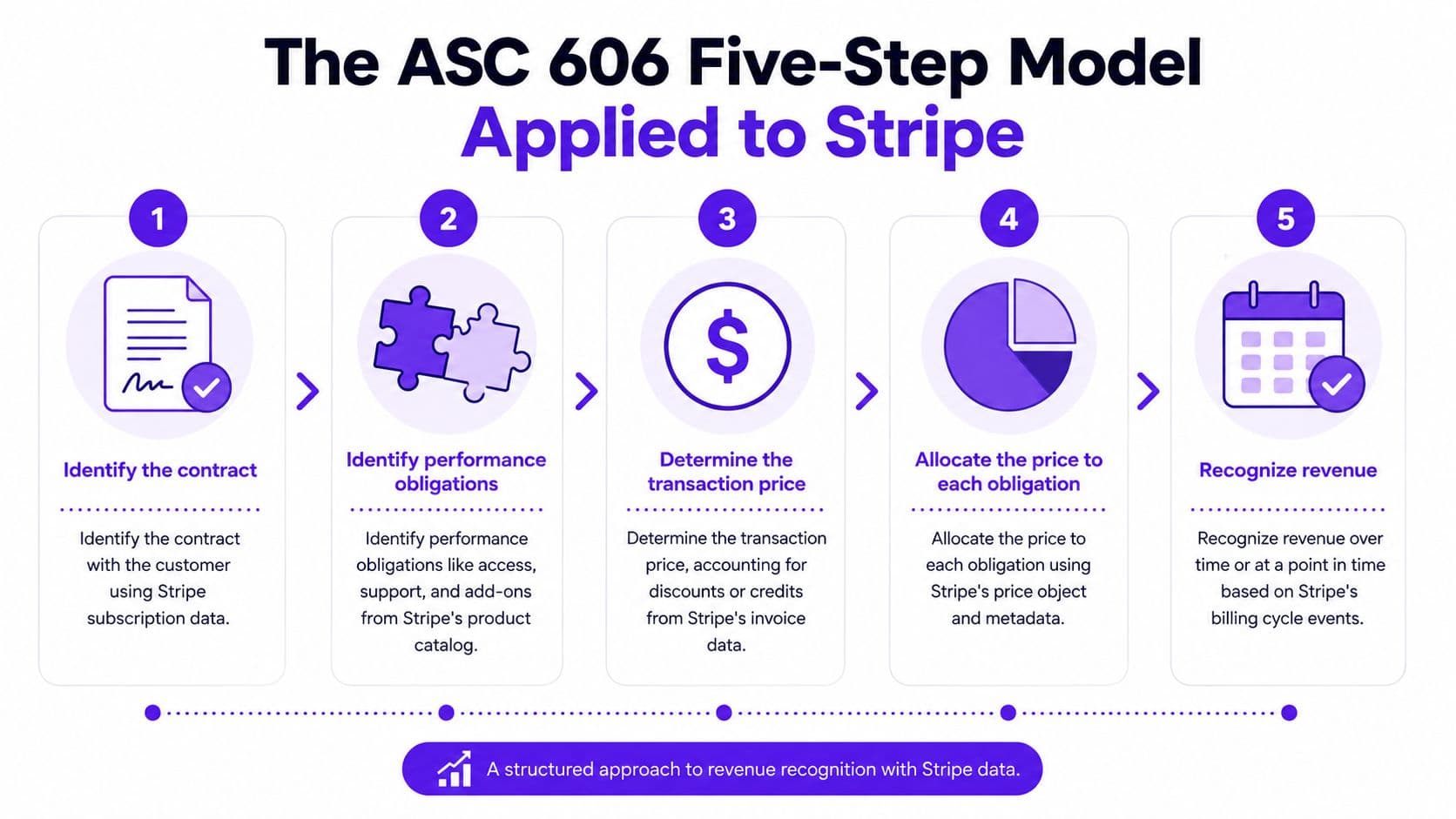
Stripe's framework follows the five-step model: identify the contract, identify performance obligations, determine the transaction price, allocate that price, and recognize revenue when the obligation is satisfied Stripe's introduction to revenue recognition. If a customer prepays for an annual subscription, you have cash in the bank, but you still owe service. That prepayment belongs in deferred revenue until the service is delivered.
Why the dashboard misleads founders
Stripe is built for payments first and accounting second. Stripe's revenue recognition tools can import transaction data, apply automation rules, generate revenue reports, and test models before going live, which is useful when you are reconciling charges, invoices, refunds, and payout batches. The problem is simpler than the dashboard wants to admit. It will not tell you whether your board deck is mixing cash collections with earned revenue.
That gap shows up quickly in real companies. Subscription revenue, milestone billing, and usage-based billing create timing differences between cash and recognition. Refunds and uncollectible invoices widen the gap, because Stripe balance data can look clean while the ledger still needs reversals, reserves, and a controller who knows how to close the books correctly.
Practical rule: if cash came in but service has not been delivered yet, you do not have revenue yet.
Bookings, cash, and revenue are separate concepts. If your team still treats them as interchangeable, read this definition of bookings before the next close. That confusion is usually where the accounting problem starts.
What breaks first
Trust breaks first. Then the close slows down. Then the controller spends hours explaining why Stripe payouts do not match the general ledger.
Stripe is a solid automation layer for ASC 606. It is not a full SaaS finance system. It does not unify investor-grade metrics like ARR, churn, and deferred revenue waterfalls, and it will not replace a clean handoff to a controller or a proper NetSuite or QuickBooks integration when the books need to tie out.
The ASC 606 Five-Step Model Applied to Stripe
Stripe gives you the automation layer, not the full accounting answer. It helps you apply ASC 606 with discipline, but it does not turn cash movement into investor-grade revenue reporting. If your billing includes guarantees, discounts, upgrades, or usage charges, Stripe can organize the inputs, then your accounting policy still has to decide what is earned and when.
A worked annual subscription example
Take a $12,000 annual SaaS subscription billed upfront. The customer gets a 30-day money-back guarantee, then the plan runs for twelve months. Under ASC 606, the contract exists when the customer accepts the terms. The performance obligation is the year of service access. The transaction price starts at $12,000, but the guarantee introduces variable consideration because not all of that cash is necessarily earned.
If the guarantee expires and no refund is issued, you recognize the annual fee over the service period, not on day one. Stripe can track the billing cadence, but billing cadence is not revenue recognition. The invoice shows what you charged. It does not tell you what you earned.
How the five steps map in practice
- Identify the contract. Stripe subscription records and finalized invoices show the customer agreement, and a clear accounting policy should map those records to the contract terms.
- Identify performance obligations. Your product access, support, and add-ons may be separate obligations if they are sold that way in Stripe.
- Determine the transaction price. Discounts, credits, guarantee-related adjustments, and other variable pieces belong here.
- Allocate the price. You assign amounts to each obligation based on the billing structure, not on what cleared in the bank.
- Recognize revenue when satisfied. For an annual subscription, that means over time as the service is delivered, as explained in this ASC 606 overview for SaaS revenue recognition.
A controller reads the invoice and asks one question first, what was earned this month? That is the right question because Stripe will not answer it for you. It will organize the transaction trail, and your accounting team still has to close the gap between cash, deferred revenue, and recognized revenue.
To see how Stripe frames the accounting logic itself, keep Stripe's ASC 606 and IFRS 15 explanation handy. For implementation details inside the product, Stripe's revenue recognition guide is the right starting point, and Stripe's broader revenue recognition documentation is the better reference once you are setting up the workflow in practice.
Journal Entries and the Deferred Revenue Schedule
Stripe can automate the accounting layer, but it does not close the books for you. The journal entry trail still has to show what was billed, what was collected, and what was earned over time. Founders who stop at cash accounting usually overstate revenue early and leave deferred revenue underreported.
A controller starts with the invoice and asks a simple question, what portion was earned this month? That is the correct lens because the service period, not the bank deposit, drives revenue recognition. If you need the accounting definition behind the liability side, review what deferred revenue is.
The annual subscription entries
For the $12,000 annual subscription, the invoice date creates a receivable and a deferred revenue liability, not earned revenue. The entries should follow the service period, not the payout timing.
-
At invoice issuance:
Dr. Accounts Receivable $12,000
Cr. Deferred Revenue $12,000 -
When cash is collected:
Dr. Cash $12,000
Cr. Accounts Receivable $12,000 -
Each month as service is delivered:
Dr. Deferred Revenue $1,000
Cr. Revenue $1,000
That monthly entry is where DIY bookkeeping usually breaks. Upfront cash does not mean upfront earnings. Until the service term runs out, the balance sheet still carries the obligation.
Deferred revenue schedule
A simple twelve-month subscription should amortize evenly if the service is delivered ratably.
Deferred Revenue Amortization Schedule, $12,000 Annual Subscription
| Month | Opening Deferred Revenue | Recognized Revenue | Closing Deferred Revenue |
|---|---|---|---|
| Month 1 | $12,000 | $1,000 | $11,000 |
| Month 2 | $11,000 | $1,000 | $10,000 |
| Month 3 | $10,000 | $1,000 | $9,000 |
| Month 4 | $9,000 | $1,000 | $8,000 |
| Month 5 | $8,000 | $1,000 | $7,000 |
| Month 6 | $7,000 | $1,000 | $6,000 |
| Month 7 | $6,000 | $1,000 | $5,000 |
| Month 8 | $5,000 | $1,000 | $4,000 |
| Month 9 | $4,000 | $1,000 | $3,000 |
| Month 10 | $3,000 | $1,000 | $2,000 |
| Month 11 | $2,000 | $1,000 | $1,000 |
| Month 12 | $1,000 | $1,000 | $0 |
That schedule is the control sheet your month-end close should reconcile to. If it does not, the problem is not Stripe, the problem is your revenue policy, your contract data, or your GL mapping.
The messy cases
Usage-based billing needs different treatment because the final transaction price changes with consumption. Overages get recognized when the usage is known and billable, not when the customer first signs up. Partial refunds reverse revenue or deferred revenue based on timing, and prorated upgrades need to respect the unused portion of the original term.
Controller rule: refunds, credits, and failed collections are accounting events, not customer service notes. Book them explicitly or your waterfall will lie.
Stripe's own support guidance is blunt about invoice timing. Revenue is recognized when an invoice is finalized, whether or not it is paid, and uncollectible invoices must be explicitly marked to reverse revenue Stripe support on mismatched revenue numbers. If your team wants to see how these entries fit into broader Stripe revenue recognition, use Stripe's revenue recognition documentation as the product reference and keep a controller on the handoff. Stripe handles ASC 606 automation. It does not build investor-grade SaaS reporting, deferred revenue waterfalls, or the ARR and churn view that belongs in a proper ERP or in a controller-led close.
For finance teams running a stack that includes tutoring billing software, the same rule applies. Billing tools can produce the invoices, but the journal entries still need to match the contract, the service term, and the revenue policy.
Mapping Stripe Events to Your General Ledger
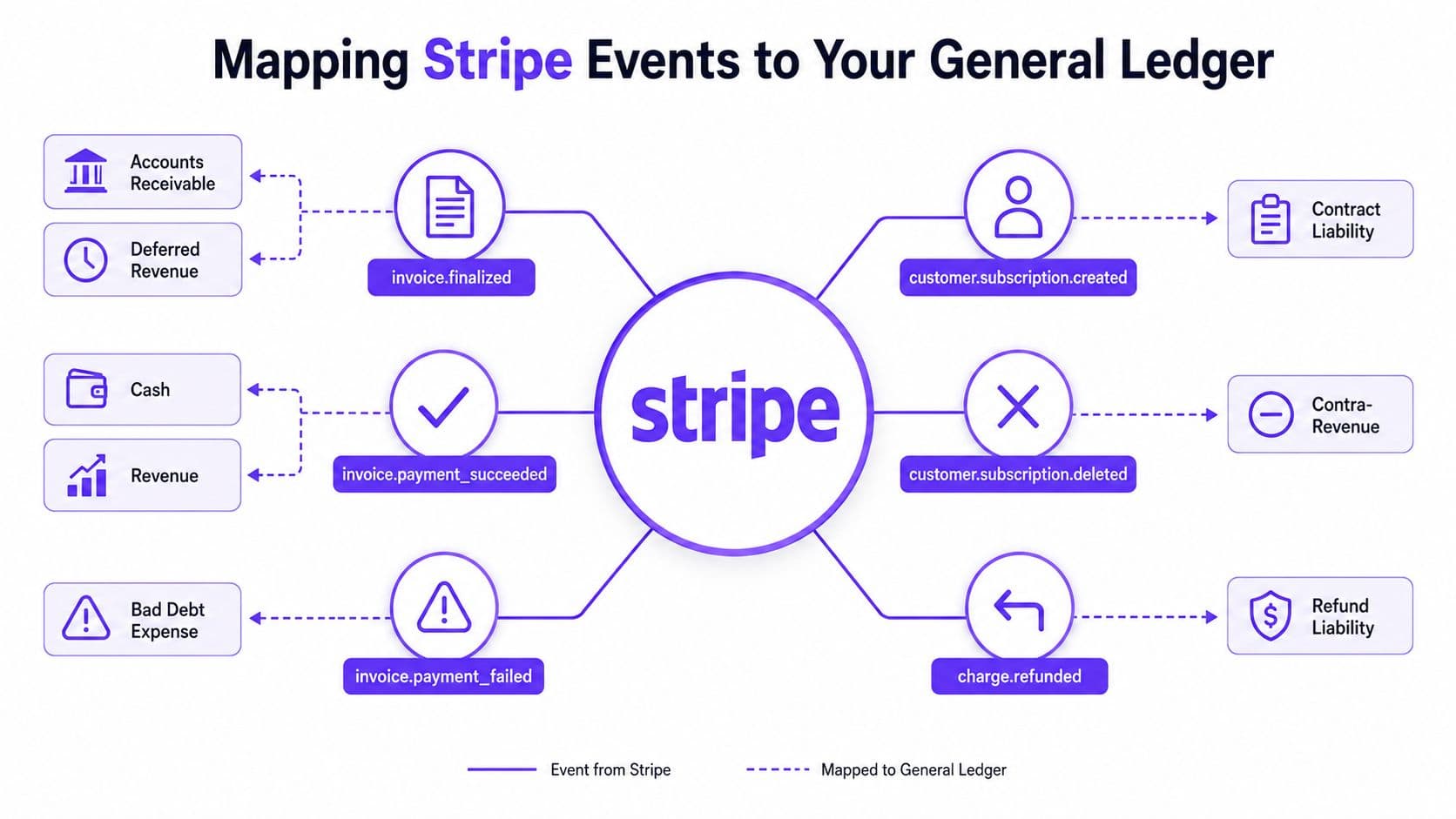
Stripe events should drive the journal, not your bank feed. That's the core principle. If you let payouts dictate accounting, you'll end up recognizing revenue on cash timing instead of service timing, which is exactly how month-end closes get noisy and audit trails get weak.
The events that matter
The event names matter less than the accounting behavior they trigger. Here's the practical mapping finance teams should use.
| Stripe event | GL impact | Why it matters |
|---|---|---|
invoice.finalized | Accounts Receivable, Deferred Revenue | Confirms the billed obligation |
invoice.payment_succeeded | Cash, Accounts Receivable | Clears the open invoice |
invoice.payment_failed | Bad Debt Expense or collections workflow | Signals collection risk |
customer.subscription.updated | Deferred Revenue, Revenue, or contract changes | Captures plan changes and proration |
charge.refunded | Revenue reversal or refund liability | Keeps revenue and cash aligned |
payout.paid | Cash in bank, cash clearing | Confirms Stripe settlement, not revenue |
Stripe's support note also points finance teams to transaction overrides when charges were linked incorrectly, which is one more sign that the source event needs controlled handling, not blind automation Stripe support on mismatched revenue numbers.
How to move the data
You've got three workable paths. CSV export is fine for small volume, but it becomes manual fast. Webhooks into middleware give you more control, which is what you want if you're pushing entries into QuickBooks, Xero, or NetSuite. A native connector can work too, but only if it respects the accounting logic and doesn't just mirror Stripe activity into the ledger.
If you run something like tutoring billing software, the same rule applies. The billing system can produce clean source data, but the GL still needs proper mapping, especially when invoices, payments, and service periods don't line up neatly.
For the underlying accounting structure, keep what is a general ledger in view. The general ledger is where the truth lives, not in the payout tab.
When Stripe alone is enough
Stripe Revenue Recognition works best when Stripe is your primary billing system and your business model is simple. If you have connected accounts, multiple revenue streams, or manual invoice adjustments, you'll still need tighter controls and usually a controller-level review. Stripe's own documentation says its product lets you create custom rules that can override default treatment for specific products, customers, line items, taxes, fees, passthrough amounts, test invoices, amortization periods, or future fulfillment dates, and only one rule applies when multiple rules match Stripe Revenue Recognition rules.
QuickBooks vs Xero vs NetSuite for Stripe Revenue Recognition
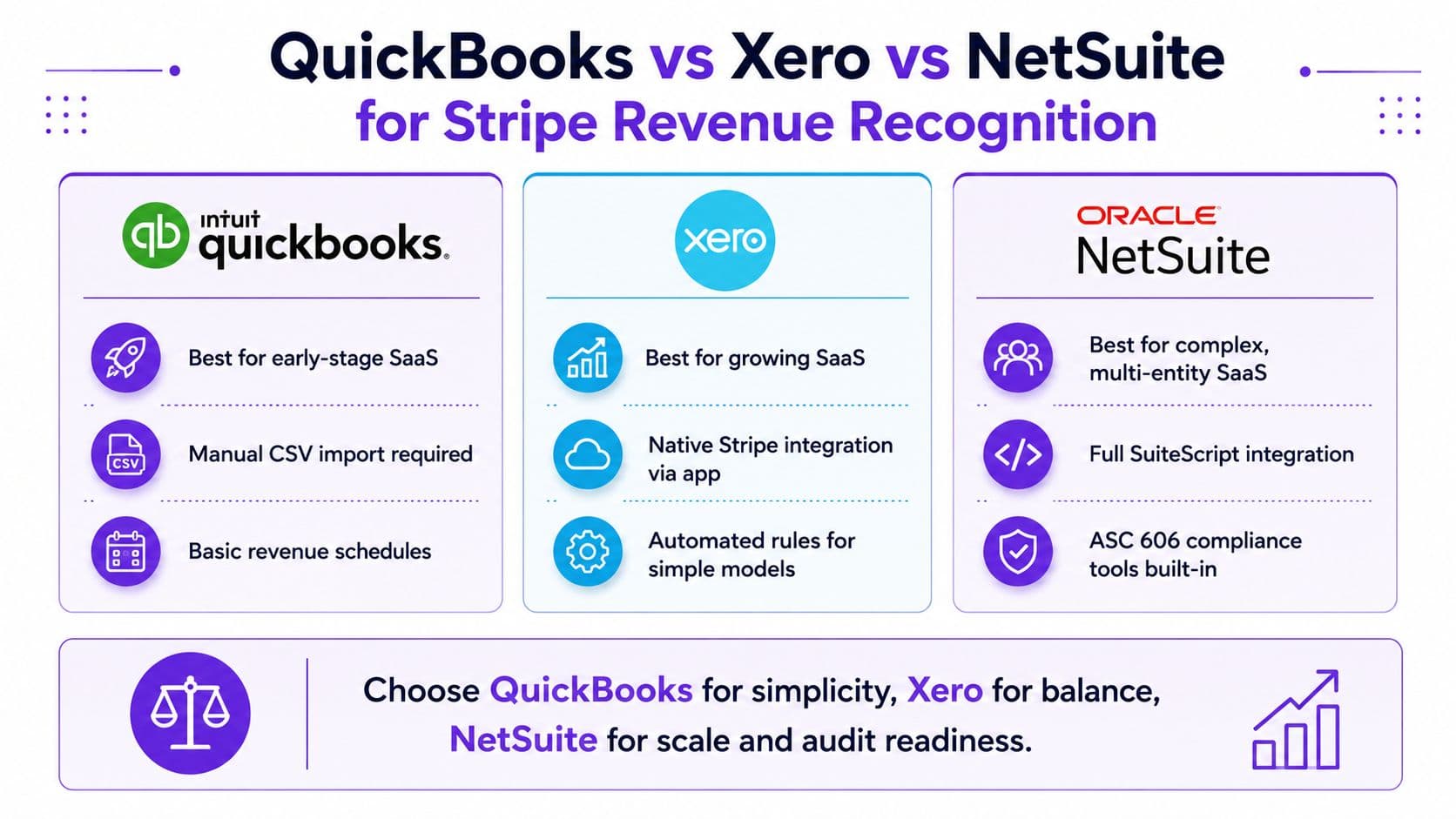
The right downstream ledger depends on how messy your revenue really is. QuickBooks and Xero are both workable for simpler businesses. NetSuite is the right answer when you've crossed into multi-entity, multi-currency, or audit-heavy territory and you're tired of pretending the books are still simple.
Side-by-side comparison
| Platform | Native Stripe Integration | Multi-Entity / Multi-Currency | Deferred Revenue Handling | Audit Readiness |
|---|---|---|---|---|
| QuickBooks | Limited, usually via export or connector | Basic | Adequate for simple schedules | Light to moderate |
| Xero | Better via app ecosystem | Stronger than QuickBooks for some global workflows | Better for growing teams with cleaner processes | Moderate |
| NetSuite | Deepest fit with structured integrations | Strong | Built for complex schedules and reporting | Strongest at scale |
My recommendation
Use QuickBooks if you're early and your revenue model is still simple. Use Xero if you want a cleaner middle ground and your books are growing in complexity. Move to NetSuite when you have multiple revenue streams, usage-based pricing, connected account complexity, or serious audit demands.
That's not theory. It's how the work changes. At a small scale, manual reconciliation is annoying. At a bigger scale, it becomes a blocker that keeps your close from ever being stable. Stripe can automate recognition logic, but your ledger still has to hold the reporting architecture.
For a broader software selection view, choosing accounting software for a growing business is worth reading before you commit. The wrong ledger creates years of cleanup.
Red Flags and Reconciliation Pitfalls Before Audit
Most Stripe close issues don't start with bad intent. They start with one team posting something twice, another team leaving an invoice unresolved, or a rule change that rewrites a closed month. If you want an audit-ready close, you need a checklist, not optimism.
The six red flags that show up again and again
- Uncollectible invoices left open: Stripe still shows them as collectible, but your GL hasn't reversed them. Mark them explicitly so revenue doesn't stay inflated.
- Refunds booked as expenses: Refunds should reverse revenue or deferred revenue, not sit in miscellaneous expense.
- Connected account activity missing from the parent ledger: If platform fees or application fees are involved, the parent books need the right recognition path.
- Double-counted payouts: A Stripe payout is cash settlement, not revenue. If you book it twice, your close gets inflated fast.
- Closed period rewrites after rule changes: Stripe warns that applying rules to match your business model changes the history of closed accounting periods, so prior-period reports can change after a rule update Stripe Revenue Recognition revenue settings.
- Currency timing mismatches: Stripe and the GL may convert differently if the timing or source rates don't line up.
What the symptom usually looks like
The bookkeeper says the Stripe balance “almost ties.” The controller says the revenue waterfall doesn't match the board metric. The auditor asks for support on a few invoice lines and the answer lives in three spreadsheets, a Slack thread, and one half-finished journal entry. That is the smell of a broken close.
Fix the root cause, not the tie-out. If the source event is wrong, the journal is wrong. If the journal is wrong, the report is wrong. Reclassifying the payout won't save you.
For teams trying to improve payments matching in other contexts, reconcile club payments in 2026 is a useful reminder that the mechanics of reconciliation are always about source data, timing, and control. Finance is the same problem in a different costume.
What to hand your controller
Ask for three things before the next close. First, a review of all uncollectible and refunded invoices. Second, a check for duplicate entries tied to Stripe payout data. Third, confirmation that rule updates didn't reopen prior months. If your controller can't answer those cleanly, you're not audit-ready yet.
When to Outsource Stripe Revenue Recognition to a Specialist
Stripe Revenue Recognition is solid automation, but it is not a finance system by itself. It doesn't unify your SaaS metrics, and it doesn't remove the need for a controller who knows how to tie revenue, deferred revenue, and ARR together without spreadsheet gymnastics. That gap is why growing companies still end up with a manual layer somewhere in the process.
The triggers that tell you to stop DIYing it
If you're preparing for a fundraise, you need numbers you can defend. If your first audit is coming up, you need the close to be repeatable. If you've crossed a few revenue streams, usage billing, or connected-account complexity, your accounting process is no longer simple enough for ad hoc cleanup. And if you want a five-day close, you need someone owning the workflow end to end.
That's where a specialist earns their keep. Jumpstart Partners handles outsourced controller and bookkeeping work for growing businesses, including ASC 606 workflows, Stripe integration, and ledger cleanup, with support for QuickBooks, Xero, NetSuite, and Stripe. They also publish SaaS revenue recognition guidance and map Stripe data flow into the accounting process, which is exactly the handoff growing businesses need when software automation stops short.
What to do this week
Don't wait for the audit fieldwork email. Pull your last close, your deferred revenue schedule, and your Stripe reconciliation file, and ask a controller to review the gaps. If the numbers don't tie cleanly, you need a process owner, not another workaround.
If you want a cleaner close, stronger audit support, and a controller who knows how Stripe data should land in the books, visit Jumpstart Partners and book a consultation. Bring your Stripe setup, your ledger, and your current revenue policy, and get the reconciliation layer sorted before the next month-end close.