Financial Operations
Definition of Bookings: A Guide for Founders and CEOs
Get the clear definition of bookings you need. Learn how it differs from revenue, MRR, and cash, and how to report it correctly for investors and audits.
ByJumpstart Partners, CPA, QuickBooks ProAdvisor
··19 min readMost founders get the definition of bookings wrong in exactly the same way. They treat bookings like revenue, pitch that number with confidence, and then watch investor trust evaporate the second diligence starts.
That mistake isn't cosmetic. It breaks your forecast, distorts hiring decisions, and creates a mess when your controller tries to reconcile your CRM to your financials. If you say your company did strong “revenue” last quarter when you mean signed contract value, you're telling the market you don't understand your own business.
The right definition of bookings is simple. The disciplined use of it is where many organizations stumble.
Table of Contents
- Why Confusing Bookings and Revenue Is a Costly Mistake
- What Are Bookings Really? A Practical Definition
- How Bookings Differ From Revenue, MRR, and Cash
- How to Handle Bookings in Your Accounting System
- Building a Dashboard to Track Bookings Like a CFO
- Red Flags in Bookings Reporting That Kill Deals
- Your Action Plan for Clean, Credible Bookings Reporting
Why Confusing Bookings and Revenue Is a Costly Mistake
If you're raising money, the definition of bookings matters before you ever get to valuation. Investors hear sloppy metric language and assume the rest of your finance stack is sloppy too.
Bookings are not revenue. Revenue follows delivery and recognition rules. Bookings reflect signed customer commitments. When you blur those lines, your forecast stops being a forecast and turns into a sales wish list.
A lot of founders defend the confusion by saying, “The customer signed, so it's real.” Yes, the contract is real. That still doesn't make the full contract amount recognized revenue under accounting standards. If you need a refresher on the accounting side, read this guide to ASC 606 revenue recognition.
What goes wrong when you misuse bookings
- Your board deck overstates performance: You present contract value as if it already hit the P&L.
- Your cash forecast breaks: Signed deals don't automatically turn into collected cash.
- Your diligence process gets ugly: Buyers and investors will ask you to reconcile bookings, billings, deferred revenue, and recognized revenue.
- Your sales team gets measured badly: If you don't define what counts, comp plans drift and disputes start.
Practical rule: If your metric can't be reconciled to signed contracts and then bridged to billings and revenue, you shouldn't put it in an investor deck.
Experienced operators distinguish themselves. They don't just report a big top-line sales number. They show exactly what was signed, what was billed, what was earned, and what remains to be delivered.
What Are Bookings Really? A Practical Definition
Founders get this wrong all the time. They treat bookings like a loose sales KPI, then act surprised when investors ask for a reconciliation and the numbers fall apart.
Bookings are the total committed value of signed customer contracts at the point of execution. In SaaS and recurring-revenue businesses, that usually includes new contracts, renewals, expansions, and multi-year agreements, as explained in NetSuite's bookings model overview. The key word is committed. If legal has not approved it and the customer has not signed it, it is not a booking.
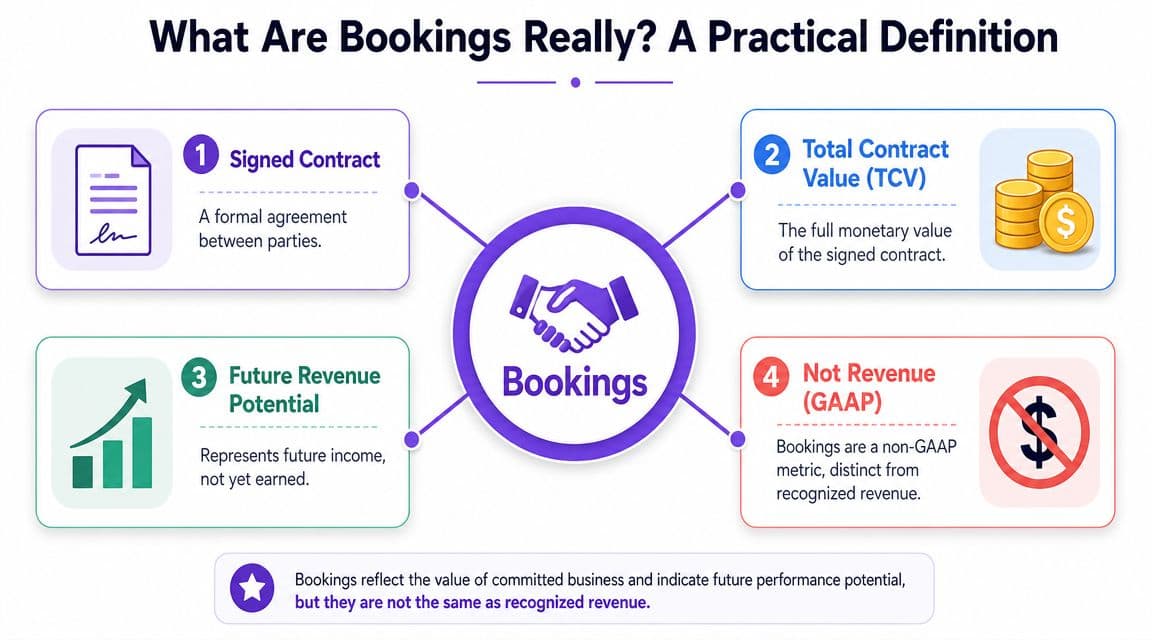
Start with the contract, then classify it correctly
Your source document is the signed order form, MSA, or amendment. Not the invoice. Not the cash receipt. Not the CRM stage marked “closed won” before paperwork is complete.
Use a clean example. If you sign a 2-year SaaS contract worth $48,000, you record $48,000 of TCV bookings on the signing date. If you want an annual planning view, that same contract represents $24,000 of ACV.
| Contract item | Amount |
|---|---|
| Total contract term | 2 years |
| Total contract value | $48,000 |
| TCV bookings at signing | $48,000 |
| ACV equivalent | $24,000 per year |
That single contract can produce several different numbers in your reporting stack. Bookings are $48,000 at signing. Revenue is recognized over the service period. Cash depends on billing terms. If you invoice annually, collect upfront, and deliver monthly, part of that amount will sit on the balance sheet as deferred revenue. Founders who cannot explain that flow lose credibility fast.
Separate the booking types or your story gets distorted
Do not report one blended bookings number. Break it out at minimum into:
- New bookings: First contract from a new customer
- Renewal bookings: Signed continuation of an existing customer agreement
- Expansion bookings: Upsells, add-on products, extra seats, or expanded service scope
This is not cosmetic reporting. A company with $500,000 of bookings driven mostly by renewals and expansions tells a very different story from one with $500,000 driven by one-time new logo deals that may not repeat.
You also need a policy for contract components. Setup fees, implementation, one-time services, usage minimums, and recurring subscription fees can all appear inside total bookings if they are contractually committed. But if you lump them together without labels, your forecast quality drops and your board gets the wrong signal about recurring demand. Teams managing subscriptions and refunds run into this problem constantly because contract value, billing events, credits, and recognition timing rarely line up neatly.
What counts as a booking
Count signed, enforceable commitments.
Do not count:
- Draft contracts
- Verbal approvals
- Procurement emails that say “should be fine”
- Unsigned renewal quotes
- Opportunities with start dates but no executed agreement
My recommendation is simple. Write a one-page bookings policy and make finance own it. Define the signing trigger, define which contract values are included, define how you handle multi-year terms, and define how amendments affect the original booking amount. If your sales leader, controller, and CEO cannot apply the policy the same way to the same contract, your bookings metric is not ready for investors, auditors, or serious forecasting.
How Bookings Differ From Revenue, MRR, and Cash
Founders blow this constantly. They announce a big quarter because bookings went up, then get grilled by investors when cash is flat, revenue lags, and the forecast misses.
Use the terms correctly or stop using them in board decks.
According to Softrax's definition of booking, bookings are the total contractual value a customer commits to when the contract is signed. That makes bookings a sales and pipeline conversion metric. It does not tell you what you earned under GAAP, what hit the bank, or what recurring revenue looks like this month.
Bookings vs Revenue vs MRR vs Cash
| Metric | What It Measures | Timing | Primary Use Case |
|---|---|---|---|
| Bookings | Total signed contract value in the period | At contract signing | Demand tracking, sales performance, future revenue visibility |
| Revenue | Amount earned as you deliver the product or service | Over the service period | Financial reporting, margin analysis, audit support |
| MRR | Monthly recurring portion of contracted recurring value | Monthly | Subscription growth tracking and trend analysis |
| Cash | Money collected from customers | When payment arrives | Liquidity, runway, and collections management |
If you mix these up, your forecast breaks in predictable ways. Sales says the quarter was strong. Finance says revenue is behind plan. Your bank balance says neither story matters if customers have not paid.
One contract, four different numbers
Take a simple SaaS contract. You sign a $12,000 annual subscription in January. The customer gets billed $3,000 each quarter. Revenue is recognized ratably at $1,000 per month.
Here is the January view:
| Metric outcome from the same contract | January view |
|---|---|
| Bookings | $12,000 |
| Quarterly billing | $3,000 |
| Monthly recognized revenue | $1,000 |
| Cash collected | $0 to $3,000, depending on payment timing |
That difference is not accounting trivia. It is the bridge between your CRM, your invoicing system, and your financial statements.
A founder who tells investors, “We booked $12,000, so we made $12,000,” looks sloppy. A founder who says, “We booked $12,000 of ACV in January, billed $3,000, recognized $1,000, and collected cash on a 30-day term,” sounds like someone who can run a company.
Where founders misreport this
The biggest mistake is stuffing different concepts into one KPI and calling it growth.
A multi-year deal is the classic example. If you sign a three-year contract worth $36,000, bookings may be $36,000 on signing if your policy counts full committed contract value. MRR is still only $1,000 if the recurring subscription value is spread evenly. Revenue for January is still $1,000 if service starts immediately and is recognized monthly. Cash could be $36,000, $12,000, or $0, depending on billing terms.
Those are four different answers to four different questions.
This is also where reporting gets messy for companies using Stripe or similar systems. Proration, credits, failed payments, contract amendments, and refunds can distort the numbers fast. Teams dealing with managing subscriptions and refunds need a clean rule set that separates signed contract value from invoices, collections, and earned revenue.
Deferred revenue is the control point
If you invoice before you deliver, the balance sheet carries the obligation until you earn it. That liability is deferred revenue. If your team cannot explain how bookings turn into billings, then into deferred revenue on the balance sheet, and then into recognized revenue, your numbers will fall apart under diligence.
Investors notice this immediately. Auditors do too.
Use this simple test in every monthly close:
- Can finance tie bookings to signed contracts?
- Can billing tie invoices to contract terms?
- Can accounting tie billed amounts to deferred revenue and recognized revenue?
- Can the CEO explain why those numbers differ without guessing?
If the answer is no, fix the reporting before you raise money.
If your CRM shows one number, your bank shows another, and your P&L shows a third, that is normal. If you cannot reconcile them contract by contract, your reporting is not investor-ready.
How to Handle Bookings in Your Accounting System
Bookings don't create a standard journal entry by themselves. That's the first thing you need to drill into your team.
Bookings are usually a non-GAAP operating metric. Your accounting system records the downstream events. Those events are billing and revenue recognition.
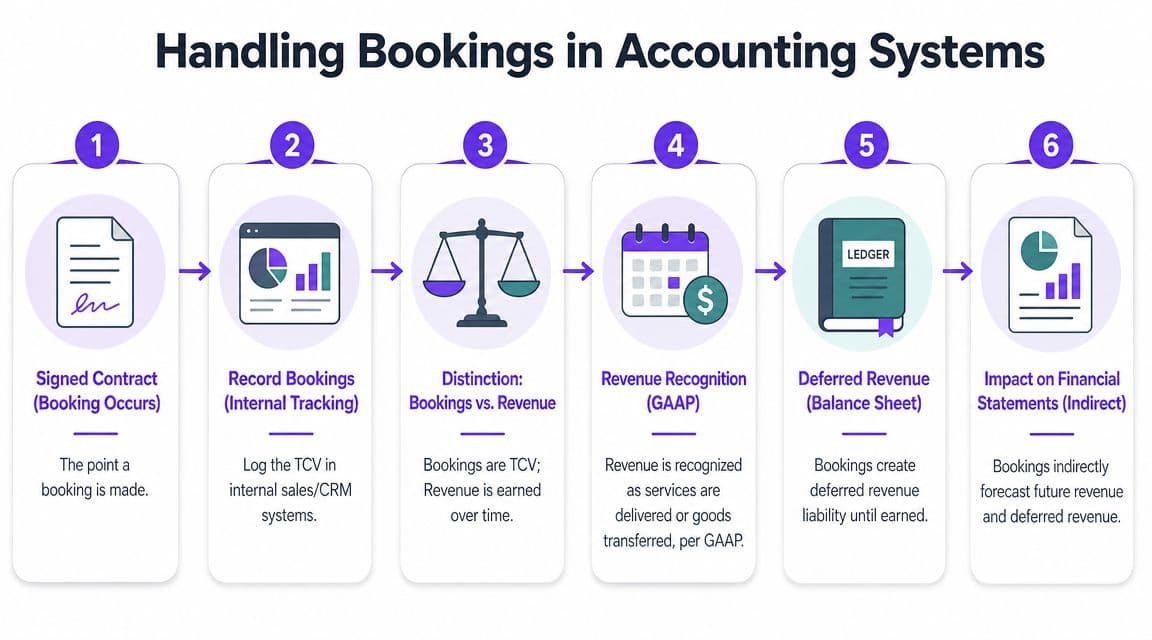
What happens after the contract is signed
Once sales closes the deal, finance needs a workflow that does three things:
- Track the booking internally in the CRM or a bookings schedule.
- Issue the invoice based on the contract terms.
- Recognize revenue over time as you deliver the service.
If you run a SaaS business, your finance team needs this flow tied tightly to your revenue policy. This overview of accounting for SaaS companies is the right operational lens.
Simple journal entries founders should understand
Use the same kind of annual contract example. Suppose you invoice $12,000 upfront for a year of service.
At billing:
| Account | Debit | Credit |
|---|---|---|
| Accounts Receivable | $12,000 | |
| Deferred Revenue | $12,000 |
That entry says the customer owes you money, but you haven't earned it yet.
When you recognize one month of service:
| Account | Debit | Credit |
|---|---|---|
| Deferred Revenue | $1,000 | |
| Revenue | $1,000 |
That entry moves one month's worth from the balance sheet to the income statement.
Where founders lose control
The common failure isn't technical accounting. It's broken handoffs.
- Sales closes terms finance never sees
- Contracts live in email instead of a system of record
- Invoices don't match signed commercial terms
- Revenue schedules are built manually and drift over time
Your books don't care what sales intended. They care what the signed contract says, what was invoiced, and what was delivered.
That's why bookings should live in a controlled reporting process. Track them outside the general ledger if you want, but make sure every reported booking can be traced back to an executed agreement and then forward into billing and revenue schedules.
Building a Dashboard to Track Bookings Like a CFO
Founders love a single bookings number because it looks clean on a board slide. That shortcut is exactly how weak finance teams lose credibility. A CFO-grade dashboard shows what was signed, what will repeat, what will not, and where forecast risk is hiding.
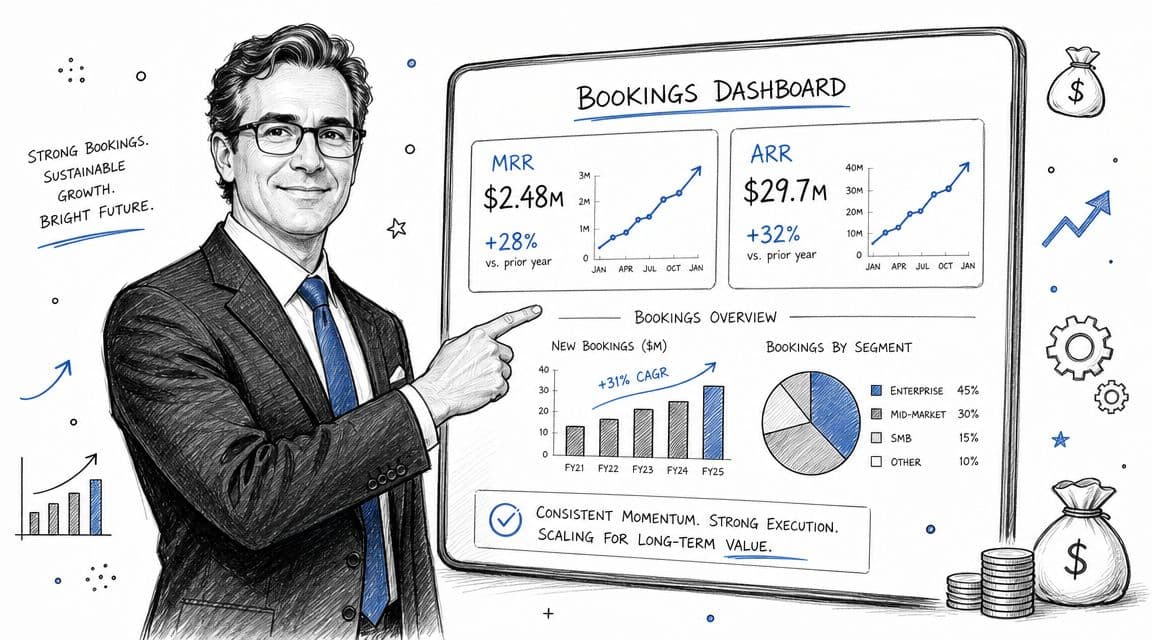
If an investor asks why bookings grew from $200,000 to $260,000 and your answer is “sales had a strong month,” you are not ready for diligence. You need to show whether that extra $60,000 came from new logos, early renewals, multi-year deals, price increases, or one-time services that disappear next quarter.
For founders building a broader reporting stack, this guide to financial dashboards for CEOs and key metrics shows how KPI design should support decision-making, not just reporting.
What to include on the dashboard
Review these views every month, with the current month, quarter to date, and trailing 12 months side by side:
| Dashboard view | Why it matters |
|---|---|
| Total bookings | Shows signed contract value added in the period |
| New vs renewal vs expansion bookings | Tells you whether growth comes from acquisition, retention, or account growth |
| Recurring vs non-recurring bookings | Stops implementation and setup fees from overstating durable growth |
| Bookings by term length | Shows whether headline growth depends on longer contract duration |
| Bookings by product or service line | Reveals if core software is growing or services are carrying the month |
| Average contract value | Helps explain whether bookings moved because of volume, pricing, or deal size |
| Top 10 deals as a percent of total bookings | Exposes concentration risk that can wreck a forecast |
Build the dashboard so every view reconciles to signed contracts. If sales says bookings were $500,000 and finance can only support $430,000 with executed agreements, finance wins. The unsupported $70,000 is fiction until the paperwork exists.
A worked dashboard example
Suppose your team signs these contracts in one month:
| Signed deal | Contract value | Likely category |
|---|---|---|
| New annual subscription | $12,000 | New recurring |
| Renewal annual subscription | $12,000 | Renewal recurring |
| Expansion add-on module | $6,000 | Expansion recurring or hybrid |
| Implementation package | $3,000 | Non-recurring |
Total bookings = $33,000
Now split that total into decision-useful buckets:
- Recurring bookings: $30,000
- Non-recurring bookings: $3,000
- New bookings: $12,000
- Renewal bookings: $12,000
- Expansion bookings: $6,000
That version is useful. The raw $33,000 is not.
If you present $33,000 without the mix, an investor may assume all of it supports next year's run rate. It does not. Only $30,000 is recurring in this example, and even that should be reviewed for term length, start date, and any ramp clauses. Founders often encounter trouble when they report a strong bookings month, then miss the forecast because too much of the number came from one-time work or contracts that start later than expected.
Investor lens: A smaller bookings number with clear recurring mix and clean support beats a bigger number built on messy categorization every time.
Here's a useful walkthrough of finance reporting logic in practice:
What strong teams do differently
Strong teams set policy before they build charts.
They define exactly what counts as a booking, when a contract enters the dashboard, how amendments are handled, and when a de-booking is required. They also separate recurring subscriptions from services in the source data, not just in a spreadsheet right before the board meeting.
Do not paste CRM totals into your investor deck and call it finance reporting. Pull from a controlled contract register, tie each reported booking to an executed agreement, and make someone on finance own the classification. That discipline will help you defend your numbers in fundraising, survive diligence, and produce a forecast that matches reality.
Red Flags in Bookings Reporting That Kill Deals
Big bookings numbers do not impress investors. Numbers you can defend do.
A founder walks into diligence claiming $1.2 million in quarterly bookings. Then the buyer or investor asks for signed contracts, amendment history, cancellation treatment, and a bridge to billings. Suddenly $300,000 is still in legal review, $150,000 is implementation work booked like recurring revenue, and another $200,000 came from an expansion that never went live. That is how a strong pipeline story turns into a credibility problem.
The problem is not complexity. The problem is sloppy rules.
Bookings are a management metric, not a GAAP line item. That means you need a written definition, consistent calculation rules, and a clean audit trail. If sales, finance, and the board deck use different versions of "bookings," investors will assume the rest of your reporting is loose too.
The biggest warning signs
- You count unsigned deals: Verbal approvals, draft MSAs, and non-binding letters of intent do not belong in bookings.
- You have no de-booking policy: Cancellations, downgrades, failed launches, and contract reversals need a documented treatment.
- You mix recurring and one-time work: A $100,000 deal with $70,000 of services and $30,000 of software cannot be presented like $100,000 of recurring growth.
- Your definition changes by audience: If sales reports TCV, finance reports ACV, and the board deck calls both "bookings," your trend line is meaningless.
- Your CRM and accounting records do not reconcile: That signals a manual process with weak controls, which is exactly what buyers and auditors hunt for.
Edge cases that expose immature finance teams
Hybrid contracts expose weak finance discipline fast.
Say a customer signs a 12 month agreement with a $60,000 minimum commitment and usage above that floor. You need a rule now, not during diligence. Do you book only the committed $60,000? Do you exclude variable overages until earned? If your team answers that differently each quarter, your historical bookings trend is not reliable.
Amendments create the same problem. A customer upgrades from $8,000 to $12,000 per month halfway through the term. Another customer cuts seats and shortens the contract. If your team cannot show exactly how those changes flow through current-period bookings and prior-period comparisons, your dashboard is decoration, not finance reporting.
If the answer to "what happens when this contract changes or dies?" depends on who answers first, your bookings number is not investable.
A quick self-audit
Before your next board meeting or raise, run your numbers against a real financial due diligence checklist:
| Question | Red flag if answer is no |
|---|---|
| Do you have a written bookings policy approved by finance? | Your reported trend can shift without anyone noticing |
| Can every reported booking be tied to an executed contract? | Your KPI may include pipeline, not closed business |
| Do you split recurring, non-recurring, and variable components at the source? | Investors cannot judge growth quality |
| Do you document how cancellations, downgrades, and amendments affect bookings? | Historical comparisons will break under diligence |
| Can you reconcile bookings to billings and revenue schedules? | Forecasting and audit support will not hold up |
Founders call these reporting issues. Investors call them judgment issues. Auditors call them control issues. Buyers call them deal risk.
Your Action Plan for Clean, Credible Bookings Reporting
Fixing this doesn't require a giant finance transformation. It requires discipline.
Do these three things now
-
Write a bookings policy
Define exactly what counts as a booking, when it is recorded, how TCV and ACV are treated, and how cancellations or amendments affect prior reporting.
-
Separate systems by purpose
Track bookings in your CRM or KPI layer. Track invoices, deferred revenue, and recognized revenue in your accounting system. Don't force one metric to do every job.
-
Build a monthly reconciliation
Each month, bridge signed contracts to bookings, bookings to billings, and billings to revenue schedules. If that bridge breaks, fix the process before you publish the numbers.
The founders who do this well raise capital more smoothly, forecast with less drama, and survive diligence without rewriting history.
If you want help putting that structure in place, work with people who build clean reporting systems for growing businesses every day.
Jumpstart Partners helps SaaS companies, agencies, and service businesses clean up messy books, implement reliable revenue workflows, and produce investor-ready reporting without building a full in-house finance team. If your bookings, deferred revenue, and forecasting logic don't line up, book a consultation and get the numbers fixed before your next raise, audit, or board meeting.