Financial Operations
What Is a Tax Accountant? a Founder's Guide for 2026
What is a tax accountant and when does your business need one? A guide for founders on services, costs, and hiring a strategic tax partner vs. a preparer.
ByJumpstart Partners, CPA, QuickBooks ProAdvisor
··18 min readMost founders learn what a tax accountant is too late. They find out when cash gets trapped in avoidable tax payments, when a new state creates filing obligations nobody tracked, or when diligence exposes sloppy tax positions that hurt a raise or sale.
That outdated view of tax as a once-a-year filing task doesn't match how growth businesses operate. OECD data from 2024 to 2025 shows that over 65% of medium-sized firms now face cross-border VAT/GST obligations (OECD). If you run a SaaS company, digital agency, or professional services firm in the $500K to $20M range, tax isn't a back-office afterthought. It's part of pricing, hiring, entity structure, cash flow, and margin.
Table of Contents
- Your Tax Accountant Is More Than a Filer They Are a Profit Driver
- Core Services Beyond Annual Tax Preparation
- Tax Accountant vs CPA vs Bookkeeper vs Preparer
- Key Growth Milestones That Demand Tax Expertise
- How Tax Accountants Structure Their Fees
- Questions to Ask and Red Flags to Watch For
- From Information to Action Your Next Steps
Your Tax Accountant Is More Than a Filer They Are a Profit Driver
If your definition of a tax accountant is “the person who files my return,” you're limiting your company.
A tax accountant is a financial professional who specializes in preparing, analyzing, and advising on tax-related matters for individuals and businesses. That role sits inside a large and durable profession. Accountants and auditors held about 1.4 million jobs in the United States, with a median annual wage of $81,680 in May 2024, and the field is projected to grow 5% from 2024 to 2034 with about 124,200 openings each year (Kent State summary citing BLS-related figures). The market is large because tax work is core business infrastructure, not seasonal paperwork.
The founder mistake
Most content on what a tax accountant is stops at compliance. That's incomplete and, for a growth-stage company, expensive.
Most explanations miss the difference between strategic tax planning and routine tax compliance. The OECD finding above matters because your tax exposure now follows your customers, contractors, employees, and digital footprint, not just your headquarters address. A preparer records what already happened. A strategic tax accountant helps shape what happens next.
Practical rule: If your tax advisor only appears after year-end, you don't have tax strategy. You have tax cleanup.
For SaaS and agencies, this shows up in familiar places:
- Remote hiring creates nexus issues: One employee in another state can trigger tax obligations.
- Recurring revenue creates timing issues: Book treatment and tax treatment don't always match under ASC 606-driven models.
- Product development creates credit opportunities: Many founders expense engineering without asking whether the work supports credits.
- Global customers create indirect tax complexity: VAT, GST, and sourcing rules don't care that you're still “small.”
Profit, not paperwork
A real tax accountant protects margin by working alongside your controller, bookkeeper, and leadership team. They look at contracts before signature, compensation plans before rollout, and structure before financing or a sale.
If you're funding product development, tax strategy also overlaps with cash planning. Founders exploring non-dilutive funding options should treat tax credits as part of capital strategy, not just as an accounting line item. The same logic applies if you want a deeper look at R&D tax credits for startups, especially if your team is shipping software and assuming all the upside sits in revenue growth alone.
Core Services Beyond Annual Tax Preparation
The baseline job is simple. File accurate returns. Keep you compliant.
That's not the service that changes outcomes.
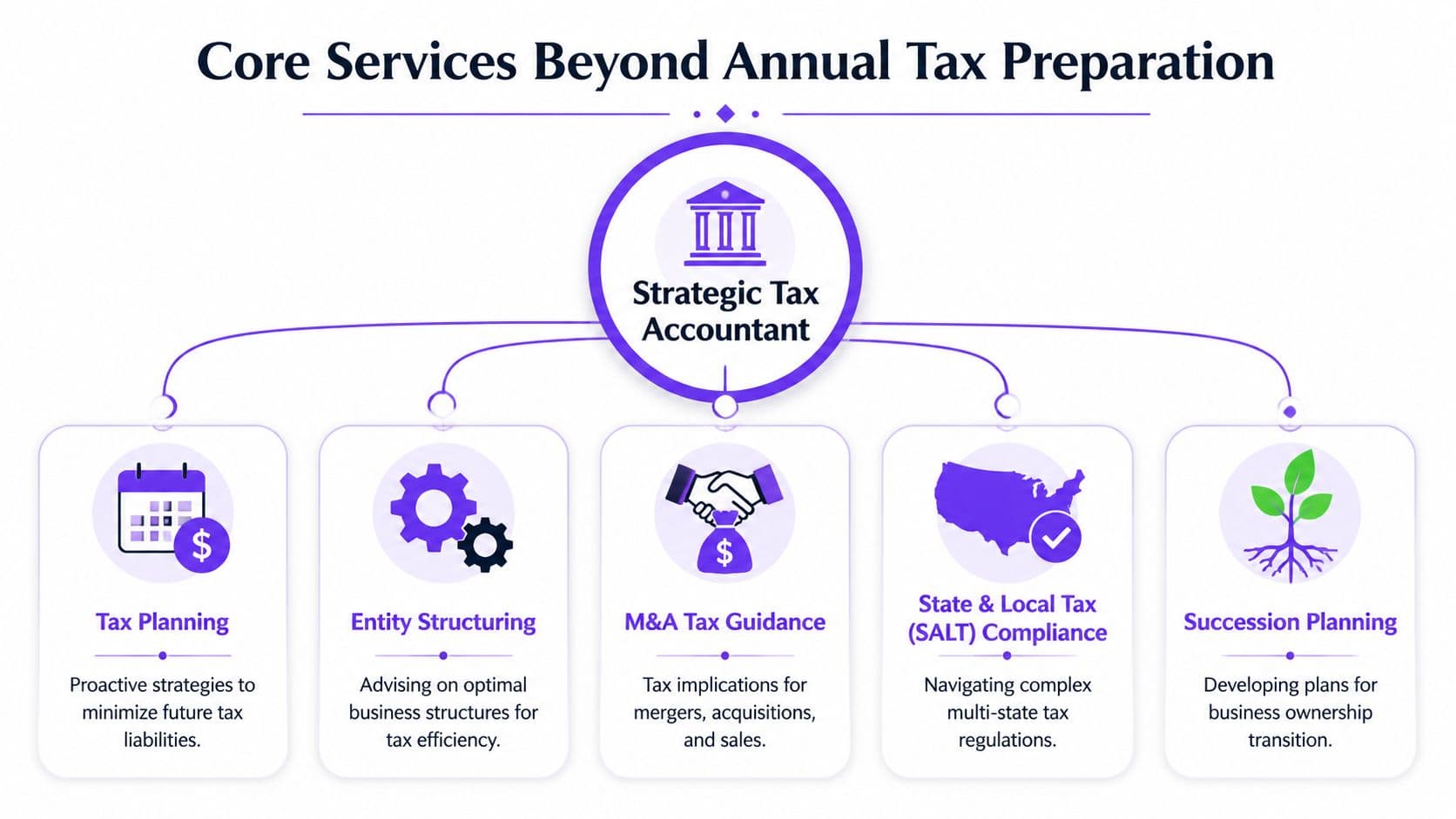
A strategic tax accountant works across the year, tying tax decisions to cash flow, hiring, product development, market expansion, and ownership planning. For businesses in the $500K to $20M range, that work is far more valuable than the return itself.
What strategic work actually includes
A strong tax accountant usually handles five categories of work.
| Service | What it means for your business | Why it matters |
|---|---|---|
| Tax planning | Estimates liability before year-end | You stop getting surprised by tax bills |
| Entity structuring | Reviews LLC, S-Corp, C-Corp, and subsidiary decisions | Structure affects taxes, fundraising, and exits |
| SALT compliance | Tracks state and local tax obligations | Remote teams and multi-state revenue create exposure fast |
| Revenue and provision alignment | Reconciles book and tax treatment | SaaS timing differences can distort cash expectations |
| Transaction guidance | Advises on acquisitions, ownership changes, and exits | Bad structure creates avoidable tax leakage |
A worked example with real numbers
Here's where founders usually miss the point. Tax strategy creates cash.
A small business with $3 million in revenue might owe $450,000 in income tax at a blended 15% rate. A strategic tax accountant can identify deductions and credits that reduce taxable income by $100,000, cutting the final tax bill by $15,000 (Indeed Career Advice).
That isn't abstract. It's direct cash flow.
- Starting tax bill: $450,000
- Reduction in taxable income: $100,000
- Tax impact at the blended rate: $15,000
- Revised tax bill: $435,000
If you're a SaaS founder, that savings can fund part of a key hire, extend runway, or reduce the need to tap debt.
A tax accountant earns their keep before filing season. The return is the receipt for the planning work.
Where SaaS and agencies need more than a preparer
SaaS and service firms create tax issues that generic firms often mishandle:
-
R&D activity
Product development, technical experimentation, and engineering payroll often deserve a closer tax review. -
State footprint
Sales into multiple states, remote employees, and contractor networks create SALT obligations that don't wait for scale. -
Revenue timing
Book revenue under ASC 606 and tax reporting often move on different schedules. -
Entity structure
Your current structure may be fine for today's tax return and wrong for your next financing round.
If you operate internationally or serve founders comparing jurisdictional rules, it helps to understand how other markets frame personal and business tax obligations. A practical example is the Smart Classic Business Hub guide to UAE personal tax, which is useful context for founders dealing with cross-border planning and owner-level tax questions.
And if your current process still treats tax as a once-a-quarter scramble, tighten that up with a better planning cadence. This guide to quarterly estimated taxes for small businesses is a good operational starting point.
Tax Accountant vs CPA vs Bookkeeper vs Preparer
These titles are not interchangeable. Founders use them that way anyway, then wonder why they get clean books and bad tax outcomes, or filed returns and no planning.
The cleanest way to answer what a tax accountant is starts with what they are not.
Finance Role Comparison
| Role | Primary Function | Key Deliverable | Best For |
|---|---|---|---|
| Bookkeeper | Records daily transactions and keeps books current | Accurate categorization and reconciliations | Early-stage businesses that need clean financial records |
| Tax Preparer | Completes and files returns from provided records | Filed tax forms | Simple annual filing needs |
| CPA | Holds state licensure and can provide broad accounting services | Varies by specialty, including attest, advisory, or tax | Businesses needing licensed accounting support |
| Tax Accountant | Specializes in applying tax law to your facts and decisions | Tax planning, compliance, projections, and structuring advice | Growth companies with complex tax exposure |
The role confusion that hurts founders
A bookkeeper keeps your records usable. That matters. But a bookkeeper generally isn't evaluating nexus, deferred tax implications, or entity-level planning.
A tax preparer turns historical records into filed forms. That's useful, but it's backward-looking by design.
A CPA credential signals training and licensure, not necessarily tax specialization. Many CPAs are excellent operators, auditors, or controllers. That does not automatically make them the right tax strategist for a SaaS business dealing with state nexus, credits, and multi-entity issues.
A tax accountant focuses narrowly on tax. According to Indeed's tax accountant job description overview, that means interpreting and applying tax rules, preparing returns, modeling liabilities, and handling issues such as depreciation, tax positions, and the relationship between book and tax treatment. That's why the tax accountant often becomes the specialist on a broader finance team.
Why growth companies split these roles
Private tech and SaaS companies increasingly separate controller-level work from strategy-focused tax work once they hit growth mode. Surveys of private tech and SaaS companies indicate that firms hitting $1M to $10M in ARR increasingly bifurcate ongoing controller-level work from episodic, strategy-focused tax work like R&D credit optimization and entity structuring (KPMG).
That split makes sense.
- Your controller owns the close: revenue recognition, monthly reporting, forecast support, and investor-ready numbers.
- Your tax accountant owns tax interpretation: planning, compliance posture, credits, state exposure, and transaction consequences.
- Your bookkeeper maintains records: they keep the inputs clean.
- Your preparer files forms: they execute the return package if that's their only role.
Founder test: Ask who is reviewing tax impact before you hire in a new state, change pricing, or form a new entity. If the answer is “nobody,” you have a gap.
If you're still sorting out who should own what, this breakdown of accountants for startups is useful because it frames finance hiring by business stage, not by title alone.
The common objection
Founders often say, “My CPA already handles taxes.”
Maybe. But ask a better question. Are they handling tax returns, or are they handling tax strategy?
If your advisor isn't talking about timing, structure, nexus, credits, and owner outcomes, you're getting compliance. Compliance is necessary. It isn't enough.
Key Growth Milestones That Demand Tax Expertise
Tax strategy becomes urgent at business milestones, not at arbitrary calendar moments.
You don't hire a tax accountant because it's March. You hire one because your business changed and your tax exposure changed with it.
The milestones that matter
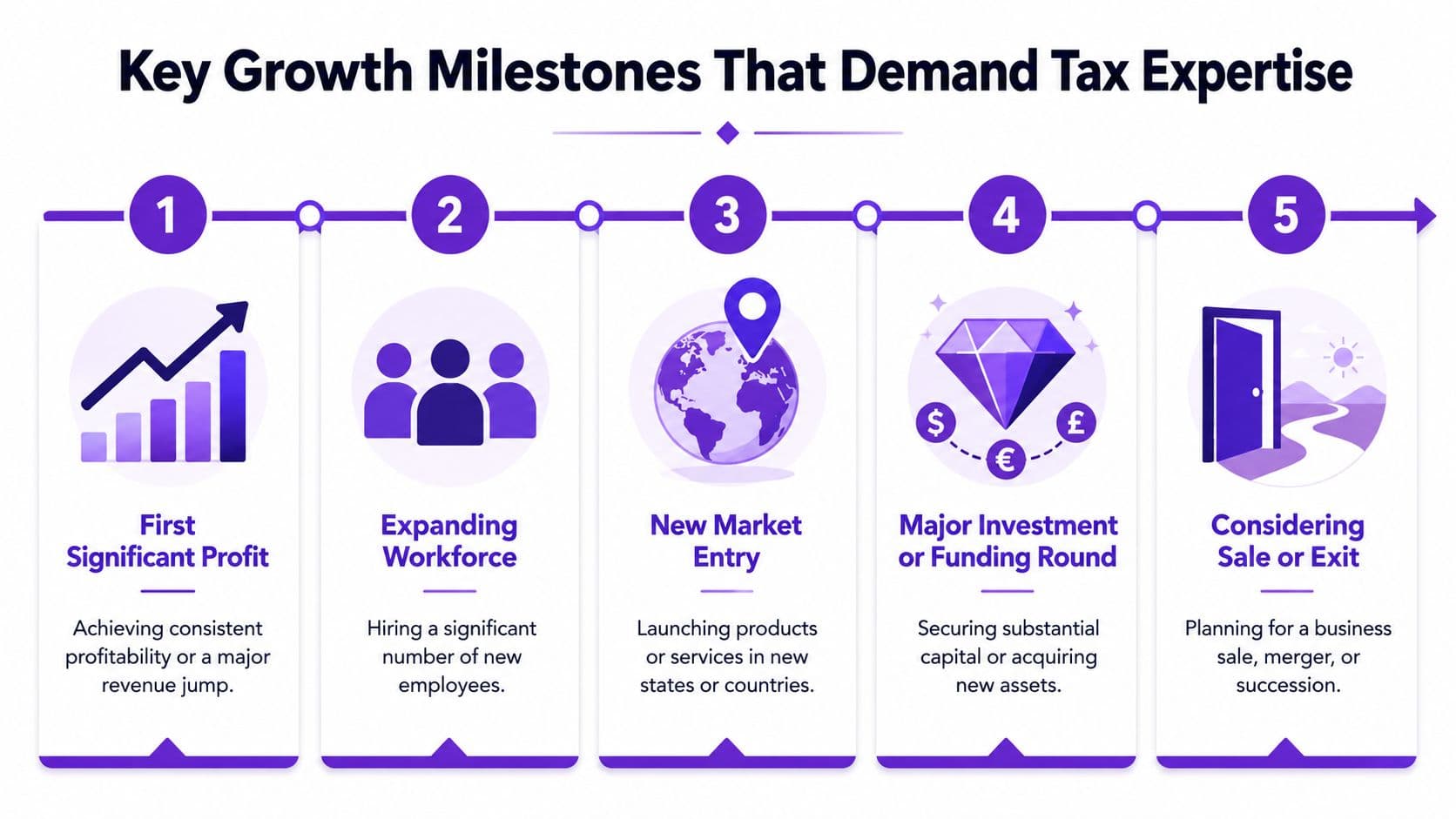
For growth-stage SaaS and agencies, these are the points where tax expertise stops being optional:
| Milestone | What usually changes | Why tax needs to get involved |
|---|---|---|
| First significant profit | Estimated taxes and owner expectations shift | You need planning before cash gets distributed or spent |
| Expanding workforce | Payroll footprint spreads | New states can trigger filings and compliance duties |
| New market entry | Sales move into additional jurisdictions | Revenue sourcing and indirect tax exposure get more complex |
| Major funding or asset investment | Structure and reporting scrutiny increase | Investors care about clean, defensible tax positions |
| Sale or exit planning | Entity and transaction structure matter more | Tax leakage can cut net proceeds |
The rate problem founders underestimate
Tax gets expensive quickly when you stop planning.
The U.S. federal corporate income tax rate is 21%, and many states add another 5% to 10%, so the combined effective rate can reach roughly 26% to 31% (TurboTax overview). If you're making decisions without tax input, you're often choosing the most expensive legal path by default.
That's why proactive tax work matters at each milestone. The tax accountant doesn't just compute the bill. They help you choose accounting methods, structure transactions, and adjust strategy before the bill hardens.
Growth changes your tax profile faster than most founders change advisors.
A simple timing framework
Use this sequence to decide whether you're already overdue:
-
You crossed into consistent profitability
Start planning projected liability now. Waiting until filing season is cash mismanagement. -
You hired outside your home state
Review nexus, payroll taxes, and state registrations immediately. -
You invested heavily in product or platform development
Review whether your activities support credits or deductions. -
You're preparing for a raise or sale
Clean up tax positions before diligence starts, not during it.
If you're unsure whether your business has outgrown basic bookkeeping support, this guide on when to hire a bookkeeper, controller, or CFO helps clarify where tax strategy fits alongside broader finance leadership.
How Tax Accountants Structure Their Fees
Fee confusion causes bad hiring decisions. Founders either overpay for routine work or underbuy the strategic support they need.
Tax accountants usually bill in three ways. The right model depends on whether you need compliance, a defined project, or ongoing advice tied to growth decisions.
The three common pricing models
| Fee model | Best use | What to watch for |
|---|---|---|
| Hourly billing | Open-ended research or cleanup work | Scope can drift if nobody defines the decision clearly |
| Fixed-fee project | Annual returns, nexus reviews, or credit studies | Good for known deliverables with a clear endpoint |
| Monthly retainer | Ongoing planning and access throughout the year | Best fit when tax decisions happen continuously |
What founders should prefer
For a growth company, retainers are usually the best value because tax issues don't show up once a year. They show up when you hire, sign contracts, expand, raise capital, or change compensation.
Project fees make sense when you have a contained need, such as an R&D credit study or a one-time entity restructuring review. Hourly billing is fine for narrow technical research, but it often rewards ambiguity.
Decision standard: Pay for availability when tax decisions are recurring. Pay for projects when the problem is contained.
What to ask before signing
Don't ask only for price. Ask what's included.
- Meeting cadence: Are quarterly planning calls included?
- Responsiveness: Can you ask questions when deals or hiring decisions come up?
- Deliverables: Will you get projections, memos, or just filed returns?
- Coordination: Will they work with your bookkeeper or controller?
A vague proposal usually produces vague value. If you need a practical framework for budgeting finance support more broadly, review this guide to small business accountant costs. It helps founders compare recurring support against one-off project work.
Questions to Ask and Red Flags to Watch For
A bad tax hire does more than waste a fee. It costs you cash, creates avoidable state exposure, and leaves planning opportunities on the table while your company grows.
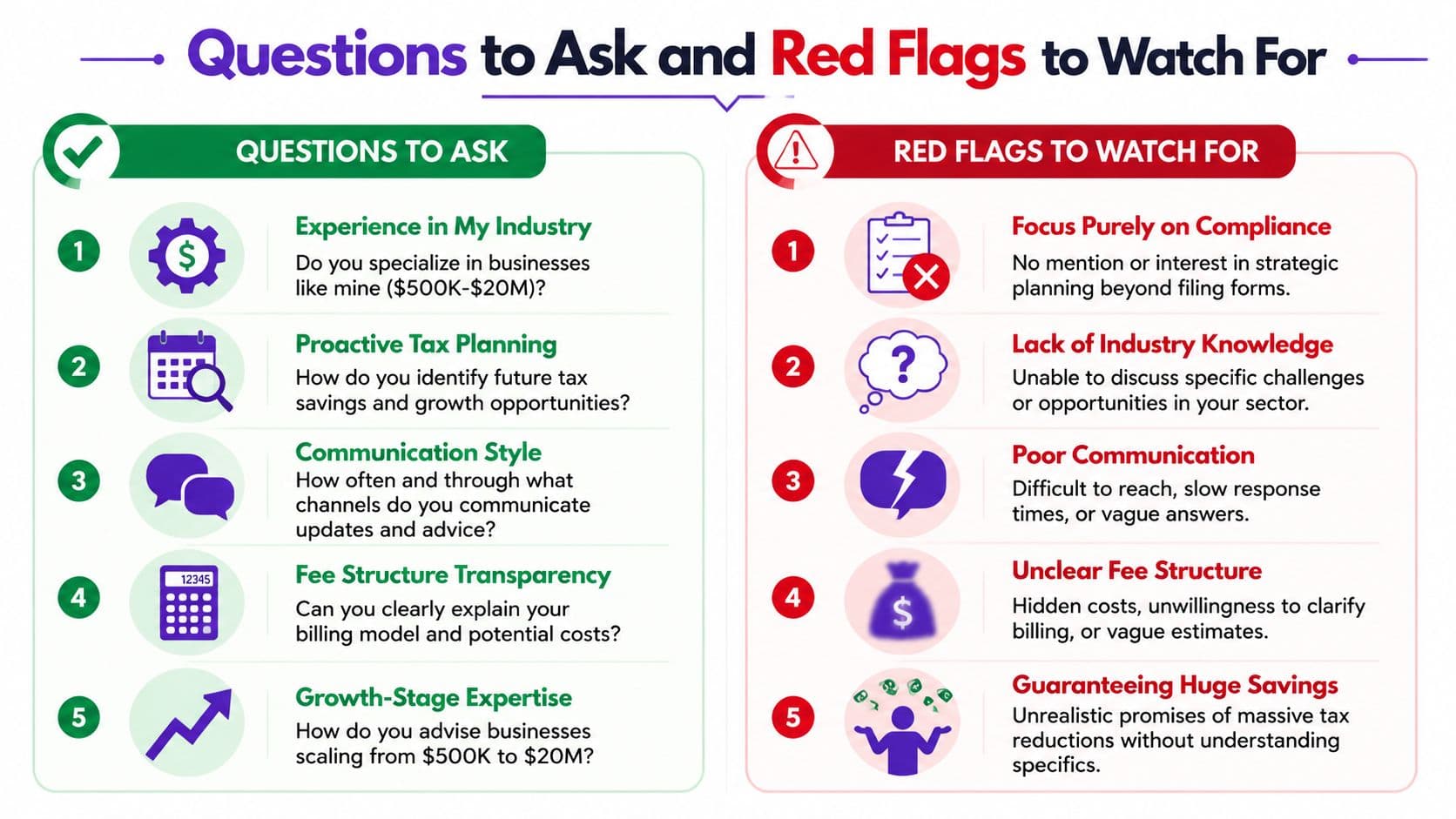
Founders in the $500K to $20M range often screen for the wrong thing. They ask whether someone can file returns accurately. Of course they should. The real question is whether that advisor can help you keep more of what you earn as the business gets more complex.
For SaaS and agency companies, complexity shows up early. Remote hiring creates nexus questions. Product development can create R&D credit opportunities. Changes in ownership, compensation, and entity structure affect cash flow and founder outcomes. If your tax accountant does not work comfortably in those areas, you are buying compliance and calling it strategy.
Five questions worth asking
Ask questions that expose how they think.
-
What tax issues do you see most often for SaaS or agency businesses at our stage?
A strong answer should cover state tax exposure, revenue recognition implications, owner compensation, entity structure, and R&D credit potential. If they answer like every business has the same tax profile, keep looking. -
What does your planning process look like during the year?
You want a real process. Quarterly reviews, projections, deadline planning, and decision support before major moves. "Reach out if something comes up" is not a process. -
How do you assess nexus when we hire in a new state or start selling into one?
Good advisors explain their method clearly. They ask about payroll, contractors, sales activity, and filing thresholds. They do not guess. -
How do you work with our bookkeeper, controller, or outsourced finance team?
Tax strategy depends on clean books and timely data. If they cannot explain what they need each month or quarter, expect delays, rework, and bad estimates. -
How do you advise clients before a raise, acquisition, or exit?
The right answer includes structure, diligence readiness, stock or option treatment, and how the transaction affects the founder personally. You want someone who plans before the event, not after the documents are signed.
A short video can help you sharpen your interview lens before those conversations.
Red flags that should end the conversation
Some problems are obvious. Others sound polished until you look closely.
-
They stay at the return level
If every answer comes back to forms, deadlines, and filing mechanics, they are describing compliance work. Growth companies need planning around structure, timing, nexus, credits, and owner decisions. -
They have no point of view on your business model
SaaS and agencies have recurring revenue, multi-state activity, contractor risk, and margin pressure. If the advisor cannot discuss those issues without speaking in generalities, they are not ready for your company. -
They ask for last year's return but not next year's plan
A strategic tax accountant asks about hiring, product investment, customer concentration, compensation changes, and expansion plans. Tax follows business decisions. It should not lag behind them. -
They cannot explain fees, scope, or deliverables in plain English
Confusion at the proposal stage usually turns into scope fights and surprise invoices later. -
They promise big savings before reviewing your facts
Serious advisors diagnose first. Anyone selling a number before doing the work is selling hope.
“A tax preparer reports history. A strategic tax accountant helps you write it. If your accountant isn't asking about your growth plans, sales strategy, and hiring roadmap, they can't help you build a more profitable future.”
David Johnson, Managing Partner at Jumpstart Partners
The misconception to drop
"We're not big enough yet" is the excuse that keeps founders overpaying in tax.
The businesses that need better tax advice are often the ones in the middle. Big enough to create multi-state exposure, credit opportunities, and structuring decisions. Lean enough that every missed deduction, bad election, or late registration hits hard. If you run a SaaS or agency business in the $500K to $20M range, basic filing support is usually below the level your company needs.
From Information to Action Your Next Steps
You don't need a better definition of what a tax accountant is. You need a better standard for what your tax advisor should be doing.
Start with three steps.
Step one, identify your tax inflection point
Look at your business right now. Have you reached profitability, hired across state lines, expanded into new markets, invested heavily in product development, or started planning for a raise or exit? If yes, your tax position already changed.
Step two, audit your current advisor honestly
Ask whether your current professional is giving you strategy or just filing output. Do they review structure, timing, state exposure, and future decisions before they happen? If not, you have a preparer, not a strategic tax accountant.
Step three, build tax into decision-making
Treat tax as part of finance leadership. That means involving the right specialist before major hires, entity changes, owner distributions, contract shifts, and transaction planning. The payoff is cleaner cash flow, fewer surprises, and stronger diligence readiness.
Tax compliance keeps you out of trouble. Tax strategy helps you grow with more control.
If your company is growing and your tax questions keep colliding with bookkeeping, reporting, and cash flow decisions, talk to Jumpstart Partners. Their team works with SaaS, agencies, and service businesses in the $500K to $20M range, helping founders build a finance function that supports smarter decisions before tax issues become expensive problems.