Financial Operations
Accountants for Startups: A Founder's Hiring Guide
Find the right accountants for startups with this guide. Learn to assess needs, vet firms, ask the right questions, and avoid costly hiring mistakes.
ByJumpstart Partners, CPA, QuickBooks ProAdvisor
··16 min readYou know the moment. Your books live in QuickBooks, Stripe, Gusto, and three spreadsheets no one fully trusts. Your co-founder asks for cash runway. A prospective investor wants clean monthly financials and revenue detail. Your answer is some version of, “Give me a day.”
That's already too slow.
Founders usually hire accountants for startups too late. They wait until tax season, a fundraise, or a painful cleanup. That's backwards. The right accounting model gives you decision-grade numbers before you need them, not after the damage is done.
If you're running a SaaS company, digital agency, or services business between $1M-$5M ARR, this is a hiring decision with operating consequences. The question isn't whether you need help. It's whether you need a freelancer, a CPA, or an outsourced controller setup that can keep up with your business.
Table of Contents
- Why Your Startup's Accounting Can No Longer Be an Afterthought
- The Right Time to Hire an Accountant
- Choosing Your Accounting Model Freelancer vs CPA vs Outsourced Firm
- The Vetting Playbook Questions to Ask and Pricing to Expect
- Onboarding Your New Partner for a Fast Start
- Red Flags Your Accounting Partner Is Holding You Back
Why Your Startup's Accounting Can No Longer Be an Afterthought
Most founders treat accounting like a recordkeeping task until the business gets complicated. That works for a while. Then the business starts billing annual contracts, hiring employees, selling across states, or preparing for diligence. At that point, weak accounting stops being annoying and starts becoming expensive.
A local retail shop can survive with basic bookkeeping and year-end tax prep. Your startup usually can't. SaaS businesses need revenue recognition discipline. Agencies need project and client margin visibility. Professional services firms need clean accruals, payroll treatment, and reliable monthly reporting. If your accounting only tells you what happened last quarter, it isn't helping you run the company.
Financial control is a growth function
The scale of the profession tells you this isn't back-office trivia. Kent State University notes that the worldwide accounting services market was expected to reach about $735 billion in 2025, with about 1.4 million accountants and auditors in the United States, and the field projected to grow 6% from 2023 to 2033 with about 130,000 to 131,000 openings each year over that period (Kent State University accounting and statistics overview).
That matters for one reason. Serious businesses need serious financial control.
If you want a solid primer on the mechanics, this financial guide for startups is useful. But once your company has recurring revenue, payroll, and investor scrutiny, mechanics alone aren't enough. You need a finance operating system.
Bad accounting creates strategic blind spots
When founders say, “Our books are mostly fine,” what they often mean is:
- Cash is unclear: You can't answer runway questions without rebuilding the numbers.
- Revenue is muddy: Deferred revenue, prepaid contracts, or usage billing aren't handled consistently.
- Margins are invisible: You know revenue, but not profit by product line, client, or service category.
- Fundraising prep is reactive: Every investor request turns into a fire drill.
Practical rule: If you need spreadsheets outside your accounting system to explain the business, your accounting setup is behind your company.
Good startup accounting converts raw transactions into operating insight. You should be able to pull a current P&L, balance sheet, cash flow view, and a small set of management metrics without detective work.
For a deeper look at how finance function design changes as a company grows, see this piece on accounting in startups.
The Right Time to Hire an Accountant
The right time isn't based on some magical revenue milestone. It's based on complexity. The minute your business creates accounting questions you can't answer quickly and confidently, DIY has stopped being cheap.
INAA reports that businesses with detailed business plans are 16% more likely to achieve viability when accountants help build the financial framework (INAA on accounting for startups and financial success). That's the right lens. A startup accountant isn't just a compliance vendor. They're part of the system that makes the business legible.
The real triggers are operational
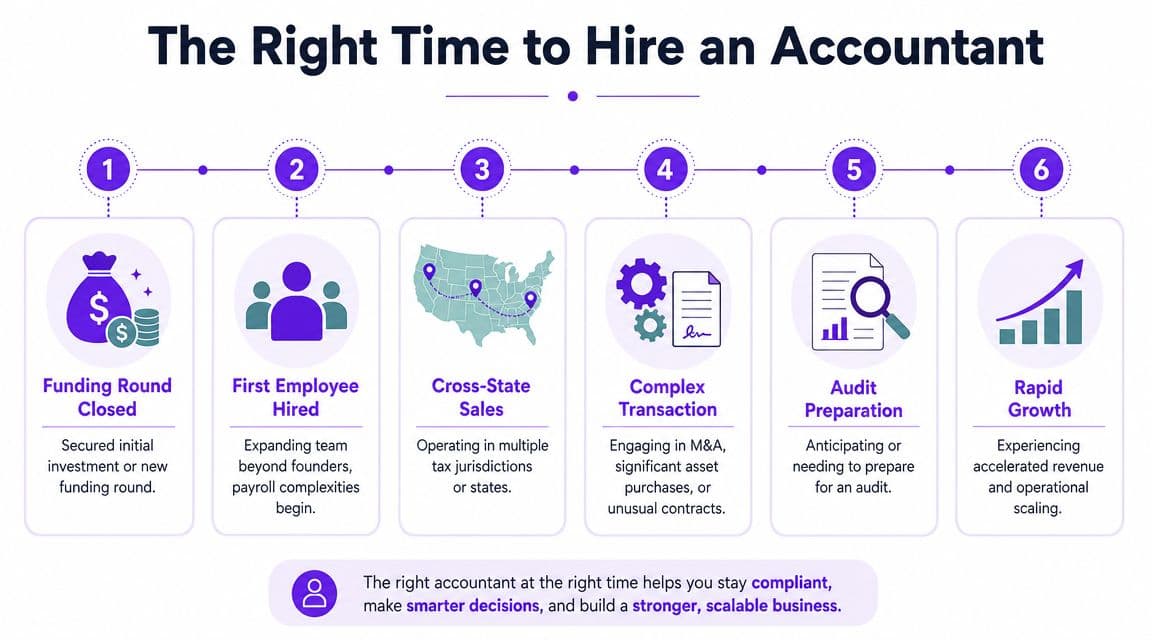
You should upgrade your accounting support when one or more of these happens:
- You close a funding round: Investors expect clean reporting, not founder memory.
- You hire employees: Payroll, reimbursements, benefits, and state filings create immediate complexity.
- You sell in multiple jurisdictions: Sales tax and compliance stop being simple.
- You add contract complexity: Annual prepaids, retainers, usage pricing, milestone billing, or multi-entity structures need proper treatment.
- You prepare for diligence or audit: Cleanup under a deadline is expensive and distracting.
- You grow faster than your close process: If month-end drags, every decision lags with it.
The founder-time math is brutal
Founders often pretend doing the books themselves is free. It isn't. It's a direct allocation of executive time to low-impact work.
Here's a simple worked example using real operating math:
| Item | Amount |
|---|---|
| Founder time spent on bookkeeping and finance admin per month | 15 hours |
| Founder opportunity cost per hour | $200 |
| Monthly hidden cost of founder-led bookkeeping | $3,000 |
Calculation: 15 hours x $200 = $3,000 per month
That $3,000 doesn't buy quality controls, a better close, or cleaner reporting. It buys delay. It also creates a second cost that doesn't show up in the math: context switching. You stop selling, hiring, and shipping so you can recode transactions and chase receipts.
If you can't state your current cash runway within 15 minutes, you've already outgrown DIY accounting.
A lot of founders are "too early" only in their own heads. You're not too early if financial ambiguity is affecting pricing, hiring, burn, or fundraising.
A quick self-test
You need an accountant now if you answer “no” to two or more of these:
- Can you close the prior month quickly?
- Can you explain revenue by customer or service line from your accounting system?
- Can you trust payroll, reimbursements, and contractor classification?
- Can you produce investor-ready financials without manual cleanup?
- Can you forecast cash with confidence?
If that list feels uncomfortable, act on it. This guide on when to hire a bookkeeper, controller, or CFO is a useful next step for sorting the role by stage.
Choosing Your Accounting Model Freelancer vs CPA vs Outsourced Firm
Most founders shop for accounting support the wrong way. They compare monthly fees first. That's how you end up buying cheap bookkeeping and paying for expensive cleanup six months later.
The better question is this: what finance capability does your business need right now?
EisnerAmper's startup coverage makes the key point clearly. Startups need more than basic bookkeeping. They need support for issues like revenue recognition, due diligence prep, and investor-facing metrics that a general small-business accountant often won't handle well (EisnerAmper early-stage startup services).
Startup Accounting Model Comparison
| Attribute | Freelance Bookkeeper | Traditional CPA Firm | Outsourced Controller Service |
|---|---|---|---|
| Core strength | Transaction entry and reconciliations | Tax, compliance, year-end filings | Monthly close, controls, reporting, finance operations |
| Best fit | Very early, low-complexity businesses | Companies with tax complexity but simple monthly ops | Growth-stage startups needing timely numbers |
| Speed | Depends heavily on one person | Often slower and calendar-driven | Usually built around recurring monthly cadence |
| Tech stack integration | Varies widely | Often limited to standard systems | Typically works across QuickBooks, Xero, payroll, billing, and payments tools |
| Strategic insight | Usually low | Moderate on tax, lower on operations | Higher on cash flow, metrics, and reporting discipline |
| Coverage risk | High if the person gets overwhelmed | Moderate, but work may be segmented | Lower if the firm has a team structure |
| Fundraising readiness | Often weak | Better for tax and formal review needs | Better for management reporting and diligence prep |
| Scalability | Breaks under complexity | Can become expensive and slow for day-to-day needs | Built to grow with process complexity |
Where each model works
A freelance bookkeeper can be fine if your business is simple. One entity. Limited transaction volume. Straightforward billing. No investors asking hard questions.
A traditional CPA firm usually becomes valuable when tax planning, returns, and compliance are the center of the job. That's useful, but many firms still aren't built for operational reporting speed. They tend to look backward more than founders need.
An outsourced controller service is the right fit when the books need to support decisions every month. That includes accruals, deferred revenue logic, margin reporting, close management, and cash visibility. For example, firms such as virtual accounting firm providers and outsourced finance teams can sit between basic bookkeeping and a full in-house controller hire.
My recommendation by business type
- SaaS companies: Don't hire a generic local accountant if you have subscriptions, annual prepaids, or investor reporting needs.
- Agencies: You need project, client, and labor visibility. Pure tax firms rarely build this well.
- Professional services: Focus on accrual discipline, payroll accuracy, and monthly margin reporting by service line.
If you're evaluating systems alongside service models, this guide to accounting software for UK startups is a decent reference for what software capability should support your accounting process.
Cheap accounting becomes expensive the first time you need cleanup, restated reports, or an all-hands investor scramble.
The Vetting Playbook Questions to Ask and Pricing to Expect
Once you've picked the model, don't wing the selection process. Most founders ask the weakest possible questions: What do you charge? How many clients do you have? Do you work with startups?
Those questions won't tell you whether this partner can run your close.
What to evaluate before you ask about fees
Use this checklist first:
- Industry fit: Ask for specific experience with SaaS, agencies, or services businesses like yours.
- System fit: They should know your stack. QuickBooks Online, Xero, NetSuite, Stripe, Gusto, Shopify, Square, or BambooHR shouldn't require a learning curve on your dime.
- Close process: They need a clear monthly workflow with responsibilities, deadlines, and review steps.
- Controls and security: They should explain permissions, approvals, document handling, and secure data access in plain English.
- Reporting quality: Sample reports matter. You want commentary and analysis, not a PDF dump.
- Escalation path: If your lead contact disappears for a week, who owns your close?
The interview questions that actually matter
Ask these in the first call:
- Walk me through your month-end close process.
- How do you handle accruals, deferred revenue, and prepaid expenses in a recurring revenue business?
- How would you redesign our chart of accounts so we can see gross margin by service line or product line?
- What does your review process look like before financials are delivered?
- How do you work with Stripe, QuickBooks, Gusto, and our bank feeds?
- If you saw a sudden margin drop, how would you investigate it?
- What would you need from us each month to keep the close on time?
A lot of proposals sound polished. The answers to those questions usually aren't.
Test for insight, not output. If they can produce reports but can't interpret them, you're buying labor, not finance leadership.
This is a useful benchmark article on the cost of accounting if you want a framework for comparing proposals without defaulting to the cheapest bid.
What pricing should look like
I won't invent market ranges. You told me not to, and you shouldn't trust firms that do it casually either.
What I will tell you is how to think about pricing:
| Service level | What you're paying for | Common mistake |
|---|---|---|
| Bookkeeping | Transaction coding, reconciliations, baseline books | Expecting strategy from clerical work |
| Controller support | Close management, accruals, reporting, process discipline | Buying too late, after complexity has piled up |
| Controller-led finance ops | Forecasting, board reporting, capital planning, strategic finance | Using a CFO to fix broken bookkeeping |
Before you watch a sales demo or approve a proposal, get clear on scope. Then compare three things only: turnaround time, review quality, and whether they can support the decisions your business makes.
A quick primer on what founders often miss in vendor evaluation:
Onboarding Your New Partner for a Fast Start
A bad handoff wastes the first two months. A good handoff gets you to a clean reporting rhythm fast.
Here, many founders sabotage a strong hire. They sign the engagement, forward a few logins, and assume the rest will sort itself out. It won't. Your accounting partner can only move as fast as the access, history, and process clarity you give them.
The AICPA has highlighted accelerating AI use in accounting workflows such as data extraction and processing, but the key for startups is still the blend of automation plus expert review (AICPA and CPA.com on AI in accounting workflows). Speed matters. Accuracy under review matters more.
What you need to provide
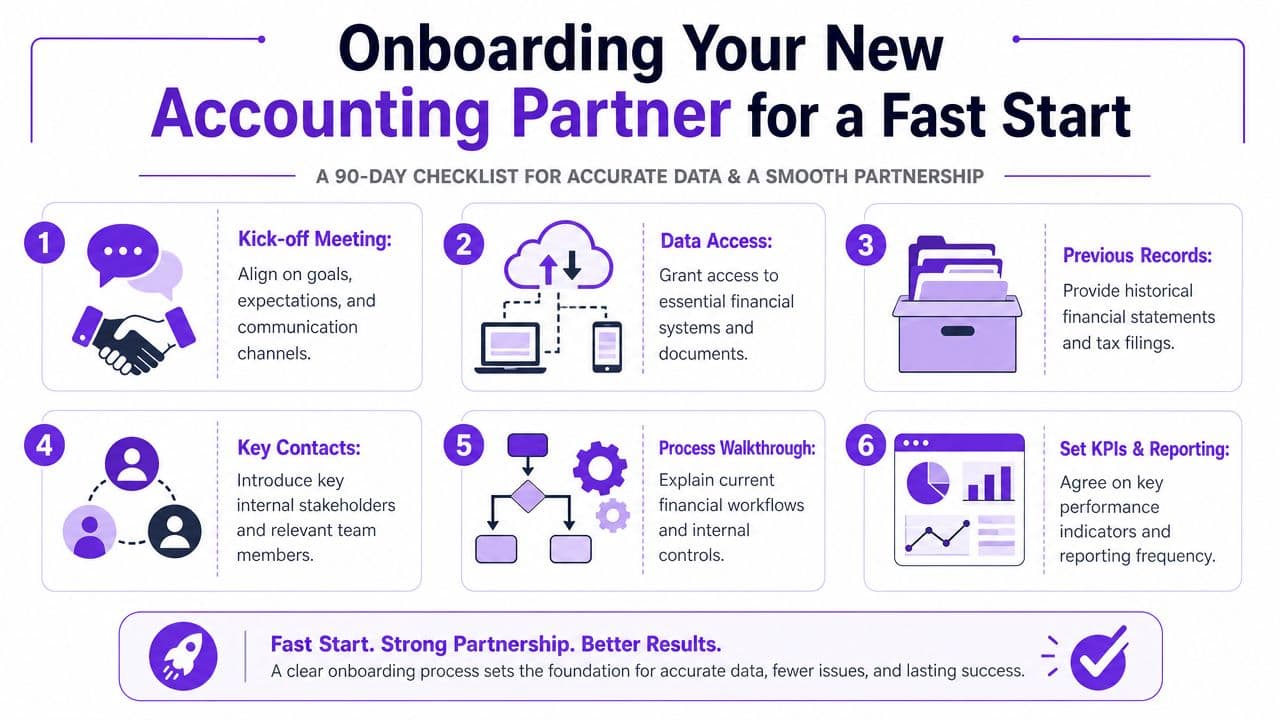
Your side of onboarding should be boring and complete:
- System access: Banking, credit cards, QuickBooks or Xero, payroll, payment processors, expense tools, and loan portals.
- Historical records: Prior financial statements, tax returns, payroll reports, loan documents, major contracts, and sales tax filings.
- Org context: Who approves bills, who runs payroll, who owns invoicing, and where customer billing data lives.
- Business priorities: Fundraising, margin improvement, runway visibility, cleanup, or audit prep. Tell them what matters now.
What they should deliver quickly
A capable partner should establish structure early. Not eventually. Early.
| First-90-day deliverable | Why it matters |
|---|---|
| State-of-the-books review | Finds cleanup issues before they poison current reporting |
| Chart of accounts refinement | Makes reports useful by product, client, or service line |
| Monthly close calendar | Creates deadlines and accountability |
| Management reporting pack | Gives you repeatable decision-ready output |
| Control recommendations | Reduces errors in payables, payroll, and reconciliations |
One option in this category is Jumpstart Partners, which provides outsourced controller and bookkeeping support for growing companies and integrates with tools like QuickBooks, Xero, NetSuite, Stripe, Gusto, and BambooHR. Whether you choose them or another provider, the standard should be the same: clear ownership, clean monthly closes, and reporting you can use.
Your first 90 days should end with a repeatable close process, not a vague promise that things are “getting organized.”
For a practical checklist of what a disciplined close should include, use this month-end close checklist template.
Red Flags Your Accounting Partner Is Holding You Back
A weak accounting partner rarely fails loudly. They fail by degrees. Reports arrive late. Questions take too long. You stop trusting the numbers, so you build side spreadsheets and work around them.
That's your signal to replace the setup.
The warning signs are obvious if you look
Here are the red flags that matter:
- Reports arrive without interpretation: If they send statements but never explain what changed, you don't have a partner.
- They don't understand your business model: SaaS, retainers, implementation fees, pass-through costs, and payroll-heavy delivery models all create different accounting needs.
- Every month feels improvised: Missing checklists, shifting close timing, and recurring reclasses mean the process isn't controlled.
- They stay reactive: Tax deadline? They respond. Investor request? They scramble. A real partner builds ahead of events.
- They can't answer metric questions: If they freeze when you ask about customer profitability, gross margin trends, or revenue treatment, they aren't operating at the right level.
The difference between reports and insight
“A good accountant gives you reports. A great accounting partner gives you insights. Your vetting process should relentlessly test for the latter. Ask them to identify an opportunity or risk in a sample P&L. Their answer will tell you everything,” says David Allen, Partner at Jumpstart.
That's the standard. You don't need someone to export numbers. Software does that. You need someone who can tell you why gross margin slipped, why cash is tighter than revenue suggests, or why your billing model is creating reporting noise.
What to do if this is your current situation
If your accounting partner is holding you back, take these actions now:
- Audit the last three closes: Were they timely, consistent, and reviewable?
- Request a sample management package: If they can't provide one quickly, that's revealing.
- List unresolved finance questions: Runway, margin, deferred revenue, payroll treatment, tax exposure. Count how many stay unanswered.
- Switch before a major event: Don't wait until fundraising or year-end cleanup forces the decision.
You shouldn't need to chase your accounting team for clarity. You should expect clean books, timely reporting, and finance support that helps you act faster.
If you're done tolerating late closes, messy books, and reports that don't answer real operating questions, talk to Jumpstart Partners. They work with growing SaaS, agency, and services businesses that need outsourced controller support, investor-ready financials, and a finance function built for decisions, not just compliance.