Financial Operations
What Is Accounts Receivable Turnover? A Guide for Founders
Learn what is accounts receivable turnover, how to calculate it, and why it's critical for SaaS and service firms. Improve your cash flow and financial health.
ByJumpstart Partners, CPA, QuickBooks ProAdvisor
··17 min readUncollected invoices are more than just an accounting headache; they represent frozen capital that's actively stalling your company's growth. For founders and CEOs of SaaS, agency, and professional services firms, every dollar tied up in slow collections is a dollar you can't reinvest into hiring key talent, launching a marketing campaign, or accelerating product development.
The accounts receivable turnover ratio is the metric that tells you exactly how efficiently you're turning those invoices back into the cash you need to grow.
Why Slow Collections Are a Hidden Threat to Your Growth
When a client takes 60 or 90 days to pay, they’re not just late—they're effectively using your business as an interest-free line of credit. This starves your cash flow and forces you into tough decisions about where to allocate your limited capital.
This isn't an administrative problem. It's a strategic bottleneck that can bring a promising business to a standstill. A low accounts receivable turnover ratio is the red flag that this is happening.

Red Flags of a Broken Collections Process
The damage from slow collections extends far beyond a number on your balance sheet. It creates tangible roadblocks that suffocate even the most innovative SaaS or service business.
- Stalled Growth: You can't hire that critical engineer or launch the ad campaign you planned if the cash to fund it is locked up in receivables. Growth initiatives die on the vine.
- Increased Financial Risk: Poor collections make your business fragile. You're more exposed to economic shifts and unexpected expenses, which often increases your reliance on expensive debt or dilutive funding rounds.
- Damaged Investor Confidence: Sophisticated investors and lenders don't just look at revenue; they scrutinize your AR turnover. A low ratio signals operational weakness and poor cash management, making you a far less attractive investment.
"A company’s accounts receivable aging is a direct reflection of its billing and collections discipline. It’s not just about the money owed—it’s about the health of your customer relationships and the efficiency of your internal financial processes." - Maria Gonzalez, Fractional CFO
Your First Line of Defense
Getting a handle on your accounts receivable turnover is the first step toward regaining control. This ratio is a leading indicator of your financial health—a clear diagnostic tool for your collections efficiency. It answers one vital question: how many times per year do you successfully collect your entire accounts receivable balance?
By mastering this metric, you can pinpoint the inefficiencies in your collections process and start building a more resilient financial engine. A solid collections process is a core part of your overall billing cycle; for more context, see our complete guide on what is accounts receivable management.
In the sections that follow, we'll break down exactly how to calculate, interpret, and improve your AR turnover ratio—turning this hidden threat into a major strategic advantage.
Calculating Your Accounts Receivable Turnover Ratio
Now that you see the risk of slow collections, let's get practical. The formula itself is simple, but the details are what make the number meaningful. A sloppy calculation leads to flawed decisions.
Accounts Receivable Turnover Ratio = Net Credit Sales / Average Accounts Receivable
This ratio tells you how many times per year your company collects its entire accounts receivable balance. A higher number signals a more efficient collections engine. Let's break down each piece so you can calculate it with confidence.
Breaking Down the Formula Components
To get an accurate ratio, you must be precise about what goes into the numerator and the denominator. Garbage in, garbage out.
- Net Credit Sales: This is your total sales made on credit during a period, after accounting for returns or allowances. It's critical to exclude all cash sales. If you include them, your sales figure will be inflated, creating a misleadingly high turnover ratio that makes you look more efficient than you actually are.
- Average Accounts Receivable: This is the average amount your customers owed you during that same period. You find it by adding the AR balance from the start of the period to the balance at the end, then dividing by two. This smooths out any big swings and gives you a far more representative number than just picking a single day's balance from your balance sheet.
Worked Calculation Examples: SaaS vs. Digital Agency
Let's apply this to two common business models: a B2B SaaS company and a project-based digital agency. Seeing how this works in practice reveals how efficiently each business converts its credit sales into actual cash. You can explore more examples of how this ratio impacts cash flow management.
The table below walks through the calculation for both a SaaS company and a digital agency, showing how different revenue models affect the outcome.
| Metric | B2B SaaS Co. (Example) | Digital Agency (Example) |
|---|---|---|
| Annual Net Credit Sales | $2,000,000 | $1,200,000 |
| Beginning AR (Jan 1) | $150,000 | $120,000 |
| Ending AR (Dec 31) | $170,000 | $180,000 |
| Average AR | ($150,000 + $170,000) / 2 = $160,000 | ($120,000 + $180,000) / 2 = $150,000 |
| AR Turnover Ratio | $2,000,000 / $160,000 = 12.5 | $1,200,000 / $150,000 = 8.0 |
| Days Sales Outstanding (DSO) | 365 / 12.5 = 29.2 days | 365 / 8.0 = 45.6 days |
The SaaS company turns over its receivables 12.5 times per year, while the agency does it just 8.0 times. This means it takes the SaaS company an average of 29 days to collect payment, while the agency takes over 45 days.
This difference is completely expected. SaaS businesses with automated monthly billing and standardized payment terms usually have faster, more predictable collection cycles. Agencies, on the other hand, often deal with larger, milestone-based project invoices that come with longer payment terms (like Net 30 or Net 60), naturally slowing the cycle down.
What a Good AR Turnover Ratio Looks Like
So you've calculated your accounts receivable turnover ratio. It's 8.5. Now what?
That number tells you nothing on its own. The real answer depends entirely on your industry and business model. A "good" ratio isn't a universal target; it's a competitive one. A B2B SaaS company with automated monthly billing will naturally turn over its receivables far faster than a creative agency that manages large, milestone-based projects on Net 60 terms. You must compare your performance to the right peer group.
Benchmarking Your Collections Efficiency
To see how you stack up, you need to look at industry benchmarks. A ratio that’s perfectly fine in one industry signals a serious cash flow problem in another. The goal is to know where you stand against your direct competition.
This is why two companies with different business models can have wildly different—yet equally "healthy"—turnover ratios.
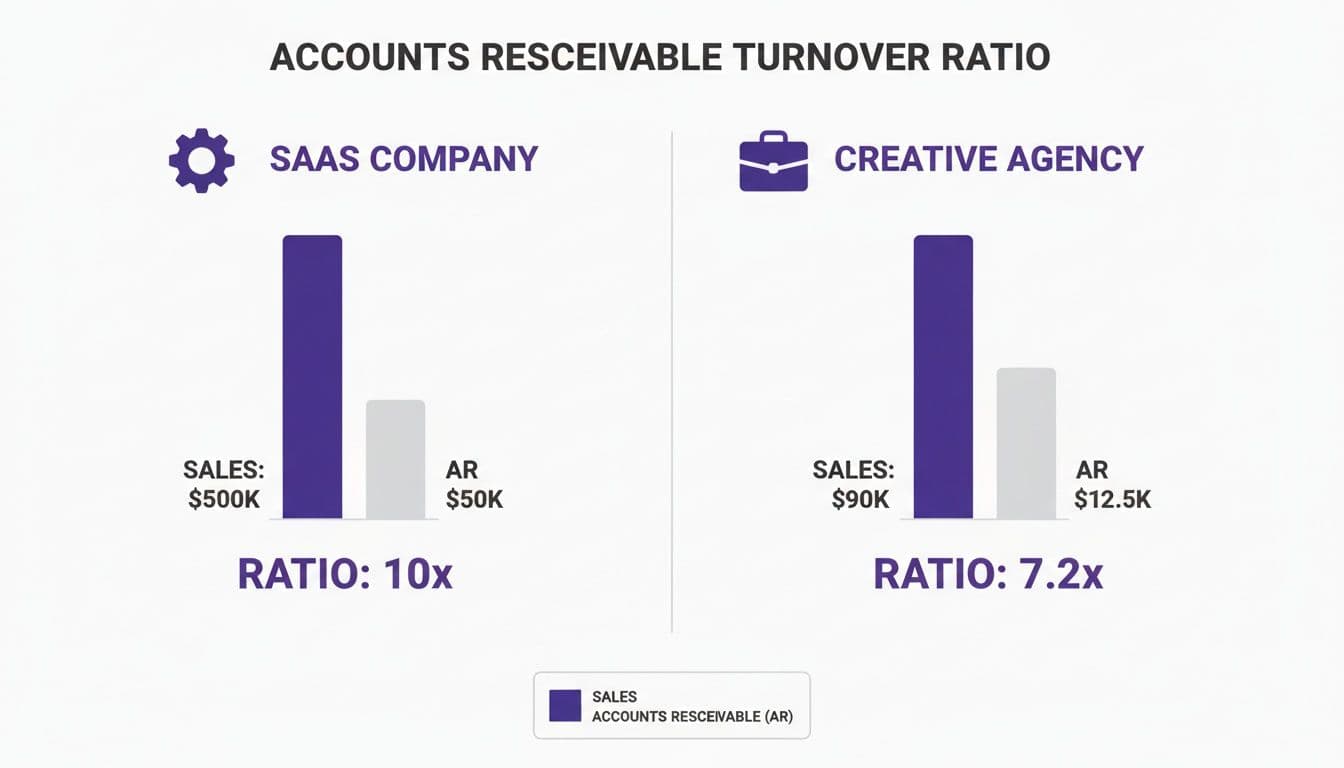
The SaaS company’s 10x turnover reflects a highly efficient, automated collections engine. In contrast, the agency's project-based billing results in a lower but still solid 7.2x turnover. Neither is inherently "better"—they just reflect different operational realities.
"Context is everything with financial KPIs. A standalone metric is just a number; a metric benchmarked against your industry peers is an insight. It tells you whether you're leading the pack or falling behind in operational excellence." — David Anderson, Head of Finance, ScaleUp Tech
Accounts Receivable Turnover Benchmarks by Industry
To put your own ratio into perspective, here’s a table of common industry benchmarks. According to OpenView's 2024 SaaS Benchmarks and data from other industry analysts, these are strong targets for companies in the $500K-$20M revenue range.
| Industry | Target AR Turnover Ratio | Target Days Sales Outstanding (DSO) |
|---|---|---|
| B2B SaaS | 10 - 12 | 30 - 37 days |
| Professional Services/Agencies | 7 - 9 | 40 - 52 days |
| E-commerce/DTC | 9 - 11 | 33 - 41 days |
| Manufacturing | 8 - 12 | 30 - 45 days |
If your ratio is significantly below these numbers, it’s a clear signal that your collections process needs attention. A lower-than-average turnover means your competitors are getting paid faster than you are, giving them a direct cash advantage to fund their own growth. It's just one of many crucial financial KPIs for small business success.
Interpreting High vs Low Turnover Ratios
Calculating your AR turnover ratio is just the first step. The real value comes from understanding what that number is telling you about the health of your business. This isn't just a metric for your finance team; it's a direct signal of your company’s operational efficiency and the quality of your customer base.
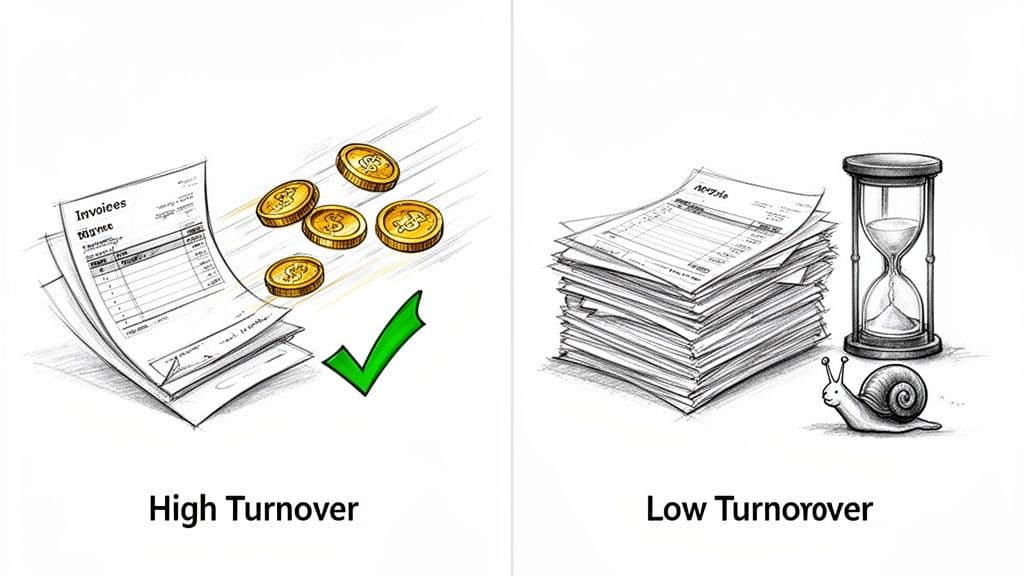
In short, a high ratio is what you’re aiming for. It means you’re turning sales into cash quickly, your collections process is disciplined, and your customers are paying their bills on time. A high turnover ratio is the sound of a healthy financial engine.
The Problem with a Low Turnover Ratio
A low accounts receivable turnover ratio is a major red flag. It means your cash is trapped in unpaid invoices, and you’re essentially providing free, short-term financing to your customers. The lower the ratio, the longer it’s taking you to get paid.
This is almost always a symptom of deeper problems:
- Inefficient Collections: Your team is letting invoices age without a systematic follow-up process.
- Overly Generous Payment Terms: Offering Net 60 or Net 90 terms without a strong strategic reason cripples your cash flow.
- At-Risk Customer Base: A low ratio reveals that many of your clients are struggling financially, increasing the risk that those receivables will become uncollectible bad debt.
A low ratio under 4 ties up critical capital and can starve a business of the cash it needs to operate. You can learn more about how this metric predicts liquidity and business health on Quadient.com.
Misconception: Can Your Turnover Ratio Be Too High?
Yes. While a high number is good, an extremely high ratio often signals a different kind of problem: your credit policies are too restrictive.
If you’re turning away perfectly good customers because your payment terms are too rigid or your credit checks are too stringent, you are sacrificing revenue for the sake of a perfect collections score. You’re winning the battle but losing the war. An extremely high AR turnover ratio might feel like a win, but it means your credit policy is so tight it’s choking off sales. The goal is to find the sweet spot: efficient collections without creating unnecessary friction for good customers who just need reasonable terms.
The key is balance. You want a collections process that is efficient but not so aggressive that it damages customer relationships or limits your potential market.
Connecting Turnover Ratio to Days Sales Outstanding (DSO)
The AR turnover ratio has a more intuitive cousin: Days Sales Outstanding (DSO). They measure the exact same thing but from different angles.
- AR Turnover Ratio tells you how many times you collect your receivables in a period.
- DSO tells you the average number of days it takes to collect an invoice.
The formula to convert between them is simple: DSO = 365 / Accounts Receivable Turnover Ratio.
As a founder or CEO, DSO is often easier to grasp—it’s the average number of days your cash is stuck in someone else’s bank account.
Actionable Next Steps to Improve Your AR Turnover
Knowing your accounts receivable turnover ratio is just step one. Taking action to improve it is how you unlock cash for growth. A higher ratio isn't just a number for your accountant; it's a strategic weapon that gives you more capital to hire, invest, and scale. These are specific, battle-tested strategies that will accelerate your cash collections today.
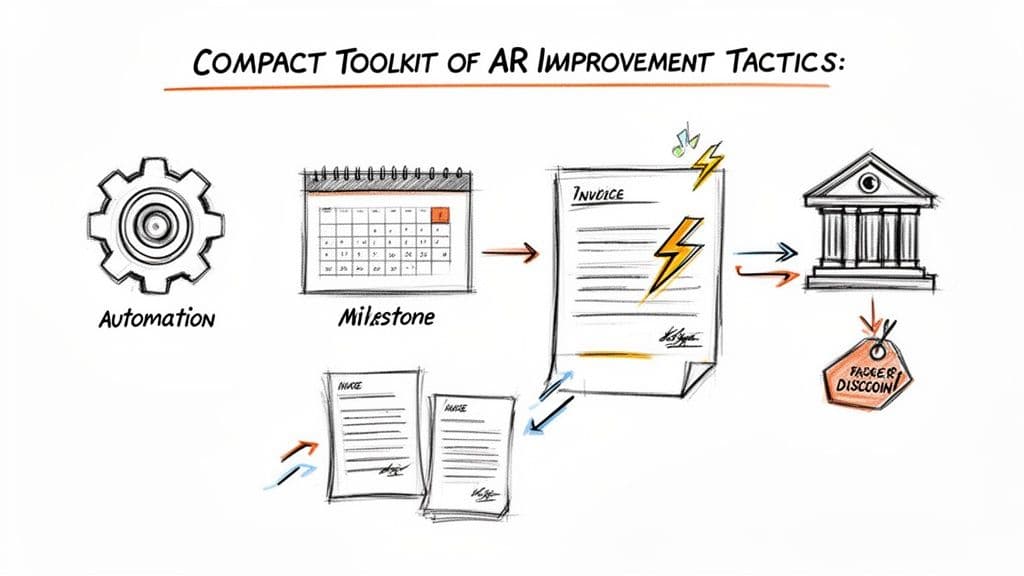
Nail Your Invoicing and Payment Terms
The collections clock starts the second you send an invoice. Getting this part right prevents most downstream delays.
| Tactic | Actionable Step |
|---|---|
| Invoice Immediately | Don't batch invoices at the end of the month. Send them the moment a project milestone is hit or a service is delivered with a crystal-clear due date. |
| Link Invoices to Milestones | For agencies and professional services, tie payments directly to deliverables. This creates an obvious trigger for payment and connects the bill to the value you just provided. |
| Rethink Your Credit Policy | If you offer Net 30 or Net 60 by default, ask why. For new clients, demand an upfront deposit, tighter terms like Net 15, or even payment in advance. |
Systematize and Automate Your Follow-Up
Manually chasing invoices is a recipe for inconsistency and wasted time. A systematic, automated process ensures nothing falls through the cracks. It’s a powerful way to improve your AR turnover, as you can automate invoice processing to guarantee faster and more accurate billing.
"Many founders are afraid to ask for their money. But a polite, persistent, and automated follow-up process isn't aggressive—it's professional. It signals that you take your business and your cash flow seriously." – Sarah Chen, CPA and Financial Strategist
Set up a clear dunning schedule. For example, send automated reminders three days before the due date, on the due date, and then at regular intervals—like 7, 14, and 30 days—after the invoice becomes past due.
Use Technology and Incentives
Modern tools and smart incentives dramatically speed up your collections. Stop making it hard for customers to give you money.
| Tactic | Actionable Step |
|---|---|
| Offer Early Payment Discounts | A "2/10, net 30" term (2% discount if paid in 10 days) gives clients a compelling financial reason to pay your invoice first. |
| Integrate Payment Processors | Use tools like Stripe or GoCardless to allow one-click payments directly from the invoice. Accepting credit cards and ACH removes friction. |
| Automate Late Fees | If your contracts permit it, automatically apply late fees to overdue invoices. This creates a clear, tangible consequence for paying late. |
Putting these tactics into action creates a tough, reliable system that turns outstanding invoices into cash in the bank—fast. For a deeper look at related strategies, check out our guide on how to improve cash flow.
Take Control of Your Cash Flow and Scale Your Business
Understanding your accounts receivable turnover isn't an accounting chore—it's about building a more resilient, valuable business. This single metric transforms your financial data from a backward-looking report card into a powerful tool for making smarter decisions.
But tracking KPIs is only half the battle. The real win comes from having a financial system that gives you accurate, timely data so you can focus on steering the company, not wrestling with spreadsheets. If you spend more time exporting CSVs than analyzing your business, your back office is holding you back.
From Reactive to Proactive Financial Management
A strong accounts receivable turnover ratio is a sign of operational discipline. It tells investors, lenders, and potential buyers that you have a firm grip on your cash flow. This is the bedrock of a company that's built to last.
Too many founders get stuck in a reactive loop, only scrambling to fix cash flow when the bank account is already low. Shifting to a proactive stance means having systems that show you what's coming. This is where an expert financial partner becomes a game-changer.
"True financial control isn't about looking in the rearview mirror. It's about having the visibility to see what's coming, allowing you to make strategic moves before you're forced to make reactive ones. That's the difference between scaling with confidence and just getting by." – John Davis, Managing Partner at Jumpstart Partners
To get there, you need more than just a bookkeeper; you need a financial engine built for growth. That means having systems that not only track metrics but also provide the forward-looking analysis you need for strategic planning. One of the best tools for this is a rolling cash forecast, which we break down in our guide to the 13-week cash flow model.
Build Your Foundation for Growth
Jumpstart Partners delivers the expert controller and bookkeeping services you need for investor-ready financials, a 5-day close, and complete cash flow visibility. Our team of US-based, CPA-certified experts understands the specific challenges SaaS, agency, and professional services firms face.
We don’t just close your books. We build the financial foundation that enables your next stage of growth. Stop letting slow collections and messy financials dictate your company’s future.
Schedule a consultation with our team today and see how we can give you the financial clarity and control you need to scale confidently.
Frequently Asked Questions About AR Turnover
As a founder, you're drowning in metrics. Let's cut through the noise and answer the most common questions we get from leaders about what accounts receivable turnover really means for your business.
How Often Should I Calculate My AR Turnover Ratio?
You should calculate your accounts receivable turnover ratio at least quarterly, but monthly is far better for operational control. An annual calculation only gives you a 30,000-foot view, and it's too slow to catch problems before they spiral. It’s like checking your car's oil once a year—by the time you notice an issue, the engine is already damaged. Monthly tracking gives you immediate insight into your collections, allowing you to fix problems right away.
Can My AR Turnover Ratio Be Too High?
Yes, an extremely high AR turnover ratio is often a red flag. While it looks great on paper—you’re collecting cash lightning fast—it usually means your credit policies are too restrictive. If you’re demanding payment upfront from every new client or enforcing rigid Net 7 terms, you're likely scaring away perfectly good customers who just need standard Net 30 terms to operate. In your quest for a perfect collections record, you could be actively killing sales and choking your own growth.
The goal isn't the highest possible ratio; it’s the optimal ratio that balances getting paid quickly with a credit policy that helps you close deals.
What Is the Difference Between AR Turnover and DSO?
Accounts receivable turnover and Days Sales Outstanding (DSO) are two sides of the same coin. They both measure how efficiently you collect cash.
- AR Turnover Ratio: Answers, "How many times did we collect all our receivables this year?" A ratio of 12 means you turned over your entire AR balance once a month.
- Days Sales Outstanding (DSO): Answers, "On average, how many days does it take us to get paid?"
Think of it like measuring a car's speed. AR turnover is like "trips per hour," while DSO is "minutes per trip." While the turnover ratio is a powerful KPI for financial analysis, DSO is often far more intuitive. Saying your DSO is 30.4 days (365 / 12) is a crystal-clear metric that everyone from sales to finance can understand and act on.
Ready to stop wrestling with spreadsheets and gain complete control over your cash flow? Jumpstart Partners provides the expert, US-based controller and bookkeeping services you need for investor-ready financials and a 5-day month-end close.
Schedule a consultation with our team to see how we build the financial foundation for your next stage of growth.